CERN-PH-EP/2013-206 2013/11/22
CMS-B2G-12-014
Search for pair production of excited top quarks in the
lepton+jets final state
The CMS Collaboration
∗Abstract
A search is performed for pair-produced spin-3/2 excited top quarks (t∗t∗), each de-caying to a top quark and a gluon. The search uses data collected with the CMS detec-tor from pp collisions at a center-of-mass energy of√s = 8 TeV, selecting events that have a single isolated muon or electron, an imbalance in transverse momentum, and at least six jets, of which one must be compatible with originating from the fragmen-tation of a b quark. The data, corresponding to an integrated luminosity of 19.5 fb−1, show no significant excess over standard model predictions, and provide a lower limit of 803 GeV at 95% confidence on the mass of the spin-3/2 t∗ quark in an exten-sion of the Randall–Sundrum model, assuming a 100% branching fraction of its decay into a top quark and a gluon. This is the first search for a spin-3/2 excited top quark performed at the LHC.
Submitted to the Journal of High Energy Physics
c
2013 CERN for the benefit of the CMS Collaboration. CC-BY-3.0 license
∗See Appendix A for the list of collaboration members
arXiv:1311.5357v1 [hep-ex] 21 Nov 2013
1
Introduction
The large mass of the top quark [1] may indicate that it is not an elementary particle, but has a composite structure, as has been proposed in several models of new physics [2–5]. The ex-istence of an excited top quark (t∗) would provide a direct test of this possibility [6, 7]. Weak isodoublets can be used to describe both the left-handed and right-handed components of a t∗, and provide finite masses prior to the onset of electroweak symmetry breaking [6]. Thus, in contrast to the heavy top quark of a fourth generation model, the existence of an excited top quark is not ruled out by the recent discovery of a Higgs boson with properties consistent with those of a standard model (SM) Higgs particle [8–10]. It has also been suggested that the top quark may have higher spin excitations, and in particular, in string realizations of the Randall– Sundrum (RS) model [11, 12], the right-handed t∗ quark is expected to be the lightest spin-3/2 excited state [13].
This analysis adopts a model in which a t∗quark has spin 3/2 and decays predominantly to a top quark through the emission of a gluon (g) [13–16]. A spin-3/2 excitation of a spin-1/2 quark is governed by the Rarita-Schwinger [17] vector-spinor Lagrangian, with the rate of production of spin-3/2 quarks being larger than that of spin-1/2 quarks of similar mass. This is because the pair production cross section of spin-3/2 quarks is proportional to ˆs3for large values of ˆs, while that of spin-1/2 quarks is proportional to ˆs−1, where ˆs is the square of the energy in the parton-parton collision rest frame. Consequently, at large proton-proton center-of-mass energies√s, integrating over parton distribution functions (PDF), spin-3/2 quarks benefit more from contributions at large parton momentum fractions (x) than spin-1/2 quarks [13, 14]. The growth with energy as ˆs3violates unitarity at high enough energies, but we assume the relation is valid at the energies provided by the Large Hadron Collider (LHC). The t∗ in the RS model is expected to have a pair production cross section at√s= 8 TeV of the order of a few pb for a t∗ of mass mt∗ =500 GeV [15, 16].
Searches have been performed for single production of excited generic quarks (q∗) that decay to qg, a process that dominates in spin-1/2 models. The Compact Muon Solenoid (CMS) collabo-ration has excluded q∗in the mass range of 1 TeV to 3.19 TeV [18], and the ATLAS collaboration has set a lower limit on mq∗of 2.83 TeV [19]. However, a t∗signal would not have been observed
in such searches. We present the first dedicated search at the LHC for the pair production of excited top quarks with spin 3/2 that decay to t+g.
We assume a 100% branching fraction for B(t∗ → tg), the channel that is expected to be the dominant decay mode [13, 16]. With mixing between spin-1/2 and spin-3/2 states suppressed, the production of mixed pairs of tt∗or tt∗is expected to have a much smaller cross section than t∗t∗, despite being kinematically favored [13, 14]. We consider therefore only pair production of the t∗ quark and its antiparticle, and focus on decay channels containing a single charged lepton (`) specifically in the µ+jets and e+jets final states. We use a fourth-generation model to mimic the t∗ signal because the MADGRAPH5.1.3.30 [20] Monte Carlo (MC) generator does
not normally include spin-3/2 particles. We show in the following section that this choice does not affect the results of the study.
The analysis strategy is to reconstruct the t∗ mass from the t∗t∗ → ttgg → W+bW−bgg → `+ν`bqq0bgg decay chain, including charge-conjugate states, and to compare the resultant mass
distributions expected for signal and background. The analysis is performed using pp collision data at√s=8 TeV collected with the CMS detector, corresponding to an integrated luminosity of 19.5±0.5 fb−1.
2 2 The CMS detector, simulations and data
2
The CMS detector, simulations and data
The central feature of the CMS apparatus is a superconducting solenoid of 6 m internal diame-ter, providing a magnetic field of 3.8 T. A silicon pixel and strip tracker, a lead-tungstate crystal electromagnetic calorimeter (ECAL), and a brass/scintillator hadron calorimeter (HCAL) re-side within the magnetic volume. Muons are measured in gas-ionization detectors embedded in the steel flux return yoke outside of the solenoid. Extensive forward calorimetry comple-ments the coverage provided by the central barrel and endcap ECAL and HCAL detectors. The CMS experiment uses a right-handed coordinate system, with origin at the center of the detec-tor, the x axis pointing to the center of the LHC ring, the y axis pointing up (perpendicular to the plane of the LHC ring), and the z axis along the counterclockwise beam direction. The polar angle θ is measured from the positive z axis, and pseudorapidity is defined as η = −ln[tan(θ
2)].
The azimuthal angle φ is defined in the x-y plane. A more detailed description of the detector can be found in Ref. [21].
The data are collected using single-lepton+jets triggers. The single-muon+jets trigger requires that at least one muon candidate is reconstructed within |η| < 2.1 and has a transverse mo-mentum pT > 17 GeV. The single-electron+jets trigger requires that an electron candidate is
reconstructed with pT > 25 GeV within|η| <2.5 (with a small region of exclusion in the
tran-sition region between the ECAL barrel and endcaps at|η| ≈1.5). Both channels must have at least three jets reconstructed within|η| <2.5 and with transverse momenta larger than a value which was increased in steps from 20 to 45 GeV, as the average instantaneous luminosity of the LHC increased during the course of data taking.
Simulated inclusive t∗t∗events, including up to two additional hard partons, are generated for t∗ masses of 450–950 GeV in 50 GeV steps using the MADGRAPH5.1.3.30 [20] event generator
and the CTEQ6L1 PDF [22]. We usePYTHIA6.426 [23] to model parton showers and hadroni-zation. The generated events are processed through a simulation of the CMS detector based on GEANT4 4.3.1 [24], and reconstructed using the same algorithms as used for data. The MAD -GRAPHgenerator does not normally include spin-3/2 particles, so we use a fourth-generation model to mimic the t∗signal. As our acceptance criteria are not sensitive to opening angles be-tween particles or other variables that might be affected by spin, we do not expect this choice to impact our results. Although it was not possible to simulate all samples this way, to check this assumption, we were able to include the Rarita–Schwinger Lagrangian in MADGRAPH,
and generate a true spin-3/2 event sample. As expected, within uncertainties, the acceptance for the spin-3/2 sample agrees with that for spin-1/2. The direction and momentum of jets from final-state particles is consistent between the two samples, although the number of jets produced in the spin-3/2 sample is higher than it is in spin-1/2.
Although the analysis is based mainly on an estimate of background obtained from data, we also use MC simulation of background processes to study the modeling of the data and to pro-vide a cross-check of our results. The production of tt events with up to three additional hard partons, single-top-quark production in the s-channel and t-channel, tW processes, W+jets and Z+jets production, and the smaller diboson (WW, WZ, ZZ), ttW, and ttZ contributions have all been modeled in the MC simulation used for these checks. The diboson processes are gener-ated with thePYTHIA program, while the other processes are modeled using the MADGRAPH
package. The cross section for single top-quark production is taken from Ref. [25], and the cross section for WZ production is computed using theMCFMgenerator [26, 27]. The cross sections
for ttW and ttZ are computed using MADGRAPH. All other cross sections are normalized to
the published CMS measurements [28, 29]. All simulated samples include additional contribu-tions from minimum bias events that model the energy from overlapping pp collisions within
the same bunch crossing (“pileup”) at large instantaneous luminosities.
3
Event reconstruction
Events are reconstructed using a particle-flow algorithm, in which each particle is reconstructed and identified by means of an optimized combination of information from all subdetectors [30]. The energies of photons are obtained directly from the ECAL signals, corrected for effects of the algorithm used for noise suppression in the readout. The energies of electrons are determined from a combination of the track momenta at the main interaction vertex, the corresponding ECAL cluster energy, and the energy sum of all bremsstrahlung photons emitted along their trajectories. The energies of muons are obtained from the corresponding track momenta mea-sured in the silicon tracker and outer muon system. The energies of charged hadrons are de-termined similarly from a combination of track momenta and the corresponding ECAL and HCAL energies, which are corrected for effects of noise suppression. Finally, the energies of neutral hadrons are obtained from calibrated ECAL and HCAL energies [30–33].
We require events to contain at least one interaction vertex, with > 10 associated charged-particle tracks, located within a longitudinal distance|z| <24 cm and a radial distance r<2 cm from the center of the CMS detector. The vertex with the largest value for the sum of the p2
Tof
the associated tracks is taken as the primary vertex for the hard collision.
Muon candidates are reconstructed using hits in the silicon tracker and in the outer muon system by making a global fit to the hits in both detectors [34]. Electron candidates are recon-structed from energy clusters in the ECAL that are also matched to tracks in the tracker. Trajec-tories of electron candidates are reconstructed using a CMS model of electron energy loss, and fitted using a Gaussian sum filtering algorithm [35]. Jets are reconstructed from particle-flow candidates using the anti-kTjet clustering algorithm [36] with a distance parameter of 0.5, and
jet energies are corrected to establish a uniform relative response of the calorimeter in η, and a calibrated absolute response in pT[37].
Jets are identified as originating from a b quark through a combined secondary vertex (CSV) al-gorithm [38] that provides optimal b-tagging performance. This alal-gorithm uses a multivariate discriminator to combine information on the significance of the impact parameter, the jet kine-matics, and the location of the secondary vertex. The working point of the CSV discriminant is chosen such that light quarks are mistagged at a rate of 1%, with a corresponding efficiency for identifying b-quark jets of 70%. Small differences in b-tagging efficiencies and mistag rates between data and simulated events are accounted for by scale factors applied to the simulation. The imbalance in transverse momentum (p/ ) of an event is defined as the magnitude of theT
vector sum of the transverse momenta of all objects reconstructed using the particle-flow algo-rithm. The corrections applied to jet energies are propagated to the measured p/ .T
4
Offline event selection
Charged leptons from t → b`νdecays are expected to be isolated from nearby jets. Relative isolation, I, is defined as the ratio of the scalar sum of the transverse momenta of all photons, charged hadrons, and neutral hadrons, associated with the primary vertex, in an angular cone around the lepton direction to the lepton pT. The sum includes all these particle-flow
candi-dates within a cone of ∆R ≡ p
(∆η)2+ (∆φ)2 < 0.4 around the muon candidate, and<0.3
around the electron candidate, where∆η and ∆φ are the differences in pseudorapidity and az-imuth relative to the lepton direction. Estimates of the contributions from pileup interactions to
4 5 Mass reconstruction
the neutral hadron and photon energy components are subtracted from the above sums [34, 39]. Event candidates in the µ+jets channel are required to have only one muon with pT >26 GeV, |η| < 2.1, I < 0.12, and with transverse and longitudinal distances of closest approach to the primary vertex of dr < 2 mm and|dz| <5 mm, respectively. Candidates in the e+jets channel
are required to have only one electron with pT > 30 GeV, |η| < 1.44 (restricting electrons to
the central rather than forward regions reduces contributions from generic multijet events), I <0.1, and dr< 0.2 mm. These selections are more restrictive than those used for the trigger,
ensuring the selected leptons are in the plateau of the trigger efficiency.
Additional selection criteria require at least six jets with pT > 30 GeV and|η| < 2.5. To ensure
high trigger efficiency, the three leading jets (i.e. with largest pT) are each required to have
pT >45 GeV in the initial data-taking period, and pT >55, 45, and 35 GeV, respectively, in the
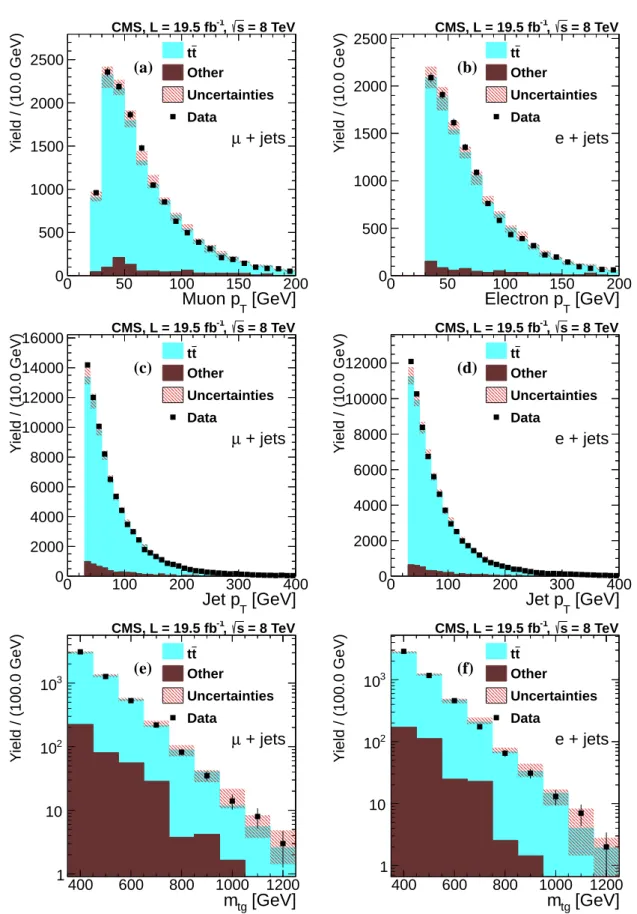
subsequent data-taking periods. At least one jet must be b-tagged through the CSV algorithm. Signal events pass our selections with efficiencies varying from 18% at low t∗ masses to 20% at higher masses. The largest efficiency losses arise from the lepton isolation and jet require-ments. After the application of all selection criteria, we observe 13 636 events in the µ+jets channel and 11 643 events in the e+jets channel. The yields predicted from simulated SM back-ground processes are 15 100±4 400 events in the µ+jets channel and 13 100±3 700 events in the e+jets channel. The event yield uncertainties are dominated by uncertainties in the choice of the renormalization and factorization scales used in the MADGRAPHgeneration of tt events, and by the uncertainty in the jet energy scale (JES). The small deficits in data relative to SM ex-pectations are within the estimated uncertainties. Furthermore, the differential distributions of the kinematic variables are in agreement. We determine this by renormalizing the simulation to the number of events observed in data, and find agreement in the distributions of all kinematic variables for the predicted and observed tt events, as seen in Figure 1. Of particular impor-tance, the distribution in the mass of the tg system (see Section 5 for details) is reproduced by the simulation. In the following sections, we describe the strategy adopted for reconstructing the mass of the t∗candidate and for estimating the background from control samples in data.
5
Mass reconstruction
The dominant background to a t∗t∗signal is expected to be from SM tt production in association with extra jets. We therefore use the reconstructed mass distribution of the t+jet systems to distinguish a t∗t∗signal from tt background.
The procedure adopted for reconstructing the mass is as follows. In the`+jets channels, one W boson decays leptonically, while the other decays into a q0q pair, i.e. t∗t∗ → (`νbg)(q0qbg). The reconstructed objects in the event, namely, the charged lepton, the p/ , and the six leadingT
jets correspond to the particles in the decay of the t∗t∗ system, and are assigned to one of the initially produced objects. We assume that the p/ is carried away entirely by the neutrinoT
emitted by the leptonically decaying W boson. The longitudinal component of the neutrino momentum (pz) cannot be measured, but an initial estimate of its value is determined (within
a two-fold ambiguity) using the requirement that the two reconstructed top quarks have the same mass. All possible permutations of jet-parton assignments are considered in the analysis, subject to the condition that a b-tagged jet must be assigned to one of the b quarks. When multiple jets are b-tagged, all binary combinations are interpreted as b quarks.
After assigning the reconstructed objects to their progenitor particles, a constrained kinematic fit is performed to the t∗t∗ hypothesis to improve the resolution of the reconstructed mass of
[GeV] T Muon p 0 50 100 150 200 Y ie ld / ( 1 0 .0 G e V ) 0 500 1000 1500 2000 2500 tt Other Uncertainties Data = 8 TeV s , -1 CMS, L = 19.5 fb (a) + jets µ [GeV] T Electron p 0 50 100 150 200 Y ie ld / ( 1 0 .0 G e V ) 0 500 1000 1500 2000 2500 t t Other Uncertainties Data = 8 TeV s , -1 CMS, L = 19.5 fb (b) e + jets [GeV] T Jet p 0 100 200 300 400 Y ie ld / ( 1 0 .0 G e V ) 0 2000 4000 6000 8000 10000 12000 14000 16000 t t Other Uncertainties Data = 8 TeV s , -1 CMS, L = 19.5 fb (c) + jets µ [GeV] T Jet p 0 100 200 300 400 Y ie ld / ( 1 0 .0 G e V ) 0 2000 4000 6000 8000 10000 12000 tt Other Uncertainties Data = 8 TeV s , -1 CMS, L = 19.5 fb (d) e + jets [GeV] tg m 400 600 800 1000 1200 Y ie ld / ( 1 0 0 .0 G e V ) 1 10 2 10 3 10 t t Other Uncertainties Data = 8 TeV s , -1 CMS, L = 19.5 fb (e) + jets µ [GeV] tg m 400 600 800 1000 1200 Y ie ld / ( 1 0 0 .0 G e V ) 1 10 2 10 3 10 t t Other Uncertainties Data = 8 TeV s , -1 CMS, L = 19.5 fb (f) e + jets
Figure 1: Kinematic distributions of single ` + > 5-jet events in data (points), compared to MC simulation normalized to the number of events observed in data. Shown are pT spectra
for muons (a) and electrons (b), and jet spectra for the channels µ+jets (c) and e+jets (d). The reconstructed mtgdistribution is shown for the µ+jets channel in (e) and for e+jets in (f).
6 6 Background model and extraction of t∗signal
the t∗candidates. We use an algorithm originally designed to measure mtin tt events [40, 41],
but modified to reconstruct t∗t∗ events that contain two additional jets. The momenta of the reconstructed objects are adjusted in the fit to simultaneously satisfy the following constraints:
m(`ν) =m(qq) = mW, (1)
m(`νb) =m(qqb) =mt, (2)
m(`νbg) =m(qqbg) =mtg, (3)
where mW = 80.4 GeV is the mass of the W boson, mt = 173.5 GeV is the mass of the top
quark [1], and mtgis a free parameter, the resolution of which is improved through the fit.
All the momentum components of the reconstructed objects, with the exception of pz of the
neutrino momentum, are measured. There is consequently one unknown and seven constraints to the kinematics: (i) two from each of Equations (1) and (2), (ii) two from the conservation of transverse momentum in the collision, and (iii) one constraint from Equation (3). We perform a fit to the t∗t∗ hypothesis by minimizing a χ2 computed from the sum of the squares of the difference between the measured components of momenta of all reconstructed objects and their fitted values, each term divided by the sum of the squares of their estimated uncertainties, subject to the remaining six constraints. The jet permutation with the smallest χ2 value is chosen to represent the event.
The above procedure selects the correct jet-parton assignment in about 11% of the simulated t∗t∗ events, with the t∗quark that decays through the W→ `ν`mode being reconstructed
cor-rectly in about 1/3 of the lepton+jets final states. We have studied the possibility of including up to eight jets in the reconstruction (i.e. considering all combinations of six out of the leading six, seven, or eight jets). However, there is little gain using this approach, despite that it yields 13% in correct assignments. A major reason for getting the wrong jet-parton combination is that in approximately 40% of the t∗t∗ events, at least one jet from the W → q0q decay fails the offline jet-pTrequirement. In events where all the hadronic decay products are included among
the six leading jets, the correct jet-parton assignment is selected 68% of the time, but this frac-tion decreases significantly if we consider up to eight jets in the final state. Consequently, χ2 fits using more than six jets contain far more background.
6
Background model and extraction of t
∗signal
We model the mtgdistribution for the background from the SM using a Fermi function:
f(m) = a
1+em−cb
, (4)
where m represents the mass reconstructed under the t∗hypothesis, and a, b, and c are param-eters that are determined through a fit to the data. The mtgdistribution for a t∗t∗signal is taken
from simulated events.
The t∗t∗ signal and the background contributions in data are estimated simultaneously. For each generated mt∗ value, we perform a binned likelihood fit to the sum of the background
function f(m) and the reconstructed mass spectrum for the t∗t∗ model for mtg > 350 GeV.
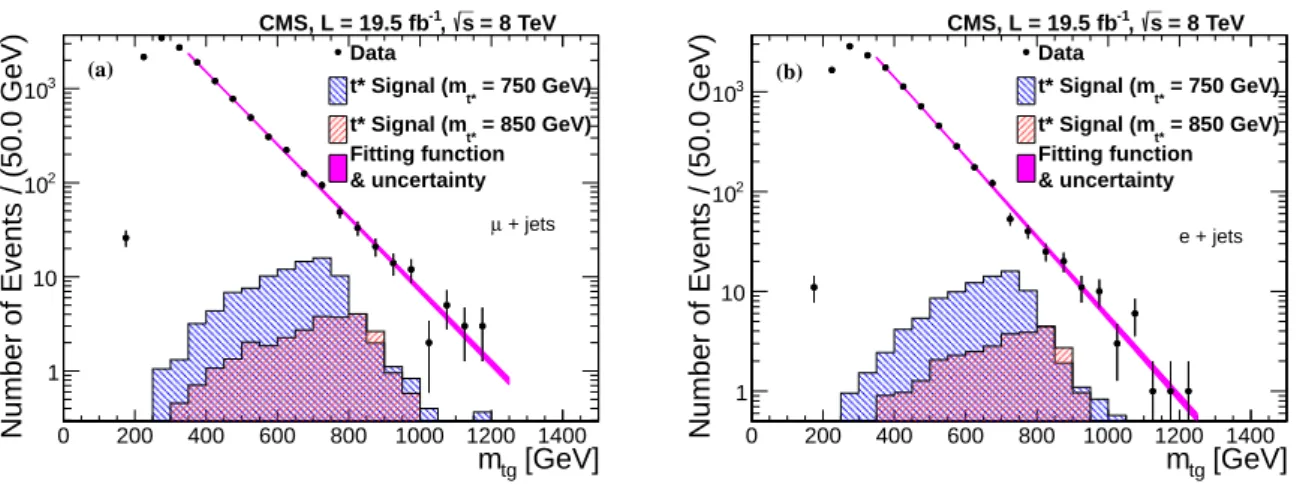
The t∗t∗ cross section and the three parameters of the background function are varied in this fit. Figure 2 shows the distribution of the reconstructed mtg for the µ+jets channel (a) and
e+jets channel (b), along with the fit to the background. The function f(m) shown in the figure represents the contribution from background events only, and does not include the mt∗ =
[GeV]
tg
m
0 200 400 600 800 1000 1200 1400
Number of Events / (50.0 GeV)
1 10 2 10 3 10 Data = 750 GeV) t* t* Signal (m = 850 GeV) t* t* Signal (m & uncertainty Fitting function + jets µ = 8 TeV s , -1 CMS, L = 19.5 fb (a) [GeV] tg m 0 200 400 600 800 1000 1200 1400
Number of Events / (50.0 GeV)
1 10 2 10 3 10 Data = 750 GeV) t* t* Signal (m = 850 GeV) t* t* Signal (m & uncertainty Fitting function e + jets = 8 TeV s , -1 CMS, L = 19.5 fb (b)
Figure 2: Reconstructed mass spectrum for the tg system in data (points), along with a fit of the background f(m)of Equation (4) to the data in the µ+jets channel (a) and e+jets channel (b). The reconstructed masses correspond to the results of kinematic fits for the jet-quark assign-ments that provide the best match to the t∗t∗ hypothesis. Also shown are the expectations of t∗ signals for mt∗ =750 and 850 GeV normalized to the integrated luminosity of the data.
To show that the fitting method is sensitive to the presence of t∗ signal, pseudo-data are gen-erated according to a probability distribution function representing the sum of f(m) and a specific t∗signal. Performing the kinematic fit on the pseudo-data provides a cross section for the extracted t∗signal that indicates no bias in the fitting procedure.
As a check of our method, we also model the background using MC samples. As noted in Section 4, the distribution of the simulated background samples is in agreement with the data. The background and signal MC templates are fit to the data to determine their contributions.
7
Systematic uncertainties
Systematic uncertainties influence the assessment of whether the mtgdistributions for the
ob-served events are consistent with the presence of a signal, or with expectations from back-ground alone. The dominant sources of systematic uncertainty are described below.
The uncertainties in the differential distributions for background are estimated from the uncer-tainties in the fitted parameters of Equation (4), and incorporated into the calculation of limits, as discussed in Section 8. These uncertainties affect both the distribution and the normaliza-tion of the background. To determine the overall effect of these uncertainties, we perform limit setting calculations including and excluding the uncertainties and find a 5% effect on the mass limit from the uncertainty in background.
Given that the distributions of signal are based on simulation, we consider the impact of both experimental and theoretical sources of uncertainty. For each source, we adjust the relevant parameters in the simulation to produce alternative templates for signal. We take the relative differences between the templates for the alternative parameters and the templates produced using their nominal values to estimate the magnitude of the uncertainties in the final result. We also consider the effect of uncertainties in the differential distribution of the signal. These effects are small, as the mass reconstruction algorithm tends to change the particle momenta to meet the kinematic constraints and, in so doing, maintains the stability of the differential spectra.
lumi-8 8 Statistical analysis and extraction of limits
nosity is known to a precision of 2.6% [42]. All jet energies are corrected using standard CMS JES constants [37]. We generate alternative distributions in mtgafter rescaling the nominal jet
energies by±1 standard deviation, using the known parametrization of these uncertainties as a function of jet pT and η [37]. This rescaling is also propagated to the p/ . An observed dif-T
ference in the jet energy resolution (JER) in simulation relative to data is taken into account by applying an η-dependent pT smearing of 5–12% to the simulated jets, as required to match
the measured resolution. The uncertainty affecting this extra correction is propagated to the expected mtg in a way similar to that used for the jet energy scale. The uncertainties from p/T
are mostly included in the uncertainties in the jet energies. We also consider the uncertainty in any remaining “unclustered energy” not arising from one of the jets or lepton in the event, and find that its impact is negligible. Other sources of experimental uncertainty include those in trigger efficiencies and corrections to lepton identification efficiencies, which are measured using “tag-and-probe” methods [43] in the data and in simulation. The systematic uncertainty in b-tagging efficiency is estimated by changing the tagging and misidentification rates for b, c, or light-flavor jets according to the uncertainties estimated from data [38]. The systematic uncertainty from the modeling of pileup events is checked by changing the minimum-bias cross section by±1 standard deviation, which changes the average number of pileup events by±4%[42].
We estimate the effect of theoretical uncertainties arising from the choice of PDF by changing the CTEQ PDF parameters within their estimated uncertainties, and measuring the effect on the simulated acceptance. We further check that a change of the renormalization and factorization scales from their nominal values has negligible impact on the signal.
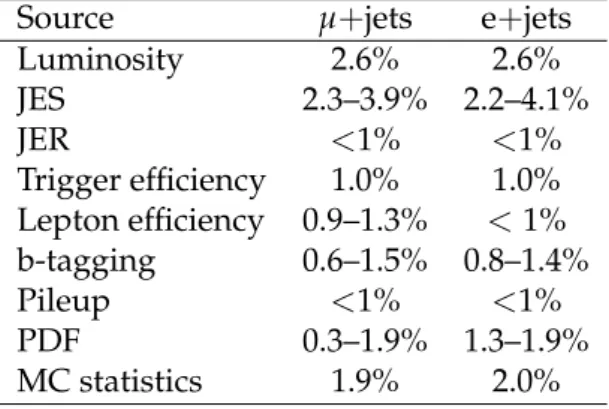
The statistical uncertainties associated with the simulated samples are also taken into account as a systematic uncertainty in the measurement. Table 1 quantifies the uncertainties in the normalization of the signal from each of the above sources. As can be seen from the table, the luminosity and JES uncertainties generally dominate the overall signal uncertainty. Never-theless, the uncertainties in the signal have less than 1% effect on the limit while those in the differential distribution of mtgfor the background have a 5% impact on the limit.
Table 1: Systematic uncertainties in the normalization of the t∗t∗ templates. The specified ranges indicate the minimum and maximum uncertainties for the examined values of mt∗.
Source µ+jets e+jets Luminosity 2.6% 2.6% JES 2.3–3.9% 2.2–4.1% JER <1% <1% Trigger efficiency 1.0% 1.0% Lepton efficiency 0.9–1.3% <1% b-tagging 0.6–1.5% 0.8–1.4% Pileup <1% <1% PDF 0.3–1.9% 1.3–1.9% MC statistics 1.9% 2.0%
8
Statistical analysis and extraction of limits
We examine the top+jet mass spectrum for evidence of t∗quark decay into the top+gluon final state. The t∗t∗ cross section determined by the fit described in Section 6 is consistent with no signal for each tested value of mt∗. In the absence of evidence for any excess, we set an
uniform prior for a cross section of σ>0. The systematic uncertainties for signal are included through “nuisance” parameters assuming log-normal priors that are integrated over in the pro-cess of computing the likelihood [44]. The combination of the function f(m)for background and a template for signal is used in a log-likelihood fit to the data. The uncertainty in the differ-ential distribution for the background is incorporated by integrating over the parameters of the fitted background assuming uniform priors. The integration over such nuisance parameters is performed over a sufficiently large range around the best-fit values to ensure that the results are stable. To combine the µ+jets and e+jets channels, we multiply the likelihoods for the two sets of lepton events. Many of the uncertainties are correlated between the two channels, and accounted for by requiring the corresponding nuisance parameters to have the same value in both channels. Expected limits are obtained by generating pseudo-experiments based on the fitted f(m)(ignoring t∗signal), including the uncertainties on the fit, and repeating the above calculations as a function of mt∗.
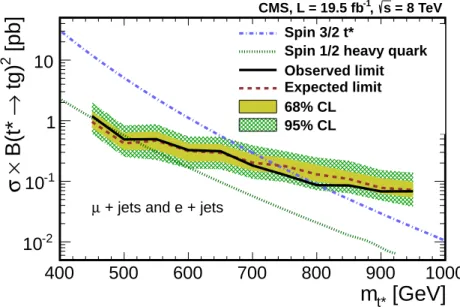
Figure 3 shows the observed and expected upper limits at 95% confidence level (CL) for the t∗-pair production cross section multiplied by its branching fraction into t+g, as a function of mt∗. The lower limit for mt∗is given by the value at which the upper limit intersects the
[GeV]
t*m
400 500 600 700 800 900 1000[pb]
2tg)
→
B(t*
×
σ
-2 10 -1 10 1 10 = 8 TeV s , -1 CMS, L = 19.5 fb+ jets and e + jets µ
Spin 3/2 t*
Spin 1/2 heavy quark Observed limit Expected limit 68% CL 95% CL
Figure 3: The observed (solid line) and expected (dashed line) 95% CL upper limits for the product of the inclusive t∗t∗ production cross section and the branching fraction B(t∗ → tg), as a function of the t∗ mass, for the combined lepton data. The ranges for±1 and±2 standard deviations for the expected limits are shown by the bands. The theoretical cross section for the spin-3/2 model is shown by the dashed-dotted line [15]. Also shown is the theoretical cross section for producing an excited top-quark pair of spin-1/2 [45].
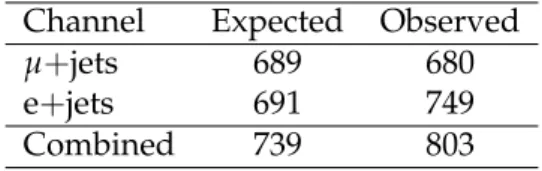
order spin-3/2 cross section from Ref. [15]. This procedure yields an observed lower limit for mt∗ of 803 GeV for the combined muon and electron data, at 95% CL. The expected limit from
pseudo-experiments is 739 GeV. The limits are also listed separately for each channel in Table 2. Although not the primary issue under consideration, Figure 3 also shows the limits set for a spin-1/2 excited quark, based on the next-to-next-to-leading-order cross section calculated with the HATHOR(1.5) program [45]. Assuming the same signature for the decays of excited spin-1/2 and spin-3/2 top quarks, the expected lower limit on mt∗for a spin-1/2 excited quark
confi-10 9 Summary
Table 2: Expected and observed lower limits on mt∗ (GeV) for a spin-3/2 t∗.
Channel Expected Observed
µ+jets 689 680
e+jets 691 749 Combined 739 803 dence.
As noted in Section 6, we check the data-driven method by repeating the analysis using sim-ulated distributions to represent the background. The limits obtained using this background estimation agree with our main result within the assigned uncertainties.
9
Summary
We have conducted a search for excited spin-3/2 top quarks (t∗) that are pair produced in pp interactions, with each t∗ decaying exclusively to a standard model top quark and a gluon. Events that have a single muon or electron, and at least six jets, at least one of which is identified as a b-jet, are selected for analysis. Assuming t∗t∗ production, a kinematic fit is performed to final-state objects to reconstruct t∗ candidates in each event. The observed mass spectrum of the t-jet system, showing no significant deviation from predictions of the standard model, is used to set upper limits on the production of t∗t∗ as a function of the t∗ mass. By comparing the results with expectations for spin-3/2 excited top quarks in an extension of the Randall– Sundrum model [13], we exclude t∗ masses below 803 GeV at 95% confidence. This is the first dedicated search for an excited spin-3/2 top quark, and sets strong bounds on its existence.
Acknowledgments
We congratulate our colleagues in the CERN accelerator departments for the excellent perfor-mance of the LHC and thank the technical and administrative staffs at CERN and at other CMS institutes for their contributions to the success of the CMS effort. In addition, we gratefully ac-knowledge the computing centers and personnel of the Worldwide LHC Computing Grid for delivering so effectively the computing infrastructure essential to our analyses. Finally, we ac-knowledge the enduring support for the construction and operation of the LHC and the CMS detector provided by the following funding agencies: BMWF and FWF (Austria); FNRS and FWO (Belgium); CNPq, CAPES, FAPERJ, and FAPESP (Brazil); MEYS (Bulgaria); CERN; CAS, MoST, and NSFC (China); COLCIENCIAS (Colombia); MSES (Croatia); RPF (Cyprus); MoER, SF0690030s09 and ERDF (Estonia); Academy of Finland, MEC, and HIP (Finland); CEA and CNRS/IN2P3 (France); BMBF, DFG, and HGF (Germany); GSRT (Greece); OTKA and NKTH (Hungary); DAE and DST (India); IPM (Iran); SFI (Ireland); INFN (Italy); NRF and WCU (Re-public of Korea); LAS (Lithuania); CINVESTAV, CONACYT, SEP, and UASLP-FAI (Mexico); MSI (New Zealand); PAEC (Pakistan); MSHE and NSC (Poland); FCT (Portugal); JINR (Arme-nia, Belarus, Georgia, Ukraine, Uzbekistan); MON, RosAtom, RAS and RFBR (Russia); MSTD (Serbia); SEIDI and CPAN (Spain); Swiss Funding Agencies (Switzerland); NSC (Taipei); ThEP-Center, IPST and NSTDA (Thailand); TUBITAK and TAEK (Turkey); NASU (Ukraine); STFC (United Kingdom); DOE and NSF (USA). Individuals have received support from the Marie-Curie programme and the European Research Council and EPLANET (European Union); the Leventis Foundation; the A. P. Sloan Foundation; the Alexander von Humboldt Foundation; the Belgian Federal Science Policy Office; the Fonds pour la Formation `a la Recherche dans l’Industrie et dans l’Agriculture (FRIA-Belgium); the Agentschap voor Innovatie door
Weten-schap en Technologie (IWT-Belgium); the Ministry of Education, Youth and Sports (MEYS) of Czech Republic; the Council of Science and Industrial Research, India; the Compagnia di San Paolo (Torino); the HOMING PLUS programme of Foundation for Polish Science, cofinanced by EU, Regional Development Fund; and the Thalis and Aristeia programmes cofinanced by EU-ESF and the Greek NSRF.
References
[1] Particle Data Group, J. Beringer et al., “Review of Particle Physics”, Phys. Rev. D 86 (2012) 010001, doi:10.1103/PhysRevD.86.010001.
[2] H. Georgi, L. Kaplan, D. Morin, and A. Schenk, “Effects of top compositeness”, Phys. Rev. D 51 (1995) 3888, doi:10.1103/PhysRevD.51.3888, arXiv:hep-ph/9410307. [3] B. Lillie, J. Shu, and T. M. P. Tait, “Top compositeness at the Tevatron and LHC”, JHEP
04(2008) 087, doi:10.1088/1126-6708/2008/04/087, arXiv:0712.3057. [4] A. Pomarol and J. Serra, “Top quark compositeness: Feasibility and implications”, Phys.
Rev. D 78 (2008) 074026, doi:10.1103/PhysRevD.78.074026, arXiv:0806.3247. [5] K. Kumar, T. M. P. Tait, and R. Vega-Morales, “Manifestations of top compositeness at
colliders”, JHEP 05 (2009) 022, doi:10.1088/1126-6708/2009/05/022, arXiv:0901.3808.
[6] U. Baur, M. Spira, and P. Zerwas, “Excited quark and lepton production at hadron colliders”, Phys. Rev. D 42 (1990) 815, doi:10.1103/PhysRevD.42.815.
[7] R. M. Harris, “Discovery mass reach for excited quarks at hadron colliders”, (1996). arXiv:hep-ph/9609319.
[8] ATLAS Collaboration, “Observation of a new particle in the search for the Standard Model Higgs boson with the ATLAS detector at the LHC”, Phys. Lett. B 716 (2012) 1, doi:10.1016/j.physletb.2012.08.020, arXiv:1207.7214.
[9] CMS Collaboration, “Observation of a new boson at a mass of 125 GeV with the CMS experiment at the LHC”, Phys. Lett. B 716 (2012) 30,
doi:10.1016/j.physletb.2012.08.021, arXiv:1207.7235.
[10] CMS Collaboration, “Observation of a new boson with mass near 125 GeV in pp collisions at√s=7 and 8 TeV”, JHEP 06 (2013) 081,
doi:10.1007/JHEP06(2013)081, arXiv:1303.4571.
[11] L. Randall and R. Sundrum, “A large mass hierarchy from a small extra dimension”, Phys. Rev. Lett. 83 (1999) 3370, doi:10.1103/PhysRevLett.83.3370,
arXiv:hep-ph/9905221.
[12] L. Randall and R. Sundrum, “An alternative to compactification”, Phys. Rev. Lett. 83 (1999) 4690, doi:10.1103/PhysRevLett.83.4690, arXiv:hep-th/9906064. [13] B. Hassanain, J. March-Russell, and J. G. Rosa, “On the possibility of light string
resonances at the LHC and Tevatron from Randall-Sundrum throats”, JHEP 07 (2009) 077, doi:10.1088/1126-6708/2009/07/077, arXiv:0904.4108.
12 References
[14] B. Moussallam and V. Soni, “Production of heavy spin 3/2 fermions in colliders”, Phys. Rev. D 39 (1989) 1883, doi:10.1103/PhysRevD.39.1883.
[15] W. J. Stirling and E. Vryonidou, “Effect of spin-3/2 top quark excitation on t¯t production at the LHC”, JHEP 01 (2012) 055, doi:10.1007/JHEP01(2012)055,
arXiv:1110.1565. Cross sections at√s=8 TeV obtained though private communication.
[16] D. A. Dicus, D. Karabacak, S. Nandi, and S. K. Rai, “Search for spin-3/2 quarks at the Large Hadron Collider”, Phys. Rev. D 87 (2013) 015023,
doi:10.1103/PhysRevD.87.015023, arXiv:1208.5811.
[17] W. Rarita and J. Schwinger, “On a theory of particles with half integral spin”, Phys. Rev.
60(1941) 61, doi:10.1103/PhysRev.60.61.
[18] CMS Collaboration, “Search for dijet resonances in 7 TeV pp collisions at CMS”, Phys. Rev. Lett. 105 (2010) 211801, doi:10.1103/PhysRevLett.105.211801,
arXiv:1010.0203.
[19] ATLAS Collaboration, “ATLAS search for new phenomena in dijet mass and angular distributions using pp collisions at√s=7 TeV”, JHEP 01 (2013) 029,
doi:10.1007/JHEP01(2013)029, arXiv:1210.1718. [20] J. Alwall et al., “MadGraph 5: going beyond”, JHEP 06 (2011) 128,
doi:10.1007/JHEP06(2011)128, arXiv:1106.0522.
[21] CMS Collaboration, “The CMS experiment at the CERN LHC”, JINST 03 (2008) S08004, doi:10.1088/1748-0221/3/08/S08004.
[22] J. Pumplin et al., “New generation of parton distributions with uncertainties from global QCD analysis”, JHEP 07 (2002) 012, doi:10.1088/1126-6708/2002/07/012, arXiv:hep-ph/0201195.
[23] T. Sj ¨ostrand, S. Mrenna, and P. Z. Skands, “PYTHIA 6.4 physics and manual”, JHEP 05 (2006) 026, doi:10.1088/1126-6708/2006/05/026, arXiv:hep-ph/0603175. [24] GEANT4 Collaboration, “GEANT4—a simulation toolkit”, Nucl. Instrum. Meth. A 506
(2003) 250, doi:10.1016/S0168-9002(03)01368-8.
[25] N. Kidonakis and R. Vogt, “The theoretical top quark cross section at the Tevatron and the LHC”, Phys. Rev. D 78 (2008) 074005, doi:10.1103/PhysRevD.78.074005, arXiv:0805.3844.
[26] J. M. Campbell and R. K. Ellis, “MCFM for the Tevatron and the LHC”, Nucl. Phys. Proc. Suppl. 205-206 (2010) 10, doi:10.1016/j.nuclphysbps.2010.08.011,
arXiv:1007.3492.
[27] J. M. Campbell and R. K. Ellis, “An update on vector boson pair production at hadron colliders”, Phys. Rev. D 60 (1999) 113006, doi:10.1103/PhysRevD.60.113006, arXiv:hep-ph/9905386.
[28] CMS Collaboration, “Measurement of W+W−and ZZ production cross sections in pp collisions at√s=8 TeV”, Phys. Lett. B 721 (2013) 190,
[29] CMS Collaboration, “Measurement of associated production of vector bosons and top quark-antiquark pairs at sqrt(s) = 7 TeV”, Phys. Rev. Lett. 110 (2013) 172002,
doi:10.1103/PhysRevLett.110.172002, arXiv:1303.3239.
[30] CMS Collaboration, “Particle–Flow Event Reconstruction in CMS and Performance for Jets, Taus, and EmissT ”, CMS Physics Analysis Summary CMS-PAS-PFT-09-001, (2009). [31] CMS Collaboration, “Commissioning of the particle-flow event reconstruction with the
first LHC collisions recorded in the CMS detector”, CMS Physics Analysis Summary CMS-PAS-PFT-10-001, (2010).
[32] CMS Collaboration, “Commissioning of the Particle-Flow Reconstruction in Minimum-Bias and Jet Events from pp Collisions at 7 TeV”, CMS Physics Analysis Summary CMS-PAS-PFT-10-002, (2010).
[33] CMS Collaboration, “Commissioning of the particle-flow event reconstruction with leptons from J/ψ and W decays at 7 TeV”, CMS Physics Analysis Summary
CMS-PAS-PFT-10-003, (2010).
[34] CMS Collaboration, “Performance of CMS muon reconstruction in pp collision events at√ s =7 TeV”, JINST 7 (2012) P10002, doi:10.1088/1748-0221/7/10/P10002, arXiv:1206.4071.
[35] W. Adam, R. Fr ¨uhwirth, A. Strandlie, and T. Todorov, “Reconstruction of electrons with the Gaussian sum filter in the CMS tracker at LHC”, J. Phys. G 31 (2005) N9,
doi:10.1088/0954-3899/31/9/N01, arXiv:physics/0306087.
[36] M. Cacciari, G. P. Salam, and G. Soyez, “The anti-ktjet clustering algorithm”, JHEP 04
(2008) 063, doi:10.1088/1126-6708/2008/04/063, arXiv:0802.1189.
[37] CMS Collaboration, “Determination of jet energy calibration and transverse momentum resolution in CMS”, JINST 6 (2011) P11002,
doi:10.1088/1748-0221/6/11/P11002, arXiv:1107.4277.
[38] CMS Collaboration, “Identification of b-quark jets with the CMS experiment”, JINST 8 (2013) P04013, doi:10.1088/1748-0221/8/04/P04013, arXiv:1211.4462. [39] M. Cacciari and G. P. Salam, “Pileup subtraction using jet areas”, Phys. Lett. B 659 (2008)
119, doi:10.1016/j.physletb.2007.09.077, arXiv:0707.1378.
[40] CMS Collaboration, “Measurement of the top-quark mass in t¯t events with lepton+jets final states in pp collisions at√s=7 TeV”, JHEP 12 (2012) 105,
doi:10.1007/JHEP12(2012)105, arXiv:1209.2319.
[41] D0 Collaboration, “Direct measurement of the top quark mass at D0”, Phys. Rev. D 58 (1998) 052001, doi:10.1103/PhysRevD.58.052001, arXiv:hep-ex/9801025. [42] CMS Collaboration, “CMS Luminosity Based on Pixel Cluster Counting - Summer 2013
Update”, CMS Physics Analysis Summary CMS-PAS-LUM-13-001, (2013).
[43] CMS Collaboration, “Measurements of Inclusive W and Z Cross Sections in pp Collisions at√s=7 TeV”, JHEP 01 (2011) 080, doi:10.1007/JHEP01(2011)080,
14 References
[44] H. B. Prosper, “Small signal analysis in high-energy physics: A Bayesian approach”, Phys. Rev. D 37 (1988) 1153, doi:10.1103/PhysRevD.37.1153.
[45] M. Aliev et al., “HATHOR: HAdronic Top and Heavy quarks crOss section calculatoR”, Comput. Phys. Commun. 182 (2011) 1034, doi:10.1016/j.cpc.2010.12.040, arXiv:1007.1327.
A
The CMS Collaboration
Yerevan Physics Institute, Yerevan, Armenia
S. Chatrchyan, V. Khachatryan, A.M. Sirunyan, A. Tumasyan
Institut f ¨ur Hochenergiephysik der OeAW, Wien, Austria
W. Adam, T. Bergauer, M. Dragicevic, J. Er ¨o, C. Fabjan1, M. Friedl, R. Fr ¨uhwirth1, V.M. Ghete, N. H ¨ormann, J. Hrubec, M. Jeitler1, W. Kiesenhofer, V. Kn ¨unz, M. Krammer1, I. Kr¨atschmer, D. Liko, I. Mikulec, D. Rabady2, B. Rahbaran, C. Rohringer, H. Rohringer, R. Sch ¨ofbeck,
J. Strauss, A. Taurok, W. Treberer-Treberspurg, W. Waltenberger, C.-E. Wulz1
National Centre for Particle and High Energy Physics, Minsk, Belarus
V. Mossolov, N. Shumeiko, J. Suarez Gonzalez
Universiteit Antwerpen, Antwerpen, Belgium
S. Alderweireldt, M. Bansal, S. Bansal, T. Cornelis, E.A. De Wolf, X. Janssen, A. Knutsson, S. Luyckx, L. Mucibello, S. Ochesanu, B. Roland, R. Rougny, Z. Staykova, H. Van Haevermaet, P. Van Mechelen, N. Van Remortel, A. Van Spilbeeck
Vrije Universiteit Brussel, Brussel, Belgium
F. Blekman, S. Blyweert, J. D’Hondt, A. Kalogeropoulos, J. Keaveney, M. Maes, A. Olbrechts, S. Tavernier, W. Van Doninck, P. Van Mulders, G.P. Van Onsem, I. Villella
Universit´e Libre de Bruxelles, Bruxelles, Belgium
C. Caillol, B. Clerbaux, G. De Lentdecker, L. Favart, A.P.R. Gay, T. Hreus, A. L´eonard, P.E. Marage, A. Mohammadi, L. Perni`e, T. Reis, T. Seva, L. Thomas, C. Vander Velde, P. Vanlaer, J. Wang
Ghent University, Ghent, Belgium
V. Adler, K. Beernaert, L. Benucci, A. Cimmino, S. Costantini, S. Dildick, G. Garcia, B. Klein, J. Lellouch, A. Marinov, J. Mccartin, A.A. Ocampo Rios, D. Ryckbosch, M. Sigamani, N. Strobbe, F. Thyssen, M. Tytgat, S. Walsh, E. Yazgan, N. Zaganidis
Universit´e Catholique de Louvain, Louvain-la-Neuve, Belgium
S. Basegmez, C. Beluffi3, G. Bruno, R. Castello, A. Caudron, L. Ceard, G.G. Da Silveira, C. Delaere, T. du Pree, D. Favart, L. Forthomme, A. Giammanco4, J. Hollar, P. Jez, V. Lemaitre, J. Liao, O. Militaru, C. Nuttens, D. Pagano, A. Pin, K. Piotrzkowski, A. Popov5, M. Selvaggi, M. Vidal Marono, J.M. Vizan Garcia
Universit´e de Mons, Mons, Belgium
N. Beliy, T. Caebergs, E. Daubie, G.H. Hammad
Centro Brasileiro de Pesquisas Fisicas, Rio de Janeiro, Brazil
G.A. Alves, M. Correa Martins Junior, T. Martins, M.E. Pol, M.H.G. Souza
Universidade do Estado do Rio de Janeiro, Rio de Janeiro, Brazil
W.L. Ald´a J ´unior, W. Carvalho, J. Chinellato6, A. Cust ´odio, E.M. Da Costa, D. De Jesus Damiao,
C. De Oliveira Martins, S. Fonseca De Souza, H. Malbouisson, M. Malek, D. Matos Figueiredo, L. Mundim, H. Nogima, W.L. Prado Da Silva, A. Santoro, A. Sznajder, E.J. Tonelli Manganote6, A. Vilela Pereira
Universidade Estadual Paulistaa, Universidade Federal do ABCb, S˜ao Paulo, Brazil
C.A. Bernardesb, F.A. Diasa,7, T.R. Fernandez Perez Tomeia, E.M. Gregoresb, C. Laganaa, P.G. Mercadanteb, S.F. Novaesa, Sandra S. Padulaa
16 A The CMS Collaboration
Institute for Nuclear Research and Nuclear Energy, Sofia, Bulgaria
V. Genchev2, P. Iaydjiev2, S. Piperov, M. Rodozov, G. Sultanov, M. Vutova
University of Sofia, Sofia, Bulgaria
A. Dimitrov, R. Hadjiiska, V. Kozhuharov, L. Litov, B. Pavlov, P. Petkov
Institute of High Energy Physics, Beijing, China
J.G. Bian, G.M. Chen, H.S. Chen, C.H. Jiang, D. Liang, S. Liang, X. Meng, J. Tao, X. Wang, Z. Wang, H. Xiao
State Key Laboratory of Nuclear Physics and Technology, Peking University, Beijing, China
C. Asawatangtrakuldee, Y. Ban, Y. Guo, Q. Li, W. Li, S. Liu, Y. Mao, S.J. Qian, D. Wang, L. Zhang, W. Zou
Universidad de Los Andes, Bogota, Colombia
C. Avila, C.A. Carrillo Montoya, L.F. Chaparro Sierra, J.P. Gomez, B. Gomez Moreno, J.C. Sanabria
Technical University of Split, Split, Croatia
N. Godinovic, D. Lelas, R. Plestina8, D. Polic, I. Puljak
University of Split, Split, Croatia
Z. Antunovic, M. Kovac
Institute Rudjer Boskovic, Zagreb, Croatia
V. Brigljevic, K. Kadija, J. Luetic, D. Mekterovic, S. Morovic, L. Tikvica
University of Cyprus, Nicosia, Cyprus
A. Attikis, G. Mavromanolakis, J. Mousa, C. Nicolaou, F. Ptochos, P.A. Razis
Charles University, Prague, Czech Republic
M. Finger, M. Finger Jr.
Academy of Scientific Research and Technology of the Arab Republic of Egypt, Egyptian Network of High Energy Physics, Cairo, Egypt
A.A. Abdelalim9, Y. Assran10, S. Elgammal9, A. Ellithi Kamel11, M.A. Mahmoud12, A. Radi13,14
National Institute of Chemical Physics and Biophysics, Tallinn, Estonia
M. Kadastik, M. M ¨untel, M. Murumaa, M. Raidal, L. Rebane, A. Tiko
Department of Physics, University of Helsinki, Helsinki, Finland
P. Eerola, G. Fedi, M. Voutilainen
Helsinki Institute of Physics, Helsinki, Finland
J. H¨ark ¨onen, V. Karim¨aki, R. Kinnunen, M.J. Kortelainen, T. Lamp´en, K. Lassila-Perini, S. Lehti, T. Lind´en, P. Luukka, T. M¨aenp¨a¨a, T. Peltola, E. Tuominen, J. Tuominiemi, E. Tuovinen, L. Wendland
Lappeenranta University of Technology, Lappeenranta, Finland
T. Tuuva
DSM/IRFU, CEA/Saclay, Gif-sur-Yvette, France
M. Besancon, F. Couderc, M. Dejardin, D. Denegri, B. Fabbro, J.L. Faure, F. Ferri, S. Ganjour, A. Givernaud, P. Gras, G. Hamel de Monchenault, P. Jarry, E. Locci, J. Malcles, L. Millischer, A. Nayak, J. Rander, A. Rosowsky, M. Titov
Laboratoire Leprince-Ringuet, Ecole Polytechnique, IN2P3-CNRS, Palaiseau, France
S. Baffioni, F. Beaudette, L. Benhabib, M. Bluj15, P. Busson, C. Charlot, N. Daci, T. Dahms, M. Dalchenko, L. Dobrzynski, A. Florent, R. Granier de Cassagnac, M. Haguenauer, P. Min´e, C. Mironov, I.N. Naranjo, M. Nguyen, C. Ochando, P. Paganini, D. Sabes, R. Salerno, Y. Sirois, C. Veelken, A. Zabi
Institut Pluridisciplinaire Hubert Curien, Universit´e de Strasbourg, Universit´e de Haute Alsace Mulhouse, CNRS/IN2P3, Strasbourg, France
J.-L. Agram16, J. Andrea, D. Bloch, J.-M. Brom, E.C. Chabert, C. Collard, E. Conte16, F. Drouhin16, J.-C. Fontaine16, D. Gel´e, U. Goerlach, C. Goetzmann, P. Juillot, A.-C. Le Bihan, P. Van Hove
Centre de Calcul de l’Institut National de Physique Nucleaire et de Physique des Particules, CNRS/IN2P3, Villeurbanne, France
S. Gadrat
Universit´e de Lyon, Universit´e Claude Bernard Lyon 1, CNRS-IN2P3, Institut de Physique Nucl´eaire de Lyon, Villeurbanne, France
S. Beauceron, N. Beaupere, G. Boudoul, S. Brochet, J. Chasserat, R. Chierici, D. Contardo, P. Depasse, H. El Mamouni, J. Fan, J. Fay, S. Gascon, M. Gouzevitch, B. Ille, T. Kurca, M. Lethuillier, L. Mirabito, S. Perries, L. Sgandurra, V. Sordini, M. Vander Donckt, P. Verdier, S. Viret
Institute of High Energy Physics and Informatization, Tbilisi State University, Tbilisi, Georgia
Z. Tsamalaidze17
RWTH Aachen University, I. Physikalisches Institut, Aachen, Germany
C. Autermann, S. Beranek, M. Bontenackels, B. Calpas, M. Edelhoff, L. Feld, N. Heracleous, O. Hindrichs, K. Klein, A. Ostapchuk, A. Perieanu, F. Raupach, J. Sammet, S. Schael, D. Sprenger, H. Weber, B. Wittmer, V. Zhukov5
RWTH Aachen University, III. Physikalisches Institut A, Aachen, Germany
M. Ata, J. Caudron, E. Dietz-Laursonn, D. Duchardt, M. Erdmann, R. Fischer, A. G ¨uth, T. Hebbeker, C. Heidemann, K. Hoepfner, D. Klingebiel, S. Knutzen, P. Kreuzer, M. Merschmeyer, A. Meyer, M. Olschewski, K. Padeken, P. Papacz, H. Pieta, H. Reithler, S.A. Schmitz, L. Sonnenschein, J. Steggemann, D. Teyssier, S. Th ¨uer, M. Weber
RWTH Aachen University, III. Physikalisches Institut B, Aachen, Germany
V. Cherepanov, Y. Erdogan, G. Fl ¨ugge, H. Geenen, M. Geisler, W. Haj Ahmad, F. Hoehle, B. Kargoll, T. Kress, Y. Kuessel, J. Lingemann2, A. Nowack, I.M. Nugent, L. Perchalla, O. Pooth, A. Stahl
Deutsches Elektronen-Synchrotron, Hamburg, Germany
I. Asin, N. Bartosik, J. Behr, W. Behrenhoff, U. Behrens, A.J. Bell, M. Bergholz18, A. Bethani, K. Borras, A. Burgmeier, A. Cakir, L. Calligaris, A. Campbell, S. Choudhury, F. Costanza, C. Diez Pardos, S. Dooling, T. Dorland, G. Eckerlin, D. Eckstein, G. Flucke, A. Geiser, I. Glushkov, A. Grebenyuk, P. Gunnellini, S. Habib, J. Hauk, G. Hellwig, D. Horton, H. Jung, M. Kasemann, P. Katsas, C. Kleinwort, H. Kluge, M. Kr¨amer, D. Kr ¨ucker, E. Kuznetsova, W. Lange, J. Leonard, K. Lipka, W. Lohmann18, B. Lutz, R. Mankel, I. Marfin, I.-A. Melzer-Pellmann, A.B. Meyer, J. Mnich, A. Mussgiller, S. Naumann-Emme, O. Novgorodova, F. Nowak, J. Olzem, H. Perrey, A. Petrukhin, D. Pitzl, R. Placakyte, A. Raspereza, P.M. Ribeiro
18 A The CMS Collaboration
Cipriano, C. Riedl, E. Ron, M. ¨O. Sahin, J. Salfeld-Nebgen, R. Schmidt18, T. Schoerner-Sadenius, N. Sen, M. Stein, R. Walsh, C. Wissing
University of Hamburg, Hamburg, Germany
M. Aldaya Martin, V. Blobel, H. Enderle, J. Erfle, E. Garutti, U. Gebbert, M. G ¨orner, M. Gosselink, J. Haller, K. Heine, R.S. H ¨oing, G. Kaussen, H. Kirschenmann, R. Klanner, R. Kogler, J. Lange, I. Marchesini, T. Peiffer, N. Pietsch, D. Rathjens, C. Sander, H. Schettler, P. Schleper, E. Schlieckau, A. Schmidt, M. Schr ¨oder, T. Schum, M. Seidel, J. Sibille19, V. Sola, H. Stadie, G. Steinbr ¨uck, J. Thomsen, D. Troendle, E. Usai, L. Vanelderen
Institut f ¨ur Experimentelle Kernphysik, Karlsruhe, Germany
C. Barth, C. Baus, J. Berger, C. B ¨oser, E. Butz, T. Chwalek, W. De Boer, A. Descroix, A. Dierlamm, M. Feindt, M. Guthoff2, F. Hartmann2, T. Hauth2, H. Held, K.H. Hoffmann, U. Husemann, I. Katkov5, J.R. Komaragiri, A. Kornmayer2, P. Lobelle Pardo, D. Martschei, Th. M ¨uller, M. Niegel, A. N ¨urnberg, O. Oberst, J. Ott, G. Quast, K. Rabbertz, F. Ratnikov, S. R ¨ocker, F.-P. Schilling, G. Schott, H.J. Simonis, F.M. Stober, R. Ulrich, J. Wagner-Kuhr, S. Wayand, T. Weiler, M. Zeise
Institute of Nuclear and Particle Physics (INPP), NCSR Demokritos, Aghia Paraskevi, Greece
G. Anagnostou, G. Daskalakis, T. Geralis, S. Kesisoglou, A. Kyriakis, D. Loukas, A. Markou, C. Markou, E. Ntomari, I. Topsis-giotis
University of Athens, Athens, Greece
L. Gouskos, A. Panagiotou, N. Saoulidou, E. Stiliaris
University of Io´annina, Io´annina, Greece
X. Aslanoglou, I. Evangelou, G. Flouris, C. Foudas, P. Kokkas, N. Manthos, I. Papadopoulos, E. Paradas
Wigner Research Centre for Physics, Budapest, Hungary
G. Bencze, C. Hajdu, P. Hidas, D. Horvath20, F. Sikler, V. Veszpremi, G. Vesztergombi21, A.J. Zsigmond
Institute of Nuclear Research ATOMKI, Debrecen, Hungary
N. Beni, S. Czellar, J. Molnar, J. Palinkas, Z. Szillasi
University of Debrecen, Debrecen, Hungary
J. Karancsi, P. Raics, Z.L. Trocsanyi, B. Ujvari
National Institute of Science Education and Research, Bhubaneswar, India
S.K. Swain22
Panjab University, Chandigarh, India
S.B. Beri, V. Bhatnagar, N. Dhingra, R. Gupta, M. Kaur, M.Z. Mehta, M. Mittal, N. Nishu, A. Sharma, J.B. Singh
University of Delhi, Delhi, India
Ashok Kumar, Arun Kumar, S. Ahuja, A. Bhardwaj, B.C. Choudhary, S. Malhotra, M. Naimuddin, K. Ranjan, P. Saxena, V. Sharma, R.K. Shivpuri
Saha Institute of Nuclear Physics, Kolkata, India
S. Banerjee, S. Bhattacharya, K. Chatterjee, S. Dutta, B. Gomber, Sa. Jain, Sh. Jain, R. Khurana, A. Modak, S. Mukherjee, D. Roy, S. Sarkar, M. Sharan, A.P. Singh
Bhabha Atomic Research Centre, Mumbai, India
A. Abdulsalam, D. Dutta, S. Kailas, V. Kumar, A.K. Mohanty2, L.M. Pant, P. Shukla, A. Topkar
Tata Institute of Fundamental Research - EHEP, Mumbai, India
T. Aziz, R.M. Chatterjee, S. Ganguly, S. Ghosh, M. Guchait23, A. Gurtu24, G. Kole, S. Kumar, M. Maity25, G. Majumder, K. Mazumdar, G.B. Mohanty, B. Parida, K. Sudhakar, N. Wickramage26
Tata Institute of Fundamental Research - HECR, Mumbai, India
S. Banerjee, S. Dugad
Institute for Research in Fundamental Sciences (IPM), Tehran, Iran
H. Arfaei, H. Bakhshiansohi, S.M. Etesami27, A. Fahim28, A. Jafari, M. Khakzad, M. Mohammadi Najafabadi, S. Paktinat Mehdiabadi, B. Safarzadeh29, M. Zeinali
University College Dublin, Dublin, Ireland
M. Grunewald
INFN Sezione di Baria, Universit`a di Barib, Politecnico di Baric, Bari, Italy
M. Abbresciaa,b, L. Barbonea,b, C. Calabriaa,b, S.S. Chhibraa,b, A. Colaleoa, D. Creanzaa,c, N. De Filippisa,c, M. De Palmaa,b, L. Fiorea, G. Iasellia,c, G. Maggia,c, M. Maggia, B. Marangellia,b, S. Mya,c, S. Nuzzoa,b, N. Pacificoa, A. Pompilia,b, G. Pugliesea,c, G. Selvaggia,b, L. Silvestrisa, G. Singha,b, R. Vendittia,b, P. Verwilligena, G. Zitoa
INFN Sezione di Bolognaa, Universit`a di Bolognab, Bologna, Italy
G. Abbiendia, A.C. Benvenutia, D. Bonacorsia,b, S. Braibant-Giacomellia,b, L. Brigliadoria,b, R. Campaninia,b, P. Capiluppia,b, A. Castroa,b, F.R. Cavalloa, G. Codispotia,b, M. Cuffiania,b,
G.M. Dallavallea, F. Fabbria, A. Fanfania,b, D. Fasanellaa,b, P. Giacomellia, C. Grandia, L. Guiduccia,b, S. Marcellinia, G. Masettia, M. Meneghellia,b, A. Montanaria, F.L. Navarriaa,b, F. Odoricia, A. Perrottaa, F. Primaveraa,b, A.M. Rossia,b, T. Rovellia,b, G.P. Sirolia,b, N. Tosia,b, R. Travaglinia,b
INFN Sezione di Cataniaa, Universit`a di Cataniab, Catania, Italy
S. Albergoa,b, M. Chiorbolia,b, S. Costaa,b, F. Giordanoa,2, R. Potenzaa,b, A. Tricomia,b, C. Tuvea,b
INFN Sezione di Firenzea, Universit`a di Firenzeb, Firenze, Italy
G. Barbaglia, V. Ciullia,b, C. Civininia, R. D’Alessandroa,b, E. Focardia,b, S. Frosalia,b, E. Galloa, S. Gonzia,b, V. Goria,b, P. Lenzia,b, M. Meschinia, S. Paolettia, G. Sguazzonia, A. Tropianoa,b
INFN Laboratori Nazionali di Frascati, Frascati, Italy
L. Benussi, S. Bianco, F. Fabbri, D. Piccolo
INFN Sezione di Genovaa, Universit`a di Genovab, Genova, Italy
P. Fabbricatorea, R. Ferrettia,b, F. Ferroa, M. Lo Veterea,b, R. Musenicha, E. Robuttia, S. Tosia,b
INFN Sezione di Milano-Bicoccaa, Universit`a di Milano-Bicoccab, Milano, Italy
A. Benagliaa, M.E. Dinardoa,b, S. Fiorendia,b, S. Gennaia, A. Ghezzia,b, P. Govonia,b, M.T. Lucchinia,b,2, S. Malvezzia, R.A. Manzonia,b,2, A. Martellia,b,2, D. Menascea, L. Moronia, M. Paganonia,b, D. Pedrinia, S. Ragazzia,b, N. Redaellia, T. Tabarelli de Fatisa,b
INFN Sezione di Napoli a, Universit`a di Napoli ’Federico II’ b, Universit`a della Basilicata (Potenza)c, Universit`a G. Marconi (Roma)d, Napoli, Italy
S. Buontempoa, N. Cavalloa,c, A. De Cosaa,b, F. Fabozzia,c, A.O.M. Iorioa,b, L. Listaa, S. Meolaa,d,2, M. Merolaa, P. Paoluccia,2
20 A The CMS Collaboration
INFN Sezione di Padovaa, Universit`a di Padovab, Universit`a di Trento (Trento)c, Padova, Italy
P. Azzia, N. Bacchettaa, M. Bellatoa, M. Biasottoa,30, D. Biselloa,b, A. Brancaa,b, R. Carlina,b, P. Checchiaa, T. Dorigoa, M. Galantia,b,2, F. Gasparinia,b, U. Gasparinia,b,
P. Giubilatoa,b, A. Gozzelinoa, K. Kanishcheva,c, S. Lacapraraa, I. Lazzizzeraa,c, M. Margonia,b, A.T. Meneguzzoa,b, N. Pozzobona,b, P. Ronchesea,b, M. Sgaravattoa, F. Simonettoa,b, E. Torassaa, M. Tosia,b, A. Triossia, S. Venturaa, P. Zottoa,b, A. Zucchettaa,b, G. Zumerlea,b
INFN Sezione di Paviaa, Universit`a di Paviab, Pavia, Italy
M. Gabusia,b, S.P. Rattia,b, C. Riccardia,b, P. Vituloa,b
INFN Sezione di Perugiaa, Universit`a di Perugiab, Perugia, Italy
M. Biasinia,b, G.M. Bileia, L. Fan `oa,b, P. Laricciaa,b, G. Mantovania,b, M. Menichellia, A. Nappia,b†, F. Romeoa,b, A. Sahaa, A. Santocchiaa,b, A. Spieziaa,b
INFN Sezione di Pisaa, Universit`a di Pisab, Scuola Normale Superiore di Pisac, Pisa, Italy
K. Androsova,31, P. Azzurria, G. Bagliesia, J. Bernardinia, T. Boccalia, G. Broccoloa,c, R. Castaldia, M.A. Cioccia, R.T. D’Agnoloa,c,2, R. Dell’Orsoa, F. Fioria,c, L. Fo`aa,c, A. Giassia, M.T. Grippoa,31, A. Kraana, F. Ligabuea,c, T. Lomtadzea, L. Martinia,31, A. Messineoa,b, C.S. Moona, F. Pallaa, A. Rizzia,b, A. Savoy-Navarroa,32, A.T. Serbana, P. Spagnoloa, P. Squillaciotia, R. Tenchinia,
G. Tonellia,b, A. Venturia, P.G. Verdinia, C. Vernieria,c
INFN Sezione di Romaa, Universit`a di Romab, Roma, Italy
L. Baronea,b, F. Cavallaria, D. Del Rea,b, M. Diemoza, M. Grassia,b, E. Longoa,b, F. Margarolia,b, P. Meridiania, F. Michelia,b, S. Nourbakhsha,b, G. Organtinia,b, R. Paramattia, S. Rahatloua,b, C. Rovellia, L. Soffia,b
INFN Sezione di Torino a, Universit`a di Torino b, Universit`a del Piemonte Orientale (No-vara)c, Torino, Italy
N. Amapanea,b, R. Arcidiaconoa,c, S. Argiroa,b, M. Arneodoa,c, R. Bellana,b, C. Biinoa, N. Cartigliaa, S. Casassoa,b, M. Costaa,b, A. Deganoa,b, N. Demariaa, C. Mariottia, S. Masellia, E. Migliorea,b, V. Monacoa,b, M. Musicha, M.M. Obertinoa,c, N. Pastronea, M. Pelliccionia,2, A. Potenzaa,b, A. Romeroa,b, M. Ruspaa,c, R. Sacchia,b, A. Solanoa,b, A. Staianoa, U. Tamponia
INFN Sezione di Triestea, Universit`a di Triesteb, Trieste, Italy
S. Belfortea, V. Candelisea,b, M. Casarsaa, F. Cossuttia,2, G. Della Riccaa,b, B. Gobboa, C. La Licataa,b, M. Maronea,b, D. Montaninoa,b, A. Penzoa, A. Schizzia,b, A. Zanettia
Kangwon National University, Chunchon, Korea
S. Chang, T.Y. Kim, S.K. Nam
Kyungpook National University, Daegu, Korea
D.H. Kim, G.N. Kim, J.E. Kim, D.J. Kong, S. Lee, Y.D. Oh, H. Park, D.C. Son
Chonnam National University, Institute for Universe and Elementary Particles, Kwangju, Korea
J.Y. Kim, Zero J. Kim, S. Song
Korea University, Seoul, Korea
S. Choi, D. Gyun, B. Hong, M. Jo, H. Kim, T.J. Kim, K.S. Lee, S.K. Park, Y. Roh
University of Seoul, Seoul, Korea
Sungkyunkwan University, Suwon, Korea
Y. Choi, Y.K. Choi, J. Goh, M.S. Kim, E. Kwon, B. Lee, J. Lee, S. Lee, H. Seo, I. Yu
Vilnius University, Vilnius, Lithuania
I. Grigelionis, A. Juodagalvis
Centro de Investigacion y de Estudios Avanzados del IPN, Mexico City, Mexico
H. Castilla-Valdez, E. De La Cruz-Burelo, I. Heredia-de La Cruz33, R. Lopez-Fernandez, J. Mart´ınez-Ortega, A. Sanchez-Hernandez, L.M. Villasenor-Cendejas
Universidad Iberoamericana, Mexico City, Mexico
S. Carrillo Moreno, F. Vazquez Valencia
Benemerita Universidad Autonoma de Puebla, Puebla, Mexico
H.A. Salazar Ibarguen
Universidad Aut ´onoma de San Luis Potos´ı, San Luis Potos´ı, Mexico
E. Casimiro Linares, A. Morelos Pineda, M.A. Reyes-Santos
University of Auckland, Auckland, New Zealand
D. Krofcheck
University of Canterbury, Christchurch, New Zealand
P.H. Butler, R. Doesburg, S. Reucroft, H. Silverwood
National Centre for Physics, Quaid-I-Azam University, Islamabad, Pakistan
M. Ahmad, M.I. Asghar, J. Butt, H.R. Hoorani, W.A. Khan, T. Khurshid, S. Qazi, M. Shoaib
National Centre for Nuclear Research, Swierk, Poland
H. Bialkowska, B. Boimska, T. Frueboes, M. G ´orski, M. Kazana, K. Nawrocki, K. Romanowska-Rybinska, M. Szleper, G. Wrochna, P. Zalewski
Institute of Experimental Physics, Faculty of Physics, University of Warsaw, Warsaw, Poland
G. Brona, K. Bunkowski, M. Cwiok, W. Dominik, K. Doroba, A. Kalinowski, M. Konecki, J. Krolikowski, M. Misiura, W. Wolszczak
Laborat ´orio de Instrumenta¸c˜ao e F´ısica Experimental de Part´ıculas, Lisboa, Portugal
N. Almeida, P. Bargassa, C. Beir˜ao Da Cruz E Silva, P. Faccioli, P.G. Ferreira Parracho, M. Gallinaro, F. Nguyen, J. Rodrigues Antunes, J. Seixas2, J. Varela, P. Vischia
Joint Institute for Nuclear Research, Dubna, Russia
S. Afanasiev, P. Bunin, M. Gavrilenko, I. Golutvin, I. Gorbunov, A. Kamenev, V. Karjavin, V. Konoplyanikov, A. Lanev, A. Malakhov, V. Matveev, P. Moisenz, V. Palichik, V. Perelygin, S. Shmatov, N. Skatchkov, V. Smirnov, A. Zarubin
Petersburg Nuclear Physics Institute, Gatchina (St. Petersburg), Russia
S. Evstyukhin, V. Golovtsov, Y. Ivanov, V. Kim, P. Levchenko, V. Murzin, V. Oreshkin, I. Smirnov, V. Sulimov, L. Uvarov, S. Vavilov, A. Vorobyev, An. Vorobyev
Institute for Nuclear Research, Moscow, Russia
Yu. Andreev, A. Dermenev, S. Gninenko, N. Golubev, M. Kirsanov, N. Krasnikov, A. Pashenkov, D. Tlisov, A. Toropin
Institute for Theoretical and Experimental Physics, Moscow, Russia
V. Epshteyn, M. Erofeeva, V. Gavrilov, N. Lychkovskaya, V. Popov, G. Safronov, S. Semenov, A. Spiridonov, V. Stolin, E. Vlasov, A. Zhokin
22 A The CMS Collaboration
P.N. Lebedev Physical Institute, Moscow, Russia
V. Andreev, M. Azarkin, I. Dremin, M. Kirakosyan, A. Leonidov, G. Mesyats, S.V. Rusakov, A. Vinogradov
Skobeltsyn Institute of Nuclear Physics, Lomonosov Moscow State University, Moscow, Russia
A. Belyaev, E. Boos, V. Bunichev, M. Dubinin7, L. Dudko, A. Ershov, A. Gribushin, V. Klyukhin, O. Kodolova, I. Lokhtin, A. Markina, S. Obraztsov, S. Petrushanko, V. Savrin
State Research Center of Russian Federation, Institute for High Energy Physics, Protvino, Russia
I. Azhgirey, I. Bayshev, S. Bitioukov, V. Kachanov, A. Kalinin, D. Konstantinov, V. Krychkine, V. Petrov, R. Ryutin, A. Sobol, L. Tourtchanovitch, S. Troshin, N. Tyurin, A. Uzunian, A. Volkov
University of Belgrade, Faculty of Physics and Vinca Institute of Nuclear Sciences, Belgrade, Serbia
P. Adzic34, M. Djordjevic, M. Ekmedzic, D. Krpic34, J. Milosevic
Centro de Investigaciones Energ´eticas Medioambientales y Tecnol ´ogicas (CIEMAT), Madrid, Spain
M. Aguilar-Benitez, J. Alcaraz Maestre, C. Battilana, E. Calvo, M. Cerrada, M. Chamizo Llatas2, N. Colino, B. De La Cruz, A. Delgado Peris, D. Dom´ınguez V´azquez, C. Fernandez Bedoya, J.P. Fern´andez Ramos, A. Ferrando, J. Flix, M.C. Fouz, P. Garcia-Abia, O. Gonzalez Lopez, S. Goy Lopez, J.M. Hernandez, M.I. Josa, G. Merino, E. Navarro De Martino, J. Puerta Pelayo, A. Quintario Olmeda, I. Redondo, L. Romero, J. Santaolalla, M.S. Soares, C. Willmott
Universidad Aut ´onoma de Madrid, Madrid, Spain
C. Albajar, J.F. de Troc ´oniz
Universidad de Oviedo, Oviedo, Spain
H. Brun, J. Cuevas, J. Fernandez Menendez, S. Folgueras, I. Gonzalez Caballero, L. Lloret Iglesias, J. Piedra Gomez
Instituto de F´ısica de Cantabria (IFCA), CSIC-Universidad de Cantabria, Santander, Spain
J.A. Brochero Cifuentes, I.J. Cabrillo, A. Calderon, S.H. Chuang, J. Duarte Campderros, M. Fernandez, G. Gomez, J. Gonzalez Sanchez, A. Graziano, C. Jorda, A. Lopez Virto, J. Marco, R. Marco, C. Martinez Rivero, F. Matorras, F.J. Munoz Sanchez, T. Rodrigo, A.Y. Rodr´ıguez-Marrero, A. Ruiz-Jimeno, L. Scodellaro, I. Vila, R. Vilar Cortabitarte
CERN, European Organization for Nuclear Research, Geneva, Switzerland
D. Abbaneo, E. Auffray, G. Auzinger, M. Bachtis, P. Baillon, A.H. Ball, D. Barney, J. Bendavid, J.F. Benitez, C. Bernet8, G. Bianchi, P. Bloch, A. Bocci, A. Bonato, O. Bondu, C. Botta, H. Breuker,
T. Camporesi, G. Cerminara, T. Christiansen, J.A. Coarasa Perez, S. Colafranceschi35,
M. D’Alfonso, D. d’Enterria, A. Dabrowski, A. David, F. De Guio, A. De Roeck, S. De Visscher, S. Di Guida, M. Dobson, N. Dupont-Sagorin, A. Elliott-Peisert, J. Eugster, W. Funk, G. Georgiou, M. Giffels, D. Gigi, K. Gill, D. Giordano, M. Girone, M. Giunta, F. Glege, R. Gomez-Reino Garrido, S. Gowdy, R. Guida, J. Hammer, M. Hansen, P. Harris, C. Hartl, A. Hinzmann, V. Innocente, P. Janot, E. Karavakis, K. Kousouris, K. Krajczar, P. Lecoq, Y.-J. Lee, C. Lourenc¸o, N. Magini, L. Malgeri, M. Mannelli, L. Masetti, F. Meijers, S. Mersi, E. Meschi, R. Moser, M. Mulders, P. Musella, E. Nesvold, L. Orsini, E. Palencia Cortezon, E. Perez, L. Perrozzi, A. Petrilli, A. Pfeiffer, M. Pierini, M. Pimi¨a, D. Piparo, M. Plagge, L. Quertenmont, A. Racz, W. Reece, G. Rolandi36, M. Rovere, H. Sakulin, F. Santanastasio, C. Sch¨afer, C. Schwick,
I. Segoni, S. Sekmen, A. Sharma, P. Siegrist, P. Silva, M. Simon, P. Sphicas37, D. Spiga, M. Stoye, A. Tsirou, G.I. Veres21, J.R. Vlimant, H.K. W ¨ohri, S.D. Worm38, W.D. Zeuner
Paul Scherrer Institut, Villigen, Switzerland
W. Bertl, K. Deiters, W. Erdmann, K. Gabathuler, R. Horisberger, Q. Ingram, H.C. Kaestli, S. K ¨onig, D. Kotlinski, U. Langenegger, D. Renker, T. Rohe
Institute for Particle Physics, ETH Zurich, Zurich, Switzerland
F. Bachmair, L. B¨ani, L. Bianchini, P. Bortignon, M.A. Buchmann, B. Casal, N. Chanon, A. Deisher, G. Dissertori, M. Dittmar, M. Doneg`a, M. D ¨unser, P. Eller, K. Freudenreich, C. Grab, D. Hits, P. Lecomte, W. Lustermann, B. Mangano, A.C. Marini, P. Martinez Ruiz del Arbol, D. Meister, N. Mohr, F. Moortgat, C. N¨ageli39, P. Nef, F. Nessi-Tedaldi, F. Pandolfi,
L. Pape, F. Pauss, M. Peruzzi, F.J. Ronga, M. Rossini, L. Sala, A.K. Sanchez, A. Starodumov40, B. Stieger, M. Takahashi, L. Tauscher†, A. Thea, K. Theofilatos, D. Treille, C. Urscheler, R. Wallny, H.A. Weber
Universit¨at Z ¨urich, Zurich, Switzerland
C. Amsler41, V. Chiochia, C. Favaro, M. Ivova Rikova, B. Kilminster, B. Millan Mejias, P. Robmann, H. Snoek, S. Taroni, M. Verzetti, Y. Yang
National Central University, Chung-Li, Taiwan
M. Cardaci, K.H. Chen, C. Ferro, C.M. Kuo, S.W. Li, W. Lin, Y.J. Lu, R. Volpe, S.S. Yu
National Taiwan University (NTU), Taipei, Taiwan
P. Bartalini, P. Chang, Y.H. Chang, Y.W. Chang, Y. Chao, K.F. Chen, C. Dietz, U. Grundler, W.-S. Hou, Y. Hsiung, K.Y. Kao, Y.J. Lei, R.-W.-S. Lu, D. Majumder, E. Petrakou, X. Shi, J.G. Shiu, Y.M. Tzeng, M. Wang
Chulalongkorn University, Bangkok, Thailand
B. Asavapibhop, N. Suwonjandee
Cukurova University, Adana, Turkey
A. Adiguzel, M.N. Bakirci42, S. Cerci43, C. Dozen, I. Dumanoglu, E. Eskut, S. Girgis, G. Gokbulut, E. Gurpinar, I. Hos, E.E. Kangal, A. Kayis Topaksu, G. Onengut44, K. Ozdemir,
S. Ozturk42, A. Polatoz, K. Sogut45, D. Sunar Cerci43, B. Tali43, H. Topakli42, M. Vergili
Middle East Technical University, Physics Department, Ankara, Turkey
I.V. Akin, T. Aliev, B. Bilin, S. Bilmis, M. Deniz, H. Gamsizkan, A.M. Guler, G. Karapinar46, K. Ocalan, A. Ozpineci, M. Serin, R. Sever, U.E. Surat, M. Yalvac, M. Zeyrek
Bogazici University, Istanbul, Turkey
E. G ¨ulmez, B. Isildak47, M. Kaya48, O. Kaya48, S. Ozkorucuklu49, N. Sonmez50
Istanbul Technical University, Istanbul, Turkey
H. Bahtiyar51, E. Barlas, K. Cankocak, Y.O. G ¨unaydin52, F.I. Vardarlı, M. Y ¨ucel
National Scientific Center, Kharkov Institute of Physics and Technology, Kharkov, Ukraine
L. Levchuk, P. Sorokin
University of Bristol, Bristol, United Kingdom
J.J. Brooke, E. Clement, D. Cussans, H. Flacher, R. Frazier, J. Goldstein, M. Grimes, G.P. Heath, H.F. Heath, L. Kreczko, C. Lucas, Z. Meng, S. Metson, D.M. Newbold38, K. Nirunpong, S. Paramesvaran, A. Poll, S. Senkin, V.J. Smith, T. Williams
Rutherford Appleton Laboratory, Didcot, United Kingdom