Brazilian Journal of Physics, vol. 37, no. 2C, June, 2007 739
Heavy Flavour Production in ep Collisions at HERA
Avraam A. Keramidas
The National Institute for Nuclear Physics and High Energy Physics, NIKHEF, Kruislaan 409, 1098SJ, Amsterdam, the Netherlands
Received on 6 November, 2006; revised on 25 January, 2007
Heavy flavour quarks in ep collisions are produced mostly from pair-production through a fusion of a virtual photon and a gluon from the proton. Therefore, the production cross sections provide information on the gluon distribution in the proton. The presence of a hard scale from the heavy quark mass, in principle, ensures that the cross sections are calculable through pQCD. Measurements in ep collisions, however, show that the calculations reasonably agree with the data in general, but underestimate the cross sections in some regions of phase space.
Keywords: Charm cross sections; Beauty cross sections; ep scattering; c fragmentation; Proton structure functions
I. INTRODUCTION
The HERA particle accelerator, is located at DESY in Ham-burg and collides electrons (positrons) at 27.5GeV and pro-tons at 920 GeV. Due to the large mass scale, heavy quark production, namelycandbquarks, is used to test perturbative QCD. Heavy flavor production is dominated by boson-gluon fusion where a photon from the lepton and a gluon from the proton collide to produce aqq¯pair. Charm and Beauty con-tributions to the proton structure functions is one of the main goals of the two collider experiments at HERA, ZEUS and H1.
Two kinematic regimes are distinguished: photoproduction, where the photon virtualityQ2<1GeV2, and deep inelastic scattering (DIS) whereQ2>1GeV2.
II. MEASUREMENT OF CHARM PRODUCTION IN DIS
Charm quarks are copiously produced in DIS at HERA. Previous measurements of D∗ cross sections [1-5] indicate that the production of charm quarks in the range of 1<Q2< 1000GeV2is consistent with calculations in Quantum Chro-modynamics (QCD) in which charm is produced mainly via boson-gluon-fusion. This implies that the charm cross sec-tion is directly sensitive to the gluon density in the proton. In this paper, measurements of theD∗cross section are presented which have comparable precision to the ZEUS HERA I mea-surement [5] and which extend the kinematic region to larger pseudorapidity,η(D∗). Single differential cross sections have
been measured as a function ofQ2, (Fig. 1), the transverse momentum, pT(D∗), andη(D∗)of theD∗meson. The cross sections are compared to a next-to-leading-order (NLO) QCD calculation using the ZEUS NLO QCD fit[8], in which the parton densities in the proton have been parameterised by fit-ting inclusive DIS measurements from ZEUS and fixed-target experiments.
III. MEASUREMENTS OF FRAGMENTATION FUNCTIONS AND FRACTIONS
Measurements of c quark fragmentation properties have also been made, to test the universality of this fragmentation by comparing the results to the corresponding results fromγp
ande+ereactions, and to test pQCD predictions for charm production.
FIG. 1: Charm cross section as a function ofQ2
A. Neutral to Charged Charm Meson Ratio
The ratio of neutral to chargedDmeson production rates, Ru/d, is the ratio of the production cross sections for the sum of direct neutral mesons, (D∗00,D0), to the sum of di-rect charged mesons, (D∗+,D+). Direct production ofD0and D+ means these mesons do not originate fromD∗0andD∗+ decays. The ratio of neutral to charged D-meson production rates is given by the by the formula:
Ru/d= σ(D
∗0+σdir(D0)
σ(D∗++σdir(D+) (1)
Here,σdir(D0)andσdir(D+)are those parts of theD0and D+inclusive cross-sections which do not originate fromD∗0 andD∗+decays. Influences from decays of heavier excited D-mesons have been neglected.Ru/dwas found to be:
Ru/d=1.100±0.078(stat.)+−00..038061(sys.)+ 0.047
−0.049(br) (2) where the last error is due to branching ratio uncertainties. The measured ratio is consistent with one.
B. Strangeness Suppression Factor
740 Avraam A. Keramidas
quarks in fragmentation can be cleanly determined fromDs production. It is given by [4].
γs= 2σ(D
+
s)
σ(D+) +σ(D0) (3)
A value forγswas obtained:
γs=0.257±0.024(stat)+−00..013016(sys.) +0.078
−0.049(br) (4) This result has been compared with a previous ZEUS mea-surement from 96-97 [2] and with values obtained from charm production in DIS [3] and ine+e−anihilations. The ZEUS measurements agree within the experimental uncertainties and are competitive to thee+e−result.
C. Fraction of Charged D Mesons Produced in a Vector State
The fraction ofDmesons produced in a vector state is given by the ratio of vector charm meson production cross sections to the sum of vector and direct pseudoscalar charmmeson pro-duction cross sections.
PVd= σ(D
∗+)
σ(D∗+) +σdir(D+) (5)
PVdis found to be:
PVd=0.566±0.025(stat.)+0.007
−0.022(sys.)+−00..022023(br) (6) It can be seen from the measured fractions Pd
V andPV, the fraction ofDmesons produced in a vector state for the charged and neutral charm-mesons, that naive spin counting, which predicts a value of 0.75, does not hold for charm production.
D. Charm Fragmentation Fractions
The fraction of charm quarks hadronising as a particular charm hadron, f(c→D,Λc), is given by the ratio of the duction cross-section for the hadron to the sum of the pro-duction cross-sections for all charm ground states that decay weakly,σgs.σgsis defined as:
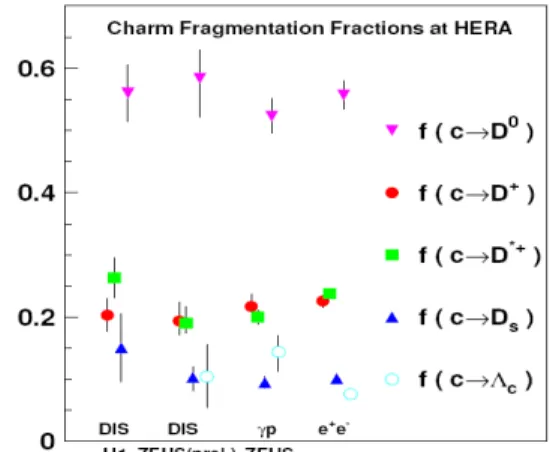
σgs=σ(D+) +σ(D0) +σ(D+s) +σ(Λ+c) (7) The open charm fragmentation fractions (namely c→D+, c→D0,c→D+s andc→Λc) are summarized in (Fig. 2). The abundance ofD0is mostly due to the large branching ratio for D∗→D0.
IV. D∗+/−-JET CORRELATIONS IN PHP
Differential cross sections forD∗+jet production are
de-termined and the correlations between theD∗meson and the jet(s) are studied. The results are compared with perturbative QCD predictions applying collinear- orκt-factorisation.
Correlations between theD∗ and the jet in the transverse
plane are investigated by measurements of the difference in
FIG. 2: Recent ZEUS measurement (γp) compared to previous DIS ande+e−results.
FIG. 3:D∗+jetcross sections as function of∆φ(D∗,jet)compared with the predictions of the next-to-leading order calculations FMNR and ZMVFNS.
azimuthal angle∆φ(D∗,jet). A large fraction of the produced
D∗+jet combinations deviates from a back-to-back config-uration, indicating the importance of higher order contribu-tions. The available NLO calculations underestimate signifi-cantly the observed cross sections in the region∆φ(D∗,jet)<
120◦(Fig. 3), as already found earlier in [9].
V. CHARM AND BEAUTY CONTRIBUTIONS TOF2
H1 has recently measured inclusive charm and beauty cross-sections for values of the photon virtuality 12≤Q2≤
60 GeV and of the Bjorken scaling variable 0.0002≤x≤
0.005 [5]. Due to the long lifetimes of c and b flavoured hadrons, events containing heavy quarks are distinguished from the ones containing only light quarks by reconstructing the displacement of tracks from the primary vertex, using pre-cise spacial information from the H1 vertex detector.
The measured charm contribution toF2,Fcc¯
predic-Brazilian Journal of Physics, vol. 37, no. 2C, June, 2007 741
FIG. 4: New H1 measurement ofF2bb¯ (in solid circles) as a function ofQ2 for different values of x. This is compared to an older H1 measurement at highQ2and topQCDpredictions
tions of theQCDcalculations.
Similarly, the beauty contribution toF2is shown in Fig. 4. The data are compared toQCDpredictions from MRST and CTEQ at NLO and NNLO. This is the first measurement of F2bb¯ in the lowQ2kinematic region. In this kinematic range, the charm cross-section contributes on the average 24% to the inclusive ep cross-section and the beauty fraction increases from 0.4% atQ2=12GeV2to 1.5% atQ2=60GeV2. The structure functionsF2b¯bandF2cc¯are found to be well described by predictions of perturbativeQCD.
VI. MEASUREMENTS OF BEAUTY PRODUCTION AT HERA
Measurements of beauty production cross sections have also been made. Events are selected by requiring the
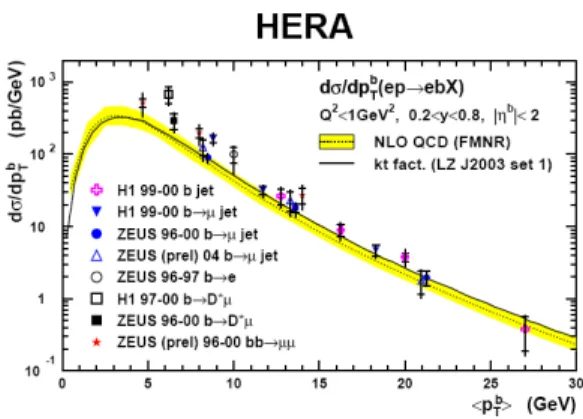
pres-ence of jets and muons or electrons in the final state. Both the long lifetime and the large mass of b-flavoured hadrons are exploited to identify events containing beauty quarks. Differ-ential cross sections are measured in photoproduction, with photon virtualitiesQ2<1GeV2, and in deep inelastic scatter-ing. The results are compared with perturbative QCD calcu-lations to leading and next-to-leading order. At high pt re-gion, NLO calculations provide reasonable agreement with data. At lowerpt region, however, the model under predicted the beauty cross sections. The prediction fromktfactorization agrees with the NLO prediction, and shows similar marginal agreement with the data. Thektfactorization approach uses an unintegrated gluon density in the CCFM approach and lead-ing order matrix elements. It is often claimed to be in better agreement with beauty measurements.
FIG. 5: The differential cross-sectiondσ/d pbTcombined results as a function of the transverse momentum,pT, of thebquark.
VII. CONCLUSIONS
Measurements from ZEUS and H1 for fragmentation frac-tions are comparable with these from e+e− experiments. Cross sections are in reasonable agreement with NLO QCD apart from some regions of phase space. More HERA II re-sults will be combined with HERA I in the future leading to higher precision measurements.
[1] ZEUS Collab., S. Chekanovet al., Eur. Phy. J. C 44, (2005) DESY-05-47.
[2] ZEUS Collab., J. Breitweget al., Phys. Lett. B481, 312 (2000). [3] H1 Collab., A. Aktaset al., Eur. Phys. J. C38, 447 (2005). [4] Particle Data Group, S. Eidelman et al., Phys. Lett. B592, 1
(2004).
[5] H1 Collab., A. Aktaset al., Eur. Phys. J. C45, 23 (2006). [6] R. Thorne, ”A Variable Flavor Number Scheme at NNLO”,
To appear in the proceedings of 13th International Workshop
on Deep Inelastic Scattering (DIS 2005), Madison, Wisconsin, USA, April 2005 [hep-ph/0506251].
[7] M. Corradi (H1 and ZEUS Collab.), ”Heavy Quarks at Hera with Lifetime Tag”, Proceedings of HEP2005, 70 (2005).
[8] ZEUS Collab., S. Chekanovet al., Phys. Rev. D 67, 012007 (2003).