Electronic Payments Workflow Optimization
in Fashion E-tail
João Henrique Pereira Meireles de Barros
Master’s Dissertation
Supervisor: Maria Teresa Peixoto Braga Bianchi de Aguiar
Mestrado Integrado em Engenharia Industrial e Gestão
2015-07-26Abstract
Electronic payments are a crucial part of E-commerce. From the Customer perspective, being able to easily pay without incidents improves the shopping experience. Nevertheless, sometimes Cus-tomer experience payment refusal by the system and although a few cases occur due to CusCus-tomer’s fault, there is a larger part occurring because of the most problematic inefficiencies of the payment workflow, that runs in the background.
The payment system is very complex and involves a very diverse group of entities, frequently situated in different backgrounds, ruled by distinct legislation and with proper procedural prac-tices. This results, in some cases, in incompatibilities that undermine the success of the trans-action. The number of transactions exposed to this issue has made Farfetch, an online fashion retailer, to lose a considerable amount of revenues.
To tackle this problem, a large quantity of data was collected and analysed, allowing to identify the causes of inefficiencies and the improvement opportunities. Two markets, the United States and the United Kingdom, were studied and compared to understand the performance of each entity in both markets, relatively to the metric: percentage of authorised transactions.
With the analysis’ results it was possible to build a new workflow model based on the Bank Identification Number (BIN), essential tool to recover the Customer bank information. The logic behind the new workflow consists in routing the transaction through the path which best suits the respective bank in terms of authorisation performance.
The dissertation discriminates all the steps to achieve the model as well as all the relevant analyses covering the issuing banks. The main conclusion is the importance of a creating payment workflows where the entities are aligned in what concerns procedural aspects beceause it is the way of improving the gains for both parts. The Customer, in the end, is benefited in his shopping experience despite being unaware of the whole process behind.
Resumo
O processo de pagamento é uma parte fundamental do comércio electrónico. Da perspectiva do cliente, ter uma experiência sem sobressaltos no pagamento de uma encomenda, melhora a exper-iência da compra. No entanto, por vezes, o cliente tem de lidar com a recusa de pagamento por parte do sistema. Muitas vezes deve-se a culpa directa do cliente mas uma grande parte acontece devido a um conjunto de ineficiência próprias do sistema, pela forma como foi construído.
O sistema de pagamentos é muito completo e envolve um conjunto de entidades muito difer-entes, muitas vezes provenientes de diferentes contextos, leis e com práticas operacionais muito próprias. Isto resulta, em muitos casos, em incompatibilidades inultrapassáveis que tornam o re-sultado da transacção negativo. O numero de casos em que isto sucede na Farfetch, empresa de comércio online de moda de luxo, resulta numa perda considerável de receitas.
Para resolver este problema, um grande quantidade de dados foi analisada, permitindo a iden-tificação das principais causas das ineficiências registadas anteriormente e das oportunidades de melhoria. Os dois mercados estudados, norte americano e británico, foram comparados de forma a perceber o rendimento de cada entidade envolvida em ambos os mercados relativamente à métrica definida: percentagem de transacções autorizadas.
Após esta análise de dados, foi possível construir um novo modelo de fluxo de pagamentos baseado em BIN’s (Número de Identificação do Banco), ferramenta essencial para a identificação da informação do banco do cliente. A lógica deste modelo consiste em dirigir cada transacção pelo fluxo que sirva melhor o banco em questão em termos de performance.
A dissertação descrimina todos os passos realizados para obter este modelo assim como todas as análises realizadas cobrindo principalmente os bancos dos clientes. A principal conclusão a retirar é a importância de criar um fluxo de pagamentos onde as entidades estão alinhadas no que diz respeito aos aspectos processuais porque é a melhor forma de potenciar os ganhos para ambas as partes. O cliente, por seu lado, é beneficiado na sua experiência enquanto consumidor apesar de estar completamente alheio de todo o processo.
Acknowledgements
First of all, I would like to thank my dissertation supervisor, Prof. Teresa Bianchi Aguiar, for always being available for me and for the wonderful inputs given to the project. Without them, the dissertation wouldn’t be the same.
I would like to thank Farfetch for giving me the opportunity to develop this project and spe-cially to my company supervisor Joana Fernandes for always supporting me and transmitting the passion about the subject. A word of gratitude to Francisca Marinho for helping me in the project initial phase.
I would also like to thank to my intern colleagues in Farfetch for being with me in this path, all together. To all my friends and to the people that in the most difficult moments knew how to cheer me up and to take me forward.
To all the professors that guided me through the years and made me a better person.
Finally, to my family, brother, mother, father and Conceição for giving me the best of the educations and providing the best opportunities. And to my grandfather, an inspiration.
“It is only through labor and painful effort, by grim energy and resolute courage, that we move on to better things.”
Contents
1 Introduction 1
1.1 Farfetch . . . 1
1.2 Project . . . 3
1.3 Objectives and Structure . . . 3
2 State of the Art 5 2.1 E-commerce . . . 5 2.2 Luxury . . . 6 2.3 Payments Workflow . . . 7 2.3.1 Electronic Payments . . . 7 2.3.2 Transaction Flow . . . 9 2.3.3 Entities . . . 9
2.4 BIN-based Payment Workflow Optimization Solutions . . . 13
3 Current Workflow Structure 15 3.1 Payment System . . . 17
3.1.1 Payment Methods . . . 17
3.1.2 Payment System Architecture . . . 19
3.1.3 Multilayer decision . . . 21
3.1.4 Payment Authorisation . . . 23
4 Data Collection and Analysis 25 4.1 BIN Assessment . . . 25
4.2 Mapping of Refusal Reasons . . . 28
4.2.1 Global Weight . . . 29
4.3 Authorisation Performance Diagnosis . . . 29
4.3.1 Authorisation Rate Analysis - Issuing Bank Country . . . 31
4.3.2 Authorisation Rate Analysis - Issuing Bank Name . . . 38
4.3.3 Two Acquirers Performance - US Market test . . . 41
4.4 Costs Analysis . . . 44
5 Redefinition of the Workflow 47 5.1 Short Term Solution . . . 47
5.1.1 Limitations of the Current System Infrastructure . . . 47
5.1.2 The Workflow . . . 48
5.2 Medium/Long Term Solution . . . 51
5.2.1 Acquirers - wider offer range . . . 51
5.2.2 Payment System Providers - Double System . . . 52
5.2.3 APAC Division - an important market solution . . . 52
6 Conclusions and Future Work 55
A Local Payments 59
B Authorisation Rate - Evolution 61
B.1 United States . . . 61
B.2 United Kingdom . . . 62
C United Kingdom - Number of Orders vs Amount Value 63
D Fallback 65
Abbreviations
A-A Acquirer A
A-B Acquirer B
A-C Acquirer C
A-FEU Acquirer Fallback Europe and Rest of the world A-FUS Acquirer Fallback United States
A-FBR Acquirer Fallback Brazil
AMEX American Express
APAC Asia-Pacific
AR Authorisation Rate
ATM Automated Teller Machine AUD Australian Dollar
AWB Airway Bill
BIN Bank Identification Number
BR Brazil
BRL Brazilian Real
CAD Canadian Dollar
CHF Swiss Franc
EUR Euro
EU & ROW Europe and Rest of the World
FF Farfetch
GBP British Pound
JPY Japanese Yen
KRW South Korean Won
RUB Russian Ruble
MXN Mexican Peso
P-A Provider A
P-FEU Provider Fallback Europe and Rest of the world P-FUS Provider Fallback United States
P-FBR Provider Fallback Brazil PSP Payment Service Provider ROW Rest of the World
SGD Singapore Dollar
UAE United Arab Emirates
UK United Kingdom
US United States
List of Figures
2.1 Authorisation and Settlement - Payment Processing [Van der Valk, 2015] . . . . 10
3.1 Order Processing Steps . . . 17
3.2 Weight of the different Payment Methods in Farfetch in the last years . . . 18
3.3 Current payment workflow at Farfetch . . . 21
3.4 Multilayer payment workflow decision system . . . 22
3.5 Authorisation Rate evolution - two calculation methods . . . 24
4.1 Impact of payment refusal reasons by main groups . . . 29
4.2 Weight of global sales in the most relevant markets . . . 30
4.3 Weight of foreign bank countries transactions in US market . . . 34
4.4 . . . 35
4.5 Amounts Settled/Lost - Other countries - US Market . . . 35
4.6 Weight of foreign bank countries transactions in UK market . . . 35
4.7 Amounts Settled/Lost - Other countries - UK Market . . . 36
5.1 New Payment Workflow - Only Issuing Country criterion . . . 49
5.2 New Payment Workflow - Issuing Country and Bank criteria . . . 50
5.3 New Payment Workflow - Complete Model . . . 51
B.1 Authorisation Rate IR issues evolution - Other Countries - US Market . . . 61
List of Tables
4.1 Card Numbers Coverage . . . 26
4.2 Card Number Coverage - After Token Recovery . . . 26
4.3 BIN Match Assessment . . . 27
4.4 BIN Match assessment - New Database . . . 27
4.5 Summary Table - Current KPI’s results and improvement margins . . . 31
4.6 Summary table describing the performance of both markets and the differences between national and foreign banks . . . 32
4.7 AR Comparison between US and UK markets . . . 36
4.8 Authorisation Rate Value Calculation for both markets and each bank country . . 37
4.9 Comparison between the current settled amount and the new estimated for both combined markets - with maximized AR . . . 38
4.10 Top 10 Banks - US and UK markets - Main indicators performance and character-ization . . . 39
4.11 Top 10 national and foreign banks in the US market and their performance rela-tively to the payment workflow metrics . . . 39
4.12 Top 10 national and foreign banks in the UK market and their performance rela-tively to the payment workflow metrics . . . 40
4.13 Foreign Banks performance comparison for US and UK markets . . . 41
4.14 TOP 15 Banks - US Market - 2 acquirers system performance comparison . . . . 42
4.15 TOP 15 countries - US Market - Possible gains with the optimal acquirer solution for each bank . . . 43
4.16 Transaction Costs Overview for US and UK markets . . . 44
4.17 Transaction Costs in US and UK markets - Region Clustering . . . 45
4.18 TOP Banks in the US market - Gains vs Costs analysis . . . 45
C.1 Top 15 foreign bank countries weight - UK market - Different criteria . . . 63
D.1 Fallback performance for US and UK Markets - Issuing bank and country granularity 66 E.1 ARV calculated for the current results (real) . . . 67
Chapter 1
Introduction
The present dissertation arises from a compelling need to optimize and increase the efficiency of the core processes within the 8-year-old online luxury fashion company - Farfetch. In this particular context, the project will approach mainly the remodeling and improvement of the current electronic payment system with credit card implemented in the company.
Online payment systems with credit card is admittedly a very complex topic taking into ac-count the number of entities involved and the major security issues required for enabling the trust of Customers in these methods. Moreover, due to a very stringent legislation and a group of con-tractual issues with the several entities involved, it only allows to act on some surgical parts of the system in order to achieve better results.
Payment failures by the issuing bank are the responsible for many lost orders, resulting in a considerable loss of revenues. Part of these rejections have their root cause on the inadequate payment flow where the several actors are not linked in the most profitable and efficient way. For that reason it is necessary to spot the biggest flaws and to tackle them in order to increase the payment operational performance and consequently the Customer service and the company revenues.
1.1
Farfetch
Farfetch is an online marketplace focused on luxury fashion launched in 2008. The company has grown in a rapid pace in the last few years raising a huge interest in investors which allowed the company to become an "unicorn" start-up after raising 86 million dollars in March 2015 reaching to 1 million dollar valuation.
The company sells a wide range of luxury fashion items from more than 400 boutiques all over the world such as Stefanie Mode, Biondini Paris or Eraldo. It allows Customers to buy from their favourite boutiques from any place in the globe that were inaccessible in the past. Its diversity and creativity cause an excellent impression on customers as well as the continuous effort on satisfying the customer strongest desires. The market where the sales volume is higher is United States and then, with a lower expression, United Kingdom, Hong Kong, China and Russia.
Introduction
Farfetch business model is the main competitive advantage that allowed the company to thrive on this market. First of, the most relevant characteristic is that Farfetch does not own stock. All the articles presented and sold to Customers are owned and kept by boutiques. The company works on a sales commission basis o established with each boutique. Each item is sold and sent to the Customer via an external courier provider.
The company is the intermediary between Customers and boutiques. All operational issues like standardize and support order processing by boutiques, photographing all the items, develop-ing the website and integratdevelop-ing all its components as well as vital Customer service are the part of the service delivered by Farfetch and responsible in a great part for its success.
Until now, there has not been a company able to replicate the business model of Farfetch. The huge number of boutiques aggregated in one single network and the global scale in terms of delivery (currently FF delivers in 190 countries) at such low operational costs discourage most of the companies and boutiques on going by themselves on the same kind of business. Furthermore, dealing with the amount of seasonal stock typical from this business is a major setback for the idea of increasing scale business. Another great advantage relatively to the competition is the fact that Farfetch has partnerships with many boutiques from many different cultures which allows a substantially bigger product offer.
Farfetch is a very innovative and forward thinking company, being in a constant reinvention process. Many business units were introduced. The company now sells fashion for kids as well as jewelry. Some pilot projects that resulted in expansions of the business model are also absolutely relevant. The first is the acquisition of the British boutique "Browns", which is viewed as a sample tube and works as an assessment of the performance of a boutique completely managed by FF processes. It is also useful to try out some features and evaluate the corresponding results. This project permits a deeper analysis and provides enough knowledge to implement some process improvements in the Farfetch partner boutiques. The Black and White project consists in the same business model but applied to brands. Instead of working with boutiques the objective is to partnership with brands to provide Farfetch technology to brands e-commerce. The most recent fashion brand working on this project is Manolo Blahnik.
Currently Farfetch has more than 700 employees and operates in 9 offices in 7 countries: United Kingdom (London - Headquarters), Portugal (Porto and Guimarães), Brazil (São Paulo), Tokyo (Japan), China(Shanghai), Russia(Moscow) and United States (New York and Los Ange-les). The dissertation was developed in the Porto’s office where all the Operations department is placed and where more than half of the Customers work. The 8 major departments in Porto are: Human Resources, Office Management, Operations, Account Management, Customer Service, Partner Service, Finance, Merchandising and Tech.
The Operations department is the most relevant department for the developed topic and is composed by the following main areas:: Customer Operations, Supply, Continuous Improvement and Black and White Operations. Customer Operations is subdivided in Delivery (Support and Development), Fraud and Payments. The Payments area is responsible to analyse the impact of the whole payment process and the different payment methods in the operational results of the
Introduction
company.
1.2
Project
Every day, Farfetch Customers place new orders that require an online payment. The respective triggered transaction can be made by a variety of payment methods that are provided by the com-pany but, for this project, the relevant method is credit card. A credit card payment transaction, from the Customer point of view, only has two final status: accepted or rejected.
The status comes from the complex payment workflow process: the authorisation. This pro-cess involves several entities which communicate among themselves in order to provide the Mer-chant (vendor) with the authorisation information. A transaction could be rejected by a group of various reasons from different sources. These can be Customer funding problems, fraud suspicions and other similar, but the most relevant group in this particular context is refused transactions by the issuing bank (Customer’s bank).
Although most of the times the available information is not complete by the lack of integration of all entities involved, these group of reasons normally indicate that the issuer bank refused due to incompatibilities with the rest of the workflow entities. These kind of transactions are global including countless banks and countries which leads to dealing with several deviating legislation and procedural practices which ends in insurmountable discrepancies.
A substantial part of these discrepancies happen because of the payment workflow inefficien-cies. Farfetch system was built as a response to the company’s necessities and adversities which resulted in a capable and responsive system but not exploiting its full potential. This project aims to study the whole system, understand what are the main inefficiencies and if they are the root cause of these refused transactions, and analyse how to improve the payment workflow to a more capable, efficient and logical system that can bring better operational results to the company.
1.3
Objectives and Structure
The main objective of this dissertation is to be able to provide a new complete online credit card payment workflow that can be efficient, maximizing the percentage of authorised transactions, well structured to provide the opportunity to be used in the long term, and flexibility to improve constant alterations with future new analyses. This proposed workflow will be based on a strong analytic ground.
In order to accomplish this novel payment workflow, first we have to closely study the current workflow and to understand what are its flaws. Secondly, we have to associate each credit card with the respective issuing bank and country using the worldwide BIN system (the first 6 digits of a credit card identify the original bank). This association requires data treatment and access to an external database of bins. Thirdly, by tracking the bank and country of each transaction, we have to study the performance of each issuing bank. These analysis will be the basis for all the decisions taken concerning the new payment workflow.
Introduction
In order to fulfill all these objectives in an organized and clear way, the dissertation was struc-tured as following: the Chapter 2 will consist in the state of the art addressing topics related with the business model and with online payment systems; Chapter 3, Current Workflow Structure, will give a detailed description of Farfetch’s internal processes and how the current workflow system was built; Chapter 4, Data Collection and Analysis, will show, firstly, the necessary steps to assure the existence of quality data for the following analyses. Secondly, this chapter consists in a group of analyses regarding the performance of the system in the studied markets and the identification of improvement opportunities; Chapter 5, Redefinition of the Workflow, will focus initially in the transacted costs and their relevance for the workflow and then in all the proposed payment work-flow models; in the end, Chapter 6, Conclusions and Future Work,will give a smaller overview of all the conclusions taken along the dissertation and will set the basis for the future work.
Chapter 2
State of the Art
The present chapter aims to provide a global overview of the most pertinent subjects related with the main topic.
Firstly, it will be given a quick insight in the e-commerce business along with its relationship with luxury goods’ market. A slightly more detailed description of the way electronic payments are processed in this business, and the wide range of concepts associated, will be presented soon after, ending . . .
2.1
E-commerce
Although E-commerce appears as a recognized modern 21st century concept “whose history is only fifteen years old” [Mohapatra, 2013], its origin dates back to the 1960s, at the time the de-velopment of EDI allowed companies to exchange information, place orders, and make electronic payments through computers. It was called the first generation of E-commerce. The second phase was characterized by the commerce of goods and services using the Internet as a commercial tool [Tian and Stewart, 2007]. Along with the rampant growth of the Internet in the two ending decades of the 20th century came its attractiveness as a business platform. In the end of 1991, with the lift of online commercial restrictions by the NSFNET, it finally overthrew the last barrier to the E-commerce world [Tian and Stewart, 2007]. E-commerce is considered “the most significant industrial revolution since the first industrial revolution” [Mohapatra, 2013].
There are several definitions of E-commerce, such as the one from OEDC as “electronic trans-action which is the sale or purchase of goods or services between businesses, individuals (. . . ) conducted over computer mediated networks.” or the US government as “E-commerce is a collec-tion of all business activities through the Internet”. However, [Evans, 2001] states e-commerce as the shift of all traditional business operation practices to an online basis and a mean of expanding business to a global scale. It enables a wider range of supplier choice (without concerning about geographical location) and allows getting products and services being delivered to the Customer in a more efficient and flexible way, becoming at the same time more responsive and providing a better Customer service. [Siddiqui et al., 2003] states that E-commerce “not only can greatly raise
State of the Art
productivity, improve the efficiency of economic operations, lower economic operating costs and make possible things that were impossible before”.
Another relevant aspect is related with the customer relationship with Merchant in online busi-ness. The customer became powerful, has easy access to information and exchange it with other customers from another companies which makes the customer opinion on the company extremely important and the customer satisfaction strategy a key figure for business success.
E-commerce is seen as the new revolution and its impact will be in every single aspect of human life, reformulating everything human society knows, far beyond business. It can go from industry processes, logistics, and finance to law systems, education, government and even agricul-ture. It is fair to say that embracing the use of e-commerce in current businesses is already a main competitive advantage in business world [Evans, 2001].
2.2
Luxury
Defining Luxury is not always easy. Because of its unique characteristics, it represents a very specific niche that is not recognized as a product or service not even a concept but as “an identity, a philosophy and a culture” [Okonkwo, 2009]. Historically, luxury origins are assigned to France, to the royal, nobles and aristocrat classes, where the meaning was connoted with power, majesty, wealth, ostentation and, above all, social status and distinction from lower and poorer classes [Okonkwo, 2009] [Hines and Bruce, 2007] [Kapferer and Bastien, 2009]. The original concept evolved to recreation of the social stratification but in a democratic way in which who has money could achieve it [Kapferer and Bastien, 2009]. The most relevant factors sought by luxury cus-tomers are extreme quality, aesthetics, scarcity and uniqueness and high price combined with its functionality [Hines and Bruce, 2007]. One of the most relevant factors that customers are not being driven by rationality but human senses as the smell, touch and vision [Okonkwo, 2009].
As a business, this concept diverges from the most common resulting in a very particular niche where several characteristics must be attended to ensure the company success. A luxury customer should be able to perceive enough value in the product worth the high value charged [Tynan et al., 2010] and recognize the product as fashionable, stylish and even as a possible trend [Ko and Megehee, 2012].
This industry is composed by a small quantity of companies but when referring to sales and above all, influence on social behaviour, the values have a huge impact. The best materials, pack-aging, products and image must happen on luxury so that these brands can lead the way for the rest of the marketing way [Ko and Megehee, 2012]. Increasing competition with the appearance of new brands is evident and is becoming hard to maintain the original image and controlling the business globalization [Jung Choo et al., 2012]. Another awareness is related with bloggers and other digital consumers and its influence in masses behaviour [Petkova, 2016].
This Luxury fashion industry deals with some paradoxes that should be treated carefully. The most relevant examples are the struggle between creating “desire and exclusivity” in a wider range of customers maintaining the equity of the brand. Another important conceptual dispute lies on
State of the Art
the wish of increasing sales volumes without the risk of overexposure. These are some of the argu-ments mostly used by skeptical brands to enter the online market, placing Internet in the opposite position when referring to the core elements [Okonkwo, 2009].
What online customers want is a website experience that is pleasant, interactive and engaging [Bjørn-Andersen and Hansen, 2011] while maintaining the prestigious atmosphere of a boutique with its multi-sensory experience (visual, smell, sound, customization). The most required fea-tures for a successful online channel (from client POV) are undoubtedly aesthetics, communication by e-mail, information on products and easiness to navigate on portal [Hines and Bruce, 2007]. Another important issue to be aware of is that customers talk with each other, are more informed and want to know everything. They want to understand from other people how good the brand, product and its materials are. The same person can buy a product using more than one channel.
Luxury online customers are as much involved as when they buy in a physical place. Stud-ies show customers tend to abandon firms that neglect the relation and not provide the required attention. The increasing role of Smartphones and Tablets is also important: circa 50 of luxury customers do search in mobile devices and there is also a strong correlation between the increase in sales and the number of web pages visited [Mosca and Casalegno, 2016].
From the retailer point-of-view, internet allows access to a greater audience, many cost savings, opportunity of doing business 24/7 and increased customisation as well as improving the customer relationship to a more detailed and customised level [Siddiqui et al., 2003].
A report of Bain and Company from 2015 states that the personal luxury goods market is evaluated in $250 billions in 2015 which corresponds to a 13% growth comparing with 2014. In the last 20 years this value has tripled [Claudia D’Arpizio, 2015]. Regarding online business, sales of luxury products reached to $7.5 billion, accounting for 4% of total selling and for 2017 the estimation is an increase of $17 billion[Mosca and Casalegno, 2016].
2.3
Payments Workflow
2.3.1 Electronic PaymentsRegarding electronic payments there are a great variety in the methods available. Moreover ev-ery year different types of methods appear in the market allowing each customer to choose the most suitable method.Globally, the most common electronic payments currently available are: [Khan et al., 2011]
• Electronic payment cards (credit, debit, charge • Virtual credit cards
• Smart cards • E-wallets • Electronic cash • Wireless payments
State of the Art
• Loyalty cards
• Payments made kiosks or certified shops . . .
These payment systems can be divided in bank card payment systems and non bank card pay-ment systems. The first group includes credit cards, smart cards and debit cards and are paypay-ment methods widely accepted by customers and merchants, being the most popular all over the world. It works based on a cardholder account in a bank, where the customer has an account card for pay-ments being the bank responsible for the security of the transaction and assumes fraud issues costs. As for the non bank card systems, they are digital money schemes such as e-loyalty cards, reward cards, paypal, among others. These methods usually only involves three parts: the merchants, the client and the financial institution that issues the cards and works as an intermediate between customers and merchants. Comparing the two divisions, the bank card payments corresponds to 85% of all internet purchases [Abdellaoui et al., 2011].
2.3.1.1 Security
An E-commerce company can only achieve success if the general public can trust in the virtual environment. People which participate in e-commerce transactions are willingly to take a certain risk but, it must stand below the personal threshold [Yao-Hua Tan, 2000]. Transactions can occur without any prior human contact which creates a circumstance of security threat. The phase of electronic payment is confidential when all phases of the process are capable to satisfy the needs of participants and their security expectations [Tsiakis and Sthephanides, 2005]. All the proce-dure involves collecting, storing and sending information from a huge amount of customers and their cards and transactions between all the actors in the process. Therefore if any security breach happens the damages to card users and merchants can be catastrophic [Liu et al., 2010]. A se-cure e-payment system should provide security against fraudulent activities and must protect the privacy of consumers with the most important values being integrity, payment confidentiality, pay-ment anonymity, and payer traceability [Kim et al., 2010]. To meet these market security needs, there are security protocols for e-commerce transactions [Khan et al., 2011].
Security Socket Layer is a set of cryptographic protocols that provide communication safety through the Internet and it was developed by Netscape Communications Corporation. It permits to client and server to define previously their private keys for communication and turns possible to use the public Web server with a high level of encryption during the transaction. [Khan et al., 2011].
The huge amount of data managed by the merchants and providers increases the risk of expo-sure to a security breach. For some years the card brands developed their own security programs and the compliance programs among all were not organized and fractured. In order to prevent new security breaches, the major card brands created together a standardized group of security standards (Payment Card Industry Data Security Standard) managed by a council formed by them (PCI Security Standards Council). The PCI DSS guides all entities involved through a set of a mandatory practices to protect cardholder data and to avoid fraud issues [Liu et al., 2010]. The merchants to be able of doing this kind of transaction must acquire the compliance certificate
State of the Art
that requires endowing the payment system with high security levels which may be expensive [Abdellaoui et al., 2011].
2.3.2 Transaction Flow
There has been a great effort in standardize electronic payment systems. Most of them consist in a solid common basis involving 5 major entities: The client or customer (C), the merchant or retailer (M), the financial entities Acquiring Bank (A) and Issuing Bank (I) and finally a payment system provider (PSP) [Carbonell et al., 2008].
A credit card payment is a complex multi-staged process involving every entity mentioned before. Right after the customer makes the payment his card authenticity is verified by the card is-suer via the merchant acquirer together with the corresponding card network. If the procedure runs successfully the purchase amount eventually is debited from the original account [Liu et al., 2010].
Authorisation and Settlement
The payment processing is composed by two distinct main steps: the authorisation and the clearing/settlement. The authorisation is essentially a flow of information between all parts in-volved. It starts at the moment the client places the card details on the E-commerce website. It is then recorded the type of card, account number, expiry date and security codes by the mer-chant. Then the payment request is redirected to the merchant acquiring bank or payment proces-sor through a payment provider or simply a payment gateway. The card network reads the card number, determines the issuing bank and sends the relevant information to it. The issuing bank, verifies the account details and whether the referred amount is within the line of credit allowed to the client. Lastly, the acquirer is responsible to send the final authorization code to the merchant. [Liu et al., 2010][Kossler, 2013].
The settlement process happens immediately after the acquirer receives transaction details. The card networks conduct the transaction data to the issuers which are responsible of charging their own clients. The merchant, in a defined periodic time frame, sends the batch of transactions to its acquirer or payment processor. The batch is then divided by the card network being all the transactions sent to the correspondent issuing banks. Here the banks issue the purchase to the cardholder and the payment is sent to the acquirer. The acquirer then deposits the due amount to the personal account of the company less the processing fees [Liu et al., 2010][Kossler, 2013]. The whole process is schemed in Figure2.1.
2.3.3 Entities
2.3.3.1 Client and Merchant
These two entities are the main responsibles for the transaction. The client requests a service/prod-uct provided by the merchant and for that a payment must be done. The Client is viewed as the entity who places the order and pays for the goods or services provided by the merchant. It is the
State of the Art
Figure 2.1: Authorisation and Settlement - Payment Processing [Van der Valk, 2015]
entity who triggers the whole process [Carbonell et al., 2008]. The Merchant is the entity respon-sible to provide goods and services for which the customer actually paid [Carbonell et al., 2008].
2.3.3.2 Issuer
The Issuer is the financial organization that issues the validity of the payment. It is the customer’s bank and the responsible for the alleged account. Afterwards it transfers the respective funds to the Acquirer [Carbonell et al., 2008].
2.3.3.3 Payment Service Provider (PSP)
PSP is the pivot element in payment flow. It is a company that enables the connection between the Merchant and the other market entities, the Issuer and the Acquirer [Sellxed, 2016]. Primarily the Provider is the responsible for processing the payment , on behalf of the Merchant and then to communicate with the Issuer obtaining response about the Merchant payment authorization request. If this authorization is successful it is then forwarded to the Acquirer (financial entity responsible to communicate with the customer bank - Issuer)[Carbonell et al., 2008].
PSP became a cornerstone of the payment flow because it allowed Merchant to capitalize main business issues like Risk Management, Reporting or even Fraud Protection, all provided as services by the Provider. Furthermore, it relieved Merchants from the strict safety requirement issues from the card industry[Sellxed, 2016].
The Provider usually integrates a wide range of payment methods (debit and credit cards, bank payment, e-banking or e-wallet) and offers the possibility to work with multiple currencies which
State of the Art
can be used as a competitive advantage. There is no strict bound to any Acquirer which permits the integration with multinational payment methods in only one provide [Sellxed, 2016].
The relevance of the PSP does not end here. Banks have normally conservative standards for merchants in terms of age in the business, level of capital, past credit record with vendors and other business viability measures. Many new and small companies had trouble to cope with these demand requirements and were forced to accepting only cash. The PSP’s brought the opportunity of being themselves to represent the firm in the bankcard payment system. It’s the natural best option for brand new start-ups[Kossler, 2013]. With the growth of the small firms and with the respective higher sales volumes, PSP usually keep processing the company payments, allowing simultaneously the transition for the company to behave as a full merchant in a direct relationship with Acquirer [Kossler, 2013].
[Abdellaoui et al., 2011] notes that, in absence of a PSP in the system, the online shop must incorporate the payment functions directly in the platform. The merchant must guarantee a high level of security, ability to manage fraud and technology capacity to handle all the transactions and the PCI compliance must be assured. Most online businesses with this traditional payment system, must use Payment Gateways.
A Payment Gateway authenticates and routes payment details in an extremely secure environ-ment between various parties and related banks. The Payenviron-ment Gateway functions in essence as an encrypted channel, which securely passes transaction details from the buyer’s Personal Computer to banks for authorisation and approval. By handling the two key parts of credit card processing, authorization and payment settlement, the Payment Gateway is the key link in an online transac-tion. These kind of software and servers allow the Merchant to process credit cards, otherwise it would be not possible. In case of the use of a PSP, a Payment Gateway is already integrated in the service provided [Gulati and Srivastava, 2007] [Lowry et al., 2006].
2.3.3.4 Acquirer
It is defined as the financial institution of the Merchant. The Acquirer is the main responsible to communicate with the Issuer and to assess the validity of the requested payment. It commu-nicates directly with the Provider which in turn informs the Merchant [Carbonell et al., 2008]. It has a buffer function which enables the protection of the Merchant from having to deal with con-stantly changing legislation, card schemes, among other issues [Sellxed, 2016]. In some markets, Acquirer could be confused with Payment Processor. Payment Processors enable Merchants to receive credit card payments online by providing a connection to an acquiring bank. These are the interface that in reality process the transaction with the card networks and Issuers. Processors are held to standards and regulations organized by credit card associations. In many cases the acquiring bank is already the Payment Processor [2Checkout, 2016].
For card networks such Visa and Mastercard, the Merchant Acquirer is defined as the member financial institution responsible for its merchant-customers’ transactions with the network. It is important to note that it is the network member financial institution that is ultimately responsible for the underlying transactions, issued through the customers member financial institutions. The
State of the Art
common name for this model is four-party card schemes. Other card networks involve other ac-quiring models. Most significant among these are American Express and Discover which are not based on a bank-member structure but operate as independent entities. As such, they maintain the contract relationship with cardholders as issuers and similar direct relationships with the Mer-chant that accepts their cards as Acquirers. In other words, Discover and American Express play two roles: Merchant-Acquirer and payment network. These are called third-party card schemes [Kjos, 2007] [Liu et al., 2010].
However, not all payment systems work with a traditional Acquirer with a Merchant account. Internet Merchant accounts can be hard to obtain. This is because of increased security risks as no signatures are involved, nor is a card physically presented at the point of sale. Another option may be to use a Third Party Processor, which is basically a Payment Gateway and Merchant account rolled into one. A Third Party credit card Processor is a company that accepts credit card orders on behalf of other online businesses [VPSource, 2016]. It lets Merchant accepting online payments without a merchant account their own. Instead, they let Merchants use the Payment Processor account under their own terms of service, usually with very little setup required [Shopify, 2016].
2.3.3.5 Card Networks
Credit card networks provide all the credit cards for the banks as well as other products and can be classified as two types: proprietary and open networks. Proprietary networks, such as Ameri-can Express and Discover, operate as Issuer, Acquirer, and network operator. Open networks are comprised of member banks that can be Issuers, Acquirers or both. The main purpose of these or-ganizations is to meet the needs of their members by providing a set of rules, underlying infrastruc-ture, and some level of research and development to improve their networks [Chakravorti, 2003]. According to [Mead et al., 2011], based on debit and credit card purchase volume in 2010, Visa maintained about 57% of the market, followed by MasterCard at 25%, American Express at 15%, and Discover at 3%. In other words, all credit and signature debit card transactions are routed through one of the four major card networks. For the majority of card transactions, those involv-ing the Visa and MasterCard networks, four parties are involved: the Consumer, Merchant, Issuers and Acquirers. The latter is an institution that provides card payment processing services, for which it charges the Merchant.
Processing Fees
In a bank credit card transaction, the network collects a switch fee (or card scheme fee) from the acquirer and the issuer. The acquirer charges the merchant a Merchant discount (markup), which is the difference between the face value of the transaction and the amount the acquirer transfers to the merchant [Prager et al., 2009]. When the Issuer and Acquirer are different, the ac-quirer pays the issuer an interchange fee, set collectively by the banks that belong to the system. In recent years, interchange fees in the Visa and MasterCard systems have averaged between one and two percent of transaction value [Schmalensee, 2002]. An interchange fee is one way to ensure that network participants are able to recover their costs. Even though consumers do not directly
State of the Art
pay the interchange fee, it often affects the cost and benefits of using a payment card [Hunt, 2003].
Chargebacks
After a sale, some problems can occur with the card holder that can result in retrievals and chargebacks. Chargebacks represent a reversal of a purchase and can occur when the client does not recognize a purchase on his card statement. The reasons can be many and include a deliberate or inadvertent violation of the card acceptance rules by the Merchant, like a fraudulent transac-tion accepted by the merchant. There are some grey areas difficult to disput like cards used by family members without permission. There are always space for disputing the chargeback by the Merchant and the final result will decide if the chargeback is reversed or not. Payment system participants take chargebacks very seriously. There are extensive rules and regulations pertaining to chargebacks that Acquirers and Merchants must follow. Programs rapidly identify Merchants that do not properly process sales or respond to disputes [Kossler, 2013].
2.4
BIN-based Payment Workflow Optimization Solutions
BIN
A Bank Identification Number (BIN) is the first sequence in a payment card number (4-6 digits) and is used to identify the card’s issuer. It is also known as Issuer Identification Number due to the rising weight of non-bank institutions like American Express. It identifies the bank which issued the particular card and it is a great help to the Merchants identifying the issuing bank [Chargebacktech, 2016].
The anatomy of the card number permits to retrieve some useful information. The first digit (Major Industry Identifier) identifies the industry that issued the card, the two digits (the MII plus one) identify the brand (Visa - 4*; American Express - 35 or 37; Diners - 36; Mastercard - 51 or 55). These combined with two or four more digits identify the bank. The remaining numbers are the account identification number [Chargebacktech, 2016].
The optimization of payment systems based on BIN routing are not common and they are still little explored in this scientific area. However there are some examples with interesting approaches which can be a good starting point to this project:
Implementing a global acquiring strategy with country approach
[Dunn, 2012] states that global online Merchants need to take into account country specificities related to card acquiring, such as domestic regulations or national payments infrastructure, that can have a direct influence on authorization rates and therefore on conversion rates. The online Merchants have only two main options for card acquiring: to utilize local acquiring or to utilize international acquiring (multi-national acquiring license). In some countries like Brazil, France and India, adopting a local acquiring approach will have a positive impact on authorization rates.
State of the Art
It proposes a solution with five main key components: Global Visa and Mastercard acquir-ing license increasacquir-ing the granularity of the refusal reasons available; Local licenses for domestic schemes in somes countries like France where there is a local card scheme (Cart Bancaire) with the assumption that authorisation rate decreases with Acquirers with international licenses instead of local; Partnerships with domestic Acquirers because in selected countries, based on bin identi-fication, processing with local Acquirers leads to higher authorisation rates; Multi-Acquirer with the transactions declined in one Acquirer being resent to another Acquirer set up in the model; One-stop shop contract with Provider which is based on establishing a unique partnership with one Provider in order to benefit from the integration, reporting and a unique technology platform [Dunn, 2012].
BIN Routing for payment processing
[Fernandez, 2009] presents a BIN routing method that includes receiving a proposed transac-tion as payment for a purchase from a Merchant at a card processing terminal configured to identify a cardnumber and then routing the transaction to the determined financial institution related to the BIN. The method provides transaction optimization for payment processing and the criteria for the optimization should be defined by the Merchant. The optimization criteria is mapped to the data required and the Merchant is responsible to provide all the information through the card processing terminal.
BIN routing optimization module can select a one bank from the 140 banks available to receive the transaction according to a BIN identified for the card. Similarly, cash management optimiza-tion module can route the transacoptimiza-tion to a particular one of the banks according to pre-specified preferential banking relationships. In this regard, the Merchant can determine which transactions are routed to which of the banks based on defined parameters, including Merchant or Customer identification, device type used to process the transaction, product type (Visa, Mastercard, credit card, debit card) or currency [Fernandez, 2009].
These models help to understand what has been done in this kind of payment optimization and will serve as term of comparison in some cases.
Chapter 3
Current Workflow Structure
The following chapter serves to demonstrate what are the most relevant processes in the company that directly or indirectly affect the payment procedure.
Firstly a quick overview of the order processing system will be given. Afterward the focus will be the whole payment system with a detailed description of all entities involved and the most important process steps emphasizing the most critic points with potential to be improved. Afterwards, the multi layer decision process is clarified with the relevant variables in each step. Lastly, it is given a quick overview on the relevant performance indicators and the way they are calculated which will be crucial for the analyses of the following chapter.
Order Processing
The order processing is triggered when the customer confirms the order placement in the website portal. The order must contemplate one or more items added to the shopping bag. Until the confirmation page the client must fill all required fields like shipping details and payment details. Shipping details include the desired delivery address that should be error free to avoid operational problems in the following processes. Concerning payment details, the payment method needs to be chosen as well as the method correspondent details (card number and security code in credit card method) must be introduced. A bad data entry can result in a payment failure by customer issue.
As soon as an order is placed the system creates a Portal Order code identifying it. At the same time, for each group of articles from different boutiques is created a Boutique Order code. Each Boutique Order code is processed independently though the different steps but, in the end, all must be aggregated again under one single Portal Order and delivered at the same time to the customer.
All the order processing steps are quickly described below:
Current Workflow Structure
In this step the boutique is responsible for checking if the product is still physically available in the store. It may happen that the customer buys something in the portal that was already bought in the physical store and because the boutique did not update the item status or due to a lack of synchronization it becomes a problem of No Stock.
Step 2 - Approve Payment
This step purpose is to evaluate the customer and order details and assess the degree of trust-worthiness each order deserves. The Fraud team manages this step entirely and approves or rejects the orders following a group of standard procedures and indicators. If there are suspects of fraud there are two options: the order is immediately rejected or further investigation is made and more supporting documents are requested to the client.
To avoid the embarrassment of having to contact the client informing the inability to deliver an item already bought this step aims to happen, as far as possible, in parallel with Step 1.
There are a percentage of orders automatically approved or rejected based on the history of the customers using a system of coloured flags. These flags are clusters of customers with different probabilities varying from very good customers to historically fraudulent customers.
Step 3 - Decide Packaging
Once the order passes by step 1 and 2, the boutique chooses the packaging in which each item will be delivered to the client. The boxes are designed by Farfetch and are stored directly in each partner boutique. The boutiques can personalize each box to improve the customer experience.
Step 4 - Create Shipping Label
Step 4 is most of the times an automatic step. This step consists of the creation of the airwaybill (AWB) which is the transport document that is fundamental to the courier provider to deliver correctly the package to the customer.
Sometimes this process cannot be automatic due to various mistakes that go from mispelling of shipping addresses to duplicate AWB. The Delivery Team present in Portugal, United States, Brazil and Japan’s offices are responsible for this step.
Step 5 - Send Parcel
After the package is ready to be sent, it awaits in this step to be picked up by the courier. In boutiques with many sales the pick up is made daily. The others need to manually schedule pick up using Farfetch managing tools.
Step 6 - In transit
The parcel remains in transit from the moment that it is picked up until the exact moment the package is delivered to the final customer. As soon as the parcel is registered by the courier, it is sent an e-mail to the customer with a link to track the order.
Current Workflow Structure
Should something go wrong during this process it is possible to create a RTO (Return to Origin) where the process is inverted and the package returns to the boutique. This could happen if the parcel is held at customs or if during the process it is cancelled by several motives.
The whole order processing system is visually described in Figure3.1:
Figure 3.1: Order Processing Steps
3.1
Payment System
The payment process is a crucial step both for customers and Farfetch. For the most part it is what separates the ability of the customer to place an order. It is then extremely important to assess each relevant element in the process and decide what can be made to improve customer experience and Farfetch’s success.
3.1.1 Payment Methods
Currently, the breadth of payment methods offered to the customer is very diverse and complete with a growing trend. The most common and global methods are credit card payments followed by Paypal. However the vicissitudes of some markets required the flexibility to innovate and to bring new solutions. Therefore local payments were introduced in some specific but very important markets like Brazil and China. Others were introduced due to its popularity in German speaking countries and Netherlands.
3.1.1.1 Credit Cards
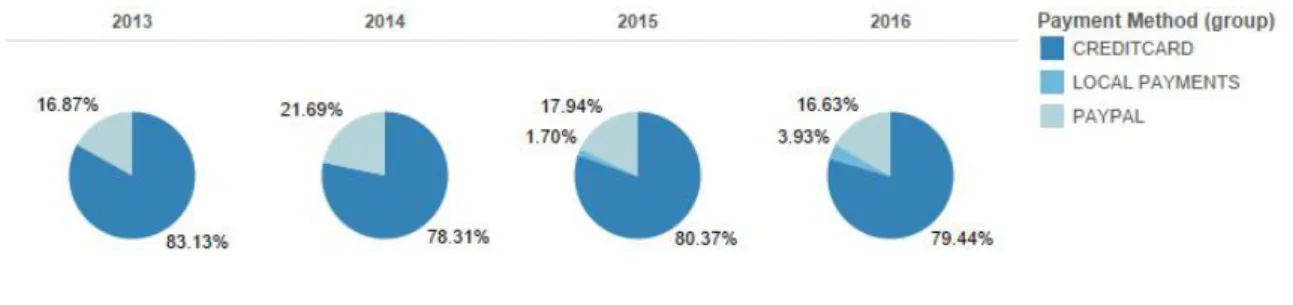
The credit card payment method is the most common payment method used at Farfetch, repre-senting almost 80% of all transactions made in the last 4 years without any significant decreasing trend, even with the new local payments introduced more recently. This method is globally used because it groups, in the same integrated system, countless financial institutions and card networks providing a comfortable payment method to any user. The payment methods evolution in the last 4 years can be checked in Figure3.2.
From the customer perspective, this payment method is triggered as soon as the customer chooses this option in the portal payment page (when making the checkout) and introduces the card details: card number, cardholder name and security code. When the customer tries to conclude the transaction, he only sees two final results: Success or Failure.
Current Workflow Structure
Figure 3.2: Weight of the different Payment Methods in Farfetch in the last years
On the other hand, in the background processes, in a time frame of a few seconds, many enti-ties are involved, even more messages are transmitted, authentication and fraud verification need to happen and bureaucracy is always present. It is then relevant to explore how Farfetch has built its credit card payment system.
3.1.1.2 Paypal
Paypal is the second payment method mostly used in Farfetch purchases. This method differs from credit cards by working itself as a Third Party Payment Processor. This method allows the Customer to directly transfer electronic funds to the vendor, from a Paypal account, operating as an intermediate between Merchant and Customer, in the exchange of a fee. It is a global business that is present in most of the countries and is recognized as one of the most reliable payment methods.
In Farfetch, Paypal has revealed to be an important strategic asset representing a value close to 17% of all transactions and representing a group of Customers who still do not rely on the credit card system and looks for another reliable and quick method of making online payments. As most of the times the Customer has his own account where the funds are managed by him it becomes more appealing to this certain group. One of the most relevant features in Farfetch is the possibility for the Customer paying with Paypal to save his details in the system in such a way that allow the next payment to be quicker. It is called the billing agreement.
3.1.1.3 Local Payments
Local Payments are payment methods only available in particular countries. Mostly these meth-ods were developed based on the singularities of each market and some of them reached to high levels of popularity and started to compete strongly with the other payment methods. Therefore it became important to provide these methods to the countries in the respective countries. A brief description of each one it is given in AppendixA.
Current Workflow Structure
3.1.2 Payment System Architecture
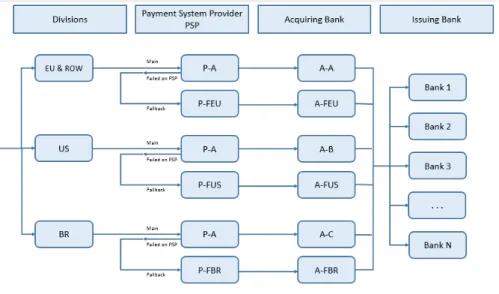
Farfetch credit card payment system has suffered several mutations since the company was created a few years ago. Currently, the existing model includes 4 major entities: The Merchant (Farfetch), the main Payment System Provider, the Merchant’s Acquirer and all the issuing banks representing the final Customer.
The system is not universal. Some variations were introduced to improve efficiency and to remove recurrent problems that the company was facing in some markets. Thus the system was divided in three main divisions: United States, Europe and Rest of the World (includes Asia) and Brazil. This division is made based on the shipping country of an order, i.e., accordingly to the country where the order will be delivered. Each division process will be described shortly.
3.1.2.1 Europe and Rest of the World (EU & ROW
From the three divisions this is the one that has the widest geographic coverage, being the most common process.
It is the simplest process because the main PSP P-A has an integrated solution for payment processing and works also as an Acquirer (A-A). Therefore despite having two different institu-tions as Provider and Acquirer, the same institution delivers both tasks. This solution reduces communication problems and removes the bureaucracy and inefficiency between the process ele-ments.
Regarding the process itself. As Provider A is an integrated solution it works also as gateway for the payment, sending it automatically to the Processor. From this moment on, the Acquirer (Payment Processor in this case) is responsible to interact with the Issuer (the customer bank) in order to proceed with the Customer details verification. The last step is to inform if the information given checks and the transaction could be accepted.
3.1.2.2 United States
Payment processes can reveal themselves to be very bureaucratic. The American Banking market is a very selective and singular one. The system is composed by their own rules that most of the times are quite different from the rest of the world. In many cases this results in incompatibilities hard to overcome when it comes to accepting a transaction.
The US market is currently the biggest and most important market for the company, represent-ing circa 30% of sales volume. Due to this incontestable importance and for the reasons stated before the system was built to include the US division.
The most relevant difference from the first model is the introduction of an American Acquirer. Maintaining the same Provider (P-A), there are now two separate entities as Provider and Acquirer. Having an American Acquirer fully established and in accordance with the specific market rules it became easier to communicate with Issuers and for them to provide a higher rate of transactions authorisation. For this model the Acquirer chosen was A-B.
Current Workflow Structure
3.1.2.3 Brazil
Brazil is even a more specific and complex market than the United States. The way payment systems work in this country is particularly different and it has some very characteristic rules that many times prevent from doing business with Brazilian Customers.
Another singularity is the allowance of paying with installments. Installments are multi-staged payments that permit Customer not to pay the full amount at once. This is a very common proce-dure in Brazil but not accepted worldwide.
In order to be able to explore this market’s potential, a third payment system division was created for Brazil. This system is adapted to the requirements allowing installments. Its structure is quite similar to the United States having the same main Provider (P-A) but a different Brazilian Acquirer already used to lead with installments and other market issues. More recently, with the final objective of a better integration with the Provider, the Acquirer A-OBR was changed to A-C.
3.1.2.4 Fallback
The common point linking these three structural divisions is the main provider: A. However, depending on only one provider for the whole structure carries some major risks. First of all, having one institution managing such huge amount of data could put the Merchant in a vulnerable position. Secondly, in case of system failure or any other kind of problem of the main Provider becomes impossible to process any payment transaction.
Therefore Farfetch decided to build a background Fallback model. The concept of this model is to use other providers and Acquirers to process transactions that did not go through the main system. Thereby the dependency on the main flow can be reduced and the ability to process the payment orders emerges strengthened.
Concerning this structure, there are three different options to the three divisions. For EU & ROW the PSP used is P-FEU together with A-FEU as Acquirer. For United States the model is the same with P-FUS as PSP and A-FUS as Acquirer. For Brazil the PSP is P-FBR and the Acquirer is A-FBR.
3.1.2.5 AMEX Parallel Flow
Within the existing card networks available (Visa, Mastercard, Discover,...) there is one special case that has structural implications in what concerns the payment workflow. This card network is American Express. Besides working as one of the main card networks, it is also a big finan-cial institution. As a finanfinan-cial institution, American Express (AMEX) can work as an integrated Acquirer-Issuer, working in a three party card scheme. Therefore, when card type is American Ex-press the process changes drastically: the initial role of the PSP keeps the same and what changes is that American Express manages the rest of the acquiring process by itself.
For these reasons, the AMEX workflow is considered as being in parallel and not connected directly to the general creditcard workflow presented in this project. This special case diverges in a great extension from the scope of the study and so it will be skipped during the rest of the
Current Workflow Structure
dissertation.
After a detailed description of the whole payment process structure, the schematic Figure3.3
summarizes all divisions synthetically.
Figure 3.3: Current payment workflow at Farfetch
3.1.3 Multilayer decision
One of the key aspects of the payment workflow is how to decide to which flow division must forward each transaction be forwarded. As before, the decision process is not simple and, in this case, it involves more than one layer decision.
3.1.3.1 Currency
The first and most important is the currency layer. Each Acquirer only processes a defined quantity of currencies. Currently, Farfetch allows customers to pay in 11 different currencies: GBP, USD, EUR, BRL, AUD, CAD, SGD, HKD, KRW, CHF, RUB. The currency is a static variable and automatically determined by the shipping details inserted by the customer (if the shipping indicates United States the currency must be USD. On the other hand, if the shipping country is France the currency paid must be EUR).
The Acquirer B, responsible for US market, only processes USD and the Brazilian one, C, only BRL. The Acquirer for the rest of the world, A, processes all the other currencies (including USD) with the respective conversion fees (rates, taxes). With these restrictions, the first layer already decides that each transaction in BRL goes though Brazilian division and each transaction in a currency different from USD has to go through the EU & ROW division. As for USD transactions, there is another decision step to determine which flow is most suitable.
Current Workflow Structure
3.1.3.2 Billing/Shipping
The second layer is the billing address. Billing address is the address that each customer introduces in order to verify the validity of card details. The problem is that clients can type anything they want which sometimes results in matching errors due to wrong inserted information. However, this was the most practical way to find the card origin country and to define the best payment flow.
The billing decision consisted in based on the card country information, introduced by the customer, choosing the most suitable division. As only USD transactions were subjected to this second decision step, all transactions from American cards would go to the US division while the others would go to the EU & RoW division.
Nevertheless, the appearance of the local payments required a remodeling of this layer. The local payments can only be shown as options for the available countries. So, for countries like China, Germany or Netherlands, as soon as shipping details are introduced, payment options are filtered for the available payment methods. Therefore the system was changed in this layer to attend only to the shipping country.
In terms of process decision it remains exactly the same, only changing the criterion from directing the transaction through the bank country criterion (billing) to forwarding it through the shipping country. The consequences of this criterion is that in cases that the shipping country differs from the acquiring bank country (characteristic of the flow) it decreases the efficiency of the flow and it has impacts on the transactions success as will be demonstrated in the next chapter.
The described multilayer decision system is presented in Figure3.4.
Figure 3.4: Multilayer payment workflow decision system
For evaluating the payment system behaviour and its performance in the company results, it is crucial to have very clear and pertinent metrics. Farfetch assigns the highest significance to the metric Authorisation rate, being the most monitored metric in the area.
Current Workflow Structure
3.1.4 Payment Authorisation
Every payment attempt is accepted or rejected. This information must be given as a response from the provider where the transaction was previously directed. Besides this essential information, it is also given the standardized reason why the transaction essentially failed. In the scope of this project, this is the most relevant information because the amount of transactions accepted or rejected end up to be the key variables.
Thereby for evaluating the payment system behaviour and its performance in the company results, it is crucial to have very clear and pertinent metric about authorisation performance. This metric is Authorisation Rate (AR) and roughly indicates the percentage of transactions which have been successfully approved by the system. It is calculated by dividing the number of successes by the number of attempts.
However every attempt can be rejected based on several reasons. There are around 300 dif-ferent reasons that could trace the root cause to many difdif-ferent sources. The closest the relation between the Merchant and the Provider and the highest the degree of integration between the en-tities, the more details are given in the responses. These responses are fundamental to understand why did the transaction failed and who is the main responsible for it: the Customer, the Merchant or the Issuer/Acquirer.
The most common reasons come from Issuer Banks that simply do not allow the transaction to be successful. But for the other cases many fail only because the customers commit errors typing information, have problems with the card validity or have lack of funds. Other reasons could be related with fraud suspicions from the system, which have a considerable weight, or even Merchant giving wrong information in transaction details or simply system errors.
For assessing where are the major flaws and the elements to improve in the established pay-ment systems it is necessary to filter the real motives why the transaction is being rejected. In this case, the most important reasons and the ones that have relevant impact are directly linked with the issuer forbidding the payment.
Understanding the authorisation rate and its relevance for the payment system performance is fundamental but screening all the main refusal reasons and complement metrics with this informa-tion becomes the cornerstone of a correct analysis. So a new adapted and modified authorisainforma-tion rate metric is calculated in the company analysis. This is based on the same principle of calculating the ratio of authorised transactions but now excluding all transactions which are not directly linked to a Issuer refusal. The refusal reasons mapping and this metric construction is demonstrated in the next chapter.
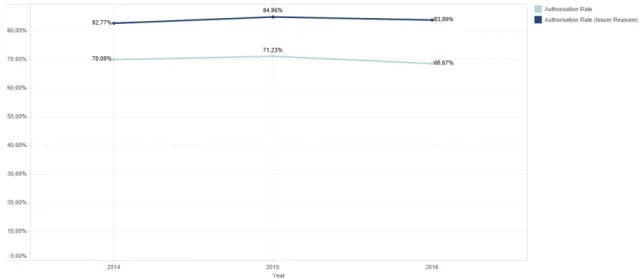
The authorisation rate evolution since the last years for credit card payments is given in the Figure3.5. The overall authorisation rate performance is 75% and with a stable trend during the years which is not sufficiently good. However attending to the metric calculated only with issuer reasons the numbers are higher , close to 85% but still with a good margin to improve. In the next chapter the method for studying these indicators will be presented to further understand the situation.
Current Workflow Structure
![Figure 2.1: Authorisation and Settlement - Payment Processing [Van der Valk, 2015]](https://thumb-eu.123doks.com/thumbv2/123dok_br/15939826.1096142/30.892.110.744.148.507/figure-authorisation-settlement-payment-processing-van-der-valk.webp)