Contents lists available atScienceDirect
Food Packaging and Shelf Life
journal homepage:www.elsevier.com/locate/fpslPreservation of phytosterol and PUFA during ready-to-eat lettuce shelf-life
in active bio-package
M. Llana-Ruíz-Cabello
a, M. Puerto
a, S. Pichardo
a, N.T. Jiménez-Morillo
b, J.M. Bermúdez
c,
S. Aucejo
c, A.M. Camean
a, J.A. González-Pérez
a,⁎aUniversidad de Sevilla, Profesor García González n°2, 41012, Seville, Spain bIRNAS-CSIC, MOSS Group, Av. Reina Mercedes, 10, 41012, Seville, Spain cITENE, c/ Albert Einstein 1, 46980, Paterna, Valencia, Spain
A R T I C L E I N F O Keywords: Lettuce Bioactive compounds PUFAs Analytical pyrolysis A B S T R A C T
Natural preservatives are used in food packages to improve the shelf life of perishable products. Carvacrol and thymol, the main components of oregano essential oil (OEO), are used in active packaging due to their anti-microbial and antioxidant properties. Here, the effect of a bioactive polylactic acid (PLA)/polybutylene succinate (PBS) package in the conservation of lettuce compounds with dietetic value is studied. Analytical pyrolysis (Py-GC/MS) was used to detect changes in dietary components such are phytosterols (PHSTs) and polyunsaturated fatty acids (PUFAs) after 1, 4 and 8 days of packaged in PLA/PBS (95:5%) films containing different OEO concentrations (2–10%). Lettuce PUFAs and PHSTs content decreased when packed in films without OEO. However, when packed in films containing 5 and 10% OEO, these bioactive components were preserved during the estimated lettuce shelf life, for up to 8 days of storage.
1. Introduction
The market of ready-to-eat leaf vegetables is rapidly growing at a global scale providing consumers with appealing products, rich in healthy and beneficial bioactive compounds. Among the most relevant nutritious components in leafy vegetables are phytosterols (Kim et al., 2015) and unsaturated/polyunsaturated fatty acids (Saini, Shang, Choi, Kim, & Keum, 2016). Lettuce is known to contain high quantities of dietary phytosterols (PHSTs) (Kaliora, Batzaki, Christe, & Kalogeropoulos, 2015) and of polyunsaturated fatty acids (PUFAs) (Saini, Shetty, & Giridhar, 2014).
Both, PHSTs and PUFAs are relevant bioactive components of ve-getables known to have positive effects on health when included in the diets. Plant sterols exhibit cholesterol-lowering properties and are able to protect against cardiovascular diseases (Moreau, Whitaker, & Hicks, 2002;Weststrate & Meijer, 1998). Dietary PUFAs like α-linolenic acid (ALA) have also many beneficial effects in the control of chronic dis-eases i.e. inhibition of synthesis of vasoaggressive low-density lipo-protein (LDL) and acceleration of its elimination, reduction of blood pressure, prevention of cardiovascular disease and cancer (Abedi & Sahari, 2014). This has led to the development of functional foods en-riched in such bioactive components like plant sterols and PUFAs
(Lagarda, García-Llantas, & Farré, 2006;Volker, Weng, & Quaggiotto, 2005).
There is also interest in providing the industry with effective means for food preservation and of its nutritious beneficial properties. New trends are focusing in the development of active packaging, which can interact with the product or its environment and then improve food preservation. In general, active packaging containing essential oils (EOs) are developed to improve the shelf life of food and to avoid the undesirable flavours caused by direct addition of these substances (Gutiérrez, Sánchez, Battle, & Nerín, 2009). In this sense, oregano es-sential oil (OEO) is being included in these new food packaging mate-rials due to its bioactive properties (Jouki, Mortazavi, Yazdi, & Koocheki, 2014; Wu et al., 2014) that are related to its content in bioactive monoterpenes, sesquiterpenes and phenolic compounds (Ortega-Nieblas et al., 2011) and because of their safety ( Llana-Ruiz-Cabello, Pichardo et al., 2015;Llana-Ruiz-Cabello et al., 2017).
Therefore, different films containing OEO has been found useful in reducing the microbial counts of several microorganisms in food stuffs i.e. cooked salmon (Tammineni, Ünlü, & Min, 2013), cheese (Otero et al., 2014), chicken breast (Fernández-Pan, Carrión-Granda, & Maté, 2014), rainbow trout (Jouki, Yazdi, Mortazavi, Koocheki, & Khazaei, 2014) and also in lettuce (Llana-Ruiz-Cabello, Pichardo, Bermúdez
https://doi.org/10.1016/j.fpsl.2019.100410
Received 20 July 2018; Received in revised form 30 July 2019; Accepted 26 September 2019
⁎Corresponding author.
E-mail address:[email protected](J.A. González-Pérez).
2214-2894/ © 2019 Elsevier Ltd. All rights reserved.
et al., 2016). Moreover, OEO and films incorporated with this EO have shown different antioxidant activities related with the retardation of lipid peroxidation through their potent radical scavenging activity de-rived from their composition in carvacrol and thymol (Maisanaba et al., 2017). In fact, in a previous work we found that carvacrol, thymol, and their mixture (10:1) at low concentrations exert protective role against induced oxidative stress on Caco-2 cell lines system model ( Llana-Ruiz-Cabello, Gutiérrez-Praena et al., 2015).
Therefore, different films containing OEO has been found useful in reducing the microbial counts of several microorganisms in food stuffs i.e. cooked salmon (Tammineni et al., 2013), cheese (Otero et al., 2014), chicken breast (Fernández-Pan et al., 2014), rainbow trout (Jouki, Yazdi et al., 2014) and also in lettuce (Llana-Ruiz-Cabello, Pichardo, Bermúdez et al., 2016). Moreover, OEO and films in-corporated with this EO have shown different antioxidant activities related with the retardation of lipid peroxidation through their potent radical scavenging activity derived from their composition in carvacrol and thymol (Maisanaba et al., 2017). In fact, in a previous work we found that carvacrol, thymol, and their mixture (10:1) at low con-centrations exert protective role against induced oxidative stress on Caco-2 cell lines system model (Llana-Ruiz-Cabello, Gutiérrez-Praena et al., 2015).
Such antimicrobial and antioxidant properties of additives in bio-plastics improve food preservation and consumer acceptance and this, desirably should include the preservation of the nutritional profile of the packed food. As far as we know there is no information available regarding the benefits of food packaged in active films in relation with the conservation of specific compounds with dietetic value i.e. PHSTs and PUFAs.
Such antimicrobial and antioxidant properties of additives in bio-plastics improve food preservation and consumer acceptance and this, desirably should include the preservation of the nutritional profile of the packed food. As far as we know there is no information available regarding the benefits of food packaged in active films in relation with the conservation of specific compounds with dietetic value i.e. PHSTs and PUFAs.
Analytical pyrolysis is a tool providing a direct fingerprinting and precise information about composition, quality and additives in foods and packages. The products of pyrolysis are amenable to chromato-graphic separation and when combined with a mass spectrometry de-tector (Py-GC–MS), yields molecular information about the structure of complex mixtures of natural and synthetic macromolecular substances (González-Pérez et al., 2007; González-Pérez, Jiménez-Morillo, de la Rosa, Almendros, & González-Vila, 2015). Other well-known ad-vantages of the technique are the requirement of small sample sizes and little or no sample preparation. This technique has been used with success to detect EOs added to synthetic and bio-based polymers ( Llana-Ruiz-Cabello, Pichardo, Jiménez-Morillo et al., 2016). Major plant lipid components such are sterols and fatty acids are also easily detected by direct analytical pyrolysis (Py-GC/MS) of biomass (González-Vila, Tinoco, Almendros, & Martín, 2001, 2009; Schnitzer, McArthur, Schulten, Kozak, & Huang, 2006).
Analytical pyrolysis is a tool providing a direct fingerprinting and precise information about composition, quality and additives in foods and packages. The products of pyrolysis are amenable to chromato-graphic separation and when combined with a mass spectrometry de-tector (Py-GC–MS), yields molecular information about the structure of complex mixtures of natural and synthetic macromolecular substances (González-Pérez et al., 2007,2015). Other well-known advantages of the technique are the requirement of small sample sizes and little or no sample preparation. This technique has been used with success to detect EOs added to synthetic and bio-based polymers (Llana-Ruiz-Cabello, Pichardo, Jiménez-Morillo et al., 2016). Major plant lipid components such are sterols and fatty acids are also easily detected by direct ana-lytical pyrolysis (Py-GC/MS) of biomass (González-Vila et al., 2001, 2009;Schnitzer et al., 2006).
In previous works, a polylactic acid (PLA) & polybutylene succinate (PBS) (95:5) film containing OEO was developed (Llana-Ruiz-Cabello, Pichardo, Bermúdez et al., 2016), its antioxidant properties evaluated (Llana-Ruiz-Cabello, Gutiérrez-Praena et al., 2015) and the ability of this material to reduce microbial counts of yeasts and molds in ready-to-eat salad was confirmed (Llana-Ruiz-Cabello, Pichardo, Bermúdez et al., 2016).
In previous works, a polylactic acid (PLA) & polybutylene succinate (PBS) (95:5) film containing OEO was developed (Llana-Ruiz-Cabello, Pichardo, Bermúdez et al., 2016), its antioxidant properties evaluated (Llana-Ruiz-Cabello, Gutiérrez-Praena et al., 2015) and the ability of this material to reduce microbial counts of yeasts and molds in ready-to-eat salad was confirmed (Llana-Ruiz-Cabello, Pichardo, Bermúdez et al., 2016).
In this work we use a detailed Py-GC/MS analysis performed to detect changes in food composition of the relevant dietetic compounds mono, di and polyunsaturated fatty acids (PUFAs) and PHSTs, in ice-berg lettuce (Lactuca sativa) after 1, 4 and 8 days packaged in PLA/PBS (95:5) films containing different quantities of OEO (0, 2, 5 and 10%). The concentrations of OEO were selected according to Llana-Ruiz-Cabello, Pichardo, Bermúdez et al. (2016).
In this work we use a detailed Py-GC/MS analysis performed to detect changes in food composition of the relevant dietetic compounds mono, di and polyunsaturated fatty acids (PUFAs) and PHSTs, in ice-berg lettuce (Lactuca sativa) after 1, 4 and 8 days packaged in PLA/PBS (95:5) films containing different quantities of OEO (0, 2, 5 and 10%). The concentrations of OEO were selected according to Llana-Ruiz-Cabello, Pichardo, Bermúdez et al. (2016).
2. Materials and methods 2.1. Bio-polymer and additives
Plastic films were made of a mixture of polylactic acid (PLA) with polybutylene succinate (PBS) (950 g kg−1:50 g kg−1) and extruded
with variable quantities of oregano essential oil (EO). The EO was ob-tained from El Jarpil® (Almería, Spain), PLA (2003D extr. grade) was purchased from Nature Works LLC (Minnetonka, MN, USA) and PBS (GS PlaTM FD92WD) from Mitshubishi Chemical Corporation (Tokyo, Japan). Chemicals for the different assays were purchased from Sigma-Aldrich (Spain) and VWR International Eurolab (Spain).
Plastic films were made of a mixture of polylactic acid (PLA) with polybutylene succinate (PBS) (950 g kg−1:50 g kg−1) and extruded
with variable quantities of oregano essential oil (EO). The EO was ob-tained from El Jarpil® (Almería, Spain), PLA (2003D extr. grade) was purchased from Nature Works LLC (Minnetonka, MN, USA) and PBS (GS PlaTM FD92WD) from Mitshubishi Chemical Corporation (Tokyo, Japan). Chemicals for the different assays were purchased from Sigma-Aldrich (Spain) and VWR International Eurolab (Spain).
The active PLA films were obtained by melt blending in a twin-screw extruder (DSE 20-40D; Brabender, Duisburg, Germany). Different concentrations (0, 2, 5 and 10% w/w) of OEO and were fed into the barrel at L/D 10. Barrel temperatures were set at 200–205 °C working at a screw speed of 70 min−1. Final average thickness of the final films
was 80 μm (315 Gauge).
The active PLA films were obtained by melt blending in a twin-screw extruder (DSE 20-40D; Brabender, Duisburg, Germany). Different concentrations (0, 2, 5 and 10% w/w) of OEO and were fed into the barrel at L/D 10. Barrel temperatures were set at 200–205 °C working at a screw speed of 70 min−1. Final average thickness of the final films
was 80 μm (315 Gauge). 2.2. Packaging and storage
Developed lettuce packages containing 5 g of iceberg salad packed in PLA films (0, 2, 5 and 10% w/w OEO) as explained in Section2.1.
were produced. Then, PLA bags were heat sealed with an initial mod-ified atmosphere composed by 10% O2, 10% CO2and 80% N2. Sample
bags of iceberg salad were stored at 4ºC for 8 days, simulating com-mercial conditions of production, transport and comcom-mercialisation.
Developed lettuce packages containing 5 g of iceberg salad packed in PLA films (0, 2, 5 and 10% w/w OEO) as explained in Section2.1. were produced. Then, PLA bags were heat sealed with an initial mod-ified atmosphere composed by 10% O2, 10% CO2and 80% N2. Sample
bags of iceberg salad were stored at 4ºC for 8 days, simulating com-mercial conditions of production, transport and comcom-mercialisation. 2.3. Analytical pyrolysis (Py-GC/MS)
Direct pyrolysis-gas chromatography–mass spectrometry (Py-GC/ MS) of samples was performed using a double-shot pyrolyzer (Frontier Laboratories, model 2020i, Fukushima, Japan) attached to a GC system (Agilent Technologies, Palo Alto, CA. USA, model 6890N), 1, 4 and 8 days after packaged. Samples (0.3-0.4 mg dry lettuce biomass) were
placed in crucible deactivated steel pyrolysis capsules and introduced into a preheated micro-furnace at (500 °C) for 1 min. The volatile pyrolysates were then directly injected into the GC/MS for analysis. The gas chromatograph was equipped with a low polar-fused silica (5%-phenyl-methylpolysiloxane) capillary column (Agilent J&W HP-5ms Ultra Inert, of 30 m × 250 μm × 0.25 μm film thickness. The oven temperature was held at 50 °C for 1 min and then increased to 100 °C at 30 °C min−1, from 100 °C to 300 °C at 10 °C min-1, and stabilized at 300
°C for 10 min with a total analysis time of 32 min. The carrier gas was He at a controlled flow of 1 mL min−1. The detector consisted of a mass
selective detector (Agilent 5973 Technologies, Palo Alto, CA. USA, model 5973N) and mass spectra were acquired at 70 eV ionizing en-ergy. Compound assignment was achieved by single-ion monitoring (SIM) for the major homologous series and by comparison with pub-lished data reported in the literature or stored in digital NIST 14 (Maryland, USA) and Wiley 7 (Weinheim, Germany) libraries.
Direct pyrolysis-gas chromatography–mass spectrometry (Py-GC/ MS) of samples was performed using a double-shot pyrolyzer (Frontier Fig. 1. Fresh lettuce fingerprinting (Py-GC/MS at 500 °C), with an indication of the relative contribution of the main compound families. Numbers on peaks corresponds to the major compounds identified and listed inTable 1. The insert units are in % of total chromatographic area.
Table 1
Lettuce Py-GC/MS (500 °C) fingerprinting. Major compounds identified with indication of the retention time (RT: retention time in minutes), relative abundance (RA: % total chromatographic area), abundance (Ab μg/mg lettuce biomass dry weight pyrolyzed) and type (probable biogenic origin).
Ref RT RA AB Compound Type Ref RT RA AB Compound Type
1 2.01 3.29 9.66 2,5-Dimethylfuran PS 23 8.49 1.44 4.24 2-Pentylcyclopentanone LIP
2 2.23 5.35 15.74 Cyclopentene, 1-methyl- PS 24 8.59 0.95 2.78 1H-Indole, 3-methyl- N
3 2.35 7.06 20.78 Toluene ARO 25 8.76 0.74 2.19 Vanillin LIG
4 2.47 2.88 8.48 Cyclopentane-1,2-diol PS 26 9.32 0.45 1.33 Phenol, 2-methoxy-5-(1-propenyl)-, (E)- LIG
5 2.71 7.38 21.71 1H-Pyrrole, 1-methyl- N 27 12.27 0.32 0.93 Cyclohexene, 1,5,5-trimethyl-6-acetylmethyl- LIP
6 3.31 2.82 8.28 2(5 H)-Furanone PS 28 12.41 0.51 1.49 Furfural phenylhydrazone N
7 3.39 3.82 11.22 2-Hydroxy-2-cyclopenten-1-one PS 29 14.81 3.81 11.20 n-Hexadecanoic acid FA
8 3.72 2.59 7.60 5 Methyl furfural PS 30 16.44 1.98 5.81 9,12-Octadecadienoic acid (Z,Z)- FA
9 3.85 4.40 12.94 Phenol ARO 31 16.50 1.79 5.26 9,12,15-Octadecatrienoic acid (Z,Z,Z)- FA
10 4.05 2.77 8.14 Benzofuran PS 32 16.67 0.53 1.56 n-Octedecanoic acid FA
11 4.34 4.98 14.64 2-Cyclopenten-1-one, 2-hydroxy-3-methyl- PS 33 17.85 0.31 0.93 Alk LIP
12 4.58 1.46 4.30 Phenol, 2-methyl- ARO 34 18.04 0.57 1.66 Alk LIP
12 4.80 2.39 7.03 Phenol, 4-methyl- ARO 35 19.42 1.86 5.46 Alk LIP
13 4.99 1.81 5.32 Phenol, 2-methoxy- LIG 36 20.96 1.09 3.21 Alk LIP
14 5.08 1.50 4.42 Ethanol, 2-butoxy- LIP 37 21.20 0.51 1.51 Tetracosanoic acid, methyl ester FAME
15 5.32 2.86 8.41 2-Cyclopenten-1-one, 3-ethyl-2-hydroxy- PS 38 22.38 1.08 3.17 Alk LIP
16 5.55 1.72 5.06 Benzyl nitrile N 39 22.60 0.38 1.13 Hexacosanoic acid, methyl ester FAME
17 6.22 2.40 7.07 5-Hydroxymethyldihydrofuran-2-one PS 40 23.06 0.23 0.66 Sitosterol acetate PHST
18 6.63 4.02 11.83 2-Furancarboxaldehyde, 5-(hydroxymethyl)- PS 41 23.68 1.06 3.11 Stigmasterol acetate PHST
19 6.76 1.07 3.15 Benzenepropanenitrile N 42 24.16 1.34 3.93 Stigmastan-3,5-diene PHST
20 7.46 3.96 11.66 Indole N 43 25.79 2.29 6.73 Stigmasterol PHST
21 7.66 2.03 5.96 2-Methoxy-4-vinylphenol LIG 44 26.46 2.84 8.34 Sitosterol PHST
22 8.18 1.38 4.05 3,5-Dihydroxytoluene ARO
Laboratories, model 2020i, Fukushima, Japan) attached to a GC system (Agilent Technologies, Palo Alto, CA. USA, model 6890N), 1, 4 and 8 days after packaged. Samples (0.3-0.4 mg dry lettuce biomass) were placed in crucible deactivated steel pyrolysis capsules and introduced into a preheated micro-furnace at (500 °C) for 1 min. The volatile pyrolysates were then directly injected into the GC/MS for analysis. The gas chromatograph was equipped with a low polar-fused silica (5%-phenyl-methylpolysiloxane) capillary column (Agilent J&W HP-5ms Ultra Inert, of 30 m × 250 μm × 0.25 μm film thickness. The oven temperature was held at 50 °C for 1 min and then increased to 100 °C at 30 °C min−1, from 100 °C to 300 °C at 10 °C min-1, and stabilized at 300
°C for 10 min with a total analysis time of 32 min. The carrier gas was He at a controlled flow of 1 mL min−1. The detector consisted of a mass
selective detector (Agilent 5973 Technologies, Palo Alto, CA. USA,
model 5973N) and mass spectra were acquired at 70 eV ionizing en-ergy. Compound assignment was achieved by single-ion monitoring (SIM) for the major homologous series and by comparison with pub-lished data reported in the literature or stored in digital NIST 14 (Maryland, USA) and Wiley 7 (Weinheim, Germany) libraries. 3. Results and discussion
3.1. Lettuce Py-GC/MS fingerprint
The analytical pyrolysis of lettuce produced typical biomass chro-matograms. A detailed pyrolysis fingerprint of lettuce is depicted in Fig. 1and the identified compounds inTable 1. A complete list of the pyrolysis results obtained for all samples can be found in Supl. Table 1.
Fig. 2. Chemical structure and mass spectra of the main compounds with dietetic value detected by direct analytical pyrolysis of lettuce (Py-GC/MS at 500 °C). The mass spectra correspond to those obtained in our instrument.
The first part of the chromatogram (min 2 to 14) is dominated by pyrolysis products from lignocellulose that represent c. 43% of the total chromatographic area and included products from the major poly-saccharide component (38%) i.e. furan [1,6,8,10,17,18] and cyclo-pentane [2,4,7,11,15] derivatives and methoxyphenols [13,21,25,26] from the polyphenolic lignin domain (5%). Most long chain lipids, mainly alkane/alkene doublets [33–36, 38] and fatty acids (FA) [29–32] are eluted in the central section of the chromatogram (min 14 to 23), with a major prominent peak of palmitic acid [29] (c. min 14.8) and an oleic complex cluster that include the polyunsaturated (PUFAs) linoleic [30] and linolenic [31] acids, the monounsaturated oleic [co-eluted] and saturated FA stearic [32] acids. The last section of the chromatogram (min 23 to 28) is dominated by triterpenes, plant sterols known as PHSTs. Other compounds identified in the pyrograms from iceberg lettuce included: aromatic structures of unknown origin (ARO), alkyl benzenes [3,22], phenol [9] and methyl phenols [12]; compounds with nitrogen (N) probably derived from the protein/polypeptide do-main, nitriles [16, 19], hydrazones [28] and the heterocyclic pyrroles [5] and indoles [20,24]. Also a small proportion (1%) of methylated FAs (FAME) were identified [37, 39] probably derived from the pyr-olysis of epicuticular waxes.
The analytical pyrolysis of lettuce produced typical biomass chro-matograms. A detailed pyrolysis fingerprint of lettuce is depicted in Fig. 1and the identified compounds inTable 1. A complete list of the pyrolysis results obtained for all samples can be found in Supl. Table 1. The first part of the chromatogram (min 2 to 14) is dominated by pyrolysis products from lignocellulose that represent c. 43% of the total chromatographic area and included products from the major poly-saccharide component (38%) i.e. furan [1,6,8,10,17,18] and cyclo-pentane [2,4,7,11,15] derivatives and methoxyphenols [13,21,25,26] from the polyphenolic lignin domain (5%). Most long chain lipids, mainly alkane/alkene doublets [33–36, 38] and fatty acids (FA) [29–32] are eluted in the central section of the chromatogram (min 14 to 23), with a major prominent peak of palmitic acid [29] (c. min 14.8) and an oleic complex cluster that include the polyunsaturated (PUFAs) linoleic [30] and linolenic [31] acids, the monounsaturated oleic
[co-eluted] and saturated FA stearic [32] acids. The last section of the chromatogram (min 23 to 28) is dominated by triterpenes, plant sterols known as PHSTs. Other compounds identified in the pyrograms from iceberg lettuce included: aromatic structures of unknown origin (ARO), alkyl benzenes [3,22], phenol [9] and methyl phenols [12]; compounds with nitrogen (N) probably derived from the protein/polypeptide do-main, nitriles [16, 19], hydrazones [28] and the heterocyclic pyrroles [5] and indoles [20,24]. Also a small proportion (1%) of methylated FAs (FAME) were identified [37, 39] probably derived from the pyr-olysis of epicuticular waxes.
Compounds with a particular dietetic interest found in the lettuce chromatograms were the bioactive PUFAs included in the oleic domain (c. min 16.5) that represented c. 4% of total chromatographic area and the PHSTs, eluted at the end of the chromatogram that represents c. 8% of total chromatographic area. The chemical structures of these com-pounds as well as their mass spectra are inFig. 2. The preservation of these compounds during the shelf life of the packed lettuce was con-sidered as the main target for this study.
Compounds with a particular dietetic interest found in the lettuce chromatograms were the bioactive PUFAs included in the oleic domain (c. min 16.5) that represented c. 4% of total chromatographic area and the PHSTs, eluted at the end of the chromatogram that represents c. 8% of total chromatographic area. The chemical structures of these com-pounds as well as their mass spectra are inFig. 2. The preservation of these compounds during the shelf life of the packed lettuce was con-sidered as the main target for this study.
3.2. Lettuce decay with time
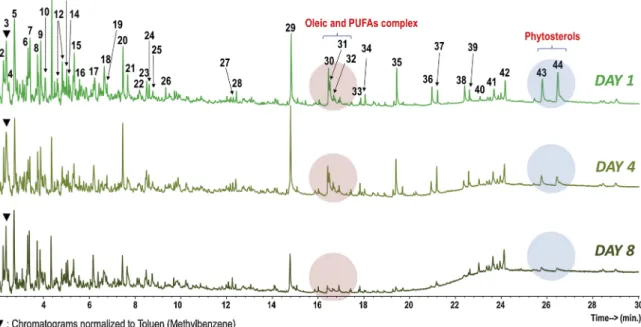
The evolution of lettuce pyrolysis fingerprint packed in PLA/PBS bioplastic without OEO is shown inFig. 3. A conspicuous disappearance of peaks of particular dietetic interest: oleic and PUFAs complex as well as of PHSTs, can be observed at a first sight in the chromatogram from days 4 and 8. This confirms that iceberg lettuce rapidly and progres-sively lost relevant dietetic compounds during conservation time when packed in our bioplastic (PLA/PBS) without any OAO additive.
Fig. 3. Evolution of lettuce fingerprinting (Py-GC/MS at 500 °C) with time (1, 4 and 8 days) packed in PLA/PBS bioplastic (95:5) film without OEO. Numbers on peaks corresponds to the major compounds identified and listed inTable 1.
The evolution of lettuce pyrolysis fingerprint packed in PLA/PBS bioplastic without OEO is shown inFig. 3. A conspicuous disappearance of peaks of particular dietetic interest: oleic and PUFAs complex as well as of PHSTs, can be observed at a first sight in the chromatogram from days 4 and 8. This confirms that iceberg lettuce rapidly and progres-sively lost relevant dietetic compounds during conservation time when packed in our bioplastic (PLA/PBS) without any OAO additive.
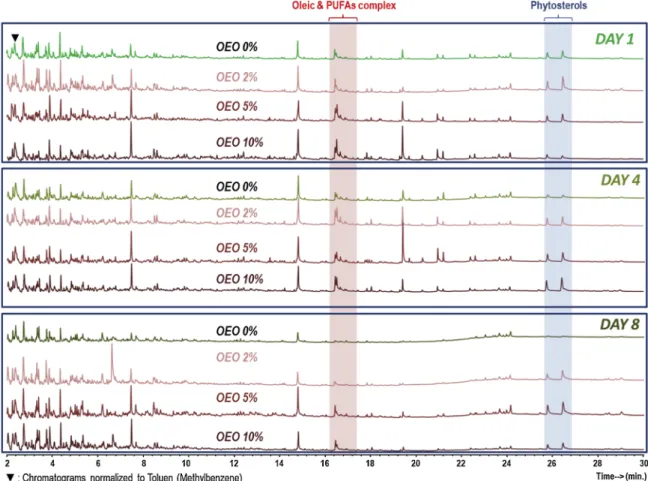
When analysing the evolution of the lettuce pyrogram fingerprint with time and packed in the PLA/PBS bioplastic without (OEO 0%) or with variable concentrations of the OEO additive (2, 5, 10%), the preservation of the peaks corresponding to compounds of particular dietetic interest is also evident (Fig. 4). In this regard, even when the lettuce is packed in bioplastic with the minimum OEO content (OEO 2%) the relative content of PHST is preserved along the storage time and when packaged in 5 and 10% OEO containing films, both PUFAs and PHST relative contents are preserved even after 8 days of storage. Comparing the abundance of the oleic complex (peaks 30–32) and of the major PHSTs (stigmasterol and sitosterol, peaks 43 and 44 re-spectively) allow us to compare the evolution of compounds with die-tetic interest with time and with the different concentrations of OEO added to the package bioplastic. The evolution of dietetic relevant compounds is shown inFig. 5A, B. Also, an attempt was made to detect possible degradation or cracking of long chain fatty acids with storage time. For this, we compared the chromatographic areas of the most abundant long chain FA (palmitic acid) with that of acetic acid. Acetic
acid is found in relative high abundance in biomass pyrolyates and is usually consider a degradation product of fatty acids (Fig. 5C).
Therefore, lettuce packaged in films with high concentrations of OEO (5% and 10%) maintained the values of oleic complex nutrients at levels similar to those observed for the first day of storage (Fig. 5A) that may be attributed to an effective antioxidant activity exerted by the additive in the film. In addition, values of PHSTs experimented an in-creased in lettuce packaged in films containing OEO (Fig. 5B), this may reflect the occurrence of a selective preservation of PHSTs with time. Although not conclusive, the results also point to a positive effect of OEO in films by diminishing long chain palmitic acid degradation to short chain acids (Fig. 5C).
4. Conclusions
Analytical pyrolysis was found useful in characterizing lettuce composition and particularly in tracing the evolution with time of dietetic relevant components like the bioactive PUFAs and PHSTs. Using this technique, we were able to evaluate the effect of an active film bio-package (PLA/PBS) containing variable quantities of OEO in the conservation of these specific dietetic compounds in packed food. The use of active bio-packages containing OEO, allowed appropriate preservation of both PHSTs and PUFAs relative contents during the shelf life (8 days) of the packed food.
Fig. 4. Evolution of lettuce fingerprinting (Py-GC/MS at 500 °C) with time (1, 4 and 8 days) packed in PLA/PBS bioplastic (95:5) film casted with variable con-centrations of OEO (0, 2, 5, 10% w/w).
Acknowledgements
Projects CSIC10-1E-448, AGL2012-38357-C02-01 and INTERCARBON (CGL2016-78937-R) co-financed by FEDER Funds, and AGR-7252 Junta de Andalucía. M. Llana-Ruiz-Cabello wish to ac-knowledge ‘Junta de Andalucía’ grant associated to AGR-7252 project. Alba Carmona Navarro and Desire Monis Carrere are recognized for their technical assistance.
Appendix A. Supplementary data
Supplementary material related to this article can be found, in the online version, at doi:https://doi.org/10.1016/j.fpsl.2019.100410.
References
Abedi, E., & Sahari, M. A. (2014). Long-chain polyunsaturated fatty acid sources and evaluation of their nutritional and functional properties. Food Science and Nutrition, 2, 443–463.
Fernández-Pan, I., Carrión-Granda, X., & Maté, J. I. (2014). Antimicrobial efficiency of edible coatings on the preservation of chicken breast fillets. Food Control, 36, 69–75. González-Pérez, J. A., Arbelo, C. D., González-Vila, F. J., Rodríguez Rodríguez, A.,
Almendros, G., Armas, C. M., et al. (2007). Molecular features of organic matter in diagnostic horizons from andosols as seen by analytical pyrolysis. Journal of
Analytical and Applied Pyrolysis, 80, 369–382.
González-Pérez, J. A., Jiménez-Morillo, N. T., de la Rosa, J. M., Almendros, G., & González-Vila, F. J. (2015). Pyrolysis-gas chromatography-isotope ratio mass spec-trometry of polyethylene. Journal of Chromatography A, 1388, 236–243. González-Vila, F. J., Tinoco, P., Almendros, G., & Martín, F. (2001). Pyrolysis-GC-MS
analysis of the formation and degradation stages of charred residues from lig-nocellulosic biomass. Journal of Agriculture and Food Chemistry, 49, 1128–1131. González-Vila, F. J., González-Pérez, J. A., Akdi, K., Gómis, M. D., Pérez-Barrera, F., &
Verdejo, T. (2009). Assessing the efficiency of urban waste biocomposting by ana-lytical pyrolysis (Py–GC/MS). Bioresource Technology, 100, 1304–1309. Gutiérrez, L., Sánchez, C., Battle, R., & Nerín, C. (2009). New antimicrobial active
package for bakery products. Trends in Food Science and Tecnology, 20, 92–99. Jouki, M., Mortazavi, S. A., Yazdi, F. T., & Koocheki, A. (2014). Characterization of
an-tioxidant-antimicrobial quince seed mucilage films containing thyme essential oil.
Carbohydrate Polymers, 99, 537–546.
Jouki, M., Yazdi, F. T., Mortazavi, S. A., Koocheki, A., & Khazaei, N. (2014). Effect of quince seed mucilage edible films incorporated with oregano or thyme essential oil on shelf life extension of refrigerated rainbow trout fillets. International Journal of
Food Microbiology, 174, 88–97.
Kaliora, A. C., Batzaki, C., Christe, M. G., & Kalogeropoulos, N. (2015). Nutritional eva-luation and functional properties of traditional composite salad dishes. LWT-Food
Science and Technology, 62, 775–782.
Kim, T. J., Lee, K. B., Baek, S.-A., Choi, J., Ha, S.-H., Lim, S.-H., et al. (2015). Determination of lipophilic metabolites for species discrimination and quality as-sessment of nine leafy vegetables. Journal of the Korean Society for Applied Biological
Chemistry, 58, 909–918.
Lagarda, M. J., García-Llantas, G., & Farré, R. (2006). Analysis of phytosterols in foods.
Journal of Pharmaceutical and Biomedical Analysis, 41, 1486–1496.
Llana-Ruiz-Cabello, M., Maisanaba, S., Puerto, M., Pichardo, S., Jos, A., Moyano, R., et al. (2017). A subchromic 90-day oral toxicity study of Origanum vulgare essential oil in rats. Food and Chemical Toxicology, 101, 36–47.
Llana-Ruiz-Cabello, M., Gutiérrez-Praena, D., Puerto, M., Pichardo, S., Jos, A., & Cameán, A. M. (2015). In vitro pro-oxidant/antioxidant role of carvacrol, thymol and their mixture in the intestinal caco-2 cell line. Toxicology in Vitro, 29, 647–656. Llana-Ruiz-Cabello, M., Pichardo, S., Maisanaba, S., Puerto, M., Prieto, A. I.,
Gutiérrez-Praena, D., et al. (2015). In vitro toxicological evaluation of essential oils and their main compounds used in active food packaging: A review. Food and Chemical
Toxicology, 81, 9–27.
Llana-Ruiz-Cabello, M., Pichardo, S., Bermúdez, J. M., Baños, A., Núñez, C., Guillamón, E., et al. (2016). Development of PLA films containing oregano essential oil (Origanum vulgare L. virens) intended for use in food packaging. Food Additives and
Contaminants: Part A, 33, 1374–1386.
Llana-Ruiz-Cabello, M., Pichardo, S., Jiménez-Morillo, N. T., Bermúdez, J. M., Aucejo, S., González-Vila, F. J., et al. (2016). Molecular characterisation of a bio-based active packaging containing Origanum vulgare L. essential oil using pyrolysis gas chroma-tography-mass spectrometry. Journal of the Science of Food and Agriculture, 96, 3207–3212.
Maisanaba, S., Llana-Ruiz-Cabello, M., Gutiérrez-Praena, D., Pichardo, S., Puerto, M., Prieto, A. I., et al. (2017). New advances in active packaging incorporated with es-sential oils or their main components for food preservation. Food Reviews
International, 33, 447–515.
Moreau, R. A., Whitaker, B. D., & Hicks, K. B. (2002). Phytosterols, phytostanols, and their conjugates in foods: Structural diversity, quantitative analysis, and health-promoting uses. Progress in Lipid Research, 41, 457–500.
Ortega-Nieblas, M. M., Robles-Burgueño, M. R., Acedo-Félix, E., González-León, A., Morales-Trejo, A., & Vázquez-Moreno, M. L. (2011). Chemical composition and an-timicrobial activity of oregano (Lippia palmeri S. Wats) essential oil. Revista Fitotecnia
Mexicana, 34, 11–17.
Otero, V., Becerril, R., Santos, J. A., Rodríguez-Calleja, J. M., Nerín, C., & García-López, M.-L. (2014). Evaluation of two antimicrobial packaging films against Escherichia coli O157: H7strains in vitro and during storage of Spanish ripened sheep cheese (Zamorano). Food Control, 42, 296–302.
Saini, R. K., Shetty, N. P., & Giridhar, P. (2014). GC-FID/MS analysis of fatty acids in Indian cultivars of Moringa oleifera: Potential sources of PUFA. Journal of the American
Oil Chemists’ Society, 91, 1029–1034.
Saini, R. K., Shang, X. M., Choi, J. H., Kim, D., & Keum, Y.-S. (2016). Characterization of nutritionally important phytoconstituents in minimally processed ready-to-eat baby-leaf vegetables using HPLC–DAD and GC–MS. Journal of Food Measurement and
Characterization, 2, 341–349.
Schnitzer, M., McArthur, D. F. E., Schulten, H.-R., Kozak, L. M., & Huang, P. M. (2006). Fig. 5. (A) and (B); evolution of the abundance (μg/mg lettuce biomass dry
weight) of the main compounds with dietetic value and (C); evolution of the relative abundance of palmitic acid vs acetic acid (% chromatographic area) in lettuce with conservation time (1, 4 and 8 days) packed in PLA/PBS (95:5) film containing OEO (0, 2, 5 and 10% w/w).
Long-term cultivation effects on the quantity and quality of organic matter in selected Canadian prairie soils. Geoderma, 130, 141–156.
Tammineni, N., Ünlü, G., & Min, S. C. (2013). Development of antimicrobial potato peel waste-based edible films with oregano essential oil to inhibit Listeria monocytogenes on cold-smoked salmon. International Journal of Food Science & Technology, 48, 211–214.
Volker, D. H., Weng, X., & Quaggiotto, P. (2005). Bioavailability of long-chain omega-3 polyunsaturated fatty acid enriched luncheon meats. Nutrition & Dietetics, 62, 130–137.
Weststrate, J. A., & Meijer, G. W. (1998). Plant sterol-enriched margarines and reduction of plasma total- and LDL-cholesterol concentrations in normocholesterolaemic and mildly hypercholesterolaemic subjects. European Journal of Clinical Nutrition, 52, 334–343.
Wu, J., Ge, S., Liu, H., Wang, S., Chen, S., Wang, J., et al. (2014). Properties and anti-microbial activity of silver carp (Hypophthalmichthys molitrix) skin gelatin-chitosan films incorporated with oregano essential oil for fish preservation. Food Packaging and