Kinetic parameters estimation using the Paired Equivalent
Isothermal Exposures
(PETE)
method under non-isothermal
heating conditions
VIEIRA, M.M.C., Silva; C.L.M.*, Teixeira, A.A., Escola Superior de Biotecnologia do Porto. Universidade CatOlica Portuguesa, Rua Antonio Bernardino de Almeida, 4200 Porto, Portugal.(*) email: [email protected]
Abstract
With the purpose of testing the recently developed Paired Equivalent Isothermal Exposures (PETE) method, to determine reaction kinetic parameters under non-isothermal conditions, continuous pasteurizations were carried out with a nectar of a tropical fruit [25% of Cupuacu (Theobroma grandiflorum) pulp and 15% of sugar] in order to estimate the ascorbic acid thermal degradation kinetic parameters.
The experimental ascorbic acid thermal degradation activation energy (96±13kJ/mol) estimated by the PETE, compared well with the previously determined value (74±5kJ/mol) for the same product under isothermal conditions. The PETE method is a reliable, easy and faster method to estimate first order reactions activation energy.
Introduction
To date the design of food thermal processes assumes conservative safety factors which, although reliable, are not satisfactory for nowadays consumer quality requirements. Therefore, the reduction of microbial loads to a safety level (pasteurization or commercial sterilization) while avoiding major changes in the product's quality attributes became one of the most important food research fields. Knowledge of both quality attributes thermal kinetic parameters and reaction model in a food product allows prediction of concentration reductions for a particular heating process and therefore the optimization of its thermal process conditions. To experimentally determine thermal kinetic parameters both isothermal and non-isothermal approaches have been used. Isothermal approaches although not realistic are useful to determine reactions models (Silva, 1993).
The Equivalent Point Method (EPM)
Many questions were raised when the Equivalent Point Method, EPM, (Swartzel, 1982) was developed. This non-isothermal method considers that a dynamic heating process can be defined by an equivalent isothermal process, i.e. an equivalent time, tE, and corresponding equivalent temperature, TE, the Equivalent Point (EP). The EP was
claimed to be independent of the activation energy (Ea) value. A 'G value' concept was
introduced, similar to the Fo value, but restricted to be used when the kinetic characteristics of the quality attribute are known.
t — G= ex Ea jai 0 p R T(t) where: (1)
G Thermal reduction relationship To) - Time temperature history Ea - Activation energy
t- time (min)
R- Universal gas constant (8.14 J/mol)
If Ea is assumed and T(t) is known then the G can be calculated. G can also be expressed by: G = tE.exp RE.Ta E) Il Or, In = InG+ Ea R.TE
It was postulated that an infinite number of straight lines (each representing all possible combinations of temperature T and time t causing a given concentration change in the quality attribute) could be generated depending on the Ea assumed. However, there were cases where not all lines would intersept in the same point. Swartzel (1984), considered the cause to be the inherent experimental and calculation errors. Different numerical methods were later tried, (Nunes and Swartzel, 1990) but only with Non Linear Least Square Regression (NLSR) or Weighted Least Squares Linear Regression (WLSR), a high level of accuracy was reached throughout the range of Ea values, being the WLSR referred as a simpler method to be used. Due to the limitations of microcomputers, (Nunes and Swartze1,1993), a finite reference temperature was also introduced in the method ,
GTref =iexPR Es)1 R )T Tref1 11dt (4)
There have been several attempts to validate the method for non isothermal heat processes. Maesmans et al (1995), concluded that when the heating pattern deviated from isothermal conditions the degradation kinetics of a quality parameter estimated by this method would start differing from the calculated values using the temperature profile.
Iterative method for kinetic parameter estimation from dynamic thermal treatments
Recently another method was developed to estimate thermal kinetic parameters of reactants in non-uniform heating processes, the Paired Equivalent Isothermal Exposures (PEW) The PETE method is an iterative method that estimates kinetic parameters from at least one pair of dynamic thermal treatments (Welt et al, 1997a). For two thermal treatments with respective extents of reaction determined, two Ea values are assumed, Eau and Eci 12=2xEci 1 1 . The G1 and G2 values arel then calculated and the EIE (TE,tE) will be determined as explained above. Next, the respective
isothermal rate constants kE/ and kE2 are determined. From an Arrhenius plot lnkE vs 1/TE a new Eau is obtained and a kraf. The point where two lines intersect is called the Equivalent Isothermal Exposure (EIE)(Welt et al, 1997a).
For the second iteration the new Ea 21 and Ea22F-2xEau are used. Thus for each pair of thermal exposures an Arrhenius plot and a set of dynamic parameters can be obtained. For n thermal exposures, n(n-1)12 pairs can be obtained
Validation of the method Paired Equivalent Isothermal Exposures (PETE)
This method was theoretically validated with three different non-isothermal processes where experimental uncertainty was simulated in the final concentration data, (Welt et al, 1997a). Recently the method was validated for conduction heating foods under non-uniform heating (pea puree inoculated with Bacillus stearotermophilus spores), (Welt et al, 1997b). Fourteen experiments were used which would give in theory 91 experimental pairs, however, they reported that only thermal exposures that yielded significantly different equivalent temperatures could be used and therefore only some pairs were allowed which accounted for 34 data points. The method has not been yet validated for continuous non-isothermal processes.
The objective of this study was to test the Paired Equivalent Isothermal Exposures (PETE) method to determine the thermal degradation reaction kinetic parameters of a quality attribute on a fluid under continuous thermal heating in the pasteurization temperature range.
Materials and methods
Cupuacu nectar preparation
Cupuacu pulp was imported frozen from Belem, Brazil, and stored at -20±2°C Right before the experiments it was taken out of the freezer and cut into small chunks. Refined sugar plus deionized water were then added to the pulp in order to obtain a nectar with 25% pulp and 15% sugar. The mixture was homogenized with a Moulinex Turbomix 2 blender during 5 minutes and passed through a plastic screen. Brix and pH were measured with an Atago hand refractometer and a Crison micropH meter 2001, respectively.
Non isothermal heating studies (pasteurization of a cupuacu nectar)
Two studies were carried out for the validation of the method using the Cupuacu nectar. In the first study the values of thermal degradation were predicted from the time temperature history experimentally obtained and using the kinetic parameters (Ea and kref ) previously determined under isothermal conditions and in the second study the quality parameter (ascorbic acid) was experimentally evaluated
The tests were conducted under non-uniform heating conditions. A plate heat exchanger and a holding tube have been used (Armfield Pasteurizer FT-43A). In order to obtain the time-temperature histories the temperature was monitored by inserting TCT thermocouples between the plates where the fluid passed and at the entrance and exit of each holding and cooling tube. The data was recorded by a data acquisition system, Delta Logger. Based on the plates' holding and cooling tubes dimensions the
residence times were calculated. For each experiment the degradation of ascorbic acid content was evaluated by an HPLC method (Zapata and Dufour, 1992). The pasteuriser allowed only mild heat treatments therefore to obtain more severe processes the heating section was increased by adding plates (that originally belonged to the regeneration section) and adding two new holding tubes. Also heating pulses were used (i.e. heating once and then cooling the nectar down to 4°C then heating again and cooling down again).
Computer Programs
In order to analyze the data obtained three FORTRAN programs were developed. `Gcalculo' calculates the G values from experimental heating profile (equation 4). `Cdegrad' is used to calculate (equation 5) the ascorbic acid (AA) degradation that would be obtained if the kinetic parameters previously obtained by an isothermal method would apply, by using the equation 5, (Ea=74±5kJ/mole, k800c=0.032±0 03min-1), (Vieira et al, 1998).
, G, — = e ref re.
Co (5)
where :
C- concentration
Co- initial concentration
The program `Kinprm' was finally used to apply the PETE method step by step:
1-Select arbritarily two activation energy values (Eau and Eau) (in this study Eal2=60kJ/mol).
2-Calculate Gvalue for each thermal profile and for each Ea value. 3-Determine the EIE (TE, tE) for each dynamic heating pair.
Calculate the isothermal rate constants and the corresponding thermal degradation. Calculate the new Ea values for each thermal process pair.
6- Replace the originally selected Ea's with the obtained ones and repeat the whole procedure until the Ea's values match.
100 90 80 70 60 50 a 1. 40 30 i- 20 10 0 5 10 15 20 time (min)
Results and Discussion
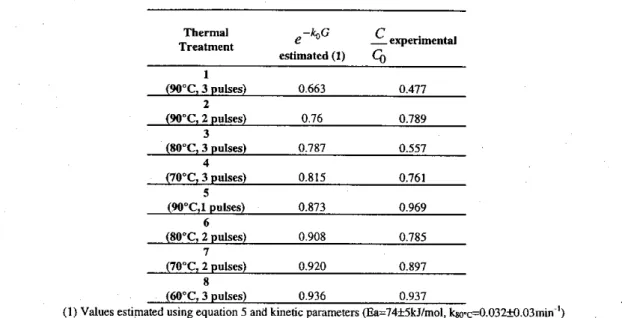
A set of 8 experiments, as described in table 1, were carried out. Figure 1 presents the temperature as a function of time for experiments 1 to 4 in table 1. With this set of experiments (8 heating processes) the kinetic parameters could be determined. However, some discrepancy from the values obtained by the isothermal method was observed.
Table 1- Experimental and estimated final retentions for ascorbic acid in Cupuacu nectar
Thermal Treatment e —4G estimated (1) _ experimental CO 1 (90°C, 3 pulses) 0.663 0.477 2 (90°C, 2 pulses) 0.76 0.789 3 (80°C, 3 pulses) 0.787 0.557 4 (70°C, 3 pulses) 0.815 0.761 5 (90°C,I pulses) 0.873 0.969 6 (80°C, 2 pulses) 0.908 0.785 7 (70°C, 2 pulses) 0.920 0.897 8 (60°C, 3 pulses) 0.936 0.937
(1) Values estimated using equation 5 and kinetic parameters (Ea=74±5k3/mol, Icso•c=0.032±0.03min-1) previously determined for isothermal experiments.
With the exception of processes 2 and 5, the experimental degradation seems to be higher than the predicted values. These results gave rise to a higher activation energy. A systematic experimental error, the estimation of the residence times corresponding to each temperature, might have occurred. Although 8 experiments were ran which would give 28 combinations and therefore 56 data points in the PEIE method, only 12 combinations could be taken into account and therefore only 24 data points were used in the experimental study. To run the program kinprm and avoid negative or too high Ea values the dynamic thermal processes had to be oriented from high to low thermal impact (i.e. descending order in G values). However in the experimental study in processes number 2 and 5 the percentages of ascorbic acid degradation were not in agreement with the other results and that caused the loss of several combinations. Figure 2 presents the Arrhenius plot of the PEIE method using predicted concentrations from previously determined kinetic parameters. A good linear fit to the points was obtained and the calculated activation energy is in agreement with the value initially assumed. On the other hand, the POE method was able to calculate the activation energy, (96±13kJ/mol), from experimental concentration data, with less accuracy (Figure 3 and 4).
One of the advantages of the PETE method is to determine kinetic data in an easy and faster way, saving laboratory time and reagents. However, it seems that the number of experiments ran in this study were not enough to tell if the tendency observed to obtain higher degradation of ascorbic acid was due to the fact that the system was dynamic.
References
Maesmans, G. Hendrickx M., De Cord, A. and Tobback P.(1995). Theoretical consideration of the general validity of the equivalent point method in thermal process evaluation. J. of Food Eng.; 24(2) 225-248, 41 ref.
Nunes, R.V. and Swartzel K. R.,(1990) Modeling thermal processes using the equivalent point method. J. Food Eng. 11 ,103- 107.
Nunes, R.V., Swartzel, K.R. and 011is D.F., (1993).Thermal evaluation of food processes: the role of a reference temperature J Food Eng. 20 (1) 1-15, 29 ref.. Silva, C. Optimization of Sterilized Conduction Heated Foods: A Generalized
Approach. Ph.D. thesis, Escola Superior de Biotecnologia Porto, 1993
Swartzel,K.R., (1984). A continuous flow procedure for reaction kinetic data generation. J. Food Sci. 49:803.
Welt, B.A., Teixeira, A.A., Balaban, M.O., Semerage, G.H., and Sage D.S.1997a. Iterative method for kinetic parameter estimation from dynamic thermal treatments. J. Food Sci. 62(1) 8-14.
Welt, BA., Teixeira, A.A., Balaban, M.O., Semerage, G.H., Hintinlang, and Smittle,B.J.,1997b. Kinetic parameter estimation in conduction heating foods subjected to dynamic thermal treatments.J.Food Sci. 62(3) 529-534.
Vieira, M. C., Teixeira A.A. and Silva, C.L.M. 1998. Mathematical Modeling of the thermal degradation kinetics of total vitamin C in Cupuacu
(Theobroma
grandiflorum)
nectar. Part 1 -ascorbic acid. Submitted to J.Food Science.Zapata, S. and Dufour, J. (1992) Ascorbic, Dehydroascorbic and Isoascorbic Acid Simultaneous Determinations by Reverse Phase Ion Interaction HPLC. Journal of Food Science, Volume 57, No. 2 .