International Journal of Marketing, Communication and New Media. ISSN: 2182-9306. Vol 5 Nº 8, January/June 2017
84
Research Paper
Popularity and Activity in Social Networks: An analysis of their impact on chinese online series. Popularidade e atividade nas redes sociais: uma análise dos seus impactos nas séries online chinesas.
Danqing Wang * Juan A. García **
ABSTRACT
The interaction between social media and audiovisual products (series, films, TV programmes, etc.) is frequently analysed in marketing literature. However, no previous study has tackled this question in the case of China, one of the most active countries as regards social media of the type that includes blogs, microblogging networks, social networks, and online communities. This paper analyses the relationship between popularity (measured by the number of fans and the discussion index) and activity (measured by the number of tweets) in Weibo, a microblogging social network, and the number of online reproductions of nine Chinese series. The results obtained have allowed us to conclude that the number of fans and tweets are positively and significantly related to the number of online reproductions of only two series. The results obtained for the other series were either insignificant or contrary to those expected. However, the popularity measurement ‘discussion index in Weibo’ is largely correlated with the online reproductions as expected. These results have allowed us to offer some advice regarding the use of social networks as marketing tools for audiovisual products in China.
Keywords: Web 2.0; Social Network; Weibo; Online Series; China.
* Department of Business Administration, University of Castilla-La-Mancha, Spain. E-Mail: [email protected] ** Department of Business Administration, University of Castilla-La-Mancha, Spain. E-Mail: [email protected]
International Journal of Marketing, Communication and New Media. ISSN: 2182-9306. Vol 5 Nº 8, January/June 2017
85
RESUMO
A interação entre os social media e os produtos audiovisuais (séries, filmes, programas de TV, etc.) é frequentemente analisada na literatura de marketing. No entanto, nenhum estudo anterior abordou esta questão no caso da China, um dos países mais ativos em relação aos social media que incluem blogs, microblogs, redes sociais e comunidades online. Este artigo analisa a relação existente entre popularidade (medida pelo número de fãs e o índice de discussão) e atividade (medida pelo número de tweets) na Weibo, uma rede social de microblogs e o número de reproduções online de nove séries chinesas. Os resultados obtidos permitiram concluir que o número de fãs e tweets está relacionado de forma positiva e significativa com o número de reproduções em linha de apenas duas séries. Os resultados obtidos para as outras séries foram insignificantes ou contrários aos esperados. No entanto, o índice de discussão de medição da popularidade na Weibo está em grande parte correlacionado com as reproduções online conforme o esperado. Estes resultados permitiram apontar alguns conselhos sobre o uso das redes sociais como ferramenta de marketing para produtos audiovisuais na China.
Palavras-chave: Web 2.0, Rede social, Weibo, Série Online; China.
Received on: 2017.02.12 Approved on: 2017.05.30
Evaluated by a double blind review system
1. INTRODUCTION
The sphere of marketing application contains a wide range of objects, including products, services, people, places and ideas. Audiovisual products in the entertainment sector differ from other products in that they are more emotional and it is, therefore, more difficult to evaluate the quality of the product a priori before deciding whether or not to watch a particular series, film or programme.
In 2009, the Chinese State Council proposed a plan to promote the culture industry, thus converting the production of series into one of the strategic national industries (Deloitte, 2013). According to statistical data obtained from Vlinkage (2016), which is a consultancy firm specialised in market studies and online marketing actions for large producers of series in China, the volume of reproductions of online series increased by 47% in 2015 when compared to that of the year before. In the same year, it was estimated that 513 million users consumed online entertainment products in China, of whom 86% spent more than an hour on the Internet, dedicating 87% of their time to the consumption of audiovisual products (iResearch, 2015).
Social media have, in the era of Web 2.0, become a fundamental tool for companies’ marketing actions (Walmsley, 2010). However, we have found no previous studies
International Journal of Marketing, Communication and New Media. ISSN: 2182-9306. Vol 5 Nº 8, January/June 2017
86
analysing how Chinese online series should use these media to increase the volume of reproductions. The general objective of this paper is, therefore, to evaluate whether popularity (measured by the number of fans and the discussion index) and activity (measured by the number of tweets) in the Weibo social network – one of the most popular in China – are related to the number of online reproductions of each series. This paper is structured in four parts in addition to this introduction. Section 2 contains a literature review regarding the subject being researched. Section 3 provides an explanation of the method used, including a description of the nine series considered and the variables measured. The results obtained are presented in Section 4. These have been integrated by means of a quantitative analysis in order to evaluate the relationship between online reproductions and the variables used to measure popularity and activity in Weibo. Finally, the conclusions, practical implications for companies in the audiovisual sector, limitations of the paper and future lines of research are shown in Section 5.
2. LITERATURE REVIEW
2.1. Web 2.0 and social media in China
As Rainie and Wellman (2012) comment, the development of Web 2.0 services now allows people to not only to contact their families, friends and colleagues, but also participate in events and contact groups of interest, companies, brands and other entities. According to Hansen, Shneiderman, and Smith (2011), the social media have supposed a radical change, since they constitute a new way in which to interact. The development of digital media has revolutionised marketing, thus favouring the creation of new means of communication and influence for the commercialisation of products and services (Walmsley, 2010).
Chinese consumers are sceptical about the information provided by all kinds of institutions (including companies) and formal authorities, but they overvalue advice given by opinion leaders. An independent survey observed that 66% of Chinese consumers use the recommendations provided by their families and friends as a basis on which to make decisions, in comparison with the 38% registered in the United States (Chiu, Ip, & Silverman, 2012). Another research by Nielsen (2013) reached a similar conclusion upon analysing Chinese consumers’ confidence in different sources of
International Journal of Marketing, Communication and New Media. ISSN: 2182-9306. Vol 5 Nº 8, January/June 2017
87
information. It was found that 86% of those surveyed trusted in the comments of their families and friends. The online comments published by other users, such as those that appear in social media, registered a percentage of 76%, which was above almost all the sources of information controlled by the companies.
Before discussing the social media in China, it is important to bear two pieces of data in mind. China has the largest population in the world – 1,240 users with mobile phones are registered, which supposes 91% of the population (Kemp, 2014); and in 2014 it had 648 million Internet users (National Bureau of Statistics of China - NBSC, 2015). The use of mobile technologies to access social media is increasingly more popular in China. In 2010 there were specifically 100 million people using social media by means of mobile phones, with an estimated annual growth of 30% (Chiu et al., 2012). These statistics establish China as the largest and most active market worldwide as regards social media.
There were 625 million social media users in China in 2014 (Kemp, 2014). However, access to the most important social networks at a worldwide level, such as Facebook, Twitter and YouTube, is limited. The leading social media in the country are, therefore, very different from those in the USA or European countries. Although the Chinese use different social media, their basic functions can be associated with those provided by Facebook or Twitter. One of the best known is Weibo, which was set up in 2009 and is considered to be the ‘Twitter of China’.
According to the research of Chiu et al. (2012), the internet users in China spend more than 40% of their time online in social media, and this percentage is rising rapidly. The same authors consider that China is becoming the most active market as regards the type of social media that includes blogs, microblogging networks, social networks, and online communities. Moreover, the figures involved are almost equivalent to those for the sum of the populations of France, Germany, Italy, Spain and the United Kingdom. The social media in China are highly fragmented as regards both the importance of different platforms and their geographic distribution (Chiu et al., 2012). It is possible to find two types of social media: Weibo, which is more focused on functions related to microblogging; and other such as Renren or Kaixen that are similar to social networks like Facebook, the leader in western counties. These social media brands have different strengths and areas of interest, and their importance often varies considerably according to the geographical region of the country. This fragmentation increases the complexity
International Journal of Marketing, Communication and New Media. ISSN: 2182-9306. Vol 5 Nº 8, January/June 2017
88
related to carrying out marketing activities in the social media in China, and requires considerable resources and knowledge.
As will be noted in Table 1, when compared with the data presented for other social networks, Weibo has a very high level of interest as regards both its high volume of users and its high rate of coverage. According to the statistics managed by Kemp (2014), the heterogeneity when using Weibo is quite high since users use this social network after meal (65%), before sleep (62%), at work or study (39%) or while commuting (38%).
Social network
Rate of coverage
(millions of users of Alexa) Type
Users in 2015 (millions)
Weibo 36,300.0 Principal website 600
QQ Zone 21,886.6 Channel 755
Renren 590.0 Principal website 195
Baidu Zone 459.7 Channel -
Kaixin 220.0 Principal website 113
Table 1. Rate of coverage and users of the 5 most important social networks in China. Source: iWebChoice (2016)
2.2. Online audiovisual products in China
The studies of Xiong (2013) and Yang (2011) provide a general view of the sector and the audiovisual market in China, particularly as regards the development of television channels and series in the country. The development of the Internet and Web 2.0 has enabled series to be reproduced online. The majority of large Internet companies in China have created their own platforms for online videos. The seven most prominent and important platforms in the country are: Youku, Xiangchao, iQiyi, Letv, V.qq, Sohu and PPTV. According to data obtained from Vlinkage (2016), the volume of reproductions of series has multiplied by almost three in the last four years, with the highest rate of growth being registered in 2014, which reached 64.95% (Table 2).
International Journal of Marketing, Communication and New Media. ISSN: 2182-9306. Vol 5 Nº 8, January/June 2017 89 Concept 2012 2013 2014 2015 Number of reproductions (millions) 161,251.32 183,210.98 302,204.40 443,944.41
Annual growth rate - 13.62% 64.95% 46.90%
Table 2. Number of reproductions and growth rate of online series (2012-2015) Source: Vlinkage (2016)
One important aspect when defining the characteristics of the audiovisual market concerns the most popular genres in China. The series launched in 2014 were focused on four principal varieties of drama: historical, family, military and romantic. Although the categorisation traditionally used contains 14 types of series, these series normally include a mixture of the elements appertaining to each of these types, and it can therefore be deduced that the limits between these genres are increasingly more fuzzy (Jin & Zhou, 2015). According to the data obtained from Vlinkage (2016), Chinese consumers prefer series about ancient history. The products with the highest volume of reproductions have, since 2012, been focused on this subject, and have attained 6.34% of the market. The ranking of the 50 most viewed series contains 22 dramas related to this genre. The others are romantic, deal with republican history (set between 1919 and 1949) or are military (Table 3). Another very interesting phenomenon in the sector is that of foreign dramas, particularly those from Korea. The Korean culture is, in many respects, similar to that of China, and popular Korean dramas are often of a better quality, have more attractive plots and are better promoted (Jin & Zhou, 2015).
Genre Number of series Market share
Number of reproductions (in millions) Ancient history 22 11.76% 144,013.93 Romantic 15 5.70% 69,797.53 Republican history 8 3.18% 39,005.21 Military 3 1.25% 15,265.34 Korean 2 0.52% 6,352.20
Table 3. Ranking of the 50 series with most online reproductions and market share (2012-2015) Source: Vlinkage (2016)
2.3. Relationship between social media and audiovisual products
International Journal of Marketing, Communication and New Media. ISSN: 2182-9306. Vol 5 Nº 8, January/June 2017
90
connections among users. What is more, social media can provide television viewers with far more opportunities to communicate with each other in real time while they are watching their favourite programme or series. According to Smith and Boyles (2012), 52% of mobile phone users in the USA use their mobile phones while they are watching the television. More specifically, 29% use them to interact with other users who are watching the same television programmes in different places. This tendency suggests the appearance of a new group of viewers who maintain their individual identity for the majority of time, but behave collectively when specific subjects of common interest appear (Hardt & Negri, 2004).
In addition to this, as a consequence of globalization and the economic context, youth culture in China has undergone a major transformation (Fung, 2009). Cultural movements and “fans” are normal phenomena among those younger users of social media in China. The cultural movement of the fans is composed in turn of multiple phenomena, which complicates their movements and decisions when they are as a part of audience for audiovisual products.
Modelling the relationship between social media and the consumption of audiovisual products is, therefore, a complicated affair. Nevertheless, media such as Twitter are used as platforms for everyday interactions, and producers and channels have therefore begun to integrate actions into the social media as part of their content and programming strategies (Harrington, Highfield, & Bruns, 2013). There are two main theories regarding the effects of social media on results in terms of the audience of an audiovisual product (Godes & Mayzlin, 2009; Liu, 2006). These are described as follows.
Liu (2006) takes as a starting point the hypothesis that audiovisual products, and particularly films, affect the volume of commentaries in social media and their (positive or negative) sentiments. According to this author, the volume of commentaries in social media generates a conscious effect, while the sentiment produces a persuasion effect. Liu (2006) is of the opinion that there is a positive relationship between the volume of online commentaries and ticket box takings, while the link between the persuasion effect and takings is insignificant. Barrios (2012) also attained a similar result upon analysing the influence that comments in social media have on the audience of a Spanish television series.
International Journal of Marketing, Communication and New Media. ISSN: 2182-9306. Vol 5 Nº 8, January/June 2017
91
Godes and Mayzlin (2009) analyse the effects of marketing activities as regards generating online commentaries or electronic Word of Mouth (eWOM). According to these authors, there are two types of eWOM: endogenous and exogenous. Literature has focused principally on the former, which is characterised by conversations that normally emerge among consumers according to their experiences with the product. The latter, however, refers to eWOM that is created as the result of a company’s actions. Although literature has shown the importance of the relationship between endogenous eWOM and sales, Godes and Mayzlin (2009) state that the creation of a certain amount of exogenous eWOM may have the same beneficial impact as endogenous eWOM.
The aforementioned literature can be used as a basis to state that social media have three possible influences on a series’ audience: (1) they constitute a means to exchange information and opinions; (2) they influence viewers’ decisions; and (3) they allow an interaction between the series and its audience.
The first point is that certain social media may constitute a means for the audience to exchange information and opinions. For example, microblogging social networks such as Twitter enable users to exchange simple sentences of up to 140 characters, and are frequently used to comment on television programmes and series. Their simplicity allows users to exchange text messages, photos and audio/video clips in real time (Java, Song, Finin & Tseng, 2007; Zhao & Rosson, 2009). Their most distinctive characteristic is their retweet function, which allows the expansion of tweets (publications) and, therefore, increases the diffusion of messages over a short period of time (Heo, Park, Kim, & Park, 2016).
Twitter is an open relationship platform on which other users’ permission is not necessary, thus facilitating weak links. The means used to exchange information differs from that of Facebook, since the latter is a platform for the exchange of information that is based on networks of friends, not on users in general. Although it may be the case that Facebook is a channel for more believable information than Twitter, instantaneous communication is not as strong in Facebook (Shih, 2009). These characteristics have led previous studies to highlight a certain similitude between Twitter and the television as regards being a ‘one-to-many’ means of communication (Barash & Golder, 2010). Twitter does not need to replace already existing channels, but rather to serve as a complement, providing its users with diverse opportunities to make a more active contribution to the social relationship. This is true, particularly when Twitter is used
International Journal of Marketing, Communication and New Media. ISSN: 2182-9306. Vol 5 Nº 8, January/June 2017
92
together with the television as a simple means to return to live programming for more users (Harrington et al., 2013). For a television company, Twitter is a social media that constantly provides the ‘conversation points’ that are so vital for western societies. It has thus become a media that easily catalyses public debate and interaction (Harrington et al., 2013). According to Deller (2011), those subjects that frequently appear on Twitter as tendencies of the moment are related to television series and programmes. Viewers now use social media to commit themselves to television programmes with great enthusiasm, particularly in the case of those which explicitly invite them to do so by means of instructions that appear on the screen, such as the hashtags designed with this objective (Broadcast Engineering, 2012).
Moreover, not only the audience but also the programmes and series publish opinions in social media. In these cases, the producers take advantage of conversations with the audience that appear in Twitter and, to a certain extent, incorporate the tweets into the show itself. In other words, Twitter becomes a part of the show (Harrington et al., 2013). The second point concerns the fact that social networks and the discussions that take place in them add a different dimension, which influences other viewers’ decisions. For example, Twitter provides previews and monitoring of what is on television, which may influence others’ decisions as regards watching or not watching a particular programme. It can also be used to maintain interest between weekly broadcasts or between seasons. Twitter thus makes it possible to maintain a community of enthusiasts (Harrington et al., 2013).
The third point is that social media make it possible to generate interaction between the audience and the series. In the case of China, almost all audiovisual products like series, films, and television programmes have their own account in some sort of social media. These accounts frequently contain interesting content, images with humorous phrases or jokes related to the product, comics, etc. (Xiong, 2013). The promotion of series, films and/or programmes often relies on the cooperation of people who have a lot of followers or a great deal of influence online. The producers therefore seek a viral extension of the message, thus increasing their audience. Another highly utilised resource as regards interaction is that of the interview, during which the public can ask questions and chat directly with famous actors and producers about the plot, anecdotes, launching plans, etc. This high level of interaction helps to improve the market share
International Journal of Marketing, Communication and New Media. ISSN: 2182-9306. Vol 5 Nº 8, January/June 2017
93
and increase the volume of online reproductions (Li & Lv, 2015).
It is for these reasons that companies dedicated to audiovisual production have recourse to promotion in social media in an attempt not to be consigned to oblivion. Nevertheless, we have been unable to find any empirical study that analyses how popularity (measured by the number of fans) and activity (measured by the number of publications) in social media have an influence on the results of the number of reproductions of online series in China. The interest value of this paper lies therein.
3. METHOD
3.1. Online series analysed
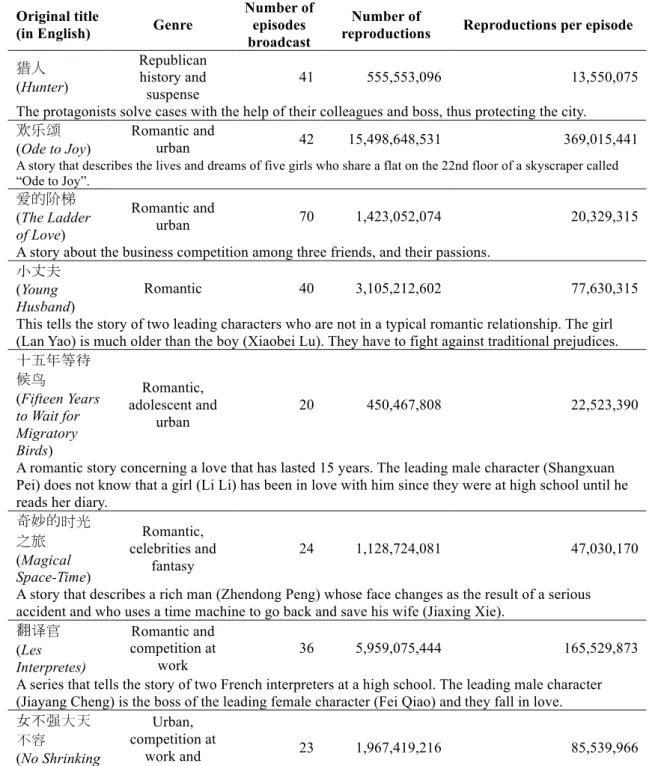
The proposed empirical analysis was carried out by selecting nine Chinese online series that were launched in the first six months of 2016 (until 13th June). As will be noted in Table 4, all the series selected are romantic, with the exception of Hunter, which is a suspense series with historical overtones. Nevertheless, the series analysed mix contents from various genres, and each series therefore has its own distinguishing points.
International Journal of Marketing, Communication and New Media. ISSN: 2182-9306. Vol 5 Nº 8, January/June 2017
94
Original title
(in English) Genre
Number of episodes broadcast
Number of
reproductions Reproductions per episode 猎人 (Hunter) Republican history and suspense 41 555,553,096 13,550,075
The protagonists solve cases with the help of their colleagues and boss, thus protecting the city. 欢乐颂
(Ode to Joy)
Romantic and
urban 42 15,498,648,531 369,015,441
A story that describes the lives and dreams of five girls who share a flat on the 22nd floor of a skyscraper called “Ode to Joy”. 爱的阶梯 (The Ladder of Love) Romantic and urban 70 1,423,052,074 20,329,315
A story about the business competition among three friends, and their passions. 小丈夫
(Young
Husband)
Romantic 40 3,105,212,602 77,630,315
This tells the story of two leading characters who are not in a typical romantic relationship. The girl (Lan Yao) is much older than the boy (Xiaobei Lu). They have to fight against traditional prejudices. 十五年等待 候鸟 (Fifteen Years to Wait for Migratory Birds) Romantic, adolescent and urban 20 450,467,808 22,523,390
A romantic story concerning a love that has lasted 15 years. The leading male character (Shangxuan Pei) does not know that a girl (Li Li) has been in love with him since they were at high school until he reads her diary.
奇妙的时光 之旅 (Magical Space-Time) Romantic, celebrities and fantasy 24 1,128,724,081 47,030,170
A story that describes a rich man (Zhendong Peng) whose face changes as the result of a serious accident and who uses a time machine to go back and save his wife (Jiaxing Xie).
翻译官 (Les Interpretes) Romantic and competition at work 36 5,959,075,444 165,529,873
A series that tells the story of two French interpreters at a high school. The leading male character (Jiayang Cheng) is the boss of the leading female character (Fei Qiao) and they fall in love. 女不强大天 不容 (No Shrinking Violet) Urban, competition at work and romantic 23 1,967,419,216 85,539,966
The leading female character (Yuqing Zhen) works as a journalist, and while fighting to keep her job after becoming the editor of a newspaper, she attempts to improve her relationships with her daughter and her ex-husband.
好先生 (To Be a Better Man) Romantic, gastronomic and urban 26 4,073,562,192 156,675,469
A chef with three Michelin stars (Yuan Lu) goes back to China without any hope in his life, but the people he meets at work bring him peace, and he finds new love.
Table 4. Summary of series considered (13th June, 2016)
International Journal of Marketing, Communication and New Media. ISSN: 2182-9306. Vol 5 Nº 8, January/June 2017
95
3.2. Measuring the variables
The data were obtained from two different sources. The volume of reproductions of the nine series was taken from the data provided by Vlinkage. This is a consultancy company with 15 years of experience that provides marketing services oriented towards companies in the publicity and audiovisual sector. It has its own data platform containing all the series and actors in the sector. Every day it publishes the ranking of the 20 series with the highest volume of reproduction, and this provides an excellent means to analyse the evolution of the series. The evolution as regards the number of reproductions of the series considered is shown in Figure 1. As will be noted, that which attains a peak as regards the most reproductions on the 9th May 2016 is Ode to Joy. The
three series to be first broadcast at a later date (Les Interpretes, No Shrinking Violet and
To Be a Better Man) were still broadcasting the first showing of episodes on 13th June, and were also attaining quite high levels of reproduction.
Figure 1. Evolution of online reproductions of the series considered. Source: Vlinkage (2016)
Data were also obtained from Weibo, which allowed us to gather information in order to
Hunter
Young Husband Les Interpretes
Ode to Toy
Fifteen Year to Wait… No Shrinking Violet
The Ladder of Love Magical Space-Time To Be a Better Man
International Journal of Marketing, Communication and New Media. ISSN: 2182-9306. Vol 5 Nº 8, January/June 2017
96
measure the popularity and activity of each series. As mentioned previously, the Weibo brand is that which is most recognised as regards its microblogging services in China. Its parent company, Sina, is a traditional publishing firm in the area of news and blogs. There is, therefore, a high level of confidence in its user base. Moreover, the first users of Weibo were famous actors. This was a promotion strategy and brought with it the fan phenomenon, thus leading it to attain 87% of the market share in microblogging (Sina, 2011). In order to attain a greater number of users, Weibo has developed news publication functions. Many organisations (companies, brands, institutions, etc.) therefore have their own Weibo accounts. In the particular case of series, production companies also have Weibo accounts, which they use to interact with their audience and potential consumers. A more detailed description of the variables obtained from Weibo is shown below for their later analysis:
- Daily number of fans. This variable measures the popularity of the series in Weibo. - Daily number of tweets. This measures the degree or level of the activity of each of the producers in the Weibo social network.
- Discussion index in Weibo. This measures the global level of discussion or interest in a specific subject or topic in Weibo. This index is calculated by Weibo itself for each topic (series), and not including those contents that are not related to the series in question, but rather for those in which a hashtag is used.
4. RESULTS
In order to attain the objectives proposed in the introduction, we have first calculated the Spearman correlation coefficients between the volume of reproductions of each series and the variables used to measure the number of fans, number of tweets and level of discussion (Table 5). It would a priori be expected that the coefficient of correlation between these three variables and the number of reproductions would be positive. This would indicate that there is a direct relationship between activity (measured by the number tweets published in the accounts of each series) and popularity in Weibo (measured by the number of fans of the series and its discussion index) and the results in terms of viewings on online video platforms.
International Journal of Marketing, Communication and New Media. ISSN: 2182-9306. Vol 5 Nº 8, January/June 2017
97
to the number of fans, the relationship with the reproductions is negative for four of the series analysed, while for three it is not significant and for two it is positive; (2) in the case of the number of tweets, this variable correlates negatively for five of the series, it does not correlate in a significant way for two, and it correlates positively for two; and (3) the discussion index correlates positively for four out of seven series for which this measurement was available (Ode to Joy, The Ladder of Love, Young Husband, and
Fifteen Years to Wait for Migratory Birds), while for the other three the correlation is
not significant. It is, therefore, possible to state that the variable that most behaves as expected is that of the discussion index, and this is also the most relevant result with regard to improving the results regarding online series audiences. The only two series to behave as expected as regards the relationship between the number of fans and tweets were No Shrinking Violet and To Be a Better Man. In both cases, as the fans and publications increased so did their online reproductions. Moreover, in both cases, the coefficients of correlation estimated attained values very close to 1, thus indicating a highly intense relationship.
Series Fans Tweets Discussion Index
Hunter (Days = 85) -.915* -.513* -.031
Ode to Joy (Days = 57) -.692* -.676* .845*
The Ladder of Love (Days = 96) -.020 -.782* .791*
Young Husband (Days = 44) -.459* -.478* .649*
Fifteen Years to Wait for Migratory
Birds (Days = 89) -.852* -.849* .906*
Magical Space-Time (Days = 48) .055 .209 n.a
Les Interpretes (Days = 21) .252 .253 .148
No Shrinking Violet (Days = 14) .829* .829* n.a
To Be a Better Man (Days = 14) .965* .965* -.310
Table 5. Spearman nonparametric correlation analysis between the number of online reproductions and the indicators of popularity and activity in Weibo.
Note: *p < .01; n.a: not available.
To finish, we carried out a linear regression analysis by considering all the data regarding the nine series together (Table 6). As was shown with the F-test, the regression as a whole had some parameters that were different to zero, since their level of significance is just below .05. The adjusted R2, which represents the goodness of fit
International Journal of Marketing, Communication and New Media. ISSN: 2182-9306. Vol 5 Nº 8, January/June 2017
98
of the model, meanwhile indicates that the variability of the variable response is explained by the three independent variables in an appropriate manner. In other words, 70.4% of the variation in volume of reproductions is explained by the variability in the independent variables. Firstly, the discussion index has the highest standardised parameter, at .662, which indicates that this variable is very strongly related to online viewing of the series. The second variable in order of importance is the number of fans in Weibo, with a parameter of .398 and a level of significance of less than .05. This signifies that the greater the popularity of the series in the Weibo social network, the better the online audience results. Finally, the variable ‘number of tweets’ has a negative (-.233) and significant parameter, which suggests that the producers’ activity in the Weibo social network is not being converted into a higher number of viewings. All the results of the variance inflation factor (VIF) are close to 1, thus indicating that there is no colinearity among the independent variables.
Independent variable Standardized coefficient (β) t p VIF Intercept 0.660 .510 Fans .398 14.056 .000 1.097 Tweets -.233 -8.017 .000 1.155 Discussion index .662 23.592 .000 1.076
Table 6. Lineal regression analysis with all series: influence of popularity and activity in Weibo.
Notes: Model fit: F = 321.319, p < .001; Adjusted R2 = .704.
5. DISCUSSION AND CONCLUSIONS
This paper has analysed the relationship between one of the most popular social networks in China – Weibo – and the online reproductions of nine different series. No other previous study has, to date, tackled this question in the case of one of the countries that is most active in social networks.
Contrary to the initial hypothesis, we have concluded that the number of fans and tweets are only positively and significantly related to the number of online reproductions of two series: No Shrinking Violet and To Be a Better Man. The results obtained for the remaining cases were either not significant or the opposite of those expected. This could
International Journal of Marketing, Communication and New Media. ISSN: 2182-9306. Vol 5 Nº 8, January/June 2017
99
be explained by the fact that some series are ‘buying fans’ in Weibo, thus leading the coefficient of correlation with reproductions to take on negative and non-significant values. The fact that the tweets published were almost never positively related to a greater number of reproductions could be explained by the fact that the contents concerning the series that were published in Weibo were not as attractive as they should have been. The discussion index in Weibo is the measure of popularity that, to a great extent, correlates with the online reproductions as expected, i.e. in a positive manner. Those series that are most frequently discussed in Weibo therefore obtain a greater number of reproductions, independently of whether the comments about them are good or bad.
The model estimated in order to predict the audience results has provided a reasonable fit and this has allowed us to conclude that the popularity of the series (discussion index and number of fans) is, in general, the most relevant when predicting the audience of the nine online series considered as a whole.
These results make it possible to offer certain advice regarding the use of social networks as marketing tools for audiovisual products in China. First, it would appear to be clear that the most important issue for those companies that produce online series is that of increasing the level of discussion about the series in the Weibo social network. They should, therefore, encourage people to talk more about it, by interacting with the audience, inviting the actors to take part in interviews with the fans using the Weibo social network, etc. Second, bearing in mind that activity in Weibo is not a complete success as regards attaining more reproductions, the companies should pay more attention to the type of contents published and attempt to make them more attractive to their potential audience. According to the results presented, the majority of the series analysed have an inverse relationship between tweets and the volume of reproductions of the series. The companies could propose a specific flexible strategy for the series being launched according to the audiences’ preferences. It would also be useful for the production companies to carry out an exhaustive analysis in order to sound out their potential customers’ tastes before showing a series for the first time. Third, the production companies do not broadcast a single audiovisual product but rather manage it as an integral brand. The producers could associate the series with its own brand as a company, thus allowing the audience to get a previous impression of their audiovisual products. This would also make it easier for the companies to take advantage of a series’
International Journal of Marketing, Communication and New Media. ISSN: 2182-9306. Vol 5 Nº 8, January/June 2017
100
fan culture in order to improve the reproductions of other series produced by the same company.
When interpreting the results of the study it is important to bear in mind a series of limitations. First, the first showings of series in China depend very much on the quarter of the year in which they are broadcast. Channels so not normally launch any series starring more popular actors that have a greater chance of generating a high level of discussion in the social media before July. The series considered in the paper are not, therefore, representative of those in the whole sector. Second, although the regression model estimated has a fairly adequate fit, it is also true that there are more independent variables that affect the volume of reproductions of the series. In the case of fan culture, the level of impact of the starring actors, their public images and public relations are, among others, considered to be very relevant variables. Third, in this paper we have used a quantitative approach without considering the semantics or sentiments of the discussions generated online. Despite having reached the conclusion that the level of discussion in Weibo is directly related to the reproductions, it will still be necessary to carry out a more qualitative study of the comments in order to obtain more in-depth conclusions.
Bearing the aforementioned limitations in mind, in future studies it will be necessary to include more examples of online series launched at other times of the year and belonging to different genres. This will allow us to evaluate whether the results obtained coincide with those presented in this study. Another possible line of improvement would be to include variables related to actors, channel, duration of launch, etc. It would thus be possible to incorporate, for example, the number of fans who have the Weibo accounts of the stars of each series into the model. Finally, in order to define the semantics or sentiment of the comments that generate discussions in Weibo, it would be possible to analyse the content of a sample of them and study whether the remarks made about the series are positive or negative. A semantic analysis would also help us to study the emotional variables in greater depth.
International Journal of Marketing, Communication and New Media. ISSN: 2182-9306. Vol 5 Nº 8, January/June 2017
101
REFERENCES
Baidu (2016). System data. Retrieved from http://index.baidu.com
Barash, V., & Golder, S. (2010). Twitter: conversation, entertainment, and information, all in one network! In D. Hansen, B. Shneiderman, & M. A. Smith (Eds.), Analyzing
social media networks with NodeXL: Insights from a connected world (pp. 143-164).
Burlington, MA: Morgan Kaufmann.
Barrios, C. A. (2012). Utilidad del e-WOM para la gestión de un producto televisivo. El
caso de la serie Toledo (Degree thesis). Universidad de Castilla La-Mancha, Talavera de
la Reina.
Broadcast Engineering (2012). TV-driven social media interaction popular among U.S.
viewers, says survey. Retrieved from
http://broadcastinginCering.com/news/tv_socialmedia_interaction_popular_04252012/ Chiu, C., Ip, C., & Silverman, A. (April 2012). Understanding social media in China.
McKinsey Quarterly, pp. 78-81.
Deller, R. (2011). Twittering on: Audience research and participation using Twitter.
Participations: Journal of Audience & Reception Studies, 8(1), 216-245.
Deloitte (2013). 中 国 两 岸 三 地 文 化 产 业 研 究 报 告 . Retrieved from
https://www2.deloitte.com/content/dam/Deloitte/cn/Documents/technology-media-telecommunications/deloitte-cn-tmt-china-culture-entertainment-report-zh-170413.pdf Fung, A. Y. (2009). Fandom, youth and consumption in China. European Journal of
Cultural Studies, 12(3), 285-303. doi: 10.1177/1367549409105365
Godes, D., & Mayzlin, D. (2009). Firm-created word-of-mouth communication: Evidence from a field test. Marketing Science, 28(4), 721-739. doi: 10.1287/mksc.1080.0444 Hansen, D., Shneiderman, B., & Smith, M. A. (2011). Analyzing social media networks
with NodeXL: Insights from a connected world. Burlington, MA: Morgan Kaufmann.
Hardt, M., & Negri, A. (2004). Multitude: War and democracy in the age of empire. New York, NY: Penguin.
Harrington, S., Highfield, T., & Bruns, A. (2013). More than a backchannel: Twitter and television. Participations: Journal of Audience & Reception Studies, 10(1), 13-17.
Heo, Y.-C., Park, J.-Y., Kim, J.-Y., & Park, H.-W. (2016). The emerging viewertariat in South Korea: The Seoul mayoral TV debate on Twitter, Facebook, and blogs. Telematics
and Informatics, 33(2), 570-583. doi: 10.1016/j.tele.2015.08.003
iResearch, (2015) 2015 年 中 国 在线 娱 乐 行 业 研 究 报 告 . Retrieved from http://report.iresearch.cn/report/201505/2377.shtml
International Journal of Marketing, Communication and New Media. ISSN: 2182-9306. Vol 5 Nº 8, January/June 2017
102
http://www.iwebchoice.com/html/smallclass_6.shtml
Java, A., Song, X., Finin, T., & Tseng, B. (2007). Why we Twitter: understanding microblogging usage and communities. In H. Zhang, B. Mobasher, L. Giles, A. McCallum, O. Nasraoui, M. Spiliopoulou, J. Srivastava, & J. Yen (Eds.), Proceedings of
the Joint 9th WEBKDD and 1st SNA-KDD Workshop 2007. Retrieved from
http://ebiquity.umbc.edu/_file_directory_/papers/369.pdf
Jin, D., & Zhou, X. (2015). 类型· 审美· 资本· 媒介: 对 2014 年中国电视剧研究的分析. 现代传播, 3, 80-85.
Kemp, S. (2014). Understanding social media in China in 2014. Retrieved from http://www.socialmediatoday.com/content/understanding-social-media-china-2014 Li, W., & Lv, F. (2015). "粉丝经济" 的发展趋势与应对策略. 福建师范大学学报: 哲 学社会科学版, 6, 136-136.
Liu, Y. (2006). Word of mouth for movies: Its dynamics and impact on box office revenue. Journal of Marketing, 70(3), 74-89. doi: 10.1509/jmkg.70.3.74
National Bureau of Statistics of China (NBSC, 2015). 18-42: 互联网主要指标发展情况 (年底数). Retrieved from http://www.stats.gov.cn/tjsj/ndsj/2015/indexch.htm
Nielsen (2013). 口 碑 传 播 依 旧 最 受 中 国 消 费 者 信 赖 . Retrieved from http://www.nielsen.com/cn/zh/press-room/2013/nielsen-earned-advertising-remains-most-credible-among-chinese-consumers.html
Rainie, L., & Wellman, B. (2012). Networked: the new social operating system. Cambridge, MA: Mit Press.
Shih, C. (2009). The Facebook era: Tapping online social networks to build better
products, reach new audience, and sell more stuff. Boston, MA: Prentice Hall.
Sina (28 de enero de 2011). 未来资产报告称新浪微博使用率市场份额达 87%. Retrieved from http://tech.sina.com.cn/i/2011-01-28/18045144960.shtml
Smith, A., & Boyles, J. L. (2012). The rise of the ‘connected viewer’. Retrieved from http://pewinternet.org/~/media//Files/Reports/2012/PIP_Connected_Viewers.pdf
Vlinkage (2016). Private system data. Retrieved from http://vbk.vlinkage.com/
Walmsley, A. (2010). New media needs new PR. Retrieved from http://www.marketingmagazine.co.uk
Xiong, B. (2013). 新媒体时代中国电视产业发展研究 (Doctoral dissertation). 武汉大 学, Wuhan.
International Journal of Marketing, Communication and New Media. ISSN: 2182-9306. Vol 5 Nº 8, January/June 2017
103
京大学, Nanjing.
Zhao, D., & Rosson, M. B. (2009). How and why people Twitter: The role that micro-blogging plays in informal communication at work. In W. Prinz & W. Lutters (Eds.),
Proceedings of the ACM 2009 International Conference on Supporting Group Work, (pp.
261-270). Retrieved from
http://www.personal.psu.edu/duz108/blogs/publications/group09%20microblogging.pdf
How to cite this article:
Wang, D. & García, J. A. (2017). Popularity and Activity in Social Networks: An analysis of their impact in chinese online series.. International Journal of
Marketing, Communication and New Media. 8 (5), 84-103. Available at