Proceedings of the
15
th
European Conference on
Research Methodology for
Business and Management Studies
Kingston Business School, Kingston University
London, UK
9 - 10 June 2016
9 - 10 June 2016
Edited by
Proceedings of
The 15th European
Conference on
Research Methodology for
Business and Management
Studies
ECRM2016
9 ‐ 10th June 2016
Hosted by
Kingston Business School
Kingston University London
UK
Edited by
Vladlena Benson
Kingston University, UK
And
Fragkiskos Filippaios
University of Kent, UK
Copyright The Authors, 2016. All Rights Reserved. No reproduction, copy or transmission may be made without written permission from the individual authors. Review Process Papers submitted to this conference have been double‐blind peer reviewed before final acceptance to the con‐ ference. Initially, abstracts were reviewed for relevance and accessibility and successful authors were invited to submit full papers. Many thanks to the reviewers who helped ensure the quality of all the submissions. Conference Proceedings The Conference Proceedings is a book published with an ISBN and ISSN. The proceedings have been submitted to a number of accreditation, citation and indexing bodies including Thomson ISI Web of Science and Elsevier Scopus. Author affiliation details in these proceedings have been reproduced as supplied by the authors themselves. The Electronic version of the Conference Proceedings is available to download from DROPBOX. (http://ecrm.com/2016) Select Download and then Direct Download to access the Pdf file. Free download is available for conference participants for a period of 2 weeks after the conference. The Conference Proceedings for this year and previous years can be purchased from http://academic‐ bookshop.com Print version ISSN: 2049‐0968 Print version ISBN: 978‐1‐910810‐94‐1 E‐Book ISSN: 2049‐0976 E‐Book ISBN: 978‐1‐910810‐95‐8 Published by Academic Conferences and Publishing International Limited Reading, UK. 44‐118‐972‐4148. www.academic‐publishing.org
Contents
Paper Title Author(s) Page
No Preface iv Committee v Biographies vi Research papers Linguistic Analysis of Manager Behaviour Aimed at Replacing Human Managers with Robots Justyna Alnajjar and Olaf Flak 1 Comparing Millennials With Their Predecessors Regarding Online Travel Behaviours: A Logistical Regression Modelling Approach Suzanne Amaro, Carla Henriques and Paulo Duarte 9 Modelling Formative Second Order Constructs in PLS Suzanne Amaro and Paulo Duarte 19 Innovation on the RM Curriculum to Help Develop Research Skills Before the Final Year Master’s Dissertation Marie Ashwin and Alan Hirst 28 Square but Straight: Measurement Tool Design to Improve Response Task Fluency and Certainty Alice Audrezet and Béatrice Parguel 34 From Methods to Design: Teaching Research Methodology as a Reflective Practice Lars Bækgaard and Christian Lystbæk 43 Taking off With a Pilot ‐ the Importance of Testing Research Instruments Jane Brooks, Deborah M Reed and Barbara Savage 51 21st Century Managers and Intuition: Evaluating the Learning Achieved From an Example of Pedagogic Change for Business Undergraduates Ann Brown and Martin Rich 60 Evaluating the Contribution of Technology Start‐up Incubators: Exploring Methodological and Data‐related Conundrums Anthony Paul Buckley and Stephen Davis 68 Interdisciplinary Approach to Research in Business and Management Studies Based on Consumer Behaviour and Organizational Conflict Felicjan Bylok and Leszek Cichobłaziński 76 Teaching Subjectivist Research Methodology: Starting With “why?” not “what?” Oliver Couch, Caroline Cole, Steven Chase and Murray Clark 84 DBA Impact Statements as Self‐Research Methods: PhD Plus or Practitioner Frolic? Julie Davies 91 Using Relationship‐building Methodology for Developing Trust: World Café in Action Lesley Gill, Philip Ramsey, Sarah Leberman and Stephen Atkins 99 Learning, Teaching and Researching for Developing Professional Agency: the Ethics of Self‐Making Gloria Gordon 108 The VIPLAN Methodology in Management Research Stephen Harwood 117 Contingency Theory as a Lens for Qualitative Data Analysis in Information Systems Studies Tiko Iyamu and Sibongiseni Tunzelana 126 Strategies for Reconciling Positionality Dynamics in a ‘Homecomer‐Stranger’ International Research Team Eva Kipnis and Aurelie Broeckerhoff 136 Psychogeography in a Time of Calamity – Deriving with Defoe Deborah Knowles, Damian Ruth and Clare Hindley 143
Applying Grounded Theory in Complex Case Study Context – Issues and Lessons Learned From Knowledge Management Research Shuyang Li, Alex Peng and Jorge Martins 149 Facilitating Organizational Change: A Collaborative, Open Systems Perspective Ludmila Malinova, Peter M Bednar and Christine Welch 159 Analysis of Research Methodology in Business and Management Studies as Reflected in the ECRM 2015 Proceedings Hendrik Marais and Magdalena Pienaar‐ Marais 167 Gaining Access to Organizational Elites in Qualitative Research: Implications for Teaching Research Methods Efrider Maramwidze‐Merrison 175 Confirming the Measurement Properties of an Engagement Measure Nico Martins 184 Teaching and Learning Research Methods – Towards Developing a Deeper Appreciation of Their Assumptions John Mendy 193 Application of Quantitative and Ex‐post Facto Research Methodology in Corporate Borrowing in Nigeria: Empirical Evidence. Peter Okpamen 201 Increasing Response Rates for Surveys Conducted in Busy Cities: Lessons Learned From a Smart City Study Guochao Alex Peng and Luqing Zheng 210 The Challenges of Using Mixed Methods in Requirements Engineering Research Rozilawati Razali, Fares Anwar, Marfizah Abdul Rahman and Fatin Filzahti Ismail 217 Telling Tales; Storytelling as a Methodological Approach in Research Tara Rooney, Katrina Lawlor and Eddie Rohan 225 A Mixed Methods Approach to a Bourdiean Analysis of Innovation in Family Firms Udeni Salmon 233 Research 3.0—Use of Semantic Web Technology in a Qualitative Research Process Reto Schneider 241 Meta‐Action Research: A Methodology for Improving Practice‐Based Research Gertjan Schuiling and Derk Jan Kiewiet 251 A Review of Mixed Methods Research by South African Computing Researchers Shawren Singh 259 Detecting and Militating Against Data “Curbstoning” in Business and Management Research Anthony Stacey 265 Semi‐quantitative Systems Analysis Using Fuzzy Cognitive Maps Anthony Stacey 275 Making Bricks From Straw: Promoting Undergraduate Research With Diminishing Resources Barry Strydom and Kerry McCullough 285 Appreciating Methods/Analysis Choices: Humanitarian Aid as a Teaching Context Tonny Tonny and Stephen Atkins 293 Applying Educational Design Research to Virtual Reality Safety Training in Mines Etienne Anton van Wyk and Mary Ruth de Villiers 302 Effective Methodological Tools applied to Modelling the Influence of Relational Efforts on Performance Armando Luís Vieira, Carlos Costa, and Arthur Filipe Araújo 313 Reducing the Carbon Footprint of Research by Recycling Item Level Data Hartmut von der Ohe and Nico Martins 322 Towards a Systemic Landscape Model for Operational Excellence Christine Welch, Tammi Sinha and Nigel Ward 330 Towards a Systematic Approach to Reviewing Literature for Interpreting Business and Management Research Results Kambidima Wotela 338
Strategy Variable in Subsidiary Research – the Case of Miles and Snow Typology Sylva Žáková Talpová 349 PhD Research Papers 359 Developing a Frameworks for a Successful for Claim Management in Malaysian Construction Industry Nor Azmi Bakhary, Hamimah Adnan and Azmi Ibrahim 361 Investigating Employee Attitudes Towards Adopting Green Supply Chain Practices in Indian Smes – Using Qualitative Methods: Literature Review and Research Methodology Manpreet Dhillon, Yongmei Bentley and Teslim Bukoye 367 Critical Perspectives on Corporate Social Responsibility Research Methods: An Evaluation of Two Different Research Strategies and Designs Barbara Jensen 375 A Case Study as a Method of Researching the use of Social Media in Enterprises Marta Zembik 383 Non Academic Paper 391 From Case Analysis to Model: Inspiration Drawn From an Investigation of Company Culture Luciano Traquandi 393 Work In Progress Papers 403 What is Your Influence on Social Media? A Sentiment‐ Based Model Wei‐Lun Chang 405 Integrating Qualitative Data Collection Methods to Examine Knowledge Management Across Disciplinary Boundaries Titima Thumburmung, Ana Cristina Vasconcelos and Andrew Cox 408 Late Submission Paper 413 A Critique of the Structural Equation Modeling Technique Daniel Makina 415
Preface
The 15th European Conference on Research Methodology for Business and Management Studies is hosted this year by the Kingston Business School, Kingston University London, UK on the 9‐10 June 2016.
The Conference Chair is Dr Vladlena Benson from Kingston University, and the Programme Chair is Dr Frag‐ kiskos Filippaios from Kent Business School, University of Kent.
ECRM is a recognised event on the European research conferences calendar and provides the opportunity for individuals working in the area of business and management research to meet and discuss their experiences of using the varied and expanding range of research methods available to them.
Three keynote speakers will give presentations at the conference this year; The Revival of Deductive Qualita‐
tive Research by Professor Ad Kil from Nyenrode Business University in The Netherlands. Professor George
Saridakis, from Kingston University Business School, UK will continue on the theme of qualitative research methodology with a presentation on Emerging Challenges in Quantitative Methodology Nick Rushby of Cona‐ tion Technologies Ltd, in the UK will address the issue of Research and Publication Ethics in Rapidly Changing
Times.
With an initial submission of 136 abstracts, after the double blind, peer review process there are 43 Research papers, 4 PhD papers and 1 non Academic paper, 2 work in progress papers published in these Conference Proceedings. These papers come from some many different countries including Czech Republic, Denmark, France, Ireland, Italy, Malaysia, Netherlands, New Zealand, Nigeria, Poland, Portugal, Slovenia, South Africa, Taiwan, UK.
A selection of the best papers – those agreed by a panel of reviewers and the editor will be published in a con‐ ference edition of the EJBRM (Electronic Journal of Business Research Methods www.ejbrm.com, ISSN 1477‐ 7029). These will be chosen for their quality of writing and relevance to the Journal’s objective of publishing papers that offer new insights or practical help into the application of research methods in business research. Papers presented in the Systems Approach and its applications in Management Research mini track will be considered for further development and publication in the International Journal of Systems and Society (IJSS), published by IGI‐Global, ISSN: 2327‐3984. We wish you a most interesting conference. Vladlena Benson And Fragkiskos Filippaios June 2016
Conference Committee
Conference Executives
Dr Vladlena Benson, Kingston Business School, UK Dr Fragkiskos Filippaios, Kent Business School, University of Kent, UK Dr Chris Hand, Kingston University, UK Dr Elena Fitkov‐Norris, Kingston University, UK Dr Rebecca Steliaros, Kingston University, UKMini track chairs
Prof Nico Martins, University of South Africa, RSA Prof. Mortaza Kokabi, Shaheed Chamran University, Ahwaz, Iran Dr; Khodayar Abili, The University of Tehran, Iran; Dr; Bulent Acma, Anadolu University, Eskisehir, Turkey; Ass; Prof; Dr; Hamimah Adnan, Universiti Teknologi MARA, Malaysia; Dr; Hamid AL‐Asadi, Basra University, Iraq; Dr; George Alexandrou, Kingston University, UK; Prof; Dr; Maizam Alias, Universiti Tun Hussein Onn Malaysia, Ma‐ laysia; Dr; Suzanne Amaro, Polytechnic Institute of Viseu, Portugal; Dr; Fatima Annan‐Diab, Kingston University, UK; Dr; Andrew Armitage, Anglia Ruskin University, UK; Dr; Marie Ashwin, Ecole de Management de Nor‐ mandie, France; Udo Averweg, eThekwini Municipality and University of KwaZulu‐Natal, South Africa; Joseph Azzopardi, University of Malta, Malta; Sue Balint, Westminster Business School, London, UK; Dr; Joan Bal‐ lantine, University of Ulster, UK; Dr; Heather Banham, Okanagan College, Kelowna, Canada; Andrew Basden, University of Salford, UK; Dr; Hazel Beadle, University of Chichester, UK; Ass; Prof; David Bednall, Deakin Uni‐ versity, Australia; Peter Bednar, Department of ISCA, Portsmouth University, UK; Lau Bee Theng, Swinburne University of Technology Sarawak Campus, Malaysia; Dr; Gary Bell, London South Bank University, UK; Angela Benson, University of Brighton, UK; Dr; Egon Berghout, University of Groningen, The Netherlands; Dr; Frank Bezzina, University of Malta, Malta; Dr; Milena Bobeva, Bournemouth University, UK; Dr; Ann Brown, CASS Business School, UK; Cathal Brugha, University College Dublin, Ireland; Dr; Roslyn Cameron, C Q University Aus‐ tralia, Australia; Dr; Marian Carcary, The National University of Ireland Maynooth, Ireland; Dr; Lindsey Carey, Glasgow Caledonian University, UK; Prof; Sven Carlsson, School of Economics and Management, Lund Univer‐ sity, Sweden; Dr; Vincent Cassar, Birbeck College, University of London, UK; Dr; Jennifer KimLian Chan, Univer‐ siti Malaysia Sabah, Malaysia; Prof; Prasenjit Chatterjee, MCKV Institute of Engineering, India; Dr; Vikas Choudhary, National Institute of Technology, Kurukshetra, India; Dr; Jyoti Choudrie, University of Hertfordshire , UK; Dr; Murray Clark, Sheffield Business School, UK; Aileen Corley, Liverpool John Moores University, UK; Dr; Reet Cronk, Harding Universtity, USA; Ken D'Silva, London South Bank University, UK; Fariba Darabi, Sheffield Hallam University, UK; Geoffrey Darnton, Bournemouth University, UK; Dr; Linda Dawson, University of Wol‐ longong, Australia; Prof; Leslie Dinauer, University of Maryland University College, USA; Dr; Eileen Doherty, Innovation Value Institute, Maynooth University, Ireland; Verena Dorner, Chair of Business Computing II, Uni‐ versity of Passau, Germany; David Douglas, Staffordshire University, UK; Prokopios Drogkaris, University of Aegean, Greece; Prof; Dr; Paulo Duarte, University of Beira Interior, Portugal; Dr; Dev Dutta, University of New Hampshire, Durham, UK; Prof; Rohit Dwivedi, Rajiv Gandhi Indian Institute of Management Shillong, India; Dr; Hossein Ebrahimpour, The University of Kashan, Iran; Dr; Jose Esteves, IE Business School, Madrid, Spain; Mahmoud Fakhra, College of Business Studies, Kuwait; Prof; Paula Fern ndez Gonz lez, University of Oviedo, Spain; Prof; Paula Odete Fernandes, Polytechnic Institute of Bragança, Portugal; Dr; Paula Fernández González, University of Oviedo, Spain; Dr; Elena Fitkov‐Norris, Kingston University, UK; Dr; Elena Fitkov‐Norris , Kingston University, UK; Olaf Flak, University of Silesia in Katowice, Poland; Prof; Balan George, German‐Romanian Uni‐ versity, Romania; Prof; Dr; Adriana Giurgiu, University of Oradea, Faculty of Economic Sciences, Romania; Dr Aaron Glassman, Embry‐Riddle Aeronautical University, USA; Gerald Goh, Multimedia University, Melaka, Ma‐ laysia; Dr; Sayed Mahdi Golestan Hashemi, Iranian Research Institute for Creatology,TRIZ & Innovation Man‐ agement & Engineering, Iran; Dr; Karuna Gomanee, Regents College, UK; Dr; Andrea Gorra, Leeds Metropoli‐ tan University, UK; Gillian Green, School of Informatics, University of Northumbria, UK; Dr; Anabel Gutierrez Mendoza, Regent's College London, UK; Dr Birgit Hagen, University of Pavia, Italy; Dr; Chris Hand, Kingston University, UK; Dr; Stylianos Hatzipanagos, King's College London, UK; Dr; Prof; Yunke He, Okanagan College, Kelowna, Canada; Alex Hiller, Nottingham Trent University, UK; Prof; Clare Hindley, International University Bad Honnef ‐Bonn,, Germany; Clive Holtham, Cass Business School, City of London University, UK; Dr; Bob Hughes, University of Brighton, UK; Prof; Rahinah Ibrahim, Universiti Putra Malaysia, Malaysia; Fahmi Ibrahim, Glasgow Caledonian University, UK; Prof; Devos Jan, Ghent University, Belgium; Dr; Wyn Jenkins, Staffordshire University, Stoke‐on‐Trent, UK; Kristina Jesperson, Aarhus University , Denmark; Helena Karjalainen, NormandyBusiness School, France; Diane Keeble‐Allen, Anglia Ruskin University, UK; Prof; Habibul Khondker, Zayed Uni‐ versity, Abu Dhabi, United Arab Emirates; Cyril Kirwan, Cyril Kirwan Associates, Dublin, Ireland; Rembrandt Klopper, University of Kwa Zulu Natal, South Africa; Dr; Jenny Knight, University of Brighton Business School, UK; Dr; Deborah Knowles, University of Westminister, London, UK; Karl Knox, Nottingham Trent University, UK; Prof; Mortaza Kokabi, Shaheed Chamran, Iran; Dr; Branka Krivokapic‐Skoko, Charles Sturt University, Australia; Branka Krivokapic‐Skoko, Charles Sturt University, Australia; Dr; Kelly La Venture, Bemidji State University, USA; David Lamb, Edith Cowan Uiversity, Australia; Rebecca Lees, Kingston University, UK; Prof; João Leitão, University of Beira Interior, Portugal; Prof; Arminda Lopes, Instituto Politécnico de Castelo Branco, Portugal; Prof; Eurico Lopes, Polytechnic Institute of Castelo Branco, Portugal; Jonathan Lord, University of Salford, UK; Prof; Sam Lubbe, NWU, South Africa; Dr; Maria Cristina M; De los Santos, Kyungdong University‐Global Cam‐ pus, South Korea; Dr; Sandy MacDonald, University of Northampton, UK; Prof; Dalgobind Mahto, Green Hills Engineering College, India; Prof; Hendrik Marais, University of Pretoria, South Africa; Garance Marechal, Uni‐ versity of Liverpool, UK; Dr; Maria do Rosário Martins, Universidade Cape Verde, Portugal; Dr; Ellen Caroline Martins, Organisational Diagnostics, South Africa; Prof; Nico Martins, University of South Africa, South Africa; Angela McGrane, Northumbria University, UK; Dr; Rachel McLean, University of Bolton, UK; Cathi McMullen, School of Management and Marketing Charles Sturt University, Australia; Lisa McNeill, University of Otago, Dunedin, New Zealand; Mr Mohd Shamsuri Md Saad, Universiti Teknikal Malaysia Melaka, Malaysia; Anabela Mesquita , Instituto Politécnico do Porto, Portugal; Dr; Ian Michael, Zayed University, Dubai, United Arab Emir‐ ates; Dr; Avinash Mulky, Indian Institute of Management, Bangalore, India; Dr; Graham Myers, Durban Univer‐ sity of Technology, South Africa; Dr; Emanuela Alia Nica, Center for Ethics and Health Policy (CEPS) and Univer‐ sity "Petre Andrei" Iasi, Romania; Dr; Arlene Nicholas, Salve Regina University, India; Prof; Rita Niemann, Uni‐ versity of the Free State, South Africa; Prof; Hester Nienaber, Unisa, Pretoria, South Africa; Dr; Kersti Nogeste, RMIT University, Melbourne, Australia; Dr; Chetsada Noknoi, Thaksin University, Thailand; Miguel Nunes, Shef‐ field University, UK; Dr; Madeleine Ogilvie, Edith Cowan University, Perth, Australia; Ass; Prof; Dr; Abdelnaser Omran, School of Economics, Finance and Banking, Universiti Utara Malaysia, Malaysia; Steve Page, University College Chester, UK; Dr; Vijayakumar Parameswaran Unnithan, Tata Institute of Social Sciences, India; Dr; H;B; Patel, Grow More College of Education, India; Dr; Swetketu Patnaik, LAIBS, Anglia Ruskin University, UK; Dr; Noel Pearse, Rhodes University, Grahamstown, South Africa; Prof; Rui Pimenta, Escola Superior Tecnologia Saúde Porto, Portugal; Dr; Iwona Pisz, Opole University, Poland; Ganesh Prabhu, Indian Institute of Manage‐ ment at Bangalore, India; Diana Rajendran, Swinburne University of Technology, Melbourne, Australia; Prof; Thurasamy Ramayah, Universiti Sains Malaysia, Malaysia; Dr; Isabel Ramos, Minho University, Portugal; Kar‐ sten Boye Rasmussen, University of Southern Denmark, Odense, Denmark; Theo Renkema, Rabobank Neder‐ land, The Netherlands; Martin Rich, CASS Business School, UK; Kristina Risom, The Aarhus School of Business, Denmark; Dr; Isabelle Royer, University Lyon, France; Dr; Maria Ryan, Edith Cowen University, Perth, Australia; Dr; Faith Samkange, SHMS Hotel Belvedere, Switzerland; Joseph Santora, International School of Management, Paris, France; PhD Risto Säntti, University of Vaasa, Finland; Prof; Chaudhary Imran Sarwar, Mixed Reality Uni‐ versity, Pakistan; Mark Saunders, University of Surrey, UK; Dr; Ousanee Sawagvudcharee, Liverpool John Moores University, Thailand; Dr; Simone Domenico Scagnelli, University of Torino, Italy; Dr Elena Seghedin , Alexandru Ioan Cuza University of Iasi , Romania; Dr; Nima Shahidi, Islamic Azad University, Iran; Junaid Shaikh, Curtin University, Malaysia; Dr; Anshuman Sharma, College of Applied Sciences, Ministry of Higher Education, Oman; Marie Sheahan, Charles Sturt University, Australia; Miles Shepherd, Bournemouth University Business School, UK; Prof; Ali Simsek, Anadolu University, Turkey; Dr; Tammi Sinha, Winchester University, UK; Ibrahim Sirkeci, Regent's University, London, UK; Prof; Peter Smith, University of Sunderland, UK; Dr; Shahryar So‐ rooshian, University Malaysia Pahang (UMP), Malaysia; Prof; Rui Dinis Sousa, University of Minho, Portugal; Dr; Rajeev Srivastava, Motilal Nehru National Institute of Technology, India; Prof; Anthony Stacey, University of the Witwatersrand, Johannesburg, South Africa; Prof; Jim Stewart, Coventry Business School , UK; Kerstin Thomson, Stockholm University, Sweden; Claudine Toffolon, Université du Mans ‐ IUT de Laval, France; Prof; Shiv Tripathi, Mzumbe University, Tanzania; Dr; Jim Underwood, University of Technology, Sydney, Australia; Arvind Upadhyay, University of Brighton, UK; Dr; Prof; Asta Valackiene, Kaunas University Of Technology Panevezys Faculty, Lithuania; Dr; Jocene Vallack, CQ University, Rockhampton, Australia; Dr; Ana Vasconcelos, University of Sheffield, UK; Dr; John Venable, Curtin University of Technology, Perth, Australia; David Wain‐ wright, University of Northumbria, UK; John Walton, Sheffied Hallam University, UK; Teresa Waring, Northum‐ bria University, UK; Christine Welch, University of Portsmouth, UK; Dr; Piotr Wiśniewski, Warsaw School of Economics, Poland; Lilia Zerguit, Sheffield Business School, Sheffield Hallam University, UK; Prof; Dr; Mu‐ hamamd Zia‐ur‐Rehman, National Defence University, Pakistan; Dr; Daiva Zostautiene, Kaunas University of Technology, Lithuania
Biographies
Conference Chair
Dr Vladlena Benson is an Associate Professor and a Course Director of the MA Manage‐
ment programme at Kingston Business School, Kingston University. Vladlena’s research interests are in the area of information security, information strategy and social plat‐ forms. She publishes widely and her research is recognised by the British Computing So‐ ciety (BCS) and the British Academy of Management (BAM). She has authored and edited several books including Cutting‐Edge Technologies and Social Media Use in Higher Educa‐ tion and Implications of Social Media Use in Personal and Professional Setting. Vladlena publishes extensively in such journals as British Journal of Educational Technology, International Journal of e‐ Business, Computers in Human Behaviour and others.
Programme Chair
Dr Fragkiskos Filippaios is currently a Reader in International Business at Kent Business
School, University of Kent. Fragkiskos was awarded his Ph.D. in 2004 by the Department of International and European Economic Studies, Athens University of Economics and Business. His research interests are on the roles of subsidiaries of Multinational Enter‐ prises, the location strategies of multinationals’ subsidiaries, and the role of technology in the multinational group. He is also actively researching areas of education management and development with specific focus on the use of online social networks. Fragkiskos has worked as a consultant for the Ministry of Development in Greece and published in internationally recognised academic journals. He also acts as a reviewer for various international journals, he is an Association of MBAs Accreditation panel member and he is an active member of the Academy of International Business and the European and International Business Academy
Keynote Speakers
Ad Kil is Professor of Research Didactics for Professionals and Director of Executive PhD
programs, Nyenrode Business Universiteit, The Netherlands and Chendu (China) and Pro‐ fessor of Research at Nordic International Management Institute, China. Ad holds a MA in Social Pedagogic, a BA in Psychology, a PGDip P&O, a PGDip CE (Corporate Education), a MA Managing Human Resources, a MBA Legal Practice, a MSc Human Resource Development and a PhD in Management Science and Business Administration. His PhD research was on competences of managing partners of law firms. Nick Rushby has been working in the area of educational and training technology for over 44 years. He holds a Diploma in Teaching and Course Management in Higher Education from the London Institute of Education. Nick is the author of numerous papers on various aspects of learning technology and most recently is the co‐editor of the Wiley Handbook of Learning Technology (to be published in February 2016). He has been a journal editor for 36 years, firstly for Programmed Learning and Educational Technology, then for Inter‐ active Learning International and, for the past 22 years, for the British Journal of Educa‐ tional Technology. Professor George Saridakis is a Professor of Small Business and Entrepreneurship at the
Kingston University Business School and Honorary Professor at the University of the West Indies. He is also an Editor of the International Small Business Journal Special Issue on “Enterprise Activity, Performance and Policy during Times of Crisis” and co‐editor of the book on “How Can HR Drive Growth?”. His research focuses on the econometric analysis of cross‐sectional, time‐series and panel data related to entrepreneurship, small businesses and illicit behaviour. His recent work appears in Journal of Business Ventur‐ ing, British Journal of Industrial Relations, Human Resource Management, British Journal of Management, In‐ ternational Small Business Journal, Journal of Applied Statistics and Review of Law & Economics.
Executive Committee
Dr Birgit Hagen is Assistant Professor of International Entrepreneurship and International Marketing at the University of Pavia, Italy. She received her PhDs from the Vienna Univer‐ sity of Economics and Business and from the University of Pavia. Her research interests fall at the intersection of small firm internationalization and international entrepreneur‐ ship with a focus on small firms’ strategic patterns. She has published in the International Business Review, Management International Review as well as in several books on Inter‐ national Business and International Entrepreneurship. She is a visiting fellow at the Uni‐ versity of Sussex, regular visiting professor at the University of Lyon 3 and she was visiting scholar at the Uni‐ versity of Valencia. She is currently the Pavia‐Unit leader for a Horizon 2020 project and a Strategic Partnership Program on Entrepreneurship. Dr Chris Hand is Associate Professor of Marketing in the Department of Strategy, Marketing and Innovation at Kingston Business School, Kingston University where he teaches market research and research methods at undergraduate and postgraduate level and directs the Business School’s doctoral training programme. His research interests include online buying behaviour and consumer behaviour in leisure and entertainment markets. Chris' work has appeared in journals such as the European Journal of Marketing, Journal of MarketingManagement, International Journal of Market Research and the European Journal of Opera‐ tional Research.
Dr Elena Fitkov‐Norris is an Associate Professor at the Department of Accounting Finance
and Informatics, Kingston Business School, London. She has a BSc in Mathematics and Man‐ agement from King’s College London before moving to University College London, where she was awarded an MSc in Information Technology and a PhD in Electrical and Electronic Engineering. Her research interests are wide ranging, from the use of quantitative optimisa‐ tion and control techniques for yield management to semi‐qualitative methods such as neu‐ ral networks for building predictive models. Currently, Elena is looking into ways to support social science and business students on their journey through the challenges of statistical analysis and identify‐ ing innovative approaches for supporting their learning. She is an expert evaluator for the European Commis‐ sions Future and Emerging Technologies Open Scheme, designed to be “continuously responsive to novel and fragile ideas that challenge current thinking and to support foundational breakthroughs that can open radically new directions for information and communication technologies in the future”.
Mini‐Track Chairs
Jonathan Lord is a Lecturer in HRM at the University of Salford previously being a HR
Director, Manager and Consultant, working across all three sectors. Jonathan is a Char‐ tered Fellow of the CIPD, a Fellow of the Higher Education Academy and a member of the Industrial Law Society as well as the British Academy of Management.
Prof Nico Martins has worked in the Department of Industrial Psychology at the Uni‐
versity of South Africa since 1995, where he specialises in the field of organisational psychology. His fields of expertise are organisational development and change. Articles which he has published have dealt with organisational culture and climate, organisa‐ tional diagnoses, employee engagement, organisational trust and diversity. He has presented papers at more than 50 national and international conferences based on work performed at various companies. He has participated in about 500 reports on various aspects of organisational diagnoses. His research approach is both quantitative and qualitative.
Dr Christine Welch is a Visiting Research Fellow in Portsmouth Business School, follow‐
ing thirty years’ service in further and higher education. She has research interests in the fields of Systems thinking and practice, knowledge management and Information Systems, in which she has published many articles, conference papers and book chap‐ ters. She is co‐author of The Manager’s Guide to Systems Practice, published by Wiley.
Christine is a director of SPMC, a member of SCIO and a former Director and President of the UK Systems Soci‐ ety. She serves on the Editorial Review Boards of several journals, including the International Journal of Sys‐ tems and Society.
Contributing Authors
Dawuda Alhassan 1st year PhD student at the Faculty of Management and Economics, Department of Indus‐ trial Engineering and Information Systems from the University of Tomas Bata in Zlin – Czech Republic. Have a Master of Art in International Economics from Faculty of Economic Science at the University of Warsaw‐ Poland, ACCA – CAT (UK) Affiliate and Graduate Diploma in Accounting.Justyna Alnajjar, PhD, is Assistant Professor at the Institute of Specialised and Intercultural Communication
and Head of the Research Center for Business Communication Audit at the University of Warsaw. Her research interests include intercultural business communication, communication in virtual project teams, and commu‐ nication audit. She is deputy editor of Lingwistyka Stosowana/ Applied Linguistics/ Angewandte Linguistik. Suzanne Amaro has a PhD in Marketing and is an associate professor at the Management Department of the Polytechnic Institute of Viseu, Portugal. She is currently head of the Marketing BSc Degree and of the Market‐ ing Research MSc Degree. Her current research interests include: travellers’ online purchase behaviour and the use of social media. Dr Paul‐Alan Armstrong is Senior Lecturer in HRM and Leadership, University of Sunderland, UK. He research‐ es digital reflection and reflexivity, approaches to teaching for creative thinking, developing reflexive conscious professionals and the visualization of professional identity. Presented at national and international confer‐ ences, he is a reviewer for Reflective Practice: An Interdisciplinary Journal. Marie Ashwin . With over two decades of experience in higher education in the UK and the Far East, Marie is currently working at EM Normandie, France. She collaborates with colleagues from around the world on teach‐ ing and research projects to enhance the standing of RM amongst staff and students, and add value to the teaching of methodology
Stephen Atkins spent his early adult life as a manager and industrial engineer in spacecraft operations and
later as a behavioral scientist in the study of astronaut performance in Shuttle and Space Station environ‐ ments. He now serves as Research Coordinator (Business) for Otago Polytechnic’s College for Enterprise and Development. Alice Audrezet is an Assistant Professor of Marketing at Institut Supérieur de Gestion (ISG International Busi‐ ness School, Paris) since 2012. She holds a Ph.D from Paris‐Dauphine University. Her research interests focused on Market Research Methodology and Fashion Behaviors. She has spoken in national and international confer‐ ences on marketing. Alice teaches marketing and methodology courses.
Nor Azmi Bakhary, Senior Lecturer Universiti Teknologi MARA, Shah Alam, Selangor, Malaysia BEng in Civil
Engineering – Universiti Teknologi MARA, Malaysia. MEng in Construction Management – Universiti Teknologi Malaysia. 15 years of teaching in Construction Business and Project Management Division, Universiti Teknologi Mara, Malaysia. Teaching area: Construction and Project management course Construction management; Con‐ struction contract; Project management. Peter Bednar is from the School of Computing, University of Portsmouth, UK and Department of Informatics, Lund University, Sweden. Senior academic at the University of Portsmouth, UK. He is also a researcher at the Department of Informatics at Lund University, Sweden. Educated in engineering Peter worked in industry be‐ fore becoming an academic. His main research interests are in Information Systems, Systems Thinking and Contextual Inquiry into Complex and Ambiguous problem spaces.
Jane Brooks has a nursing background, with extensive management experience in the NHS, voluntary and edu‐
lectures part‐time. Jane has an MSc in Strategic Quality Management and is studying for a PhD, researching patient and carer involvement in primary care.
Ann Brown Visiting Senior Lecturer in Information Management,Faculty of Management, Cass Business School.
Doctorate from City University (2005), based on work into problems and potential of Information Systems ap‐ plications to create Business Value for organisations. Ann is also the editor of Electronic Journal of Business Research Methods (EJBRM). Research interests include IS implementation; IS exploitation by organisations; Research methods for business, ethnography and innovative teaching and learning methods.
Anthony Paul Buckley is Assistant Head, School of Marketing, College of Business at the Dublin Institute of
Technology. Tony holds a PhD in Management from Lancaster University (UK), a Post Graduate Certificate in Learning and Teaching from DIT, an MBS in International Marketing from UCD and an MA and BSc in manage‐ ment from Trinity College Dublin.
Wei‐Lun Chang is the associate professor in department of business administration of Tamkang University,
Taiwan. His major was management information systems and primary research area covers service science and management, social network analysis, and general management. Leszek Cichobłaziński is an Assistant Professor of Human Resources Management and Negotiation at the Man‐ agement Faculty of the Częstochowa University of Technology, Poland. His main scholarly interests are in hu‐ man resources management. His research focuses on the anthropology of organization, organizational semiot‐ ics, mediation in collective bargaining as well as on organizational conflict management. The educational back‐ ground of Cichobłaziński is in Sociology. Caroline Cole is a Visiting Fellow at Sheffield Business School. She contributes to the school on organisation theory, research philosophies and methods and doctorial supervision. Her Doctorate of Business Administra‐ tion was awarded in recognition of a programme of research: ‘The emotions of individuals during strategic and organisational change: a hermeneutic exploration”. Julie Davies is Subject Lead for HR, University of Huddersfield. She researches on higher education and diver‐ sity. Julie completed a PhD at Warwick Business School in strategic management. She is a Fellow of the CIPD and HEA, a member of the CIPD’s membership committee. She chairs the membership committee for the As‐ sociation of Asia‐Pacific Business Schools. Previously she was Deputy Chief Executive at the Chartered Associa‐ tion of Business Schools. Ruth de Villiers is a professor emeritus and professor extraordinaire at Unisa where she taught Computer Sci‐ ence and Information Systems and delivered masters and doctoral students. Her research interests are human‐ computer interaction and e‐learning, which she combines by developing and evaluating varying e‐learning en‐ vironments. She also conducts meta‐research on research designs and methodologies. Manpreet Dhillon studying PHD in University of Bedfordshire, MBA from London School of Commerce and my MSc from Glyndwr University. Topics are employees’ attitudes towards adopting green supply chain practices in indian smes – using qualitative methods: literature review and research methodology. Olaf Flak is an assistant Professor at the University of Silesia (since 2010), Assistant Professor at University of Economics in Katowice (2002‐2012). Olaf is a Scientist and specialist in business management, Managing Direc‐ tor in a consulting company konsultanci24.pl. He investigates how automatic pattern recognition techniques can be applied in the management science in order to replace managers with robots.
Gloria Gordon teaches in the Business School at London South Bank University. Her academic specialism is
Human Resource Development underpinning her 2002 National Teaching Fellowship remit of engaging in pro‐ fessional learning for professional agency: the purpose being to transform the black British
Stephen Harwood has experience as both a practitioner in the oil, electronics and tourism sectors and an aca‐
demic. His research interests span a variety of areas, that included Problem Structuring Methodologies, the use of technologies and Innovation System dynamics. His research is conceptually grounded in the domains of Sociology of Technology and Organisational Cybernetics.
Carla Henriques holds a PhD degree in Applied Mathematics, in the field of Probability and Statistics. She con‐
ducts research in statistics and data analysis, with several articles published in International journals. She is an associate professor at the Polytechnic Institute of Viseu, Portugal and member of the Centre for Mathematics of the University of Coimbra.
Clare Hindley is a Professor in the Language and Communication department of the IUBH School of Business
and Management. She is Coordinator for the university’s Research Methods and Thesis Writing courses and also lectures in Business Communication. Barbara Jensen, Dipl. Kfm, Exec. MBA is conducting her PhD and working in the department Strategy, Market‐ ing and Innovation of Kingston Business School after having successfully finished her MBA at Kingston Business School, London with her dissertation on customer value and CSR initiatives. Prior to her academic career she worked in different positions at leading telecommunication companies in Germany and Denmark. Derk Jan Kiewiet has a PhD in management studies and is director of a research center on Strategic Entrepre‐ neurship at the Windesheim University of Applied Sciences. He was an associate professor in business research methodology at the University of Groningen and head of the innovation department of an insurance company before joining Windesheim UAS.
Deborah Knowles is a Principal Lecturer at the University of Westminster. She divides her time among aca‐
demic research and teaching on Organizational Behaviour modules. The application of a psychogeographical approach to business and management research combines these two interests.
Minhye Lee is a lecturer in Marketing and Innovation at the University of Winchester. She received her PhD
from the School of Management, University of Leicester in 2015. Minhye’s research interests lie in the field of ethical consumption, consumer identity, consumer culture and qualitative research methods. She is particu‐ larly interested in the complex dynamics of ethical consumption such as various forms of practices and inter‐ pretations of ethics in consumption. Ophillia Ledimo has a PhD in Industrial and Organisational Psychology and is currently working at The Univer‐ sity of South Africa; Department of Industrial and Organisational Psychology. Her field of specialization is Or‐ ganisational Psychology and has presented papers at several national and international conferences within this field. Shuyang Li is a PhD student in the Information Systems Research Group in the Information School at the Uni‐ versity of Sheffield, UK. Her research interests include knowledge management, knowledge sharing and pro‐ ject management. Particularly, her PhD research is focused on knowledge sharing skills required by project managers in the construction industry. Christian Lystbaek is an associated professor at Department of Business Development and Technology, Aarhus University, Denmark. His main research interests are Human Resource Management and Knowledge Manage‐ ment ‐ and research methodology in these fields of research. He is teaching business research methodology in BA and MA programs. He has a background in philosophy, and is primarily interested in the mutual develop‐ ment of technical, practical and paradigmatic competencies in research methodology Daniel Makina holds a PhD from the University of Witwatersrand, Johannesburg and is Professor at the Uni‐ versity of South Africa. His research interest is business, finance and economics and has published in, among others, international journals such as the International Journal of Social Economics, Journal of Applied Business Research, Business Review and Applied Economics. Hendrik Marais holds a Ph D in experimental social psychology and specialises in research methodology, man‐ agement and innovation policy. He is currently Research Fellow, Institute for Economic Research on Innovation at the Tshwane University of Technology, Pretoria.
Efrider Maramwidze‐Merrison, PhD is a Lecturer in the Department of International Business and Manage‐
Management. A research methods enthusiast, Dr Efrider also holds a Master's degree in Business Research Methods. Nico Martins holds a PhD in Industrial Psychology and is with the Department of Industrial and Organisational Psychology at The University of South Africa and specializes in the field of Organisational Psychology. He pub‐ lished several articles and presented papers at several national and international conferences in organisational culture/climate, organisational trust, employee engagement, organisational diagnoses and research. . Brian McArthur holds a BSc in Computer Science, an MA in English, an MBA and a PhD in Education (Informa‐
tion Systems Research Methodology Curricula). He is currently an Associate Professor at the University of KwaZulu‐Natal where he teaches Research Methodology in the discipline of Information Systems and serves as the Academic Leader: Research. John Mendy is currently a Senior Lecturer and Programme Leader for MSc HRM. He is interested in research, HRM, Organisational Behaviour, organisational culture and change, change management, how to manage rela‐ tionships between international graduates, home graduates and other employees and smart cities as learning cities. Alex Peng is a Lecturer in Information Systems in the Information School at the University of Sheffield, UK. He has been the PI of a number of projects funded by research councils and industrial partners, produced over 50 publications, and served as the chair of a number of international conferences.
Rozilawati Razali received her PhD in Computer Science from University of Southampton, United Kingdom.
Prior to joining Universiti Kebangsaan Malaysia, she used to work in industry as a Software Engineer. Her re‐ search interests include requirements engineering, empirical software engineering and software management as well as information systems and information security management.
Tara Rooney is a Lecturer in Strategic Marketing. Her developed skills are in both qualitative and quantitative
research with particular expertise in narrative methodologies and social constructionism. Tara has consider‐ able practical and theoretical knowledge of Consumer Relationship Marketing, specialising in the process and mechanics of consumer relationship dissolution. Udeni Salmon is doctoral candidate at the University of Salford. Her PhD thesis explores how Bourdieu’s theo‐ ries of doxa, fields and habitus can be used to understand the distinctive nature of family firms in the manufac‐ turing sector of the UK. Reto Schneider is a part‐time researcher. He got degrees in mechanical engineering, information technology,
business administration, organizational psychology and education. He is the founder and owner of two con‐ sulting companies in Switzerland which are specialised in organizational development and digital marketing. His major research interest is in the semantic web and its application in digital marketing. Gertjan Schuiling is a senior partner of Thierry & Schuiling. He obtained his PhD from VU University Amster‐ dam in 2001. He served as professor of Organizational Learning at HAN University of Applied Sciences and was a member of the editorial board of M&O, the Dutch Journal for Management and Organization, for six years. Shawren Singh, is a senior lecturer in the School of Computing at the University of South Africa, and has spent more than 15 years teaching and researching in the Information Systems space. His research has focused on e‐ Government, with particular interest in the design and development of these applications. His research has been published internationally and he has presented papers at several conferences. He is also supervising several post graduate candidates.
Andrej Srakar, PhD, is a research associate at the Institute for Economic Research and teaching assistant at the
Faculty of Economics, University of Ljubljana. His main research interests include cultural economics, mathe‐ matical economics, macroeconomics and economics of ageing. He has numerous publications in scientific pub‐ lications and frequently lectures at scientific conferences home and abroad.
Anthony Stacey is Associate Professor of Research Methodology and Decision Science at the Wits Business
School, Johannesburg. He is director of graduate research and is responsible for coordinating and facilitating the research activities of all MBA students at the School. His principal research interests are research ethics and quantitative methods.
Barry Strydom is a Senior Lecturer in the School of Accounting, Economics and Finance at the University of
KwaZulu‐Natal, South Africa where he has taught Finance for more than 20 years. His research interests in‐ clude asset pricing theory and SME financing. He is a co‐author of the South African edition of Principles of Managerial Finance.
Titima Thumbumrung is a Ph.D. student of the Information School, the University of Sheffield, the United
Kingdom. Her research is centred on knowledge management across disciplinary boundaries. She was a librar‐ ian in the National Science and Technology Development Agency, Thailand where she was offered a scholar‐ ship to study in a Master and a Ph.D. degree in the United Kingdom.
Luciano Traquandi is Adjunct Professor in Organizational Behaviour at MIP Polytechnic of Milano, Graduate
School of Business . He teaches Psycho Sociology of Organisations at LIUC University, Italy. He is founder and partner of Aalto Hi Touch Consultants, performing management training and organizational culture analysis
Armando Luís Vieira teaches at University of Aveiro, where also serves as director and vice‐director of under‐
graduate and postgraduate degrees in Tourism Management and Planning. Researches services marketing, tourism and hospitality management, and psychology. He is the author of a range of books and articles on these and related subjects. Recent publications have appeared in International Journal of Tourism Research, Journal of Business‐to‐Business Marketing, and Journal of Sexual Medicine. Kambidima Wotela is an Andrew W. Mellon Foundation Scholar and a William and Flora Hewlett Foundation Fellow. He studied demography and population studies for all his degrees. He teaches development interven‐ tions as well as ‘research strategy, design, procedure and methods’ at the WITS Graduate Schools of Govern‐ ance and Business Administration. His current research is on ‘research tuition’.
Sylva Žáková Talpová works as an assistant professor, her research has particularly dealt with MNEs, MNE
subsidiaries and project management. Her teaching experience includes international management, project management, international trade and management simulation games. She worked as a consultant in a com‐ pany focusing on consulting, coaching and expert services in the field of public expense programmes and pro‐ ject implementation.
Marta Zembik, M.Sc., University of Economics in Katowice, Institute of Business Information Systems in Po‐
land. Her principal research areas are focused on social media marketing, virtual communities and marketing research on the Internet.
Comparing Millennials With Their Predecessors Regarding Online
Travel Behaviours: A Logistical Regression Modelling Approach
Suzanne Amaro
1,3, Carla Henriques
1,4and Paulo Duarte
2,51
Polytechnic Institute of Viseu, Viseu, Portugal
2
Human and Social Sciences Faculty, University of Beira Interior, Covilhã, Portugal
3CI&DETS – Centre for the Study of Education, Technologies and Health
4
CMUC - Centre for Mathematics of the University of Coimbra
5
NECE – Research Center in Business Sciences
[email protected] [email protected] [email protected]
Abstract: Millennials, also known as Generation Y, are characterized by their use of technology, which is an integral part of their lives. Research has shown that they are different from earlier generations regarding their behaviours and attitudes. This article investigates and compares the behavior of Millennials with those of previous generations using data collected among 1,732 Worldwide Internet users. In order to understand what differentiates Millennials, this study considers several characteristics related with the way travelers use and perceive online resources to exchange information and buy travel products. Logistic Regression was applied to identify which factors independently discriminate between the two groups and the area under the receiver operator characteristic (ROC) curve, known as AUC, was used to assess the discriminative ability of the model. To select the variables to be considered in the multivariate logistic regression modelling stage, a univariate comparison was conducted. All significant variables were included in the multivariate analysis, significant being measured as having a p-value<0.05. Furthermore, because some non-significant variables may constitute an important contribution in the presence of other variables, all variables with p-value<0.1 were also considered for inclusion in the regression model. Forward step analysis was then used to find the final model, identifying a set of variables that independently contribute to differentiate the two groups. A distribution-free approach which aims to find the best linear combination that maximizes the AUC was also applied. The study found that, when compared with their predecessors, Millennials are more involved with travel social media and have a higher estimation to purchase travel online. Millennials behaviours may be an indication of the way people will behave in the future (Bolton et al., 2013). Therefore, it is crucial that Marketers and retailers better understand this young generation. This study provides useful insights, with indications of which factors matters most to Millennials in the online travel domain.
Keywords: Generation y, logistic regression modelling, millennials, online travel behaviour, ROC, travel social media.
1. Introduction
Research has shown that Millennials are different from earlier generations regarding their behaviours and attitudes. For instance, they are more likely to be influenced by WOM and learn about new products through WOM (eMarketer, 2007). Also, when choosing a destination, they consider visiting big cities more important than their predecessors (Huang & Petrick, 2010).
While there are several studies addressing travel behaviours of seniors and baby boomers, there is a lack of studies investigating Millennials (Huang & Petrick, 2010). Furthermore, there is scarce research addressing this cohort’s use of social media (Bolton et al., 2013).
In order to fill these gaps, this article investigates and compares Millennials’ behavior with those of previous generations, considering several characteristics related with their use of social media for travel purposes, the purchase of travel online and other travel related behaviors. The findings are useful to online marketers and travel managers and organizations in general, since the Millennials represent an important market. Indeed, it has been projected that by 2020, the impact of this group will increase and their spending power will be significant (Donnelly & Scaff, 2013). On the other hand, the millennials’ behavior may be an harbinger of how people will behave in the future (Bolton et al., 2013). Thus, it is paramount that research is carried out to investigate which factors differentiate the millennials from their predecessor cohorts.
Suzanne Amaro, Carla Henriques and Paulo Duarte
2. Millennials
2.1 Definition and Characteristics
There is not a general consensus for the categorization of Millennials, also referred to as Digital Natives or Generation Y. It is usually defined as those born between the years 1977 and 1994 (Huang & Petrick 2010). Yet, other period ranges can be found in the literature. For instance, from 1982 to 2002 (Pendergast 2010; Sago 2010) or from 1980 to 1991 (Lenhart et al. 2010). Seppanen and Gualtieri (2012) reported as many as 21 different birth spans.
Although dates do vary from author to author, the main characteristics attributed to this new generation is the utilization of technology and the Internet (Koutropoulos, 2011). According to the generational theory, each generation has common traits, values, beliefs and interests (Pendergast 2010). The millennial generation has grown up with digital technologies and the Internet (Kilian, Hennigs & Langner 2012) that undeniably influence their traits. Although there may be some contradictions regarding millennials traits, there is one that is consistent: their digital sixth sense (Seppanen & Gualtieri 2012), which encourages them to be efficient multitaskers (Koutropoulos 2011). They are strongly influenced by online and media content (Tripadvisor 2015), but also by friends and peers (Pendergast 2010).
2.2 Travel Behaviours
According to a study conducted recently by Tripadvisor (2015), millennials are engaged and adventurous travelers. When making travel plans they want to travel somewhere they have never been and experience something new. Simultaneously, they are the generation most price conscious, regarding flight and accommodation prices. Tripadvisor’s study also revealed that when gathering ideas before travelling, Millennials are the group most influenced by word of mouth and by contents posted not only from family and friends, but also from other travelers.
Regarding the purchase of travel, the Tripadvisor study (2015) found that 63% of millennials book an accommodation online. Interestingly, a higher percentage of travelers from Generation X book online (66%), demonstrating that millennials are not the only active group on the Internet. Yet, the fact that Millennials are the group with a higher percentage of bookings made by a mobile app (Tripadvisor 2015) may be a sign of their fluency with new technologies.
Millennials are indeed a wired generation, even when they travel. Eighty seven per cent of millennials consider that their smartphone is the most essential item while travelling, against 73% in Generation X and 55% of Baby Boomers (Tripadvisor 2015). Compared to their predecessor generations, they consider the inclusion of in-room Wi-Fi more important. Millennials are much more likely than non-Millennials to have a travel app on their smartphone (Barton et al. 2013).
2.3 Social Media Use
Members of the millennial generation are significant users of social media (Sago 2010). In 2014, 89% accessed social sites regularly (eMarketer 2014). The perceived utility they obtain from using these websites is a key reason for Millennials to use and interact on social media (Nusair, Bilgihan & Okumus 2013).
Millennials are more likely than the general population to share content on their social networks, with an average of four shares per week (eMarketer 2014). Sixty percent of them produce and upload online content compared to 29% of non-millennials (Barkley 2011). These shares influence purchases, as millennials are more likely than older generations to make a purchase based on content shared by their peers on social media (eMarketer 2014).
Different sources demonstrate the importance of social media to millennials in the travel domain. For instance, Gretzel and Yoo (2008) found that older travelers were less likely to read travelers reviews and that 90% of younger travelers consider reviews important for deciding where to stay. A different study revealed that Millennials are twice as likely as non-Millennials to share travel photos on social media, blog or recount travel experiences online, and post travel reviews (Barton et al. 2013).
Suzanne Amaro, Carla Henriques and Paulo Duarte
3. Methodology
3.1 Data collection and measures
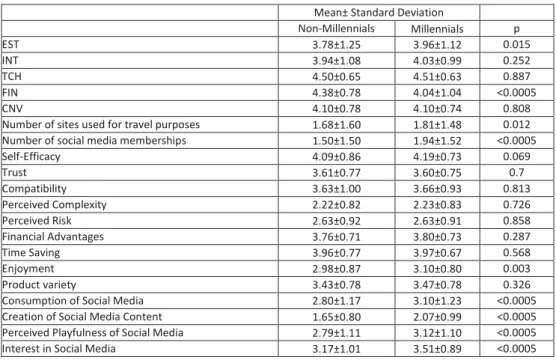
An online survey was designed in which the first section contained questions regarding travel behaviors in the past 12 months, such as the number of domestic and international trips taken, the number of online travel purchases and the number of online purchases of other products or services. The second section contained questions regarding social media use for travel purposes, such as which social media sites were used and if respondents were members of travel social media websites. It also included questions to assess respondents’ involvement with travel social media, using four dimensions, social media creation, social media consumption, perceived playfulness and interest (see Table 1). The third section of the questionnaire included questions regarding respondents’ opinion on the purchase of travel online and are presented also in Table 1. The last part of the survey included socio-demographic questions, such as nationality, education and age.
Table 1: Measures used to assess travel related behaviors
Construct Indicators References
Estimation of Purchasing Travel Online(a)
EST - If you were to purchase travel the probability of purchasing online would be…
Teo & Yeong (2003) and Grewal, Monroe & Krishnan
(1998) Intention to Purchase
Travel Online(b)
INT - I expect to purchase travel online in the near future. Limayem, Khalifa & Frini (2000) and Bigné et al. (2010)
Self-Efficacy(b)
SEF1 - I am proficient in using the Internet for travel shopping.
SEF2 - I feel confident that I can use the Internet to purchase travel. Vijayasarathy (2004) Technical resources(b) TCH - All necessary resources (e.g. computer, internet access, time)
for purchasing travel online are accessible to me.
Pavlou & Fygenson (2006) Financial Instruments(b) FIN - I have the necessary financial means (e.g. credit card, Paypal)
to purchase travel online.
New Measure
Trust(b) TRT1 -I believe online travel sites are trustworthy. Kim, Chung & Lee (2011)
TRT2 - Internet shopping is unreliable. (R)
TRT3 - Internet shopping cannot be trusted, there are too many uncertainties. (R)
Lee & Turban (2001) Compatibility(b) CMP1 - Using the internet to purchase travel is compatible with the
way I like to shop.
CMP2- Using the Internet to purchase travel fits with my lifestyle.
Vijayasarathy (2004) Perceived Complexibility(b) CXY1 - I feel online purchasing procedures are not clear to me.
CXY2 - I feel it is not easy to book travel online.
Li & Buhalis (2006)
Perceived Risk(b)
RSK1 - I do not feel comfortable giving out credit card information to make a transaction over the Internet.
Cho (2004)
RSK2 - I feel apprehensive about purchasing online. New Measure
Convenience(b)
CNV - Purchasing travel online is more convenient than regular
shopping, as I can do it anytime and anywhere. Limayem, Khalifa & Frini (2000)
Financial Advantages(b)
FAD1 - I save money by purchasing travel online.
FAD2 - Online travel shopping provides more discounts than offline travel purchasing.
Kim, Chung & Lee (2011) FAD3- Generally, travel websites offer tourism products at cheaper
prices.
Li & Buhalis (2006)
Enjoyment(b)
EJY1 - Purchasing travel online is more exciting than purchasing offline.
Verhoef & Langerak (2001) EJY2 - Purchasing travel online enjoys me more than purchasing
offline.
Childers et al. (2001)
Construct Indicators References
Time Saving(b)
TSV1-Purchasing travel online enables (will enable) me to complete shopping quickly.
Davis (1989) TSV2 - I can save time by purchasing travel online. Limayem, Khalifa & Frini (2000) TSV3- Purchasing travel online takes less time than purchasing at
travel agencies.
Cho (2004)
Product Variety(b)
PVR1 - There is a larger choice of travel products available when
purchasing online. Jensen (2009)
PVR2 - The Internet allows me to purchase travel services that are not available offline.