The
pgm
locus and pigmentation phenotype in
Yersinia pestis
Tereza Cristina Leal-Balbino
1, Nilma Cintra Leal
1, Mirna Gisele Medeiros do Nascimento
1,
Maria Betânia Melo de Oliveira
1, Valdir de Queiroz Balbino
2and Alzira Maria Paiva de Almeida
11
Fundação Oswaldo Cruz, Centro de Pesquisas Aggeu Magalhães, Departamento de Microbiologia,
Recife, PE, Brazil.
2
Universidade Federal de Pernambuco, Departamento de Genética, Recife, PE, Brazil.
Abstract
The pigmentation (pgm) locus is a large unstable area of theYersinia pestischromosome composed of a segment of iron acquisition (HPI) linked to a pigmentation segment. In this work we examined the mobility of HPI and the pigmen-tation segment in threeY. pestisisolates using successive subcultures on Congo red agar (CRA) plates. Strain P. CE 882 was shown to be highly stable while strains P. Exu 340 and P. Peru 375 dissociated into several phenotypes, PCR analysis showing evidence of changes in thepgmlocus of the derived cultures. Strains P. Exu 340 and P. Peru 375 produced previously unreported cultures positive for the pesticin/yersiniabactin outer membrane receptor (psn+) but negative for the iron-regulated protein (irp2-), suggesting the occurrence of rearrangements in this chromosomal region and either a sequential loss or the loss of separated segments. These results provide evidence that besides deletionen bloc, specific rearrangements are also involved in the deletion events for that locus.
Key words:Y. pestis, high pathogenicity island,pgm, psn.
Received: August 24, 2004; Accepted: May 10, 2005.
Introduction
The genusYersinia(Enterobacteriaceae) contains 11 species, three of which, pestis (causing bubonic plague) and the enteropathogens pseudotuberculosis and
enterocolitica, are pathogenic in humans (Perry and Fetherston, 1997), with plague strains as well as
enterocolitica biotype 1B and pseudotuberculosis sero-groups I and III also being highly pathogenic in mice (Carniel, 2001). All pathogenic strains ofYersiniacarry the conserved 70-kb plasmid associated with Yersinia viru-lence (pYV) which is essential for viruviru-lence, withY. pestis
also harboring two other plasmids (pFra and pPst) that are necessary for the expression of complete virulence in this organism (Perry and Fetherston, 1997).
The chromosome of highly pathogenic yersiniae con-tains a region involved in siderophore-mediated iron acqui-sition, which is considered a high-pathogenicity island (HPI) (Carniel, 2001). TheY. pestisHPI is located in a large unstable area of chromosomal DNA (102-kb) first identi-fied by Fetherstonet al. (1992) and named the pigmentation locus (pgm). This area is composed of a ~35 kb iron
acqui-sition segment (the HPI) linked to a ~68 kb pigmentation segment (Buchrieseret al., 1998). In theY. pestisiron ac-quisition segment there is a cluster of genes formed by the iron-regulated protein (irp), yersiniabactin siderophore biosynthetic protein (ybt) and the pesticin/yersiniabactin outer membrane receptor (psn) cluster (called thepsn clus-ter inY. pestisor the pesticin/yersiniabactin receptor pro-tein (fyuA) cluster inY. enterocolitica) which is involved in the biosynthesis of the yersiniae-siderophore (yersinia-bactin or Ybt). Besides having two different names (psn
andfyuA), this gene cluster has dual functions in that it en-codes for both the pesticin bacteriocin receptor and Ybt (Carniel, 2001; Rakinet al., 1994, 1996). The hemin stor-age (hms) locus is located in the pigmentation segment and is responsible for the Congo red binding pigmented pheno-type (pgm+) of colonies grown on Congo red-agar plates (CRA) (Buchrieseret al., 1998; Fetherston e Perry, 1994; Pendrak and Perry, 1993).
InY. pestis,the iron acquisition and transport systems are also under the regulation of a ferric uptake regulation (Fur) protein encoded by thefurgene located in another area of the chromosome outside the iron acquisition seg-ment (Staggs and Perry, 1992).
Two copies of the insertion sequence (IS) IS100flank the 102-kb region ofY. pestis.Homologous recombination between two IS100sequences leads to the deletion of the
www.sbg.org.br
Send correspondence to Tereza Cristina Leal-Balbino. Fundação Oswaldo Cruz, Centro de Pesquisas Aggeu Magalhães, Departa-mento de Microbiologia, Campus da Universidade Federal de Per-nambuco s/n, Cidade Universitária, 50670-420 Recife, PE, Brazil. E-mail: [email protected].
segment responsible for the pigmentation (Pgm-) pheno-type (Fetherstonet al., 1992). Pgm- cultures are avirulent in mice inoculated via the peripheral route, except when coadministered with iron (Fetherstonet al., 1992; Jackson and Burrows, 1956). These deletions were believed to oc-curen bloc. However, the existence of Pgm-irp2+ cultures (Itemanet al., 1993) suggests that the pigmentation seg-ment is mobile and independent of the iron acquisition segment. Buchrieseret al. (1998) identified several rear-rangements involved in different phenotypes of colonies developed on CRA plates from cultures of different geo-graphical origin.
The aim of the work described in this paper was to de-termine the mobility of HPI and the pigmentation segment inY. pestisisolates through successive subcultures on CRA plates and using PCR for the determination of the genes from the two segments of the pigmentation locus andfur.
Material and Methods
Bacterial isolates and culture conditions
The study involved threeY. pestisisolates: an early isolate (P. Exu 340) derived from the bone marrow of a fin-ger from a fatal human case of plague in 1969; a more re-cent Brazilian isolate (P. CE 882) derived from a blood culture from a plague case in 1997 in the Brazilian State of Ceará; and a 1994 isolate (P. Peru 375) from a Peruvian plague patient. The Girard-Robic EV76 vaccinal strain served as the pigmentation phenotype control. These strains are held at the culture collection of the Department of Microbiology, CPqAM (Leal-Balbinoet al., 2004). For
this work, the parent cultures were reactivated by growing them at 28 °C in brain heart infusion (BHI) broth, (Difco, USA) for 24 h and then plating on blood agar base (BAB; Difco, USA) for 48 h.
After reactivation, the cultures were submitted to suc-cessive subculturing on Congo red agar (CRA) plates incu-bated at 26 °C for 4 days (Surgalla et al., 1970) for phenotypic observation. There were five different types of colonies: red (R), white (W), half red/half white (RW), red with a thin white border (RWB) and white with a red pin-point center (WRP). Phenotypically selected colonies from the CRA plates were grown in brain heart infusion (BHI) broth and their genomic DNA extracted according to Maniatiset al. (1982) for PCR assay.
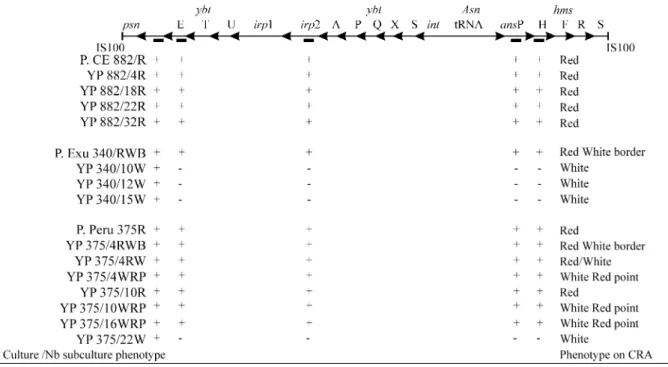
The number of subcultures and colonies analyzed varied for each parent culture, the derivative strains were allocated a strain number commencing with YP (for Y. pestis) followed by the parent strain number, subculture number and phenotype (Figure 1).
PCR analysis
Parent and derivative cultures of strains P. CE 882, P. Exu 340 and P. Peru 375 were analyzed for the presence of genes from the iron acquisition (psn,ybtE, irp2) and the pigmentation segments (hmsH) using PCR with primers derived from published sequences (Rakin and Heeseman, 1995; Buchrieseret al.1999; Guilvoutet al.1993; Schubert
et al.1998).
To further understand the events involved in the mod-ifications of thepgmlocus, the presence of theansPgene,
located in the central area of this locus (between the iron
quisition and the pigmentation segments), was investigated with specific PCR primers obtained using the ‘PrimerSe-lect’ program (DNAstar, Inc.).
The role of Fur in the different phenotypes obtained on CRA plates from the parent cultures was examined by determining the presence of thefur gene by PCR using primers derived from the published sequence of this gene (Hinnebushet al.1998).
The PCR reactions forpsn,ybtE, irp2, hmsH,furand L-asparagine permease (ansP) genes, consisted of 20 ng of strain DNA, 1U ofTaqDNA polymerase (CENBIOT, BR), 160mM of each dNTP (Amersham Biosciences of Brazil Ltda, BR), 1.5 mM MgCl2, 20 pmol of each primer, 50 mM
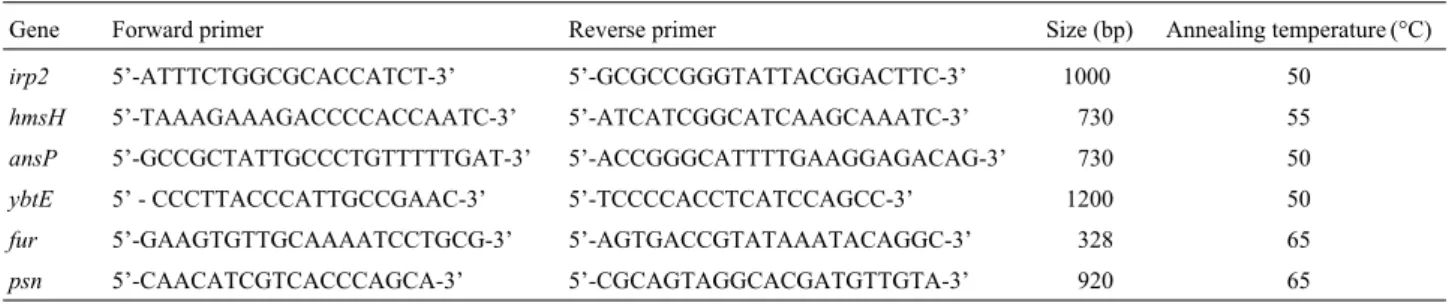
KCl and 10 mM Tris-HCl-pH 8 in a final volume of 25mL. Amplifications were performed in a thermocycler (Perkin Elmer, USA) programmed for 25 cycles of 1 min at 94 °C, 2 min at the annealing temperatures (Tm) and 3 min at 72 °C, finishing with a final elongation step of 7 min at 72 °C. The sequences of the forward primer (FP), reverse primer (RP) the size of the expected segments and Tm are shown in Table 1. The annealing regions of the primers on the targeted genes (pgmlocus) were confirmed using the ‘PrimerSelect’ program.
Construction of the HmsH probe and hybridization
The presence of the pigmentation segment was deter-mined in the RWB and WRP phenotypes by amplification of thehmsH gene and the three phenotypes (R, RWB and WRP) were compared with regard to this genomic region. Total DNA of the parent strains (P. Exu 340, P. CE 882 and P. Peru 375) and derived cultures was digested with the
DraI andAvaI restriction enzymes and hybridized with a probe directed to thehmsH gene.
The HmsH probe was obtained by PCR and labeled during the amplification reaction using the DIG-dNTP DNA Labeling and Detection Kit (Boehringer Mannheim, DE) following the manufacturer’s instructions.
Based on the restriction map of thehmsH gene ob-tained with the ‘PrimerSelect’ program we choseDraI and
AvaI to digest the total DNA extracted from theY. pestis
cultures. The restriction fragments were separated by elec-trophoresis, transferred by vacuum to nylon membranes us-ing the VacuGeneTMXL (Amersham Biosciences of Brazil
Ltda, BR) system and hybridized with the HmsH probe. Pre-hybridization (for 30 min) and overnight hybridization were performed at 65 °C in a hybridization oven (Cole-Parmer, USA) following the protocol provided with the kit (Amersham Biosciences of Brazil Ltda, BR).
Analysis of thepsngene sequence
To confirm that the segment amplified by PCR was really part of thepsngene, the amplifiedpsnsegments of theY. pestiscultures were eluted from the gel, purified us-ing the Concert Nucleic Acid Purification Kit (Gibco, USA) and analyzed in an ABI 310 automatic sequencer (Applied Biosystems, USA). The nucleotide sequences ob-tained were analyzed with the BLAST program (www. ncbi.nlm.nih.gov) (Altschulet al., 1997).
To compare the segments of thepsngene amplified from the different cultures, the PCR products were digested withEcoRV andBclI and the fragments separated by aga-rose gel electrophoresis.
Nucleotide sequence accession number
The Genbank accession number for the sequence of thepsngene of strain YP 340/15W is AY461411.
Results and Discussion
Pigmentation analysis of the colonies grown on CRA plates revealed important differences among the three iso-lates studied. Strain P. CE 882 has proved to be highly sta-ble, since its isolation in 1997 (Leal and Almeida, 1999) it has produced only red (R or Pgm+) colonies on CRA plates and no phenotypic alteration has been detected through 32 subcultures (Figure 1).
Strain P. Exu 340 was found to be unstable because when it was obtained in 1969 and first analyzed it was Pgm+ but developed red colonies with a thin white border (RWB). After 10 subcultures of the RWB colonies only white (W or Pgm-) colonies were produced on CRA plates (Figure 1).
Strain P. Peru 375 also proved to be unstable, with its initially red colonies producing five different types of sub-culture colonies (R, W, RW and WRP). After the 22nd sub-culture from RWB or WRP, completely white colonies were observed (Figure 1).
Table 1- Primers used in the PCR analysis.
Gene Forward primer Reverse primer Size (bp) Annealing temperature (°C)
irp2 5’-ATTTCTGGCGCACCATCT-3’ 5’-GCGCCGGGTATTACGGACTTC-3’ 1000 50
hmsH 5’-TAAAGAAAGACCCCACCAATC-3’ 5’-ATCATCGGCATCAAGCAAATC-3’ 730 55
ansP 5’-GCCGCTATTGCCCTGTTTTTGAT-3’ 5’-ACCGGGCATTTTGAAGGAGACAG-3’ 730 50
ybtE 5’ - CCCTTACCCATTGCCGAAC-3’ 5’-TCCCCACCTCATCCAGCC-3’ 1200 50
fur 5’-GAAGTGTTGCAAAATCCTGCG-3’ 5’-AGTGACCGTATAAATACAGGC-3’ 328 65
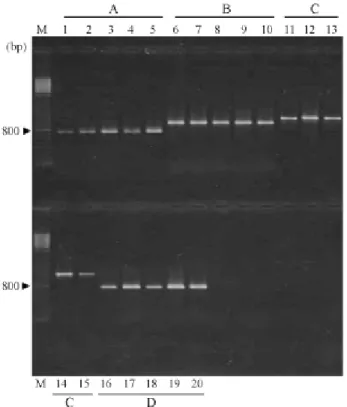
PCR using primers directed to genes of both seg-ments of thepgmlocus resulted in amplification of all the expected DNA segments of the correct sizes corresponding to the genes irp2 (1000 bp), ybtE (1200 bp) and hmsH (730 bp) in the parent strain P. CE 882 and its derivative cultures (Figures 1, 2B-D). There was also amplification of all the targeted genes of strain P. Exu 340 (RWB) and of the different P. Peru 375 phenotypes (R, RWB and WRP) ana-lyzed. These genes were not amplified in the white cultures derived from strains P. Exu 340 and P. Peru 375 (Figure 1).
A segment of the expected size (730 bp) for theansP
gene was amplified in the parent strain P. CE 882 (R) and in the four (Pgm+) derivative cultures analyzed after the 4th, 18th, 22ndand 32ndsubcultures (Figures 1, 2A). This seg-ment was also amplified in cultures of P. Exu 340 (RWB), P. Peru 375 (R) and in the phenotypes RWB and WRP, ana-lyzed after the 4th, 10thor 16thsubcultures from P. Peru 375. However, there was no amplification in the three white cul-tures obtained (YP 340/10W, YP 340/12W, YP 340/15W), respectively from the 10th, 12th, and 15thsubcultures of P. Exu 340 and from the white culture (YP 375/22W) ob-tained from the 22ndsubculture of P. Peru 375 (Figure 1). These results suggest that the central region of thepgm lo-cus is complete in the R, RWB and WRP phenotypes and is deleted in the W phenotype.
The PCR analysis showed that thepgmlocus is simi-lar in the R, RWB and WRP phenotypes. However, the
HmsH probe only recognized the R and RWB phenotypes and the hybridization profiles obtained in the two pheno-types were identical (Figure 3). Despite the phenotypic dif-ference, no alteration was detected in thepgmlocus of the R and RWB isolates using either PCR or hybridization with the probe. The WRP phenotype was not recognized by the probe in spite of PCR amplification of thehmsH gene. This phenotype is probably composed of a mixed population, where the number of Pgm+ cells is too small and the target is not detected by hybridization, although efficiently ampli-fied by PCR.
The amplification product of the expected size for thefurgene (328 bp) was obtained in all the parent and de-rivative cultures studied, independent of whether the phe-notype was R, RWB, WRP or W, suggesting that the phenotypic modifications are not related to this gene (Fi-gure 4).
Amplification of a segment of the expected size (920 bp) for thepsngene was observed in all cultures of strains P. CE 882, P. Exu 340, P. Peru 375 and derivative cultures, independent of their phenotype on CRA plates. Unex-pectedly, this segment was also amplified in the white cul-tures (W) derived from strains P. Exu 340 and P. Peru 375,
Figure 2- PCR products from primers directed to the genes:ansp(A);
irp2(B);ybtE (C) andhmsH (D) and the strains P. CE 882R (lines 1, 6, 11, 16); YP 882/4R (lines 2, 7, 12, 17); YP 882/18R (lines 3, 8, 13, 18); YP 882/22R (lines 4, 9, 14, 19); and YP 882/32R (lines 5, 10, 15, 20); M = 100 bp DNA ladder.
Figure 3- Hybridization with the HmsH probe and DNA from strain P. CE 882R as positive control (lines 1); P. Exu 340/RWB (line 2); YP 375/4RWB (line 3); YP 375/16WRP (line 4); and YP 375/22W (line 5), digested withDraI (A) andAvaI (B).
in spite of the absence of theirp2,ybtE,ansP and hmsH genes in these cultures (Figures 1, 5A).
Analysis of the results with the BLAST program re-vealed high homology between thepsngene ofY. pestisand thefyuA ofY. enterocoliticaandY. pseudotuberculosisand we also observed that the deduced sequence of the protein was similar to that of the FyuA protein ofY. enterocolitica,
Y. pseudotuberculosisandE. coli. These results confirm the presence of thepsngene in theirp2- Pgm-Y. pestiscultures
analyzed, and they also demonstrate high homology for the
psngene among yersiniae.
Comparison of agarose gel electrophoresis bands of the segments of thepsngene amplified in the different cul-tures and digested withBclI andEcoRV revealed an identi-cal restriction pattern in all the cultures (Figure 5B-C).
It has been reported that inY. enterocoliticadeletion of thefyuAirp2genes occurs only in thefyuA part of the gene cluster. Three different types of cultures (fyuA+ irp2+, fyuA-irp2-andfyuA- irp2+) were observed inY. enterocoliticaby Rakinet al. (1994) but thepsn + irp2- iso-late found among theY. pestisstrains in the present study has not been previously described.
The irp1, irp2, fyuA fragment is unstable in Y. enterocolitica and Y. pseudotuberculosis. Lesic et al.
(2004) showed that the excision of HPI in Y. pseudotuberculosis requires the combined actions of an integrase and a recombination directionality factor. In Y. enterocolitica, this instability is due to IS1328 or other in-sertion elements adjacent tofyuA (Fetherstonet al., 1992; Rakin and Heeseman, 1995). The deletion may involve the
fyuA gene only or bothfyuA andirp2(Rakin and Heese-man, 1995).
The finding ofpsn + irp2- cultures suggests the oc-currence of rearrangements in this region and a sequential loss or the loss of separated segments. These events are also probably due to the presence of repetitive sequences (RS4 and RS5) or of insertion sequences (IS100) flanking theY. pestisHPI (Fetherstonet al., 1992; Buchrieseret al., 1998).
Our results suggest that the alteration of the 102-kb region ofY. pestisinvolves not only deletion en bloc by homologue recombination between IS100 sequences flank-ing the region but also other specific rearrangements in this segment.
Acknowledgments
We thank Dr Osvaldo Pompílio (CPqAM/FIOCRUZ) for advice during the work. We are grateful to Silvana Santos and Yara Nakasawa for their technical assistance and the Brazilian Research Council Conselho Nacional de Desenvolvimento Científico e Tecnológico (CNPq) for fi-nancial support.
References
Altschul SF, Madden TL, Schaffer AA, Zhang J, Zhang Z, Miller W and Lipman DJ (1997) Gapped BLAST and PSI-BLAST: A new generation of protein database search programs. Nu-cleic Acids Res 25:3389-3402.
Buchrieser C, Prentice M and Carniel E (1998) The 102-kilobase unstable region ofYersinia pestiscomprises a high-patho-genicity island linked to a pigmentation segment which un-dergoes internal rearrangement. J Bacteriol 180:2321-2329. Buchrieser C, Rusniok C, Frangeul L, Couve E, Billault A, Kunst
F, Carniel E and Glaser P (1999) The 102-kilobase pgm lo-cus ofYersinia pestis: Sequence analysis and comparison of Figure 5- PCR products from the primers directed to the genepsn(A) and
selected regions among different Yersinia pestis and
Yersinia pseudotuberculosis strains. Infect Immun 67:4851-61.
Carniel E (2001) The Yersinia high-pathogenicity island: An iron-uptake island. Microbiol Infect 3:561-569.
Fetherston JD, Schuetze P and Perry RD (1992) Loss of the pig-mentation phenotype inYersinia pestisis due to the sponta-neous deletion of 102 kb of chromosomal DNA which is flanked by a repetitive element. Mol Microbiol 6:2693-2704.
Fetherston JD and Perry RD (1994) The pigmentation locus of
Yersinia pestisKIM6+ is flanked by an insertion sequence and includes the structural genes for pesticin sensivity and HMWP2. Mol Microbiol 3:697-708.
Guilvout I, Mercereau-Puijalon O, Bonnefoy S, Pugsley AP and Carniel E (1993) High-molecular-weight protein 2 of
Yersinia enterocoliticais homologous to AngR ofVibrio anguillarumand belongs to a family of proteins involved in nonribosomal peptide synthesis. J Bacteriol 175:5488-5504. Hinnebusch BJ, Gage KL and Schwan TG (1998) Estimation of vector infectivity rates for plague by means of a standard curve-based competitive polymerase chain reaction method to quantifyYersinia pestisin fleas. Am J Trop Med Hyg 58:562-569.
Iteman I, Guiyoule A, Almeida AMP, Guilvout I, Baranton G and Carniel E (1993) Relationship between loss of pigmentation and deletion of the chromosomal iron-regulatedirp2gene in
Yersinia pestis: Evidence for separate but related events. In-fect Immun 61:2717-2722.
Jackson S and Burrows TW (1956) The virulence enhancing ef-fect of iron on non-pigmented mutants of virulent strains of
Pasteurella pestis. Brit J Exp Pathol 37:577-583.
Leal-Balbino TC, Leal NC, Lopes CV and Almeida AM (2004) Differences in the stability of the plasmids ofYersinia pestis
culturesin vitro: Impact on virulence. Mem Inst Oswaldo Cruz 99:727-732.
Leal NC and Almeida AMP (1999) Diagnosis of plague and iden-tification of virulence markers inYersinia pestisby multi-plex-PCR. Rev Inst Med Trop São Paulo 41:339-342. Lesic B, Bach S, Ghigo J-M, Dobrindt U, Hacker J and Carniel E
(2004) Excision of the high-pathogenicity island ofYersinia pseudotuberculosis requires the combined actions of this cognate integrase and Hef, a new recombination directionality factor. Mol Microbiol 52:1337-1348. Maniatis T, Frisch E and Sambrook J (1982) Molecular Cloning:
A Laboratory Manual. Cold Spring Harbor Laboratory, NY, pp 368-369.
Pendrak ML and Perry RD (1993) Proteins essential for expres-sion of the Hms+ phenotype of Yersinia pestis. Mol Microbiol 8:857-864.
Perry RD and Fetherston JD (1997)Yersinia pestis- Etiologic agent of plague. Clin Microbiol Rev 10:35-66.
Rakin A, Saken E, Harmsen D and Heeseman J (1994) The pesticin receptor ofYersinia enterocolitica:A novel viru-lence factor with dual function. Mol Microbiol 13:253-263. Rakin A and Heeseman J (1995) Virulence-associatedfyuA/irp2
gene cluster ofYersinia enterocoliticabiotype 1B carries a novel insertion sequence IS1328. FEMS Microbiol Lett 129:287-292.
Rakin A, Boolgakowa E and Heeseman J (1996) Structural and functional organization of theYersinia pestis bacteriocin pesticin gene cluster. Microbiology 142:3415-3424. Schubert S, Rakin A, Karch H, Carniel E and Heesemann J (1998)
Prevalence of the “high-pathogenicity island” ofYersinia
species amongEscherichia colistrains that are pathogenic to humans. Infect Immun 66:480-5.
Staggs TM and Perry RD (1992) Fur regulation inYersinia spe-cies. Mol Microbiol 6:2507-2516.
Surgalla MJ, Beesley ED and Albizo JM (1970) Pratical applica-tions of new laboratory methods for plague investigaapplica-tions. Wld Hlth Org Bull 42:993-997.