THE M/G/ ∞ QUEUE BUSY PERIOD
DISTRIBUTION EXPONENTIALITY
FERREIRA, Manuel Alberto M., (PT), ANDRADE, Marina, (PT)
Abstract. Infinite servers queuing systems are often used to solve a large number of practical
problems, namely in Engineering, Biology, Management, Finance and Sociology. The study of the M/G/∞ systems busy period is very important. Yet it is a very difficult task. This paper presents a service time distributions collection for which the length of the busy period is almost exponential. It is also shown that in heavy-traffic conditions, for a certain class of service time distributions, the length of the busy period of the M/G/∞ systems is approximately exponentially distributed. Thus, in all these cases, the study of this busy period is much simpler. It is also exemplified, with the power function and the Pareto service distributions, that it is possible to have in some particular situations an approximately exponential behaviour for the M/G/∞ queue busy period length.
Key words. M / G / ∞ queue, busy period, exponential distribution, power function distribution,
Pareto distribution.
Mathematics Subject Classification: 60K35.
1 Introduction
The M / G / ∞ queue is a system where customers arrive according to a Poisson process at rate . Each customer receives a service which length is a positive random variable with mean and distribution function , and . When a customer arrives its service starts at once (i.e., there are infinite servers) and it is independent both from the services of the other customers and from the arrival process. The quantity is the traffic intensity.
Infinite servers queuing systems are often used to solve a large number of practical problems, namely in Engineering, Biology, Management, Finance and Sociology. See, for instance, (Syski, 1960, 1986), (Kleinrock, 1975), (Kelly, 1979), (Hershey, Weiss and Morris, 1981), (Carrillo, 1981), (Figueira and Ferreira, 1999) and (Ferreira, Andrade and Filipe, 2009).
Aplimat – Journal of Applied Mathematics
volume 4 (2011), number3
250
In this paper some more results will be given about the busy period of the M / G / ∞ queue.
For any queuing system, a busy period begins when a customer arrives at the system, finding it empty, ends, when a customer leaves the system, letting it empty, and in it there is always at least one customer present. So, in a queuing system, there is a sequence of idle and busy periods.
The length of an idle period of a M / G / ∞ queue is a random variable, called , which distribution is exponential with parameter , as happens in any queue where the arrival process is Poisson. For the random variable , length of the busy period of the M / G / ∞ queue, the situation is not so simple.
Tackács (1962) studied the busy cycle, a busy period followed by an idle period, for the M / G / ∞ queue. Its length is a random variable and, evidently, . That author showed that and are independent and deduced the expression for the Laplace-Stieltjes transform of . Using this expression and the fact that and are independent, (Stadje, 1985) deduced the expression
0 1 1 01
1
t st G v dvB s
s
e
dt
(1)for the Laplace-Stieltjes transform of and it is possible to show that
e 1 E B
(2)which is independent of the form of . This is not, however, valid for higher order moments. The inversion of (1) to obtain b , the probability density function of , is very hard to carry out.
tFor a particular service distributions collections, see (Ferreira, 1998), it will be shown that it is easy to invert (1). And simple expressions for related to the exponential distribution will be obtained. Then, it is deduced that for a large class of service distributions, since and are great enough, b is approximately exponential.
tFinally, service distributions cases for which does not occur necessarily lim ( )0
G t
, as it happens
with power function and Pareto ones, are studied in order to identify situations for which has a similar behaviour.
Aplimat – Journal of Applied Mathematics
volume 4 (2011), number 3 251
2 The M/G/ ∞ Systems with Almost Exponential Busy Periods Lemma 1 If
1
1
, 0, 1 1 t e G t t e e e
(3)Bis exponentially distributed at rate e
, with an atom at the origin which value is
e . DemonstrationSubstituting (3) in (1) and inverting the consequent B
s , it is obtained the following probability density function:
1 0 t , 1
e e e e t e t b e t( is the Dirac function).
Notes - For 0,
s e e e e s B 1 and then
e t e e e t e t b 1 .- Note that for this distribution the Laplace-Stieltjes transform of Z is
s e e s e e e e s s Z 1 .That is: Z is exponentially distributed at rate e
and so the points in time at which begin busy periods occur according to a Poisson process at ratee.
- For 1 e ,
1 1 1 1 e s e sB and B is exponential with mean
1
e
. Now the situation for Z is not as simple as for 0. It is easy to show, following the same procedures as in the precedent case that the probability density function of Z is
Aplimat – Journal of Applied Mathematics volume 4 (2011), number3 252
, 0 2 1 e e t e t z e t t .3 Distributions of B when the Service Distribution is such that lim ( ) 0
G t
An example of a distribution for which lim ( ) 0
G t
is the exponential one.
From (1), see for instance (Stadje, 1985) for the distribution function of B the following expression is obtained
.1 , 0 1 1 1 * 1 1 1 0 t e e dt t G e t B n n n dv v G t
(4) where* is the operator convolution.Fixing , if lim ()0,1 1
Gt Gt
for great enough. And, if is great enough, then 1 1
e . Thus
t dv v G e e dt t G e t
1 1 01 and
n
n n t e e t B
1
1 * 1 1 . The Laplace-Stieltjes transform of the second member is
s
e
e
e
s
e
s
1
and, after its inversion, it is obtained
e t e e 1 1 .So it results that in such conditionsB
t 1eet . Then Lemma 2For service distributions verifying lim ()0,
G t
fixing , for and great enough, B is
approximately exponentially distributed.
In order to feel the meaning of and great enough, the coefficient of variation of B,CV
BAplimat – Journal of Applied Mathematics
volume 4 (2011), number 3 253
M/G1/ (service distribution given by (3) for 0), M/D/ (service distribution constant) and
M/M/ (service distribution exponential) systems for .5 ,1 ,10 ,20 ,50 ,100 with 1(therefore
).
According to (Kendall and Stuart, 1979)
B E B E B E B CV 2 2 (5),
2 2
3 2 3 2 3 1 2 3 B E B E B E B E B E B E B (6) and
2 2
2 2 4 2 2 3 4 2 3 6 4 B E B E B E B E B E B E B E B E B (7).For an exponential distribution,CV 1, 2 4 and 2 9. From Lemma 1 with 0, to the M/G1/ queue
1
! , 1,2,... n e n e B E n n (8).With n1 (2) results from (8).
For the remaining systems, note that (1) is equivalent to
B
s 1
C
s 1
1sC
sbeingC
s e
G
t
dt t dv v G st
1 0 1 0 . Differentiating n times, using Leibnitz’s formula and
makings0, results
1
0 1
1 .
0 , 1,2,... 1 1 1
n C B E p n e nC e B E n n n n n p n p p (9) being
0
1
, 0,1,2,... 0 1 0
t e Gt dtn C t dv v G n n (10). The expression (9) gives a recursive method to compute E
Bn ,n1,2,... as a function of
0,n0,1,2,...C n
Making n1 (2) results from (9) - For the M/D/ system
e C 0 0 1
0 e
nC 1
0,n1,2,... C n n n (11)Aplimat – Journal of Applied Mathematics
volume 4 (2011), number3
254
and it is possible to compute any E
Bn exactly.- For the M/M/ system it is not possible to obtain expressions as simple as (11) to the
n
0C . It is mandatory to compute numerically integrals with infinite limits and so approximations must be done.
The results are:
System ρ M /G1 / M / D / M / M / .5 2.0206405 .40655883 1.1109224 1 1.4710382 .56798436 1.1944614 10 1.0000454 .99959129 1.1227334 20 1.0000000 .99999999 1.0544722 50 1.0000000 .99999999 1.0206393 100 1.0000000 .99999999 1.0101547 Table 1: CV[B] System ρ M /G1 / M / D / M / M / .5 9.5577742 6.0360869 5.0972761 1 5.5867425 4.5899937 5.4821324 10 4.0000000 4.0000000 4.1511831 20 4.0000000 4.0000000 4.0326858 50 4.0000000 4.0000000 4.0049427 100 4.0000000 4.0000000 4.0012250 Table 2: γ1[B] System ρ M /G1 / M / D / M / M / .5 15.983720 11.142336 10.454678 1 10.878212 9.6137084 10.923071 10 9.0000000 9.0000000 9.1617573 20 9.0000000 9.0000000 9.0337903 50 9.0000000 9.0000000 9.0550089 100 9.0000000 9.0000000 9.0012250 Table 3: γ2[B]
Aplimat – Journal of Applied Mathematics
volume 4 (2011), number 3 255
The parameters studied assume values that are typical of an exponential distribution, after , for the M/G1/ and M/D/ queues. For the M/M/ system, only after 20 it can be said that
those values are the ones of an exponential distribution.
Finally note that the convolution of the exponentials with parameters and e gives an approximate expression for Z t , distribution function of Z , in the same condition of Lemma 2:
1
,
0
1
t t e pe
e
e
z t
t
e
(12).4 Power Function Service Distribution
If the service distribution is a power function with parameter C,C 0
1 , 1 1 0 t t t t G c , 1 C C and 0 1. So
1, 1 1 0 , 0 lim t t t G C and Clim 1For this service time distribution, since and C are great enough,
. 1 0 , 1 ) ( 1 ( 01 t e e t G e t t dv v G
Computing the Laplace-Stieltjes transform of (4) with this approximation it is obtained first
1
1
.
0 1 0 1 0
e
e
dt
e
dt
e
s
s
e
s t s t s t stBut, for great enough, this is approximately
s
. So, from (4), assuming the Laplace-Stieltjes transform of
1
0
,
1
)
(
1
(
01
t
e
t
G
e
t dv v G
as being s Aplimat – Journal of Applied Mathematics
volume 4 (2011), number3
256 Lemma 3
In an M/G/ queue where the service distribution is a power function, for near 1, since and
are great enough B is approximately exponential with mean
e
.
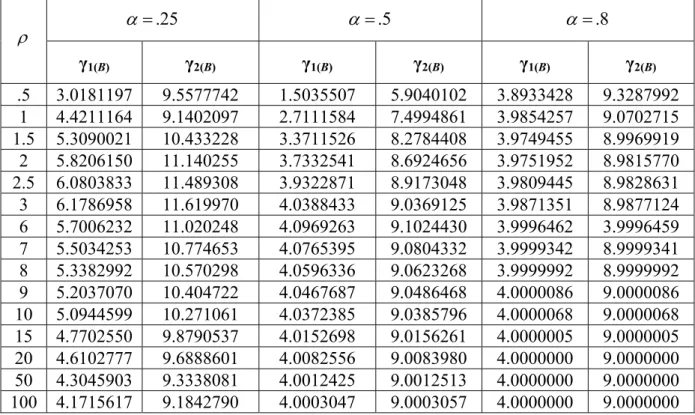
For this system the values of 1
B and 2
B were computed for .25, .5 and .8 making, in each case, take values from .5 till 100. The results are: .25 .5 .8 γ1(B) γ2(B) γ1(B) γ2(B) γ1(B) γ2(B) .5 3.0181197 9.5577742 1.5035507 5.9040102 3.8933428 9.3287992 1 4.4211164 9.1402097 2.7111584 7.4994861 3.9854257 9.0702715 1.5 5.3090021 10.433228 3.3711526 8.2784408 3.9749455 8.9969919 2 5.8206150 11.140255 3.7332541 8.6924656 3.9751952 8.9815770 2.5 6.0803833 11.489308 3.9322871 8.9173048 3.9809445 8.9828631 3 6.1786958 11.619970 4.0388433 9.0369125 3.9871351 8.9877124 6 5.7006232 11.020248 4.0969263 9.1024430 3.9996462 3.9996459 7 5.5034253 10.774653 4.0765395 9.0804332 3.9999342 8.9999341 8 5.3382992 10.570298 4.0596336 9.0623268 3.9999992 8.9999992 9 5.2037070 10.404722 4.0467687 9.0486468 4.0000086 9.0000086 10 5.0944599 10.271061 4.0372385 9.0385796 4.0000068 9.0000068 15 4.7702550 9.8790537 4.0152698 9.0156261 4.0000005 9.0000005 20 4.6102777 9.6888601 4.0082556 9.0083980 4.0000000 9.0000000 50 4.3045903 9.3338081 4.0012425 9.0012513 4.0000000 9.0000000 100 4.1715617 9.1842790 4.0003047 9.0003057 4.0000000 9.0000000
Table 4: γ1(B) and γ2(B) considering power function service distribution
The analysis of the results shows a strong trend of γ1(B) and γ2(B), to 4 and 9, respectively, after
10
. This trend is faster the greatest is the value of .
5 Pareto Service Distribution
Through this section only some examples will be presented. So consider a Pareto distributions such that
, 0 , , 1 1 3 k k t t k k t t G (13) Then, k 2 3 Aplimat – Journal of Applied Mathematics
volume 4 (2011), number 3 257
The values calculated for γ1(B) and γ2(B) with 1 and, so, were
γ1(B) γ2(B) .5 1028.5443 1373.4466 1 1474.7159 1969.0197 10 38.879220 54.896896 20 4.0048588 9.0049233 50 4.0000000 9.0000000 100 4.0000000 9.0000000 Table 5: γ1(B) and γ2(B) considering the Pareto service distribution given by (13)
and show a strong trend from γ1(B) and γ2(B) to 4 and 9, respectively, after20. This is natural
because, in this case, the convergence of to infinite imposes the same behaviour to k . And so, after (13), it resultslim
0. G t
But, considering now a Pareto distribution, such that
, 1 4 . 4 . 4 . , 1 1 t t t t G (14), 1 4 . (See, again, Murteira, 1979) and the values got for γ1(B) and γ2(B) in the same
conditions of the previous case are γ1(B) γ2(B) .5 10.993704 16.675733 1 6.8553306 12.010791 10 4.5112470 9.5724605 20 4.4832270 9.5397410 50 4.4669879 9.5208253 100 4.4616718 9.5146406 Table 6: γ1(B) and γ2(B) considering the Pareto service distribution given by (14)
and do not go against the hypothesis of the existence of a trend from γ1(B) and γ2(B) to 4 and 9,
respectively, although much slower than in the previous case. But, now, the convergence of to infinite implies the convergence of to 1. So
1 .4 .4 4 . , 0 lim t t t t G Aplimat – Journal of Applied Mathematics
volume 4 (2011), number3
258
6 Conclusions
The exponential distribution is very simple and quite useful from a practical point of view. It has been frequently used to study queuing systems. Among its various properties, it is remarkable its lack of memory, i.e.:P
T t yT y
P
T t
, where T is an exponential random variable.The determination of b
t is very fastidious for any kind of queuing system and not only for theM/G/ ∞ queue.
Conditions under which B is exponential or approximately exponential for the M/G/ ∞ queue were derived.
Many quantities of interest in queues are insensible. This means that they depend on the service distribution only by its mean. Thus it is indifferent which service distribution is being considered. But using those given by (3), result quasi-exponential or exponential busy periods. And, for these service distributions, all distributions related to the busy cycle have simple forms and are related to the exponential distribution.
In section 3, for a large class of distributions under conditions of heavy- traffic, it was proved that
B is approximately exponential irrespectively of the service distribution.
But, for instance, if the service distribution is a power function, as it was seen, such conditions can not hold, at least in the same way. However, for near 1 and and great enough, it is possible to guarantee that B is approximately exponentially distributed.
And in the case of the Pareto distribution, where G
t 0 for great enough does not necessary hold. Although it is not possible to give identical guarantees to those of the power function service, the results got for γ1(B) and γ2(B) are not against that, for great enough, B is approximatelyexponentially distributed.
References
[1] CARRILLO, M. J.: Extensions of Palm’s Theorem: A Review. In Management Science, Vol. 37, No 6, pp. 739-744, 1991.
[2] FERREIRA, M. A. M.: Application of Ricatti Equation to the Busy Period Study of the
MG System. In Statistical Review, Vol I. INE, pp. 23-28, 1998.
[3] FERREIRA, M. A. M.: MG Queue Heavy-Traffic Situation Busy Period Length Distribution (Power and Pareto Service Distributions). In Statistical Review, Vol. 1. INE, pp.
27-36, 2001.
[4] FERREIRA, M. A. M.: The Exponentiality of the MG Queue Busy Period. In Actas das
XII Jornadas Luso-Espanholas de Gestão Científica, Volume VIII- Economia da Empresa e Matemática Aplicada. UBI, Covilhã, Portugal. pp. 267-272, 2002.
[5] FERREIRA, M. A. M.: Statistical Queueing Theory. Entry in Lovric, M. (ed.), International Encyclopaedia of Statistical Science. Springer. Forthcoming.
[6] FERREIRA, M. A. M. and Andrade, M.: The Ties Between the M/G/ Queue System Transient Behaviour and the Busy Period. In International Journal of Academic Research 1
Aplimat – Journal of Applied Mathematics
volume 4 (2011), number 3 259
[7] FERREIRA, M. A. M. and ANDRADE, M.: Looking to a M/G/ system occupation through
a Ricatti equation. In Journal of Mathematics and Technology, 1(2), pp. 58-62, 2010.
[8] FERREIRA, M. A. M. and ANDRADE, M.: M/G/ System Transient Behavior with Time Origin at the Beginning of a Busy Period Mean and Variance. In Aplimat- Journal of Applied
Mathematics, 3(3), pp. 213-221, 2010.
[9] FERREIRA, M. A. M. and ANDRADE, M.: M/G/ Queue Busy Period Tail. In Journal of Mathematics and Technology, 1(3), 11-16, 2010.
[10] FERREIRA, M. A. M. e RAMALHOTO M. F.: Estudo dos parâmetros básicos do Período
de Ocupação da Fila de Espera MG. In A Estatística e o Futuro da Estatística. Actas do I Congresso Anual da S.P.E.. Edições Salamandra, Lisboa, 1994
.
[11] FERREIRA, M. A. M., ANDRADE, M. and FILIPE, J. A.: The Ricatti Equation in the
MG Busy Cycle Study. In Journal of Mathematics, Statistics and Allied Fields 2(1),
2008.
[12] FERREIRA, M. A. M., ANDRADE, M. and FILIPE, J. A.: Networks of Queues with Infinite
Servers in Each Node Applied to the Management of a Two Echelons Repair System. In
China-USA Business Review 8(8), pp. 39-45 and 62, 2009.
[13] FIGUEIRA, J. and FERREIRA, M. A. M.: Representation of a Pensions Fund by a Stochastic
Network with Two Nodes: An Exercise. In Portuguese Revue of Financial Markets, Vol. I, No
3, 1999.
[14] HERSHEY, J. C., WEISS, E. N. and MORRIS, A. C.: A Stochastic Service Network Model
with Application to Hospital Facilities. In Operations Research, Vol. 29, No 1, pp. 1-22, 1981.
[15] KELLY, F. P.: Reversibility and Stochastic Networks. New York: John Wiley and Sons, 1979.
[16] KENDALL and STUART: The Advanced Theory of Statistics. Distributions Theory. London. Charles Griffin and Co., Ltd. 4th Edition, 1979.
[17] KLEINROCK, L.: Queueing Systems. Vol. I and Vol. II. Wiley- New York, 1985.
[18] MURTEIRA, B.: Probabilidades e Estatística,. Vol. I. Editora McGraw-Hill de Portugal, Lda. Lisboa, 1979.
[19] STADJE, W.: The Busy Period of the Queueing System MG. In Journal of Applied
Probability, 22, pp. 697-704, 1985.
[20] SYSKI, R.: Introduction to Congestion Theory in Telephone Systems, Oliver and Boyd- London, 1960.
[21] SYSKI, R.: Introduction to Congestion Theory in Telephone Systems. North Holland. Amsterdam, 1986.
[22] TACKÁCS, L.: An Introduction to Queueing Theory. Oxford University Press. New York, 1962.
Current address
Manuel Alberto M. Ferreira, Professor Catedrático ISCTE – Lisbon University Institute
UNIDE - IUL
Av. das Forças Armadas 1649-026 Lisboa
Aplimat – Journal of Applied Mathematics
volume 4 (2011), number3
260
fax: + 351 21 790 39 41
e-mail: [email protected]
ISCTE – Lisbon University Institute UNIDE - IUL
Av. das Forças Armadas 1649-026 lisboa
telefone: + 351 21 790 34 05 fax: + 351 21 790 39 41