Escola de Psicologia
Gabriela dos Santos e Silva Carvalho de Figueiredo
junho de 2017
Weight and problematic eating behaviors:
Comparison between gastric bypass and
sleeve gastrectomy
Gabriela dos Santos e Silva Carvalho de Figueiredo
W
eight and problematic eating beha
vior s:Comparison be tw een gas tric b
ypass and slee
ve gas
trectom
y
Gabriela dos Santos e Silva Carvalho de Figueiredo
junho de 2017
Weight and problematic eating behaviors:
Comparison between gastric bypass and
sleeve gastrectomy
Trabalho efetuado sob a orientação da
Professora Doutora Eva Conceição
Dissertação de Mestrado
Mestrado Integrado em Psicologia
Index Agradecimentos ... iii Resumo ... iv Abstract ... v Introduction ... 6 Methods ... 9 Objectives ... 9 Participants ... 10 Assessments ... 10 Sociodemographic questionnaire ... 10
Semi-structured clinical interviews ... 10
Self-repost measures ... 11 Weight outcomes ... 12 Procedures ... 12 Statistics ... 13 Results ... 15 Discussion ... 23 Conclusion ... 26 References ... 27 Tables index Table 1. ... 15 Table 2 ... 17 Table 3 ... 19 Table 4 ... 21 Table 5 ... 21 Figure index Figure 1 ... 22
Agradecimentos
Aos meus pais e irmã, pelo apoio incondicional, esforço, compressão, aceitação, e por toda a dedicação com que me ajudaram a vencer esta etapa. Sem eles nunca teria conseguido. À Professora Dra. Eva Conceição, pela partilha de conhecimento, disponibilidade e prontidão de resposta na orientação deste trabalho. Quero salientar a oportunidade de escolha que me proporcionou bem como a confiança que depositou em mim.
À Dra. Cristina Teixeira, que me recebeu de portas abertas no hospital, sempre com uma palavra de simpatia, disponibilizando e facilitando o acesso à população deste estudo. Aos meus avós Málita e Tónio, a quem eu dedico inteiramente este meu trabalho. Pelo incentivo, curiosidade, interesse, confiança e fé em mim (mesmo sem uma presença física), o meu maior obrigado.
Aos meus amigos, que nunca me deixaram desanimar, compreenderam as minhas ausências e estiveram presentes ao longo de todo o processo.
A todos os participantes do estudo, que aceitaram dispor um pouco do seu tempo para a realização desta investigação científica.
Comportamentos alimentares problemáticos e peso: Comparação entre gastrectomia vertical e bypass gástrico
Resumo
A investigação mostra que após cirurgia bariátrica, há pacientes que desenvolvem
comportamentos alimentares problemáticos, influenciando o peso. No entanto, pouco se sabe sobre o impacto que o tipo de cirurgia bariátrica tem nos pacientes.
O objetivo deste estudo é comparar os dois tipos de cirurgia bariátrica mais utilizados mundialmente relativamente aos comportamentos alimentares problemáticos, algumas características psicológicas e ainda à perda de peso e o que a influencia.
Num total de 126 participantes, com um a três anos após cirurgia, avaliados através de uma completa entrevista clínica semiestruturada seguido pelo preenchimento de cinco
questionários de autorrelato. A amostra foi dividida em dois grupos de acordo com o tipo de procedimento cirúrgico, gastrectomia vertical (n = 78) e bypass gástrico (n = 48).
Os resultados mostram que o tipo de cirurgia bariátrica não afeta diretamente nenhuma das variáveis em estudo. Na gastrectomia vertical 41% apresenta comportamentos alimentares problemáticos versus 39.6% no bypass com maior ganho de peso. A idade, o índice de massa corporal pré operatório, tempo de follow-up, sintomas depressivos e comer emocional estão correlacionados com a perda de peso.
Palavras-chave: Cirurgia bariátrica; Gastrectomia vertical; Bypass gástrico; Comportamento
Weight and problematic eating behaviors: Comparison between gastric bypass and sleeve gastrectomy
Abstract
The literature suggest that a wide range of problematic eating behaviours after bariatric surgery significantly influences weight results. However little is known on bariatric procedures comparisons.
This study investigates the role of the two most performed worldwide bariatric surgeries on the presence of problematic eating behaviors, on weight outcomes also psychological variables, in a cross-sectional design. Additionally understand what variables directly influences weight loss.
In total 126 Portuguese patients, who undergone sleeve gastrectomy (n = 78) or roux-en-y gastric bypass (n = 48) between one and three years follow-up, were assessed through a complete semi-structured clinical interview followed by five self-report questionnaires. Results shows the type of bariatric surgery performed does not directly affected problematic eating behaviors, weight or psychological variables. Both groups report a high percentage of problematic eating behaviors, 41% in the sleeve gastrectomy and 39.6% in roux-en-y gastric bypass in which increased weight regain was observed. Percentage of total weight loss is affected by age, time elapse since surgery, pre surgery body mass index, problematic eating behaviors, emotional eating and depression.
Keywords: Bariatric Surgery, Gastric bypass, Sleeve gastrectomy, Eating behaviors, Weight
Introduction
Obesity is defined by the World Health Organization [WHO] (2000) as an “abnormal or excessive fat accumulation in adipose tissue, to the extent that health is impaired” (p.6), which affects all ages, gender, socioeconomic status, ethnicity, culture and country. In 2014, about 13% of the world’s adult population were obese and this worldwide prevalence of obesity more than doubled between 1980 and 2014 [WHO] (2016).
Bariatric surgery is currently seen as the most successful treatment, in short and long-term, for severe obesity although it is not enough by itself to maintain weight loss, and variability of the outcomes is high. Different factors have been investigated which influence and may moderate results (Herpertz, et al., 2003).
In 2015, it was estimated that 468.609 bariatric procedure were done annually worldwide and USA/Canada was the region with the highest number of bariatric procedures (n=154.276). There has been a constant increase in the total number of bariatric procedures performed worldwide over the past 10 years and it is still increasing (Angrisani, et al., 2015).
According to Angrisani and colleagues (2015), with 45%, Roux-en-Y Gastric Bypass (RYGB) (also known as gastric bypass) represents the most performed technique of bariatric procedure worldwide, being a mixed technique with both malabsorptive and restriction components, as food capacity and absorption is considerably smaller, due to bypass on the small intestine along with the reduced stomach. Followed by the Sleeve Gastrectomy (SG) which has showed a steep increase to 37%, since 2003, in which approximately 80% of the stomach is removed, a mainly restrictive technique (American Society for Metabolic and Bariatric Surgery, n.d.).
As a result of these procedures, restriction and/ or malabsorption of nutrients, as well as changes in the hunger hormones results in major weight loss (American Society for
Metabolic and Bariatric Surgery, n.d.). Regardless, as suggested on the study of Herpertz and colleagues (2003), each procedure have a different impact on weight loss and are thought to also present changes on eating disturbances as binge eating, yet little is known on this comparisons.
RYGB in considered to be the gold standard technique for weight loss, being significantly more effective treating obesity and reduction of related comorbidities such as type two diabetes mellitus, hypertension, hypercholesterolemia and arthritis in long term treatments. However, it has more complications and reoperation rates than SG that is
studies have shown that one year after surgery the improvements in weight loss and Body Mass Index (BMI) remains comparable between SG and RYGB (Peterli, et al., 2012).
Different weight loss trajectories are observed between the type of bariatric surgery performed. As described in the study of Courcoulas and colleagues (2013), RYGB patients reported major weight loss on the first year of follow-up, maintaining it until two years, regaining weight afterwards. Though for SG there is no clear information on this trajectories due to the few studies on these comparisons. Additionally, RYGB has a 3.58x risk of
complications post-surgery for being a more complex procedure than SG (2.46x the risk). Nowadays SG has substantial expansion since is associated with rapid, sustainable weight loss and it is a less complicated surgical procedure that RYGB (Caiazzo, & Pattou, 2013; Courcoulas, et al., 2013).
The study of Hutter and colleagues (2012) shows that laparoscopic RYGB tends to be more effective, while laparoscopic SG is associated with less reduction on weight and lower reoperation rates, no differences were found between the two surgeries in mortality rates.
Bariatric surgery patients “hungrily” seek for a swift and major weight loss. However there are many variables influencing it such as postoperative Problematic Eating Behaviors (PEBs) which are associated with weight regain and weight loss trajectory. About 65% of the sample in Conceição and colleagues study (in press) reported weight regain in the presence of PEBs.
Most patients are not aware that after surgery eating disorders can emerge like Binge Eating Disorder (BED), bulimia nervosa, anorexia nervosa, night eating syndrome,
compensatory behaviours (as vomiting) and other PEBs such as grazing, emotional eating, craving, sweet eating, food addiction, and gastrointestinal problems related to eating (as dumping syndrome and plugging) (Conceição, Utzinger, & Pisetsky, 2015). Additionally in a recent study of Conceição and colleague (in press) the authors found that about 40% of patients develop PEBs after surgery, even without it on preoperative.
BED is considered to be the second most common psychiatric diagnosis in bariatric surgery population (Sarwer, et al., 2004). According to the Diagnostic and Statistical Manual of Mental Disorders (5th ed. ; DSM-5; American Psychiatric Association, 2013) BED is defined as “eating in a discrete period of time (within a 2 hour period), an amount of food that is definitely larger than most people would eat in a similar period of time under similar
Of Control (LOC) issue, is characterized as “being unable to stop eating or control what or how much was consumed”(Colles, Dixon, & O’Brien, 2008).
Two types of BED can be distinguished by the perception of the amount of food. If regarded as a large quantity and indeed excessive it is an Objective Binge Eating (OBE). If the amount of consumed food is misperceive as “excessive” but not unambiguously large amount, is a Subjective Binge Eating (SBE). Interestingly, OBE episodes decreased initially after surgery, especially laparoscopic RYGB appears linked to physical restriction induced by the procedure (Conceição, et al., 2014; White, Kalarchian, Masheb, Marcus, & Grilo, 2010).
When in control, the intake of a large amount of food is considered an Objective Overeating Episode (OOE) and when is present a misperception of the quantity ingested it is a Subjective Overeating Episode (SOE), similarly to BED classification.
Grazing is a frequent behaviour among bariatric surgery patients, frequency rates are up to 59.8% (Conceição, et al., 2014), as well as in the community population with 91% (Reas, Wisting, Kapstad, & Lask, 2012). A wide range of similar concepts such as picking or nibbling, snack eating and between-meals snacking have been used in the literature.
Conceição and colleagues (2014) proposed a standardized definition, characterized by a “repetitive eating of small/modest amount of food in an unplanned manner and/or not in response to hunger/satiety sensations”. This repetitive characteristic is defined “as engaging in more than two eating events in the same period of time”, no more than one hour of gap
between eating events. There are two subtypes of grazing: a) compulsive subtype in which people are “not able to resist eating, returning to snack on food even if not intending to” and b) noncomplusive subtype which is characterized by “eating in a distracted way over a long period” (Conceição, et al., 2014).
Although repetitive eating is the most decisive characteristic of grazing, it does not necessarily means that the person is in full control or without any control of their eating behaviour. Contrariwise it should be perceived in a continuous dimension, with several degrees during the eating episode associated with grazing and binge eating episodes (Conceição, et al., 2015).
Those who experienced severe emotional disturbance due to felling of LOC reported higher symptoms of depression and poorer mental health-related to quality of life. Similarly, patients who engaged in SBE were at higher risk for psychological distress, particularly if they experience LOC along with feelings of upset and remorse (Colles, et al., 2008). In the study of Conceição and colleagues (2014) it was found that besides grazing being a common
maladaptive eating behaviour it is particularly frequent in bariatric surgery patients with SBE and OBE. These patients with LOC eating have a triple risk of reporting grazing than those without it. Saunders (2004) found in her study an emerging regular pattern of grazing, on people diagnosed as binge eaters, as well on people six months after bariatric surgery, which experience a less rapid weight loss that can make some people lose focus, return to old habits and can shift to grazing behaviours having a less favourable outcome. Surprisingly, grazing behaviour is associated with weight regain despite the successful weight loss (Conceição, et al., 2014).
Bariatric surgery dramatically alters the patient’s diets along with the amount of food that can be intake. Besides, binge eating episodes are impossible post-surgery due to physical changes in capacity and digestion of food (Meany, Conceição, & Mitchell, 2013). However the experience of LOC eating over smaller portions of food continues to be reported post-surgery (Conceição, et al., 2014). Grazing and chewing/spitting were reported as alternatives to binge eating and were considered strategies by patients to overcome the physical restriction imposed by the bariatric surgery and to prevent plugging (Conceição, et al., 2013). Identically as a consequence of the restrictions in eating behaviour during the period of weight loss these patients have a higher risk to develop anorexic and bulimic symptoms afterwards the surgery (Guisado, et al., 2002).
Therefor it is of extreme importance to evaluate and detect vulnerability factors that might lead to future psychiatric complications and revisional surgery in these patients (Guisado, et al., 2002).
This research is relevant and innovative because there are few studies comparing the two most performed worldwide bariatric procedures. Also past research has focused on the surgery success in terms of weight loss, but left out other variables influencing it. Thus, this study integrates in a complete way the effects of three major components: weight results, PEBs and psychological variables. Additionally, it revels important knowledge for a better comprehension of post bariatric patients for clinical and empirical psychological practice.
Methods Objectives
The main purpose of this thesis is to study differences on PEBs between the two most performed bariatric surgery procedures and the influence on weight loss.
Summarily it is analysed if there are (1) differences on weight loss due to SB or RYGB; (2) understand the frequency of PEBs according the type of bariatric surgery procedure used; (3) test the interaction effect of the type bariatric procedure between PEBs and weight loss; (4) understand influences on weight loss according the presence of PEBs and other psychological variables.
Participants
Post bariatric surgery individuals were invited to participate after attending their postoperative routine medical appointments. Preferably required in between one and three years, where highest prevalence of PEBs time frame described in the literature. The sample of this study was composed by two different groups according the type of undergone bariatric surgery, one for SG and the other for RYGB.
Specific exclusion criteria were used in the selection of participants such as pregnant women, women on breast-feeding, intellectual disables individuals who do not have control on their eating choices, individuals that could not understand or speak Portuguese and patients with history of previous bariatric surgery procedure.
Assessments
Sociodemographic questionnaire
To collect personal and clinical information as gender, age, marital status, level of education, employment status, health issues, medication, psychological counselling, weight and bariatric history.
Semi-structured clinical interviews
Based on the Eating Disorder Examination (Fairburn, Cooper, & O’Connor, 2014) a semi structured screening interview was conducted focusing in the past four weeks, with open and closed questions considering eating habits: intensity, frequency, amount and type of food and local (where the ingestion event happens). Evaluating problematic eating, to identify and classify OBE, SBE, OOE, SOE episodes and degree of LOC associated through a five likert scale from zero (nothing) to four (extremely). To assess grazing subtypes and degree of LOC the researchers used the Rep(eat) interview (Conceição et al., 2014), with twelve questions according the grazing definition by Conceição and colleagues (2014).
Self-repost measures
Eating Disorders (ED-15) - To assess eating disorders, measure eating behaviours and
attitudes towards it, using ED-15 Portuguese version. This self-report questionnaire with fifteen items consists in ten items for cognitions, participants rate each item on a seven point rating scale from zero (never) to six (always), and five items for behaviour (in each,
participants have to write the number of times that behaviour happened), all item based upon the previous week. Allowing the calculation of two subscales, for weight, shape and eating concerns (Tatham, et al., 2015). In this study, the total of ED-15 revealed a medium internal consistency for this sample (α = .68).
Three Factor Eating Questionnaire (TFEQ-R21) - With twenty-one items, short version of
the TFEQ-51 translated for Portuguese population was used to assess eating habits and hungry sensations. It consists of three factors: the cognitive restriction, with six items assessing eating restriction with influence on weight and body shape; the emotional eating, with also six items assess the tendency to eat excessively as a trigger to negative emotional states such as loneliness, anxiety and depression; and at last the uncontrolled eating with nine items to verify the tendency to lose control on eating in the presence of external stimulus or hungry sensations. Items one to twenty were measured with a four point rating scale, from one (completely true) to four (completely false), and the last , item twenty-one, in an eight points scale in which one is eat whatever and where ever i want and eight constantly limiting
food intake (Stunkard, & Messick, 1985). In TFEQ-R21 turn out to have a medium internal
consistency (α = .63).
Repetitive Eating Questionnaire (Rep(Eat)_Q) - The repetitive eating questionnaire
self-report assess a grazing-type eating pattern resulting in two subscales that represent compulsive and non-compulsive grazing subtypes. Validated for Portuguese population grounded on Conceição and colleges (2014) grazing definition. Involving fifteen items based on previous four weeks with a seven point rating scale in which zero (never) and six (more
than once every day). Total score range from zero to ninety points (Conceição, et al., 2014).
The Rep(Eat) questionnaire demonstrate to have an excellent internal consistency (α = .95).
Escala de Depressão, Ansiedade e Stress (EADS) - Portuguese version of Depression
Honrado, and Leal (2004) authenticated for Portuguese population. With twenty-one items distributed in three dimensions – Depression, Anxiety and Stress, each subscale with seven items. Focusing on the previous week with a four point Likert scale, zero (not applied to me) and three (most times). Total score of twenty-one points with higher scores correspond to more negative affective states. EADS revealed an excellent internal consistency for this sample (α = .95).
Impulsive Behaviour Scale (UPPS-P) - Instrument assessing impulsive behaviour based
upon the big five personality theory, it is organized in five subscales: negative urgency; lack of premeditation; lack of perseverance; sensation seeking and positive urgency. Only the negative urgency subscale was administrated with twelve items evaluating an individual’s tendency to surrender to strong impulses, particularly when accompanied by negative emotions such as depression, anxiety, or anger, in a four point rating scale, one (strongly
agree) and four (strongly disagree) (Whiteside, Lynam, Miller, & Reynolds, 2005). The
UPPS-P negative urgency subscale presented a very good internal consistency for this sample (α = .87).
Weight outcomes
Individual measures such as bariatric surgery date; surgical procedure; height; presurgery, nadir and post-surgery weights were self-reported by participants and then confirmed thru medical charts.
Procedures
This study was approved by the Institutional Review Board Committee of both hospitals and the university involved. In a cross-sectional design study, participants were recruited in two public hospitals in the north of Portugal (Centro Hospitalar do São João and
Hospital de Braga) between November 2015 and April 2017.
Researchers detailed the study requirements to those who voluntarily accepted the invitation and it was sign the consent form after all doubts have been clarified. There was not any kind of costs or compensations to participate in this study.
On a face to face setting, after reading and signing the informed consent each
participants would start by fill in the sociodemographic questionnaire with personal data. The psychological assessment followed by two semi structured interviews to evaluate PEBs and associated LOC. On the final part of the data collection, participants would answer five different self-report questionnaires, where higher scores in all questionnaires indicate increased symptomatology.
Statistics
Statistical data analysis were performed using Statistical Package for the Social Science (SPSS) 24.0 software for windows and Analysis of Moment Structure (AMOS) software 24.0 version. P values under .05 was considered as statistically significant and if under .1 as marginally significant.
BMI (given in kg/m²) was computed for each preoperative, postoperative and nadir point through the formula (weight/(height*height)).
Percentage of total weight loss (%TWL) was calculated as ([weight presurgery – weigh current]/[weight presurgery] ×100.
The Percent of excessive BMI loss (%EBMIL) was considered as ([BMI_pre – BMI_post] / [BMI_pre − 25]×100).
Percentage of excessive weight loss (%EWL) was calculated using ([weight presurgery – weight current] / [excess weight] × 100).
Total weight regain (TWR) was calculated using (current weight – nadir weight), and considered weight regain defined by Stevens, Truesdale, McClain, and Cai, (2006) as changes in 3% and/or 5% of nadir weight clinically relevant.
Dichotomous variables were created reflecting the presence or absence of PEBs (in case of reporting any of OBE, SBE, CG, NCG, OOE and/or SOE episodes). Also for the presence of these behaviors at least four times a month according to DSM-5 for temporal diagnose criteria. As for 3% and 5% weight regain variables.
LOC variable was assessed through a continuous scale along with the problematic behavior episode although for this study it was codded as dichotomous.
Descriptive statistics and cross-tabulation were performed for demographic variables, PEBs characterization as well as for weight outcomes and self-report questionnaires in each
type of bariatric procedure. Values were reported as means, standard deviation, frequencies and percentage.
Chi-square tests were used to assess association between the type of bariatric procedure and the different PEBs (OBE, SBE, CG, NCG, OOE and SOE). Whenever chi-square trusted results percentage was over 20% for cells on the contingency table with 5 inferior expected frequency, significance was read on Fisher’s Exact Test line given the adjustment on results in presence of violated assumption.
Point-biserial correlation coefficients were used to analyse possible correlation between the two type of surgery and questionnaires subscales scores.
Pearson correlation coefficient was applied when testing the correlation between the follow-up time and weight loss.
Exploratory data analysis were performed in order to establish parametric tests
assumptions. When normality was not established, non-parametric Mann-Whitney U test were used, as when comparing PEBs on weight regain.
In this inter-subject design, t-test for independent samples were used to assess differences between SG and RYGB on PEBs and %TWL.
Multivariate analyses of variance (MANOVA) were performed to test the causal influence of the type of bariatric procedure on different questionnaires domains, with all assumptions fulfilled.
Multiple linear regression was performed to test the best model explaining %TWL, with all assumptions met. Generalized linear model were used to evaluate the interference of type of bariatric surgery in the relation between PEBs with weight loss. As well as testing if intercedes in the relation of eating pathology (ED-15 and Rep(Eat) total scores) and weight loss.
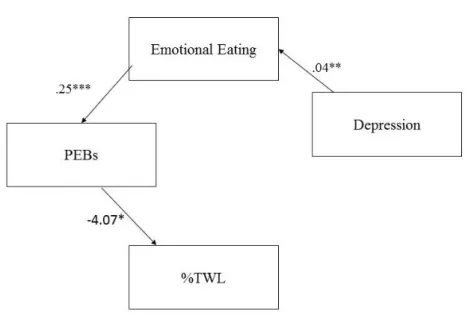
Path analysis in AMOS was performed to examine the relationship between depression, emotional eating, PEBs and %TWL. Assumptions for the model were assured according to Streiner (2005); Tabachinick and Fidell (2013, p.952). To compare the fit of the model, standard fit indices were examined. Comparative fit index (CFI), goodness-of-fit (GFI) and adjusted GFI (AGFI) should have values equal or over higher .90 and root mean square error of approximation (RMSEA) should present lower values then .06, indicating a good model-data fit (Lei, & Wu, 2007) .
Results
In total 139 post bariatric surgery patients were invited to participate in the study. Twelve declined due to the lack of time or interest in the research and one was excluded for being a statistical outlier according outlier labelling rule, g = 2.20 as seen on Hoaglin & Iglewicz (1987).
Of the 126 patients assessed, all Portuguese natives without ethnicity distinction, most were female 88.1% (n = 111) and 11.9% (n = 15) were male. The mean age was 43.32 (SD = 9.81), range between 24 to 67 years.
This sample was divided in two groups according undergone bariatric procedure, sleeve gastrectomy (n = 78) and roux-en-y gastric bypass (n = 48). The majority of participants were married, had at least one or more children, most had in between sex and nine years of formal education and were employed. For complete sample characterization see on table 1. Table 1 Sample characterization n (%) Marital status Single 22 (17.5%) Married 80 (63.5%) Live together 4 (3.2%) Separated 1 (0.8%) Divorced 13 (10.3%) Widowers 6 (4.8%) Child situation Childless 26 (20.6%)
One or more children 100 (79.4%)
Education level 4 years of education 24 (19%) 6 years of education 30 (23.8%) 9 years of education 30 (23.8%) 12 years of education 29 (23%) College degree 12 (9.5%)
Did not complete college 1 (0.8%) Job situation Employed 80 (63.5%) Unemployed 37 (29.4%) Students 6 (4.8%) Retired 3 (2.4%) Diabetes No 112 (88.9%) Type I 6 (4.8%) Type II 8 (6.3%)
Psychiatric or psychological counselling
Never had 73 (57.9%)
Had in the past 25 (19.8%)
Present counselling 28 (22.2%)
Currently following nutritional plan
Yes 110 (87.3%) No 16 (12.7%) Dieting Yes 40 (31.7%) No 86 (68.3%) Bariatric procedure Sleeve Gastrectomy 78 (61.9%) Gastric Bypass 48 (38.1%)
Differences on weight due to SB or RYGB
Significant statistical differences were found between the SG and RYGB in the number of month after surgery, t(124) = -2.15, p = .034. Patients undergone RYGB had more 3.6 months than SG group (Table 2).
RYGB had higher values on BMI pre surgery, percentage of total weight loss, success weight loss rate, total weigh regain, increased 3% and 5% more of nadir weight, higher percentage of excessive weight regain over 15%. However, the mean weigh regain (40kg) for RYGB is lower than the maximum value on weight regain for SG (51kg).
In turn, SG groups had the higher means for lowest weight achieve since surgery and higher post-surgery BMI. Also lost more percentage of excessive BMI and excessive weight loss.
Despite of the fact that no difference was found between the type of surgery on total weigh regain, 43.59% of SB patients and 47.92% on RYBG had at least an increase of 3% or more since their lowest weight achieved. Interestingly, patients undergoing BG were the ones who had the higher values on weigh regain.
The differences found on weigh regain equal or superior to 5% of nadir weight are partially significant, wherein (35.42%) RYGB had the highest weight regain U = 1617.00, p = .096 (Table 2).
Table 2
Weight outcomes comparing sleeve gastrectomy (n=78) and roux-en-y gastric bypass (n=48)
SG RYGB Measure M (SD) or n (%) Min (Max) M (SD) or n (%) Min (Max) t / U Age (months) 43.31 (9.66) 24 (67) 43.33 (10.15) 27 (66) -0.01 Months post-surgery 23.88 (8.70) 12 (51) 27.48 (9.80) 12 (53) -2.15* BMI_pre 43.83 (5.86) 31.49 (60.94) 44.70 (6.19) 36.23 (71.93) 1752.00 BMI_nadir 27.82 (4.06) 19.96 (40.25) 27.72 (4.60) 19.78 (42.10) 1831.50 BMI_post 29.25 (4.46) 20.80 (41.12) 29.20 (5.05) 21.30 (50.00) 1863.50 %EBMIL 79.36 (21.65) 21.94 (121.26) 78.42 (22.84) 27.59 (120.45) 1824.00 %TWL 32.78 (9.23) 8.36 (53.60) 34.05 (11.31) 8.60 (55.38) -0.69 %EWL 69.78 (18.08) 18.76 (106.40) 69.48 (20.56) 23.04 (106.60) 0.09 Success_WL 71 (91%) - 45 (93.8%) - 1821.00 TWR 3.88 (5.34) 0 (21.60) 3.90 (4.58) 0 (18.00) 1807.50 WR≥3% 34 (43.59%) - 23 (47.92%) - 1791.00
WR≥5% 17 (21.79%) - 17 (35.42%) - 1617.00 ⁺ %EWR 7.41 (10.34) 0 (43.47) 7.45 (9.59) 0 (40.33) -0.02 %EWR>15% 11 (14.1%) - 7 (14.6%) - 1863.00
Note. SG = Sleeve gastric; RYGB = Roux-en-y gastric bypass; SD = Standard deviation; n
(%) = number and percentage of patients; BMI = body mass index; BMI_pre = BMI presurgery; BMI_nadir = lowest BMI postsurgery; BMI_post= BMI at the momente of the assessment; %EBMIL = percent of excessive BMI loss; %TWL = percentage of total weight loss; %EWL = percentage of excessive weight loss; Success_WL = unsuccess BMI>35 if
BMIpre<50; success BMI>40 if BMIpre>50; TWR = total weight regain; WR3% = weight
regain (≥3% of nadir weight); WR5% = weight regain (≥5% of nadir weight); %EWR = percentage of excessive weight regain; %EWR>15% = excessive weight regain over 15%. ⁺ p < .1; *p < .05
Differences on PEBs and questionnaires subscales scores between both bariatric surgery procedures
Table 3 describes the frequencies and percentage of the different PEBs as well as mean scores and deviation pattern for self-report questionnaires and each subscale used.
Although there is no significant difference between the various PEBs and the type of bariatric procedures, 25% of the sample in RYGB exhibits OBE, SBE, CG, NCG, OOE and/or SOE at least four times a month. The presence of these PEBs is quite high for both type of surgery’s (41% in SG and 39.6% in RYGB).
Comparing binge eating behaviors SG had the highest percentage with 20.5% versus RYGB 12.6%. In grazing behavior RYGB reported 29.9% compared to 26.5%% in SG. Over eating episodes were more frequent in SG (6.4%) than RYGB (2.1%). Loss of control rates were higher for SG groups (46.2%).
No significance was found between the type of bariatric procedure and questionnaires subscales scores as seen on table 3.
Table 3
Descriptive and statistical measures of eating behaviour and psychopathology
SG (n=78) RYGB (n=48) Measure M (SD) n(%) M (SD) n(%) 𝜒²/
r
pb PEBs OBE - 4 (5.1%) - 3 (6.3%) 0.07 SBE - 12 (15.4%) - 3 (6.3%) 2.36 CG - 10 (12.4%) - 7 (14.6%) 0.08 NCG - 11 (14.1%) - 7 (14.6%) 0.06 OOE - 2 (2.6%) - 0 (0%) 1.25 SOE - 3 (3.8%) - 1 (2.1%) 0.01 LOC - 36 (46.2%) - 18 (37.5%) 0.06 PEBs dichotomous - 32 (41.0%) - 19 (39.6%) 0.03 PEBs 4x month - 24 (30.8%) - 12 (25%) 0.49 Questionnaires measures EADS-21_D 4.19 (5.29) - 4.06 (4.61) - -0.01 EADS-21_A 4.60 (4.88) - 3.67 (3.96) - -0.10 EADS-21_S 6.79 (5.34) - 6.04 (5.07) - -0.07 ED-15_WC 1.31 (1.48) - 1.14 (1.30) - -0.06 ED-15_EC 2.63 (1.58) - 2.17 (1.48) - -0.15 ED-15_Total 1.84 (1.30) 1.55 (1.17) -0.11 Rep(eat)_C 0.86 (1.20) - 0.90 (1.31) - 0.02 Rep(eat)_NC 0.87 (1.16) - 0.76 (1.14) - -0.05 Rep(eat)_Total 0.81 (1.09) 0.80 (1.19) -0.01 TFEQ-R21_CR 2.87 (0.56) - 2.93 (0.56) - 0.04 TFEQ-R21_EE 1.66 (0.77) - 1.74 (0.77) - 0.05 TFEQ-R21_UE 1.61(0.58) - 1.56 (0.57) - -0.04 UPPS-P_NU 2.35 (0.66) - 2.40 (0.54) - 0.04 Note. SG = Sleeve gastric; GB = Gastric bypass; SD = Standard deviation; OBE = Objective binge eating; SBE = Subjective binge eating; CG = Compulsive grazing; NCG =noncompulsive grazing; OOE = Objective overeating episode; SOE = Subjective overeating episode; LOC = Loss of control eating; PEBs dichotomous = presence of PEBs at least once
a month; PEBs 4x month = presence of PEBs at least four times a month; EADS-21_D =
EADS-21 depression subscale; EADS-21_A = EADS-21 anxiety subscale; EADS-21_S = EADS-21 stress subscale; ED-15_WC = ED-15 weight concern subscale; ED-15_EC = ED-15
eating concern subscale; ED-15_Total = Total score for ED-15_Total; Rep(eat)_C = Rep(eat) compulsive subtype; Rep(eat)_NC = Rep(eat) noncompulsive subtype; Rep(eat)_Total = total score for Rep(eat)_Total; R21_CR = R21 cognitive restraint domain ; TFEQ-R21_EE = TFEQ-R21 emotional eating domain; TFEQ-R21_UE = TFEQ-R21 uncontrolled eating domain; UPPS-P_NU = UPPS-P negative urgency subscale.
Type of bariatric surgery procedure effect
The type of chirurgical procedure did not interfere in the relation between the presence or absence of PEBs F(3,123) = 1.56, p = .202, or even in a fourth monthly frequency,
F(3,123) = .66, p = .581, over the percentage of total weight loss.
Likewise the type of bariatric procedure did not went in between the relation of eating pathology on total weight loss, F(5,120) = 1.52, p = .188. Either in eating pathology and current body mass index, F(5,120) = 1.02, p = .408.
Testing the predictive relation between the type of bariatric procedure and the
questionnaires subscales, thru MANOVA, were found no multivariate significant differences, Wilks’ λ = .93, F (11,114) = .76, p = .681.
Influences on weight loss and weight regain
Significant differences were found between the patients that had PEBs at least four times a month and the ones with less frequency on weight regain with ≥3% of nadir weight, U = 1606.50, p = .024. Patients with problematic eating behaviors have more weigh regain.
Patients in the presence of PEBs (M = 30.84, SD = 10.93) have significant lower percentage of weight loss than those without PEBs (M = 34.91, DP = 9.10), t (124) = 2.27,
p=.025.
Time elapsed since surgery made no statistical influence on the presence of PEBs four times a month, t (124) = -0.55, p=.584.
Although time elapsed since surgery was significantly different on weight regain either to 3%, t (124) = -5.70, p=.000, or 5% more of nadir weight, t (124) = -4.47, p=.000.
Patients with more time elapse since surgery report higher scores on weight regain than patients with less time follow up.
The percentage of total weight loss and time elapsed since surgery are negatively correlated, r = - 0.18, p =.042. Higher weight loss is observed in the first periods after surgery.
Age, time elapse since surgery and pre BMI are significant predictors of %TWL. Higher levels of %TWL are associated with younger patients, as well as less time elapse since surgery and with higher values on pre BMI (see Table 4).
Table 4
Multiple linear regression on predictors of percentage of total weight loss
R² (R²aj) Models β t
Gender .14 1.75⁺
Age -.22 -2.76**
Number of months after surgery .29 (.25) F(6,119) = 7.93*** -.20 -2.54*
Type of bariatric surgery .05 .68
Pre BMI .37 4.64***
PEBs 4x month -.14 -1.73⁺
Note. ⁺ p < .1 * p < .05 ** p < .01 *** p < .000
Testing the theoretical relationship base on the literature findings, a casual model was stablish (in Figure 1) explaining weight loss. All variables in the model are significantly correlated, except for the association between depression and the presence of PEBs also depression and %TWL (as seen on Table 5).
Table 5
Path Analysis Variables: Correlations (n=126)
Variables 1 2 3 4
1. Depression -
2. Emotional eating .246** -
3. PEBsᵃ .089 .383** -
4. %TWL -.042 -.205* -.201* -
Note: ᵃProblematic Eating Behaviors: 0 = without, 1 = with.
According to indices and significances values this model fit the sample data
reasonably well as indicated by the selected overall goodness-of-fit statistics (𝜒² = 3.403, df = 3, p = .334; CFI = .987; GFI = .987; AGFI = .956; RMSEA = .033). A direct interaction effect can be verified, as depression, emotional eating and PEBs influence %TWL and are
correlated, please refer to Figure 1. This model shows that more depressive patients are associated with emotional eating regulation thru food (β = .04), which in turn it is related with the presence of problematic eating behaviors, at least one of these OBE, SBE, CG, NCG, OOE and/or SOE once a month (β = .25) which is directly associated with lower %TWL after bariatric surgery (β = -4.07).
Figure 1. Path analysis causal model testing relationships between psychological, behavioral
and weight variables. *p<.05; **p<.01;***p<.000
Discussion
In the present study, two bariatric procedures were compared regarding problematic eating behaviours, weight and psychological variables.
Results of this study show that no correlation was found between the type of surgery and the different PEBs, and that the presence of these episodes is surprisingly high in both SG (41%) and RYGB (39.6%) groups.
SBE was the most frequent PEBs for SG group and grazing behaviour (either
compulsive or noncompulsive subtype) were the most frequent in RYGB. Emphasizing, SG scored higher on weight concern, eating concern, anxiety and stress probably they appeared to be more concerned with possible weight regain, thence they misperceive the quantity ingested food as more than it really is. Contrary to expectations RYGB patients had more OBE
episodes than SG, supposedly RYGB as malabsorptive and restricting procedure would not physically allow such food intake with these characteristics. These finding put things in perspective: is RYGB really the gold standard for bariatric surgery success? Have patients found a new path to get room for more caloric ingestions? Should not post-surgery effects drastically reduced the presence of malaptative eating patterns? Could this less efficacy on changing eating patterns be the justification for the same results on both groups? However, as seen in the literature, these patients with PEBs increased on weight regain and decreased on weight loss.
It was found that SG and RYGB do not significantly differ on the %TWL as initially expected (32.78% vs. 34.05%) although there is a slightly better results for patients undergone RYGB. A possible reason why is the variety of time elapsed since surgery in this sample, as RYGB patients have significant more number of months passed since the surgery date, precisely 2 years and 3 moths while SG group have 1 years and 11 months. Corroborated by the statistical differences on the time elapse since surgery on with regain and on %TWL, less time passes leads to more weight loss, more time passed more weight regain. Additionally, the two groups are partially different on weigh regain (equal or superior to 5% of nadir weight) RYGB groups have higher weight regain, 13.63% more than SG. Which agrees with Courcoulas and colleagues (2013). Increased weight loss is predicted by younger patients, higher BMI pre scores (as observed in the RYGB group) and less time elapsed since surgery but not by either SG or RYGB procedures. Additionally, interference hypothesis of bariatric procedure between PEBs and weight loss was not confirmed.
However, some published research shows similar results, with no evidence of significant differences in the excess weight loss at one year after surgery in SG and RYGB (Leyba, Aulestia, & Llopis, 2011) also between both laparoscopic SG and RYGB (Benaiges, et al., 2011).
Path analysis was used to elucidate relationships of direct effects on weight loss. Although results on qui-square default model were low than desirable, possible reasons were exalted, as small sample size for this type of analysis and high correlation between variables were observed although the others fit indices indicate a good fit model for this data.
As psychological variable, depressive disorder is the most common psychiatric diagnosis in bariatric surgery population (Sarwer, et al., 2004) often results in unhealthy lifestyle, little physical activity, increased social isolation and high-calorie eating behaviour associated with fast weight regain. At baseline explains about 4% weight loss variance in bariatric patients (Legenbauer, et al., 2009) although this was not an objective of this model, no direct significant relation was found between depression and %TWL in this sample. Nevertheless, depression is characterized by a negative emotional state that increases food consumption (Canetti, Bachar, & Berry, 2002) which may lead these patients to regulation emotions thru food due to the association of certain types of food to positive or comforting emotions, as seen on psychological theories of human behaviour.
Path analysis revealed that emotional eating is a good mediator for weight loss, corroborated by the study of Canetti, Berry, and Elizur (2009). Moreover, individuals with this characteristic remained heavier than their counterparts even in the presence of
accentuated weight loss (Canetti, et al., 2002). Obese people are the “target population” for emotional eating since is stronger than in non-obese population and in people on diets. Emotions influence eating behaviours in across populations/worldwide.
Likewise the presence of PEBs also have an interaction effect on the %TWL, as found in other studies, binge eating behaviour is related to poorer surgical results, reporting more maladaptive diet-related behaviours and regain significantly more weight (Kruseman,
Leimgruberl, Zumbach, & Golay, 2010). Alike the presence of LOC predicts less weight loss at 12 and 24 months after surgery (White, Kalarchian, Masheb, Marcus, & Grilo, 2010) as observed in this sample.
In short these results indicate that a larger weight loss would be associated with reduction in depression, which reduces the emotional eating component, in turn affects the frequency and/or presence of problematic eating behaviour and consequently directly affects
weight in terms of loss and regain. Therefore, these are important variables to take into account and assess for bariatric surgery patients in order to maximize procedure success.
Across this study new results corroborate and augment the literature mechanisms of understanding problematic eating after bariatric surgery and its impact.
Some limitations should be taken into account when making conclusions as well as when planning future research. No distinction was done between laparoscopic and opens surgery, impact could be weakened or less visible. Time elapse since surgery was very
variable between surgeries, which could influence results on weight outcomes and presence of PEBs, although this differences, both groups are included in a two to three years post-surgery follow up. Additionally the groups were unequal in size. The presence of PEBs could be prior to surgery or simply a maintenance of the eating pattern which was not evaluated so it is not sure that all of these assessed and diagnosed behaviours are due to post bariatric surgery. Using self-report questionnaires could be compromised because of the social desirability effect as item avoidance on measured variables under the study. As well as due to the reduced sample size may influence statistical power of analysis.
Generalizability is also limited by the fact that reported data are only from the north of Portugal, which is not a representative sample of bariatric procedures in this country. Direct comparison to groups of patients not receiving treatment for their obesity or alternative treatments to promote weight loss such as medications, behaviours modifications, diet or exercise, are not possible with this data.
Conclusion
This study indicates that SG and RYGB bariatric procedures are a favourable option in the treatment of severe obesity, with a high success rate and weight loss. Although there were no interaction effect between the type surgical procedure and the outcomes. There are other concerns that should be taking into account, as psychological traits influence eating
behaviours which play a role on weight.
In conclusion, data from the São João and Braga hospitals with the present chirurgical team’s shows that both SG as well as RYGB have in short and medium term have no
significant differences in terms of %TWL, SG has more PEBs in general and RYGB regained more weight. In long term, five, ten, fifteen years comparative effectiveness of these
procedures are yet to be determined also if the type of bariatric procedure leads to long term improvement on weight loss and PEBs.
Nevertheless psychological monitoring for detection and evaluation of vulnerability factors preventing future psychiatric complications is crucial and scientific associated with excess weight loss, as higher number of psychological consultations predict success (Kruseman, et al., 2010).
References
American Psychiatric Association. (2013). Diagnostic and statistical manual of mental
disorders (5th ed.). Washington, DC: Author.
American Society for Metabolic and Bariatric Surgery (n.d). Bariatric surgery procedures.
nnRetrieved from http://asmbs.org/patients/bariatric-surgery-procedures
Angrisani, L., Santonicola, A., Iovino, P., Formisano, G., Buchwald, H., & Scopinaro, N. (2015). Bariatric Surgery Worldwide 2013. Obesity Surgery, 25, 1822–1832. doi:10.1007/s11695-015-1657-z
Benaiges, D., Goday, A., Ramon, J. M., Hernandez, E., Pera, M., & Cano, J. F. (2011). Laparoscopic sleeve gastrectomy and laparoscopic gastric bypass are equally effective for reduction of cardiovascular risk in severely obese patients at one year of follow-up.
Surgery for Obesity and Related Diseases, 7(5), 575-580.
doi:10.1016/j.soard.2011.03.002
Caiazzo, R., & Pattou, F., (2013). Adjustable gastric banding, sleeve gastrectomy, or gastric bypass. Can evidence-based medicine help us to choose?. Journal of Visceral Surgery,
150, 85–95. Retreived from https://doi.org/10.1016/j.jviscsurg.2013.03.011
Canetti, L., Bachar, E., & Berry, E. M. (2002). Food and emotion. Behavioural Processes, 60, 157-164. Retreived from https://doi.org/10.1016/S0376-6357(02)00082-7
Canetti, L., Berry, E. M., & Elizur, Y. (2009). Psychosocial predictors of weight loss and psychological adjustment following bariatric surgery and a weight- loss program: the mediating role of emotional eating. International Journal of eating disorders, 42(2), 109-117. doi:10.1002/eat.20592
Colles, S. L., Dixon, J. B., & O’Brien, P. E. (2008). Loss of control is central to psychological
nndisturbance associated with binge eating disorder. Obesity reviews, 16(3), 608–614.
nndoi:10.1038/oby.2007.99
Conceição, E. M., Crosby, R., Mitchell, J. E., Engel, S. G., Wonderlich, S. A., Simonich, H.,
nn… Le Grange, D. (2013). Picking or nibbling: Frequency and associated clinical nnfeatures in bulimia nervosa, anorexia nervosa, and binge eating disorder. International
nnJournal of Eating Disorders, 46(8), 815–818. doi:10.1002/eat.22167
Conceição, E. M., Mitchell, J. E., Engel, S. G., Machado, P. P. P., Lancaster, K., &
nnWonderlich, S. A. (2014). What is “grazing”? Reviewing its definition, frequency, nnclinical characteristics, and impact on bariatric surgery outcomes, and proposing a
nnstandardized definition. Surgery for Obesity and Related Diseases, 10(5), 973–982.
nndoi:10.1016/j.soard.2014.05.002
Conceição, E. M., Mitchell, J. E., Pinto-Bastos, A., Arrojado, F., Brandão, I., & Machado, P. P. (in press). Stability of problematic eating behaviours and weight loss trajectories after bariatric surgery: a longitudinal observational study. Surgery for Obesity and
Related Diseases. Retrieved from https://doi.org/10.1016/j.soard.2016.12.006
Conceição, E., Mitchell, J. E., Vaz, A. R., Bastos, A. P., Ramalho, S., Silva, C., . . . Machado, P. P. (2014 ). The presence of maladaptive eating behaviors after bariatric surgery in a cross sectional study: Importance of picking or nibbling on weight regain. Eating
Behaviors, 15(4), 558-562. doi:10.1016/j.eatbeh.2014.08.010
Conceição, E. M., Utzinger, L. M., & Pisetsky, E. M. (2015). Eating disorders and problematic eating behaviours before and after bariatric surgery: characterization, assessment and association with treatment outcomes. European Eating Disorders
Review, 23, 417-425. doi:10.1002/erv.2397
Conceição, E., Orcutt, M., Mitchell, J., Engel, S., Lahaise, K., Jorgensen, M., …Wonderlich,
nnS. (2013). Eating disorders after bariatric surgery: A case series. International Journal
nnof Eating Disorders, 46(3), 274–279. doi:10.1002/eat.22074
Courcoulas, A. P., Christian, N. J., Belle, S. H., Berk, P. D., Flum, D. R., Garcia, L., ... Wolfe, B. M. (2013). Weight change and health outcomes at 3 years after bariatric surgery among individuals with severe obesity. American Medical Association, 310 (22), 2416-2425. doi:10.1001/jama.2013.280928
Fairburn, C. G., Cooper, Z., & O’Connor, M. (2014). Eating Disorder Examination.
nnRetrieved from http://credo-oxford.com/pdfs/EDE_17.0D.pdf
Guisado, J. A., Vaz, F. J., Alarcón, J., LópezIbor, J. J., Rubio, M. A., & Gaite, L. (2002). Psychopathological status and interpersonal functioning following weight loss in
morbidly obese patients undergoing bariatric surgery. Obesity Surgery, 12(6), 835-840. doi:10.1381/096089202320995664
Herpertz, S., Kielmann, R., Wolf, A., Langkafel, M., Senf, W., & Hebebrand, J. (2003). Does obesity surgery improve psychosocial functioning? A systematic review. International
Journal of Obesity, 27, 1300–1314. doi:10.1038/sj.ijo.0802410
Hoaglin, D. C., & Iglewicz, B. (1987). Fine tuning some resistant rules for outlier labelling.
Journal of American Statistical Association, 82, 1147-1149.
doi:10.1080.01621459.1987.10478551
Hutter, M. M., Schirmer, B., Jones, D. B., Ko, C., Cohen, M. E., Merkow, R. P., & Nguyen, N. T. (2011). First report from the american college of surgeons bariatric surgery center network: laparoscopic sleeve gastrectomy has morbidity and effectiveness positioned Between the Band and the bypass. Annals of surgery, 254(3), 410-422. doi:10.1097/SLA.0b013e31822c9dac
Jian-Fang, L., Dan-Dan, L., Zhi-Hong, L., Tian-Ye, J., Ai-Min, Z., & Jian-Feng, D. (2014). Comparison of the long-term results of roux-en-y gastric bypass and sleeve
gastrectomy for morbid obesity: A systematic review and meta-analysis of randomized and nonrandomized trials. Surgical Laparoscopy, Endoscopy & Percutaneous
Techniques, 24(1), 1-11. doi:10.1097/SLE.000000000000041
Kruseman, M., Leimgruberl, A., Zumbach, F., & Golay, A. (2010). Dietary, weight, and psychological changes among patients with obesity, 8 years after gastric bypass.
American Dietetic Association, 110(4), 527-534. doi:10.1016/j.jada.2009.12.028
Legenbauer, T., Zwaan, M. D., Beneckec, A., Mühlhansb, B., Petraka, F., & Herpertza, S. (2009). Depression and anxiety: their predictive function for weight loss in obese individuals. Obesity Fact, 2, 227-234. doi:10.1159/00022678.
Lei, P., & Wu, Q. (2007). Introduction to Structural Equation Modeling: Issues and Pratical Considerations . Educational Measurements: Issues and Practice, 33-43.
doi:10.1111/j.1745-3992.2007.00099.x
Leyba, J. L., Aulestia, S. N., & Llopis. (2010). Laparoscopic roux-en- y gastric bypass versus laparoscopic sleeve gastrectomy for the treatment of morbid obesity. A prospective study of 117 patients . Obesity surgery, 21, 212-216. doi:10.1007/s11695-010-0279-8
Lovibond, P.F., & Lovibond, S. H. (1995) The structure of negative emotional states:
nncomparison of the depression of the depression anxiety stress scale (DASS) with the
nnbeck depression and anxiety inventories. Behaviour Research and Therapy, 33(3),
nn335-343. doi:10.1016/0005-7967(94)00075-U
Meany, G., Conceição, E., & Mitchell, J. E. (2013). Binge eating, binge eating disorder and loss of control eating: effects on weight outcomes after bariatric surgery. European
Eating Disorders Review, 22, 87-91. doi:10.1002/erv.2273.
Pais-Ribeiro, J. L., Honrado, A., & Leal, I. (2004). Contribuição para o estudo da adaptações portuguesa das escalas de ansiedade, depressão e stress (EADS) de 21 itens de
Lovibond e Lovibond. Psicologia, Saúde & Doença, 5(2), 229-239. Retreived from https://repositorio.ispa.pt/bitstream/10400.12/1058/1/PSD%202004%205(2)%20229-239.pdf
Peterli, R., Steinert, E., R., Woelnerhanssen, B., Peters, T., Christoffel-Courtin, C., Gass, M., . . . Beglinger, C. (2012). Metabolic and hormonal changes after laparoscopic roux-en-y gastric bypass and sleeve gastrectomy: a randomized, prospective trial. Obesity
Surgery, 22, 740–748. doi:10.1007/s11695-012-0622-3
Reas, D. L., Wisting, L., Kapstad, H., & Lask, B. (2012). Nibbling: Frequency and
nnrelationship to BMI, pattern of eating, and shape, weight, and eating concerns among
nnuniversity women. Eating Behaviors, 13(1), 65–66. doi:10.1016/j.eatbeh.2011.10.005 Sarwer, D. B., Cohn, N. I., Gibbons, L. M., Magee, L., Crerand, C. E., Raper, S. E., . . .
Wadden, T. A. (2004). Psychiatric diagnoses and psychiatric treatment among bariatric surgery candidates. Obesity Surgery, 14, 1148-1156.
doi:10.1381/0960892042386922
Saunders, R. (2004). “ Grazing ”: A High-Risk Behavior. Obesity Surgery, 14, 98–102.
nndoi:10.1381/096089204772787374
Sjöström, L., Lindroos, A.-K., Peltonen, M., Jarl Torgerson, J., Bouchard, C., Carlsson, B., . . . Sjöst, C. D. (2004). Lifestyle, diabetes, and cardiovascular risk factors 10 years after bariatric surgery. The new england journal of medicine, 351(26), 2683-2693.
Retrieved from http://www.nejm.org/doi/full/10.1056/nejmoa035622#t=article Stevens, J., Truesdale, K. P., McClain, J. E., & Cai, J. (2006). The definition of weight
nnmaintenance. International Journal of Obesity, 30(3), 391-399.
nndoi:10.1038/sj.ijo.0803175
Stunkard, A. J., & Messick, S. (1985). Questionnaire to mesure dietary restraint, disinhibition and hunger. Journal of Psychosomatic Research, 29(1), 71-83. doi:10.1016/0022-3999(85)90010-8Streiner, D. L. (2005). Finding Our Way: An Introduction to Path Analysis. The Canadian Journal of Psychiatry—Research Methods in Psychiatry, 50(2), 115-122. Retreived from
http://journals.sagepub.com/doi/pdf/10.1177/070674370505000207
Tabachnick, B. G., & Fidell, L. S. (2013). Using multivariate statistics (6th ed.). New Jersey: Pearson.
Tatham, M., Turner, H., Mountford, V. A., Tritt, A., Dyas, R., & Waller, G. (2015).
Development psychometric propreties and preliminary clinical validation of a brief, session-by-session mesure of eating disorder conitions and behaviours: ED-15.
International Journal of Eating Disorders, 48(7), 1005-1015. doi:10.1002/eat.22430
White, M. A., Kalarchian, M. A., Masheb, R. M., Marcus, M. D., & Grilo, C. M. (2010). Loss of control over eating predicts outcomes in bariatric surgery: A prospective 24-month follow-up study. The Journal of Clinical Psychiatry, 71(2), 175-184.
doi:10.4088/JCP.08m04328blu
Whiteside, S. P, Lynam, D. R, Miller, J. D., & Reynolds, S. K. (2005). Validation of the
nnUPPS impulsive behaviour scale: a four-factor model of impulsivity. European
nnJournal of Personality, 19, 559-574. doi:10.1002/per.556
World Health Organization (2016). Obesity and Overweight fact sheet Nº 311. Retrieved from
nnhttp://www.who.int/mediacentre/factsheets/fs311/en/
World Health Organization, Obesity: Preventing and Mananging the Global Epidemia. nnnn nn (2000). Report of the WHO Obesity: Preventing and Mananging the Global
nnEpidemia. Retrieved from