DOI: 10.9789/2175-5361.2018.v10i1.9-16 | Almeida WA, Ferreira AM, Ivo ML, et al. | Fatores associados à qualidade...
Fatores associados à qualidade de vida de pessoas com feridas
complexas crônicas
*Factors associated with quality of life of people with chronic complex wounds
Los factores asociados con la calidad de vida de personas con heridas crónicas
complejo
Willian Alburquerque de Almeida1; Adriano Menis Ferreira2; Maria Lúcia Ivo3; Marcelo Alessandro Rigotti4;
Larissa da Silva Barcelos5; Adaiele Lúcia Nogueira Viera da Silva6
Como citar este artigo:
Almeida WA, Ferreira AM, Ivo ML, et al. Factors associated with quality of life of people with chronic complex wounds. Rev Fund Care Online. 2018 jan/mar; 10(1):9-16. DOI: http://dx.doi.org/10.9789/2175-5361.2018. v10i1.9-16
ABSTRACT
Objective: To analyze the quality of life of people with chronic complex wounds. Method: Data were collected through a questionnaire containing the WHOQOL-Bref instrument of the World Health Organization and questions about sociodemographic and clinical variables. Statistical analysis methods used were: linear correlation of Pearson; Analysis of Variance and Tukey with reliability of 95% and p <0.05. Results: We evaluated 53 patients with complex wounds. 28 (52.83%) of these were female with an average age of 62.17 years and with low education. In the evaluation of the quality of life, the pain was correlated with the physical domain (p = 0.030) and psychological (p = 0.051); while the area was correlated with age (p = 0.051) and pain correlated with the time of injury (p = 0.001). Conclusion: Knowning the clinical characteristics and the quality of life enables better understanding of the complaints and better healthcare planning, which contributs to improved quality of life.
Descriptors: the Quality of Life, Wounds and Injuries, Chronic Disease, Pain, Socioeconomic Factors.
* Study carried out with the support of the Coordination for the Improvement of Higher Education Personnel (Capes), 2013-2015. Campo Grande (MS), Brazil. Article extracted from part of the master’s thesis entitled “Impact of wounds on the quality of life of people served in the primary health network” developed at the Master Course in Nursing, Federal University of Mato Grosso do Sul, Campo Grande-MS, Brazil. 2015.
1 Nurse. Master in Nursing. Permanent Education Nurse and Intra-Hospital Transplant Commission, Santa Casa de Andradina, Andradina (SP), Brazil. E-mail: [email protected].
2 Nurse. PhD in Nursing, Associate Professor of the Nursing Course of the Federal University of Mato Grosso do Sul/UFMS - Três Lagoas (MS), Brazil. E-mail: [email protected].
3 Nurse. PhD in Nursing. Full Professor of the Nursing Course of the Federal University of Mato Grosso do Sul/UFMS - Campo Grande (MS), Brazil. E-mail: [email protected].
4 Nurse. PhD in Health Sciences. Adjunct Professor of the Nursing Course of the Federal University of Mato Grosso do Sul - Três Lagoas (MS). Brazil. E-mail: [email protected].
5 Nurse. PhD in Health and Development in the Center-West Region. Adjunct Professor of the Nursing course of the Federal University of Mato Grosso do Sul/UFMS - Três Lagoas, (MS). Brazil. E-mail: [email protected].
6 Nurse. Master in Nursing, PhD student in Health and Development at the Center-West Region, Federal University of Mato Grosso do Sul/UFMS - Campo Grande (MS). Brazil. E-mail: [email protected].
RESUMO
Objetivo: Analisar a qualidade de vida de pessoas com feridas complexas
crônicas. Método: Os dados foram coletados por meio de questionário contendo o instrumento WHOQOL-Bref da Organização Mundial de Saúde e questões sobre variáveis sociodemográficos e clínicas. Para análise estatística foram utilizados os métodos: Correlação Linear de Pearson; Análise de Variância e Tukey com confiabilidade de 95% e p<0,05. Resultados: Foram avaliados 53 pacientes com feridas complexas. Desses, 28 (52,83%) são do sexo feminino com média de idade de 62,17 anos e com baixa escolaridade. Na avaliação da qualidade de vida, a dor se correlacionou com o domínio físico (p=0,030) e psicológico (p=0,051); enquanto que a área se correlacionou com a idade (p=0,051), e a dor se correlacionou com o tempo de lesão (p=0,001). Conclusão: Conhecer as características clínicas e a qualidade de vida possibilita melhor compreensão das queixas e melhor planejamento assistencial contribuindo para melhoria da qualidade de vida.
Descritores: Qualidade de Vida, Ferimentos e Lesões, Doença Crônica,
Dor, Fatores Socioeconômicos.
RESUMEN
Objetivo: Analizar la calidad de vida de las personas con heridas
crónicas complejas. Métodos: Los datos fueron recolectados a través de un cuestionario que contiene el instrumento WHOQOL-BREF de la Organización Mundial de la Salud y las preguntas acerca de las variables sociodemográficas y clínicas. Se utilizaron métodos de análisis estadístico: correlación lineal de Pearson; El análisis de varianza y Tukey con una fiabilidad del 95% y p <0,05. Resultados: Se evaluaron 53 pacientes con heridas complejas. De éstos, 28 (52,83%) eran mujeres con una edad media de 62,17 años y con bajo nivel de educación. En la evaluación de la calidad de vida el dolor se correlacionó con el dominio físico (p = 0,030) y psicológico (p = 0,051); mientras que el área se correlacionó con la edad (p = 0,051) y el dolor correlacionado con el momento de la lesión (p = 0,001). Conclusión: Conocer las características clínicas y la calidad de vida permite una mejor comprensión de las quejas y una mejor planificación de la salud, lo que contribuye a una mejor calidad de vida.
Descriptores: Calidad de Vida, Heridas y Traumatismos, Enfermedad
Crónica, Dolor, Los Factores Socioeconómicos.
INTRODUCTION
Complex chronic wounds carry multiple burdens for patients, family members, caregivers, and the health care system. These generate suffering, pain, serious infections, various comorbidities, social isolation, depression, mental health impairment in general, loss of mobility and increased costs. In many cases, they can lead to amputation of the affected limb and even death.1
The wound is considered chronic if healing does not occur within a period of up to three months. Increasingly, this has become a major therapeutic challenge worldwide and is considered a public health problem that tends to worsen with increasing incidence of conditions that prevent wound healing, such as diabetes, obesity, and Vascular diseases. Chronic wounds can be classified as typical or atypical. Most (95%) are considered typical, which include ischemic ulcers, neurotrophic, diabetic foot and pressure injury.1-2
Studies have reported that 80% of leg ulcers are the result of chronic venous insufficiency, 5 to 10% of arte-rial etiology, and the others of neuropathic origin. Older adults are more frequently affected by complex chronic wounds, profoundly impacting the Quality of Life (QoL) of this population.1,3 Several factors play an important
role in the quality of life of people with wounds and are related to physical functioning, psychosocial functioning and aspects of treatment.4
The assessment of the quality of life of patients with wounds provides important information for clinical decision making, treatment evaluation and prognosis.5 Thus,
kno-wing the characteristics that involve wounds and how they affect the QoL of these patients, as well as the involvement rates, risk factors and causes, allows the multidisciplinary team to elaborate actions of prevention and treatment of this condition, favoring the improvement of targeted public policies and more assertive to this clientele.
OBJECTIVE
In view of the above, with the aim of contributing to the health care of people living with chronic wounds, this study aimed to analyze the quality of life of people with complex wounds and sociodemographic and clinical variables.
METHODS
It is an observational, cross-sectional, analytical study with a quantitative approach that identified sociodemo-graphic/clinical aspects and quality of life of patients with chronic complex wounds during the period from June to August 2014. Sampling was non-probabilistic for convenience, composed of 53 patients with complex chronic wounds of diverse etiologies based on the medical diagnosis.
The study was carried out in Primary Health Care Units, with seven basic health units, seven family health strategies, one referral center: surgery and diagnosis clinic and visits to the homes of wounded patients in a munici-pality in the interior of the State of Mato Grosso do Sul, Brazil. Patients who met the following inclusion criteria were selected to participate in the study: venous, arterial, neoplastic, neuropathic, diabetic foot ulcers and pressure lesions; with a minimum duration of three months or more; attended in the dressing rooms of all the health units of the municipality, or in their residence; aged 18 years or over; and with cognitive conditions to respond to the research instrument. Before inclusion in the study, parti-cipants received information about the research objectives and those who agreed to participate signed the Informed Consent Term (TCLE). Two forms were used for data collection: the first one considered the sociodemographic characteristics and information regarding the wound;
the second evaluated the Health-Related Quality of Life (HRQoL), WHOQOL-bref.6
The sociodemographic variables included in the form were: age, gender, marital status, number of children, religion, current professional activity, family monthly income and race. The data related to the wound were: lesion etiology, history of previous lesions, number of lesions, presence and intensity of pain using the nume-rical scale of pain. In the evaluation of quality of life, the WHOQOL-bref instrument was composed of 26 items that refer to four domains: physical, psychological, social relations and the environment in which the individual is inserted. In addition to these four domains, the WHO-QOL-bref is also composed of a domain that analyzes the overall quality of life.7
The answers to all questions of the instrument were obtained through a scale of Likert responses, with a scale of intensity (nothing - extremely), capacity (nothing - com-pletely), frequency (never - always), and evaluation (very dissatisfied - Very satisfied; very poor - very good). Each domain consists of questions whose answers range from 1 to 5. The final scores of each domain are calculated by a syntax, which considers the answers of each question that compose the domain, resulting in final scores on a scale of 4 to 20, comparable to those of WHOQOL-100, which can be transformed into a scale of 0 To 100. The WHOQOL-bref has been translated into several languages and validated in several countries. In Brazil, this work was carried out at the Federal University of Rio Grande do Sul (UFRGS) by Fleck.7
The software used for statistical analysis was Minitab 17 (Minitab Inc.) and Statistica 10 (StatSoft Inc.). To verify the reliability of the instrument, the Cronbrach alpha inter-nal consistency test was performed, suggesting sufficient internal consistency of the data for coefficients equal to or greater than 0.700. The descriptive statistics were used to meet the proposed objectives, the average, median and standard deviation were calculated. The quantitative analysis regarding the comparison of domain scores was performed using the Analysis of Variance test and Tukey’s post-hoc test when p <0.05. The comparison of the domains scores among the variables of interest was performed by applying the t-test for independent samples when two groups were compared and applying the Variance Analysis with Tukey’s multiple comparison test, at p <0.05. In addition, the variables of
choice were correlated to each other and to the domains of the QoL instrument using the Pearson correlation coefficient test performed with 95% confidence, adopting p <0.05.
The study complied with ethical principles and was presented in accordance with Resolution 466/2012 of the National Health Council and was submitted to the Ethics Committee in Research with Human Subjects linked to the Federal University of Mato Grosso do Sul and approved with the certificate No. 25681513.2.0000.0021 - Protocol No. 545.595/2014.
RESULTS AND DISCUSSION
From the 53 participants in the study, 28 (52.83%) were female, with an average age of 62.17 years (± 11.24), 36 (67.92%) and per capita income up to a minimum wage (Minimum salary valid at the time of research R $ 724.00), 41 (77.36%) with low schooling, ie individuals who repor-ted having attended up to eight years of study. 50 (94.34%) participants were inactive professionally and more than half, 28 (52.83%) as a whole lived without partners.
With regard to the etiology of the lesion, 29 (54.72%) of the total participants were of venous origin, 35 (66.04%) had only one lesion, and 24 (45.28%) reported presenting the wound more than 5 years. Regarding the lesion area, 36 (67.92%) had an area smaller than or equal to 50 cm2.
Pain was quantitatively assessed (n = 53) and it was found that on a scale of 0 (no pain) to 10 (very strong pain), the average pain intensity score of the patients evaluated was 5.45 with a standard deviation of 4.16 and a median of 6.00. The minimum score was 0.00 and the maximum score was 10.00. The coefficient of variation of pain scores resulted in 76.33%, showing high dispersion and variation of pain results. The median indicates that 50% of the patients evaluated presented a pain score equal to or greater than 6.00. Of the total, 15 (39.47%) had very strong pain.
The results show that using WHOQOL-bref among people with chronic wounds, it was verified (p = 0.201), that is, they did not present significant differences in average quality of life scores when domains were compared. On average, the physical domain was the one with the lowest score among those evaluated. Thus, the issues related to this domain are the most problematic for patients presenting with chronic/ complex wounds (Table 1).
Table 1 – Average scores of WHOQOL-bref domains among patients with chronic complex wounds in a municipality in the interior of the state of Mato
Grosso do Sul/Brazil, 2014
Domains (n=53) Average SD Minimum Median Maximum Value of p*
General 57.08 25.42 0.00 62.50 100.00 0.201 Physical 49.87 20.67 0.00 53.57 82.14 Psychological 56.21 19.45 16.67 58.33 100.00 Social relationships 58.81 24.43 0.00 58.33 100.00 Environment 59.08 20.40 18.75 59.38 100.00
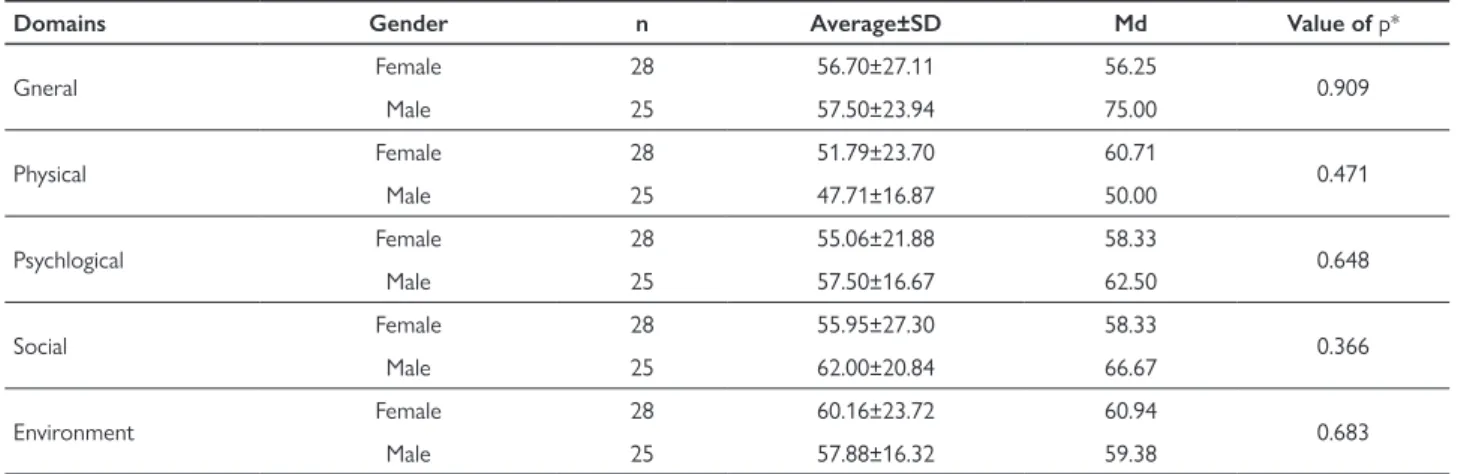
The quality of life scores of all the domains evaluated regarding patients with chronic and high complexity wounds did not present significant differences in relation to gender, ie, gender is not a variable that significantly influenced patients’ quality of life evaluated as described in table 2.
The results of table 3 show that the wound etiology is not a preponderant factor to influence the quality of life of the evaluated patients. The P-value of all comparisons was greater than 0.050 and this assumes that there are no statistically significant differences between the averages of quality of life scores for each of the domains when patients are compared in relation to the wound etiology.
Table 2 – Average ± standard deviation (SD) of the quality of life scores in relation to the patients’ gender
Domains Gender n Average±SD Md Value of p*
Gneral Female 28 56.70±27.11 56.25 0.909 Male 25 57.50±23.94 75.00 Physical Female 28 51.79±23.70 60.71 0.471 Male 25 47.71±16.87 50.00 Psychlogical Female 28 55.06±21.88 58.33 0.648 Male 25 57.50±16.67 62.50 Social Female 28 55.95±27.30 58.33 0.366 Male 25 62.00±20.84 66.67 Environment Female 28 60.16±23.72 60.94 0.683 Male 25 57.88±16.32 59.38
*P value for the t test for independent samples at P <0.05..
Table 3 – Average ± standard deviation (SD) of quality of life scores in relation to wound etiology
Domains Etiology of wound n Average±SD Md Value of p*
General Venous ulcer 29 54.74±22.01 50.00 0.759 Pressure ulcer 8 57.80±31.30 62.50 Diabetic foot 9 65.28±24.03 75.00 Other types 7 55.40±36.00 62.50 Physical Venous ulcer 29 53.33±20.78 60.71 0.172 Pressure ulcer 8 37.95±19.27 39.29 Diabetic foot 9 55.16±21.66 60.71 Other types 7 42.35±16.55 46.43 Psychological Venous ulcer 29 55.17±19.28 58.33 0.875 Pressure ulcer 8 59.90±27.45 62.50 Diabetic foot 9 58.80±18.33 62.50 Other types 7 52.98±13.11 50.00 Social Venous ulcer 29 59.77±25.11 66.67 0,720 Pressure ulcer 8 52.08±24.70 45.83 Diabetic foot 9 64.81±29.69 75.00 Other types 7 54.76±14.32 58.33 Environment Venous ulcer 29 61.31±20.72 62.50 0.556 Pressure ulcer 8 49.61±26.70 53.13 Diabetic foot 9 60.76±19.65 71.88 Other types 7 58.48±10.48 56.25
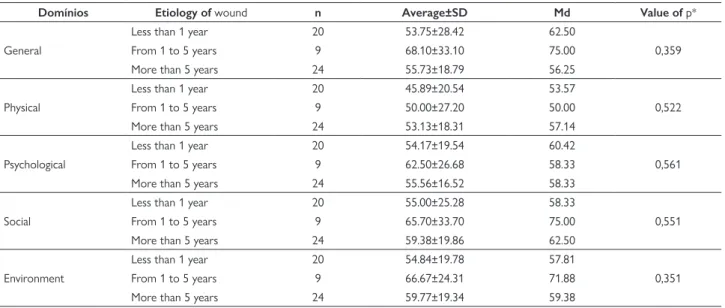
Table 4 – Average ± standard deviation (SD) of quality of life scores in relation to wound time
Domínios Etiology of wound n Average±SD Md Value of p*
General
Less than 1 year 20 53.75±28.42 62.50
0,359
From 1 to 5 years 9 68.10±33.10 75.00
More than 5 years 24 55.73±18.79 56.25
Physical
Less than 1 year 20 45.89±20.54 53.57
0,522
From 1 to 5 years 9 50.00±27.20 50.00
More than 5 years 24 53.13±18.31 57.14
Psychological
Less than 1 year 20 54.17±19.54 60.42
0,561
From 1 to 5 years 9 62.50±26.68 58.33
More than 5 years 24 55.56±16.52 58.33
Social
Less than 1 year 20 55.00±25.28 58.33
0,551
From 1 to 5 years 9 65.70±33.70 75.00
More than 5 years 24 59.38±19.86 62.50
Environment
Less than 1 year 20 54.84±19.78 57.81
0,351
From 1 to 5 years 9 66.67±24.31 71.88
More than 5 years 24 59.77±19.34 59.38
*P value for the Variance Analysis test at P <0.05.
Table 5 – Pearson correlation coefficients (p - values) of correlation analysis between quality of life scores versus age, injury time, pain score and lesion
area in a municipality in the state of Mato Grosso do Sul/Brazil, 2014
∆t wound Pain Score Area of Injury General QoL Physical Psychological Social Environment
Age 0.042 -0.049 0.268 0.001 0.035 -0.102 -0.029 0.101 p 0.761 0.725 0.051* 0.992 0.798 0.465 0.836 0.469 ∆t wound -0.428 0.227 0.148 0.171 0.098 0.050 0.218 p 0.001* 0.101 0.288 0.219 0.484 0.719 0.116 Pain 0.078 -0.173 -0.298 -0.268 -0.216 -0.174 p 0.577 0.215 0.030* 0.051* 0.119 0.211 Area of Injury 0.135 0.097 0.089 0.124 0.165 p 0.332 0.487 0.523 0.373 0.235
*P value for the Pearson correlation coefficient test being p≤0.05 significant. The results of table 4 assume that the wound time does not significantly influence the quality of life of the patients evaluated, since all P values were higher than the level of significance adopted for the test. This indicates that the quality of life of all domains evalua-ted is not influenced by the patient’s greater or lesser wound time.
In table 5, the injury time correlated with the pain score (p = 0.001), assuming that the pain may increase or decrease according to the duration of the lesion. In addi-tion, the area also correlated with the age of the participants (p = 0.051), indicating that the area of the lesion tends to increase or decrease with advancing age. The correlation results indicate that the pain score correlated significantly (p = 0.030) with the quality of the physical domain and the psychological domain (p = 0.051), assuming that the higher the pain score, the lower the pain score Domains and vice versa. This inversely proportional relation is determined by the negative Pearson correlation coeffi-cient, showing that when one score increases or another decreases (Table 5).
In the present study, female predominance is corro-borated by several studies.8-10 However, in other studies,
male predominance has been found.11-12 It should also be
pointed out, the increase of female longevity as a contri-buting factor to the predominance of women affected by wounds. However, this disparity of information evidences the need for further investigation, analyzing the rela-tionship between gender and the demand for assistance in certain services.
The participants had a average age of 62.17 years (± 11.24), with a minimum of 31 and a maximum of 87 years. The findings of this study showed that the elderly population constituted the majority (64.1%) of affected individuals with complex / chronic wounds, a fact corroborated by other studies.1,3,11 The literature
points out that the appearance of wounds has become increasingly common with the aging of the population, being the largest age group between 65 and 70 years and mainly affecting women.10,12-13 Studies have
indica-ted a significant increase in the population affecindica-ted by complex wounds due to the increase in life expectancy,
and the appearance of risk factors that predisposes the onset of these diseases.1,3,12-13
It was verified that the majority of participants (67.9%) have monthly income per capita equal to or less than a mini-mum wage. Several studies have shown that low schooling and precarious income is present in patients with wounds. These two factors can generate interference in both the understanding and the assimilation of health care, espe-cially injury care.9,14 The presence of ulcers is considered
an additional source of costs for services, especially in pharmacological treatment and dressing materials. In preca-rious economic situations, the presence of wounds and the necessary care are probable elements for the disruption of the financial balance of the family, which may compromise the quality of life.14
The level of schooling is probably an expressive factor in relation to self-care and is sometimes an obstacle to adequate treatment, which may indicate a lifestyle that favors the appearance of injuries or the lack of access to specialized health services or inadequate management by the professionals that provide care to this population.14
In the present investigation, participants who attended elementary school 31 (58.4%) predominated, followed by those with 8 years or more (22, 6%), which often interferes with the comprehension and applicability of care, especially among The elderly with chronic diseases, who need to deal with various medications, dressings and nutrition.14
The health professional plays an important role on this occasion, and should use effective communication with the person with the wound, facilitating the understanding and assimilation of the guidelines related to the care and treat-ment of these diseases.
Regarding the occupational situation, it was observed that the majority (94.34%) were inactive, which is in agreement with another study with patients with venous ulcers.15 This fact portrays the size of the physical
impair-ment caused by the injuries, which impairs the indivi-dual’s ability to work, contributing to early retirement, unemployment and increased work leave, generating a sig-nificant burden on the health and social security system. Faced with this situation, it is possible to verify that the presence of chronic wounds, besides affecting the quality of life of the patients, causes family dependence, social isolation and loss for self-esteem of these individuals.15
Regarding marital status, unlike another study15, most interviewees (52.83%) stated that they live without a partner. Living with a partner can contribute to the person affected by injury in overcoming the difficulties experienced, as advanced age and injury conditions interfere with basic wound care and daily activities. The health professional should instigate the development of independent care by promoting self-care and contributing to the treatment and promotion of the improvement of self-esteem and the quality of life of these people.
Concerning the characterization of the different types of wounds, the prevalence of ulcers of venous etiology, due to chronic venous insufficiency with 29 (54.72%) cases, was observed. Studies12,16 registered that venous ulcers represent 70-90% of all lower limb ulcers, being considered the most serious complication of chronic venous insufficiency, mainly to the detriment of varicose veins, sequelae of deep venous thrombosis, abnormalities in the venous valves, among other able to interfere in the venous return causing hypertension of the venous system causing the appearance of the Venous Ulcer.17
The average scores of the WHOQOL-Bref domains were not affected by the presence and clinical charac-teristics of the wounds when compared to the averages between the domains. Regarding the evaluation of QoL, on average, the domain that had the best evaluation, that is, the best QoL index, was the domain environment. However, the physical domain was the one with the lowest score among the evaluated domains, fact that occurred in another study,12 Which shows that the characteristics that most affected the quality of life are present in the physical domain as the pain. Other studies that assessed the quality of life of patients with venous ulcers also identified low quality of life, physical aspects, pain and functional capacity, since the same studies used another instrument of QoL assessment.8-9,14
The present study found a correlation between the time of the wounds and the pain score, in which 71.69% of the patients interviewed reported pain. Of these, 68.42% repor-ted severe pain and prevalence of ulcers with more than 5 years of pain duration (45.28%). A study evaluating pain and health-related quality of life of people with chronic ulcers found in no significant association with elevated levels of pain in small ulcers and of shorter duration, and emphasizes that studies on the relationship between size and duration of Ulcers and pain intensity have been very limited. (10) In contrast to this study, another study pointed out that injury time was not significantly associated with the Medical Outcome Study Short Form 36 (SF-36) QoL pain score.18
There was correlation with the lesion area and age; Research has shown that the predominance of chronic com-plex wounds is present mostly in the elderly population. According to the literature3,19, wound healing tends to decrease with increasing age. However, the basic biology of the underlying complex wounds and the influence that age brings about healing are still not well understood since studies in animal models translate a poor condition of cure for humans.19
The present study demonstrated that pain correla-ted significantly (p = 0.030) with the physical domain. This indicates that the higher the pain score, the lower the score of this domain. Of the 53 patients interviewed, 38 (71.6%) reported pain, of which 15 (39.4%) reported feeling the worst pain and 11 (28.9%) had severe pain.
The analysis of this showed that the pain variable was recurrent and affected the QoL of these patients, being this data consistent with that found in the literature12. Another study13 demonstrated that 82% of patients with chronic leg ulcers reported worse pain at the site of the injury, and of these 42% the pain is not alleviated with the use of analgesics. In integrative review studies20, pain is a common symptom in patients with wounds and it is also associated with quality of care and the characteris-tics of the injury, negatively impacting QoL, generating mobility limitations, sleep deprivation, modifying family and social life and favoring the installation of Depression, anxiety and despair, being described as a major factor in the worsening of quality of life, characteristics probably incident in this study.
In relation to the psychological domain, pain can exert negative effects on the quality of life generating negative feelings which can aggravate the depressive symptoms present in patients with complex wounds.9,12 Another study
points out that, faced with the situation, the questioning of pain relief actions and the inclusion of the psychological approach are necessary to deal with the disturbing issues related to the stressful situation that the wounds entail to individuals.20
The present study has as limitations the fact that the participants were recruited in Primary Health Care Units, by spontaneous demand, and visited the residences of patients who, on many occasions, did not match the data provided by the professionals of the health units, a fact that may not have covered all patients in the city. It should be noted that although the instrument used is not specific for patients with chronic wounds, it is a generic instrument used worl-dwide. On the other hand, it provides insight into QoL and its relation to socioeconomic and clinical aspects. It can also provide useful information to support the health policies of prevention and treatment of patients with chronic wounds, improving their QoL.
CONCLUSION
The present research showed the predominance of female, age over 60 years, with per capita income equal to or less than a minimum wage, low educational level, professionally inactive people and who lived without partners among patients affected by complex chronic wounds. There was a predominance of venous ulcers, and WHOQOL-Bref scores were not affected by wounds, except for the physical domain that obtained a lower score compared to the other domains. Schooling affected the psychological domain, while pain correlated with physical, psychological and time domain of injury, and age with the area of injury.
The nursing team, especially the nurse, has an important role both in the evaluation and in the
treat-ment of these patients, since it has autonomy in the management of these affections. Management must be committed to providing the necessary treatment so that this aggravation has a prospect of improvement in all aspects, in such a way as to have a positive impact on public spending.
Knowing the clinical characteristics of the wounds and the current situation of patients regarding QoL allows a better understanding of the complaints and better care planning contributing to better QoL of the same.
REFERENCES
1. Situm M, Kolic M, Redzepi G, Antolic S. Chronic wounds as a public health problem. Acta Med Croatica. 2014;68(supl 1):5-7. 2. Nunan R, Harding KG, Martin P. Clinical challenges of chronic
wounds: searching for an optimal animal model to recapitulate their complexity. Dis Model Mech. 2014;7(11):1205-13.
3. Gould L, Abadir P, Brem H, Carter M, Conner-Kerr T, Davidson J, et al. Chronic wound repair and healing in older adults: Current status and future research. Wound Repair Regen. 2015;23(1):1-13. 4. Vishwanath V. Quality of life: Venous leg ulcers. Indian Dermatol
Online J. 2014;5(3):397-9.
5. Salomé GM, Blanes L, Ferreira LM. The impact of skin grafting on the quality of life and self-esteem of patients with venous leg ulcers. World J Surg. 2014;38:233-40.
6. The Whoqol Group. Development of the World Health Organization WHOQOL-Bref quality of life assessment. Psychol Med. 1998;28(3):551-8.
7. Fleck MPA, Louzada S, Xavier M, Chachamovich E, Vieira G, Santos L, et al. Aplicação da versão em português do instrumento abreviado de avaliação da qualidade de vida “WHOQOL-bref”. Rev Saúde Pública. 2000;34(2):178-83.
8. Dias TYAF, Costa IKF, Liberato SMD, Souza AJG, Mendes FRP, Torres GV. Quality of life for venous ulcer patients: a comparative study in Brazil/Portugal. Online Braz J Nurs (On line) [internet]. 2013 Sept [Cited 2016 July 11];12(2):491-500. Available from: http:// www.objnursing.uff.br/index.php/nursing/article/view/4344/pdf. 9. Dias TYAF, Costa IKF, Melo MDM, Torres SMSGSO, Maia EMC,
Torres GV. Quality of life assessment of patients with and without venous ulcer. Rev Latino-Am Enfermagem. 2014;22(4):576-81. 10. Hopman WM, Buchanan M, VanDenKerkhof EG, Harrison MB.
Pain and health-related quality of life in people with chronic leg ulcers. Chronic Dis Inj Can. 2013;33(3):167-74.
11. Kouris A, Armyra K, Christodoulou C, Sgontzou T, Karypidis D, Kontochristopoulos G. Quality of life psychosocial characteristics in Greek patients with leg ulcers: a case control study. Int Wound J. 2014. Available from: http://onlinelibrary.wiley.com/doi/10.1111/ iwj.12363/pdf. doi: 10.1111/iwj.12363
12. Wachholz PA, Masuda PY, Nascimento DC, Taira CMH, Cleto NG. Quality of life profile and correlated factors in chronic leg ulcer patients in the mid-west of São Paulo State, Brazil . An Bras Dermatol. 2014;89(1):73-81.
13. Renner R, Seikowski K, Simon JC. Association of pain level, health and wound status in patients with chronic leg ulcers. Acta Derm Venereol. 2014;94:50-3.
14. Dias TY, Costa IK, Salvetti MG, Mendes CKTT, Torres GV. Influences of health care services and clinical characteristics on the quality of life of patients with venous ulcer. Acta Paul Enferm. 2013;26(6):529-34.
15. Medeiros ABA, Andriola IC, Fernandes MICD, Silva FBBL, Sá JD, Lira ALBC. Perfil socioeconômico de pessoas com úlcera venosa: aspectos relevantes para a enfermagem. Rev Enferm UFPE on line. 2013;7(8):5220-4.
16. Edwards H, Finlayson K, Courtney M, Graves N, Gibb M, Parker C. Health service pathways for patients with chronic leg ulcers:
identifying effective pathways for facilitation of evidence based wound care. BMC Health Serv Res. 2013;13:86.
17. Agale SV. Chronic leg ulcers: epidemiology, aetiopathogenesis and management. Ulcers [internet]. 2013 (2013). Available from: http:// www.hindawi.com/journals/ulcers/2013/413604/. doi: http://dx.doi. org/10.1155/2013/413604
18. Salvetti MG, Costa IK, Dantas DV, Freitas CC, Vasconcelos QL, Torres GV. Prevalence of pain and associated factors in venous ulcer patients. Rev Dor São Paulo, 2014;15(1):17-20.
19. Parker CN, Finlayson KJ, Shuter P, Edwards HE. Risk factors for delayed healing in venous leg ulcers: a review of the literature. Int J Clin Pract [internet]. 2015 Sept [Cited 2016 July 11];69(9):967-77. Available from: http://www.ncbi.nlm.nih.gov/pubmed/25831965. doi: 10.1111/ijcp.12635. Epub 2015 Apr 1
20. Almeida WA de, Ferreira AM, Ivo ML, Rigotti MA, Gonçalves RQ, Perreira APS. Socio-demographic and clinic characteristics and quality of life of people with wounds: an integrative review. Rev Enferm UFPE on line [internet]. Dec 2014 [Cited 2016 July 11];8(12):4353-61. Available from: http://www.revista.ufpe.br/ revistaenfermagem/index.php/revista/article/viewArticle/6759. doi: 10.5205/reuol.6825-58796-1-SM.0812201421 Received on: 07/23/2016 Reviews required: 08/08/2017 Approved on: 01/04/2017 Published on: 05/01/2018 Author responsible for correspondence: Adriano Menis Ferreira Universidade Federal de Mato Grosso do Sul. Curso de
Enfermagem Av. Ranulpho Marques Leal, 3484, Distrito Industrial Três Lagoas/MS, Brazil ZIP-code: 79620-080