Probing cellulose amphiphilicity
Bruno Medronho, Hugo Duarte, Luis Alves, Filipe Antunes, Anabela Romano and Björn Lindman KEYWORDS: Cellulose dissolution, Hydrophobic
interactions, Hydrogen bonding, Amphiphilic additives, Gelation
SUMMARY: Cellulose dissolution and regeneration is
an increasingly active research field due to the direct relevance for numerous production processes and applications. The problem is not trivial since cellulose solvents are of remarkably different nature and thus the understanding of the subtle balance between the different interactions involved becomes difficult but crucial. There is a current discussion in literature on the balance between hydrogen bonding and hydrophobic interactions in controlling the solution behavior of cellulose. This treatise attempts to review recent work highlighting the marked amphiphilic characteristics of cellulose and role of hydrophobic interactions in dissolution and regeneration. Additionally, a few examples of our own research are discussed focusing on the role of different additives in cellulose solubility. The data does support the amphiphilic behavior of cellulose, which clearly should not be neglected when developing new solvents and strategies for cellulose dissolution and regeneration.
ADDRESSES OF THE AUTHORS: Bruno Medronho1 ([email protected]), Hugo Duarte1
([email protected]), Luis Alves2 ([email protected]),
Filipe Antunes2 ([email protected]), Anabela Romano1 ([email protected]) and Björn Lindman3,4,5
1) Faculty of Sciences and Technology, Centre for
Mediterranean Bioresources and Food, Ed. 8, University of Algarve, Campus de Gambelas, 8005-139 Faro, Portugal
2) University of Coimbra, Department of Chemistry,
3004-535 Coimbra, Portugal
3) Division of Physical Chemistry, Department of
Chemistry, Center for Chemistry and Chemical Engineering, Lund University, SE-221 00 Lund, Sweden
4) Materials Science and Engineering, Nanyang
Technological University, Singapore 639798
5) FSCN, Fibre Science and Communication Network,
Mid-Sweden University, Sundsvall, Sweden
Corresponding author: Bruno Medronho
There is hardly any other single material that offers such a wide variety of applications such as cellulose, the most abundant biopolymer on earth with an estimated annual production of ca. 1011-1012 tons (Klemm et al. 1998). Cellulose is well-regarded as a construction material, mainly in the form of wood but also in the form of natural textile fibers such as cotton or flax, or in the form of board and paper. Cellulose is also recognized as a versatile starting material for subsequent chemical transformation for the production of regenerated cellulose based threads and films as well as of a variety of cellulose derivatives with applications in several areas such as food, printing, cosmetic, oil well drilling, textile, pharmaceutical, etc. and domestic life. Cellulose is a
particularly stable polysaccharide; it is relatively resistant to weak acid and base hydrolysis and the glycosidic linkages are not readily accessible to the hydrolytic action of enzymes from microorganisms and fungi.
A major concern in the field of biopolymers (and cellulose is a clear example of it) is their limited solubility in water, which makes the processing challenging. Most biopolymeric materials such as proteins, DNA or polysaccharides are made of small and water-soluble hydrophilic blocks and thus solubility could be anticipated. If one takes the example of cellulose, it is composed of repeating anhydroglucose units where each unit contains three hydroxyl groups. Intriguingly, and despite its notable global hydrophilic character, cellulose is insoluble in water and in most common solvents (Medronho, Lindman 2014b; Marsh 1942; Krässig et al. 2000); the hydroxyl groups are said to form a highly ordered network of intermolecular and intramolecular hydrogen bonds which essentially represents the governing view in the specialized literature to rationalize cellulose recalcitrance to dissolution (Klemm et al. 2005).
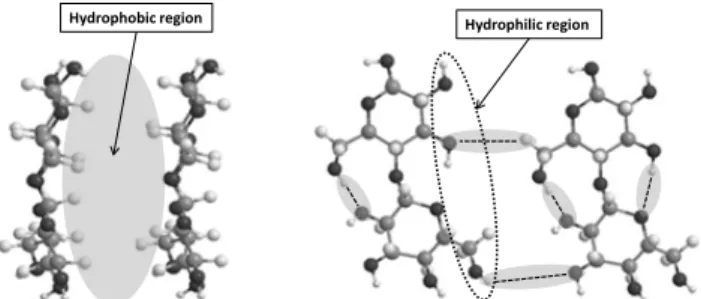
Hydrogen bonding is typically cited to explain molecular association even in aqueous systems (Kamide et al. 1984; Liu et al. 2011; Li et al. 2012; Zhang et al. 2011). Water molecules can behave both as acceptors and donors in hydrogen bonds and therefore it is unclear why there is a substantial gain in free energy in moving a molecule with hydrogen bond capabilities from an aqueous medium to a less polar environment. DNA is a clear example in literature where its association into the double helix is largely suggested to be caused by hydrogen bonding rather than the more accurate view in terms of hydrophobic interactions between the neighboring stacks of base-pairs that, in general, cause the association and helix formation (Lindman et al. 2008). In the DNA case, hydrogen bonding is rather responsible for the structural selectivity of the associated state. Hydrogen bonds occur but the driving force for association is the hydrophobic interaction. In the cellulose case, the same thought should be applied in order to understand the molecular mechanisms for association in aqueous media and to find suitable solvents for dissolution. As previously alluded to, despite hydrogen bonding being a general and well established viewpoint in the cellulose community, we have recently reviewed this problem and argued that the role of hydrophobic interactions in the cellulose solubility pattern should not be neglected (Lindman et al. 2010; Medronho et al. 2012; Medronho, Lindman 2014b). From its structural anisotropy (Fig 1) it becomes clear that there are regions of markedly different polarity within the cellulose molecules; cellulose has both hydrophilic and hydrophobic features (i.e. equatorial hydroxyl groups and axial hydrogen atoms) (Diddens et al. 2008; Biermann et al. 2001; Yamane et al. 2006; Miyamoto et al. 2009). This structural anisotropy is proposed to be the reason for
Fig 1 - Hydrophilic and hydrophobic parts of the cellulose molecule: (left), lateral view of the glucopyranose ring plane showing the hydrogen atoms of C–H bonds on the axial positions of the ring. (right), top view of the glucopyranose ring plane highlighting hydrogen bonding between the hydroxyl groups located on the equatorial positions of the ring (adapted from Medronho, Lindman (2014a).
the observed wetting properties of regenerated cellulose (Yamane et al. 2006). Therefore, in order to efficiently dissolve cellulose, a good solvent needs also to overcome these inter-sheet hydrophobic interactions (Cho et al. 2011; Medronho et al. 2012; Bergenstråhle et al. 2008; Gross, Chu 2010; Lindman et al. 2010).
This paper is divided into two parts; in the first section we discuss recent evidences in literature supporting cellulose amphiphilicity and the concomitant role of hydrophobic interactions while in the second part we discuss some examples from our own recent research supporting the role of hydrophobic interactions in dissolution and regeneration of cellulose.
Materials and Methods
Microcrystalline cellulose (MCC) was obtained from Sigma (Avicel PH-101, average particle size of 50 µm and DP of ca. 260). Tetrabutylammonium hydroxide (TBAH) of chromatographic grade was acquired from Sigma Aldrich as a 40 wt% solution in water while the NaOH pellets (>98% purity) were obtained from Fluka. An aqueous surfactant solution (~35% active substance) of a derivative of betaine (N-(Alkyl C10-C16)-N,N-dimethylglycine betaine), zinc chloride (ZnCl2), urea and
β-cyclodextrin (CD) (>97% purity) were obtained from
Sigma Aldrich.
Cellulose dissolution in alkali was obtained following the adapted standard procedures in literature (Isogai, Atalla 1998; Abe et al. 2012). Briefly, a known amount of cellulose was dispersed in a 10 wt% NaOH/H2O
solution and then allowed to freeze at -20ºC for 24 h. This was followed by thawing the solid frozen mass at room temperature with simultaneous vigorous mixing. On the other hand, for the TBAH based solvent, the dissolution procedure was simply the mixture of a known amount of cellulose with a 40 wt% TBAH/H2O solution
at room temperature for 30 min (Abe et al. 2012). Dissolution in the highly concentrated salt system was achieved by dissolving the desired amount of MCC in a 60 wt% ZnCl2/H2O solution at 80ºC for 15 min (Lu, Shen
2011).
A Linkam LTS 120 microscope equipped with a Q imaging (Qicam) Fast 1394 camera was used to observe the cellulose dissolution in both NaOH and TBAH
solvents. Samples were kept between cover slips and illuminated with linearly polarized light and analyzed through a crossed polarizer. Images were captured and analyzed using Qcapture software.
High resolution (Schottky) Environmental Scanning Electron Microscopy (FEG-ESEM), equipped with the analytical systems X-ray microanalysis (EDS) and backscattered electron diffraction pattern analysis (EBSD) was used to observe the morphology and microstructure of the dissolved samples (model Quanta 400FEG ESEM/EDAX Genesis X4M). Typically, 50 μL of a suspension was dropped onto a clean glass lamella followed by drying for 24 h in a kiln and then sputtered with an approximately 6 nm thin Au/Pd film by cathodic pulverization using a SPI Module Sputter Coater before SEM analysis. The same procedure was followed for the regenerated material, which, after being dried at room temperature, was also placed on a glass lamella using an appropriate support tape and then sputtered as previously described for the suspension case. The accelerating voltage ranged from 5 to 15 kV.
The X-Ray Diffraction (XRD) experiments were performed on a Siemens D5000 X-ray diffractometer, capable of identifying crystalline phases down to 3% of the bulk. This equipment consists of a θ/2θ diffraction instrument operating in the reflection geometry. CuKα1 is used as radiation source with λ = 1.54056 Å, focused by a primary Ge crystal monochromator. The detector is a standard scintillation counter. The Cu tube runs at 40 mA and 40 kV. The cooling is supplied by an internal water-filled recirculation chilling system, running at approximately 16ºC with a flow rate of 4-4.5 l/min. The slit arrangement is a 2 mm pre-sample slit, 2 mm post-sample slit and a 0.2 mm detector slit.
A T70 UV–vis spectrophotometer (PG Instruments Ltd) was used for the optical transmittance measurements. Essentially, the cellulose solutions were placed in a cell with a dimension of 1 cm × 1 cm × 5 cm and the transmittance of the samples was measured at a wavelength of 600 nm.
All the rheological experiments were conducted using a controlled stress Reologica Stresstech rheometer equipped with automatic gap setting. All samples were allowed to equilibrate for 10 min before the measurements. A cone-and-plate measuring geometry (1º, 50 mm diameter) with solvent trap was used to prevent sample evaporation. The instrument is equipped with an automatic gap setting. A temperature control unit ensures a temperature variation in the sample chamber not larger than 0.1ºC of the set value. The studies with temperature ramps were performed either on a heating or cooling mode at a fixed rate of 1 °C/min. The storage (G’) and loss (G’’) moduli were recorded at constant frequency (1 Hz) and stress (2 Pa).
Cellulose amphiphilicity and hydrophobic
interactions: A brief literature survey
The dissolution of a polymer, such as cellulose, in a solvent is governed by the free energy of mixing (Grulke 1999). The mixing process will occur spontaneously when the free energy change on mixing is negative.
Otherwise, phase separation may result from the mixing process. One should note that, the presence of solutes has a negative effect on the entropy of the solvent, as the solvent needs to order somehow around the solute for it to be accommodated. The loss in solvent entropy is usually balanced by increased entropy of the solute, which gains degrees of freedom upon dissolution. Since cellulose is a fairly rigid polymer, its ability to compensate for the loss of solvent entropy is limited, a factor playing a large role in its insolubility (Brandt et al. 2013). Native cellulose has a high DP, which inevitably leads to a low solubility caused by a decrease in the entropic gain in the dissolution process. The rigidity of the structure and the hydrophobic regions that allow transversely hydrogen-bonded chains to stack restrict the entropy of mixing so that a negative free energy change of dissolution is not achieved (i.e. dissolution in water is not allowed thermodynamically) (Cho et al. 2011; Krassig 1993; Klemm et al. 1998; Klemm et al. 2005). On the other hand, glucose, cellobiose and any small oligomer of cellulose up to a degree of polymerization, DP, of ca. 10 are soluble in common solvents, such as water (Taylor 1957; Klemm et al. 1998). As the molecular weight increases, the entropic driving force contribution to dissolution is weaker (Huggins 1941; Flory 1941; Flory 1942). Under these conditions, the enthalpy term is crucial in determining the sign of the Gibbs free energy change. As alluded to, water alone cannot dissolve cellulose, due to the fact that pair-wise hydrogen bond interactions involving water-water, carbohydrate-water, and carbohydrate-carbohydrate hydrogen bond pairings are about the same magnitude, approximately 5 kcal/mol (Lindman et al. 2010). The more consensual view among the leaders in the field that cellulose insolubility due to the extended network of intra- and intermolecular hydrogen bonds would only make sense if the carbohydrate-carbohydrate hydrogen bond interaction would be much stronger than the others, which is clearly not the case. Hydrogen bonds may be responsible for keeping the linear cellulose chains arranged in sheets. However, the stacking of these sheets into the three-dimensional crystal structures of the cellulose material must involve hydrophobic interactions. We highlight the fact that the driving force for association is not simply van der Waals interactions (O'Sullivan 1997; Atalla, Vanderhart 1984), but rather hydrophobic association driven by the liberation of structured water molecules (Cousins, Brown 1995). There are some striking examples in literature, which tend to support the role of hydrophobic interactions in the cellulose solubility pattern, which will be discussed next.
An interesting study performed by Bergenstråhle-Wohlert et al. combines MD simulations and solid state NMR on cellulose in water and in aqueous urea solutions (Bergenstråhle-Wohlert et al. 2012). The authors found that the local concentration of urea is significantly enhanced at the cellulose/solution interface. Radial distribution functions reveal that urea molecules have a preferential orientation, with its ‘‘hydrophobic part’’, the nitrogen atoms, pointing in the direction of the cellulose backbone, and its hydrophilic part, the carbonyl group, pointing away from it. In perfect agreement with this,
Xiong et al., while working in the same NaOH/urea system, clearly state that the addition of urea in the NaOH solvent can reduce the hydrophobic effect of cellulose since urea may play its role through interacting with the hydrophobic part of cellulose (Xiong et al. 2014). Lina Zhang’s group has been instrumental in investigating the effect of urea on cellulose solubility. Recently, an interesting study has been presented by Isobe et al. (Isobe et al. 2012) on the regeneration of cellulose, either using a coagulant or upon heating, in an aqueous alkali-urea solvent, following the process by time resolved synchrotron X-ray radiation. The authors suggested that when the medium surrounding the cellulose molecules becomes energetically unfavorable for molecular dispersion, regeneration starts and the initial process would consist in stacking the hydrophobic glucopyranoside rings (driven by hydrophobic interactions) to form monomolecular sheets, which then would line up by hydrogen bonding to form Na–cellulose IV type crystallites, a hydrate form of cellulose II. This constitutes the first experimental evidence of the development of hydrophobically stacked monomolecular sheets which has been hypothesized first by Hermans (Hermans 1949) and later by Hayashi (Hayashi et al. 1974). Later, the theoretical work of Miyamoto et al. (Miyamoto et al. 2009) simulated the regeneration of cellulose by MD, supporting the hypothesis of Hermans and Hayashi.
Regarding the regeneration aspects of cellulose, Östlund et al. observed that the properties of a regenerated cellulose material can be tunable by the proper choice of the experimental conditions such as temperature and coagulation medium (Östlund et al. 2013). It is suggested that cellulose coagulation in liquids of different polarity can be used to control the morphology of the regenerated material, as the increased polarity of the coagulant governs the hydrophobic interactions between the polymer chains during regeneration.
Based on its amphiphilicity, Rein et al. have used cellulose as a novel and efficient eco-friendly emulsifying agent, playing the role of an amphiphilic coating for oil-in-water and water-in-oil dispersions (Rein et al. 2012). The authors suggest that hydrophilic hydroxyl groups interact with the water while and the more hydrophobic planes of the glucopyranose rings are located towards the hydrocarbon oil. In particular, the oil-in-water dispersions were found to be stable for about one year, where neither flocculation nor coalescence was observed.
The amphiphilic properties of cellulose have also been noticed in synthesis. Nawaz et al. while studying the mechanism of mediated imidazole-catalyzed acylation of cellulose suggested that the observed decrease in enthalpy during the N-butanoyl- to N-hexanoylimidazole conversion may be related to favorable hydrophobic interactions between the carbon chains of the N-acylimidazole and cellulosic surface (Nawaz et al. 2013). Ionic Liquids (IL) constitute a very promising group of solvents for cellulose (Liu et al. 2012; Pinkert et al. 2009). Although, there is no clear understanding of the role of individual ionic species in dissolution it becomes clear that the strong asymmetry in the IL is fundamental
and necessary for an efficient dissolution (Medronho, Lindman 2014b). In fact, the cations are typically bulky species with amphiphilic properties (Holding et al. 2014). Proof of this is that most literature agrees on the formation of aggregates or micelles of IL in water, similar to a surfactant behavior (Le et al. 2012). Such amphiphilicity is normally not considered when discussing the mechanism of dissolution of cellulose but we believe that this is fundamental to understand the action in cellulose solubility. We recall that the dissolution of an amphiphilic polymer, such as cellulose, would be facilitated in amphiphilic solvents and therefore the amphiphilic properties of all cations in ILs clearly fit this suggestion. Recent molecular dynamics simulations, carried out on cellulose oligomers and 1-ethyl-3-methylimidazolium acetate (C2mimOAc), indeed suggest that the cations are in close contact with the cellulose through hydrophobic interactions (Liu et al. 2010). Closely related, Hauru et al. found that cellulose regeneration from IL solutions goes via the hydrophobic association of the less polar regions of cellulose (Hauru et al. 2012). An interesting work of Mostofian et al. suggests a synergistic approach for cellulose dissolution in IL (Mostofian et al. 2014). These authors performed all-atom MD simulations of a cellulose fiber in 1-butyl-3-methylimidazolium chloride (BmimCl) in order to study the role of cations and anions in the initial phase of cellulose dissolution in ILs. It was found that while the anions predominantly interact with the cellulose surface hydroxyl groups, the cations stack preferentially on the hydrophobic cellulose surfaces, a process driven by non-polar interactions with cellulose. This effect of the cation is suggested to stabilize the detached cellulose chains. This work not only provides a deep molecular description on why ILs are regarded as a very promising class of solvents for cellulose but, more importantly, highlights the concerted and distinct action of anions and cations on the hydrophobic and hydrophilic regions of cellulose surfaces as the key to an efficient dissolution of an amphiphilic molecule such as cellulose. Another important theoretical work on the mean force calculations for the separation of cello-oligomers, have suggested that hydrophobic interactions contribute favorably to stabilizing a crystal-like stacked structure (Bergenstråhle et al. 2010); the authors estimate a 2.0 kcal/mol/residue contribution for the hydrophobic stacking while the estimated hydrogen bonding contribution is about eight times less.
Some substances of intermediate polarity such as surfactants, poly(ethylene glycol), thiourea and urea can enhance the aqueous solubility of cellulose as we have recently reviewed (Medronho, Lindman 2014b). The latter additive is actually commonly used as agent for protein denaturation for more than a century and it appears reasonable to assume that the role of urea in cellulose dissolution is similar to protein denaturation (Tanford 1964). Urea has a much lower polarity than water and is well known to eliminate hydrophobic association in water. For instance, urea inhibits hydrophobic association of surfactants, which consequently results in an increase in critical micelle concentration. Obviously, as briefly mentioned above, the
key point here is the amphiphilic nature of urea which has been additionally demonstrated by molecular modeling; enhancement of its concentration close to model hydrophobic surfaces (Koishi et al. 2010) and inside hydrophobic nanotubes (Xiu et al. 2011). Its amphiphilic nature makes it act like a surfactant molecule capable of forming hydrogen bonds with the solvent while, at the same time, having the ability of solvating the hydrophobic sides of cellulose. The role of urea has also been discussed by Isobe et al., which while following the cellulose dissolution in the NaOH/urea based solvent, inferred that urea has no direct interaction with cellulose, but rather helps the alkali penetration into the cellulose crystalline regions by stabilizing the swollen cellulose molecules (Isobe et al. 2013). The authors concluded that such stabilizing effect may result from the fact that urea prevents the hydrophobic mutual association of cellulose chains.
Another striking example comes from the deposition of carboxymetylcellulose (CMC) on polymer surfaces. Kargl et al. suggest that the amphiphilicity of cellulose surfaces is important for the irreversible deposition of CMC (Kargl et al. 2012).
In the composite field, cellulose-acrylated epoxidized soybean oil (AESO) based biocomposites were shown to present oil molecules in the cellulosic material although the data strongly suggests the lack of covalent or hydrogen bonding between the two components (Narewska et al. 2014). The authors propose the existence of hydrophobic interactions between AESO molecules and cellulose hydrophobic domains thus supporting the amphiphilic nature of cellulose.
From this short but broad overview, it appears indeed that cellulose is amphiphilic in nature and that hydrophobic interactions play an important role both in dissolution and regeneration. In the next section some simple examples from our own recent research are introduced.
Evidences on the role of hydrophobic
interactions: our recent experiments
Thermal stability of cellulose solutions: Influence of
amphiphilic additives
The stability of a cellulose dope is an important feature to consider when developing and evaluating a solvent system. Normally, a cellulose solution is unstable and the self-association of cellulose chains results in gelation of the system. In Fig 2, the viscoelastic properties are represented as a function of temperature for a system of microcrystalline cellulose (MCC) dissolved in an alkali based solvent with (Fig 2b) and without (Fig 2a) an amphiphilic cosolute (betaine derivative). This solvent system is peculiar because dissolution is favored at low temperatures contradicting, at a first glance, the thermodynamics of the process. After dissolution, as temperature increases, gelation of the cellulose dope is observed and the gelation temperature, Tg, can be
estimated from the crossover of the storage (G’) and loss (G’’) moduli. The vertical dashed lines demark the transition region from a liquid-like behavior (G’’>G’) to a solid-like behavior (G’>G’’).
Fig 2 - Elastic modulus, G’ (filled symbols), and viscous modulus, G’’ (open symbols), versus temperature for 3.5 wt% microcrystalline cellulose samples dissolved in a 10 wt% NaOH/H2O solvent system: (a), without betaine derivative and
(b) with betaine derivative. Constant heating rate of 1ºC/min at 0.5 Hz. The temperature of gelation (G’ = G’’) is increased ca. 10ºC in the presence of the amphiphilic additive. The vertical dashed grey line indicates the transition region.
Fig 3 - Elastic molulus, G’, and viscous modulus, G’’, versus temperature for 3.5% microcrystalline cellulose sample dissolved in 60% ZnCl2/H2O solvent system: (a), without
betaine derivative and (b) with betaine derivative. Constant cooling rate of 1 ºC/min at 0.5Hz. The temperature of gelation, Tg, decreased by more than 30 ºC in the presence of the
amphiphilic additive. The vertical dashed grey line indicates the transition region.
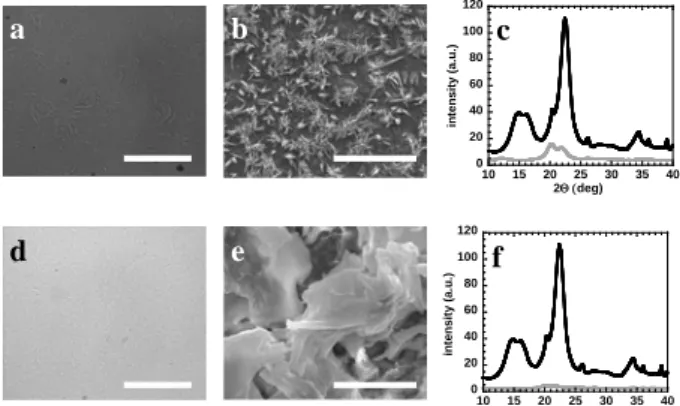
Fig 4 - Polarized light micrographs of dissolved cellulose in the cold 8 wt% NaOH/H2O solvent (a) and in 40 wt% TBAH/H2O
solvent (d). The scale bars represent 100 µm; SEM images of the cellulose after being dissolved and regenerated in acidic aqueous coagulation media. “Needle-like” crystallites are observed in the 8 wt% NaOH/H2O solvent (b) while a smooth
and flexible morphology is observed in the TBAH-based solvent (40 wt% TBAH/H2O) after regeneration (e). The scale bars
represent 10 µm. X-ray diffraction patterns: smoothed raw data of the regenerated cellulose (light grey lines) in NaOH (c) and in TBAH (f). In both cases the X-ray diffraction pattern of native cellulose (black line) is displayed for comparison proposes.
Clearly, the addition of an amphiphilic additive delays the gel formation, shifting Tg to higher temperatures. The
same effect can be seen in a different system where MCC was dissolved in a highly concentrated zinc chloride aqueous solution at high temperature (Fig 3).
In this case, gelation is observed as soon as the temperature goes below ca. 65ºC. However, when the amphiphilic additive is present (Fig 3b), the cellulose dope preserved the liquid-like behavior (G’’ > G’) for a larger temperature window; in this case, gelation is only observed at temperatures below ca. 35ºC. Despite the obvious differences between the two solvent systems and dissolution procedures, the addition of an amphiphilic additive has the same effect increasing the thermal stability of the cellulose dopes allowing the solutions to maintain their liquid behavior. Gelation is believed to be due to self-aggregation of the cellulose chains in the solution with time and/or at elevated temperatures. The progressively increased number of more hydrophobic junction zones between the cellulose chains in the solution is prevented by the presence of surfactant. Therefore, we suggest that the amphiphilic cosolute reduces the hydrophobic interactions responsible for aggregation, resulting in an increase of the thermal stability. We stress that these findings point in the same direction as the systems alluded to above (i.e. urea, PEG and other amphiphilic molecules) as all these compounds are expected to weaken hydrophobic interactions thus supporting the view on the amphiphilic properties of cellulose.
Role of cation in dissolution: inorganic versus
amphiphilic
In general, cellulose solvents are of highly different nature reflecting the great challenges in the understanding of the subtle balance between the different interactions. In Fig 4 we show the effect of two alkali-based solvents (sodium hydroxide, NaOH, and tetrabutylammonium hydroxide, TBAH) on the dissolution of cellulose.
A simple naked-eye inspection revealed a clear and transparent one-phase solution in both cases and the polarized light microscopy (PLM) pictures (Fig 4a and
Fig 4d) confirm that the initial cellulose fibers rich in
birefringent domains disappear and are dissolved in both solvents. In the cold alkali, it is still possible to see a few cellulose disks and fragments while in the TBAH solution the PLM micrograph shows no signs of undissolved material. For several practical applications, such as the formation of films and fibers, these solutions are quite acceptable. However, even if from a macroscopic and microscopic point of view, cellulose seems reasonably well dissolved, there are clear indications that the state of the solutions must be different for the two solvents used. In Fig 4b and Fig 4e, one can see scanning electron microscopy (SEM) images of the above mentioned cellulose solutions after being regenerated onto a clean glass lamella. While in the cold alkali, dissolution seems not to be completed (i.e. individual crystals are dispersed in the glass lamella), in the TBAH case dissolution is much more efficient, probably reaching the molecular level as inferred from the apparent softness and flexibility of the regenerated cellulose material. The surface of the
0.1 1 20 21 22 23 24 25 26 G' a n d G'' / P a Temp / ºC 1 10 100 20 25 30 35 40 G' a n d G' ' / P a Temp / ºC a b 1 10 100 1000 20 30 40 50 60 70 80 G' a n d G' ' / P a Temp / ºC 0.1 1 10 100 1000 20 30 40 50 60 70 80 G' a n d G'' / P a Temp / ºC a b 0 20 40 60 80 100 120 10 15 20 25 30 35 40 in te n s ity ( a .u .) 2Θ (deg) 0 20 40 60 80 100 120 10 15 20 25 30 35 40 in te n s it y ( a .u .) 2Θ (deg) a b c d e f
material is somehow flat and seems to be constituted by aggregated sheets of cellulose molecules. The flattening of the cellulose surface upon regeneration shows the high flexibility of the film and, additionally, also indicates a low crystallinity (i.e. highly crystalline samples would hardly adopt such flexible conformations and morphologies). This surface morphology is obviously facilitated if the structure of the cellulose solution is closer to a molecular dispersion state than to an aggregated state; the expected flexibility of the former is opposed to the rigidity of the later. Therefore, we suggest that while an aqueous TBAH solution gives rise to what appears to be dissolution down to the molecular level, a NaOH solution does not dissolve cellulose molecularly but rather leaves aggregates of high crystallinity stable in the cellulose dope (Roy et al. 2003). Dynamic light scattering data also supports this view; large aggregates are observed in NaOH while the size of the objects in the TBAH solution is considerably smaller (data not shown). In Fig 4c and Fig 4f the X-ray diffraction patterns of the regenerated solutions are shown for the NaOH and TBAH systems, respectively. The diffraction of native cellulose is shown for comparison. The starting MCC material presents a major sharp diffraction peak centered around 22.5º (002) with a side peak at 20.5° (021) typical for a cellulose I crystalline organization (O'Connor 1972). When cellulose is dissolved in NaOH solution and regenerated, the crystalline structure changes to a cellulose II type arrangement with two main diffraction peaks centered at 20.1º (101�) and 21.9º (002). On the other hand, when cellulose is regenerated from the TBAH solution, no diffraction peaks are observed indicating the absence of crystallinity, i.e. the regenerated material is amorphous.
We believe that the fact that dissolution into molecular solutions (or close to it) is strongly assisted by an amphiphilic ion provides good support for the view that cellulose molecules have both polar and nonpolar regions and have a strong tendency to associate by hydrophobic interactions.
Tuning the solvent quality: role of salt, urea and
cyclodextrins
Polyelectrolytes are much more soluble than nonionic polymers due to the entropy of the small counterions. Therefore, charging up a polymer is always expected to be helpful for solubility (Holmberg et al. 2002). This can be achieved either by the association of an ionic charged species (such as an ion or a surfactant) or via deprotonation or protonation of the hydroxyls groups of cellulose. One of the leading opinions is that the alkali forms hydrates with water capable to break the inter- and intramolecular hydrogen bonds between cellulose molecules (Cai et al. 2008). Instead, we believe that the mechanism of dissolution in strong alkaline environment is based on the deprotonation of the hydroxyl groups with a translational entropic gain due to the release of the counterions (Fig 5).
Again, the transformation of a neutral molecule into a polyelectrolyte is expected to trigger the dissolution. The consequence (and proof) of cellulose ionization is that the addition of a simple salt, such as KCl (also verified for
Fig 5 - Conversion of neutral cellulose into a polyelectrolyte: schematic representation of the ionization of the hydroxyls of cellulose in strong alkali medium (extremely high pH).
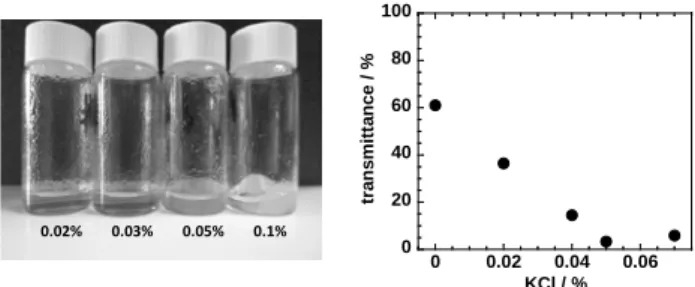
Fig 6 - Photos (left) and transmittance (right) of cellulose dissolved in strong alkali (TBAH solution) with progressive addition of KCl. As the salt concentration increases the quality of the solution decreases (increase in turbidity) until eventually gelation and/or phase separation is observed.
other salt systems), makes the cellulose dope changing from low viscous and transparent to moderately viscous and opaque with macroscopic phase separation after addition of a certain amount of salt (Fig 6).
This clearly demonstrates that cellulose is, at least partially, ionized in solution due to the extremely high pH and, upon salt addition, the cellulose charges will be progressively screened until eventually the hydrophobic attractions are dominant over the electrostatic repulsion. Next, the cellulose starts to aggregate in solution (increase in turbidity) forming a three-dimensional network with consequent gelation of the solution. We have also noted that the increase of turbidity with the progressive salt addition is accompanied by an increase of viscosity of the cellulose solution (data not shown).
Zinc oxide is known to enhance cellulose solubility in the cold alkali and recently, the role of the sodium zincate ion, Zn(OH)42−, (a possible reaction product of ZnO with
NaOH) was analyzed by Yang et al. (Yang et al. 2011). It is claimed that Zn(OH)42− can form stronger hydrogen
bonds with cellulose than hydrated NaOH. Additionally, and somewhat contradictory, the authors also consider that Zn(OH)42− plays an important role in breaking the
intermolecular hydrogen bonds of cellulose, leading to an enhancement of the dissolution capability. It is not clear why the Zn(OH)42− anion would form stronger hydrogen
bonds with cellulose than with water and, at the same time, be capable of selectively breaking cellulose intermolecular hydrogen bonds. In combination with the above described effect of an extreme pH, we have suggested that the Zn(OH)42− anion is simply charging up
cellulose by associating to it (Kihlman et al. 2013). In fact, this charging up principle is widely used in the chemical modification of cellulose (e.g. carboxymethyl cellulose). We foresee the same effect by the association of cellulose with some ionic cosolutes, such as the Zn(OH)42− anion. Thus, as a consequence of the
formation of a cellulose-zincate charged complex, the solubility of cellulose is enhanced.
High pH + + + + + + 0.02% 0.03% 0.05% 0.1% 0 20 40 60 80 100 0 0.02 0.04 0.06 tr an sm it tan ce / % KCl / %
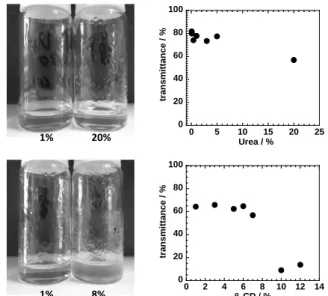
Fig 7 - Photos (left) and transmittance (right) of cellulose dissolved in strong alkali (TBAH solution) with progressive addition of urea (top) and β-cyclodextrin (bottom). While the addition of urea does not produce significant changes in transmittance but rather increases cellulose solubility, the addition of β-cyclodextrin clouds and phase separates the solution.
The addition of urea does not change the quality of the solution (Fig 7, top). In fact, we have added up to 20 wt% of urea and not only was no phase separation observed but also the cellulose dissolution and rheology properties were improved. As mentioned above, we believe that urea is weakening the hydrophobic interactions (in a similar way as it does during protein unfolding) increasing cellulose solubility and preventing the hydrophobic regions of cellulose to come together to form a gelled network (Zangi et al. 2009).
In the previous section, we have seen that a more amphiphilic cation facilitates the dissolution of cellulose and argued that this is due to the weakening of the hydrophobic interactions of cellulose via the more hydrophobic moieties of the cation. In order to demonstrate that the efficiency of the dissolution is strongly dependent on the amphiphilic cation we have also prepared some samples where β-cyclodextrin (CD) was included in the composition. Fig 7 (bottom) shows that the addition of a CD turns a good solvent into a bad
solvent. The tetrabutylammonium cation (TBA+) is suggested to be associated to the hydrophobic interior of the CD molecules decreasing its availability in solution. As a consequence, the quality of the solvent becomes poorer and the solution starts to cloud (Fig 7, bottom) until it phase separates macroscopically. We are currently investigating the association mechanism by nuclear magnetic resonance (NMR) to estimate, for instance, the stoichiometry and association constants of the process.
Conclusions
From this treatise it appears that the widely accepted cellulose dissolution and regeneration mechanisms, in terms of hydrogen bonding, have to be reanalyzed. In an attempt to review recent work, we have briefly shown robust theoretical and practical examples highlighting the role of hydrophobic interactions in both cellulose dissolution and regeneration. The conclusion is evident: the amphiphilic character of cellulose should not be neglected. In novel experiments we have attempted to shed further light on the problem. Dissolution and dope stability are found to be clearly influenced by the presence of amphiphilic species. Moreover, we have seen that combining cellulose ionization (either achieved by extreme pH or adsorption of ionic species) with the weakening of the hydrophobic effect makes dissolution more efficient, probably reaching the molecular level. In the TBAH system, we have seen that this effect can be controlled and even reversed, thus decreasing the solvent capabilities, either by the addition of salt (i.e. reducing the counterion entropy effect) or by adding β-cyclodextrin (suggested to trap the amphiphilic cations of the solvent). We believe that these simple examples are strongly supportive of the amphiphilic character of cellulose and on the role of hydrophobic interactions on its solubility pattern.
Acknowledgements
The authors acknowledge support from the Portuguese Foundation for Science and Technology (FCT, project PTDC/AGR-TEC/4049/2012, PhD and post-doc grants assigned to Luis Alves: SFRH/BD/80556/2011 and Bruno Medronho: SFRH/BPD/74540/2010, respectively). Financial support was also received from Södra Skogsägarnas Stiftelse, Stiftelsen Nils och Dorthi Troëdssons forskningsfond and the CelluNova consortium.
Literature
Abe, M., Fukaya, Y. and Ohno, H. (2012): Fast and facile
dissolution of cellulose with tetrabutylphosphonium hydroxide containing 40 wt% water, Chem Commun 48(12), 1808-1810.
Atalla, R. H. and Vanderhart, D. L. (1984): Native Cellulose -
A Composite of 2 Distinct Crystalline Forms, Science 223(4633), 283-285.
Bergenstråhle-Wohlert, M., Berglund, L. A., Brady, J. W., Larsson, P. T., Westlund, P. O. and Wohlert, J. (2012):
Concentration enrichment of urea at cellulose surfaces: results from molecular dynamics simulations and NMR spectroscopy, Cellulose 19(1), 1-12.
Bergenstråhle, M., Mazeau, K. and Berglund, L. A. (2008):
Molecular modeling of interfaces between cellulose crystals and surrounding molecules: Effects of caprolactone surface grafting, Eur Polym J 44(11), 3662-3669.
Bergenstråhle, M., Wohlert, J., Himmel, M. E. and Brady, J. W. (2010): Simulation studies of the insolubility of cellulose,
Carbohyd Res 345(14), 2060-2066.
Biermann, O., Hadicke, E., Koltzenburg, S. and Muller-Plathe, F. (2001): Hydrophilicity and lipophilicity of cellulose
crystal surfaces, Angew Chem Int Edit 40(20), 3822-3825.
Brandt, A., Grasvik, J., Hallett, J. P. and Welton, T. (2013):
Deconstruction of lignocellulosic biomass with ionic liquids, Green Chem 15(3), 550-583. 0 20 40 60 80 100 0 2 4 6 8 10 12 14 tr an sm it tan ce / % β-CD / % 0 20 40 60 80 100 0 5 10 15 20 25 tr an sm it tan ce / % Urea / % 1% 20% 1% 8%
Cai, J., Zhang, L., Liu, S. L., Liu, Y. T., Xu, X. J., Chen, X. M., Chu, B., Guo, X. L., Xu, J., Cheng, H., Han, C. C. and Kuga, S. (2008): Dynamic Self-Assembly Induced Rapid Dissolution of
Cellulose at Low Temperatures, Macromolecules 41(23), 9345-9351.
Cho, H. M., Gross, A. S. and Chu, J. W. (2011): Dissecting
Force Interactions in Cellulose Deconstruction Reveals the Required Solvent Versatility for Overcoming Biomass Recalcitrance, J Am Chem Soc 133(35), 14033-14041.
Cousins, S. K. and Brown, R. M. (1995): Cellulose-I Microfibril
Assembly - Computational Molecular Mechanics Energy Analysis Favors Bonding by Vanderwaals Forces as the Initial Step in Crystallization, Polymer 36(20), 3885-3888.
Diddens, I., Murphy, B., Krisch, M. and Müller, M. (2008):
Anisotropic Elastic Properties of Cellulose Measured Using Inelastic X-ray Scattering, Macromolecules 41(24), 9755-9759.
Flory, P. I. (1942): Thermodynamics of high polymer solutions,
J Chem Phys 10(1), 51-61.
Flory, P. J. (1941): Thermodynamics of high polymer solutions,
J Chem Phys 9(8), 660-661.
Gross, A. S. and Chu, J. W. (2010): On the Molecular Origins
of Biomass Recalcitrance: The Interaction Network and Solvation Structures of Cellulose Microfibrils, J Phys Chem B 114(42), 13333-13341.
Grulke, E. A. (1999): Solubility parameter values. In: Brandrup
J, Immergut EH, Grulke EA,, editors, 4th ed. Polymer handbook, vol. 7. New York, NY: Wiley.
Hauru, L. K. J., Hummel, M., King, A. W. T., Kilpelainen, I. and Sixta, H. (2012): Role of Solvent Parameters in the
Regeneration of Cellulose from Ionic Liquid Solutions, Biomacromolecules 13(9), 2896-2905.
Hayashi, J., Masuda, S. and Watanabe, S. (1974): Plane
Lattice Structure in Amorphous Region of Cellulose Fibers, Nippon Kagaku Kaishi(5), 948-954.
Hermans, P. H. (1949): Degree of Lateral Order in Various
Rayons as Deduced from X-Ray Measurements, J Polym Sci 4(2), 145-151.
Holding, A. J., Heikkila, M., Kilpelainen, I. and King, A. W. T.
(2014): Amphiphilic and Phase-Separable Ionic Liquids for Biomass Processing, Chemsuschem 7(5), 1422-1434.
Holmberg, K., Jonsson, B., Kronberg, B. and Lindman, B.
(2002): Surfactants and polymers in aqueous solution. Wiley, Hoboken.
Huggins, M. L. (1941): Solutions of long chain compounds, J
Chem Phys 9(5), 440-440.
Isobe, N., Kimura, S., Wada, M. and Kuga, S. (2012):
Mechanism of cellulose gelation from aqueous alkali-urea solution, Carbohyd Polym 89(4), 1298-1300.
Isobe, N., Noguchi, K., Nishiyama, Y., Kimura, S., Wada, M. and Kuga, S. (2013): Role of urea in alkaline dissolution of
cellulose, Cellulose 20(1), 97-103.
Isogai, A. and Atalla, R. H. (1998): Dissolution of cellulose in
aqueous NaOH solutions, Cellulose 5(4), 309-319.
Kamide, K., Okajima, K., Matsui, T. and Kowsaka, K. (1984):
Study on the Solubility of Cellulose in Aqueous Alkali Solution by Deuteration Ir and C-13 Nmr, Polym J 16(12), 857-866.
Kargl, R., Mohan, T., Bracic, M., Kulterer, M., Doliska, A., Stana-Kleinschek, K. and Ribitsch, V. (2012): Adsorption of
Carboxymethyl Cellulose on Polymer Surfaces: Evidence of a
Specific Interaction with Cellulose, Langmuir 28(31), 11440-11447.
Kihlman, M., Medronho, B. F., Romano, A. L., Germgård, U. and Lindman, B. (2013): Cellulose Dissolution in an Alkali
Based Solvent: Influence of Additives and Pretreatments, J Brazil Chem Soc 24(2), 295-303.
Klemm, D., Heublein, B., Fink, H. P. and Bohn, A. (2005):
Cellulose: Fascinating biopolymer and sustainable raw material, Angew Chem Int Edit 44(22), 3358-3393.
Klemm, D., Philipp, B., Heinze, T., Heinze, U. and Wagenknecht, W. (1998): in: “Fundamentals and analytical
methods. Comprehensive Cellulose Chemistry (vol 1)”, Wiley - VCH, Weinheim.
Koishi, T., Yasuoka, K., Zeng, X. C. and Fujikawa, S. (2010):
Molecular dynamics simulations of urea-water binary droplets on flat and pillared hydrophobic surfaces, Faraday Discuss 146, 185-193.
Krässig, H., Schurz, J., Steadman, R. G., Schliefer, K., Albrecht, W., Mohring, M. and Schlosser, H. (2000):
Cellulose, Ullmann's Encyclopedia of Industrial Chemistry, Wiley-VCH Verlag GmbH & Co. KGaA.
Krassig, H. A. (1993): Cellulose: structure, accessibility and
reactivity, 1st edn. Gordon and Breach Science Publishers, Amsterdam.
Le, K. A., Sescousse, R. and Budtova, T. (2012): Influence of
water on cellulose-EMIMAc solution properties: a viscometric study, Cellulose 19(1), 45-54.
Li, R., Zhang, L. N. and Xu, M. (2012): Novel regenerated
cellulose films prepared by coagulating with water: Structure and properties, Carbohyd Polym 87(1), 95-100.
Lindman, B., Dias, R. S., Miguel, M. G., Morán, M. C. and Costa, D. (2008): Manipulation of DNA by Surfactants,
Highlights in Colloid Science, Wiley-VCH Verlag GmbH & Co. KGaA, pp. 179-202.
Lindman, B., Karlström, G. and Stigsson, L. (2010): On the
mechanism of dissolution of cellulose, J Mol Liq 156(1), 76-81.
Liu, C. Z., Wang, F., Stiles, A. R. and Guo, C. (2012): Ionic
liquids for biofuel production: Opportunities and challenges, Appl Energ 92, 406-414.
Liu, H. B., Sale, K. L., Holmes, B. M., Simmons, B. A. and Singh, S. (2010): Understanding the Interactions of Cellulose
with Ionic Liquids: A Molecular Dynamics Study, J Phys Chem B 114(12), 4293-4301.
Liu, H. B., Sale, K. L., Simmons, B. A. and Singh, S. (2011):
Molecular Dynamics Study of Polysaccharides in Binary Solvent Mixtures of an Ionic Liquid and Water, J Phys Chem B 115(34), 10251-10258.
Lu, X. K. and Shen, X. Y. (2011): Solubility of bacteria
cellulose in zinc chloride aqueous solutions, Carbohyd Polym 86(1), 239-244.
Marsh, J. T. (1942): An introduction to the chemistry of
cellulose, 2nd edn. Chapman & Hall, London.
Medronho, B. and Lindman, B. (2014a): Brief overview on
cellulose dissolution/regeneration interactions and mechanisms, Adv. Colloid Interface Sci. doi: 10.1016/j.cis.2014.05.004.
Medronho, B. and Lindman, B. (2014b): Competing forces
during cellulose dissolution: From solvents to mechanisms, Curr. Opin. Colloid Interface Sci. 19, 32-40.
Medronho, B., Romano, A., Miguel, M. G., Stigsson, L. and Lindman, B. (2012): Rationalizing cellulose (in)solubility:
reviewing basic physicochemical aspects and role of hydrophobic interactions, Cellulose 19(3), 581-587.
Miyamoto, H., Umemura, M., Aoyagi, T., Yamane, C., Ueda, K. and Takahashi, K. (2009): Structural reorganization of
molecular sheets derived from cellulose II by molecular dynamics simulations, Carbohyd Res 344(9), 1085-1094.
Mostofian, B., Smith, J. C. and Cheng, X. L. (2014):
Simulation of a cellulose fiber in ionic liquid suggests a synergistic approach to dissolution, Cellulose 21(2), 983-997.
Narewska, J., Lassila, L. and Fardim, P. (2014): Preparation
and characterization of new mouldable cellulose-AESO biocomposites, Cellulose 21(3), 1769-1780.
Nawaz, H., Pires, P. A. R. and El Seoud, O. A. (2013):
Kinetics and mechanism of imidazole-catalyzed acylation of cellulose in LiCl/N,N-dimethylacetamide, Carbohyd Polym 92(2), 997-1005.
O'Connor, R. T. (1972): Instrumental Analysis of Cotton
Cellulose and Modified Cotton Cellulose, Marcel Dekker Incorporated.
O'Sullivan, A. C. (1997): Cellulose: the structure slowly
unravels, Cellulose 4, 173-208.
Östlund, A., Idstrom, A., Olsson, C., Larsson, P. T. and Nordstierna, L. (2013): Modification of crystallinity and pore
size distribution in coagulated cellulose films, Cellulose 20(4), 1657-1667.
Pinkert, A., Marsh, K. N., Pang, S. S. and Staiger, M. P.
(2009): Ionic Liquids and Their Interaction with Cellulose, Chem Rev 109(12), 6712-6728.
Rein, D. M., Khalfin, R. and Cohen, Y. (2012): Cellulose as a
novel amphiphilic coating for oil-in-water and water-in-oil dispersions, J Colloid Interf Sci 386, 456-463.
Roy, C., Budtova, T. and Navard, P. (2003): Rheological
properties and gelation of aqueous cellulose-NaOH solutions, Biomacromolecules 4(2), 259-264.
Tanford, C. (1964): Isothermal Unfolding of Globular Proteins
in Aqueous Urea Solutions, J Am Chem Soc 86(10), 2050-&.
Taylor, J. B. (1957): The Water Solubilities and Heats of
Solution of Short Chain Cellulosic Oligosaccharides, T Faraday Soc 53(9), 1198-1203.
Xiong, B., Zhao, P., Hu, K., Zhang, L. and Cheng, G. (2014):
Dissolution of cellulose in aqueous NaOH/urea solution: role of urea, Cellulose in press., DOI: 10.1007/s10570-10014-10221-10577.
Xiu, P., Yang, Z. X., Zhou, B., Das, P., Fang, H. P. and Zhou, R. H. (2011): Urea-Induced Drying of Hydrophobic Nanotubes:
Comparison of Different Urea Models, J Phys Chem B 115(12), 2988-2994.
Yamane, C., Aoyagi, T., Ago, M., Sato, K., Okajima, K. and Takahashi, T. (2006): Two different surface properties of
regenerated cellulose due to structural anisotropy, Polym J 38(8), 819-826.
Yang, Q. L., Qi, H. S., Lue, A., Hu, K., Cheng, G. Z. and Zhang, L. N. (2011): Role of sodium zincate on cellulose
dissolution in NaOH/urea aqueous solution at low temperature, Carbohyd Polym 83(3), 1185-1191.
Zangi, R., Zhou, R. H. and Berne, B. J. (2009): Urea's Action
on Hydrophobic Interactions, J Am Chem Soc 131(4), 1535-1541.
Zhang, S., Li, F. X. and Yu, J. Y. (2011): Kinetics of Cellulose
Regeneration from Cellulose-NaOH/Thiourea/Urea/H2O System, Cell Chem Technol 45(9-10), 593-604.