Oleanonic acid from
Lippia lupulina
(Verbenaceae)
shows strong
in vitro
antileishmanial and
antitrypanosomal activity
Cristiano S. FUNARI1*, Letícia de ALMEIDA2 , Thais G. PASSALACQUA2 , Isabel MARTINEZ2 ,
Daniela L. AMBRÓSIO2 , Regina Maria B. CICARELLI2 , Dulce Helena S. SILVA3 , Márcia A. S. GRAMINHA2
1São Paulo State University (UNESP), College of Agricultural Sciences, CP 237, CEP 18610-307, Botucatu, SP, Brazil 2São Paulo State University (UNESP), School of Pharmaceutical Sciences, CEP 14801-902, Araraquara, SP, Brazil 3São Paulo State University (UNESP), Institute of Chemistry, CP 355, CEP 14801-970, Araraquara, SP, Brazil
* Corresponding author: [email protected], [email protected]
ABSTRACT
Leishmaniasis and Chagas disease affect millions of people in tropical and subtropical regions. Drugs used currently to treat such diseases often present undesirable side effects and low efficiency. The aim of this work was to identify extracts and isolated compounds from the genus Lippia with leishmanicidal and trypanocidal activity. Fifteen extracts from different plant
parts of Lippia species with partially known chemical compositions, four partition fractions, six compounds and a mixture of four interconverting flavanones previously isolated from Lippia salviaefolia and Lippia lupulina were assayed in vitro towards
epimastigote forms of Trypanosoma cruzi and promastigote forms of Leishmania amazonensis. The root extract of L. lupulina
had potent activity against T. cruzi and L. amazonensis (IC50 of 20.0 and 54.5 µg mL–1, respectively). The triterpenoid oleanonic
acid showed the strongest activity against these protozoans (IC50 of 18.5 and 29.9 µM, respectively). Our results indicate that
Lippia plants and their derivatives deserve further investigation in the search for new antiprotozoal drugs, particularly for the
treatment of leishmaniasis and Chagas disease.
KEYWORDS: Leishmanicidal, trypanocidal, triterpenoids, flavonoids, T. cruzi
Ácido oleanônico isolado de
Lippia lupulina
(Verbenaceae) apresenta
potentes atividades leishmanicida e tripanocida
Leishmaniose e doença de Chagas afetam milhões de pessoas em regiões tropicais e subtropicais. As drogas atualmente usadas para tratar estas doenças frequentemente apresentam efeitos colaterais indesejáveis e baixa eficiência. Este trabalho teve como objetivo encontrar extratos, frações e compostos isolados de espécies do gênero Lippia com atividades leishmanicida e tripanocida. Quinze extratos de diferentes partes de plantas do gênero Lippia, com composições químicas parcialmente conhecidas, quatro frações de partição, seis substâncias e uma mistura de quatro flavanonas interconversíveis isolados de Lippia salviaefolia e
Lippia lupulina foram testados, in vitro, frente a formas epimastigotas de Trypanosoma cruzi e promastigotas de Leishmania amazonensis. O extrato etanólico das raízes de L. lupulina apresentou atividade potente contra T. cruzi e L. amazonensis (IC50 de 20,0 e 54,5 µg mL–1, respectivamente), enquanto que o ácido oleanônico mostrou as atividades mais fortes contra estes
protozoários, com IC50 de 18,5 e 29,9 µM, respectivamente. Estes resultados indicam que espécies do gênero Lippia e seus derivados merecem investigações adicionais na busca por novas terapias antiprotozoárias, especialmente para o tratamento de leishmaniose e doença de Chagas.
INTRODUCTION
Leishmaniasis and Chagas disease are classified as neglected diseases (Morel 2003). They occur in tropical and subtropical regions causing substantial morbidity among poor people living in low socioeconomic environment. These diseases have not been a priority in the search for drug development because of limited financial incentives from the private sector (Kappagoda and Ioannidis 2012).
Leishmaniasis is caused by the parasitic protozoa of the genus Leishmania. It affects about 12 million people worldwide in 98 countries (Barrett and Croft 2012; WHO 2016). This disease is characterized by high diversity and complexity; it is caused by more than 20 species of the genus
Leishmania and is transmitted to humans by about 30 different species of sandflies (Chappuis et al. 2007). In most cases,
leishmaniasis is divided into three primary clinical forms: cutaneous leishmaniasis, mucocutaneous leishmaniasis, and visceral leishmaniasis or Kala-azar (Van Assche et al. 2011). One of the etiologic agents of cutaneous leishmaniasis in South American countries is Leishmania amazonensis, a member of the Leishmania mexicana complex. Leishmania amazonensis can cause mild cutaneous leishmaniasis and diffuse cutaneous leishmaniasis (Soong et al. 2012). The leishmaniasis treatment includes pentavalent antimonials (Pentostam® and Glucantime®), the polyene antibiotic amphotericin B (including the lipid preparation Ambisome®) and pentamidine. However, such drugs are costly, show undesirable side effects and resistant strains have emerged (Croft and Olliaro 2011; Tempone et al. 2011) which
reinforces the need for novel therapeutic agents.
Chagas disease is caused by Trypanosoma cruzi, an intracellular parasite commonly transmitted to humans and other mammals by a Triatominae (Reduviidae). The disease may also be spread through blood transfusion, vertical transmission, and less frequently, through organ transplantation (Márquez et al. 2013). The World Health Organization (WHO) estimates that approximately 10 million individuals are currently infected with T. cruzi with
potential for developing cardiac or gut pathology associated with chronic Chagas disease (Afonso et al. 2012). The two
available drugs for treatment of Chagas disease, nifurtimox and benznidazole, have potential toxic side effects and variable efficacy. These drugs are unable to eradicate the infection during the chronic phase when most patients are diagnosed, which consequently contributes to their low prescription and rate of use (Coura 2009).
Based on these considerations, the search for new therapeutic agents for the treatment of leishmaniasis and Chagas disease is urgently needed. From 1981 to 2010, among the 1355 new chemical entities approved by the Food and Drug Administration (USA), only 29% were synthetic
in origin, thus demonstrating the influence of “other than formal synthetics” on drug discovery and approval (Newman and Cragg 2012). Brazilian flora might also be regarded as one important source of new active compounds against parasitic protozoa (Funari and Ferro 2005, Mishra et al. 2009). The aim of this work was to identify extracts and isolated compounds from Lippia spp. with leishmanicidal and trypanocidal activity.
MATERIALS AND METHODS
Plant material
Parts of Lippia salviaefolia Cham. (Verbenaceae) and
Lippia velutina Schauer were collected on April 1st, 2006
and February 12th, 2006, respectively, in Mogi-Guaçu city
(Fazenda Campininha), São Paulo State, Brazil. Voucher specimens were deposited in “Herbarium Maria Eneida P. Kaufmann” of “Instituto Botânico de São Paulo”, under the subscriptions Lima 90 and Brumati TI73, respectively. Parts of Lippia balansae Briq. and Lippia lasiocalycina Cham. were collected on March 7th, 2008 and May 15th, 2008 in Santa
Cruz do Rio Pardo (Rodovia Castelo Branco, km 03) and Pratânia cities, respectively, São Paulo State, Brazil. Voucher specimens were deposited in the “Herbarium Coleção Botânica da Floresta Estadual de Assis”, under subscriptions FEA 402, FEA 3556, respectively. Parts of Lippia sidoides
Cham. and Lippia lupulina Cham. were collected on January
19th, 2009 and January 22th, 2009, respectively, in Iaras city,
São Paulo State, Brazil. Voucher specimens were also deposited in the “Herbarium Coleção Botânica da Floresta Estadual de Assis”, under subscriptions FEA 3639 and FEA 3638, respectively (Funari et al. 2012a).
In vitro assay for trypanocidal activity
Epimastigote forms of T. cruzi Y strain were grown axenically at 28 °C in Liver-Infusion Tryptose (LIT) medium supplemented with 10% (v/v) heat-inactivated fetal calf serum (FCS). LIT medium was prepared by mixing 10 mg mL–1 hemin (bovine, type I) (1 mL) with a solution containing
NaCl (4.0 g), KCl (0.4 g), Na2PO4 (8.0 g), glucose (2.0 g), liver infusion broth (5.0 g), and tryptose (5.0 g) at pH 7.0 (900 mL). The epimastigotes were harvested during the exponential growth phase (7-day-old culture forms). An aliquot of 50 µL of a 1×10⁷ parasites mL–1 suspension was added to each
well of a 96 multi-well microplate. Extracts or compounds previously prepared or isolated by our group (Funari et al. 2011; Funari et al. 2012a; Funari et al. 2012b) were dissolved
in dimethylsulfoxide (DMSO) and further added to each well to reach final concentrations from 1 to 100 µg mL–1. Aliquots
3-(4,5-dimethylthiazol-2-yl)-2,5-diphenyltetrazolium bromide-phenazine methosulfate (MTT-PMS) solution (2.5 mg mL–1) was added to each well,
and the plates were incubated in the dark, at 28 °C, for 75 min. Subsequently, 100 µL of a solution of 10% sodium dodecyl sulfate (SDS) were added to each well and maintained at room temperature, in the dark, for 30 min. Absorbance of the solutions contained in the wells were read at 595 nm (Readwell Touch, Robonik PVT LTD, Thane, India). All the assays were performed in triplicate. Test samples concentrations corresponding to 50% of parasite growth inhibition (IC50) were determined from non-linear regression (Muelas-Serrano
et al. 2000; Santos et al. 2012).
In vitro assay for leishmanicidal activity
Promastigote forms of L. amazonensis (MPRO/BR/1972/ M1841-LV-79) were grown at 28 °C in LIT medium supplemented with 10% (v/v) heat-inactivated FCS. The parasites were harvested at the end of the exponential growth phase (4-day-old culture forms). An aliquot of 97 µL of a 8 × 10⁶ parasites mL–1 suspension was added to each well of a
96 multi-well microplate. Extracts or compounds previously prepared or isolated by our group (Funari et al. 2011; Funari
et al. 2012a; Funari et al. 2012b) were dissolved in DMSO and an aliquot of 3 µL was further added to each well to reach final concentrations from 1.6 to 100 µg mL–1. Microplates
were incubated at 28 °C for 72 h. After this period, a 10 µL aliquot of 2.5 mg mL–1 MTT-PMS solution was added to
each well, and the plates were further incubated for 75 min, in the dark, at 28 °C. Subsequently, 100 µL of 10% SDS were added to each well and maintained at room temperature, in the dark, for 30 min. Absorbances of the solutions in the wells were read at 490 nm (Readwell Touch, Robonik PVT LTD, Thane, India). Pentamidine isethionate (Sigma-Aldrich, St Louis, MO, USA) was used as reference drug. The assays were carried out in triplicate. Test samples concentrations corresponding to 50% of parasite growth inhibition (IC50) were determined from non-linear regression (Muelas-Serrano
et al. 2000; Santos et al. 2012).
RESULTS
Among the fifteen ethanol extracts tested in this work against epimastigote forms of T. cruzi, the extract of L. lupulina roots was the most active with IC50 20.0 µg mL–1.
An ethyl acetate fraction (FAc) obtained from the extract of
L. salviaefolia leaves was the second most effective against this
protozoa (IC50 71.9 µg mL–1), followed by the extract of L.
velutina leaves and an extract of L. lupulina stems and leaves
combined (both with IC50 85.5 µg mL–1). Regarding activity
against promastigote forms of L. amazonensis, the extract of L. lupulina roots was again the most active with IC50 54.5 µg mL–1. It was followed by the extract of L. lupulina leaves
(IC50 95.4 µg mL–1) and by FAc (IC
50 134 µg mL–1). The
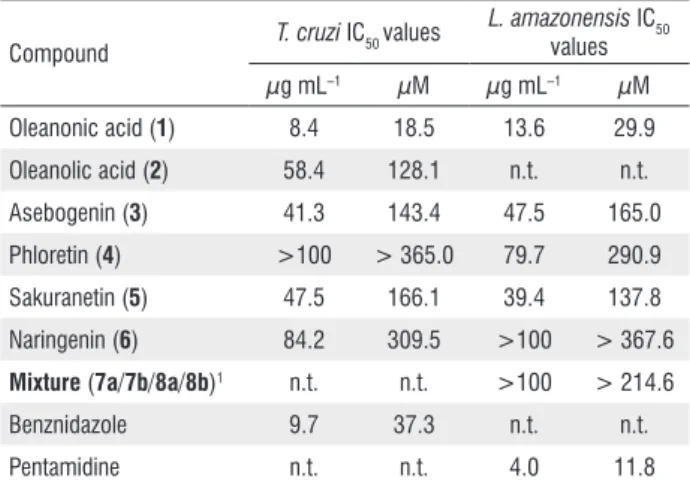
results for all extracts are summarized in Table 1. Among the pure compounds, a triterpenoid (oleanonic acid, 1; Figure 1) showed best inhibitory activity against both T. cruzi and
L. amazonensis, with IC50 8.4 and 13.6 µg mL–1, respectively.
The results obtained for pure compounds are summarized in Table 2.
Table 1. Trypanocidal and leishmanicidal activity of fifteen ethanol extracts from
Lippia species and of four partition fractions obtained from the ethanol extract of leaves of Lippia salviaefolia (EELLsal). Benznidazole and pentamidine were used as reference drugs for Trypanosoma cruzi and Leishmania amazonensis, respectively.
Sample IC50 values (µg mL
–1)
T. cruzi L. amazonensis L. balansae Flowers 147.8 n.t.
L. balansae Leaves 145.8 n.t.
L. balansae Stems 374.8 n.t.
L. lasiocalycina Leaves and Stems > 500 n.t.
L. sidoides Leaves 122.3 136.1
L. sidoides Stems > 500 430.0
L. sidoides Roots 206.1 Inactive
L. lupulina Flowers > 500 180.0
L. lupulina Leaves > 500 95.4
L. lupulina Stems 85.5 390.1
L. lupulina Roots 20.0 54.5
L. velutina Stems > 500 Inactive
L. velutina Leaves 85.5 n.t.
L. salviaefolia Stems > 500 Inactive
L. salviaefolia Leaves 150.9 173.3 Hexane fraction of EELLsal 500 269.9 Ethyl acetate fraction of EELLsal 71.9 134.7
n-Butanol fraction of EELLsal 337.9 Inactive Aqueous fraction of EELLsal > 500 Inactive
Reference drug 9.7 4.0
n.t. not tested.
DISCUSSION
Trypanocidal activity
Osorio et al. (2007) tested plant extracts against epimastigote forms of T. cruzi and promastigote forms of L. amazonensis, and proposed that extracts should be classified as highly active (IC50 lower than 10 µg mL–1), active (IC
50 between 10 and 50 µg
mL–1), moderately active (IC
50 higher than 50 and lower than
100 µg mL–1) or non-active (IC
50 higher than or equal to 100
µg mL–1). According to such criteria, the extract of L. lupulina
roots could be classified as active against T. cruzi (IC50 20.0 µg mL–1). FAc (IC
50 71.9 µg mL–1) and the extracts of L. velutina
leaves and of L. lupulina stems and leaves combined might be
classified as moderately active (both with IC50 85.5 µg mL–1).
The remaining extracts (Table 1) should be classified as non-active (Osorio et al. 2007).
Our findings corroborate previously reported data on trypanocidal activity of Lippia species polar extracts (Abe et al. 2005; Sülsen et al. 2006). Sülsen et al. (2006) reported in vitro activity of an organic and an aqueous extracts obtained from leaves of Lippia integrifolia against epimastigote forms of T. cruzi, with 34.5 and 71.2% inhibition, respectively, at 10 µg mL–1. On the other hand, Abe et al. (2005) reported
in vitro activity of a methanol extract of Lippia dulcis
leaves against trypomastigote forms of T. cruzi, with MIC (minimum inhibitory concentration) between 125 and 250 µg mL–1. Similar inhibitory activities have been observed in
our experiments against epimastigote forms of T. cruzi, with IC50 between 20 and 375 µg mL–1 (Table 1).
Among the pure compounds isolated from Lippia species, the triterpenoid oleanonic acid (1) was the most active
compound against bothparasites tested in this work (Table 2). It exhibited 2.4-fold more potent trypanocidal activity than that from the original root extract of L. lupulina (IC50 8.4
and 20.0 µg mL–1, respectively). Considering the trypanocidal
IC50 values in µM, compound 1 was 2-fold more potent than the reference drug benznidazole (Table 2). Oleanonic acid (1) was 6.9-fold more potent against T. cruzi than another triterpenoid, oleanolic acid (2) (IC50 8.4 and 58.4 µg mL–1,
respectively, Table 2). This suggests that a keto group at C-3 might be more important for trypanocidal activity than a hydroxyl group at the same position (Figure 1).
On the other hand, Cunha et al. (2003) reported just the opposite. These authors found a 3.1-fold higher in vitro
activity of oleanolic acid (2) against blood trypomastigote
forms of T. cruzi Y strain when compared to oleanonic acid
(1), with IC50 80.4 and 294.9 µM, respectively. Such chemical groups could influence the molecules lipophilicity, interfering with their ability to penetrate through biological membranes and exert its activity. More recently, Ferreira et al. (2010) reported in vitro trypanocidal activity of oleanolic acid (2) against trypomastigote forms of T. cruzi H6 strain (Bolivian strain) with IC50 45.2 µM, which is 2.2-fold more potent than the trypanocidal activity observed for compound 2 when tested against the epimastigote form of T. cruzi (Table 2).
Among the flavonoids, the dihydrochalcone asebogenin (3)and the flavanone sakuranetin (5) (IC50 41.3 and 47.5
µg mL–1, respectively, Table 2) exhibited higher trypanocidal
activity than their original source sample (FAc, IC50 71.9 µg mL–1, Table 1). On the other hand, the flavanone naringenin
(6) (IC50 84.2 µg mL–1) was slightly less effective than FAc.
Compounds 3, 5 and 6 were also detected in the remaining active extracts against T. cruzi which presented similar chromatographic profiles by HPLC-PDA and UHPLC-PDA-TOF-MS experiments (Funari et al. 2012a, Funari et al. 2012b). Therefore, these findings suggest that such compounds might be partially associated to the trypanocidal activity of the crude extracts and FAc.
According to Ribeiro et al. (1997), sakuranetin (5) isolated
from leaves of Trixis vauthieri L. killed 100% of trypomastigote forms of T. cruzi Y strain in vitro, at 100 µg mL–1. In another
report, this flavanone isolated from Baccharis retusa showed
in vitro activity against T. cruzi trypomastigotes (IC50 20.2 µg mL–1) (Grecco et al. 2012). Similar results were observed for
sakuranetin (5) in our experiments against epimastigote forms
of T. cruzi Y strain (IC50 47.5 µg mL–1,Table 2).
Although the dihydrochalcone phloretin (4) did not show detectable trypanocidal activity in our work (IC50 higher than 365 µM, Table 2), it has been described to influence the glucose metabolism of T. cruzi, T. brucei, and T. rangeli
(Bakker et al. 1999; Einicker-Lamas et al. 2000; Miletti et al. 2006).
Table 2. Trypanocidal and leishmanicidal activity of compounds isolated from
Lippia species.
Compound T. cruzi IC50 values
L. amazonensis IC50 values µg mL–1 µM µg mL–1 µM
Oleanonic acid (1) 8.4 18.5 13.6 29.9
Oleanolic acid (2) 58.4 128.1 n.t. n.t.
Asebogenin (3) 41.3 143.4 47.5 165.0
Phloretin (4) >100 > 365.0 79.7 290.9
Sakuranetin (5) 47.5 166.1 39.4 137.8
Naringenin (6) 84.2 309.5 >100 > 367.6
Mixture (7a/7b/8a/8b)1 n.t. n.t. >100 > 214.6
Benznidazole 9.7 37.3 n.t. n.t.
Pentamidine n.t. n.t. 4.0 11.8
1Mixture of interconverting flavanones (2R)- and (2S
)-3’,4’,5,6-tetrahydroxyflavanone-7-O-β-glucopyranoside (7a/7b); and (2R)- and (2S )-3’,4’,5,8-tetrahydroxyflavanone-7-O-β-glucopyranoside (8a/8b).
Leishmanicidal activity
The extract of L. lupulina roots and the extract of L. lupulina leaves might be classified (Osorio et al. 2007) as
moderately active against L. amazonensis (IC50 54.5 and 95.4 µg mL–1, respectively). All the remaining extracts should
be considered non-active against this protozoan, since they exhibited IC50 higher than 100 µg mL–1 (Table 1).
Oleanonic acid (1) proved to be the most active pure
compound isolated from Lippia spp. assayed in this work (IC50 13.6 µg mL–1, Table 2). It was 4-fold more potent than the extract
of L. lupulina roots, which afforded compound 1 in a previous
study (Funari et al. 2012a). Considering the leishmanicidal IC50 values in µM, oleanonic acid was 2.5-fold less potent than pentamidine (Table 2). On the other hand, Torres-Santos et al. (2004) reported 11-fold higher activity of oleanonic acid (1) isolated from leaves of Pourouma guianensis against promastigote forms of L. amazonensis (IC50 10.0 µg mL–1).
The flavonoids sakuranetin (5), asebogenin (3) and phloretin (4) exhibited higher leishmanicidal activities (IC50 39.4, 47.5 and 79.5 µg mL–1, respectively) than their original
source sample FAc (IC50 134.7 µg mL–1). It is noteworthy
that such flavonoids were previously detected in the ethanol extract from L. sidoides leaves and might therefore be related
to its leishmanicidal activity (Funari et al. 2012a).
Grecco et al. (2012) reported IC50 51.9 µg mL–1 for
sakuranetin (5) isolated from Baccharis retusa against promastigotes of L. amazonensis, which is similar to the results from our experiments against the same type of protozoa (Table 2). Asebogenin (3) isolated from an extract of Piper elongatum aerial parts was described by Hermoso et al. (2003) as more active against promastigote forms of L. braziliensis,
L. tropica and L. infantum (IC50 28.5, 3.8 and 6.3 µg mL–1,
respectively) than the observed inhibition against L. amazonensis
promastigotes (IC50 47.5 µg mL–1, Table 2) in our experiments.
The leishmanicidal activity observed for phloretin (4) might
be related to its influence on the glucose metabolism of L. amazonensis, since it was previously described to affect the glucose metabolism in L. mexicana (Burchmore andHart 1995)
and L. donovani (Ter Kuile andOpperdoes 1993).
CONCLUSIONS
The results presented in this work suggest that Lippia genus and its chemical constituents deserve further investigation in the search for novel antiprotozoal drugs. Special attention should be given to L. lupulina roots, since its ethanol extract exhibited the strongest trypanocidal and leishmanicidal activity among all extracts assayed in this work. Oleanonic acid also deserves further investigation since it showed leishmanicidal activity similar to that observed for the antileishmanial compound pentamidine, and trypanocidal
activity higher than benznidazole, the only anti-Chagas therapeutic agent currently in medical use.
ACKNOWLEDGEMENTS
The authors thank São Paulo Research Foundation (FAPESP) for fellowship (#06/55162-1) and research funding (#04/07932-7); Brazilian National Council for Scientific and Technological Development (CNPq) for financial support (grant 453928/2014-5); CNPq and Coordination for the Improvement of Higher Education Personnel (CAPES) for fellowships (to TGP, RMBC and DHSS); and Dr Maria Inês Cordeiro and Dr Giselda Durigan for botanical identifications.
REFERENCES
Abe, F.; Nagafuji, S.; Okawa, M.; Kinjo, J.; Akahane, H.; Ogura, T.; Martinez-Alfaro, M.A.; Reyes-Chilpa, R. 2005. Trypanocidal constituents in plants 5. Evaluation of some Mexican plants for their trypanocidal activity and active constituents in the seeds of Persea americana. Biological and Pharmaceutical Bulletin, 28: 1314-1317.
Afonso, A.M.; Ebell, M.H.; Tarleton, R.L. 2012. A systematic review of high quality diagnostic tests for Chagas disease. Plos Neglected Tropical Diseases, 6: e1881.
Bakker, B.M.; Walsh, M.C.; Ter Kuile, B.H.; Mensonides, F.I.C.; Michels, P.A.M.; Opperdoes, F.R.; Westerhoff, H.V. 1999. Contribution of glucose transport to the control of the glycolytic flux in Trypanosoma brucei. Proceedings of the National Academy of Sciences, 96: 10098-10103.
Barrett, M.P.; Croft, S.L. 2012. Management of trypanosomiasis and leishmaniasis. British Medical Bulletin, 104: 175–96.
Burchmore, R.J.S.; Hart, D.T. 1995. Glucose transport in amastigote and promastigote forms of Leishmania mexicana mexicana. Molecular and Biochemical Parasitology, 74: 77-86.
Chappuis, F.; Sundar, S.; Hailu, A.; Hashim, G.; Rijal, S.; Peeling, R.W.; Alvar, J.; Boelaert, M. 2007. Visceral leishmaniasis: what are the needs for diagnosis, treatment and control? Nature Reviews Microbiology, 5: 873-882.
Coura, J.R. 2009. Present situation and new strategies for Chagas disease chemotherapy - a proposal. Memórias do Instituto Oswaldo Cruz, 104: 549-554.
Croft, S.L.; Olliaro, P. 2011. Leishmaniasis chemotherapy-challenges and opportunities. Clinical Microbiology and Infection, 17: 1478-1483.
Cunha, W.R.; Martins, C.; Ferreira, D.S.; Crotti, A.E.; Lopes, N.P.; Albuquerque, S. 2003. In vitro trypanocidal activity of triterpenoids from Miconia species. Planta Medica, 69: 470-472. Einicker-Lamas, M.; Almeida, A.C.; Todorov, A.G.; De Castro, S.L.; Caruso-Neves, C.; Oliveira, M.M. 2000. Characterization of the myo-inositol transport system in Trypanosoma cruzi. European Journal of Biochemistry, 267: 2533-2537.
toxicity assessment of triterpene acids. Parasitology Research, 106: 985-989.
Funari, C.S.; Ferro, V.O. 2005. Uso ético da biodiversidade brasileira: necessidade e oportunidade. Revista Brasileira de Farmacognosia, 15: 178-182.
Funari, C.S.; Passalacqua, T.S.; Rinaldo, D.; Napolitano, A.; Festa, M.; Capasso, A.; et al. 2011. Interconverting flavanone glucosides and other phenolic compounds in Lippia salviaefolia Cham. ethanol extracts. Phytochemistry, 72: 2052-2061.
Funari, C.S.; Eugster, P.J.; Martel, S.; Carrupt, P.A.; Wolfender, J.L.; Silva, D.H.S. 2012a. High resolution ultra-high pressure liquid chromatography–time-of-flight mass spectrometry dereplication strategy for the metabolite profiling of Brazilian Lippia species. Journal of Chromatography A, 1259: 167-178.
Funari, C.S.; Gullo, F.P.; Napolitano, A.; Carneiro, R.L.; Mendes-Giannini, M.J.S.; Fusco-Almeida, A.M.; Piacente, S.; Pizza, C.; Silva, D.H.S. 2012b.Chemical and antifungal investigations of six Lippia species (Verbenaceae) from Brazil. Food Chemistry, 135: 2086-2094.
Grecco, S.S.; Reimão, J.Q.; Tempone, A.G.; Sartorelli, P.; Cunha, R.L.O.R.; Romoff, P.; Ferreira, M.J.P; Fávero, O.A.; Lago, J.H.G. 2012. In vitro antileishmanial and antitrypanosomal activities of flavanones from Baccharis retusa DC. (Asteraceae). Experimental Parasitology, 130: 141-145.
Hermoso, A.; Jimenez, I.A.; Mamani, Z.A.; Bazzocchi, I.L.; Pinero, J.E.; Ravelo, A.G.; Valladares, B. 2003. Antileishmanial activities of dihydrochalcones from Piper elongatum and synthetic related compounds. Structural requirements for activity. Bioorganic and Medicinal Chemistry, 11: 3975-3980.
Kappagoda, S.; Ioannidis, J.P. 2012. Neglected tropical diseases: survey and geometry of randomised evidence. BMJ, 345: e6512. Márquez, E.; Crespo, M.; Mir, M.; Pérez-Sáez; M.J.; Quintana, S.; Barbosa, F.; Pascual, J. 2013. Chagas disease and kidney donation. Nefrologia, 33:128-133.
Miletti, L.C.; Koerich, L.B.; Pacheco, L.K.; Steindel, M.; Stambuk, B.U. 2006. Characterization of D-glucose transport in Trypanosoma rangeli. Parasitology, 133: 721-727.
Mishra, B.B.; Kale, R.R.; Singh, R.K.; Tiwari, V.K. 2009. Alkaloids: future prospective to combat leishmaniasis. Fitoterapia, 80: 81-90.
Morel, C.M. 2003. Neglected diseases: under-funded research and inadequate health interventions - Can we change this reality? Embo Reports, 4: S35-S38.
Muelas-Serrano, S.; Nogal-Ruiz, J.J.; Gómez-Barrio, A. 2000. Setting of a colorimetric method to determine the viability of Trypanosoma cruzi epimastigotes. Parasitology Research, 86: 999-1002.
Newman, D.J.; Cragg, G.M. 2012. Natural products as sources of new drugs over the 30 years from 1981 to 2010. Journal of Natural Products, 75: 311-335.
Osorio, E.; Arango, G.J.; Jiménez, N.; Alzate, F.; Ruiz, G.; Gutiérrez, D.; Paco, M.A.; Giménez, A.; Robledo, S. 2007. Antiprotozoal and cytotoxic activities in vitro of Colombian Annonaceae. Journal of Ethnopharmacology,111: 630-635.
Ribeiro, A.; Pilo-Veloso, D.; Romanha, A.J.; Zani, C.L. 1997. Trypanocidal flavonoids from Trixis vauthieri. Journal of Natural Products, 60: 836-838.
Santos, V.A.; Regasini, L.O.; Nogueira, C.R.; Passerini, G.D.; Martinez, I.; Bolzani, V.S.; Graminha, M.A.; Cicarelli, R.M.; Furlan, M. 2012. Antiprotozoal sesquiterpene pyridine alkaloids from Maytenus ilicifolia. Journal of Natural Products, 75: 991–995.
Soong, L.; Henard, C.A.; Melby, P.C. 2012. Immunopathogenesis of non-healing American cutaneous leishmaniasis and progressive visceral leishmaniasis. Seminars in Immunopathology, 34: 735-751. Sülsen, V.; Güida, C.; Coussio, J.; Paveto, C.; Muschietti, L.; Martino, V. 2006. In vitro evaluation of trypanocidal activity in plants used in Argentine traditional medicine. Parasitology Research, 98: 370-374.
Tempone, A.G.; De Oliveira, C.M.; Berlinck, R.G.S. 2011. Current approaches to discover marine antileishmanial natural products. Planta Medica, 77: 572-585.
Ter Kuile, B.H.; Opperdoes, F.R. 1993. Uptake and turnover of glucose in Leishmania. Molecular and Biochemical Parasitology, 60: 313-321.
Torres-Santos, E.C.; Lopes, D.; Oliveira, R.R.; Carauta, J.P.P.; Falcao, C.A.B.; Kaplan, M.A.C.; Rossi-Bergmann, B. 2004. Antileishmanial activity of isolated triterpenoids from Pourouma guianensis. Phytomedicine, 11: 114-120.
Van Assche, T.; Deschacht, M.; Luz, R.A.I.; Maes, L.; Cos, P. 2011. Leishmania-macrophage interactions: insights into the redox biology. Free Radical Biology and Medicine, 51: 337-351. WHO, 2016. Leishmaniasis magnitude of the problem, (www.
who.int/leishmaniasis/burden/magnitude/burden_magnitude/ en/). Acessed on 18/02/2016.