AN EXPLORATORY STUDY OF LEAN
CONSTRUCTION IN PORTUGAL – OWNERS
AND DESIGNERS’ PERSPECTIVES
João Martins1 and Nuno Cachadinha2
ABSTRACT
As Lean Construction steadily grows all over the world, not much is heard about this new paradigm in Portugal, and the Portuguese construction industry still seems unaware of its potentials. This study aims at characterizing and analyzing the main causes for waste that could be tackled with Lean Construction solutions and techniques in the Portuguese construction sector. It is assumed that lean construction can greatly contribute to the Portuguese construction sector by the positive cost-benefit results.
An analysis is made on how lean construction can be beneficial in the Portuguese context, from the perspectives of owners and designers. The study is an exploratory qualitative research that is observational in nature. Overall, 8 private owners, 10 public owners and 13 design firms participated in this study.
The results obtained are in line with similar studies and indicate that the origin of most waste in Portuguese projects has its roots in the design phase due to owners’ actions. This work seeks to demonstrate the key role that owners have in the adoptions of lean construction methods and principles, which can be implemented to mitigate the main problems found.
KEY WORDS
Owner, Designer, Lean Construction, Waste, Portugal.
INTRODUCTION
The Portuguese construction industry (PCI) is often regarded as less competitive than its other Western European counterparts. The consequences of this lack of competitiveness include, among others, exceeded deadlines and budgets, poor security and the lack of quality (Couto, 2005). The public opinion is also increasingly conscious and unhappy with the budget overruns and repeated delays that occur in public works (Court of Auditors, 2009). However, these symptoms do not appear to be as striking in other European countries with similar geographical and development features, and such countries have been shown to be more competitive in the international market (Couto, 2008).
This study sets out to answer the following research question: what are the major causes for waste and delays identified by owners and designers in the Portuguese construction industry? It complements the study by Matias and Cachadinha (2010),
1
FCT-UNL. [email protected] 2
which surveyed the Portuguese contractors, by adding the perspectives of Portuguese owners and designers, the two remaining major players in PCI. The results of both studies are compared and combined, thus portraying a comprehensive picture of waste and delays in PCI, and how they the affect the performance of construction projects in Portugal. In addition, it aims at demonstrating the key role that owners have in the adoption of lean construction (LC) techniques that maximize the value produced.
LITERATURE REVIEW
Waste has been considered one of the biggest problems in the construction industry (CI) (Polat and Ballard, 2004). Mossman (2009) defines waste as “anything that does not create value for the owner/final user”, and establishes the difference between necessary waste and pure waste. Improvement efforts should be focused on the latter.CI investments are sensitive to budget and time overruns, as a direct relation is perceived between waste and the total cost of the project. Thus, delays and unforeseen costs are two threats to the success of the project (Hammad et al., 2010). Waste must be perceived from the flow and value perspective (Ballard and Howell 1998), and its elimination is one of the purposes of LC (Koskela, 1992).
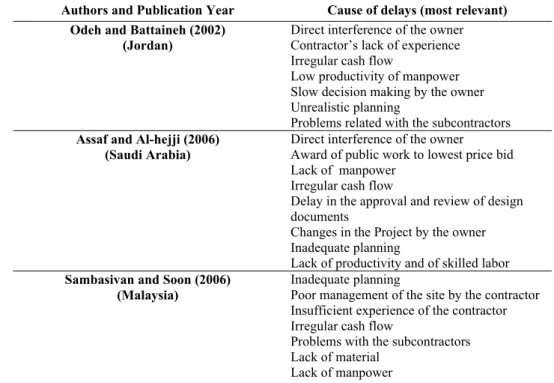
Several studies have quantified wastes in CI. Josephson and Hammarlund (1999) summarized several studies on defects in construction projects from 1969 to 1992, arguing that 32% of defect related costs originate in the earlier phases of the project, resulting from the influence of the owner on the design process. Hwang et al. (2009) sustain that the direct costs of rework in construction projects range up to 5% of its total value, and the causes with a strongest impact on the occurrence of rework are related to design errors, omissions, and changes by the owner. Table 1 presents recent relevant studies on the causes and origins of delays in CI found in the literature.
Table 1 - Studies about delays in construction industry
Authors and Publication Year Cause of delays (most relevant) Odeh and Battaineh (2002) Direct interference of the owner
(Jordan) Contractor’s lack of experience
Irregularcash flow
Low productivity of manpower
Slow decision making by the owner
Unrealistic planning
Problems related with the subcontractors
Assaf and Al-hejji (2006) Direct interference of the owner
(Saudi Arabia) Award of public work to lowest price bid
Lack of manpower
Irregular cash flow
Delay in the approval and review of design
documents
Changes in the Project by the owner
Inadequate planning
Lack of productivity and of skilled labor
Sambasivan and Soon (2006) Inadequate planning
(Malaysia) Poor management of the site by the contractor
Insufficient experience of the contractor
Irregularcash flow
Problems with the subcontractors
Lack of material
Failure and lack of equipment
Lack of coordination
Errors during the construction works
Moura, Teixeira and Pires (2007) Direct responsibility of the owner
(Portugal) Design flaws
Specificity and complexity of the project
Contractor’s responsibility
External factors
Sweis et al., (2008) Irregularcash flow
(Jordan) Changes by the owner
Matias and Cachadinha (2010) Specifications of the project
(Portugal) Legislation
Existence of contradictions and
inconsistencies between the design documents Interaction between stakeholders
Rework due to changes and design changes Unforeseen site conditions
Unrealistic planning
Lack of manpower
Although some of the causes presented for waste seem to be inevitable and are closely related to the necessary waste described in the literature (Mossman, 2009), the potential benefits that can be obtained by waste reduction are substantial and can be an incentive for the adoption of measures towards their minimization by project stakeholders (Bossink and Brouwers, 1996). LC has been considered one of the most promising theoretical approaches to improve the CI, dealing with specific problems arising from the characteristics from its dynamic production (Anderson et al. 2008).
Set based Design, Target Costing, Evidence based Design, the use of Building Information Modelling (BIM) tools, the Last Planner System, Plan Percent Complete (PPC) metrics and the use of multidisciplinary teams are just some of the Lean techniques and tools whose use can be directly influenced and encouraged by the owner. As the main decision maker and project stakeholder, he or she has the key role in the adoption of behaviours that lead to a leaner path and value generation for his projects.
RESEARCH METHOD
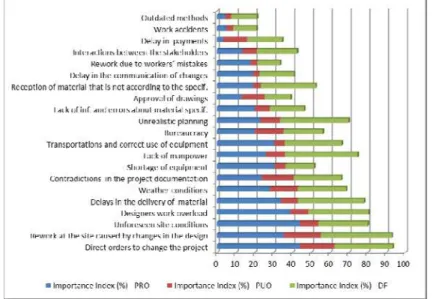
different parts, DPPh and CPh. A set of five main causes for waste were presented to the participants in DPPh, and twenty one in CPh (see Figure 1). These causes derived from a literature survey carried out on recent studies, and whose results are presented in Table 1. The participants were asked to evaluate the importance, frequency and impact in project duration and cost to the owner.
The questionnaire used closed questions and resorted to the Likert scale. In the CPh, the emphasis was set on causes of time waste present in the Portuguese industry. A Likert scale was used to quantify the frequency of occurrence of each cause for delays and its impact in terms of time and cost overrun. A subsequent analysis was performed, in order to understand how LC may resolve or minimize the causes of waste previously detected. In the interviews, this was achieved at a second round of questions, where the authors proposed LC solutions to the causes identified and asked the respondents to assess them. For the PUO group, three interviews were conducted to the top three PUO’s according to the respondents’ selection criteria described above. Phone calls were made to the remaining ones, although in a simplified fashion.
DATA ANALYSIS APPROACH
The data collected was analyzed according to the statistical methodology adopted by Assaf and Al-Hejji (2006), with the assistance of Statistics Package for Social Sciences (SPSS). Descriptive analysis (ranking and frequencies) and nonparametric statistics tests were utilized, the latter to determine correlations between the results of different respondent groups.
The ranking of the causes for delays regarding their frequency and impact on time and cost was obtained through equation 1:
Frequency (FI), Time (TI) and Cost impact (CI) Index (%) = ∑ (Eq. 1),
in which a is the constant expressing the weight given in each response (ranging from 1 for little up to 5 for severe), n is the frequency of the responses and N is the total number of responses.
The Importance Index (II) for each cause (DPPh and CPh) was calculated as a function of the frequencies, time and cost impact indexes asked (Eq. 2 and 3):
Importance Index for DPPh delays (%) = % % (Eq. 2)
Importance Index for CPh (%) = % % (Eq. 3)
Aiming at identifying differences in the perception of the three groups inquired, the Spearman correlation coefficient was then used to measure and compare the association between the rankings obtained in the three different groups.
Finally, once a tendency of answers could be verified in a first set of interviews, LC solutions were proposed to the main consensual causes. These were described and discussed with the respondents and validated in a last set of interviews.
DATA ANALYSIS
with an average of 18 years working in the city council and 8 years in the current position. For DF, the most represented type of job is Project manager (46%), with an average of 7 years working in the company and 4 years in the current position. Despite the apparent alignment of the results obtained with other studies, the specific targeted group and the limited statistical sample used render speculative generalization of the results to the entire industry. In spite of this, the way the sample is structured and the number of responses obtained allow for an exploratory picture of the sector from the owner and designer’s perspectives, and its results are consistent which those obtained by Matias and Cachadinha (2010) in their study of the waste and delays in PCI from the contractors’ perspective.
RESEARCH FINDINGS AND RESULTS
DESIGN AND PROCUREMENT PHASE
Equations 1 and 2 were applied to the responses obtained, and two main causes for waste in the DPPh were identified. The first one related to the process of answering the requests for information (RFI’s) by the owner during procurement phase, and the second was centered on the interaction between stakeholders during design phase.
The reason “answer to RFI´s” seems to confirm the results obtained in the study by Matias and Cachadinha (2010), as it indicates that the main stakeholders in Portuguese projects agree about the importance of this cause of waste. The recent Portuguese legislation revision, which deems the contractor responsible for undetected errors and omissions in the procurement phase, may have exacerbated this cause. The interaction between stakeholders during design phase is in line with the causes pointed out in the literature as chronic generators of waste in the CI (see Table 1). Poor communication, combined with the scant rigor in the definition of the preliminary program to the designers and poor definition of value by the owner, lead to waste. Also the short time available to develop design the lack of project reviews and lack of appropriate technical capacity to evaluate different situations by the owner, compromises the creation of value. Often it is only later, in the CPh, when the owner uses his authority and decides to make changes to the project in order to adjust it to his expectations and necessities.
Koskela et al. (2002) suggest that specific aspects hamper the creation of value during the design phase. These include poorly defined tasks and delays in the decisions by the owner, variability in the flows, poor definition of responsibilities and a chronic lack of input information for design. The respondents added that the reasons that lead to the majority of the RFI’s are related to the quality and level of detail in the design sent for procurement, and that the time available for the designers to develop their work is quite short. This was particularly prevalent in private projects.
as constraining when the bidders are selected and invited by the owner. It was not clear in this study whether this was influenced by the fact that the first bidding method is commonly used by PUO for public projects, whereas the second is prevalent to PRO.
ADOPTION OF LEAN CONSTRUCTION IN THE DESIGN AND PROCUREMENT PHASE
It was emphasized that the owner needs to correctly specify the preliminary project program - what he or she expects in terms of value. It also became clear that longer periods are necessary for organizing all the necessary documentation for the procurement phase. From the LC perspective, techniques such as Set Based Design, Target Costing and Evidence Based Design show a great potential for implementation and to generate value for the owner, but greater investment of time and resources in the design phase, as well as closer monitoring and the definition of cost and time allowable by the owner are required. On the other hand, the need for communication and collaborative relations that Lean advocates can possibly minimize the wastes found in this stage, especially if the model of Integrated Project Delivery can be adopted. The difficulties reported regarding the answer to the RFI’s would be minimized with the use of multidisciplinary design teams with construction experience background, and the use of Building Information Modelling (BIM) tools can also help minimize the effects of this problem. It is also argued that the traditional procurement method adds unnecessary waste to the process and often leads to false savings in the costs of the project, ultimately resulting in delays.
CONSTRUCTION PHASE
The complete set of causes for delays obtained in this study for CPh are portrayed in figure 1. Indices based on equation 1 were utilized to rank the frequency, time and cost impact for each delay reason, and the associated importance indices were calculated with equation 3.
The results portrayed are in line with the literature (Couto et al., 2005), which states that some of the chronic symptoms of the Portuguese construction’s low competitively are the successive delays and exceeded costs throughout the project. According to the respondents, the most constraining causes of delays in the CPh were “project changes by the owner”, “rework due to design changes”, “designers work overload”, “delay in the delivery of materials” and “unpredictable site conditions”.
The results are consistent with the previous studies summarized in table 1, and prove the influence of the owner in the generation of unnecessary waste. This study added one further reason, “designers work overload”, which was not found in the literature. This is consistent with the results obtained in the DPPh On which the respondents agreed on the short time available for designing the project. It is also relevant to compare the results obtained for each of the three groups (table 3), as well as the correlation between them (table 4).
Table 4 shows that there are different perceptions between groups on the most constraining causes for delays. This was expected, and can be explained by the tendency to push responsibility for the causes to other stakeholders, as explained by Assaf and Hejji (2005). Still, it is possible to observe that the factors directly related to the owner (project changes) ranked high among all groups. The results also show that the weakest correlation occurs between PUO and PRO. This finding can be explained by the different types and specificities of the projects conducted, and indicate that there are significant differences in the problems that occur, depending on whether the owner is private or public.
Table 3 –Most constraining causes for delays in the CPh– Comparison between groups
Most constraining causes for delays Ranking final
Private Owner
Public Owner
Designers
Direct orders to change the project 1 1 2 6
Rework at the site caused by changes in
the design 2 5 1 3
Designers work overload 3 3 10 5
Delays in the delivery of material 4 4 11 4
Unforeseen site conditions 5 1 12 8
Lack of manpower 6 9 6 1
Unrealistic planning 7 13 7 2
Weather conditions 8 8 4 10
Contradictions in the project
documentation 9 10 3 9
Bureaucracy 10 12 5 12
Table 4- Spearman Correlation Coefficient for the answers between groups
Group pairs Spearman Correlation Coefficient P-value
Private Owners. – Public
Owners 0,472 0,05
Private Owners – Designers 0,638 0,05
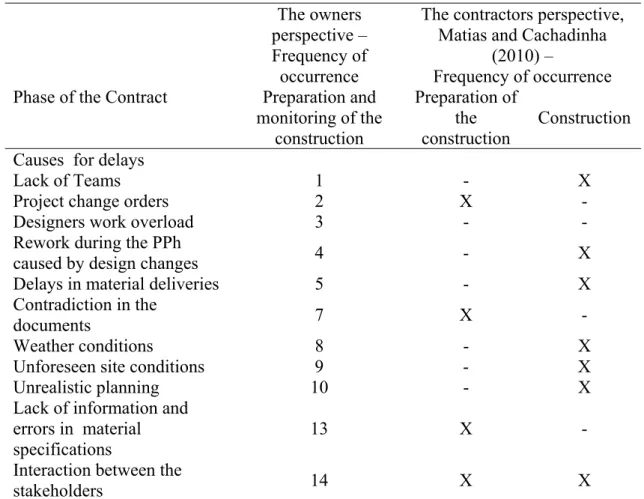
The ranking of the frequency index for each cause is listed in table 5. It shows that the most frequent causes identified in the present study (designers and owners) are in line with those pointed out by Matias and Cachadinha (2010) (contractors). Thus, the major stakeholders in the Portuguese CI are fairly unanimous or the causes for delays in their industry.
Table 5 – Comparison between the owner, designer and contractor’s perspective regarding the occurrence frequency of the main causes for delays
The owners
perspective – Frequency of
occurrence
The contractors perspective, Matias and Cachadinha
(2010) –
Frequency of occurrence
Phase of the Contract Preparation and
monitoring of the construction
Preparation of the construction
Construction
Causes for delays
Lack of Teams 1 - X
Project change orders 2 X -
Designers work overload 3 - -
Rework during the PPh
caused by design changes 4 - X
Delays in material deliveries 5 - X
Contradiction in the
documents 7 X -
Weather conditions 8 - X
Unforeseen site conditions 9 - X
Unrealistic planning 10 - X
Lack of information and errors in material specifications
13 X -
Interaction between the
stakeholders 14 X X
The comparison between the two studies reveals these two groups have common perceptions in most of the causes identified. They represent the whole of the main project stakeholders in the PCIs. Despite their often conflicting interests, their opinions coincided. This indicates that the causes for delays identified, their frequency and importance are consensual and representative of the reality of the PCI.
ADOPTION OF LEAN CONSTRUCTION IN THE CONSTRUCTION PHASE
Table 6 – Summary of the most constraining causes for delays and respective suggested LC solutions, from the owner’s perspective.
Project Phase Causes for Delays LC Solution Proposal
Construction Phase
Lack of manpower Multidisciplinary teams; Last Planner System (LSP)
Direct orders to change the
project
Better definition of the Project concept and the meaning of value by the owner; Increased supervision of the design phase by the owner; Use of 3D visualization tools and BIM;
Designers work overload Extension of the project design period; Integrated Design;
Rework at the site caused by
changes in the design
Pull techniques; LPS; BIM;
Contradictions in the project
documentation
More time assigned to the design phase; BIM tools; Project reviews; Multidisciplinary teams;
Unforeseen site conditions Fair, cooperative and proactive attitude among the stakeholders;
Interaction between
stakeholders
Collaborative environment; Team‐building initiatives.
CONCLUSIONS
This study characterized the owners’ and designers’ perspective on the the most significant causes for waste and delays found in the Portuguese CI,, and completed a previously initiated characterization focused on the contractors perspective. The results obtained have proven to be in line with previous studies on both Portuguese and international realities. It was found that a significant amount of waste sources that occur in the CPh are rooted in the previous phases, in particular in the design phase, and often result from the direct influence of the owner.
It was found that the poor definition of the preliminary project draft by the owner, combined with an inefficient management in the design phase and the traditional competitive low bid award method lead to a considerable amount of waste in the CPh, which then results in higher cost to the owner.
The respondents validated the LC solutions proposed by the authors, and agreed that they have the potential to reduce or eliminate the waste/delays found. Although previously unknown to most of the respondents, the LC solutions proposed and described in the interviews were received with interest and even enthusiasm by the respondents, indicating their openness to adopt them.
The results obtained are relevant because they close the circle between the main PCI stakeholders and corroborate other studies worldwide. They have shown that the major project stakeholders in Portugal agree on the most constraining causes of waste projects and propose solutions to these widespread construction problems, thus expanding what we know about the potential of LC as a comprehensive solution to minimize waste.
The authors wish to acknowledge the support to this study by Zagope SA, a company from the Andrade e Gutierrez Group.
REFERENCES
Anderson, B., Bolviken, T., Dammerud, H., and Skinnarland, S. (2008). “Approaching Construction as a Logistical Economical and Social Process.”
Assaf, S., and Al-Hejji, S. (2006). “Causes of Delay in Large Construction Projects.”
International Journal Project Management,24 (4) 349-357.
Ballard, G., and Howell, G. (1998). “What Kind Of Production Is Construction?”
Proceedings of the 6th annual conference of IGLC, Guaruja, Brazil.
Bossink, B., and Brouwers, H. (1996). “Construction Waste: Quantification and
Source Evaluation.” ASCE, Journal of Construction Engineering and Management, 122 (1) 55-60.
Court of Audits (2009). “Audit to Public Works Projects by Direct Award” (in Portuguese). (http://www.tcontas.pt/). [Accessed Jan 2013]
Couto, J., Teixeira, J., Moura, H., and Pires, B. (2005). “Analysis of the Causes of Time, Cost and Safety Flaws in Construction” (in Portuguese). Progress report No. 1, Project Sapiens Nº 47625, FCT.
Hammad, A., Ali, S., Sweis, G., and Sweis, R. (2010). “Statistical Analysis on the Cost and Duration of Public Building Projects.” ASCE, Journal of Management in Engineering, 26 (2) 105-112.
Hwang, B., Thomas, S., Haas, C., and Caldas, C. (2009). “Measuring the Impact of Rework on Construction Cost Performance”. ASCE, Journal of Construction Engineering and Management, 135 (3) 187-198.
Josephson, P., and Hammarlund, Y. (1999). “The causes and costs of defects in construction. A study of seven building projects.” Automation in Construction, 8 (6) 642-681.
Koskela, L., Huovila, P., and Leinonen, J. (2002). “Design Management in building construction_From theory to practice.” Journal of Construction Research, 3 (1) 1-16.
Matias, J., and Cachadinha, N. (2010). “Evaluating the Potential Benefits and Challenges of Lean Construction Adoption in the Portuguese Construction Industry: A Survey Study.” Proceedings of the 18th annual conference of IGLC, Haifa, Israel, 285-295.
Mossman, A. (2009). “Creating Value: a Sufficient Way to Eliminate Waste in Lean Design and Lean Production.” Lean Construction Journal, 13-23.
Moura, H., Teixeira, J., and Pires, B. (2007). “Dealing With Cost and Time in the Portuguese Construction Industry.” Proceedings of CIB World Building Congress, 1252-1265.
Odeh, A., and Battaineh, H. (2002). “Causes of Construction Delay: Traditional Contracts.” International Journal of Project Management, 20 (1) 67-73.
Polat, G., Ballard, G. (2004). “Waste in Turkish Construction: Need for Lean Construction Techniques.” Proceedings of the 12th annual conference of IGLC, Copenhaguen, Denmark, 488-501.
Sambasivan, M., and Soon, Y. (2007). “Causes and Effects of Delays in Malaysian Construction Industry.” International Journal of Project Management, 25 (5) 517-526.