Andreia Filipa Rodrigues Simão Teixeira
LicenciadaValorisation of Vegetable Oil Deodorizer
Distillate by Enzymatic Reaction and
Membrane Processing
Dissertação para obtenção do Grau de Doutora em Engenharia Química e Bioquímica
Orientadores :
João Paulo Goulão Crespo, Professor
Cate-drático, Faculdade de Ciências e Tecnologia,
Uni-versidade Nova de Lisboa
José Luís Cardador dos Santos, Investigador,
Hovione FarmaCiencia SA
Júri:
Presidente: Doutora Maria d’Ascenção Carvalho Fernandes Miranda Reis
Arguentes: Doutora Lidietta Giorno
Doutora Maria João Filipe Rosa
Vogais: Doutor João Paulo Serejo Goulão Crespo Doutor José Luís Cardador dos Santos Doutora Susana Filipe Barreiros
Valorisation of Vegetable Oil Deodorizer Distillate by Enzymatic Reaction and Mem-brane Processing
Copyright cAndreia Filipa Rodrigues Simão Teixeira, Faculdade de Ciências e Tecnologia, Uni-versidade Nova de Lisboa
Acknowledgements
Se eu tivesse que descrever o meu percurso durante o doutoramento seria semelhante ao da Alice no País das Maravilhas. Tudo começa pela curiosidade característica do começo de uma aventura. Como a Alice, senti-me muitas vezes perdida num labirinto, encontrei "Chapeleiros Loucos", recebi bons conselhos (como ela da Lagarta Azul), senti-me grande, outras vezes pequena e, claro que no final, terminei como o Coelho Branco sempre a olhar para o relógio com um grande stress. Antes que perguntem qual foi a vossa personagem nesta história de doutoramento, gostaria de agradecer a algumas pessoas que a tornaram em realidade. Gostaria de agradecer aos meus orientadores, João Paulo Crespo (que ainda hoje me chama Carla) e José Luís Santos, por todo o apoio científico e humano que me deram ao longo destes anos. O vosso sentido crítico e cria-tivo, disponibilidade, exigência e rigor, bem como a amizade demonstrada foram decisivos para o sucesso deste trabalho conjunto.
Gostaria de extender os meus agradecimentos à Professora Maria Ascensão Reis pelo sua amizade e apoio humano.
Agradeço igualmente a todo o BPEG por me ter proporcionado bons, por vezes loucos, mo-mentos. Trabalhar no BPEG nunca é aborrecido, o trabalho diário acarreta sempre desafios na constante busca do "Midget" (algo que todos os BPEGuianos conhecem). Terei saudades de todo o espírito de grupo e de todas aquelas pessoas que contribuiram e contribuem para o seu cresci-mento.
Um agradecimento especial para todas as colegas que partilhei o gabinete 505. Todas elas, de forma diferente, tiveram um papel predominante para o sucesso desta Tese. Ana Lanham com as suas liçõesZene ideias entusiásticas, Rita com o seu companheirismo, estando sempre
pronta a apoiar e a ouvir, Joana com as suas opiniões racionais e realísticas, Claúdia com o seu
Chi e prontidão em ajudar-me na árdua tarefa de "modelar o mundo", Filipa pelo espírito de
entreajuda demonstrado principalmente em difíceis e desesperantes momentos GCianos, Bárbara pela amizade e partilha de grandes momentos e, mais recentemente, a Margarida e a Sílvia, minhas companheiras de marmita e grandes amigas. O espírito de partilha destas colegas, dificilmente irei encontrar em qualquer outra parte do mundo...
aturarem o meu humor!). E claro, um especial agradecimento à Rute, por tudo, incluindo todas as amostragens que fez ao meu sistema, por todas as gargalhadas, lágrimas e desabafos.
Agradeço à D.Palminha e à D.Joaquina pelo seu apoio técnico, o que facilitou em muito o meu trabalho de laboratório, e á D. Maria José pelo seu apoio de secretariado.
Gostaria igualmente de agradecer à equipa integrante do projecto europeu OPTIM’OILS e à Eng. Paula Arês da Sovena, pela partilha de conhecimento do ponto de vista industrial e pela disponibilidade em me fornecerem amostras sempre que necessário.
Finalmente, gostaria de agradecer à Fundação para a Ciência e Tecnologia pelo suporte finan-ceiro da Tese, na atribuição de uma bolsa de doutoramento (SFRH/BD/46023/2008).
The White Rabbit put on his spectacles. "Where shall I begin, please your Majesty ?" he asked. "Begin at the beginning,", the King said, very gravely, "and go on till you come to the end: then stop."
Abstract
Large amounts of residues are produced by agro-food industries which, without a proper treatment and disposal, may create serious environmental problems. The recovery of added-value com-pounds from these industrial residues is very interesting from both environmental and economic point of view, especially if green technologies are used. Deodorizer distillates are by-products rich in bioactive compounds, as sterols and tocopherols, produced in the oil refining process. However, they cannot be used directly as food additive due to their high content in pesticides. The valorisation of deodorizer distillates through the recovery of added-value compounds free of contaminants (such as pesticides), is particularly challenging mainly due to the similar molecular weight, volatility and hydrophobicity of the target bioactive compounds and the contaminants.
The present Thesis proposes the production of an extract rich in steryl esters and free of pesti-cides, through the using of a nanofiltration process. The strategy followed is based on the increase of the molecular size of the target compounds, making possible their separation from pesticides, while maintaining or even increasing the bioactivity of the extract. Steryl esters are known as being more bioactive and soluble in hydrophobic matrices than their free form (sterols), which fa-cilitates their uptake in human or animal consumption. On the other hand, their higher molecular weight (700-800 g mol−1) relatively to pesticides (220-400 g mol−1) enables their easier separation by methods based on molecular weight difference.
Steryl esters can be produced by enzymatic reaction between free sterols (S) and free fatty
acids (FFA), contained in deodorizer distillates. The lipase fromCandida rugosais able to catalyse
such reaction with satisfactory yields (>80%) in 24 hours and under optimal conditions. The enzyme concentration, water activity in the reaction medium and molar ratio ofFFA:Swere the
parameters optimised to assure that the equilibrium is driven towards the esterification of sterols. A mass-balance model describing the transient-state of the reaction system was developed and assessed for different sources of sterols and free fatty acids.
The use of alternative and cheaper sources of free fatty acids (besides oleic acid) that available to the majority of the edible oil producers, such as refined oil and mixtures of deodorizer distillates with different compositions, was assessed for their potential economical advantage.
Oleic acid, hexane and ethanol were tested as solvents to perform diananofiltration of the feed mixture for removal of pesticides from esterified deodorizer distillates. The performance of available commercial solvent resistant nanofiltration membranes was evaluated in terms of solvent compatibility and discrimination between steryl esters and pesticides. Additionally, optimised operating conditions were determined.
The efficiency of the process in terms of removal of pesticides and loss of steryl esters was assessed. A mass-balance model of the diananofiltration process was developed and compared directly to experimental observations with good results.
This Thesis shows that the valorisation of deodorizer distillates using an enzymatic reaction coupled to a membrane process is technically possible. Considerations to increase the efficiency of the process were presented and discussed, specifically by identifying the requisites for the membrane in terms of permeability and discriminatory capacity, and necessary engineering mod-ifications to the process.
Keywords: Enzymatic Esterification; Bioactive Compounds; Steryl Esters; Pesticides Removal; Solvent Resistant Nanofiltration; Deodorizer Distillate
Resumo
A indústria agro-alimentar produz grandes quantidades de resíduos que, sem o devido tratamento e eliminação, poderão criar sérios problemas ambientais. A recuperação de compostos com valor acrescentado a partir desses resíduos industriais é muito interessante do ponto de vista ambiental e económico, principalmente se forem utilizadas tecnologias verdes. Os destilados da desodo-rização são sub-produtos ricos em compostos bioactivos, tais como os esteróis e os tocoferóis, produzidos no processo de refinação do óleo alimentar. No entanto, estes não podem ser usados directamente como aditivos alimentares devido ao seu elevado teor em pesticidas. A valorização de destilados da desodorização através da recuperação de compostos com valor acrescentado, livre de contaminantes (tais como os pesticidas), é particularmente desafiante devido à semelhança do peso molecular, volatilidade e hidrofobicidade dos compostos bioactivos e dos contaminantes.
A presente Tese propõe a produção de um extracto rico em ésteres de esteróis, livre de pestici-das, a partir de um processo baseado em membranas. A estratégia seguida é consiste no aumento do peso molecular dos compostos-alvo, tornando possível a sua separação dos pesticidas, enquanto mantém-se ou aumenta-se a bioactividade do extrato. Os ésteres de esteróis são conhecidos como sendo mais bioactivos e solúveis em matrizes hidrofóbicas do que a sua forma livre (esteróis), o que facilita a sua absorção quando consumidos. Por outro lado, o seu maior peso molecular (700-800 g mol−1) relativamente aos pesticidas (220-400 g mol−1) facilita a sua separação por métodos baseados na diferença do peso molecular.
Os ésteres de esterol podem ser produzidos por reacção enzimática entre os esteróis livres e s ácidos gordos livres, contidos nos destilados de deodorização. A lipase daCandida rugosa
con-segue catalisar essa reacção com rendimentos satisfatórios (>80%) em 24 horas e em condições óptimas. A concentração do enzima, a actividade da água no meio reaccional e a rácio molar entre os ácidos gordos e os esteróis livres foram optimizados de forma a assegurar que o equilí-brio está deslocado na direcção da esterificação dos esteróis. Um modelo baseado no balanço de massa, descrevendo o estado transiente do sistema reaccional, foi desenvolvido e avaliado quando utilizadas diferentes fontes de esteróis e ácidos gordos livres.
O uso de fontes alternativas e baratas de ácidos gordos livres (além do ácido oléico) que estão disponíveis para a maioria dos produtores de óleo alimentar, tais como o óleo refinado e misturas de destilados de desodorização, foi avaliado devido à potencial vantagem económica.
uma desactivação parcial do enzima em batches consecutivos. Pontenciais causas foram identifi-cadas, tendo sido investigado a sua minimização de forma a definir uma estratégia para manter o rendimento ao longo dos batches consecutivos.
O ácido oléico, o hexano e o etanol foram testados como solventes para realizar a dianano-filtração da alimentação e, desta forma remover os pesticidas dos destilados de desodorização esterificados. A performance de membranas comerciais de nanofiltração resistentes a solventes foi avaliada em termos de compatibilidade com o solvente e de discriminação entre os ésteres de esteróis e pesticidas. Adicionalmente, foram determinadas as condições óptimas de operação.
A eficiência do processo em termos de remoção dos pesticidas e perda dos ésteres de esteróis foi avaliada. Um modelo baseado no balanço de massa, descrevendo o processo de diananofil-tração, foi desenvolvido e comparado directamente com as observações experimentais, tendo sido obtidos bons resultados.
Esta Tese demonstra que tecnicamente é possível a valorização dos destilados de desodoriza-ção através de uma reacdesodoriza-ção enzimática acoplada a um processo de membranas. Considerações para aumentar a eficiência do processo foram apresentadas e discutidas, identificando, nomeada-mente, os requisitos da membrana em termos de permeabilidade e capacidade discriminatória, e as modificações de engenharia ao processo necessárias.
Palavras-chave: Esterificação Enzimática; Compostos Bioactivos; Ésteres de Esterol; Remoção de Pesticidas; Nanofiltração Resistente a Solventes; Destilado de Desodorização
Contents
1 Introduction 1
1.0.1 Background . . . 3
1.0.2 Research Strategy. . . 11
1.0.3 Thesis Outline . . . 13
2 Optimisation of the Enzymatic Reaction 15 2.1 Introduction . . . 17
2.2 Modelling of the Enzymatic Reaction . . . 19
2.3 Materials and Methods . . . 20
2.3.1 Materials . . . 20
2.3.2 Analytical Methods. . . 22
2.3.3 Experimental Procedure Methods . . . 23
2.3.4 Numerical Methods. . . 25
2.4 Results and Discussion . . . 27
2.4.1 Effect of Enzyme Concentration . . . 27
2.4.2 Effect of water activity . . . 28
2.4.3 Effect of theFFA:Smolar ratio . . . 33
2.4.4 Modelling of the Enzymatic Reaction . . . 34
2.4.5 Optimized Composition of the Deodorizer Distillate after Enzymatic Re-action . . . 38
2.5 Conclusions . . . 38
3 Modelling and Guidelines of the Enzymatic Reaction 41 3.1 Introduction . . . 43
3.2 Materials and Methods . . . 44
3.2.1 Materials . . . 44
3.2.2 Analytical Methods. . . 45
3.2.3 Experimental Procedures Methods . . . 45
3.2.4 Numerical Methods. . . 46
3.3 Results and Discussion . . . 47
4 Lipase-Catalyzed Consecutive Batch Reaction 55
4.1 Introduction . . . 57
4.2 Materials and Methods . . . 59
4.2.1 Materials . . . 59
4.2.2 Analytical Methods. . . 60
4.2.3 Experimental Procedures Methods . . . 60
4.3 Results and Discussion . . . 64
4.3.1 Consecutive Batch Reactions for Steryl Esters Production . . . 64
4.3.2 Identification of Potential Mechanisms Responsible for Enzyme Inactivation 66 4.3.3 Addition of Fresh Enzyme in Consecutive Batch Reactions . . . 72
4.4 Conclusion . . . 76
5 Assessment of solvent resistant nanofiltration membranes 79 5.1 Introduction . . . 81
5.2 Materials and Methods . . . 82
5.2.1 Material . . . 82
5.2.2 Analytical Methods. . . 83
5.2.3 Experimental Procedures Methods . . . 83
5.3 Results and Discussion . . . 86
5.3.1 Solvent Screening . . . 86
5.3.2 Membrane Screening . . . 89
5.3.3 Impact of operating in a cross-flow mode in the membrane performance . 91 5.3.4 Optimisation of the concentration of the hexane-based solution. . . 91
5.3.5 Effect of transmembrane pressure in the rejection of target compounds. . 92
5.4 Conclusions . . . 99
6 Solvent Resistant Diananofiltration 101 6.1 Introduction . . . 103
6.2 Modeling of Diananofiltration Process . . . 104
6.3 Materials and Methods . . . 105
6.3.1 Material . . . 105
6.3.2 Analytical Methods. . . 106
6.3.3 Experimental Procedures Methods . . . 107
6.3.4 Numerical Methods. . . 109
6.4 Results and Discussion . . . 109
6.4.1 Selection of membrane for diananofiltration processing . . . 109
6.4.2 Influence of the membrane exposure time to a hexane-based solution of deodorizer distillate. . . 111
6.4.3 Determination of rejection of compounds in total recirculation mode . . . 113
6.4.4 Diananofiltration . . . 114
6.5 Conclusions . . . 118
7 Conclusions and Future Work 121
7.1 Conclusions and Future Work. . . 123
7.2 Enrichment of Deodorizer Distillates in Steryl Esters . . . 123
7.3 Reuse of the Enzyme . . . 123
List of Figures
1.1 Edible oil refining process . . . 4
1.2 Main bioactive compounds present in deodorizer distillates . . . 5
1.3 Formation of triglycerides from the esterification of glycerols and free fatty acids 6
1.4 Distribution of molecular weight of compounds constituents of deodorizer distillates 7
1.5 Different reactions catalysed by a lipase . . . 8
1.6 Membrane techniques for liquid separation . . . 9
1.7 Characteristics of membrane separation processes . . . 10
1.8 Molecular transport through membranes described by the flow through by pores
or by solution-diffusion mechanism . . . 10
1.9 Steps of the proposed solvent resistant membrane-based to produce an extract rich
in steryl esters from deodorizer distillates . . . 11
2.1 Experimental setup of the lipase catalyzed reactions . . . 25
2.2 Flowchart of the methodology used for the determination of the kinetic constants 26
2.3 Effect of the enzyme concentration on the yield of the steryl esters production . . 27
2.4 Water adsorption isotherms at 40◦C . . . . 28
2.5 Water partitioning between oleic acid and enzyme at 40◦C . . . . 29
2.6 Yield of steryl esters production at various water activities . . . 30
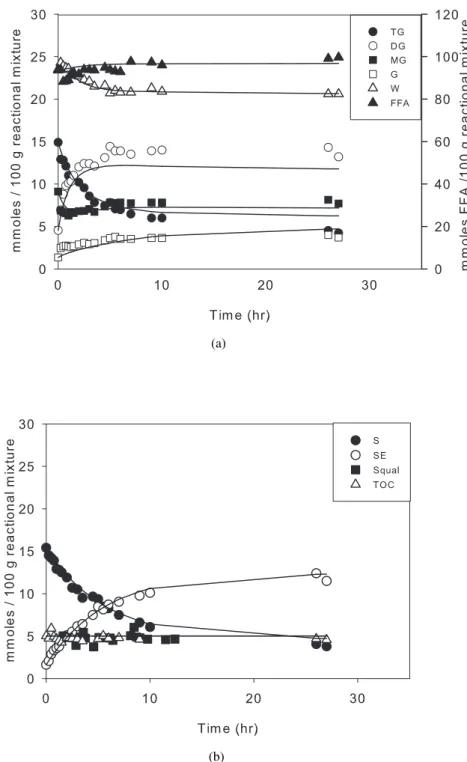
2.7 Evolvement of concentration of target solutes during a kinetic study at aW=1.0 . . 31
2.8 Evolvement of concentration of target solutes during a kinetic study with and
with-out control ofaW . . . 32
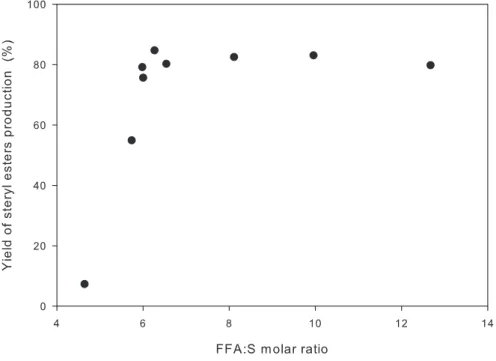
2.9 Effect of the initialFFA:Smolar ratio in the yield of steryl esters production after
24 hours of reaction . . . 33
2.10 Predicted and experimental concentration of the reaction mixture . . . 35
2.11 Evolvement of concentration of target solutes in the kinetic used for model validation 37
3.1 Examples of a good and a bad model fitting to the profile of concentrations of the
sterols and steryl esters . . . 49
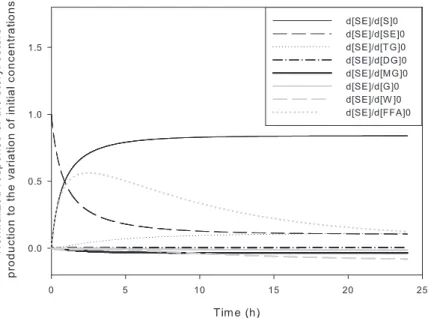
3.2 Sensitivity of the steryl esters production (after 24 hours) to the variation of the
3.3 Normalized response of steryl esters production, during the reaction, to the
varia-tion of initial concentravaria-tion of each reactant compound . . . 50
3.4 Yield of steryl esters production as a function of the initial concentration of free
fatty acids (FFA), sterols and triglycerides . . . 52
4.1 Experimental setup of the lipase catalyzed reactions . . . 61
4.2 Evolvement of the yield of steryl esters production and the corresponding concen-tration of sterols, steryl esters and acylglycerides during four consecutive batch
reactions, without water control . . . 65
4.3 Evolvement of the yield of steryl esters production and the corresponding concen-tration of sterols, steryl esters and acylglycerides during four consecutive batch
reactions, with water control . . . 68
4.4 Evolvement of the yield of steryl esters production and the corresponding con-centration of sterols (stigmasterol) and steryl esters, during four consecutive batch
reactions, carried out with oleic acid and stigmasterol . . . 70
4.5 Evolvement of the peroxide number in oleic acid and a mixture of acylglycerides,
during 24 hours and at 40◦C . . . . 71
4.6 Effect of contact between the enzyme and oleic acid and acylglycerides on the
yield of steryl esters production. . . 73
4.7 Effect of contact between the enzyme and oleic acid and acylglycerides on the
ki-netic constant of the esterification reaction (reaction I), k1, in deodorizer distillate,
performed under controlled conditions . . . 74
4.8 Effect of addition of fresh enzyme, between consecutive batch reactions, on the
yield of the production of steryl esters . . . 75
4.9 Effect of addition of fresh enzyme between consecutive batch reactions, on the
kinetic constant k1 . . . 75
4.10 Evolvement of the yield of steryl esters production and the corresponding concen-tration of sterols, steryl esters and acylglycerides, during four consecutive batch
reactions (24 hours each), performing an addition of fresh enzyme of 47% w/w
between batch reactions . . . 77
5.1 Effect of solvent in the membrane flux at different transmembrane pressures . . . 87
5.2 Permeability of solvents as a function of their kinematic viscosity and their
kine-matic viscosity and ability to swell the PDMS-based membrane 030306F . . . . 88
5.3 Curve of rejection as a function of the molecular weight of compounds present in
a solution with 10% w/w of deodorizer distillate and in oleic acid and hexane . . 89
5.4 Effect of pressure in the flux of membranes in hexane and in a solution of
deodor-izer distillate (10% w/w) . . . 90
5.5 Effect of pressure in the rejection of triglycerides, steryl esters, sterols and oleic
acid, using a hexane-based solution of deodorizer distillate (10% w/w) and
oper-ating in a dead-end mode with the membranes selected for this study . . . 94
5.6 Curve of rejection of triglycerides, steryl esters, sterols and oleic acid as a function
of the pressure, using a hexane-based solution of deodorizer distillate (10% w/w)
and operating in a cross-flow mode with the membrane 030306F . . . 95
5.7 Effect of the concentration of deodorizer distillates in hexane on the flux of the
membrane 030306F from Solsep at different transmembrane pressures . . . 95
5.8 Curve of rejection of triglycerides, steryl esters, sterols and oleic acid as a function of transmembrane pressure, using a hexane-based solution of deodorizer distillate
with different concentrations (Membrane 030306F) . . . 96
5.9 Effect of pressure in the flux of membranes in hexane and in a solution of
deodor-izer distillate (5% w/w) . . . 97
5.10 Effect of pressure in the rejection of steryl esters and pesticides, using a
hexane-based solution of deodorizer distillate (5% w/w) and operating in a cross-flow
mode. Membranes GMT-ONF2 (Borsig), PuramemS600 (Evonik) and 030306F
(Solsep) . . . 98
6.1 Schematic diagram of the process of diananofiltration . . . 108
6.2 Increase of the flux of the membrane PuraMemS600 during the processing of a
hexane-based solution of deodorizer distillate (5% w/w), with a total
recircula-tion of the permeate and retentate to the feed tank and swelling of the membrane
PuraMemS600 . . . 112
6.3 Increase of the flux of the membrane PuraMemS600 during diananofiltration of a
hexane-based solution of deodorizer distillate (5% w/w), at 20 bar and 20±3◦C . 114
6.4 Evolvement of mass of acylglycerides, free Fatty Acids, bioactive compounds and
pesticides, during diananofiltration processing . . . 115
6.5 Removal of pesticides and loss of steryl esters as a function of the number of
diananofiltration volumes . . . 117
6.6 Schematic diagram of a two-stage of diananofiltration . . . 117
6.7 Removal of pesticides and loss of steryl esters, as a function of the number of
List of Tables
1.1 Typical average composition of deodorizer distillates . . . 6
2.1 Composition of the Sunflower Deodorizer Distillates used for optimisation of the
enzymatic reaction . . . 21
2.2 Typical retention times (tR) and relative retention times (RRTs) of identified
com-pounds present in deodorizer distillate . . . 23
2.3 Saturated salt water activities at 40◦C . . . . 24
2.4 Effect of add oleic acid in the reaction mixture viscosity at 40◦C . . . 33
2.5 Initial conditions of the kinetic studies used for calibration of the model . . . 34
2.6 Kinetic constants of the reactions (I-IV) and the respective error . . . 34
2.7 Sy obtained from the estimated compounds concentrations for all kinetic studies
used for calibration of the model . . . 36
2.8 Initial conditions of the kinetic studies used for validation of the model . . . 36
2.9 Syobtained from the estimated solutes concentrations for all kinetic studies used
for validation of the model . . . 36
2.10 Typical optimized composition of the sunflower deodorizer distillates after 24
hours of reaction . . . 38
3.1 Characterisation of deodorizer distillates . . . 45
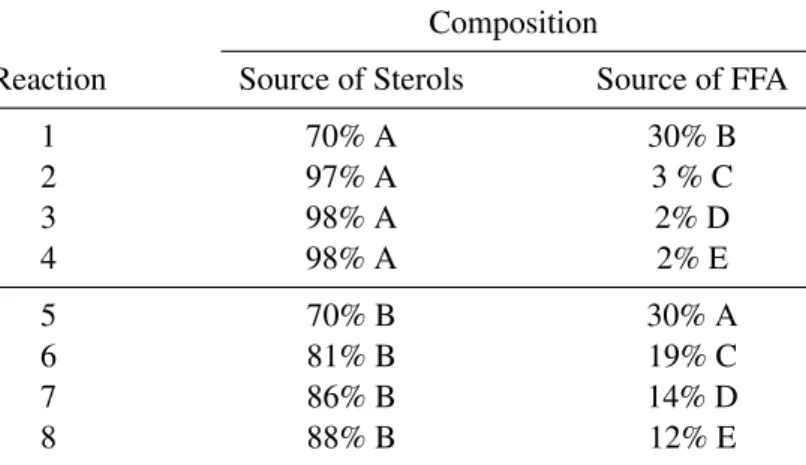
3.2 Proportion of sunflower deodorizer distillate and source of free fatty acids used
for the preparation of the reaction mixtures . . . 46
3.3 Initial concentration of reactant compounds and respective modelling range . . . 47
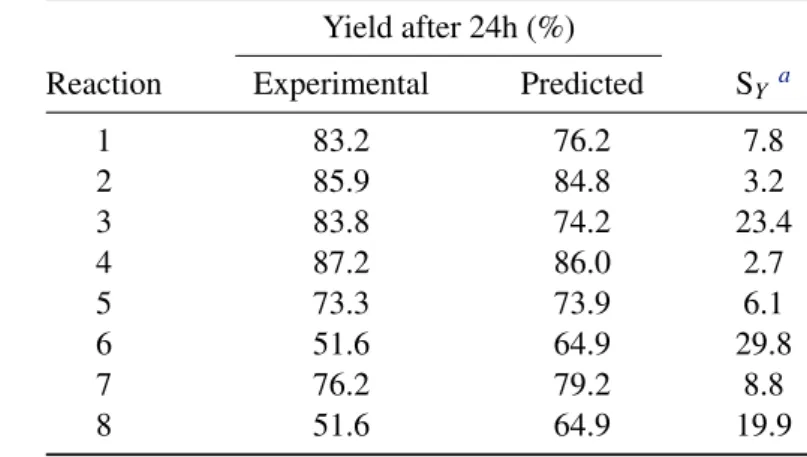
3.4 Experimental and predicted yield of steryl esters production and corresponding
quality of model fitting . . . 48
4.1 Kinetic constant of the direct reaction I, k1, in consecutive batch reactions for
steryl esters production . . . 66
4.2 Yield of steryl esters production obtained in four consecutive batch reactions (24
hours each), with and without enzyme washing between batch reactions . . . 69
4.3 Kinetic constant,k1, of the model esterification reaction between stigmasterol and
5.1 Properties of the selected membranes provided by the respective manufacturer . . 83
5.2 Kinematic viscosity of solvents and their ability to swell the membrane 030306F 86
5.3 Permeability of membranes in a dead-end operating mode. . . 89
5.4 Permeability of solutions of deodorizer distillate in hexane with different
concen-trations (operating in a cross-flow mode), using membrane 030306F . . . 92
5.5 Permeability of selected membranes in cross-flow operating mode . . . 92
6.1 Characterisation of the selected membranes (results from Chapter5) . . . 106
6.2 Typical content of phytosterols in the main oils, amount of extract to add,
di-lution factor (DF) of the extract in the final product, and removal of pesticides
(RemovalP) necessary in order to assure a concentration of pesticides below 0.05 ppm110
6.3 Simulation results for the selection of the membrane at different operating
pres-sures (see procedure description and assumptions in the subsection of Numerical Methods). Determination of the processing time and the number of
diananofiltra-tion volumes (VD) needed to remove 99% of pesticides, as well the loss of steryl
esters (LossS E) associated to the process . . . 111
6.4 Average rejection observed of compounds, at 20 bar and 20±3◦C. Membrane:PuraMemS600
from Evonik . . . 113
6.5 Composition of the esterified deodorizer distillate before and after diananofiltration 116
1
Introduction
1. INTRODUCTION
1.0.1 Background
Agro-food industries inevitably produce large amounts of agro-residues, which may represent a major waste disposal problem [1–3]. Legislation regulating the management of waste materials was issued by the European Union and has significantly contributed to the development of waste management procedures. A trend of demanding legislation regarding the agro-industrial wastes is expected, increasing the costs of their management. Under this context, the creation of value from such wastes has been highly encouraged and new technologies applying environmentally clean processes have been playing a central role.
One of the most interesting research areas is the recovery of bioactive substances from agro-food wastes using membrane technology [1,4]. Indeed, after the appropriate pretreatment of the raw material and recovery procedures (usually solvent extraction), most natural residues can pro-vide value-added natural oils, antioxidants, colorants, fragrances and other bioactive substances of great interest to the pharmaceutical, cosmetic and food industries [5]. However, bioactive com-pounds are present in low concentrations in such natural sources and are present as conjugates and mixtures in extracts, requiring labor-intensive methods for their recovery, purification and concen-tration. Membrane technology is an alternative technology, remarkably simpler and less energeti-cally intensive than other recovery processes such as distillation and crystallization. Additionally, it enables the production of value-added extracts, without requiring high process temperatures, which typically damage the valuable compounds [6].
The oilseed processing industry generates approximately 10-25 m3 of wastewater per metric tonne of oil refined produced [7], which represents a significant environmental burden. Chemical refining is the traditional method which comprises four main operations: degumming, neutral-ization, bleaching and deodorization (Figure1.1). In the degumming step, the phosphatides are removed from the crude oil, preventing the oil to darken and develop a precipitate during the storage and transport. Subsequently, the free fatty acid are neutralized with caustic soda. The resultant soapstocks are removed by means of centrifugal separators, being mainly valorised as "acid oil" for animal feed. The neutral oils are afterwards bleached to remove essentially pig-ments (carotenes and chlorophylls), degraded proteins, carbohydrates, polar oxidation products and pro-oxidant metals. The purpose of bleaching is not only to provide a lighter colored oil but also to purify it. Deodorization is the last operation and aims at removing flavors and odours from crude or semi-refined oil to obtain a bland and odorless oil. It consists in a distillation driven by vapour, performed during short periods of time (2-8 h, depending on the operating mode - batch or semi-continuous) at high temperatures (180-280◦C) and under a high vacuum (1-6 mmHg). These extreme operating conditions enables the removal of pesticides, aldehydes, ketones, free fatty acids and others volatile compounds responsible for adverse bad flavors and odours of the oil [8–10]. Simultaneously, the content of sterols and tocopherols in the oil is dramatically re-duced in about 40% [11,12], which makes the resulting distillate (about 30 kg/ton of refined oil produced [13]) a by-product with potential for downstream recovery of added-value compounds.
1. INTRODUCTION
Figure 1.1: Edible oil refining process [14]
1. INTRODUCTION
Campesterol Stigmasterol
Brassicasterol -Sitosterol
(a)
R1
R2
R1 R2 -Tocopherol CH3 CH3
-Tocopherol CH3 H
-Tocopherol H H
-Tocopherol H CH3
(b)
Squalene
(c)
Sitosteryl Oleate Ester
(d)
Figure 1.2: Main bioactive compounds present in deodorizer distillates: (a) Sterols, (b) Toco-pherols, (c) Squalene and (d) Steryl Esters [15]
deodorizer distillates varies widely, depending on several factors including the source and quality of the seeds used as raw material, the mechanical processes used to extract the oil, and the physical characteristics and operating conditions of the refining plant. The typical average composition of deodorizer distillates is summarized in Table1.1.
The family of acylglycerols present in deodorizer distillates contains triglycerols, diglycerols, monoglycerols and glycerols. Chemically speaking, tri, di and mono-glycerols are molecules derived from the natural esterification of fatty acid molecules with a glycerol molecule (Figure
1. INTRODUCTION
Table 1.1: Typical average composition of deodorizer distillates [18,19] Compounds Composition (% w/w)
Fatty Acids 30-85
Acylglycerols 5-40
Tocopherols 2-10
Free Sterols 2-15
Steryl Esters 0-5
Hydrocarbons 2-5
and it is the most relevant in sunflower and olive oil, being triolein (formed with three molecules of oleic acid) the most prevalent triglyceride [20].
Figure 1.3: Formation of triglycerides from the esterification of glycerols and free fatty acids [20]
Nowadays, and regardless of the interesting composition of deodorizer distillates, they have a very limited commercial value and are sold at a fraction of the oil cost [9,21]. Their use as animal feedstock or food additive has been discarded mainly due to the high content in pesti-cides [22,23]. Maximum residue levels (MRLs) in vegetable oils for human consumption are not specifically set, but according to the article 20 of EU Regulation No. 396/2005, they have to be derived from the MRLs established for seeds and, additionally, the concentration caused by their processing (defined as processing factor) should be taken into account [24]. The concentration of pesticides in seeds should be lower than 0.05 ppm (0.01 ppm is the limit of detection (LOD) for the main lipophilic pesticides). Their concentration in deodorizer distillates can be 500-1000 times higher than the actually allowed values [22,23]. Therefore, the valorisation of deodistillates as a
1. INTRODUCTION
food additive rich in bioactive compounds depends on the removal of pesticides, which remains challenging.
Figure 1.4: Distribution of molecular weight of compounds constituents of deodorizer distillates
Figure1.4shows the distribution of molecular weight of compounds constituents of deodor-izer distillates. Based only on the molecular weight, it is clear that within the bioactive compounds (comprising sterols, tocopherols and steryl esters) steryl esters (650<MW<800 g/mol) standout as those with the largest potential for separation from pesticides (150<MW<400 g/mol). How-ever, the attempts for valuing deodorizer distillates have been mainly focused on the recovery of sterols and tocopherols due to their higher concentrations comparatively to steryl esters (Table
1. INTRODUCTION
incorporation in fat-based products.
Typically, the content of steryl esters in deodorizer distillates is very low (0-5% according the Table 1.1) but it can be increased by enzymatic esterification between sterols and free fatty acids, making their recovery more viable. The use of enzymes compared to chemical catalysts is advantageous since enzymes are highly specific, catalyse under mild conditions (decreasing side reactions and saving energy), are more compatible with variations in the composition of the raw material and may be reused. The main drawbacks of using enzymes (depending on the process under consideration) are their low reaction rates, their high price and loss of activity [34].
Lipases (triglycerides hydrolases E.C. 3.1.1.3) are part of the family of hydrolases that act on carboxylic ester bonds. The natural function of lipases is to hydrolyze triglycerides into diglyc-erides, monoglycerides and glycerol, although, under optimal conditions, they can catalyze other reactions such as esterification, interesterification, acidolysis, alcoholysis, and aminolysis (Fig-ure 1.5). Lipases fromCandida rugosa andMucor miehei are the most used for esterification
applications [35], and more specifically, the lipase fromCandida rugosais considered the most
appropriate for obtaining yields of production of steryl esters above 80% [36–38]. Since their op-timal working temperature is already known (37-40◦C) [39], the main parameters to be optimized are the enzyme concentration, water activity in the reaction medium (aW) and reactants molar ratio (free fatty acids:sterols,FFA:S). The immobilization of the enzyme in porous carriers is one way
of increasing its lifetime and stability. Additionally, handling and recovery of the enzyme are eas-ier if an immobilization process is used. However, limitations to internal mass transport of large molecules through small pores of the carrier to reach the enzyme may be significant, decreasing consequently the efficiency of the enzyme. Furthermore, if the viscosity of the medium is high, as in the use of deodorizer distillates, limitations due to external mass transfer will be necessarily high. In such cases, the use of free enzymes is preferable with the advantage of their higher ac-tivity and significant lower price when compared to the immobilized option. The main drawbacks are their reported reduced lifetime and difficulty to handle and reuse [34].
Figure 1.5: Different reactions catalysed by a lipase
The enzymatic enrichment of deodorizer distillates in steryl esters using free and immobilized enzymes is relatively well described in the literature [8,38,40–42]. However, it is always coupled to methods as crystallization, supercritical carbon dioxide extraction or molecular distillation, for recovering of the target compounds. The use of nanofiltration membranes was still not considered,
1. INTRODUCTION
although it may be feasible given the higher molecular weight of steryl esters, 650-800 g mol−1) relatively to pesticides (150-400 g mol−1).
Nanofiltration (NF) is a pressure-driven process, that is typically considered to be between ultrafiltration (UF) and reverse osmosis (RO). Figure1.6shows the liquid separation spectrum for the separation of particles and solutes from around 0.01mm to 1Å. Nanofiltration is traditionally used for removing solutes with a size range within 6-13Å, such as sugars, dyes and organic solutes (with a molecular weight (MW) between 200 and 1000 g mol−1), from aqueous feed streams. The key difference between nanofiltration and reverse osmosis is that the latter retains monovalent salts (such as sodium chloride), whereas nanofiltration allows them to partially pass, retaining effectively only divalent and multi-valent salts (Figure1.7) [43].
Figure 1.6: Membrane techniques for liquid separation [44]
Nanofiltration was recently applied to molecular-level separations in organic solvent media, with the development of the so-called solvent resistant nanofiltration (SRNF) membranes. Nowa-days, SRNF is being used with relative success for pharmaceutical industry applications, such as purification of active pharmaceutical ingredients (API) [46], catalyst recycling [47], removal of genotoxins from APIs [48], continuous solvent exchange [49] and solvent recycling [50]. The use of SRNF in the oil refining industry has been discussed mainly from the point of view of solvent recycling and oil recovery [51–53]. Even so, the only reported application of such technology in large scale is the solvent recovery from lube oil dewaxing (MAX-DEWAXT M) [54].
1. INTRODUCTION
Figure 1.7: Characteristics of membrane separation processes [45]
Evonik [55], GMT [56] and Solsep [57]. Polyimide (PI) crosslinked with PDMS, and polyacry-lonitrile (PAN) are examples of materials that were identified to exhibit a satisfactory resistance. Most polymeric membranes used in SRNF are constituted by a porous support with a dense top layer [58]. In the case of non-porous membranes, the transport is hypothesized to be governed by a solution-diffusion mechanism [59]. This model assumes that transport occurs by solute(s) solu-bilization in the membrane and diffusion through it, being the rejection a function of the diffusivity coefficient of each substance [52]. Other authors [60,61] present a different approach, in which swollen dense membranes may exhibit an increase in internal microporosity being the rejection of solutes governed predominantly via a size-exclusion mechanism. In this case, the nature of transport of solutes is reported to be mainly convective (Figure1.8).
Figure 1.8: Molecular transport through membranes described by the flow through by pores or by solution-diffusion mechanism [43]
Ceramic materials (silicium carbide, zirconium oxide and titanium oxide) are able to endure harsh temperature conditions and show high resistance to solvents being, therefore, an excellent
1. INTRODUCTION
alternative to polymeric materials. For a long time, the lower end of molecular weight cut-off (MWCO) of these membranes was 1000 g mol−1. However, NF membranes with a pore size of 0.9 nm and a cut-offof 450 g mol−1 were developed and commercialized in 2002 by Inopor, a spin-offcompany of HITK (Germany) [58]. The hydrophilicity of the oxide materials contained in ceramic membranes, lowers the permeability of apolar solvents. Attempts for mixing oxides materials were not successful. The silylation of ceramic membranes has been proposed as a vi-able solution, however, their commercialization is still restricted, being only manufactured under demand [58].
The fact is that the application of SRNF membranes at large scale constitute a market opportu-nity, and several efforts have been made in the direction of developing better and more compatible materials in order to increase the efficiency of the separation processes.
1.0.2 Research Strategy
The main objective of this thesis is the development of an integrated process for production of a bioactive extract rich in steryl esters from deodorizer distillates. The valorisation of this by-product depends on the removal of pesticides with a minimal loss of steryl esters.
The solvent resistant membrane-based process developed in this work comprises three steps as illustrated in Figure1.9.
Figure 1.9: Steps of the proposed solvent resistant membrane-based to produce an extract rich in steryl esters from deodorizer distillates
The first stepconsists in the enrichment of deodorizer distillates in steryl esters. The enzymatic-route was chosen since that it can be carried-out under mild conditions, preventing the thermal degradation of bioactive compounds contained in the deodorizer distillate (which is typically one of the main challenges of the traditional thermal-based separation processes). The lipase from
Candida rugosa was selected to perform the esterification, since it has been referenced in the
literature as the most efficient [36–38]. The enzyme was used in the free form (instead of im-mobilized), mainly due to the high viscosity of deodorizer distillates, which may induce high limitations to mass transfer. Other advantage is the higher activity of the enzyme in the free form as a direct consequence of the absence of a enzyme-carrier interactions and possible limitations to mass transfer.
1. INTRODUCTION
account that the operation of deodorization can last 2-8 hours [14] and that only 30 kg of distil-late is produced per tonne of refined oil [13], being necessary enough time to collect a reasonable quantity of distillate from the deodorization to start a new reaction batch. The temperature of the enzymatic reaction was maintained constant at 40◦C (optimal temperature, following indications of the suppliers). The concentration of enzyme, the water activity of the reaction medium and the molar ratio of free fatty acids and sterols (FFA:S) were the parameters optimized for maximization
of the yield of steryl esters production. The importance of the water activity (aW) in the equilib-rium of hydrolysis/esterification reactions, as well as the intrinsic activity of the enzyme has been reported [35]. Therefore, different initial aWin enzymatic reactions were set (pre-equilibrating the system with different saturated salts solutions, as described by Greenspan [62]) and the impact in the yield of steryl esters production was determined. Finally, theFFA:Smolar ratio was optimized
varying the quantity of free fatty acids in the system by addition of oleic acid (main free fatty acid present in the deodorizer distillates used in this study).
The prediction of the profile of the reactant compounds during the enzymatic reaction is a powerful tool, allowing to describe the transient-state of the system once the kinetic constants were determined. Accordingly, a focus was given to the development of a mass-balance model that could be applied, independently of the source of deodorizer distillates and free fatty acids (necessary to assure that equilibrium is driven towards the esterification of sterols).
The second stepof the integrated process is focused on the reuse of the enzyme. The enzyme was recovered using UF/MF membranes and the yield of production of steryl esters was com-pared between consecutive batches. The effect of water activity, the increasing content of glycerol in the reaction medium (potential inhibitor) due to the the hydrolysis of acylglycerides and the presence of oxidation products were identified as potential causes of the loss of enzyme activity. The understanding of such phenomena was one the objectives, in order to promote the mitigation of enzyme deactivation (if possible) and the reuse of the enzyme, maintaining the yield of steryl esters production higher than 80% over consecutive batches.
The third stepconsisted on the production of an extract rich in steryl esters and free of pes-ticides, using SRNF membranes. Diananofiltration is used in this work for the removal of con-taminants (such as pesticides) from the process stream. This method consists in continuously feeding fresh solvent at the same rate as permeate is recovered, where steryl esters are retained by the membrane and pesticides are washed-out in the permeate. The selection of solvents to be used in the diananofiltration technique was based on the fact that oleic acid is already present in the original matrix in high concentrations, while hexane is a traditional solvent used in the oil refining industry and, finally, ethanol produced from renewable resources is already considered as an alternative solvent in food applications. Polymeric membranes were chosen since the ceramic membranes still present restricted application to apolar solutions due to their strong hydrophilic character. The performance of available commercial SRNF membranes was evaluated in terms of solvent compatibility and rejection of target compounds. The interaction between the selected solvents and membranes was studied in this work, and associated to the swelling phenomena ob-served and the viscosity of the solvents. The experimental data of membrane flux and rejection of compounds was used as inputs to a mass-balance model, enabling the prediction of the profile of
1. INTRODUCTION
the target compounds during diananofiltration processing, as well as the efficiency of the process in terms of loss of steryl esters and removal of pesticides. Such model enabled the comparison of the efficiency of candidate membranes and to select the one that exhibit the better performance for the present application. This model was improved by incorporating a relationship between flux and membrane exposure time to the processing solution (as a result of the interactions between the sol-vent and the membrane). Finally, the modelling data was compared to the experimentally obtained values and methods for improving the efficiency of the process were proposed and simulated.
1.0.3 Thesis Outline
This Thesis comprises the following chapters:
• Chapter 2 comprises the optimisation of the enzymatic esterification between sterols (S) and
free fatty acids (FFA) contained in deodorizer distillates from different sources. The enzyme concentration, the water activity (aW) in the reaction medium and the molar ratio between free fatty acids (FFA) and sterols (S) were the parameters optimized, in order to obtain at least 80% of yield of production of steryl esters. A mass-balance model was established and the kinetic constants of all reactions involved were determined. This model allowed to describe the transient state of the system, predicting the profile of concentration of the reactant compounds when using different deodistillates [63].DOI: 10.1021/ie1020766
• Chapter 3 discusses the possibility of using alternative and cheaper sources of free fatty acids (FFA), instead of using oleic acid in the adjustment of the initial excess of FFA (FFA:Smolar
ratio). The use of sunflower refined oil and mixtures of deodorizer distillates with different compositions was evaluated as well as the capacity of the mass-balance model developed in this work for predicting the yield of production of steryl esters. Guidelines to obtain yields of steryl esters higher than 80% are also provided in this chapter.
• Chapter 4 studies the possibility of reusing the enzyme in consecutive reactions. The ac-tivity of the enzyme between consecutive batches was analysed and possible causes of loss of activity were identified. In order to maintain the yield of production of steryl esters in consecutive batches, strategies to maintain the yield over batches were assessed and opti-mised [64].DOI: 10.1021/ie202853f
• Chapter 5 presents the SRNF membranes’ screening work to perform the removal of pesti-cides and recovery of steryl esters. The selection of the solvent to be added to the resulting reaction mixture in order to decrease the viscosity of the reaction medium is also described in this chapter. Furthermore, the optimal operating conditions to obtain the maximum dis-crimination between steryl esters and pesticides were identified.
1. INTRODUCTION
of 99% of pesticides was determined and discussed. As a result, possible improvement so-lutions are discussed in the basis of the simulations performed.
• Chapter 7 presents a summary of the main findings along with a discussion of relevant questions that have emerged from the present work and that should be addressed in future work.
The scientific work developed in this PhD project is described in Chapters 2 to 6. These chapters are written in the format of scientific papers, being already published the articles related to Chapters 2 and 4.
2
Production of steryl esters from
vegetable oil deodorizer distillates by
enzymatic esterification
Summary
This work is focused on the production of steryl esters by enzymatic esterification of free fatty acids and sterols present in deodorizer distillates. The enzyme selected, a Candida rugosa lipase, shows to be able to synthesize steryl esters with a yield of 80%, after 24 hours, under optimized conditions. These conditions were determined after studying the influence of various reaction parameters such as enzyme concentration, initial water activity in the reaction medium and initial Free Fatty Acid:Sterols molar ratio (FFA:S), at a fixed temperature of 40◦C. The optimal enzyme concentration was found to be 0.5% (w/w) which results from a compromise between the yield of steryl esters formation and the period of time to perform such task, set as 24 hours. The optimal water activity in the reaction medium was found to be in the range between 0.45 and 0.85. The influence of the substrates molar ratio (FFA:S) was also studied and a minimal ratio of 6:1 was found to be the best.
A kinetic mathematical model was established in order to describe the transient state of the reaction system during the enzymatic reaction, as well as to determine the respective kinetic con-stants, which can be used to predict the evolvement of the composition of the reaction mixture.
2. OPTIMISATION OF THEENZYMATICREACTION 2.1. Introduction
2.1 Introduction
Recent efforts from industry to achieve better and improved methods for recovery and purifica-tion of phytosterols are related with the growth of the health food market, particularly due to the widespread dissemination of functional food [19]. Under this context, the valorisation of by-product streams rich in bioactive compounds is economically very interesting.
Deodorizer distillate is a by-product stream formed in the last step of the refining process of vegetable oils. It consists on the deodorization of the oil for removal of compounds responsible for bad taste and odor (aldehydes and ketones), pesticides, herbicides and polycyclic aromatic hydrocarbons (PAHs). Due to the operating conditions used in this steam-stripping distillation,
the resulting distillate also contains sterols (S), tocopherols (TOC), squalene (Squal), free fatty
acids (FFA), triglycerides (TG), diglycerides (DG), monoglycerides (MG) and steryl esters (SE)
[9,17,65].
Phytosterols have been found to be effective in lowering plasma cholesterol concentrations and prevention of cardiovascular diseases [66,67], while tocopherols, which are physiologically active as Vitamin E, are natural antioxidants that have an important role in the protection of fats and oils from oxidation [68,69].
Despite previous efforts [10,25,26,70–76], the valorisation of deodorizer distillates still re-mains a challenge since the recovery and purification yields of the target compounds are not sat-isfactory. A high content of pesticides has been found in deodorizer distillates [77], making their valorisation dependent from the removal of pesticides, due to the stringent legislation in the ma-jority of the countries concerning the pesticides content in food additives [17]. It is important to note that none of the works referred indicate the content in pesticides in the product obtained.
The present work studies the enzymatic reaction between FFAsand sterols to produce steryl
esters for valorisation of deodorizer distillates. Although there is no real consensus, one of the ad-vantages identified by some authors in the literature for producing steryl esters is related with the fact that sterols in the esterified form are known to be more bioactive than in their free form [33]. Also, steryl esters are more soluble in the oil phase than free sterols, making easier their incor-poration in fat-based products [67]. Moreover, an increase in the difference of molecular weight between the steryl esters (650-800 Da) and pesticides (150-420 Da) enables a possible recovery of steryl esters by separation processes based on size exclusion such as pressure-driven membrane processes. The molecular weight of the target constituents of the enzymatic reaction suggests that nanofiltration may allow their efficient separation [43], which will be explored in the Chapters5 and6.
In the literature, the use of lipases (triglycerides hydrolases E.C. 3.1.1.3) for the synthesis of various steryl esters has been applied in distinct applications. In several published works,Candida rugosalipase is considered one of the most appropriate enzymes for the conversion of sterols to
steryl esters [36–38].
2. OPTIMISATION OF THEENZYMATICREACTION 2.1. Introduction
reaction occurs in a multiphasic system (water content between 20-50%), a subsequent dehydra-tion step (vaccum destilladehydra-tion) is needed. The yield of steryl esters varied between 80-90% after 24 hours of reaction, at 40◦C, with a concentration ofCandida rugosalipase (lipase-OY) of 120-250 Units per gram of reaction mixture. The influence of the excess ofFFAson the initial reaction
mixture was also studied [42], being obtained a positive effect, with a optimal ratio of Deodorizer Distillate/Oleic Acid of 1:2 (w/w), since the reaction is driven towards esterification. The influ-ence of the water content in the steryl esters yield was studied by Shimada and co-workers [42,78] and it was concluded that without adding water to the deodorizer distillate (initial water content =6500 ppm) the reaction does not occur, being necessary to guarantee an initial water content of 20%.
Torres et al. [40,79] and Villeneuve et al. [37], also performed the esterification reaction of phytosterols and oleic acid but in a monophasic system since both identified the disadvantage of working with multiphasic systems, namely the need of eliminating solvents from the products. Torres et al. [40,79] carried out the reaction with a Candida rugosa enzyme concentration of
10% (w/w), a molar ratio of substrates (FFA:S) of 2, at 40◦C, during 24 hours, obtaining a steryl esters yield production of 90%. Villeneuve et al. [37] carried out the reaction with a Candida rugosa enzyme concentration of 5% (w/w), pre-equilibrated to an optimal water activity -aw -(not especified), a molar ratio of substrates (FFA:S) of 3, at 35◦C, during 72 hours, obtaining a
steryl esters yield production of 85%.
This work aims at improving the understanding of the enzymatic esterification reaction mech-anism in order to maximize the yield of steryl esters. This objective will be accomplished through a mathematical description of the reactions taking place, and an optimization of the different pa-rameters involved.
The conversion of sterols to steryl esters leads to an increase in the molecular weight difference to pesticides that are present in deodorizer distillates. This reaction step thereby facilitates the use of a subsequent membrane-based separation process, such as nanofiltration, for the recovery of steryl esters free from pesticides.
The enzyme concentration is one of the parameters that will be optimized since it has a sig-nificant importance in the economic feasibility of the process at a large scale. This work will be focused on the determination of the minimal enzyme concentration necessary to achieve high yields (defined as the moles of steryl esters produced per the initial moles of sterols in the reaction mixture) in a period of 24 hours.
The water activity in non-aqueous media influences the dynamic and catalytic properties of the enzymes, since water acts as a molecular lubricant. Water activity is the parameter that gives a better indication about the hydration state of the enzyme, which plays a crucial role in the catalytic activity, rather than the total water content in solution. Moreover, water has an important role in the equilibrium of the esterification/hydrolysis side-reactions [80–83].
An excess ofFFAguarantees that the production of steryl esters by esterification of sterols is
not limited by the concentration ofFFAs. Therefore, the effect of the addition of oleic acid (anFFA
will be evaluated in this work as well as the subsequent and important decrease of the viscosity of the reaction medium, enhancing mass transfer.
2. OPTIMISATION OF THEENZYMATICREACTION 2.2. Modelling of the Enzymatic Reaction
2.2 Modelling of theEnzymaticReaction
In order to describe the kinetic behaviour of the enzyme-catalyzed acyl transfer in organic solvents by using esters as acyl donors, a mathematical kinetic model was developed. Since the enzyme has water available to react, the hydrolysis and esterification side-reactions of acylglycerides and sterols will occur simultaneously.
Concerning the mechanism of esterification of the sterols, one mole of sterol (S) reacts with
one mole of free fatty acid (FFA), catalyzed by the enzyme (E), releasing one mole of steryl ester
(SE) and one mole of water (W) which can be described as: S +FFA+E−−↽k1⇀−−
k−1
SE+W+E (I)
wherek1 andk−1are the kinetic constants that describe the forward and the reverse reaction, respectively.
In the esterification of the acylglycerides, one mole of glycerol (G) is stepwised esterified with
three moles of free fatty acid (FFA), by the enzyme (E), to monoglyceride (MG), diglyceride (DG)
and triglyceride (TG), releasing three moles of water (W). The following mechanism describe the
reactions:
G+FFA+E−−↽k2⇀−−
k−2
MG+W+E (II) MG+FFA+E−−↽k3⇀−−
k−3
DG+W+E (III) DG+FFA+E−−↽k4⇀−−
k−4
T G+W+E (IV)
The rate equations for the evolvement of sterols (S) and formation of steryl esters (SE) can be
expressed as:
1 [E]
d[S]
dt =k−1[SE][W]−k1[S][FFA] (2.1)
1 [E]
d[SE]
dt =k1[S][FFA]−k−1[SE][W] (2.2)
The rate equations for the formation/consumption of the acylglycerides can be expressed as:
1 [E]
d[G]
dt =k−2[MG][W]−k2[G][FFA] (2.3)
1 [E]
d[MG]
dt =k2[G][FFA]+k−3[DG][W]−k−2[MG][W]−k3[MG][FFA] (2.4)
1 [E]
d[DG]
dt =k3[MG][FFA]+k−4[T G][W]−k−3[DG][W]−k4[DG][FFA] (2.5)
1 [E]
d[T G]
2. OPTIMISATION OF THEENZYMATICREACTION 2.3. Materials and Methods
The free fatty acids (FFA) are the acyl donors in all esterification reactions, and their
evolve-ment can be expressed as:
1 [E]
d[FFA]
dt =k−1[SE][W]+k−2[MG][W]+k−3[DG][W]+k−4[T G][W] (2.7)
−k1[S][FFA]−k2[G][FFA]−k3[MG][FFA]−k4[DG][FFA]
Water induces the hydrolysis of steryl esters as well as acylglycerides. Its evolvement can be expressed as:
1 [E]
d[W]
dt =k1[S][FFA]+k2[G][FFA]+k3[MG][FFA]+k4[DG][FFA] (2.8)
−k−1[SE][W]−k−2[MG][W]−k−3[DG][W]−k−4[T G][W]
In order to guarantee that the water content in the bulk reaction medium is constant during the esterification reaction, it is possible to adjust the water content to a desirable value by equilibration with saturated salt solutions, as described in the Materials and Methods section. In this case, the rate equation for water becomes (assuming a total control of the water activity):
1 [E]
d[W]
dt =0 (2.9)
Concerning the tocopherols and squalene, the enzyme is not able to esterify them, therefore their rate equations were not considered.
If the concentration of all compounds during the enzymatic reaction is known, the kinetic constants can be determined by applying a numerical method to solve the system of differential equations and fitting the model to the experimental values by adjusting the kinetic constants (see the subsection 2.3.4). It should be stressed that different model mechanisms other than the one described here were also evaluated (results not shown). The use of those model mechanisms resulted, in all cases tested, in worse descriptions of the transient species concentration.
2.3 Materials andMethods
2.3.1 Materials
2.3.1.1 Deodorizer Distillate
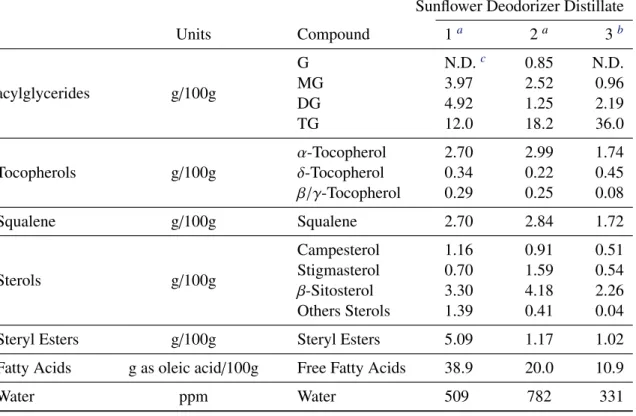
Sunflower deodorizer distillates were obtained from the producers Lesieur Cristal in Morocoo and Lesieur in France. The composition of the deodorizer distillate was determined in our labora-tory. Table2.1shows the composition variability of the deodorizer distillates depending from their
2. OPTIMISATION OF THEENZYMATICREACTION 2.3. Materials and Methods
Table 2.1: Composition of the Sunflower Deodorizer Distillates used for optimisation of the enzy-matic reaction
Sunflower Deodorizer Distillate
Units Compound 1a 2a 3b
acylglycerides g/100g
G N.D.c 0.85 N.D.
MG 3.97 2.52 0.96
DG 4.92 1.25 2.19
TG 12.0 18.2 36.0
Tocopherols
α-Tocopherol 2.70 2.99 1.74
g/100g δ-Tocopherol 0.34 0.22 0.45
β/γ-Tocopherol 0.29 0.25 0.08
Squalene g/100g Squalene 2.70 2.84 1.72
Sterols g/100g
Campesterol 1.16 0.91 0.51
Stigmasterol 0.70 1.59 0.54
β-Sitosterol 3.30 4.18 2.26
Others Sterols 1.39 0.41 0.04
Steryl Esters g/100g Steryl Esters 5.09 1.17 1.02
Fatty Acids g as oleic acid/100g Free Fatty Acids 38.9 20.0 10.9
Water ppm Water 509 782 331
aFrom Lesieur Cristal (Morocco) bFrom Lesieur (France) cN.D.-Not Detected
source and lot. Other compounds that were not quantified in this work may comprise hydrocar-bons, aldehydes, ketones, pesticides, herbicides and breakdown products of tocopherols and free phytosterols [10]. All samples were stored in the refrigerator at 4◦C.
2.3.1.2 Enzyme
Candida rugosalipase, Type VII, was obtained from Sigma (Saint Quentin, France). The activity
of this lipase as indicated by the supplier is 1535 U/mg of solid, which was experimentally con-firmed by using the Sigma Kit for determination of enzymatic activity of lipases using olive oil as substrate. One unit (U) of lipase activity is defined as the amount of enzyme that hydrolyses 1.0µequivalent of fatty acid from a triglyceride in one hour at pH 7.2 and at 37◦C using olive oil
(30 minutes of incubation).
2.3.1.3 Chemicals
Analytical-grade chloroform, food-grade oleic acid, N,O-bis (trimethylsilyl) trifluracetamide (BSTFA) containing 1% of trimethylchlorosilane (TCMS) solution (from Fluka) and pyridine were obtained from Sigma Aldrich (Belgium).
2. OPTIMISATION OF THEENZYMATICREACTION 2.3. Materials and Methods
β-sitosterol (99%purity), campesterol (99% purity), cholesteryl stearate (96% purity),
monoglyc-eride olein (>99%purity), diglyceride olein (99.7% purity) and triglyceride olein (99.6% purity) were purchased from Sigma (France). A tocopherol kit consisting ofα-,β-,γ- andδ-tocopherols
was obtained from Merck (>95% purity).
The internal standard heptadecanyl stearate (HDS) was prepared by condensation of heptade-canol and stearoyl chloride, both obtained from Aldrich (Belgium), as described by Verleyen et al. [65].
2.3.2 Analytical Methods
2.3.2.1 Analysis of acylglycerides, Tocopherols, Sterols and Steryl Esters
The following procedure was based on the method developed by Verleyen et al. [65]. In this work, the amount of the reagents used was further optimized.
The deodorizer distillates samples need to be derivatized in order to increase the volatility of the components. For derivatization, samples (≈5 mg) were weighed in a screw-capped test tube and dissolved in 50µl of pyridine and 100µl of BSTFA containing 1% of TCMS solution
as derivatizating and silylation agent. The test tube was placed in a heating block at 70◦C for 30 minutes to allow the completion of the silylation process. Afterwards, 5µl of HDS solution
(internal standard) with a concentration of 20 mg/ml in chloroform was added to the derivatized sample as well as 840µl of chloroform in order to obtain a final volume of 1 ml. The samples were
transferred to GC vials and injected within 24 hours of preparation.
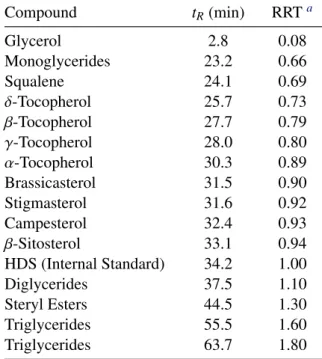
Separation of the peaks was performed in a Chrompack CP9001 series gas chromatograph with an on-column injection at a set temperature of 60◦C and with a flame ionization detector at 360◦C. A capillary column Zebron-5MS 15 m×0.25 mm, 0.25µm (Phenomenex, USA) was used. The temperature program of the oven was the following: rinsing at 30◦C/min to 140◦C and continuing the oven heating at a rate speed of 5◦C/min to 235◦C with a 7 min hold and further heating at 15◦C/min to 340◦C with a 30 minutes hold. Helium was used as a carrier gas at a pressure of 100 kPa. The peaks were integrated using the Borwin Software (JMBS Developments, France). Typical retention times for all species identified are depicted in Table2.2.
2.3.2.2 Analysis of Free Fatty Acids
The free fatty acids (FFAs) were determined by titration according to the standard NF.EN.ISO
660-1999. The method was developed and implemented in a titration workstation TitraLab 856 from Radiometer (Denmark). The result is expressed as % of oleic acid.
2.3.2.3 Analysis of Water Content
A Karl Fischer (KF) system of Metrohm AG, Herisau, Switzerland (model 756KF coulometer) was used to analyse the water content. Water content determinations of deodorizer distillates samples were conducted with Hydranal-Coulomat CG, as catholyte reagent free of halogenated hydrocarbons, for a coulometric KF titrator with a diaphragm and with Hydranal-Coulomat Oil as
2. OPTIMISATION OF THEENZYMATICREACTION 2.3. Materials and Methods
Table 2.2: Typical retention times (tR) and relative retention times (RRTs) of identified compounds
present in deodorizer distillate
Compound tR(min) RRTa
Glycerol 2.8 0.08
Monoglycerides 23.2 0.66
Squalene 24.1 0.69
δ-Tocopherol 25.7 0.73
β-Tocopherol 27.7 0.79
γ-Tocopherol 28.0 0.80
α-Tocopherol 30.3 0.89
Brassicasterol 31.5 0.90
Stigmasterol 31.6 0.92
Campesterol 32.4 0.93
β-Sitosterol 33.1 0.94
HDS (Internal Standard) 34.2 1.00
Diglycerides 37.5 1.10
Steryl Esters 44.5 1.30
Triglycerides 55.5 1.60
Triglycerides 63.7 1.80
aRetention time relative to HDS
anolyte reagent for coulometric Karl Fischer titrator, as well as working medium.
Samples are previously weighed (h1 gram) and injected into the KF titrator. The result is expressed as ppm.
2.3.3 Experimental Procedure Methods
2.3.3.1 Viscosity Measurement
The viscosity was measured using a digital viscometer (Brookfield Engineering Laboratories Inc., USA). The temperature was controlled immersing the samples (17 ml) in a water bath at 40◦C during the viscosity measurement.
2.3.3.2 Water Adsorption Isotherms
Saturated solutions may be used for pre-equilibrating a system to a defined water activity through the vapor phase, since the water activity, at a controlled temperature, will be the same for all phases in contact. Reliable values of water activity for several inorganic salts at different temperatures are tabulated by Greenspan [62]. The salts solutions selected for this study are shown in Table2.3.
![Figure 2.3: Effect of the enzyme concentration ([Enz]) on the yield of the steryl esters production (after 24 hours for reactions carried out with 0.25 and 0.50% w/w of enzyme concentration and after 2 hours for reactions carried out with 5% and 9% w / w o](https://thumb-eu.123doks.com/thumbv2/123dok_br/16496455.733578/51.892.243.677.684.998/figure-effect-concentration-production-reactions-carried-concentration-reactions.webp)
![Figure 2.6: Yield of steryl esters production at various water activities (a W ) with [Enz]=0.50% (w/w) and FFA:S molar ratio = 7.0 at 40 ◦ C](https://thumb-eu.123doks.com/thumbv2/123dok_br/16496455.733578/54.892.198.639.159.482/figure-yield-steryl-esters-production-various-water-activities.webp)
![Figure 2.7: Evolvement of concentration of target solutes during a kinetic study with a FFA:S molar ratio = 6.0, [Enz]=0.50% (w/w) and a W =1.0 (Figure (a): (•) triglycerides (TG), (◦) -diglycerides (DG),( ) - monoglycerides (MG), ( △ ) - Water (W) repr](https://thumb-eu.123doks.com/thumbv2/123dok_br/16496455.733578/55.892.239.698.179.917/figure-evolvement-concentration-solutes-kinetic-triglycerides-diglycerides-monoglycerides.webp)