Printed in Brazil - ©2007 Sociedade Brasileira de Química 0103 - 5053 $6.00+0.00
Article
*e-mail: [email protected]
Identification of Impact Aroma Compounds in
Eugenia uniflora
L. (Brazilian Pitanga)
Leaf Essential Oil
Rosineia M. Melo, Vivian F. S. Corrêa, Ana Carolina L. Amorim, Ana Luisa P. Miranda and Claudia M. Rezende*
Instituto de Química, Universidade Federal do Rio de Janeiro, Centro de Tecnologia, Bloco A, 21945-970 Rio de Janeiro-RJ, Brazil
O óleo essencial das folhas de Eugenia uniflora L. (Myrtaceae) foi obtido a partir do arraste a vapor em aparelhagem de Clevenger e analisado por cromatografia gasosa acoplada à espectrometria de massas. As folhas foram colhidas e imediatamente extraídas durante cinco dias consecutivos, às 9 e 14h, não sendo observada variação significativa no rendimento dos óleos extraídos no período. Furanodieno e seu produto de rearranjo, furanoelemeno (ou curzereno, num total de 50,2%), β-elemeno (5,9%) e α-cadinol (4,7%) foram os constituintes majoritários. Pela técnica de cromatografia gasosa-olfatometria (CG-O), associada à análise por diluição de aroma AEDA (Aroma Extract Dilution Analysis), foi possível identificar nove substâncias ativas no aroma do óleo de pitanga, sendo que três foram consideradas como de maior impacto: furanodieno (juntamente com furanoelemeno, FD 1024), β-elemeno (FD 256) e (E,E)-germacrona (FD 256). A mistura destas três substâncias, coletadas a partir do CG-sniffing port, levou a uma essência de pitanga de aroma bastante semelhante à fruta, de acordo com a avaliação por análise olfativa comparativa.
The leaf essential oil of Eugenia uniflora L. (Myrtaceae) was extracted by Clevenger apparatus and analysed by gas chromatography-mass spectrometry (GC-MS). The leaves were collected and immediately extracted for five consecutive days at 9:00 am and 2:00 pm. No variance in the oil yields were observed in the period. Furanodiene and its rearrangement product, furanoelemene (or curzerene, 50.2%), β-elemene (5.9%) and α-cadinol (4.7%) were identified as the most abundant compounds. GC-Olfatometry (GC-O) associated to Aroma Extract Dilution Analysis (AEDA) allowed the identification of nine active aroma compounds, where furanodiene (along with furanoelemene, FD 1024), β-elemene (FD 256) and (E,E)-germacrone (FD 256) were characterized as the main impact aroma compounds in the odor of this essential oil. Those substances were collected through a sniffing port adapted on the GC allowing to obtain a typical essence of pitanga as indicated by comparative olfatometric analysis.
Keywords:Eugenia uniflora L., Myrtaceae, gas chromatography olfatometry-mass spectrometry, sesquiterpenes, AEDA
Introduction
Eugenia uniflora L. (syns. E. michelii Lam.;
Stenocalyx michelii Berg; Plinia rubra Vell.), native of Brazil, is commonly found as bushes which could grow as trees reaching up to 8 meters high, depending upon the cultural practices used. Its reddish fruits grow to the size of pumpkin shaped cherries, with a sweet and sour taste. The young leaves present a pinkish color, which turns into a glossy dark green as they age. Hand crushed leaves
release a very pleasant odor with strong fresh and woody notes.1 The tea obtained from the leaves of E. uniflora
has been used in folk medicine against fever, infections and to lower blood pressure. Studies discussing the pharmacological activity of this species can be found in the literature.2 Pitanga (Portuguese common name for Eugenia uniflora L. fruit) is appreciated in ice creams and liquors and has also been used as phytocosmetic by the Brazilian cosmetics industry to develop shampoos, hair conditioners, face and bath soaps and perfumes.3
Weyerstahl and co-workers extracted from Nigerian
E. uniflora leaves 1% of essential oil after 5 hours of steam distillation and obtained 65% of oxygenated sesquiterpenoids, mainly represented by furanodiene (11a) and furanoelemene (11b), selina-1,3,7(11)-trien-8-one and oxidoselina-1,3,7(11)-trien-selina-1,3,7(11)-trien-8-one.8 Apart from
the detailed column chromatography/NMR investigation
combined to GC-MS,8,9 the major compounds were
suggested to be responsible for the odor perceived in the essential oil. It is well-known that many odor active compounds frequently occur at very low concentrations and that this is an important distinction between volatile analysis and aroma analysis.In order to investigate the real contribution of these sesquiterpenoids to the aroma of the essential oil obtained from Brazilian E. uniflora
leaves, this study was substantiated by the use of Aroma Extraction Dilution Analysis (AEDA), a dilution technique of Olfatometry (GC-O) used to determine the odor active compounds on an aromatic matrix. An extract is commonly diluted as a series of 1:2 and each dilution is sniffed until no odor is detected. Each aroma compound is referred as a FD factor, which is just the last dilution at which the odor active compound is detected.10,11 The compounds that are still detected by
sniffing in the most diluted fractions are known as impact compounds, or the most active in the extract.
Fragrance chemistry is certainly a very interesting area of research. Character impact substances have a large contribution to the aroma of an essence, a food or a fragrance, and are recognized by experts as the most representative in the organoleptic quality of an aromatic bouquet. In this context, dilution techniques coupled with olfactory GC analysis proved to be a powerful tool to identify the impact compounds accountable for the odor of a given essential oil.
Experimental
Plant material and isolation procedure
Eugenia uniflora L. leaves were harvested from cultivated plants at Universidade Federal do Rio de Janeiro campus. A voucher specimen # RB 275960 was deposited in Jardim Botânico do Rio de Janeiro. Aerial parts – mature leaves – of E. uniflora (100g) were collectedfrom the 6th
to the 10th days of February 2003 at 9 am and 2 pm. The
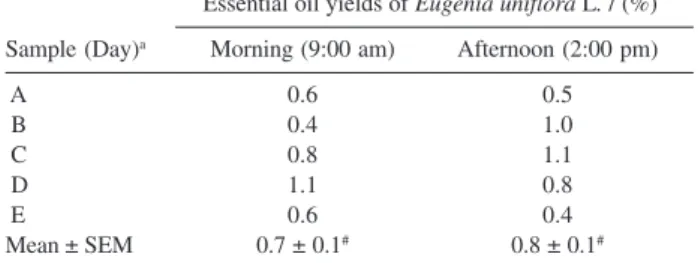
essential oil was obtained by hydrodistillation using a Clevenger apparatus (condenser at 5 °C) for 5 hours. The yield of the essential oils is presented in Table 1. The oils
were dried over anhydrous Na2SO4 and stored under
refrigeration.
After the olfatometric comparative evaluation of the 10 oils obtained at different hours and days, they were joined to proceed GC-O.
Gas Olfatometry and Gas Chromatography-Mass Spectrometry
GC and GC-Olfatometry (GC-O) analyses were performed in an Agilent 5890 gas chromatography (Avondale, PA, USA), using two fused silica HP-20 capillary columns to investigate the influence of chromatographic parameters on aroma evaluation (30 m × 0.25 mm × 0.25 µm and 12 m × 0.2 mm × 0.11 µm, Hewlett-Packard, CA, USA). Flame ionization detector (FID) at 270 °C. Injector port (in splitless mode, 0.5 min) at 250 °C. The temperature programme used for GC-O was from 80 °C to 220 °C at 2 °C min-1 (15 min) using H
2
as carrier gas (1 mL min-1). At the end of the column, the
effluent was split 1:10 (v/v) into the FID and the sniffing port, which was held at 220 °C. The procedures were made in triplicate.
GC-MS analyses were performed in an Agilent 6890 gas chromatograph coupled to an Agilent 5973 mass selective detector (Avondale, PA, USA) with 70 eV for electron impact ionization (280 °C, MS scan range from
m/z 40 to 750). A fused silica capillary column HP-20 (30 m × 0.25 mm × 0.25 µm) was used with He as carrier gas at 1 mL min-1. Injector port at 250 °C (split mode, 1:30);
temperature programme used for GC-MS was from 80 °C to 220 °C at 2 °C min-1 (15 min). Selected ion monitoring
(SIM) was performed at the same conditions of scan analyses. GC-MS were also performed with different injector (split/splitless) temperatures as 160, 180, 200, 220 and 240 °C. Identifications were made by linear
temperature programming retention index,12 library
searches of existing volatile oil constituents database supplemented with those of NIST 98 and Wiley 275, co-injection of standards and commercial essential oils with
Table 1. Yields (%,m/m) of essential oils obtained from Clevenger hydrodistillation of the leaves of E. uniflora in different hours and days
Essential oil yields of Eugenia uniflora L. / (%) Sample (Day)a Morning (9:00 am) Afternoon (2:00 pm)
A 0.6 0.5
B 0.4 1.0
C 0.8 1.1
D 1.1 0.8
E 0.6 0.4
Mean ± SEM 0.7 ± 0.1# 0.8 ± 0.1#
well reported chemical composition in literature (myrrh, sage and marigold).
Sensory evaluation
The essential oils of pitanga (10 samples) were evaluated by a sensory panel (5 panelists) trained in descriptive and comparative analyses of essential oils.13-16
The descriptors used for flavor assessment were herbaceous, woody, green, sweet, spicy, floral, tea and fresh. To get acquainted with the method, the panel members were first trained on GC-O by assessing woody and spicy notes. Sniffing was divided into two parts which lasted 10 min each. Each person evaluated both parts, in two distinct sessions. The panelists were asked to assign odor properties to each detected odorant. Detection of an odor at the sniffing port by fewer than three of the five assessors was considered as noise.
To trap the volatiles, 1 m of a fused silica capillary column DB-5 (25 m × 0.20 mm × 0.33 µm, J&W) was cut, connected to the sniffing port and immersed in a CO2/ acetone trap. After four runs, the piece of column was washed with 0.1 mL of CH2Cl2 into a vial.
Aroma extract dilution analysis
The oil was serially diluted 1:1 with dichloromethane spectroscopy grade from an initial solution of 9 mg mL-1.
The flavor dilution factors FD= 2n-1 (where n is the number
of dilution (factor 2) until no odor of the odorants was perceived) were determined at the sniffing port.
Each dilution was analysed by GC-O (1 µL injected) in triplicate until no further odors were detected. The determinations were performed by a panel of five panelists trained in describing odorants related to essential oils.
Statistical analysis
Results are expressed as mean ± SEM (standard error of the mean) of “n” samples of extracted oil. The data were statistically analyzed by the Student’s t test and One-way ANOVA (Post test: Newman-Keuls Multiple Comparison test) for a significance level of *p<0.05, using GraphPad Prism software (Version 3.00; 1999).
Results and Discussion
Fresh leaves of E. uniflora L. were collected for 5 consecutive days at 9:00 am and 2:00 pm and immediately extracted in a Clevenger apparatus. The yields obtained for the essential oils are illustrated in Table 1. Temperature,
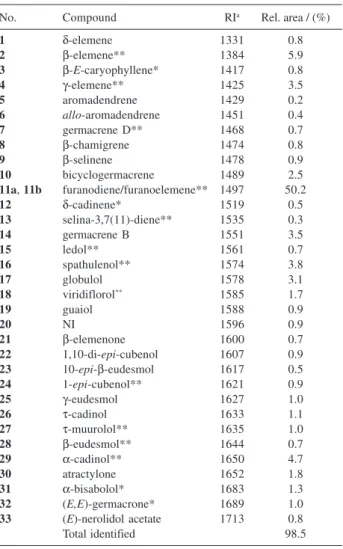
humidity and pluviometric index were accompanied and showed stable in the period. To evaluate the difference in the oil yield (%) obtained from leaves harvested at different times, a statistical analysis applying the Student t test was performed. No significant statistical difference was observed in the yield of the essential oils collected in the morning or in the afternoon (Table 1). Due to this result, analysis of variance of the oil yields between days, considering two extraction data per day, was done. Again no statistical significant difference was observed (F = 1.919; P = 0.2457; df = 9). The oil yields showed a variation of 0.4 to 1.1% in different days, with a mean value of 0.7 ± 0.1% (mean ± SEM) and a coefficient of variation of 29.5%. The sample D (fourth day) presented the major yield during the week (0.9%). Comparative olfatometric evaluation also showed a very good similarity between the oils obtained in different hours and days. So, they were joined to perform GC-O and quantification. In this resultant oil, sesquiterpenoids topped the composition, as can be seen in Table 2. The sesquiterpenoid furanodiene (11a), together with its rearrangement thermal product, furanoelemene (11b) (also known as isofuranogermacrene, isogermafurene or curzerene, Figure 2) were present in 50.2%. Furanosesquiterpenoids can undergo [3,3]-sigmatropic rearrangements (as Cope rearrangement) in the injector port and sometimes are very difficult to be resolved by capillary GC.8In attempt to infer
the aroma contribution to each isomer, E. uniflora essential oil was analyzed by GC-O in mild conditions (low injector temperatures accompanied by a short and thin film column). In all cases, only one peak with a typical fragmentation pattern of furanodiene/furanoelemene and a weak distension of baseline was observed suggesting the co-elution of the furanosesquiterpenoid isomers as previously observed.9 Thus,
no single aroma evaluation could be performed. β-elemene (2) and α-cadinol (29) were also found as major compounds (5.9% and 4.7%, respectively). Other oxygenated monohydroxy and oxosesquiterpenoids were suggested by mass spectrometry analyses associated to standards and certified essential oils co-injection. The compound selina-1,3,7(11)-trien-8-one, pointed by Weyerstahl as one of the most important compound in the aroma of E. uniflora8 was
not observed, even after co-injection of an authentic sample and single ion monitoring (SIM) GC-MS analyses. Equally, the compound oxidoselina-1,3,7(11)-trien-8-one was not detected in this leaf essential oil.
(30, 1.8%, FD 2, green, floral), (E E)-germacrone (32, 1.0%, FD 256, woody and perfume like note resembling pitanga’s leaf) and also furanodiene and furanoelemene
(11a and 11b, together 50.2%, FD 1024), the most
intense aroma-active compound due to its higher flavor-dilution factor. The literature olfatory descriptions for furanodiene are spicy, woody, mushroom-like and for
furanoelemene green, woody and geranium.8 In the
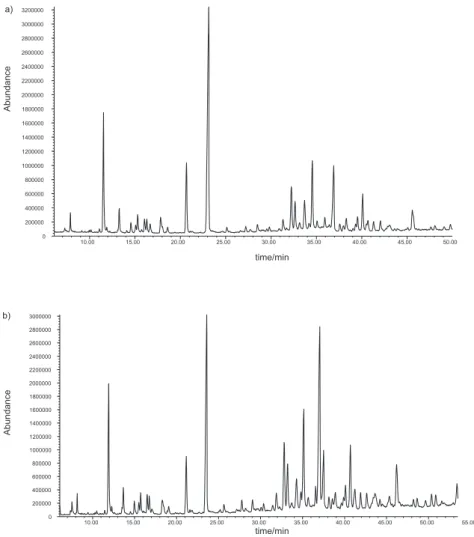
present study, the co-elution of these compounds gave a spicy and woody aroma which resembles pitanga. A comparison of the total ion chromatograms (TIC) obtained by GC-MS and the corresponding FD factors (obtained by AEDA) of the odor-contributing compounds are summarized in Figure 1.
To confirm the hypothesis that the most active compounds suggested by AEDA were more representative for the aroma of pitanga leaf, furanodiene/ furanoelemene
(11a, 11b), β-elemene (2) and (E,E)-germacrone (32) were collected by adapting a piece of phased capillary column to the sniffing-port immersed in a CO2 cold trap. After four runs, the three impact aroma substances were trapped and then washed with CH2Cl2 to a vial. After GC-MS, this solution was evaluated by the panelists who confirmed a very good aroma similarity with the crude essential oil of pitanga. Co-injection of an authentic commercial
Table 2. Chemical composition of Eugenia uniflora leaf essential oil by hydrodistillation using Clevenger apparatus
No. Compound RIa Rel. area / (%)
1 δ-elemene 1331 0.8
2 β-elemene** 1384 5.9
3 β-E-caryophyllene* 1417 0.8
4 γ-elemene** 1425 3.5
5 aromadendrene 1429 0.2
6 allo-aromadendrene 1451 0.4
7 germacrene D** 1468 0.7
8 β-chamigrene 1474 0.8
9 β-selinene 1478 0.9
10 bicyclogermacrene 1489 2.5
11a, 11b furanodiene/furanoelemene** 1497 50.2
12 δ-cadinene* 1519 0.5
13 selina-3,7(11)-diene** 1535 0.3
14 germacrene B 1551 3.5
15 ledol** 1561 0.7
16 spathulenol** 1574 3.8
17 globulol 1578 3.1
18 viridiflorol** 1585 1.7
19 guaiol 1588 0.9
20 NI 1596 0.9
21 β-elemenone 1600 0.7
22 1,10-di-epi-cubenol 1607 0.9
23 10-epi-β-eudesmol 1617 0.5
24 1-epi-cubenol** 1621 0.9
25 γ-eudesmol 1627 1.0
26 τ-cadinol 1633 1.1
27 τ-muurolol** 1635 1.0
28 β-eudesmol** 1644 0.7
29 α-cadinol** 1650 4.7
30 atractylone 1652 1.8
31 α-bisabolol* 1683 1.3
32 (E,E)-germacrone* 1689 1.0
33 (E)-nerolidol acetate 1713 0.8
Total identified 98.5
aLinear retention indices were determined using n-hydrocarbons C 9 – C22 as external references;12 NI: not identified; *co-injection with standards; **co-injection with myrrh, sage and marigold commercial essential oils.18-20
Figure 2. Sesquiterpenes correlated to the aroma of the essential oil of E.
uniflora leaves and major constituents.
Figure 1. (a) GC-MS of the essential oil obtained from Clevenger hydrodistillation of the leaves of E. uniflora; (b) aromagram of the essen-tial oil obtained from Clevenger hydrodistillation of the leaves of E.
sample of (E,E)-germacrone (Fluka, 99% purity by GC) and also with a commercial myrrh essential oil (Commiphora myrrha, Burseraceae), which major compounds were furanodiene/ furanoelemene,17 followed
by individual sensory evaluation and GC-O, led to ascertain that these compounds impart the most representative and characteristic odor of the essential oil investigated in this study.
Acknowledgments
The authors would like to thank Prof. A. Greene from the Université Joseph Fourier de Grenoble Chimie Recherche, Grenoble, France, for the kind provision of selina-1,3,7(11)-trien-8-one, Dr. Margaret Essenberg, (Biochemistry and Molecular Biology Department, Oklahoma State University) for δ-cadinene, International Flavors and Fragrances – IFF for providing the other standards (Table 2) and also Fundação José Bonifácio (FUJB), Fundação de Amparo à Pesquisa do Estado do Rio de Janeiro (FAPERJ), CNPq 520469/96-8 and CAPES for finantial support and fellowships.
Supplementary Information
Supplementary data are available free of charge at http://jbcs.sbq.org.br, as PDF file.
References
1. Silva, S.; Frutas-Brasil, Empresa das Artes: São Paulo, 1991. 2. Adebajo, A. C.; Oloke, K. J.; Adesanmi, A. J.; Fitoterapia 1989,
60, 451; Consolini, A. E.; Baldini, O. A. N.; Amat, A. G.; J.
Ethnopharmacol. 1999, 66, 33; Schapoval, E. E.; Silveira, S.
M.; Miranda, M. L.; Alice, C. B.; Henriques, A. T.; J.
Ethnopharmacol. 1994, 44, 137.
3. http://www.fruticultura.iciag.ufu.br/pitangueira.html, accessed in February, 2006.
4. Vieira Neto, R. D.; Frutíferas Potenciais para Tabuleiros
Costeiros e Baixadas Litorâneas; Embrapa Tabuleiro Costeiros:
Embrapa de Desenvolvimento Agropecuário de Sergipe: Aracaju, 2002.
5. Rucker, G.; Assis Brasil, E. S.; Bauer, L.; Schikarski, M.; Planta Med. 1977, 31, 322.
6. Maia, J. G. S.; Andrade, M. H. L.; Da Silva, M. H. L.; Zoghbi, M. G. B.; J. Essent. Oil Res. 1999, 11, 727.
7. Morais, S. M.; Craveiro, A. A.; Machado, M. I.; Alencar, J. W.; Matos, F. J.; J. Essent. Oil Res. 1996, 8, 449.
8. Weyerstahl, P.; Marschall, H.; Christiansen, C.; Oguntimein, B. O.; Adeoye, A. O.; Planta Med. 1988, 6, 546.
9. Baldovini, N.; Tomi, F.; Casanova, J.; Phytochem. Anal.2001,
12, 58.
10. Kubickova, J.; Grosch, W.; Int. Dairy J. 1997, 7, 65 11. Rezende, C. M.; Fraga, S. R. G.; J. Braz. Chem. Soc. 2003, 14,
425.
12. Adams, R. P.; Identifications of Essential Oils by Ion Trap Mass
Spectrometry, Academic Press: New York, 1995.
13. Mosciano, G.; Perfum. Flavor 2003, 28, 82.
14. Muñoz, A. M.; Civille, G. V.; The Spectrum Descriptive Analysis Methodology Manual on Descriptive Analysis Testing for
Sensory Evaluation, ASTM: MNL13, ASTM: Philadelphia, PA,
1992.
15. Rowe, D.; Perfum. Flavor 2000, 25, 1. 16. Rowe, D.; Perfum. Flavor 2002, 27, 24.
17. Maradufu, A., Warthen, J. D.; Plant Sci. 1988, 57, 181. 18. Brieskorn, C. H.; Noble, P.; Planta Med. 1982, 44, 87. 19. Chalchat, J. C.; Garry, R. P.; Michet, A.; Flavour Fragr. J. 1991,
6, 189.
20. Pitarokili, D.; Couladis, M.; Petsikos-Panayotarou, N.; Tzakou,
O.; J. Agric. Food Chem.2002, 50, 6688.
Printed in Brazil - ©2007 Sociedade Brasileira de Química 0103 - 5053 $6.00+0.00
Supplementary Information
*e-mail: [email protected]
Identification of Impact Aroma Compounds in
Eugenia uniflora
L. (Brazilian Pitanga)
Leaf Essential Oil
Rosineia M. Melo, Vivian F. S. Corrêa, Ana Carolina L. Amorim, Ana Luisa P. Miranda and Claudia M. Rezende*
Instituto de Química, Universidade Federal do Rio de Janeiro, Centro de Tecnologia, Bloco A, 21945-970 Rio de Janeiro-RJ, Brazil
Figure S4. Chiral GCMS in Cyclodex B capillary column (30m × 0.25mm × 0.25 µm) of (-)-δ-cadinene (Davis, G.D.; Essenberg, M.; Phytochemistry
1995, 39, 553).