New Analyses of Double-Bang Events in the Atmosphere
C´elio A. Moura∗ and Marcelo M. Guzzo† Instituto de F´ısica Gleb Wataghin - UNICAMP Cx.P.6165 13083-970 Campinas, SP Brazil
Received on 23 November, 2007
We use CORSIKA+Herwig simulation code to produce ultra-high energy neutrino interactions in the at-mosphere. Our aim is to reproduce extensive air showers originated by extragalactic tau-neutrinos. For charged current tau-neutrino interactions in the atmosphere, beside the air shower originated from the neutrino interac-tion, it is expected that a tau is created and may decay before reaching the ground. That phenomenon makes possible the generation of two related extensive air showers, the so called Double-Bang event. We make an analysis of the main characteristics of Double-Bang events in the atmosphere for mean values of the parameters involved in such phenomenon, like the inelasticity and tau decay length. We discuss what may happen for the “out of the average” cases and conclude that it may be possible to observe this kind of event in ultra-high energy cosmic ray observatories such as Pierre Auger or Telescope Array.
Keywords: Neutrinos; Astroparticles; Ultra-high energy; Atmosphere; Fluorescence detector
I. INTRODUCTION
It is believed that neutrinos with energies of the order of 1018 eV (1 EeV) arrive at the Earth from extragalactic sources and may interact with the nuclei in the atmosphere generating cascades of particles called Extensive Air Showers (EASs) [1, 2]. There are several techniques to measure EASs, but for energies above 1 EeV basically two of them are being used: one is to detect the particles when they reach the ground through water tanks equipped with photomultipliers [3–5]. The photomultipliers are used to detect the Cherenkov light emitted by the ultra relativistic particles when they cross the water inside the tanks. By spreading the Cherenkov tanks in a big and plane area it is possible to determine the distribu-tion of particles when the EAS reach the ground and with this information to determine the direction and energy of the inci-dent particle that generated the event. The other technique is to observe the scintillation light of the atoms which are excited during the developing process of the EAS [4–6]. The atoms emit detectable visible and ultraviolet light when they return to their ground states. The detectors used in this method are called Fluorescence Detectors (FDs) because of the similarity of the scintillation with the fluorescence light. This technique of detection can be used to measure the profile of the EAS when it develops through the atmosphere.
To distinguish which particle have generated an EAS is not an easy task, but we can take advantage of the differ-ent depth of the atmosphere depending on the zenith angle. While for vertical angles the atmospheric depth is approxi-mately 1000 g/cm2, for horizontal angles it is approximately 36000 g/cm2. Ordinary cosmic rays like protons, electrons, photons, helium nucleus or heavier nuclei, interact in the top of the atmosphere and when they come from almost
horizon-∗[email protected] ; Also at Departamento de F´ısica, Centro de In-vestigaci´on y de Estudios Avanzados del IPN. Apdo. Postal 14-740 07000 M´exico DF, Mexico.
†Electronic address:[email protected]
tal angles the EAS generated arrives at the detector basically only with the muonic component, because the hadronic com-ponent is extinguished and the electromagnetic one is almost completely absorbed by the atmosphere [7, 8]. Neutrinos, on the other hand, because of their very low cross section, are the only particles beside the muons that can go deep in the at-mosphere before interacting. In this way it is possible that neutrinos coming from very near horizontal angles interact close to the detector.
The case of tau-neutrinos is even more special. Because it is not expected that tau-neutrinos are created in extragalactic sources, i.e., tau-neutrinos are due to neutrino oscillation dur-ing the propagation from the source to the detector [9, 10], and, what is the subject of this paper, because when the tau-neutrino interacts via charged current (CC) in the atmosphere it creates an EAS which contains a tau. For energies of the order of 1 EeV, the tau decays in a distance comparable to the size of the EAS and almost all of the times it generates an-other EAS that may also be detectable. This kind of unique signature, with two EASs coming from the same direction in a time interval of the order of the tau mean lifetime, is named Double-Bang event.
that relate the fluxes of UHE neutrinos and cosmic rays can be tested, as well as UHE neutrino oscillations.
We present simulations of Double-Bang events generated in the atmosphere by tau-neutrinos with energies of 0.5 EeV, 1.5 EeV and 5 EeV. The inelasticity for the simulated events is approximately 0.2, 0.73, and 0.92 for each energy respec-tively, the tau decay length is of 20 km and the energy fraction from the tau that goes into the second EAS is of 2/3. We also discuss cases with different energies, decay lengths, inelastic-ities, and second EAS’s energy. Because for ultra-high ener-gies the neutrino cross section, inelasticity, and flux are still uncertain, and because in our analysis we do not use any spe-cific detector characteristic, we do not calculate the Double-Bang event rate for neutrinos interacting in the atmosphere. The characteristics we observe from the simulations confirm that Double-Bang events can develop in the atmosphere and FDs of experiments like Pierre Auger [17], HiRes and Tele-scope Array [18] may detect them depending on the neutrino flux and cross section, as it was pointed out in [19].
II. ULTRA-HIGH ENERGY NEUTRINO INDUCED
EVENTS
Consider a neutrino arriving at the Earth and interacting via CC with a nucleon in the atmosphere generating a charged lepton and other fragments:
νl+N→l+X, (1)
wherelis the lepton flavor (e,µ,τ). For a neutral current (NC) interaction another neutrino is created rather then a charged lepton.
After the CC interaction, the neutrino energy is divided be-tween the charged lepton and the other fragments that generate the EAS in the following way:
Eν=E1+El, (2)
whereEνis the incident neutrino energy,E1is the energy de-posited in the fragments that generate the EAS andEl is the charged lepton energy.
Because the energy distribution varies for each interaction, it is interesting to define the inelasticity, that is the fraction of the neutrino energy that goes to the EAS and not to the charged lepton. The inelasticity is:
y= (Eν−El)/Eν. (3) Combining Eqs. (2) and (3) we have:
E1=yEν, (4)
and finally from Eqs. (2) and (4) we find the neutrino energy fraction transfered to the charged lepton:
El= (1−y)Eν. (5) When a muon-neutrino interacts via CC, it creates an EAS with the same characteristics of the ones produced via NC in-teractions for any neutrino flavor. It is because similarly to the neutrinos created after the NC interactions, the muon created after a CC muon-neutrino interaction almost does not interact with the atmosphere [20] and for the energies considered, the muon decay length is much longer than its interaction length. Electron and tau-neutrino CC interactions are completely different. The electron, created after the electron-neutrino in-teraction, interacts immediately generating a cascade of elec-tromagnetic particles beside the hadronic component gener-ated by the other fragments cregener-ated in the first interaction. The tau created after the tau-neutrino interaction propagates in a very similar way to the muon, but its mean lifetime is much shorter. For the energies considered the decay length of the tau is of the order of few tens of km in the laboratory frame, comparable to the length of the hadronic EAS created. When the tau decays, it may generate a second hadronic shower and both showers together generate a sign characteristic of tau-neutrino interactions only.
III. TAU-NEUTRINOS INTERACTING IN THE
ATMOSPHERE
Many articles have been published analyzing the potential of the Pierre Auger Observatory to detect and investigate neu-trinos [21, 22] and specially Earth Skimming events. In ref-erence [14] down-going tau-neutrino events are also investi-gated. According to the estimated neutrino flux coming from Active Galactic Nuclei [23, 24], Gamma Ray Bursts [25], Topological Defects [24, 26], and Cosmogenic Neutrinos [27, 28] as well as to the neutrino cross section extrapolated to ultra-high energies [29], it is expected a number of tau-neutrino events in Auger approximately of the order of be-tween 0.1 and 1 event per year, with energies around 1 EeV.
Based on the propose of John Learned and Sandip Pakvasa to detect tau-neutrinos with energies of the order of 1 PeV in detectors under water or ice [9], it has been proposed to use FDs to detect tau-neutrinos with energies of the order of 1 EeV interacting in the atmosphere [19, 30]. Here we investigate through simulations the properties of the Double-Bang events in the atmosphere. These properties do not depend on the detector, despite we are concerned with the characteristics as efficiency and field of view for FDs.
After it is created the tau propagates on average, before de-caying in the laboratory frame, a distance given by:
hLi=γcτ, (6)
hLi ≃ Eτ
[EeV]×49 km, (7)
≃ (1−y) Eν
[EeV]×49 km. (8)
In our simulations we consider only the case of hadronic decay, despite we could have considered also the electronic decay (τ→eνeντ), which corresponds to almost 18% of the tau decay branching ratio [31] and produce a electromagnetic shower with, on average, about 1/3 of the tau energy. Only the hadronic branching ratio is responsible for 64% of the tau decays. Based on the hadronic branching ratio of the tau de-cay, that is basically decay to pions, and considering that each decay product carries on average the same amount of energy, we calculate that the energy of the second EAS, originated by the tau decay, is on average:
hE2i ≈ 2
3Eτ, (9)
≈ 2
3(1−y)Eν. (10)
This expression is confirmed by simulations [32].
IV. SIMULATIONS
Due to the low event rate expected for the neutrinos, com-bined with the limitations of the detection and discrimina-tion techniques, there is no measured UHE EAS that could be uniquely associated to a primary neutrino. Monte Carlo simulations are an important tool to study the characteristics of UHE events that may be generated by neutrinos. In general, the EAS longitudinal development depends on the energy and the type of the primary particle, as well as on the interaction depth and the incident angle in the atmosphere. Until this mo-ment, the only way to study in a systematical way the longitu-dinal development of the charged particles in a Double-Bang event is through simulations.
A study of the characteristics of the UHE EASs generated by electron and muon-neutrinos was made in [33] through CORSIKA [34] simulations. CORSIKA versions 6.203 and 6.204 themselves, that we used to do the simulations here, are not able to simulate neutrinos as primary particles, so the neu-trino interaction is made by Herwig [35] and then, the results of this interaction are taken by CORSIKA as the primary par-ticles which give rise to the EAS. In CORSIKA, the hadronic interaction models used were QGSJET [36] for high energies and GHEISHA [37] for low energies (<1011eV). We used a thinning ofεth=10−6, what permits the program to follow all the particles with energies down to 10 GeV. The energy cutoffs were 0.05, 0.05, 0.0001, and 0.0001 GeV for hadrons, muons, electrons and photons respectively. Until the present moment, simulations with tau-neutrino as primary particle and the decay of taus in CORSIKA are not available. Because of that we simulate Double-Bang events through phenomenolog-ical arguments, using muon neutrinos as primary particles and
pions as the generators of the EAS which in principle may come from the tau decay. A more accurate and particular analysis for Auger, e.g., can be done using the method de-scribed in [14], specially for the simulation of tau decays with the software TAUOLA [32] and the light propagation and the hardware detector trigger simulated by means of the Auger software framework called Offline [38]. We want to be more general and to do simulations specific for Auger is beyond the scope of this paper.
Fig. 1 presents the different behavior of an EAS depending on the type of interaction and the inelasticity value. In each of the graphics of the figure we have 50 EASs induced by muon-neutrino with energyE=0.5 EeV and incident angle of 75◦. The dashed lines are the Gaisser-Hillas fit [39] to the average of all the EASs in a graphic. The discussion here can be thought to be naive, but it is very useful to show that the simulation code is producing, on average, what is expected in the framework of the Standard Model.
On the left side of the Fig. 1 one has CC and NC interac-tions happening freely. Also the elasticity value is obtained randomly by Monte Carlo method with CORSIKA. We ob-tained 35 CC interactions (black continuous lines) and 15 NC interactions (blue dotted lines). As it is expected because of the bigger cross section, 70% of the interactions are CC inter-actions.
On the central part we present only CC interactions. There are two showers with bigger number of charged particles than in the simulations presented on the left side, but it may prob-ably be because of statistical fluctuations. On average, for tau and muon-neutrino induced EASs, one expects the same longitudinal profile for both CC and NC interactions. The dif-ference as we have seen, beside the cross section difdif-ference between CC and NC, is that in the case of CC a charged lep-ton is created and for NC it is a neutrino.
The right side of the Fig. 1 has only EAS’s generated via CC interaction and with inelasticityy=0.2±0.05. Because the most part of the energy goes to the charged lepton, the EAS with hadronic nature has low energy. Moreover, because the inelasticity is basically fixed around one value, the max-imum number of charged particles is concentrated around a fixed value too. For that value of inelasticity, the number of charged particles is around 108particles. The Gaisser-Hillas function gives a good approximation with low deviation in this case. We can see that, as expected for these energies [40], for the two previous cases the average value ofyis nearly the same, but with much bigger deviation from the average since the inelasticity is a free parameter chosen randomly by the simulation code.
A. Double-Bangs
1500 2000 2500 3000 0
1e+08 2e+08 3e+08 4e+08 5e+08
Charged Particle’s Number
Neutral Current Charged Current Gaisser-Hillas
1500 2000 2500 3000 Depth (g/cm2)
big y
1500 2000 2500 30000 1e+08 2e+08 3e+08 4e+08 5e+08
y = 0.2 +/- 0.05
FIG. 1: Charged particles as a function of atmospheric depth. Comparison of the kind of interaction of muon-neutrino induced events with energyE=0.5 EeV. In the left side we have interactions randomly induced via Monte Carlo. In the center only CC interactions are present, and in the right side we have CC interactions with inelasticityy=0.2±0.05. Read text for details.
of a tau. To simulate the tau creation and subsequent decay we use pions. One can divide the tau decay in two main modes: 64% for the hadronic modes and 36% for the leptonic modes. Despite the leptonic decay mode may generate a electromag-netic shower 18% of the times as we discuss in Section III, in our simulations we consider only the hadronic modes in which the main decay products are pions. In this way we gen-erate the second shower inputing the pion as primary particle in the same direction of the muon-neutrino, after a distanceL, from Eqs. (7)-(8), corresponding to the tau mean lifetime and with the corresponding energyE2from Eqs. (9)-(10).
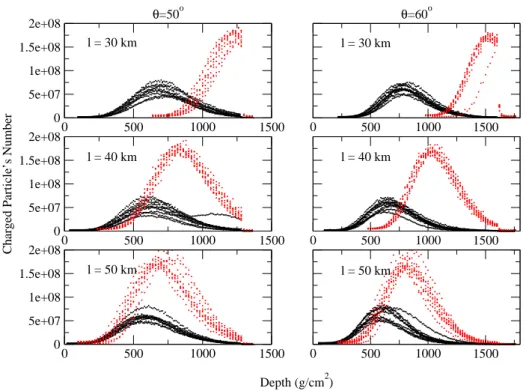
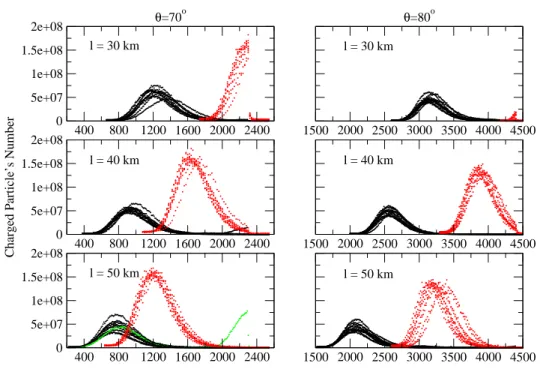
In Figs. 2, 3, and 4 we show events for the tau energy of ap-proximately 0.4 EeV. It means that on average the tau should have run a distance of about 20 km from the neutrino interac-tion point until the tau decay, and considering, from Eq. (9), that 2/3 of the tau energy goes to the decay products, it corre-sponds to a pion energy of 0.27 EeV. Each graphic of the fig-ures contain 10 Double-Bang events, that is to say 10 showers initiated by muon-neutrino and 10 initiated by pion (π−). The distance, in the neutrino propagation axis, from the neutrino interaction point to the ground is represented byl.
In the bottom left of Fig. 3 we have a kind of fake Double-Bang event where the second EAS was not generated by the tau decay, but by some fragment of the first EAS that inter-acted or decayed after traveling a very long distance compar-ing with the mean distance traveled by the taus with 0.4 EeV energy. We checked that this second generated EAS is of elec-tromagnetic characteristic and it was probably generated by a muon decay. It is important to notice that among the 310 simulations initiated by neutrino that we made, in only one it happened to be produced a second shower imitating the
sec-ond bang of a Double-Bang event. It would be a background of less than 0.5% of the total number of events. Adding to that, the fake Double-Bang is out of the average and with an elec-tromagnetic second Bang, what completely distinguish them from the case we are studying with hadronic second Bangs.
To obtain the events generated by 0.5 EeV neutrinos de-picted in Figs. 2 and 3 we use only inelasticity values of y=0.2±0.05. In this way we have, from Eq. (4),E1∼Eν/5, and also from Eq. (10),E2≈2.67E1. Analyzing events com-ing from different angles and interaction depths, we may say which values of theses parameters are more favorable for de-tecting Double-Bang events with energies of about 0.5 EeV and 20% of inelasticity.
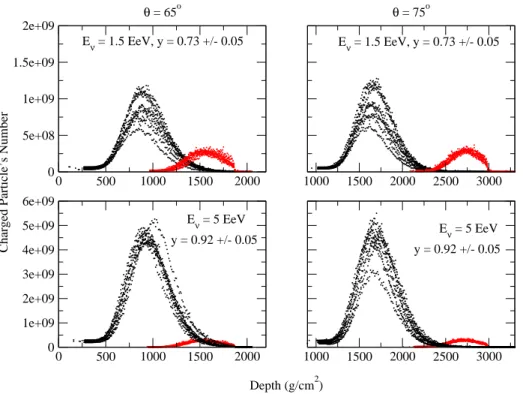
In Fig. 4 we have events with more energy for the primary neutrino. In this case, due to the energy distribution between the first EAS and the charged lepton, we have the first EAS more energetic than the second one. ForEν=1.5 EeV and y=0.73,E1=1.1 EeV≈4E2. If the neutrino energy isEν= 5 EeV andy≈0.92, thanE1=4.6 EeV≈17E2.
0 500 1000 1500 θ=50o
0 5e+07 1e+08 1.5e+08 2e+08
0 500 1000 1500
0 5e+07 1e+08 1.5e+08 2e+08
Charged Particle’s Number
0 500 1000 1500
Depth (g/cm2) 0
5e+07 1e+08 1.5e+08 2e+08
0 500 1000 1500
θ=60o
0 500 1000 1500
0 500 1000 1500
l = 30 km
l = 40 km
l = 50 km
l = 30 km
l = 40 km
l = 50 km
FIG. 2: Double-Bangs generated by tau-neutrinos in the atmosphere. Each graphic contains ten events represented by the number of charged particles as a function of depth with primary neutrino energy of 0.5 EeV. The incident angle is of 50◦in the first column and 60◦in the second one. The interaction distance to the ground isl=30, 40 and 50 km respectively for each line. The first EASs, with less than 108charged particles, are represented in black and the second ones, due to the tau decay with more than the double number of particles, are represented in red.
of particles. These effects may happen due to the different atmospheric density depending on the height. Close to the surface of the Earth, where the density is higher, the particles have more probability of interacting and consequently the lon-gitudinal development of the EAS is faster.
V. DISCUSSION AND SUMMARY
UHE neutrinos probably coming from extragalactic sources may interact in the atmosphere via NC or CC. The mean inelasticity for energies of the order of 1 EeV for neutrino-nucleon interaction ishyi ≈0.2. It means that for NC inter-actions one hadronic EAS is produced on average with ap-proximately 20% of the energy of the primary neutrino while for CC interactions there are three distinct cases for each neu-trino flavor. We analyze the case when a tau-neuneu-trino interacts and a tau is created which decay in a distance comparable to the size of the hadronic EAS generated by the neutrino inter-action. Nearly 64% of the times the tau decay generates a hadronic EAS and 18% of the times an electromagnetic one. Approximately 17% of the times the tau decay in muon and neutrinos that do not generate any cascade.
We simulate tau-neutrino induced events for three
differ-ent energies with y values such that Double-Bang events have optimal characteristics to be observed. In the case of Eν=0.5 EeV the mean inelasticity is compatible with the observation of the events because the average tau energy is hEτi ≃0.4 EeV what corresponds to a mean distance trav-elled before decaying ofhLi ≃20 km. For this specific values of Eν, y, and L the EAS that may be generated by the tau decay develops very close to the EAS created by the neutrino-nucleon interaction, but at the same time both EASs are dis-tinguishable. For the simulated energies ofEν=1.5 EeV and Eν=5 EeV, if we consider just the mean inelasticity value, i.e.,y=0.2, the energy of the tau is such that the tau decay does not happen inside the field of view of a supposed detec-tor because on average it travels too long distance compared to the field of view before decaying. So we simulate events with values ofyabove the average for the tau energy to correspond on average to a travel distance ofL≃20 km.
400 800 1200 1600 2000 2400 θ=70o
0 5e+07 1e+08 1.5e+08 2e+08
400 800 1200 1600 2000 2400 0
5e+07 1e+08 1.5e+08 2e+08
Charged Particle’s Number
400 800 1200 1600 2000 2400
Depth (g/cm2) 0
5e+07 1e+08 1.5e+08 2e+08
1500 2000 2500 3000 3500 4000 4500 θ=80o
1500 2000 2500 3000 3500 4000 4500
1500 2000 2500 3000 3500 4000 4500 l = 30 km
l = 40 km
l = 50 km
l = 30 km
l = 40 km
l = 50 km
FIG. 3: Double-Bangs generated by tau-neutrinos in the atmosphere. Each graphic contains ten events represented by the number of charged particles as a function of depth with neutrino energy of 0.5 EeV. The incident angle is of 70◦in the first column and 80◦in the second one. The interaction distance to the ground isl=30, 40 and 50 km respectively for each line. The first EASs, with less than 108charged particles, are represented in black and the second ones, due to the tau decay with more than the double number of particles, are represented in red. There is a fake Double-Bang event represented in green in the bottom left.
distance between 15 and 30 km after being created as a func-tion of the inelasticity, for the different values of primary neu-trino energy used in the simulations. Despite the mean inelas-ticity for these energies is approximately 0.2, it has a very big dispersion. As can be seen in Fig. 7 of ref. [14], about 10% of the events are expected to be in the range of inelasticity y=0.2±0.05, 45% fory<0.1, and 30% fory>0.3. One sees from Fig. 5 that the simulations we present are for the cases of inelasticity when the probability of the tau decay in the range between 15 and 30 km is larger. Because approximately 70% of the events occur with inelasticity lower than 0.3, among the cases analyzed in this paper, the most probable events are generated by neutrinos with energy ofEν=0.5 EeV.
It is important to notice that theydistribution of the cross section is very dependent on the low-xbehavior of the parton distributions in a region beyond the access of accelerator ex-periments [41], so if thexbehavior is not the expected by the extrapolation of the parameters of the Standard Model, the ydispersion may be different and our conclusions too. The Double-Bang events have the energy of the two EASs directly related to the inelasticity, as can be seen in Eqs. (4)-(5), and the detection os these kind of events can be of great impor-tance to study the behavior ofyat ultra-high energies.
If the Double-Bang event characteristics like inelasticity
and tau decay length follow the average, the energy range of the primary neutrino must be very strict because to observe the two EASs the primary neutrino energy cannot exceed about 1 EeV. But also the efficiency of the detector is an important factor and energies bellow 1 EeV are not optimal for the FDs to observe events. Because the dispersion specially in the in-elasticity and tau decay length, the primary neutrino energy range can be relaxed. The simulations we present give us a sign that the profile of Double-Bang events may be observed by FDs such as those of the Pierre Auger Observatory or Tele-scope Array. We also suggest that ground arrays such as the one of the Telescope Array and the Auger array may be an-other possibility to detect Double-Bangs. Almost horizontal Double-Bangs may develop both EASs inside the arrays. And finally the other possibility could be to use both techniques, for example, observing the first shower with the FD and the second, due to the tau decay, with the ground array.
0 500 1000 1500 2000 0
5e+08 1e+09 1.5e+09 2e+09
θ = 65o
1000 1500 2000 2500 3000
θ = 75o
0 500 1000 1500 2000
Depth (g/cm2) 0
1e+09 2e+09 3e+09 4e+09 5e+09 6e+09
Charged Particle’s Number
1000 1500 2000 2500 3000
Eν = 1.5 EeV, y = 0.73 +/- 0.05 Eν = 1.5 EeV, y = 0.73 +/- 0.05
Eν = 5 EeV
Eν = 5 EeV y = 0.92 +/- 0.05
y = 0.92 +/- 0.05
FIG. 4: Double-Bangs generated by tau-neutrinos in the atmosphere. Each graphic contains ten events represented by the number of charged particles as a function of depth generated 35 km far from the detector. The incident angle is of 65◦in the first column and 75◦in the second one. The neutrino energy is 1.5 EeV for the graphics in the first line and 5 EeV for the ones in the second line. The first EASs, with bigger number of charged particles, are represented in black while the second ones, due to the tau decay, are represented in red.
! !"# !"$ !"% !"& '
(
! !"!) !"' !"') !"# !"#)
*
+,!")+-. +,'")+-. +,)"!+-.
FIG. 5: Probability for the tau decay in a distance between 15 and 30 km after being created as a function of the inelasticity, for differ-ent values of primary neutrino energy.
we learn that considering the inelasticity for the neutrino DIS cross section around 0.2, the primary neutrino energy around 0.5 EeV is optimal to detect Double-Bangs. In this sense, the HEAT extension of the Auger experiment [42] and the TALE extension of the Telescope Array experiment [43] will be of great importance also in the study of Double-Bangs. Both experiments will have bigger efficiency and field of view for events with energies bellow 1 EeV.
Acknowledgments
We thank specially O. Pisanti for her help with the simu-lations and discussions. The work was supported by CNPq, FAPESP and AlBan.
[1] P. Sokolsky, Introduction to Ultrahigh Energy Cosmic Ray Physics(Westview Press, 2004).
[2] T. K. Gaisser, Cosmic rays and particle physics (Cambridge
University Press, UK, 1990).
[4] T. Yamamoto (Pierre Auger), AIP Conf. Proc. 842, 1016 (2006), astro-ph/0601035.
[5] A. Letessier-Selvon (Pierre Auger), AIP Conf. Proc.815, 73 (2006), astro-ph/0510627.
[6] R. Abbasi et al. (High Resolution Fly’s Eye), Astropart. Phys.
25, 93 (2006), astro-ph/0601091.
[7] E. Zas, New J. Phys.7, 130 (2005), astro-ph/0504610. [8] X. Bertou, P. Billoir, O. Deligny, C. Lachaud, and A.
Letessier-Selvon, Astropart. Phys.17, 183 (2002), astro-ph/0104452. [9] J. G. Learned and S. Pakvasa, Astropart. Phys.3, 267 (1995),
hep-ph/9405296.
[10] H. Athar, Chin. J. Phys.42, 1 (2004), hep-ph/0308188. [11] G. Miele, S. Pastor, and O. Pisanti, Phys. Lett. B 634, 137
(2006), astro-ph/0508038.
[12] C. Aramo et al., Astropart. Phys. 23, 65 (2005), astro-ph/0407638.
[13] S. Bottai and S. Giurgola, Astropart. Phys. 18, 539 (2003), astro-ph/0205325.
[14] D. Gora, M. Roth, and A. Tamburro, Astropart. Phys.26, 402 (2007).
[15] J. Abraham et al. (Pierre Auger), Nucl. Instrum. Meth. A523, 50 (2004).
[16] J. Abraham et al. (Pierre Auger), Science 318, 938 (2007), arXiv:0711.2256 [astro-ph].
[17] V. Verzi (Pierre Auger), Nucl. Phys. Proc. Suppl. 165, 37 (2007).
[18] C. C. H. Jui (HiRes and TA), AIP Conf. Proc.867, 183 (2006). [19] M. M. Guzzo and C. A. Moura, Astropart. Phys.25, 277 (2006),
hep-ph/0504270.
[20] W. M. Yao et al. (Particle Data Group ), J. Phys. G33, 267 (2006).
[21] K. S. Capelle, J. W. Cronin, G. Parente, and E. Zas, Astropart. Phys.8, 321 (1998), astro-ph/9801313.
[22] L. Anchordoqui, T. Han, D. Hooper, and S. Sarkar, Astropart. Phys.25, 14 (2006), hep-ph/0508312.
[23] T. K. Gaisser, F. Halzen, and T. Stanev, Phys. Rept.258, 173
(1995), hep-ph/9410384.
[24] R. Gandhi, C. Quigg, M. H. Reno, and I. Sarcevic (1996), hep-ph/9609516.
[25] A. Dar and A. De Rujula, Phys. Rept.405, 203 (2004), astro-ph/0308248.
[26] V. S. Berezinsky and A. Vilenkin, Phys. Rev. D62, 083512 (2000), hep-ph/9908257.
[27] D. Allard et al., JCAP0609, 005 (2006), astro-ph/0605327. [28] R. Engel, D. Seckel, and T. Stanev, Phys. Rev. D64, 093010
(2001), astro-ph/0101216.
[29] E. M. Henley and J. Jalilian-Marian, Phys. Rev. D73, 094004 (2006), hep-ph/0512220.
[30] M. M. Guzzo and C. A. Moura (2003), hep-ph/0312119. [31] W. M. Yao et al. (Particle Data Group), J. Phys. G33, 33 (2006). [32] S. Jadach, Z. Was, R. Decker, and J. H. Kuhn, Comput. Phys.
Commun.76, 361 (1993).
[33] M. Ambrosio et al. (2003), astro-ph/0302602.
[34] D. Heck, G. Schatz, T. Thouw, J. Knapp, and J. N. Capdevielle (1998), fZKA-6019.
[35] G. Corcella et al., JHEP01, 010 (2001), hep-ph/0011363. [36] S. Ostapchenko, Phys. Rev. D 74, 014026 (2006),
hep-ph/0505259.
[37] H. Fesefeldt (1985), pITHA-85-02.
[38] S. Argiro et al. (Pierre Auger) (2005), presented at 29th Inter-national Cosmic Ray Conference, Pune, India, 3-11 Aug. [39] T. K. Gaisser (1977), rapporteur Lecture presented at 15th Int.
Cosmic Ray Conf., Plovdiv, Bulgaria, Aug 13-26. [40] J. Pumplin et al., JHEP07, 012 (2002), hep-ph/0201195. [41] J. A. Castro Pena, G. Parente, and E. Zas, Phys. Lett. B500,
125 (2001), hep-ph/0011043.
[42] H. O. Klages (Pierre Auger) (2007), prepared for 30th Interna-tional Cosmic Ray Conference (ICRC 2007), Merida, Yucatan, Mexico, 3-11 Jul 2007.
[43] URL http://www.telescopearray.org/papers/