Article
J. Braz. Chem. Soc., Vol. 24, No. 10, 1592-1598, 2013. Printed in Brazil - ©2013 Sociedade Brasileira de Química 0103 - 5053 $6.00+0.00
A
*e-mail: [email protected]
Removal of BTX Compounds in Air by Total Catalytic Oxidation Promoted by
Catalysts Based on SiO
2(1-x)Cu
xRosana Balzer,*, a Valderez Drago,b Wido H. Schreinerc and Luiz F. D. Probsta
aDepartment of Chemistry and bDepartment of Physics, Federal University of Santa Catarina (UFSC),
88040-900 Florianópolis-SC, Brazil
cDepartment of Physics, Federal University of Paraná (UFPR),81531-970 Curitiba-PR, Brazil
O objetivo deste estudo foi reduzir a emissão de compostos orgânicos como BTX (benzeno, tolueno e xilenos), devido à sua toxicidade e efeitos adversos ao meio ambiente. Neste sentido, os catalisadores (SiO2(1-x)Cux) foram desenvolvidos para apresentar elevada atividade catalítica na
conversão de BTX em CO2 e H2O sem a necessidade do uso de solventes e materiais prejudiciais ao
meio ambiente, com baixo custo de produção e excelente reprodutibilidade. O Cu foi impregnado (2,99; 5,01; 10,01 e 19,97%) em suportes (SiO2) por impregnação úmida a partir de nitrato de
cobre(II). O estudo foi realizado na faixa de temperatura de 50-350 °C. Os catalisadores descritos nesse artigo apresentam elevada atividade catalítica na oxidação total de BTX. A conversão de benzeno neste estudo excedeu 85% a 150 ºC.
The aim of this study was to reduce the emissions of organic compounds, such as BTX (benzene, toluene and xylenes), due to their toxicity and adverse effects on the environment. In this regard, catalysts (SiO2(1-x)Cux) were developed which exhibit high catalytic activity for converting BTX
compounds to CO2 and H2O, and which do not require the use of solvents and materials detrimental
to the environment, with low production cost and good reproducibility. Cu (from copper(II) nitrate) was loaded (2.99; 5.01; 10.01 and 19.97 wt.%) onto supports (SiO2) by wet impregnation. The
study was carried out within the temperature range of 50-350 °C. The catalysts described in this paper have high catalytic activity in the total oxidationof BTX. The conversion of benzene in this study exceeded 85% at 150 °C.
Keywords: copper, SiO2, BTX, catalytic oxidation
Introduction
The contamination of atmospheric air, soil and groundwater by volatile organic compounds has been of concern in recent years mainly due to the high levels of petroleum hydrocarbon compounds emitted into
the atmosphere with harmful consequences.1-4 The
potential pollutant gasoline is directly related to aromatic hydrocarbons, namely benzene, toluene and xylenes
(known as BTX compounds or simply BTXs).5,6
Due to the high toxicity of BTX compounds and the resulting adverse effects in contaminated systems, the search for control and remediation procedures is of great importance. Catalytic oxidation has been recognized as an efficient method to reduce air pollution, particularly atmospheric concentrations of volatile organic compounds.
The advantages of catalytic oxidation include the fact that it can operate at relatively low temperatures and no byproducts are formed.7,8
Andreeva et al. reported studies on the effect of Au
and V2O5 on the oxidation of benzene in systems with
Au/V2O5/TiO2 and Au/V2O5/ZrO2. The conversion of
benzene obtained at 250 ºC was 70% for Au/V2O5/ZrO2
and 90% for Au/V2O5/TiO2.4,6,7
Wu et al. reported a study on the effect of the catalysts
Au/ZnO, Au/Al2O3 and Au/MgO on the oxidation of
benzene, toluene and p-xylene and the most efficient was Au/ZnO. At 300 ºC the conversion of benzene slightly exceeded that of toluene (which was around 60%) while the conversion of p-xylene did not reach 35%.9
In this context, the objective of this study was to investigate the capability of the base catalysts SiO2(1-x)Cux
in relation to the total conversion of benzene, toluene and xylenes to CO2 and H2O.
Experimental
Preparation of catalysts
Four supported metal catalysts were prepared using silicon dioxide (SiO2, 70-230 mesh) (Vetec®) as the support.
The precursor salt was copper(II) nitrate (Vetec®), which
was dissolved in distilled water and added to the support. Subsequently, the materials were dried in an oven for 24 hours at 100 °C and then calcined in a muffle furnace with circulating air at a heating rate of 5 °C min-1, starting
at ambient temperature and increasing to 550 °C, this
temperature being held for 4 hours. Samples were then crushed and sieved (to provide particles between 177 and 210 µm). The catalysts were identified as SiO2(1-x)Cux where
x (mol%) is: SiO2(0.97)Cu0.03; SiO2(0.95)Cu0.05; SiO2(0.9)Cu0.1
and SiO2(0.8)Cu0.2.
Characterization of the catalysts
The specific surface areas of the catalysts (SBET) were
determined using a Nova 2200e analyzer (Quantachrome Instruments®). The surface areas were calculated applying
the Brunauer Emmett Teller (BET) method by isothermal gas adsorption/desorption of N2 at 77 K using 40 points.
The crystalline structures of the catalysts were analyzed
by X-ray powder diffraction (Bruker-AXS Siemens®) with
CuKα radiation (V = 40 kV; I = 30 mA). The morphology
and microstructure of the catalysts were observed by scanning electron microscopy (SEM, JEOL JSM-6390LV) and field emission transmission electron microscopy (FETEM, JEOL JEM-1011). The chemical composition
and metal content of the catalysts were analyzed by energy-dispersive X-ray spectroscopy (EDX).The binding energies of the elements were determined by X-ray photoemission spectroscopy (XPS) (VG Microtech 3000).
Catalytic activity tests
The activity of the catalysts was measured in a fixed tubular quartz reactor under atmospheric pressure. The following conditions were chosen: catalyst volume 0.090 cm3, inlet benzene (Vetec®) concentration 2.5 g m−3,
toluene (Vetec®) concentration 0.65 g m−3 and o-xylene
(Vetec®) concentration 0.45 g m−3 in air and temperature
range 50-350 °C. The kinetic data were collected after at least 1 h on-stream at room temperature. The only products
were CO2 and H2O as determined by GC-MS and FTIR.
The reactant and product mixtures were analyzed with an on-line gas chromatograph equipped with a FID detector and an HP-5 column.
The catalytic activity was expressed as the degree of conversion of the BTX compounds. The conversion of BTXs was calculated as follows in equation 1:
(1)
where BTXs (%) = percentage of BTXs converted; [BTXs]in = input BTX concentration; [BTXs]out = output
BTX concentration.
Results and Discussion
Structural and textural properties of the catalysts
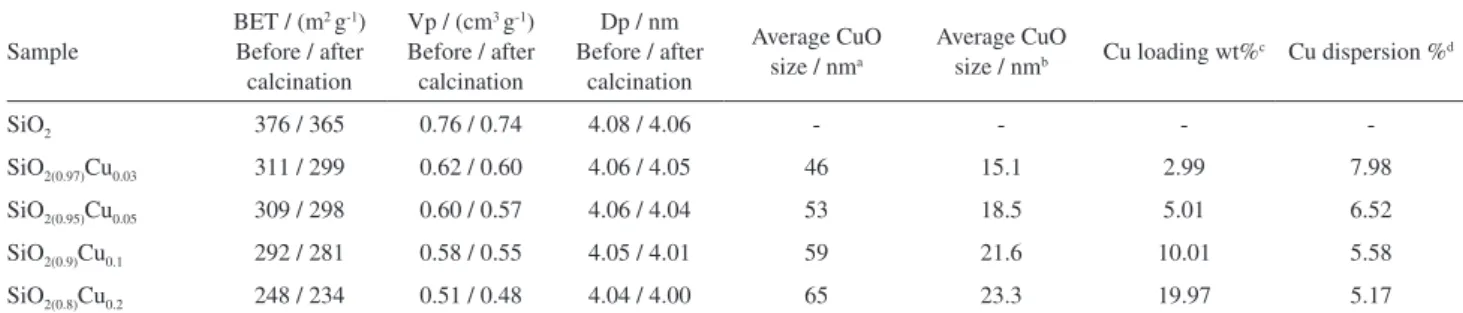
The values for the surface area, pore volume and pore diameter of the catalysts are presented in Table 1.
As expected, there was a reduction in all of these parameters as the metal content increased. This reduction
Table 1. Textural data for the supported copper catalysts
Sample
BET / (m2 g-1)
Before / after calcination
Vp / (cm3 g-1)
Before / after calcination
Dp / nm Before / after
calcination
Average CuO size / nma
Average CuO
size / nmb Cu loading wt%
c Cu dispersion %d
SiO2 376 / 365 0.76 / 0.74 4.08 / 4.06 - - -
-SiO2(0.97)Cu0.03 311 / 299 0.62 / 0.60 4.06 / 4.05 46 15.1 2.99 7.98
SiO2(0.95)Cu0.05 309 / 298 0.60 / 0.57 4.06 / 4.04 53 18.5 5.01 6.52
SiO2(0.9)Cu0.1 292 / 281 0.58 / 0.55 4.05 / 4.01 59 21.6 10.01 5.58
SiO2(0.8)Cu0.2 248 / 234 0.51 / 0.48 4.04 / 4.00 65 23.3 19.97 5.17
Vp = pore volume; Dp = pore diameter; adetermined by XRD; bobtained by HRTEM; ccalculated from semi-quantitative EDX data; dcalculated using
formula (Wu et al. 2011): DCu = 6ns MCu /rCuNA dCu , where ns is the number of Cu atoms at the surface per unit area (1.7 x 10¹⁹ m-2), MCu is the molar mass
of copper (63.546 g mol-1), r
Cu is the density of copper (8.92 g cm-3), NA is Avogadro’s number (6.023 x 10²³ mol-1) and dCu is the average Cu particle size
may be related to the high calcination temperature of 550 ºC (Table 1).
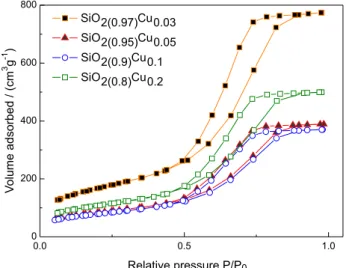
The isotherms obtained were analyzed by comparison with the classification of the IUPAC (International Union of Pure and Applied Chemistry) and it was found that the catalysts have pores of regular cylindrical and/or polyhedral shape with open ends with type IV isotherms and type H1 hysteresis (Figure 1).2
The X-ray diffractograms are shown in Figure 2, in which the diffraction peaks (2θ = 33, 35, 38, 48, 54, 58, 62, 65, 66 e 68º) are assigned to the reflections for the tenorite (CuO) phase, a monoclinic crystal system (JCPDS data file 045-0937). The peak at 2θ = 22º is characteristic of silicon oxide. The peaks are more intense for CuO (11-1) (2θ = 35º) and CuO (111) (2θ = 38º). Therefore, it can be concluded that the large crystal size, good stability and
close contact between the Cu and SiO2 particles favors the
catalytic performance of the Cu/SiO2 catalyst. 10,11
Morphology and chemical composition of catalysts
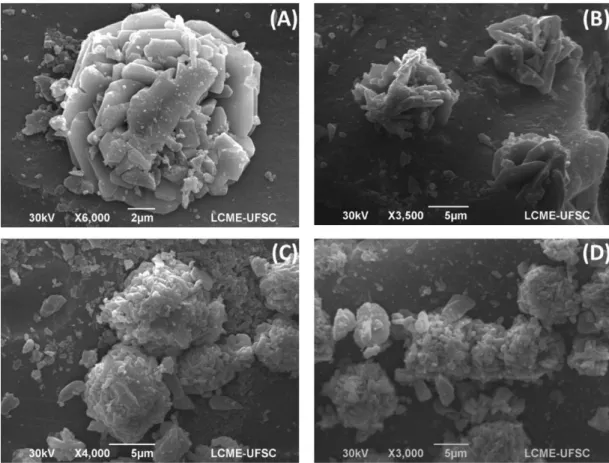
Figure 3A-D shows the morphology of the Cu-SiO2
catalyst particles in the shape of a hemisphere. The EDX analysis confirmed the presence of the element Cu, as shown in Table 1. The higher the copper content the lower the degree of metal dispersion in the catalyst due to the more pronounced formation of agglomerates in catalysts with higher metal content, as observed by SEM.
In Figure 4A-C copper oxide particles with a hemispherical shape and contact between the copper and silicon oxides at the perimeter can be observed. The size of copper-containing particles had a Gaussian distribution as represented in Figure 4D and the particle size distribution for each of the catalysts is shown in Table 1. The result shows a strong interaction between the metal and silicon oxides in the catalyst, where the particles appear to be faceted when adsorbed on the support, which could induce defects or the formation of active sites at which the reaction occurs easily, which favors the catalytic activity of the catalysts Cu/SiO2.
9
Oxidation state and binding energy of the catalysts
The XPS analysis (Figure 5) yielded the values for the bond energy of the electrons O1s (532.4 eV), Si 2p1/22p
(103.3 eV) and Cu 2p3/2 (933.4 eV) before and after the
catalytic reaction. These were used to determine the oxidation state of the elements present and to observe whether changes occurred during the catalytic reaction.12-15
It was observed that the value obtained for the binding
energy of the electron Si 2p1/2 is consistent with that
reported in the literature, suggesting that in these catalysts all of the silicon is present in the form of Si(IV).13,16,17 The
value for the binding energy of Cu 2p3/2 in the catalysts
studied was 933 eV which, on-comparing with results reported in the literature, is attributed to the presence of copper(II) oxide. This value is reported as 933.4 eV in the literature. 12, 1618, 19
Catalyst performance for BTX (benzene, toluene and o-xylene) oxidation
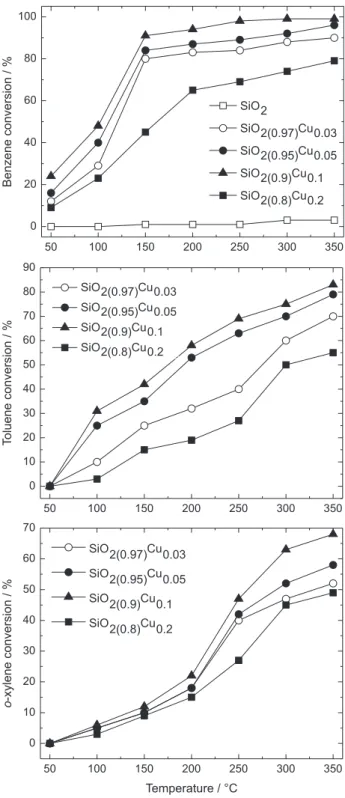
Figure 6 shows the conversion of BTXs as a function of the reaction temperature for the catalysts studied.
The catalyst SiO2(0.9)Cu0.1 showed higher catalytic
activity toward the BTX compounds.The catalytic activity of the catalyst SiO2(0.8)Cu0.2 may be related to the excessive
Figure 1. Nitrogen isotherms of the catalysts SiO2(1-x)Cux.
Figure 3. SEM images of (A) SiO2(0.97)Cu0.03; (B) SiO2(0.95)Cu0.05; (C) SiO2(0.9)Cu0.1 and (D) SiO2(0.8)Cu0.2.
formation of agglomerated particles on the surface, reducing the metal dispersion, according to Table 1. As expected the catalyst SiO2(0.97)Cu0.03 had a lower catalytic activity than the
other catalysts tested, due to its lower metal content.
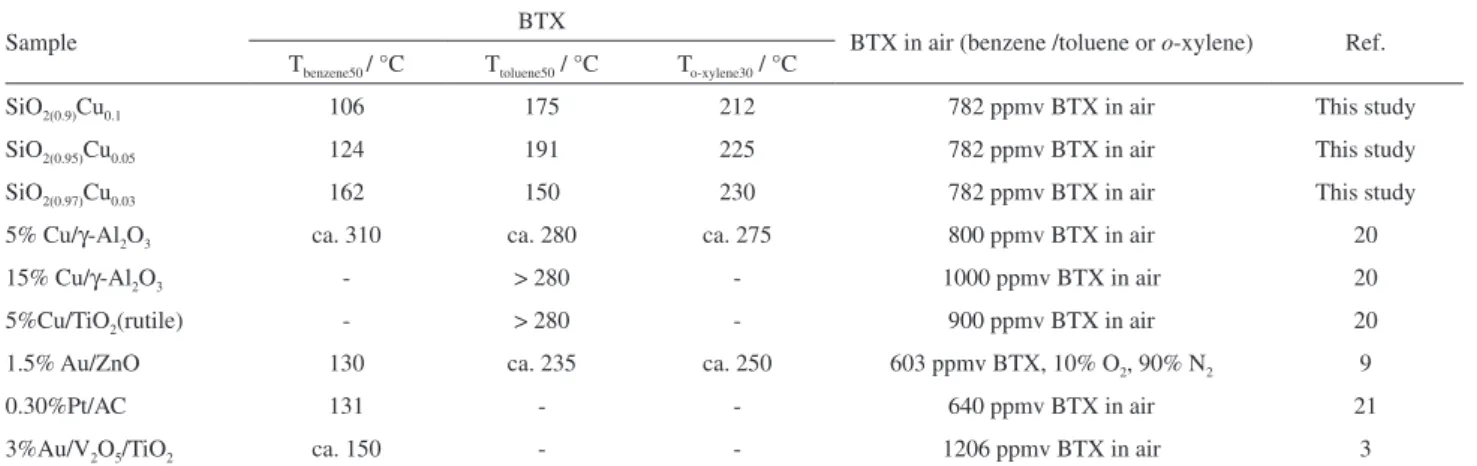
On comparing the catalytic activity of the Cu/SiO2
products with other catalysts described in the literature that are highly active in BTX oxidation (Table 2), it can be seen that the Tbenzene50 temperature (benzene conversion up to
50%) is 106 °C for SiO2(0.9)Cu0.1, 124 °C for SiO2(0.95)Cu0.05
and 162 °C for SiO2(0.97)Cu0.03. These values are comparable
with those reported in literature for the catalyst Cu/γ-Al2O3,
Figure 5. XPS spectra of the catalysts SiO2(1-x)Cux: (A) region Cu 2p3/2; (B) region Si 2p1/22p and (C) region O1s.
Figure 6. BTX conversion as a function of reaction temperature for different catalysts under varying reaction conditions: benzene 2.0 g m3,
Table 2. Comparison of data published in the literature with those obtained in this study
Sample BTX BTX in air (benzene /toluene or o-xylene) Ref.
Tbenzene50 / °C Ttoluene50 / °C To-xylene30 / °C
SiO2(0.9)Cu0.1 106 175 212 782 ppmv BTX in air This study
SiO2(0.95)Cu0.05 124 191 225 782 ppmv BTX in air This study
SiO2(0.97)Cu0.03 162 150 230 782 ppmv BTX in air This study
5% Cu/γ-Al2O3 ca. 310 ca. 280 ca. 275 800 ppmv BTX in air 20
15% Cu/γ-Al2O3 - > 280 - 1000 ppmv BTX in air 20
5%Cu/TiO2(rutile) - > 280 - 900 ppmv BTX in air 20
1.5% Au/ZnO 130 ca. 235 ca. 250 603 ppmv BTX, 10% O2, 90% N2 9
0.30%Pt/AC 131 - - 640 ppmv BTX in air 21
3%Au/V2O5/TiO2 ca. 150 - - 1206 ppmv BTX in air 3
1.5% Au/ZnO, 0.30% Pt/AC and 3% Au/V2O5/TiO2
(Table 2). In fact, the benzene conversion exceeds 80% for the catalyst Cu/SiO2 at 150 °C, and is higher than the
values for the catalysts Cu/γ-Al2O3, 1.5% Au/ZnO and 3%
Au/V2O5/TiO2 (0%, 80% and 63% respectively). Table 2
also shows the values for Ttoluene50 (toluene conversion up to
50%) and To-xylene30 (o-xylene conversion up to 30%). 3,9,20,21
The results of these experiments revealed that the SiO2
support has no activity and reports in the literature for other
catalysts indicate that interaction between Cu and SiO2
could improve the catalytic activity of Cu/SiO2 in relation
to BTX oxidation.9,21
According to the results shown in Figure 6, the
activity of the Cu/SiO2 catalyst decreases in the order
benzene > toluene > o-xylene. The conversion of benzene is higher than those of toluene and o-xylene in the same concentrations and reaction conditions. This indicates that the catalytic activity in relation to aromatic compounds is highly dependent on the relative adsorption strength of the model compounds, the strength of the weakest carbon-hydrogen bond in the structure and the ionization potential of the methyl derivatives.9,11,12
It is well known that the oxidation of BTX compounds promoted by solid oxide catalysts can proceed by the Mars-van Krevelen mechanism, in which the key steps are the supply of oxygen by the reducible oxide, the introduction of the oxygen (originating from the oxide lattice) into the substrate molecule and the re-oxidation of the reduced solid by the oxygen-containing gaseous phase, which is the rate-determining step of the reaction.9,22,23
According to the Mars-van Krevelen mechanism, the BTX oxidation rate is determined by the concentration of BTX chemisorbed onto the Cu-containing particles close to the
periphery of the Cu-SiO2 interface. The active oxygen
species formed on the metal-support interface or on the support close to the metal directly participate in the catalytic
oxidation, and the metal coated on the support serves as the adsorption site for BTXs. The catalytic cycle involves the chemisorption of BTX onto Cu-containing particles, migration of the chemisorbed BTX to the Cu-SiO2 interface,
O2 activation on the defect sites in the SiO2 or at the Cu-SiO2
interface, the formation of active oxygen species and the reaction between the chemisorbed BTX and active oxygen species at the interface.9,20,24,25
Conclusions
The SiO2(0.9)Cu0.1 productexhibits higher activity
compared with other catalysts reported in the literature
(5% and 15% Cu/γ-Al2O3, 5% Cu/TiO2(rutile), 1.5%
Au/ZnO and 3% Au/V2O5/TiO2) with regard to BTX
oxidation. The benzene conversion for the SiO2(0.9)Cu0.1
catalyst exceeded 85% at 150 °C, which is comparable
to the values for 1.5% Au/ZnO and 3% Au/V2O5/TiO2.
The high catalytic activity could be attributed to the high stability observed due to a greater energy of interaction
between the Cu-SiO2 catalysts in this study. Thus, the
catalysts of the base Cu/SiO2 proved to be highly efficient
in the conversion of BTX compounds.
Acknowledgments
The authors acknowledge the support provided by CNPq, LCME-UFSC and INCT.
References
1. Lee, K. Y.; Environ. Pollut. 2008, 154, 320.
2. Aguero, F. N.; Barbero, B. P.; Gambaro, L.; Cadus, L. E.; Appl. Catal., B 2009, 91, 108.
4. Andreeva, D.; Tabakova, T.; Idakiev, V.; Naydenov, A.; Gold Bull. 1998, 31, 105.
5. Farhadian, M.; Duchez, D.; Vachelard, C.; Larroche, C.; Water Res. 2008, 42, 1325.
6. Idakiev, V.; Ilieva, L.; Andreeva, D.; Blin, J. L.; Gigot, L.; Su, B. L.; Appl. Catal., A 2003, 243, 25.
7. Andreeva, D.; Tabakova, T.; Ilieva, L.; Naydenov, A.; Mehanjiev, D.; Abrashev, M. V.; Appl. Catal., A 2001, 209, 291. 8. Anic, M.; Radic, N.; Grbic, B.; Dondur, V.; Damjanovic, L.;
Stoychev, D.; Stefanov, P.; Appl. Catal., B 2011, 107, 327. 9. Wu, H. J.; Wang, L. D.; Zhang, J. Q.; Shen, Z. Y.; Zhao, J. H.;
Catal. Commun. 2011, 12, 859.
10. Badiger, D. S.; Hunoor, R. S.; Patil, B. R.; Vadavi, R. S.; Mangannavar, C. V.; Muchchandi, I. S.; Patil, Y. P.; Nethaji, M.; Gudasi, K. B.; Inorg. Chim. Acta 2012, 384, 197.
11. Naskar, S.; Naskar, S.; Mayer-Figge, H.; Sheldrick, W. S.; Corbella, M.; Tercero, J.; Chattopadhyay, S. K.; Polyhedron
2012, 35, 77.
12. Wang, Q. G.; Madix, R. J.; Surf. Sci. 2001, 474, L213. 13. Bond, G. C.; Tahir, S. F.; Appl. Catal. 1991, 71, 1.
14. Sinquin, G.; Petit, C.; Hindermann, J. P.; Kiennemann, A.; Catal. Today 2001, 70, 183.
15. Roberts, M. W.; Chem. Soc. Rev. 1989, 18, 451.
16. Biesinger, M. C.; Lau, L. W. M.; Gerson, A. R.; Smart, R. S. C.;
Appl. Surf. Sci. 2010, 257, 887.
17. Zhou, J. H.; Sui, Z. J.; Zhu, J.; Li, P.; De, C.; Dai, Y. C.; Yuan, W. K.; Carbon 2007, 45, 785.
18. Watts, J. F.; Castle, J. E.; Surf. Interface Anal. 2003, 35, 333. 19. Biesinger, M. C.; Hart, B. R.; Polack, R.; Kobe, B. A.; Smart,
R. S. C.; Miner. Eng. 2007, 20, 152. 20. Kim, S. C.; J. Hazard. Mater. 2002, 91, 285.
21. Wu, J. C. S.; Lin, Z. A.; Tsai, F. M.; Pan, J. W.; Catal. Today
2000, 63, 419.
22. Putna, E. S.; Bunluesin, T.; Fan, X. L.; Gorte, R. J.; Vohs, J. M.; Lakis, R. E.; Egami, T.; Catal. Today 1999, 50, 343.
23. Radic, N.; Grbic, B.; Terlecki-Baricevic, A.; Appl. Catal., B
2004, 50, 153.
24. Jia, A. P.; Jiang, S. Y.; Lu, J. Q.; Luo, M. F.; J. Phys. Chem. C
2010, 114, 21605.
25. Kim, S. C.; Shim, W. G.; Appl. Catal., B 2010, 98, 180.
Submitted: April 5, 2013