603
Revista da Sociedade Brasileira de Medicina Tropical 48(5):603-606, Sep-Oct, 2015
http://dx.doi.org/10.1590/0037-8682-0058-2015
Short Communication
Corresponding author: Dr. Afonso Dinis Costa Passos. Depto. de Medicina Social/FMRP/USP. Avenida Bandeirantes 3900, 14049-900 Ribeirão Preto, São Paulo, Brasil.
Phone: 55 16 3602-2433 e-mail: [email protected] Received 2 March 2015 Accepted 11 May 2015
Hepatitis B and C in a Brazilian deaf community
Bianca Messenberg Pacher
[1], Marina Ribeiro Barreto da Costa
[1],
Margarida Maria Passeri do Nascimento
[1], Maria Cecilia de Moura
[2]and Afonso Dinis Costa Passos
[1][1]. Departamento de Medicina Social, Faculdade de Medicina de Ribeirão Preto, Universidade de São Paulo, Ribeirão Preto, São Paulo, Brazil. [2]. Pontifícia Universidade Católica de São Paulo, São Paulo, Brazil.
ABSTRACT
Introduction: Although deaf people are exposed to hepatitis B and C risk factors, epidemiological studies regarding these
diseases in deaf people are lacking. Methods: Afterwatching an explanatory digital versatile disc (DVD) in Brazilian Sign Language, 88 deaf people were interviewed and tested for hepatitis B surface antigen (HBsAg), hepatitis B surface antibody (anti-HBs), hepatitis B core antibody (anti-HBc), and hepatitis C virus antibody (anti-HCV). Results: The prevalence of hepatitis B markers was 8%; they were associated with incarceration and being born outside the State of São Paulo. No cases of hepatitis
C were identifi ed. Conclusions: Participants showed a substantial lack of knowledge regarding viral hepatitis, indicating a need
for public policies that consider linguistic and cultural profi les.
Keywords: Epidemiology. Hepatitis B and C. Deafness.
The World Health Organization estimates that approximately 360 million people worldwide have hearing disorders(1). Because of barriers to communication, hearing impairment contributes to an individual’s marginalization in daily life, by limiting socialization as well as access to good education, health information, and health services(2).
This marginalization is also evident in the lack of scientifi c
research involving deaf people. However, studies regarding acquired immunodeficiency syndrome (AIDS) and its risk
factors among deaf individuals show serious defi ciencies in their understanding of human immunodefi ciency virus (HIV)
transmission and preventive care. Considering the similar routes of transmission for HIV and hepatitis, it is likely that understanding of viral hepatitis is also lacking; however, there are surprisingly few studies regarding this topic in the major medical databases, in which deafness is usually considered as a disease complication or medication side effect(3) (4). Thus, there are no epidemiological studies addressing the distribution of and risk factors for hepatitis B and C among the deaf, which is a major obstacle to establishing preventive measures tailored to this group. We conducted a cross-sectional study involving adult deaf attendees of the Deaf Association of Ribeirão Preto (DARP). Participants were shown a digital versatile disc (DVD) with
material about viral hepatitis B and C presented in Brazilian Sign Language [Língua Brasileira de Sinais (LIBRAS)]. The
DVD was created specifi cally for this study and included two
professionals acting simultaneously; one half of the screen showed a medical doctor orally explaining the two diseases, while the other half showed the LIBRAS teacher translating the material into sign language. The validity of the DVD was assessed by a member of the deaf community, who was also a
certifi ed teacher of LIBRAS.
Individuals who agreed to participate signed an informed consent form, after which they were asked to complete a questionnaire containing demographic and socioeconomic information as well as risk factors for hepatitis B and C. A 10-mL blood sample was collected from each participant and tested for the serological markers hepatitis B surface antigen (HBsAg), hepatitis B core antibody (anti-HBc), hepatitis B surface antibody (anti-HBs), and hepatitis C virus antibodies (anti-HCV) using immunoenzymatic techniques [enzyme-linked immunosorbent assay (ELISA)], manufactured by Abbot Laboratories) at the Laboratory of the Clinical Hospital of Ribeirão Preto Medical School (CHRPMS). Positive results for
HBsAg were confi rmed using molecular biology tests.
When it became clear that we would not be able to access the vaccination records of several participants, we conducted a search in the Hygia System (used by the Ribeirão Preto
municipal health network) during the fi nal phase of the research
to identify any information regarding prior immunization against hepatitis B in participants with only the anti-HBs marker.
Data were coded and entered into a database using the Epi-Data package (EpiEpi-Data Association, Odense Denmark 2002. v3.0).
604
Pacher BM et al. - Viral hepatitis in deaf people
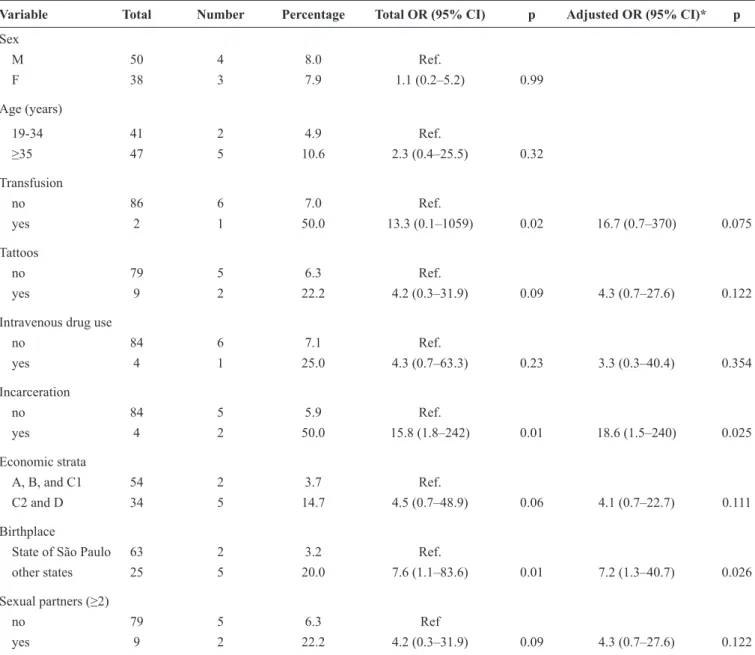
TABLE 1 - Logistic regression analysis of the association between hepatitis B and risk factors in the DARP, São Paulo, Brazil, 2013.
Variable Total Number Percentage Total OR (95% CI) p Adjusted OR (95% CI)* p
Sex
M 50 4 8.0 Ref.
F 38 3 7.9 1.1 (0.2–5.2) 0.99 Age (years)
19-34 41 2 4.9 Ref.
≥35 47 5 10.6 2.3 (0.4–25.5) 0.32
Transfusion
no 86 6 7.0 Ref.
yes 2 1 50.0 13.3 (0.1–1059) 0.02 16.7 (0.7–370) 0.075
Tattoos
no 79 5 6.3 Ref.
yes 9 2 22.2 4.2 (0.3–31.9) 0.09 4.3 (0.7–27.6) 0.122 Intravenous drug use
no 84 6 7.1 Ref.
yes 4 1 25.0 4.3 (0.7–63.3) 0.23 3.3 (0.3–40.4) 0.354 Incarceration
no 84 5 5.9 Ref.
yes 4 2 50.0 15.8 (1.8–242) 0.01 18.6 (1.5–240) 0.025 Economic strata
A, B, and C1 54 2 3.7 Ref.
C2 and D 34 5 14.7 4.5 (0.7–48.9) 0.06 4.1 (0.7–22.7) 0.111 Birthplace
State of São Paulo 63 2 3.2 Ref.
other states 25 5 20.0 7.6 (1.1–83.6) 0.01 7.2 (1.3–40.7) 0.026
Sexual partners (≥2)
no 79 5 6.3 Ref
yes 9 2 22.2 4.2 (0.3–31.9) 0.09 4.3 (0.7–27.6) 0.122
DARP: Deaf Association of Ribeirão Preto; OR: odds ratio; CI: confi dence interval; M: male; F: female; *The adjusted ORs were adjusted for age and sex.
Brazilian Economic Classifi cation Criterion(5).Risk factors were investigated using a logistic regression model in which the odds ratios (ORs) of the different variables were adjusted for age and sex only, because the small sample prevented the convergence of
the model when the other variables were included. Signifi cance was set at p ≤ 0.05.
This project was approved by the CHRPMS Ethics and Research Committee (case no. 9492/2011). Additional approval was obtained for the search in the Hygia system.
A total of 88 people were studied. The median age of the participants was 35 years (range, 19-78 years). A maximum of up to 4 years of education was reported by 34 (38.6%) participants, and only 9.1% had some college education. Only four (4.5%)
individuals were classifi ed in the high social stratum, while 34 (38.6%) were classifi ed in the lowest social stratum.
Serological markers for current or past hepatitis B infection were present in seven participants (8%, 95% CI: 2.3-13.7). In two of these participants, both HBsAg and anti-HBc were present, indicating a likely current infection (2.3%, 95% CI: 0.0-5.4). There was only one suspected case of hepatitis C infection on the ELISA test, which was subsequently eliminated by the hepatitis C virus-polymerase chain reaction (HCV-PCR) test.
Of the typical risk factors for hepatitis B and C (Table 1),
the most commonly reported were presence of tattoos and ≥2
605
The authors declare that there is no confl ict of interest.
CONFLICT OF INTEREST
Rev Soc Bras Med Trop 48(5):603-606, Sep-Oct, 2015
having tattoos, belonging to a lower economic stratum, and
having two or more sexual partners in the previous six months
were not statistically signifi cant. In the logistic regression
analysis controlled for age and sex, the variables associated with the presence of hepatitis B markers were a history of incarceration (p = 0.025) and being born outside the State of São Paulo (p = 0.026). A previous blood transfusion was borderline
signifi cant (p = 0.075).
The DARP is a public service entity that has been the only source of public support for the local deaf community since 1972. The deaf community meets there on Saturday afternoons for educational and leisure activities. Based on the available records from the DARP, we initially planned to include approximately 200 participants, which is the estimated number of members. However, the total number of participants was 88, or 44% of our original estimate, which comprises a margin of error of
8% in the prevalence estimates, with a 95% confi dence level.
Some explanations for this low response include incomplete death records, outdated addresses, and low attendance by some members during the six days of data collection. In an attempt to partially circumvent this limitation, we conducted a seventh blood collection in a health unit located next to the Ribeirão Preto bus station, where part of the deaf community meets on a daily basis. Approximately 30 potential participants who were Jehovah's Witnesses refused to participate.
Communication is a major barrier to information for the deaf, in Brazil(6) (7) and elsewhere(8). In the present study, we
observed a signifi cant lack of knowledge in the deaf community
regarding the forms of viral hepatitis, associated risk factors, forms of prevention, and availability of an effective vaccine in the public health system.
The prevalence of all hepatitis B markers was 8% [95% CI
(confi dence interval): 2.3-13.7], and the prevalence was 6.8% (95% CI: 4.1-9.5) for anti-HBc specifi cally, similar to that
reported in a recent study of the population of all Brazilian capitals (7.4%, 95% CI: 6.8-8.0)(9). Therefore, even with the diffi culties in achieving high levels of information about health issues and the presence of risk factors, the levels of hepatitis B infection in the deaf community were no different to those in the general population of the Brazilian capitals.
Some well-known risk factors for both hepatitis B and C, such as past blood transfusions, tattoos, intravenous drug use, poverty, and multiple sexual partners(10) (11) (12) were reported more frequently by participants with positive markers. However,
there were no signifi cant associations with hepatitis B, which
is likely due to the small sample.
Two variables remained associated with the risk of hepatitis B in the adjusted logistic regression analysis: history of incarceration and being born outside the State of São Paulo. The role of imprisonment has been extensively studied in different locations(13) (14) and is attributed to a range of associated behaviors, habits, and practices that might precede and result in imprisonment. Prisoners are usually exposed to all types of violence, illicit drugs, tattoos, and risky sexual practices(15), making them vulnerable to hepatitis B infection.
Due to the proximity, most participants from outside São Paulo originated from the State of Minas Gerais, where the prevalence was 18.2%. These are likely individuals with lower economic means who come to the Clinical Hospital for treatment and migrate to richer regions for survival. Although
these values did not reach signifi cance after adjusting for sex
and gender, we observed higher rates of hepatitis B among individuals from lower economic strata.
Only one serum sample tested positive for hepatitis C, but the molecular biology test (PCR) then yielded a negative result. This was unexpected because the studied population reported risky behaviors throughout the interviews. In particular, the use of illicit intravenous drugs, which are strongly associated with hepatitis C, was reported by four (4.5%) participants and almost certainly withheld by others, based on the opinion of the professional who conducted the interviews and has had extensive contact with this population over several years. This may be due to the low rate of needle or syringe sharing, as reported by the participants.
One important limitation of our research was the diffi culty
with reliably communicating with a deaf population on matters about which most individuals lacked basic knowledge, even though our interviews were conducted exclusively by a professional who was highly trained in LIBRAS. Furthermore, we used an informative DVD on hepatitis B and C, which was carefully designed for deaf individuals who lip-read as well as use LIBRAS for communication.
The diffi culty in communicating with the deaf could explain
the lack of epidemiological studies regarding viral hepatitis in deaf populations. We found no studies when we conducted
a search in Medline and Scientifi c Electronic Library Online
(SciELO) using the following terms: viral hepatitis, hepatitis B, hepatitis C, epidemiology and deaf/deafness, hard of hearing. In the few studies that were found, deafness was treated as a side effect of drugs used in treatment, and the epidemiological
profi le, prevalence, or risk factors associated with hepatitis were
not explored. However, the hypothesis that communication
diffi culties with the deaf population could explain the lack of hepatitis research is diffi cult to support given the reasonable
number of epidemiological studies investigating AIDS in the deaf population. Some of these studies were useful for the current work because of the similar risk factors for the diseases, particularly for the hepatitis B virus. Considering that the epidemiology of hepatitis B and C has been extensively studied in different population groups in many different countries, the reason for the complete absence of these studies among the global deaf population remains unknown. Therefore, to the best of our
knowledge, this is the fi rst epidemiological study of hepatitis B
606
REFERENCES
1. World Health Organization. Deafness and hearing loss. (internet). 2014 (updated Feb 2014; acessed 2014 feb 5). Available at www. who.int/mediacentre/factsheets/fs300/en/
2. Heuttel KL, Rothstein WG. HIV/AIDS: knowledge and information sources among deaf and hearing college students. Am Ann Deaf 2001; 146:280-286.
3. Huang CC, Lin WB, Chang PH, Chang KC, Lee TJ. Sudden deafness as a presenting symptom of chronic hepatitis B with acute exacerbation. Otolaryngol Head Neck Surg 2009; 141:659-660. 4. Mendes-Corrêa MCJ, Bittar RSM, Salmito N, Oiticica J. Pegylated
interferon/ribavirin-associated sudden hearing loss in a patient with chronic hepatitis C in Brazil. Braz J Infect Dis 2011; 15:87-89. 5. Associação Brasileira de Empresas de Pesquisa (ABEP). (internet). Critério de Classifi cação Econômica Brasil; 2013. (Accessed 2014 Jan 21). Available at fi le:///C:/Users/usuario/Downloads/02_ cceb_2013%20(1).pdf
6. Pereira PCA. Percepção de surdos adultos sobre o atendimento em saúde. 2008. 86 p. (Master´s Dissertation). Faculdade de Saúde Pública. Universidade de São Paulo; 2008 São Paulo.
7. Moura MC. Uma história cíclica: o surdo e as imposições sociais. In: Dep. Pontes Neto, editor. Acessibilidade e Linguagens. Cadernos Tramas da Memória, 3rd Ed. Fortaleza: INESP 2013. p 109-136.
8. Luckner JL, Gonzales RB. What deaf and hard-of-hearing adolescents know and think about AIDS. Am Ann Deaf 1993; 138:338-342.
9. Ministério da Saúde, Departamento de DST, Aids e Hepatites Virais, Secretaria de Vigilância em Saúde (Internet). Estudo de prevalência de base populacional das infecções pelos vírus das hepatites A, B e C nas capitais do Brasil. (Accessed 2014 January 21). Available at: http://www.aids.gov.br/sites/default/fi les/anexos/ publicacao/2010/50071/estudo_prevalencia_hepatites_pdf_26830. pdf
10. Passos ADC. Aspectos epidemiológicos das hepatites virais. Medicina, Ribeirão Preto 2003; 36:30-36.
11. Laumann AE, Derick AJ. Tattoos and body piercings in the United States: a national data set. J Am Acad Dermatol 2006; 55:413-421. 12. Passos ADC, Figueiredo JFC. Fatores de risco para doenças
sexualmente transmissíveis entre prostitutas e travestis de Ribeirão Preto (SP), Brasil. Rev Panam Salud Publica 2004; 16:95-101. 13. Coelho HC, Oliveira SAN, Miguel JC, Oliveira ALA, Figueiredo
JFC, Perdoná GC, et al. Soroprevalência da infecção pelo vírus da hepatite B em uma prisão brasileira. Rev Bras Epidemiol 2009; 12:124-131.
14. Adjei AA, Armah HB, Gbagbo F, Ampofo WK, Quaye IKE, Hesse IFA, et al. Prevalence of human immunodefi ciency virus, hepatitis B virus, hepatitis C virus and syphilis among prison inmates and offi cers at Nsawam and Accra, Ghana. J Med Microbiol 2006; 55:593-597.
15. Castro OG. A ressocialização de detentos da prisão provisória de Curitiba estimulada pela arte-educação: relato de experiência. 2004. 164 p. (Monografi a de Especialização). Faculdade de Artes do Paraná; 2004 Curitiba.