(Lack of) control of clinical and
anthropometrical parameters in
individuals with coronary artery disease
*(DES)CONTROLE DE PARÂMETROS CLÍNICOS E ANTROPOMÉTRICOS EM INDIVÍDUOS COM DOENÇA ARTERIAL CORONÁRIA
(DES)CONTROL DE PARÁMETROS CLÍNICOS Y ANTROPOMÉTRICOS EN INDIVIDUOS CON ENFERMEDAD ARTERIAL CORONARIA
* Taken from the thesis “Fatores de Risco Cardiovascular: crenças e comportamentos de indivíduos com doença arterial coronária”, School of Nursing, Univer-sidade Federal da Bahia, 2009. 1 RN. M.Sc. in Nursing. Assistant Professor, Nursing Department, Escola Bahiana de Medicina e Saúde Pública. Salvador, BA,
Brazil. [email protected] 2 RN. Ph.D. Adjunct Professor, School of Nursing, Universidade Federal da Bahia. Leader of the Interdisciplinary Research
Group on Cardiovascular Health Care. Salvador, BA, Brazil. [email protected] 3 Undergraduate Student, School of Nursing, Universidade Federal da Bahia. PIBIC
– CNPq Grantee 2008/2009. Salvador, BA, Brazil. [email protected] 4 Physician. Ph.D. Emeritus Professor, School of Medicine, Universidade
O
RIGINAL
A
R
TICLE
RESUMO
Estudo de corte transversal que avaliou pa-râmetros clínicos e antropométricos em 100 indivíduos com doença arterial coronária, atendidos em um ambulatório de cardio-logia preventiva em um hospital público, em Salvador/BA. Na coleta de dados em-pregou-se entrevista, avaliação clínica e laboratorial. Os resultados foram analisados em médias e percentuais. Predominou ho-mens, faixa etária <60 anos, raça/cor negra casado(a)s, baixa escolaridade e renda, in-divíduos sem ocupação e com diagnóstico de infarto do miocárdio. A maioria relatou hipertensão arterial, dislipidemia, sedenta-rismo, abandono do tabagismo e da bebi-da alcoólica. Tobebi-das as mulheres e 82% dos homens tinham circunferência abdominal aumentada, 19% glicemia casual >200 mg/ dL, 36% sobrepeso, 28% obesidade, 65% algum estágio de hipertensão arterial, 65% HDL-C baixo e 43% estava com colesterol total alto. Em indivíduos de alto risco car-diovascular e condições socioeconômicas deficitárias constatou-se o descontrole de vários fatores de risco cardiovascular, de-mandando práticas de cuidar efetivas para o controle da doença.
DESCRITORES
Doença da artéria coronariana Fatores de risco
Enfermagem
Glicia Gleide Gonçalves Gama1, Fernanda Carneiro Mussi2, Andréia Santos Mendes3, Armênio Costa
Guimarães4
ABSTRACT
This cross-sectional study evaluated the clinical and anthropometrical parameters of 100 individuals with coronary artery dis-ease, who were assisted at preventive car-diology outpatient clinic at a public hospi-tal in Salvador/BA. Data collection was per-formed through interviews and both clini-cal and laboratory evaluations. The results were analyzed as averages and percentages. Most participants were black men, aged <60 years, married, low education level and small income, unemployed and diagnosed with myocardial infarction. Most reported having arterial hypertension, dyslipidemia, a sedentary lifestyle, and had quit smoking and drinking. All women and 82% of the men had an increased abdominal circum-ference, 19% had causal blood glucose>200 mg/dL, 36% was overweight, 28% were obese, 65% were in soma stage of hyper-tension, 65% had low HDL-C and 43% had high total cholesterol. It was observed that individuals with high cardiovascular risk and deficient socioeconomic conditions show a lack of control of several cardiovascular risk factors, thus demanding effective health care practices to control the illness.
DESCRIPTORS Coronary artery disease Risk factors
Nursing
RESUMEN
Estudio transversal que evaluó parámetros clínicos y antropométricos en 100 indivi-duos con enfermedad arterial coronaria atendidos en ambulatorio de cardiología preventiva en hospital público en Salvador/ BA. Para recolección de datos se utilizó en-trevista, evaluación clínica y laboratorial. Los resultados fueron analizados con me-dias y porcentuales. Predominio de hom-bres, faja etaria <60 años, raza/color negra, casados/as, baja escolaridad e ingresos, in-dividuos desocupados con diagnóstico de infarto de miocardio. La mayoría presentó hipertensión arterial, dislipidemia, seden-tarismo, abandono de tabaquismo y de bebidas alcohólicas. Todas las mujeres y 82% de hombres tenían circunferencia ab-dominal aumentada, 19% glucemia casual >200 mg/dl, 36% sobrepeso, 28% obesidad, 65% algún estado de hipertensión arterial, 65% HDL-C bajo y 43% colesterol total alto. En individuos de alto riesgo cardiovascular y condiciones económicas deficitarias, se constató descontrol de varios factores de riesgo, demandando prácticas de cuidado efectivo para el control de la enfermedad.
DESCRIPTORES
Enfermedad de la arteria coronaria Factores de riesgo
INTRODUCTION
Cardiovascular diseases (CVD) are responsible for more
than 1/3 of deaths in Brazil(1) and projections for these
dis-eases in 2020 appoint that they will continue heading le-thality statistics(2).
Coronary artery and cerebrovascular diseases are the
main types, corresponding to 80% of CVD deaths(3). They
are due to different factors, ranging from the person’s ge-netics, age, gender and life habits to lack of control of
car-diovascular risk factors (CVRF) related to atherosclerosis(2).
The more of these factors are associated in a person, the greater the probability of developing the disease. Hence, their prevention and control is a powerful weapon to
re-duce CVD morbidity and mortality(4).
A large international study called INTERHEART(4) for the
first time assessed CVRF in 52 countries across the five con-tinents, including Brazil. It was verified that nine risk fac-tors, which are simple to detect and can be modified, are responsible for more than 90% of attributable CVD risk, six of which increase (dyslipidemia, arterial
hy-pertension, diabetes mellitus, overweight/ obesity, smoking, psychological stress) and three decrease the risk (regular physical ex-ercise, adequate vegetable and fruit intake and alcohol consumption in small to
moder-ate doses). In the AFIRMAR study(5), carried
out in Brazil, the findings were practically identical. These data evidence that predispo-sition to atherosclerotic disease in Brazil is similar to what is observed in other countries, and that CVRF control is fundamental to pre-vent and control the disease.
Industrialization, urbanization, economic
development and globalization processes have stimulated the adoption of behaviors that are harmful for health. Many of the habits related to food, physical exercise, smoking and alcohol consumption are incorporated at a young age and favor the appearance or worsening of biological cardiovas-cular risk factors that can be reverted, such as arterial
hy-pertension and obesity(6). Today, overweight for example
represents the main CVD risk factor, not only as a primary causal factor, but also as a generator of the main causal factors: hypertension, dyslipidemia and diabetes.
Studies appoint that socioeconomic variables like in-come, education and housing conditions are negatively
correlated with CVD mortality(7-8). People with lower
edu-cation levels have less knowledge on chronic illness pre-vention and the search for health services due to preven-tive reasons is greater in the population with better pur-chasing power, while visits due to diseases are more
fre-quent among poorer people(8).
In this sense, the poorest population groups with the lowest education levels particularly are the most
vulner-able to CVRF, appointing the need for efficient prevention and control actions. This entails the great challenge clients, health professionals and public authorities need to face.
The importance of CVRF control and, consequently, of reducing the combined CVD morbidity and mortality pro-file, especially lack of knowledge on these factors and their degree of control in coronary artery disease (CAD) patients living in situations of social inequality, who were attended at an cardiology outpatient clinic of a public hospital, led to the need to assess clinical and anthropometric param-eters in people at high cardiovascular risk. The assessment of these parameters provides support to direct interdisci-plinary care practices for prevention and control purposes.
OBJECTIVE
To assess clinical and anthropometric parameters in coronary artery disease patients.
METHOD
Study design and place
Cross-sectional, descriptive and explor-atory research, carried out at an outpatient clinic of a state hospital located in Salvador-BA, which serves as a referral institution for high-complexity cardiology care to Unified Health System (SUS) users.
Sample
The sample comprised adult and elderly patients, i.e. older than 18 years, male and female, oriented in time and space, registered at the outpatient clinic, with a medical diagnosis of acute myocardial infarction (AMI) (ICD - I21.9) or unstable angina (UA)(ICD - I20.0) and who agreed to sign the Informed Con-sent Term.
To calculate the sample size (n), the estimated preva-lence of AMI was used as a parameter, which corresponds
to 99/100,000 adults in Salvador/BA(9). The following
pa-rameters were also considered to calculate the sample: ...nine risk factors,
which are simple to detect and can be
modified, are responsible for more
than 90% of attributable cardiovascular diseases risk...
) 1 ( ) 1
(N D P P
n
-+
-) 1 ( P NP
-= D= B
2
Za/2
B=1–aP
where, and
N - total number of assumed population during data
collection period = 1,000; P - proportion of the study
population = 0.099; n - sample size; -significance level; (1–
)100 - confidence level; B - ewanted estimated maximum
Data collection
The data collection instrument included three parts. The first contained closed questions on socioeconomic data and the second on referred personal and family antecedents of CVRF. The third comprised items to register clinical and an-thropometric data (blood pressure, weight, height, abdomi-nal circumference, body mass index) and laboratory test re-sults (casual capillary glucose, total cholesterol and HDL-C).
Approval for the project was obtained from the Institu-tional Review Board of the Bahia State Health Secretary (protocol No 219/2008), in compliance with National Health
Council Resolution No 196/96(10).
The adequacy of the data collection instrument for the study was tested. Data were collected between March and July 2008.
After confirming the medical diagnosis of CAD in the patient files of people who were going to attend or had attended a medical consult, they were contacted at the waiting room of the clinic and received in a private room to get further explanation about the research. After they had agreed to participate in the study and signed the informed consent term, the interview started to identify socioeco-nomic data and personal and family antecedents of CVRF. Next, clinical and anthropometric parameters were assessed and, family, participants were forwarded for lipid profile collection at the laboratory of the research institution.
All clinical and laboratory assessment results were made available to participants as well as the medical team. In case of high pressure levels (systolic pressure above 140 mmhg and diastolic pressure above 90), and/or casual capillary glucose above 200 mg/dL, the participant’s physician was informed to assess the patient.
The following procedures were adopted for clinical and anthropometric assessment purposes:
a) Blood pressure measurement
Blood pressure was measured twice, at a one-minute
interval, and the average was considered(11). Patients were
advised not to talk and/or not to keep their legs crossed during the measurement. It was certified that they were not on a full bladder; had not practiced physical exercise within 90 minutes and had not drunk coffee, eaten or smoked within 30 minutes before the measurement. Blood pressure was measured in a calm environment, in a private room, at a pleasant temperature, using an OmronHEM 705 CP dive. This is a digital electronic arm blood pressure mea-surement device, with automatic air inflation and deflation, in which the pulse pressure and wave are detected through a capacitance pressure transducer. The equipment was as-sessed according to the validation standards required by
the British Hypertension Society(BHS)(12).
Pressure was measured in the sitting position, with the upper left limb resting at the height of the heart, undressed,
with the hand palm turned upwards and elbow slightly flexed. The cuff was placed at about 2 to 3 cm above the cubital fossa and the rubber bag centralized on the bra-chial artery. The size of the rubber bag corresponded to 40% of the arm circumference and the length involved at least 80%. The V Brazilian Arterial Hypertension Guideline’s blood pressure assessment and classification parameter was adopted(11).
b) Determination of anthropometric measures
Weight (in kilograms) was determined through Techline TEC 30 digital scales, with Inmetro verification, 0.1Kg varia-tion, maximum capacity 150 Kg and minimum 2.5KG. Height (in meters) was determined through an Alturexta portable stadiometer linked to a base. To determine the patient’s weight, the person was asked to wear light clothes, with-out shoes and stand with his/her back turned towards the scales’ display. After measuring the weight, the patient’s height was checked with the stadiometer’s wooden rod, marking 0.5 cm intervals. These two variables were used to determine the body mass index (BMI), whose formula is the index between weight in kilograms and squared height
in meters (BMI = weight/height2). The BMI was assessed
according to WHO criteria(13).
c) Determination of abdominal circumference
To determine the abdominal circumference, the patient was asked to stand up, breathe normally, uncovering the abdominal region. The AC was measured at the middle point between the lower rib and the iliac crest, using a 1.5m flex-ible, non-extendable metric tape with 0.5cm intervals. This
parameter was assessed according to Brazilian(14-15) and
in-ternational(16) criteria.
d) Determination of lipid and glucose profile
For capillary glucose dosage purposes, a capillary punc-ture was done in the patient’s index finger, after skin anti-sepsis with 70% alcohol, using an appropriate lancet. The blood droplet was applied on the test trip and an Accutrend portable monitor was used for glucose measurement. As the glucose collection was casual, the time of the last meal was registered and levels were classified according to the
Brazilian Diabetes Consensus(17), which considered casual
glucose levels =200 mg/dL as suspected signs of Diabetes Mellitus. Blood collection for total and HDL-C cholesterol measurement was done at the laboratory on the same oc-casion, as the participants were already present. Both pa-rameters were classified according to the IV Brazilian
Dyslipidemia Guideline(18).
Data treatment and analysis
RESULTS
Socioeconomic and clinical characteristics
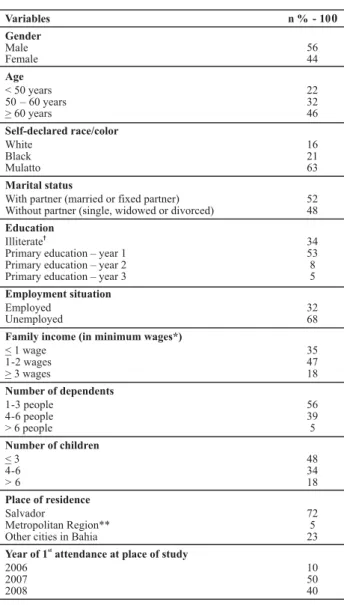
Table 1 shows the predominance of the male gender (56.0%), coming from Salvador (72.0%), mean age 58.7±10.9 years (58.5 ± 10.9 years for men and 58.9 ± 11.3 for women), with a majority younger than 60 years (54.0%). Most par-ticipants declared themselves mulatto or black (84.0%), lived with a partner (52.0%), had a low education level (87.0%) and income (82.0%), did not have an occupation due to retirement or unemployment (68.0%) and had between 1 and 3 dependents (56.0%). Half of the participants were first attended at the place of study in 2007, 40.0% in 2008 and 10.0% in 2006.
Table1 - Participants according to socioeconomic data - Salvador, BA - 2008
n % 94 94 6 6 35 35 63 63 2 2 83 83 9 9 8 8 48 48 51 51 1 1 4 4 37 37 59 59 23 23 26 26 51 51 5 5 16 16 3 3 76 76 32 32 10 10 1 1 1 1 18 18 82 82 14 77.8 3 16.7 1 5.5 54 65.8
2- 15 18.3
Personal antecedents of cardiovascular risk factors Arterial Hypertension (n=100)
Yes No
Type 2 Diabetes Mellitus (n=100)
Yes No
Does not know
Blood lipid alteration (n=100)
Yes No
Does not know
Overweight (n =100)
Yes No
Does not know
Smoking (n=100) Yes No Former smoker Drinking (n=100) Yes No Former drinker Sedentariness (n=100)
Physical exercise < 3x p/ week
Physical exercise 3-5x p/ week at least 30' Physical exercise >5x p/ week at least 30' Does not practice physical exercise
Menopause (n=44*)
Yes No
Does not know Hysterectomy
Clinical characteristics for CAD (n=100)
Chest angina
Acute Myocardial Infarction (AMI)
Diagnosis time of Unstable Angina (n=18)
<1year 2-3 years >4 years
Diagnosis time of most recent AMI (n=82)
<1year 3 years
>4 years 13 15.9
† Does not know how to read and write, can only write his/her name; *Minimum
wage in 2008: R$ 415 (four hundred and fifteen reais); ** Metropolitan Region, includes the following cities: Camaçari, Candeias, Dias d’Ávila, Itaparica, Lauro de Freitas, Madre de Deus, Mata de São João, São Francisco do Conde, São
Characterization of clinical manifestation of CAD and reference to CVRF
Most participants received a medical diagnosis of AMI (82.0%). Independently of the type of coronary event, more than two thirds of the sample had received this diagnosis less than one year before. Out of 90 patients registered at the place of study in 2007 and 2008 (Table 1), 64 had suffered the most recent coronary event less than one year earlier, picturing that the period when the event occurred seems to coincide with the period when they were attended at the outpatient clinic.
Frequency levels for references of personal risk ante-cedents were high, particularly arterial hypertension (94.0%), dyslipidemia (83.0%), sedentariness (76.0%) and menopause in 72.7% of the women (32 out of 44), as shown in Table 2. Levels below 50.0% refer to overweight (48.0%) and diabetes mellitus (35.0%). The 24 participants who prac-ticed physical exercise walked, 19 of them more than three times per week for at least thirty minutes.
Table 2 - Participants according to clinical characteristics of CAD and reference to CVRF - Salvador, BA - 2008
Variables Gender
Male Female
Age
< 50 years 50 – 60 years > 60 years
Self-declared race/color
White Black Mulatto
Marital status
With partner (married or fixed partner) Without partner (single, widowed or divorced)
Education
Illiterate†
Primary education – year 1 Primary education – year 2 Primary education – year 3
Employment situation
Employed Unemployed
Family income (in minimum wages*)
< 1 wage 1-2 wages > 3 wages
Number of dependents
1-3 people 4-6 people > 6 people
Number of children
< 3 4-6 > 6
Place of residence
Salvador
Metropolitan Region** Other cities in Bahia
Year of 1 attendance at place of studyst
2006 2007 2008
n % - 100
Risk antecedents were also reported for more than 50% of first-degree relatives: hypertension (84.0%), obesity (59.0%), dyslipidemia (59.0%) and type 2 diabetes mellitus (56.0%). Frequent reference was also made to cerebrovas-cular accident (49.0%), AMI (64.0%) and UA (50.0%).
Table 3 shows the study participants’ characteristics ac-cording to clinical and anthropometric indicators. Normal blood pressure was observed in only 20.0%, while 65.0% displayed hypertension, equally distributed among stages I to II. Overweight was observed in 64%, 28% of whom were obese. According to the mean abdominal circumference, central obesity was identified in 100.0% of women and 82.1% of men, totaling 90.0% of the sample. Casual glu-cose >200mg/dl was detected in 19.0%, all of whom had a previous medical diagnosis of diabetes mellitus. It is high-lighted that none of the participants had been fasting for eight hours or more. Regarding lipids, high total cholesterol was observed in 43.0% of participants, and low serum lev-els of HDL-C in more than half (65%).
Table 3 - Characterization of study participants’ clinical and anthropometric parameters - Salvador, BA - 2008
Risk factor Total n %
Blood pressure*
Excellent (up to 120X80) 11 11
Normal (120 – 130 X 80 – 85) 9 9
Borderline (130 – 139 X 85 – 89) 15 15
Stage I hypertension (140 – 159 X 90 – 99) 22 22 Stage II hypertension (160 – 179 X 100 – 109) 21 21 Stage III hypertension (> 180X110) 22 22
Body mass index (BMI)†
18 a 24.9 (Eutrophic) 36 36
25 a 29.9 (Overweight or pre-obesity) 36 36
30 a 34.9 (Grade I obesity) 26 26
35 a 39.9 (Grade II obesity) 2 2
Circunferência abdominal (CA)
Women<84 cm¥
or 80 cm /Mens 88 cm or 90 cm< § < ¥ < §
10
Women >84 cm¥ § ¥ §
or >80 cm / Mens >88 cm or >90 cm 90
Casual glucose♣♦
>200 mg/dL 19
<200 mg/dL 81
Total cholesterol♥♦
Excellent (<200) 57
High ( 200)> 43
HDL♥♦
Low (<40 p/ man and <50 p/ woman) 65
Borderline (40-60) 24
High ( 60)> 11
* Source: V Brazilian Arterial Hypertension Guideline (2006); † Source: World Health Organization (2004), ¥ Source: Barbosa PJ, et al. Arq Bras Cardiol
(2006), §International Diabetes Federation Classification (2006), Source:
Update on Diabetes (2006); Source: IV Brazilian Dyslipidemia and
Atherosclerosis Prevention Guideline (2007); the 100 participants had not
fasted >8 hours.
Table 4 displays the study participants’ distribution ac-cording to the combination of smoking, sedentariness, he-reditariness, high blood pressure, high blood sugar, high total cholesterol, low HDL-C and increased abdominal cir-cumference. All participants showed one of these cardio-vascular risk factors. The minimum number of risk factors
in men was 1 and the maximum 6, against a minimum num-ber of 2 and a maximum of 6 as well in women.
Table 4 Aggregated CVRF in participants according to gender -Salvador, BA - 2008
Number of risk factors – n (%) Gender
0 1 2 3 4 5 6
Male (n=56)
- 2 (3.6) 9 (16.1) 9 (16.1) 16 (28.6) 18 (32.1) 2 (3.6)
Female (n=44)
- - 1 (2.3) 8 (18.2) 16 (36.4) 12 (27.3) 7 (15.9)
TOTAL - 2 (2.0) 10 (10.0) 17 (17.0) 32 (32.0) 30 (30.0) 9 (9.0)
The general μ (mean) of these factors per participant
was 4±1.2. It is also highlighted that 64.0% of men and 79.6% of women had 4 or more associated risk factors.
DISCUSSION
The study involved a group of men and women, at high cardiovascular risk, characterized by clinical manifestations of CAD, mostly AMI. The mean age younger than 60 years stood out, indicating a population that tends to present CAD at a younger age, suggesting a more severe evolution of atherosclerotic disease. The mean age among men was 10.8% lower than the mean age of 65.8 years for American men and 16.3% lower than the mean 70.4 years for
women(19). The mean global age in this study (58.7±10.9
years) is similar to the AFIRMAR(5) study, with a median 56
(48-65) years, a Brazilian multicenter study of people after their first AMI, confirming the prematurity of clinical mani-festations of CAD in developing countries.
This group presented homogeneous socioeconomic characteristics, such as dependence on care delivery through the Unified Health System (SUS), basically coming from Salvador City and the Metropolitan Region, mainly self-declared mulatto and living in conditions of social in-equality, as evidenced by low education and family income levels and high professional inactivity, due to retirement or unemployment. These findings confirm descriptions in
Bra-zilian literature(8) on these characteristics as enhancing the
risk for CVD. In this particular case, AFIRMAR(5) is similar to
the present study population in the income level below R$600, present in 40.5% of participants, end education level up to the first year of primary education, present in 62.0%, but strongly contrasts in terms of ethnic origin, with only 16% of white participants. This aspect raises the possibility that, in a country with high levels of ethnic mixture, eco-nomic, cultural and educational inequalities serve as the main conditioning factors for greater severity of the dis-ease. This hypothesis is limited, though, by the impossibil-ity of comparing the way ethnic origin was classified, self-declared in the present sample, but not identified in the
AFIRMAR study(5).
that manifests itself earlier. As found in that research, other
studies(8) have found that between 80% and 90% of men and
women after acute coronary events or submitted to coro-nary artery bypass graft surgeries presented at least one out of eight well-known cardiovascular risk factors: arterial hy-pertension, diabetes, high total cholesterol or low HDL-cho-lesterol levels, overweight/obesity, central obesity, sedentariness and hereditariness. In comparison with the
Brazilian sample in AFIRMAR(5), the presence sample shows
prevalence levels of hypertension and diabetes 42.2% and 38.2% higher, respectively. The clinical and laboratory data obtained from patients who were under outpatient treatment, after hospital admission, showed the highest risk ratios for central obesity (90.0%) and high blood pressure (65.0%), fol-lowed by hypercholesterolemia (57.0%) and high blood glu-cose (19.0%). The condition reveals to be more severe, how-ever, when considering the aggregation of these indicators per individual, with a mean 4±1.2 and 64.0% of men and 79.6% of women displaying four or more risk factors.
After evidencing these people’s severity, whose risk in-creases in comparison with their low socioeconomic condi-tion, it should be discussed that this also reflects the ineffi-ciency of the current care model as a specialized high-com-plexity reference center. This is not an isolated example how-ever. Data on risk factor control, centered on changes in life habits, especially food habits, physical activity and adher-ence to pharmacological treatment, show difficulties that do not depend on social class. Instead, they are related to the conditions inherent in human beings, regarding values es-tablished across the lifetime and difficulties to accept the disease condition. These, however, are combined with spe-cific conditions that are aggravated in low-level social groups, hampering the understanding of messages between the care staff and the patient, and low purchasing power, another main limiting factor, especially considering the existence of a health system any citizen is entitled to.
To overcome these barriers and improve the care qual-ity, as done in this study, the situation needs to be identi-fied, so that adequate therapeutic and preventive care strat-egies can reach their goal. The most basic is the structuring of interdisciplinary teams, including physicians, nurses, nutritionists, pharmacists, social workers, psychologists and secondary-level technicians, culminating with health agents. Nevertheless, joint work training is needed, including well-defined competencies and activity strategies with a view to the greater good of risk control, without which the high cost of high care technology does not play its role.
The lack of blood pressure control was frequent in the study group, as 94% informed arterial hypertension and, in the clinical assessment, a minority (20%) showed blood pressure levels within normal parameters according to the
V Brazilian Hypertension Guideline(11). This finding is
con-cerning and calls for the establishment of control strate-gies, as arterial hypertension is considered a risk factor strongly associated with severe cardiovascular events in the
global and Brazilian population(3,11).
Another important cardiometabolic risk factor associ-ated with the increase in cardiovascular event rates is dia-betes mellitus. Besides predisposing to the development of CAD, it also increases the risk of acute coronary syn-dromes, whose incidence levels rise up to 20% in seven years
among diabetics, against 3.5% among non-diabetics(17). In
this study, most participants showed more controlled ca-sual glucose levels, with caca-sual glucose =200 mg/dL in 81.0% of cases. Nevertheless, 19% of casual glucose ³200mg/dL is a relevant percentage, mainly when considering that these were individuals with confirmed diabetes, representing 54.3% of this group.
Eighty-three percent of participants informed dyslipidemia, a risk factor associated with myocardial inf-arction of greater clinical impact, according to the
INTERHEART(4) study. Out of 17 participants who mentioned
its absence or lack of knowledge about the presence of this condition, nine showed total cholesterol levels ³200mg/dL and 13 low HDL. High frequencies were also found for pa-tients with lipid profile alterations, 43.0% with high total cholesterol (=200 mg/dL) and 65.0% with low HDL-C.
In the BMI (body mass index) assessment, an indicator of generalized obesity, more than half of the sample manifested overweight or some grade of obesity, which is related to high prevalence and incidence levels of CVD. It is considered one of the main current public health problems in developed and
emerging countries(13). The BMI has been used to stratify
car-diovascular risk levels and to make therapeutic decisions on
associated clinical situations(14) . This index alone, however,
does not join the conditions for body fat assessment. In ad-dition, it does not always estimate obesity patterns correctly,
demanding the use of other indicators(15). Recent evidence
has demonstrated a stronger association between central obesity indicators and high coronary risk than between gen-eralized obesity indicators and high risk levels(15-16).
In the present study, the mean abdominal circumfer-ence was used as a central obesity indicator. It was observed that this level was high in all women and 82.0% of men. These data demonstrate a concerning lack of control, as abdominal circumference is more specific as a risk factor, mainly in the overweight range, as it indicates abdominal fat concentrations, a basic pathophysiological expression of the metabolic syndrome, whose complete form is char-acterized by central obesity, hypertension, low HDL-C, high
triglyceride levels and diabetes melittus(2).
The finding that 59 participants quit smoking after the cardiovascular event, most of them for more than two years, was important and shows a lifestyle change needed to pre-vent and control CVD. Nowadays, only 4.0% were still smok-ing. It is known that patients after a coronary event can reduce, by up to 50%, their risk of a new event (AMI), of sudden cardiac death and total mortality if they quit smok-ing. The speed and magnitude of risk reduction when one stops smoking are a source of discussion though, with some studies mentioning 3 to 20 years after the interruption,
Although moderate consumption of alcoholic beverages
showed to be a protection factor in the INTERHEART(4) study,
in the present study, the quantity, type and frequency of patients’ daily intake was not explored. Thus, only a change in life habits can be characterized, with 51.0% of the inter-viewees who gave up drinking after the coronary event.
Another prevalent cardiovascular risk factor in the study was sedentariness, which may have contributed to the high prevalence levels of overweight/obesity, increased abdomi-nal circumference and dyslipidemia, as 81.0% of participants denied regular physical exercise, especially men. Regular physical exercise is fundamental to prevent CAD. Positive effects on the lipid and glucose profile, blood pressure, body composition, hormones, intestinal transition and psycho-logical stress seem to be the main mechanisms through which physical exercise protects patients with chronic
con-ditions(3). At least 60.0% of participants did not comply with
the recommended minimum of 30 minutes per day of mod-erate physical exercise, five days per week, increasing the
risk of CVD or another event by 1.5 times(21).
Genetic heritage of CAD is also considered a very im-portant risk factor in susceptibility to the action of envi-ronmental factors or in the development of metabolic
dis-orders, whose severity alone can determine the disease(2).
It was verified in 64% of the subjects’ first-degree relatives and more present among men.
The presented data revealed non-control of different CVRF in the study sample, which may result from the com-bination of behavioral, economic, social variables and pa-tients’ understanding of medication and non-medication treatment of CAD. When not adopted, measures to
pre-vent and control a CVRF can also imply non-control of other factors, as these are interrelated. One example is the adop-tion of healthy eating habits and physical exercise as im-portant components in hypertension, diabetes, dyslipidemia and obesity prevention and control.
The study presents a challenge towards reflection, prac-tice and assessment of interdisciplinary care pracprac-tices with a view to lifestyle changes and better control of clinical and anthropometric parameters in groups living in socially un-equal conditions. It cannot be ignored that changing be-haviors is not an easy task and that health education mini-mally presupposes that health professionals know the popu-lation they are delivering care to, take into account its so-ciocultural context and share personal healthcare projects
with the clients(22). It is essential that patients receive help
to understand the importance of treatment and to use avail-able resources in a more adequate and attractive way so as to prevent new coronary events.
CONCLUSION
CAD patients followed in high-complexity referral hos-pitals for cardiology care showed lack of control of clinical and anthropometric parameters and life habits that entail cardiovascular health risks. These risk indicators for mor-bidity and mortality due to CAD cannot solely be modified through the application of high-complexity technology, but mainly through lifestyle changes. The sample’s low socio-economic level and a dissatisfactory interdisciplinary ap-proach seem to constitute the most important factors for these findings, and efforts are needed to revert them.
REFERENCES
1. Mendes MJFL, Alves JGB, Alves AV, Siqueira PP, Freire EFC. As-sociação de fatores de risco para doenças cardiovasculares em adolescentes e seus pais. Rev Bras Saúde Mater Infant. 2006;6 Supl 1:S49-S54.
2. Guimarães AC. Prevenção de doenças cardiovasculares no sé-culo 21. Hipertensão. 2002;5(3):103-6.
3. Ishitani LH, Franco GC, Perpétuo IHO, França E. Desigualdade social e mortalidade precoce por doenças cardiovasculares no Brasil. Rev Saúde Pública. 2006;40(4):684-91.
4. Rosengren A, Hawken S, Ounpuu S, Sliwa K, Zubaid M, Almahmeed WA, et al. Association of psychosocial risk factors with risks of acute myocardial infarction in 11119 cases and 13648 controls from 52 countries (the INTER-HEART study): case-control study. Lancet. 2004;364(9438):953-62.
5. Piegas LS, Avezum A, Pereira JC, Hoepfner C, Farran JA, Ramos RF, et al. Risk factors for myocardial infarction in Brazil. Am Heart J. 2003;146(2):331-8
6. Nobre MRC, Domingues RZL, Silva AR, Colugnati FAB, Taddei JAAC. Prevalências de sobrepeso, obesidade e hábitos de vida associados ao risco cardiovascular em alunos do ensino funda-mental. Rev Assoc Med Bras. 2006;52(2):118-24.
7. Assis LS, Stipp MAC, Leite JL, Cunha NM. A atenção da enfer-meira à saúde cardiovascular de mulheres hipertensas. Esc Anna Nery Rev Enferm. 2009;13(2):265-70.
8. Kaiser SE. Aspectos epidemiológicos nas doenças coronarianas e cerebrovascular. Rev SOCERJ. 2004;17(1):11-8.
9. Lessa I. Epidemiologia das doenças cerebrovasculares no Bra-sil. Rev Soc Cardiol Estado São Paulo. 1999;9(4):509-18.
11. Sociedade Brasileira de Hipertensão. V Diretrizes Brasileiras de Hipertensão Arterial. Rev Bras Hipertens. 2006;6(5):48.
12. Furusawa EA, Ruiz MFO, Saito MI, Koch VH. Avaliação do monitor de medida de pressão arterial 0mron 705-CP para uso em adolescentes e adultos jovens. Arq Bras Cardiol. 2005; 84(5):367-70.
13. Organização Mundial de Saúde (OMS). Obesidade: prevenin-do e controlanprevenin-do a epidemia global. Genova; 2004.
14. Picon PX, Leitão CB, Gerchman F, Azevedo MJ, Silveiro SP, Gross JL, et al. Medida da cintura e razão cintura/quadril e identificação de situações de risco cardiovascular: estudo multicêntrico em pacientes com diabetes melitos tipo 2. Arq Bras Endocrinol Metab. 2007;51(3):443-9.
15. Barbosa PJ, Lessa I, de Almeida Filho N, Magalhães LB, Araújo J. Critério de obesidade central em população brasileira: im-pacto sobre a síndrome metabólica. Arq Bras Cardiol 2006;87(4):407-14.
16. International Diabetes Federation. The Consensus Worldwide definition of the Metabolic Syndrome. Belgium; 2006.
17. Sociedade Brasileira de Diabetes. Consenso Brasileiro sobre Diabetes 2002: diagnóstico e classificação do diabetes melitos e tratamento do diabetes melitos tipo 2. Rio de Janeiro; 2002.
18. Sociedade Brasileira de Cardiologia. Departamento de Ate-rosclerose. IV Diretriz Brasileira sobre Dislipidemias e Preven-ção da Aterosclerose. Arq Bras Cardiol. 2007;88 Supl 1.
19. Rosamond W, Flegal K, Friday G, Furie K, Go A, Greenlund K, et al. Heart disease and stroke statisticas – 2007 update: a report from the American Heart Association Statistics Committee and Stroke Statistics Subcommittee. Circulation. 2007;115(5):e69-171.
20. Jatoi NA, Jerrard-Dunne P, Feely J, Mahmud A. Impact of smoking and smoking cessation on arterial stiffness and aortic wave reflection in hypertension. Hypertension. 2007;49(5):981-5.
21. Organização Panamericana da Saúde (OPAS). Doenças crôni-co-degenerativas e obesidade: estratégia mundial sobre ali-mentação saudável, atividade física e saúde. Brasília; 2003.