Pediatric Patient Classification
System: construction and validation of
care categories
*SISTEMA DE CLASSIFICAÇÃO DE PACIENTES PEDIÁTRICOS: CONSTRUÇÃO E VALIDAÇÃO DE CATEGORIAS DE CUIDADOS
SISTEMA DE CLASIFICACIÓN DE PACIENTES PEDIÁTRICOS: CONSTRUCCIÓN Y VALIDACIÓN DE CATEGORÍAS DE ATENCIÓN
* Extracted from the thesis “Sistema de Classificação de Pacientes Pediátricos: construção e validação de instrumento”, State University of Campinas, Faculty of Medical Sciences, Nursing Graduate Program, 2008. 1 MSc in Nursing. Doctoral student, State University of Campinas, Faculty of Medical Sciences, Nursing Department. RN, Pediatric Nursing Services at the Hospital das Clinicas at the State University of Campinas. Campinas, SP, Brazil. [email protected] 2 Professor, University of São Paulo, Nursing School, Department of Vocational Guidance. São Paulo, SP, Brazil. [email protected] 3 Professor, University of São
O
RIGINAL
A
R
TICLE
RESUMO
A classificação de pacientes é essencial para o gerenciamento de uma unidade. Entretan-to, a literatura não dispõe de conceituações de categorias de pacientes pediátricos. Os objetivos deste estudo foram definir e vali-dar categorias de cuidado de pacientes pediátricos, de acordo com o grau de de-pendência da equipe de enfermagem. Uti-lizou-se revisão bibliográfica para definição das categorias de cuidado e a validação de conteúdo das categorias propostas foi rea-lizada por um grupo de juízes envolvidos em assistência e gerência de unidades pediátri-cas e por juízes envolvidos em ensino e pes-quisa de pediatria e construção de instru-mentos de classificação de pacientes. Foram estabelecidas e validadas cinco categorias de cuidados: Mínimos, Intermediários, Alta dependência, Semi-intensivo e Intensivo. A validação das categorias de cuidado subsi-diou a construção de um sistema de classi-ficação de pacientes pediátricos que pode-rá contribuir para o processo de tomada de decisão do enfermeiro na prática gerencial e assistencial.
DESCRITORES Enfermagem pediátrica Carga de trabalho Avaliação em enfermagem Classificação
Estudos de validação
Ariane Polidoro Dini1, Fernanda Maria Togeiro Fugulin2, Maria De La Ó Ramallo Veríssimo3, Edinêis de
Brito Guirardello4
ABSTRACT
Patient classification is essential for man-aging a hospital unit. Literature, however, does not present conceptualizations of pe-diatric patient categories. The objectives of this study were to define and validate pe-diatric patient care categories, according to the level of dependency of the nursing team. The care categories were defined based on a literature review, and the con-tent of the proposed categories was vali-dated by a group of judges involved in man-aging and providing care in a pediatric unit, and by judges involved in pediatric educa-tion and research as well as in the construc-tion of patient instruments. Five care cat-egories were established and validated: Minimal, Intermediate, High dependency, Semi-intensive and Intensive. The valida-tion of the care categories were the basis for constructing a system for the classifica-tion of pediatric patients, that may contrib-ute with the decision making process of nurses working in management and health care.
DESCRIPTORS Pediatrics nursing Workload
Nursing assessment Classification Validation studies
RESUMEN
La clasificación de pacientes es esencial para el gerenciamiento de una unidad. Sin em-bargo, la literatura no dispone de concep-tualizaciones de categorías de pacientes pediátricos. Este estudio objetivó definir y validar categorías de atención de pacientes pediátricos, de acuerdo con grado de depen-dencia del equipo de enfermería. Se utilizó revisión bibliográfica para definición de ca-tegorías de atención y la validación de las categorías propuestas fue efectuada por un grupo de jueces involucrados en atención y gerenciamiento de unidades pediátricas, y por jueces identificados con enseñanza e in-vestigación en pediatría y construcción de instrumentos de clasificación de pacientes. Se establecieron y validaron cinco categorías de atención: Mínimos, Intermedios, Alta De-pendencia, Semi-intensivo e Intensivo. La validación de categorías de atención ayudó a construir un sistema de clasificación de pacientes pediátricos que podrá contribuir al proceso de toma de decisiones del enfer-mero en la práctica gerencial y asistencial.
DESCRIPTORES Enfermería pediátrica Carga de trabajo Evaluación en enfermería Clasificación
INTRODUCTION
The main objective of health services is to produce a posi-tive impact on the health condition of the population. Analy-sis is required for issues such as demand, supply and quality of services to organize these services to that end(1). The
qual-ity of health services is determined by a set of characteristics concerning the structure, work process, and results of ac-tions implemented to improve the health of patients(2). Health
services with appropriate structures such as physical area, human resources and appropriate material, provide favor-able conditions for the delivery of quality care. Nursing ser-vices play an essential role in the care process and managing human resources should receive special attention in the analysis of health services supply in order to balance issues such as cost, efficiency and quality of care(3).
The quantitative and qualitative aspects of human re-sources in nursing are directly linked to the quality of care offered to patients. Hence, these require special attention from managers since inappropriate proportions of such resources negatively reflects on care
deliv-ery(4). Personnel assignment is a systematic
process that grounds the planning and evalu-ation of the quantitative and qualitative as-pects of the nursing staff, required to provide care and ensure its previously established quality, to a set of patients according to the philosophy, uniqueness and structure of each service(5). One is required to make a
diagno-sis of the situation of each unit or service in order to apportion the nursing staff. This di-agnosis involves the characterization of cli-entele, the philosophy, objectives and care proposal of each facility(5-8).
We stress that knowledge of the number of beds or the percentage of occupied beds
are not the only safe indicators to quantify the care de-mands of a hospitalization unit(9-11) but also that the
char-acterization of the clientele is not reduced to an isolated analysis of epidemiological data such as age, gender, and medical diagnosis. Care demand comprehends the evalua-tion of duraevalua-tion of care, the patient’s degree of dependence when performing activities of daily living, and the disease’s complexity and severity(6).
In this context, the use of a Patient Classification Sys-tem (PCS) permits estimating, quantifying, and evaluating the demand for nursing care by groups of patients, catego-rizing them according to care needs in a specific period of time(9-11). The use of PCS enables one to base the
appor-tioning and distribution of personnel, as well supports the planning and forecasting of costs, taking into account the achievement of quality care standards(11), because it allows
the characterization of the clientele, discriminating the dif-ferent categories of care actions according to the patients’ degree of dependence on the nursing team.
Based on a national study(7), the Brazilian Nursing
Coun-cil(8) established official parameters to apportion nursing
resources according to the distribution of categories of care actions to indicate the minimum number of nursing pro-fessionals required as well as the percentage of distribu-tion by profession(8). However, the conceptualizations
es-tablished for the categories of care actions in the mentioned study(7) are not appropriate for the context of pediatrics
because these do not take into account the need of pediat-ric patients. Hence, due to this gap of specific conceptual-izations in the literature, the pediatric field faces difficul-ties grounding its scaling of personnel.
Given this context, studies conceptualizing the catego-ries of care actions in pediatrics are needed.
OBJECTIVES
To construct and validate the conceptualization of care categories for Pediatric Nursing clientele that discriminate different groups of patients in relation to their needs of
nursing care.
METHOD
This methodological study aimed to trans-form intangible constructs, such as phenom-ena related to interest in nursing research and practice, into tangible constructs. The proce-dures for this type of study depend on the use of the construct, though a literature review and evaluation of validity are indispensable(12).
The first phase of the study included the design of categories of care actions based on a bibliographic study of childhood develop-ment and existing conceptualizations for adult patients. The second phase involved the evaluation of content validity of the conceptualizations of care actions, which consists of verifying the degree of correlation be-tween a given concept and its future measure(12). In this
study, it consisted of verifying whether the care categories discriminate groups of patients with common characteris-tics in relation to their needs in regard to nursing care.
The Delphi technique was used to evaluate content va-lidity. This technique consists of the judgment of a panel of experts in the field through questionnaires. After all the judges provide their answers, grouping and detailed analy-sis of opinions to refine the initial idea is performed, and then a new phase of questioning is carried out with the same judges. Various phases of questioning may be accomplished, followed by changes in the construct in order to improve it until consensus is reached among the judges. This technique is characterized by its flexibility, where the researcher respon-sible for the study establishes the rules regarding the num-ber of phases, numnum-ber of experts and level of consensus re-quired to consider the construct valid(12-14).
...the use of a Patient Classification System
(PCS) permits estimating, quantifying,
and evaluating the demand for nursing
care by groups of patients, categorizing them according to care
The conceptualization of care categories was submitted to a panel of judges composed of nurses who teach, research, and manage or provide direct care to pediatric patients, or have knowledge in the field of patient classification. Thus, the analysis of the dependence of children was possible from different perspectives and participants contributed from both academic and professional practice in the direct care of pa-tients. The following inclusion criteria were used: nurse ex-perts in pediatrics or with a minimum experience of five years in the field and professors from the pediatrics field or with studies focused on the classification of patients.
After consenting to be in the study, the judges received spe-cifically written instructions concerning the study’s objectives and how to evaluate the constructs through an instrument de-veloped for the analysis of the proposed conceptualizations. Each of the definitions of the care categories is analyzed con-cerning its clarity and agreement. The judges were also asked to provide suggestions to improve the conceptualizations. Agree-ment greater than two thirds of the panel of judges would be representative to consider the conceptualizations valid. There-fore, a level of agreement of 70% was adopted both in relation to the care categories’ definition and clarity of writing.
The project was submitted to and approved by the Re-search Ethics Committee of the Federal University of Campinas, Faculty of Medical Sciences (nº 533/2005).
RESULTS
The first version of the conceptualization of care catego-ries for pediatric patients composed of five categocatego-ries was based on concepts available in the literature on patients clas-sification systems(6-12) and child development(15-17). Each
cat-egory was described according to the different age ranges and are presented as follows:
•
Minimum Care:Infant or toddler, stable from a clinical and nursing point of view, accompanied full time by the mother or legal guard-ian, who performs feeding and hygiene activities and pro-vides comfort to the child regardless of nursing service.
Preschooler or school age child, stable from a clinical and nursing point of view, accompanied full time by a trusted person, who participates in the child’s self-care ac-tions, regardless of the nursing team.
Adolescent, stable from a clinical and nursing point of view, having or not having a companion full time, collabo-rates in treatment and performs self-care actions under the supervision of a nurse.
•
Intermediate care:Infant or toddler, stable from a clinical and nursing point of view, accompanied full time by a mother or legal
guard-ian, who performs feeding and hygiene activities and pro-vides comfort to the child, but requires guidance from nurses to perform such activities.
Preschooler or school age child, stable from a clinical and nursing point of view, accompanied full time by a trusted person, who performs self-care actions jointly with the child, but requires guidance from nurses to perform such activities.
Adolescent, stable from a clinical and nursing point of view, having or not having a companion full time, collabo-rates in treatment and performs self-care actions, but re-quires guidance from nurses to perform such activities.
•
High Dependence Care:Infant, toddler, preschooler, or school aged child, stable from a clinical and nursing point of view, may or may not have a chronic pathology, who even with a companion full time requires help eating, accomplishing hygiene and com-fort activities and/or other specific nursing care.
Adolescent, stable from a clinical and nursing point of view, may or may not have a chronic pathology, who regardless of a companion, is not able to collaborate with treatment and/or requires help eating, perform-ing hygiene and comfort activities or other specific nurs-ing care.
•
Semi-Intensive Care:Pediatric patient (newborn, infant, preschooler, school age child or adolescent) subject to unstable vital signs or glycemic levels, without imminent risk of death, who re-gardless of a companion, requires continuing and special-ized nursing and medical care.
•
Intensive Care:Pediatric patient (newborn, infant, preschooler, school age child or adolescent) in a severe condition, subject to unstable vital signs, with imminent risk of death and requires continuing and specialized nursing and medical care.
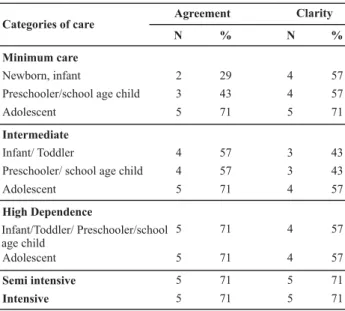
Table 1 - Evaluation of conceptualizations of care categories in pediatrics in relation to agreement and clarity, first stage - Campi-nas, SP, Brazil - 2006
Agreement Clarity
Categories of care
N % N %
Minimum care
Newborn, infant 2 29 4 57
Preschooler/school age child 3 43 4 57
Adolescent 5 71 5 71
Intermediate
Infant/ Toddler 4 57 3 43
Preschooler/ school age child 4 57 3 43
Adolescent 5 71 4 57
High Dependence
Infant/Toddler/ Preschooler/school age child
5 71 4 57
Adolescent 5 71 4 57
Semi intensive 5 71 5 71
Intensive 5 71 5 71
Score: (N= 7)
The evaluation of the first stage of the Delphi technique resulted in a level of agreement below 70% in the catego-ries Minimum and Intermediate Care for: newborns, infants, preschoolers, school age children. Results in relation to clar-ity were likewise for all the categories except
Semi-inten-sive and IntenSemi-inten-sive Care, whose level (71%) of agreement
and clarity was close to the level established for this study. Asserting the need for many reformulations in the con-ceptualization and given the importance of the theme, three judges opted for not answering the instrument completely and made themselves available to meet with one of the researchers to more deeply discuss the taxonomy of the complexity of care delivered to pediatric patients.
Given the results obtained in the first stage of the Delphi technique, the researchers adopted all the suggestions of the judges. Between the first and the second stages, two meetings were held: the first with the first judge and the second with the other two judges in the format of a work-shop in which the concepts were re-elaborated and which are presented as follows:
•
Minimum Care: Pediatric patient older than 12 yearsold, development appropriate to age, stable from a clinical point of view, who performs all self-care actions under the supervision of the nursing staff.
•
Intermediate Care: Pediatric patient older than sevenyears of age, development appropriate to age, stable from a clinical and nursing point of view, who requires help from the nursing staff to perform self-care and/or support to cope with the disease and hospitalization.
•
High Dependence Care: Pediatric patient (any age), stablefrom a clinical point of view, who depends on the nursing staff to meet his/her organic/physical, emotional and social needs.
•
Semi-Intensive Care: Pediatric patient (any age), stablefrom a clinical point of view, without imminent risk of death, who requires continuing and specialized nursing and medi-cal care.
•
Intensive Care: Pediatric patient (any age), stable froma clinical point of view, with imminent risk of death, who requires continuing and specialized nursing and medical care. The reformulated conceptualizations were submitted to the remaining eight judges who did not participate in the second meeting, who were asked to evaluate once again the conceptualization and clarity through a new questionnaire. Eight questionnaires were sent, from which seven (87.5%) returned. All the care categories obtained excel-lent agreement (from 85 to 100%), both in terms of con-ceptualization and clarity, ensuring their content validity. Additionally, we consider 100% of agreement to have been obtained from the two judges who participated in the work-shop of conceptualizations (Table 2).
Table 2 - Evaluation of conceptualizations of care categories in
pediatrics in relation to agreement and clarity, second stage - Cam-pinas, SP, Brazil - 2006.
Minimum 6 86 6 86
Intermediate 6 86 6 86
High dependence 6 86 6 86
Semi-intensive 7 100 7 100
Intensive 7 100 7 100
Agreement Clarity
Care categories
N % N %
Score: (N= 7)
DISCUSSION
Only the description of the properties of instruments of patients’ classifications and their applicability are found in the international literature(6,9-11); there are no explicit
concepts of care categories. The concepts found in the Bra-zilian literature concerning care categories for adult patients are not appropriate for pediatric patients. They do not con-sider care required by pediatric patients in different age ranges, which are determinants in relation to the degree of complexity or severity of the disease for which pediatric patients are hospitalized(7).
The judges agreed with the care categories proposed, which are similar to those used to classify adults(7).
How-ever, the judges disagreed in relation to the conceptualiza-tion according to age range for each care category because these categories are not appropriate for pediatric patients since they did not consider specific characteristics of child development and care required in each age range.
pa-tient was unacceptable, as was including infants, preschoolers, and school age children in the category
Mini-mum Care.
The opinion of the panel of judges is consonant with the literature concerning the delivery of care by family caregivers. The patients’ family members can perform many care actions as long as they are willing to and feel capable to do it. Care actions, however, are the full responsibility of nurses during the period of hospitalization.
The decision to conceptualize the category High
Depen-dency was considered a wise decision because this category
is closely linked to the characteristics inherent to pediatric patients, who regardless of the severity and complexity of the disease for which they are hospitalized, still depend on adults to perform daily living activities and also require continuous supervision to ensure their safety(17).
The Delphi technique was chosen to evaluate the care cat-egories because of its flexibility, which permits performing as many stages as necessary until the expected level of agree-ment is reached. The advantage of this technique is in reach-ing a significant number of respondents from different profes-sional practices, such as direct care, management, teaching and research, even if these are located in distant places, in order to make the assessment as broad as possible(13-14).
However, the incorporation of changes suggested from a distance is not an easy task, which can generate the need to return the model several times to the judges until a high level of agreement is achieved. Hence, when a low level of agreement and clarity was achieved for the care categories after the first phase of the Delphi technique, we verified that, given the importance of the subject, not being able to personally meet the judges would impede the achieve-ment of a consensus and conceptualizing the categories of pediatric care.
Having the opportunity to meet the two judges person-ally was a favorable factor. The direct debate among people with different backgrounds and professional experiences enabled the development of a proposal that was well
ac-cepted by the judges who evaluated the categories from a distance. Given this experience, we suggest teamwork as a methodological strategy to design the model to be ana-lyzed, before applying the Delphi technique.
The validity of the conceptualizations was ensured af-ter two meetings were held between the researcher and each judge, so that after the reformulation, an excellent level of agreement was obtained from the panel regarding the new conceptualizations (between 85% and 100%).
The design of the five categories of care in pediatrics enables the performance of new studies to estimate the time spent by the nursing team meeting the needs of pedi-atric patients, supporting the decision-making process con-cerning an appropriate apportioning of personnel both in quantitative and qualitative terms.
CONCLUSION
This study enabled a proposal to characterize pediatric patients in a relatively easy way and therefore has the po-tential to be used to ground the division of personnel in pediatric nursing. Five categories of care actions in pediat-rics were conceptualized and validated: Minimum Care, In-termediate Care, High Dependence Care, Semi-intensive
Care and Intensive Care.
We stress that the content validation process through the Delphi technique and also the meetings held with the judges involved in teaching, research, direct care and man-agement of pediatric units, with different competencies to evaluate patient classifications in pediatrics, supported es-sential changes in the definition of the proposed care cat-egories, considering the care delivery and administrative contexts of the pediatric hospitalization units.
The classification of patients in care categories supports the assignment of nursing personnel in the pediatric nurs-ing field; however, identifynurs-ing the average hours spent pro-viding nursing care in each category of care actions in pedi-atrics is needed.
REFERENCES
1. Pinheiro RS, Escosteguy CC. Epidemiologia e serviços de Saú-de. In: Medronho RA, Carvalho DM, Bloch KV, Luiz RR, Werneck GL. Epidemiologia. São Paulo: Atheneu; 2003. p. 361-9.
2. Campbell SM, Roland MO, Buetow SA. Defining quality of care.
Soc Sci Med. 2000;51(11):1611-25.
3. Fugulin FMT. Dimensionamento de pessoal de enfermagem: avaliação do quadro de pessoal das unidades de internação de um hospital de ensino [tese doutorado]. São Paulo: Escola de Enfermagem, Universidade de São Paulo; 2002.
4. Tanos MAA, Massarollo MCKB, Gaidzinski RR. Dimensionamen-to de pessoal de enfermagem em uma unidade especializada em transplante de fígado: comparação do real com o preconi-zado. Rev Esc Enferm USP. 2000;34(4):376-82.
5. Gaidzinski RR, Fugulin FMT, Castilho,V. Dimensionamento de pessoal de enfermagem em instituições de saúde. In: Kurcgant P, coordenadora. Gerenciamento em enfermagem. Rio de Ja-neiro: Guanabara Koogan; 2005. p.125-37.
7. Fugulin FMT, Silva SHS, Shimizu HE, Campos FPF. Implantação do Sistema de Classificação de Pacientes na Unidade de Clínica Médica do Hospital Universitário da USP. Rev Med HU-USP. 1994;4(1/2):63-8.
8. Conselho Federal de Enfermagem. Resolução COFEN 293/2004. Parâmetros para o Dimensionamento do Quadro de Profissio-nais de Enfermagem nas Unidades Assistenciais das Institui-ções de Saúde e Assemelhados [Internet]. Brasília; 2004 [cita-do 2009 fev. 9]. Disponível em: http://www.saude.mg.gov.br/ atos_normativos/legislacao-sanitaria/estabelecimentos-de-saude/exercicio-profissional/res_293.pdf
9. Rainio AK, Ohinmaa AE. Assessment of nursing management and utilization of nursing resourcer with the RAFAELA patient classification system-case study from the general wards of one
central hospital. J Clin Nurs.2005;14(6):674-84.
10. Giovannetti P.Understanding patient classification systems. J
Nurs Adm. 1979;9(2):4-9.
11. De Groot HA. Patient classification system evaluation. Part 1: Essential system elements. J Nurs Adm. 1989;19(6):30-5.
12. Lobiondo-Wood G, Haber J. Pesquisa em enfermagem: mé-todos, avaliação crítica e utilização. 4ª ed. Rio de Janeiro: Guanabara Koogan; 2001.
13. Goodman CM. The Delphi technique: a critique. J Adv Nurs. 1987;12(6):729-34.
14. Williams PL, Webb C. The Delphi technique: a methodological discussion. J Adv Nurs. 1994;19(1):180-6.
15. Veríssimo MLOR, Sigaud CHS.O acompanhamento do
cresci-mento e desenvolvicresci-mento da criança. In: Sigaud CHS,
Veríssimo MLOR.Enfermagem pediátrica: o cuidado de
en-fermagem à criança e ao adolescente. São Paulo: EPU; 1996. p.137-62.
16. Wong DL. Enfermagem pediátrica: elementos essenciais à in-tervenção efetiva. Rio de Janeiro: Guanabara Koogan; 1997. p. 73-92.