
NLO crystals of bis[1-(diaminomethylene)thiouron-1-ium] tartate(2
)
hemihydrate and deuterated [1-(diaminomethylene)thiouron-1-ium] tartate(
)
Genivaldo Julio Perpétuo
a, Jan Janczak
b,⇑ aDepartamento de Física, Instituto de Ciências Exatas e Biológicas, Universidade Federal de Ouro Preto, 35400-000 Ouro Preto, MG, Brazil
b
Institute of Low Temperature and Structure Research, Polish Academy of Sciences, PO Box 1410, 50950 Wrocław, Poland
h i g h l i g h t s
"Protiated and deuterated crystals of 1-(diaminomethylene)thiouron-1-ium tartate were obtained.
"Hydrogen bonding motifsR12(6) andR22(8) in protiated andR21(5) andR12(6) in deuterated crystals are present. "Both compounds crystallise in the non-centrosymmetric space groups and exhibit NLO properties.
a r t i c l e
i n f o
Article history:
Received 23 April 2012
Received in revised form 20 July 2012 Accepted 20 July 2012
Available online 27 July 2012
Keywords:
[1-(Diaminomethylene)thiouron-1-ium] tartate
Crystal structure Hydrogen bonds
Second harmonic generation Vibrational spectroscopy
a b s t r a c t
The protiated single crystals of bis[1-(diaminomethylene)thiouron-1-ium] tartate hemihydrate were grown using a solution growth technique. The deuterated single crystals of [1-(diaminomethylene)thiou-ron-1-ium] tartate() were obtained by threefold recrystallisation of protiated crystals. The protiated and deuterated compounds crystallise in the non-centrosymmetric space groups P21212 and P21of the
ortho-rhombic and monoclinic systems, respectively. The conformation of the 1-(diaminomethylene)thiouron-1-ium cation in both structures is very similar and is almost planar. The double deprotonated tartate(2) dianion in protiated crystals exhibits C2symmetry, while tartate() monoanion in deuterated crystals
has C1symmetry. The oppositely charged components of the crystals, i.e.
1-(diaminomethylene)thiou-ron-1-ium cation and tartate(2) dianion in protiated and 1-(diaminomethylene)thiouron-1-ium cation and tartate() monoanion, interact via different hydrogen bonding motifs:R12(6) andR22(8) in protiated andR21(5) andR12(6) in deuterated crystals forming 2:1 and 1:1 supramolecular complexes. These supra-molecular complexes interact each other via NAH O or OAH O hydrogen bonds forming the 2D-lay-ered structures. Both compounds were also characterised by IR-spectroscopy. The SHG efficiency relative to potassium dihydrophosphate (KDP) was found to be 0.77 and 0.82 for protiated and deuterated crys-tals, respectively.
Ó2012 Elsevier B.V. All rights reserved.
1. Introduction
Non-covalent intermolecular interactions are of fundamental importance for understanding of molecular recognition and self-organisation in supramolecular chemistry and biology[1–3]. The directional strong hydrogen bonds OAH Y and NAH Y (Y@O, N) between the molecules containing complementary array of the hydrogen bonding sites play an important role in molecular arrangement in solids[4–8].
The commercially available 2-imino-4-thiobiuret (Aldrich, CAS No. 2114-20-05) is in the fact the tautomeric form of 1-(diaminom-ethylene)thiourea as has been shown by the X-ray single crystal analysis [9]. Both tautomers are already considered to be useful building blocks in crystal engineering, since they contain active
hydrogen bonding sites. The 1-(diaminomethylene)thiourea con-tains the basic N atom with the lone-pair of electrons that can ac-cept the proton forming positively charged cation, which with the oppositely charged units forms salts with the extended hydrogen bonded networks in solids [10–16]. Several materials based on the acid–base ionic and directional hydrogen-bonding interactions exhibit non-linear optical properties due to the relatively strong hyperpolarisability of the base-organic part of the crystals[17–21]. To explore the possibility of the 1-(diaminomethylene)thiourea to form new materials with the extended hydrogen-bonding pat-terns in solid with the non-linear optical properties (NLO), we investigate the supramolecular motifs in the crystal of bis[1-(diaminomethylene)thiouron-1-ium] tartate(2) hemihydrate and the deuterated 1-(diaminomethylene)thiouron-1-ium tartate(). Both materials were also characterised by the vibra-tional spectroscopy.
0022-2860/$ - see front matterÓ2012 Elsevier B.V. All rights reserved. http://dx.doi.org/10.1016/j.molstruc.2012.07.034
⇑Corresponding author. Tel.: +48 71 343 5021; fax: +48 71 344 1029.
E-mail address:[email protected](J. Janczak).
Contents lists available atSciVerse ScienceDirect
Journal of Molecular Structure
2. Experimental
All materials were commercially available and used as received. Elemental analysis was carried out with a Perkin-Elmer 240 ele-mental analyser.
2.1. Preparation of bis[1-(diaminomethylene)thiouron-1-ium] tartate hemihydrate
Commercially available 2-imino-4-thiobiuret (amidinothiourea, Aldrich, CAS No. 2114-02-05, purity of 99 %), which is in fact the tautomeric form 1-(diaminomethylene)thiourea andL-tartaric acid
(Aldrich, purity of 99.5%) were added to hot water in a molar pro-portion of 2:1. When the solution became homogeneous it was cooled slowly and kept at room temperature. After several days, transparent colourless orthorhombic crystals of 2(C2H7N4S)
(C4H4O6)0.5(H2O) were formed. Analysis: calculated for
C8H19N8O6.5S2: C, 24.31%; H, 4.83%; N, 28.33%; O, 26.30% and S,
16.23%. Found: C. 24.45%; H, 4.88%; N, 28.20%; O, 26.35% and S, 16.12%.
Deuterated D10 1-(diaminomethylene)thiouron-1-ium tartate
was prepared by the usual reaction with heavy water. The crystals of bis(1-(diaminomethylene)thiouron-1-ium) tartate hemihydrate were dissolved in heavy water, and were left in the atmosphere saturated with heavy water for 1 week in order to avoid the con-tamination of the crystals. Then the procedure was repeated twice. The obtained deuterated 1-(diaminomethylene)thiouron-1-ium) tartate crystallises in the non-centrosymmetric space group (P21) of monoclinic system.
2.2. X-ray data collection
X-ray intensity data for the crystals were collected using graph-ite monochromatic Mo K
a
radiation on a four-circlej
geometry KUMA KM-4 diffractometer with a two-dimensional area CCD detector. Thex
-scan technique with Dx
= 1.0° for each image was used for data collection. The 930 images for six different runs covering over 99% of the Ewald sphere were performed. The unit cell parameters were refined by the least-squares methods. One image was used as a standard after every 50 images for monitoring of the crystal stability and data collection. No correction on the rel-ative intensity variations was necessary. Data collections were made using the CrysAlis CCD program[22]. Integration, scaling of the reflections, correction for Lorentz and polarisation effects and absorption corrections were performed using the CrysAlis Red pro-gram[22]. The structures were solved by the direct methods using SHELXS-97 and refined using SHELXL-97 program[23]. The hydro-gen atoms were located in difference Fourier maps and were re-fined. The final difference Fourier maps showed no peaks of chemical significance. Details of the data collection parameters, crystallographic data and final agreement parameters are collected inTable 1. Visualisation of the structure was made with the Dia-mond 3.0 program[24]. Selected geometrical parameters are listed inTable 2and the geometry of hydrogen bonding interactions are collected inTable 3.2.3. Vibrational spectra measurements
The vibrational measurements were carried out at room tem-perature. The Fourier transform infrared spectrum was recorded from Nujol mulls between 4000 and 400 cm1 on a Bruker IFS
113 V FTIR.
2.4. Second harmonic generation (SHG)
Second harmonic generation properties were measured for the solid state samples at the fundamental wavelength (1064 nm) of a Q-switched Nd:YAG laser using the modified Kurtz–Perry meth-od[25].
2.5. Thermal measurements
Thermal analysis was carried out on a Linseis L81 thermobal-ance apparatus with Pt crucibles. Powdered Al2O3has been used
as a reference. The measurements have been performed under sta-tic air atmosphere on heating from room temperature to 120°C at the heating rate of 5°C min1.
2.6. X-ray powder diffraction measurements
The rest of the samples left after thermogravimetric analyses were checked on a STOE powder diffractometer equipped with a linear position detector (PSD) [26] using Cu K
a
1 radiation (k= 1.540562 Å) at room temperature.3. Results and discussion
Good quality single crystals of bis[1-(diaminomethylene)thiou-ron-1-ium tartate hemihydrate suitable for the X-ray analysis were obtained from water solution at 25°C. The deuterated D10crystals were obtained by threefold recrystallisation of bis(1-(diaminom-ethylene)thiouron-1-ium) tartate hemihydrate from heavy water. However, the deuterated D10 crystals, in contrast to the
ortho-rhombic protiated crystals, are monoclinic.
The X-ray single crystal analysis of the protiated crystal shown that the both carboxyl groups of the tartaric acid are deprotonated (Fig. 1). In addition, the X-ray analysis revealed that only a half of the deprotonated tartate(2) anion is independent, since it lies on the twofold symmetry axis. The water molecule also lies on the twofold symmetry axis. In the deuterated D10 crystals, as shown
in the X-ray analysis, only one of two carboxyl groups of the tar-taric acid is deprotonated, and it lies in the general position (Fig. 2). In the protiated crystal the oppositely charged units, i.e. 1-(diaminomethylene)thiouron-1-ium cation and tartate dianion interact via three NAH O hydrogen bonds forming bis[1-(diami-nomethylene)thiouron-1-ium] tartate molecular complex (Fig. 3). Whereas in the deuterated D10 crystals the
1-(diaminomethyl-ene)thiouron-1-ium cation interacts with tartate monoanion via six different NAH O hydrogen bonds with a three graphs of R21(5) and two graphs ofR12(6) forming the 1:1 supramolecular mo-tif (Fig. 2).
The conformation of the 1-(diaminomethylene)thiouron-1-ium cation in both crystals is only slightly deviated from a planar con-figuration. Both arms of the cation are slightly oppositely rotated around the CAN bonds involving the central N1 atom. The dihedral angle between the N1/C1/S1/N2 and N1/C2/N3/N4 planes is equal to 2.5(2)° and 1.6(2)° in the protiated and deuterated crystals, respectively. The rotation of the arms around the CAN1 bonds in both structures is significantly smaller than that in the crystal of neutral 1-(diaminomethylene)thiourea molecule (22.2(1)°) [9]. Protonation of the neutral 1-(diaminomethylene)thiourea mole-cule causes a reduction in the steric effect of the lone pair of elec-tron at the central N1 atom. The non-planar conformation of the neutral 1-(diaminomethylene)thiourea molecule and its proton-ated cation is also observed in the gas-phase structures as show by theab initiomolecular orbital calculations: 6.2°in the neutral molecule and 4.2°in the cation[9,11]. The currently available data on 1-(diaminomethylene)thiouron-1-ium salts show that the
ion twisting conformation may differ when different anions are used and dependent on the hydrogen bonding. For example, the greatest twisting angle is observed in 1-(diaminomethylene)thiou-ron-1-ium chloride (22.9(1)°) and bromide (15.2(1)°)[11]. In the other known salts the twisting angle ranges from 1.4(1)°in per-chlorate to 9.8(1)° in hydrogen sulphate [10]. The C1AS1 bond
(Table 2) in both structures is slightly longer than the typical C@S double bond as observed in the thioformaldehyde CH2C@S
(1.6019(8) Å)[27], which represents 100% double bond character, and is shorter than the value of1.74 Å as observed is several
thio-late anions that represent 50% double bond character[28]. Thus in the present structures the bond order of C1AS1 bond is intermedi-ate between 2 and 1.5. The three CAN bond lengths linking the amine groups are shorter by0.07 Å than the CAN bonds involving the central N1 atom (Table 2). The planarity of the amine groups points to thesp2hydridisation of the p orbitals of the nitrogen atoms. This indicates that the lone pair of electrons occupies the porbital. In addition, the p orbitals of the C, S and N1 atoms form-ing the
p
bond of the C1AS1 and C2AN1 double bonds could be delocalised over the CAN bonds linking the amine groups, due to symmetry of theporbitals. In result the shortening of the CAN bonds linking the amine groups and elongation of the C CAN bonds involved the central N1 atoms are observed.The conformation of the anionic part of the crystals, i.e. tar-tate(2) dianion in protiated and tartate() monoanion in the deu-terated crystal is different. In protiated crystal the torsion angle of the carbon chain C3AC4AC4iAC3iis equal to
175.1(2)°, and the anion exhibits the C2symmetry. In deuterated crystal the
symme-try of the tartate() monoanion is C1and the torsion angle
describ-ing the conformation of the carbon chain C3AC4AC5AC6 is equal to 165.7(2)°. The deprotonated COO group lies in the plane of C3/C4/O3 (the torsion angle O2AC3AC4AO3 = 0.5(2)°), while the non-dissociated COOD (D = deuter, in deuterated crystal) is in-clined by 8.9(2)°to the respective C6/C5/O5 plane (the torsion an-gle O8AC6AC5AO5 = 8.9(2)°). In the protiated crystal due to C2 symmetry of the tartate(2) dianion the COOgroups are inclined to the respective C3/C4/O3 and symmetrically equivalent planes by 6.1(2)°. A similar conformation of the carbon chain is observed in the crystal of (+)-tartaric acid, the respective torsion angles are
175.4(1)°and 4.8(1)°for the CACACAC chain and for OACACAO describing the orientation of the both COOH groups in relation the plane[29].
Table 1
Crystallographic data for bis[1-(diaminomethylene)thiouron-1-ium] tartate hemihydrate (1) and deuterated D101-(diaminomethylene)thiouron-1-ium tartate (2).
1 2
Empirical formula (C2H7N4S)2C4H4O60.5H2O (C2D7N4S)C4H2D3O6
Formula weight (g mol1) 395.23 278.29
Crystal system Orthorhombic Monoclinic
Space group P21212(No. 18) P21(No. 4)
a(Å) 25.387(4) 5.7517(12)
b(Å) 4.8920(10) 7.0499(14)
c(Å) 6.6820(10) 13.737(3)
b(°) 90.84(3)
V(Å3) 829.9(2) 557.0(2)
Z 2 2
Dcalc/Dobs(g cm3) 1.583/1.58 1.659/1.65
l(mm1) 0.370 0.317
Crystal size (mm) 0.280.240.21 0.340.250.21
Radiation type, wavelength,k(Å) Mo Ka, 0.71073 Mo Ka, 0.71073
Temperature (K) 295(2) 295(2)
hrange(°) 3.05–29.39 2.97–29.40
Absorption correction Numerical, CrysAlis Red[22] Numerical, CrysAlis Red[22]
Tmin/Tmax 0.9112/0.9455 0.9110/0.9427
Reflections collected/unique/observed 10160/2160/1620 7530/2726/1997
Rint 0.0291 0.0225
Refinement on F2 F2
R[F2> 2r(F2)] 0.0325 0.0268
wR(F2all reflections) 0.0568 0.0494
Goodness-of-fit,S 1.006 1.003
Flack parameter 0.11(7) 0.05(5)
Dqmax,Dqmin(e Å3) +0.309,0.245 +0.173,0.252
wR¼ fR½wðF2
oF2cÞ2=RwF4og1=2;w1¼1=½r2ðF2oÞ þ ðaPÞ2wherea= 0.022 anda= 0.021 for1and2, respectively, andP¼ ðF2oþ2F2cÞ=3.
Table 2
Comparison of the bond lengths (Å) and angles (°) for bis[1-(diaminomethylene) thiouron-1-ium] tartate hemihydrate (1) and and deuterated D10 1-(diaminometh-ylene) thiouron-1-ium tartate (2).
1 2
1-(Diaminomethylene) thiouron-1-ium cation
C1AS1 1.6786(17) 1.6646(17)
C1AN1 1.375(2) 1.377(2)
C1AN2 1.316(2) 1.317(2)
C2AN1 1.352(2) 1.360(2)
C2AN3 1.316(3) 1.315(2)
C2AN4 1.313(2) 1.290(2)
N2AC1AN1 112.50(15) 112.60(15)
N2AC1AS1 122.74(13) 122.30(13)
N1AC1AS1 124.76(13) 125.07(13)
C2AN1AC1 131.11(16) 130.71(15)
N4AC2AN3 120.15(19) 120.03(17)
N4AC2AN1 116.05(19) 123.32(15)
N3AC2AN1 123.80(17) 116.66(16)
C1AN1AC2AN3 1.6(3) 177.4(2)
Tartate(2) dianion in1and tartate() monanion in2
O1AC3 1.2388(19) 1.2539(19)
O2AC3 1.263(2) 1.2503(19)
C3AC4 1.527(2) 1.523(2)
O3AC4 1.4226(19) 1.415(2)
C4AC4i(C4AC5 in2) 1.518(3) 1.524(2)
(C5AO5 in2) 1.4058(19)
(C5AC6 in2) 1.508(2)
(C6AO8 in2) 1.2176(18)
(C6AO7 in2) 1.3040(18)
O2AC3AO1 125.61(16) 123.91(15)
(O8AC6AO7 in2) 123.58(15)
The hydrogen bonding pattern involving the tartate(2) or tar-tate() anions is considerably different. In protiated crystals the
tartate(2) dianion interacts with two 1-(diaminomethylene)thi-ouron-1-ium cations via two pairs of different motifs. One of them isR22(8) that is formed by donation to the COOgroup from amine and imine groups of the 1-(diaminomethylene)thiouron-1-ium cat-ion. The other motif isR12(6) is formed by donation of amine and imine groups to the one oxygen atom (O2) of the carboxylate group. These motifs link the tartate(2) dianion with two cations forming bis(1-(diaminomethylene)thiouron-1-ium) tartate supramolecular complex (Fig. 3). These 2:1 supramolecular complexes related by a translation along thec-axis andb-axis interact via two pairs of NAH O hydrogen bonds forming two-dimensional layer aligned parallel to the (1 0 0) crystallographic plane (Fig. 4). The presence of the sulphur atom in the 1-(diaminomethylene)thiouron-1-ium
cation raises the question of whether there are hydrogen bonds with the S as an acceptor, although the importance of such interac-tions has been questioned [30]. Nevertheless, there are authors motivated by the high content of sulphur in biological systems who claim to utilise the DAH S interactions (D = donor) in the crystal engineering. The NAH S interactions have been utilised for design supramolecular arrangement of thiourea derivatives [31]. Thus such NAH S intramolecular interactions seem to be present in the bis[1-(diaminomethylene)thiouron-1-ium] tartate structure (Table 3). Besides, the NAH S intramolecular interac-tions, the weak NAH S intermolecular interactions in the present structure are also exist. These weak NAH S intermolecular inter-actions link the 2D-layers forming a three-dimensional network. In the 2D-layers, the one dimensional channels with the solvated water molecules along theb-axis are observed (Fig. 4). The water molecules are relatively weak interact with the layers and they can be easy removed from the crystalline structure at95°C. The weight loss of2.3% was registered by the thermogravimetric anal-ysis and is in agreement with the loss of water molecules form the crystal (2.28%). After TG analysis the crystals were not suitable for the single crystal X-ray analysis. However, the lattice parameters obtained by the X-ray powder diffraction technique do not change significantly (orthorhombic,a= 25.362,b= 4.886 andc= 6.663 Å), therefore we suppose that the layered structure is preserved.
In the deuterated crystal the tartate() monoanion interacts with 1-(diaminomethylene)thiouron-1-ium cation via five hydro-gen bonding motifs. Three of them are R21(5) and the other two
areR12(6). One of threeR21(5) motif is formed by donation of hydro-gen from imine group of the cation to the both oxyhydro-gen atoms (O3 and O5) of hydroxyl groups, the other twoR21(5) motifs are formed
by donation of the H atoms from the amine groups to the hydroxyl groups and to one of the oxygen atom of the COO and COOH groups of the tartate() anion. The other two R12(6) motifs are
formed by donation of H atoms from amine and imine groups of the cation to the same oxygen atoms of hydroxyl groups of the an-ion (Fig. 5). In all hydrogen bonding motifs in the structure the H atoms are involved in the bifurcate hydrogen bonds. In the deuter-ated crystal the tartate() monoanions, in contrast to the tar-tate(2) dianions in the protiated crystals in which they are
Table 3
Hydrogen-bond geometry (Å,°).
(a) Bis[1-(diaminomethylene) thiouron-1-ium] tartate hemihydratea
DAH A DAH H A D A DAH A
N1AH1 O2 0.88(2) 1.82(2) 2.697(2) 172(2) N2AH21 O1 0.89(2) 2.09(2) 2.958(2) 166(2) N2AH22 S1ii 0.82(2) 2.65(2) 3.408(2) 154(2)
N3AH31 O1iii 0.82(2) 2.17(2) 2.974(2) 168(2)
N3AH32 S1 0.93(2) 2.28(2) 3.019(2) 136(2)
N3AH32 S1iv 0.93(2) 2.91(2) 3.586(2) 131(2)
N4AH41 O3iii 0.85(2) 2.14(2) 2.836(2) 139(2) N4AH41 O1iii 0.85(2) 2.61(2) 3.333(3) 144(2) N4AH42 O2 0.94(3) 2.31(2) 3.072(2) 138(2) O3AH3 N4v 0.82(2) 2.40(1) 2.836(2) 114(2)
O4AH4O N4vi 0.82(2) 2.50(6) 3.194(2) 144(3)
(b) Deuterated D101-(diaminomethylene) thiouron-1-ium tartateb
DAD A DAH D A D A DAD A
N1AD1 O5 0.86(2) 2.16(2) 2.891(2) 143(2)
N1AD1 O3 0.86(2) 2.28(2) 3.024(2) 146(2)
N2AD2A O2 0.76(2) 2.34(2) 3.016(2) 149(2)
N2AD2A O3 0.76(2) 2.57(2) 3.216(2) 144(2)
N2AD2B S1i 0.83(2) 2.75(2) 3.472(2) 147(2) N3AD3A O1ii 0.94(2) 1.96(2) 2.882(2) 171(2) N3AD3B O8 0.78(2) 2.29(2) 2.999(2) 152(2) N3AD3B O5 0.78(2) 2.54(2) 3.140(2) 135(2)
N4AD4A O2ii 0.85(2) 2.11(2) 2.935(2) 162(2)
N4AD4B S1 0.87(2) 2.31(2) 3.007(2) 138(2)
O3AD31 O8iii 0.77(2) 2.04(2) 2.790(2) 165(2)
O5AD51 O2iv 0.80(2) 1.90(2) 2.700(2) 171(2) O7AD71 O1v 0.90(2) 1.65(2) 2.542(2) 174(2) a Symmetry codes: (ii)
x+ 1/2,y1/2,z; (iii)x,y+ 1,z+ 1; (iv)x+ 1/2,y+ 1/ 2,z+ 1; (v)x,y1,z1; (vi)x,y1,z.
b Symmetry codes: (i)
x+ 1,y1/2,z+ 2; (ii)x1,y+ 1,z; (iii)x+ 1,y,z; (iv)
x1,y,z; (v)x,y+ 1/2,z+ 1.
Fig. 1.A view of bis[1-(diaminomethylene)thiouron-1-ium] tartate(2) hemihy-drate showing displacement ellipsoids at the 50% probability level and H atoms as a sphere of arbitrary radii. Dashed lines represent the hydrogen bonds.
Fig. 2.A view of deuterated D10 1-(diaminomethylene)thiouron-1-ium tartate showing displacement ellipsoids at the 50% probability level.
Fig. 3.A view of bis[1-(diaminomethylene)thiouron-1-ium] tartate(2) hemihydrate showing theR1
2(6) andR22(8) graphs of hydrogen bonds.
Fig. 4.A view alongb-axis of the crystal packing of bis[1-(diamino-methylene)-thiouron-1-ium] tartate(2) hemihydrate showing the 2D-layers parallel to (1 0 0) plane.
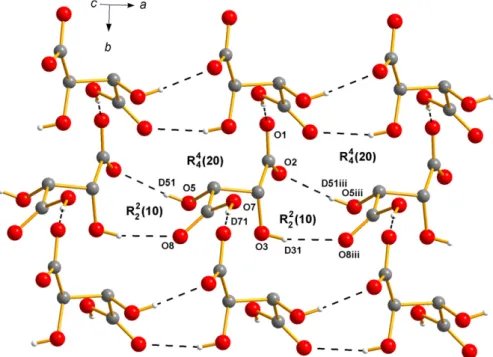
discrete, are interact each other via different hydrogen bonding motifs forming a 2D-layer parallel to the (0 0 1) crystallographic plane. On of the motif isR22(10) that is formed between the trans-lationally equivalents tartate() anions via two OAH O hydrogen bonds between the hydroxyl groups and one of oxygen atoms of COO and COOH groups. The other motif in the 2D-layer is R44(20) and is formed by four tartate() anions related by a screw axis and translation along thea-axis. The largeR44(20) hydrogen bonding motif is formed by four OAH O hydrogen bonds. Two of them are formed between the hydroxyl groups as donors and O2 and O8 atoms of COO and COOH groups as acceptors, and the other two are formed between the COOH groups as donors and the COOgroups as acceptors between the tartate() anions related by a screw axis. The arrangement of the oppositely charged
units, 1-(diaminomethylene)thiouron-1-ium cations and tar-tate() monoanions, is mainly determined by the ionic and
direc-tional OAH O and NAH O hydrogen bonds and to a lesser degree by the van der Waals forces forming a layered structure (Fig. 6). The neighbouring 2D-layers interact via van der Waals forces and by weak NAH S hydrogen bonds.
The second harmonic generation properties were measured on crystalline samples that were irradiated at 1064 nm and the sec-ond harmonic beam power diffused by the samples at 532 nm were measured as a function of the fundamental beam power. The SHG efficiency relative to KDP was found to be 0.77 and 0.82 for protiated and deuterated D10crystals, respectively.
The FT-IR spectra of bis[1-(diaminomethylene)thiouron-1-ium] tartate(2) hemihydrate and the deuterated
1-(diaminomethyl-Fig. 6.The crystal packing of deuterated D101-(diaminomethylene)thiouron-1-ium tartate showing the 2D-layers parallel to (001) plane.
4000 3500 3000 2500 2000 1500 1000 500
0.0 0.2 0.4 0.6 0.8 1.0
520
3361 3118
746 696
726 623
584
988
971
914
839
1164
1132
1079
1290
1237
1341
1377
1514
1462
1366
1666
3123 1621
1717
3185
3285
3387
3342
3410
Transmittance
Wavenumber [cm-1] N
Fig. 7.Room temperature FTIR spectrum of bis[1-(diaminomethylene)thiouron-1-ium] tartate(2) hemihydrate.
ene)thiouron-1-ium tartate() are shown inFigs. 7 and 8, respec-tively. The bands corresponding to the vibration of the functional groups were identified with the aid of infrared correlation charts [32,33]. In addition, the spectra are compared with the spectra of 1-(diaminomethylene)thiourea [15] and of tartaric acid [34–36] as well as of tartate(2) and tartate() salts [37–42]. The title compounds have several functional and skeletal groups such as three NH2(or ND2) C@S, CANAC, NACAN and NACAS groups in
the cation and COO, (COOD), OH or OD, C
AC, CACAC and CAH in the anion. The tartate(2) dianion in protiated crystals has C2
symmetry, while the tartate() monanion in deuterated crystals exhibits lower symmetry (C1), and the splitting of the vibrations
modes is expected. A careful inspection of the IR spectrum (Fig. 8) shows medium-strong intensity bands in the spectral range of 3500 and 3000 cm1that can be attributed to the asymmetric
and symmetric stretching of three NH2groups of the
1-(diaminom-ethylene)thiouron-1-ium cation as well as to stretching vibration of hydroxyl groups of tartate(2) dianion and the hydrated water
molecule. These bands, as expected, are shifted in the IR spectrum of deuterated sample (Fig. 8) to the spectral region of 2600– 2200 cm1. The strong narrow band at 1709 cm1in the IR
spec-trum of protiated sample is assigned to the stretching of imine bond of the cation, since a similar band is observed in some imines and their salts[43]. In addition, the band of imine group of the deu-terated sample is shifted, as expected, to the 1263 cm1(Fig. 8).
The X-ray data reveal that the all NH2groups of
1-(diaminometh-ylene)thiouron-1-ium cation in the protiated crystals are involved in the NAH O hydrogen bonds with N O distances ranging from 2.697(2) to 3.072(2) Å. This reveals as a broad band at2700 cm1,
which is shifted to1900 cm1in the spectrum of deuterated
crys-tals in which the amine groups ND2are involved in the NAD O hydrogen bonds with N O distances ranging from 2.891(2) to 3.216(2) Å. Additionally, the broad band in the region of 1400– 1100 cm1that overlaps with
m
(CAN) of the cation points thepres-ence of the NAH O hydrogen bonds. The
m
a(CO2) andm
s(CO2)bands of tartate anion in the IR spectrum of bis[1-(diaminomethyl-ene)thiouron-1-ium] tartate hemihydrate are observed at 1621 and 1514 cm1, respectively, which can be also found in the
spec-trum of deuterated crystals (Fig. 8). The
m
(C@S) band of the 1-(diaminomethylene)thiouron-1-ium cation, similar as in thiourea, is observed at730 cm1in both samples, while in severalthio-urea metal complexes the
m
(C@S) band is observed in the range 715–700 cm1[44]. The observed frequencies of the mostpromi-nent bands and their assignments for the protiated and deuterated samples are listed inTable 4.
4000 3500 3000 2500 2000 1500 1000 500
0.0 0.1 0.2 0.3 0.4 0.5 0.6 0.7 0.8 585 912 3123 3185 3342 3410 521 680 760 700 720 801 1110 1142 1195 959 882 1019 870 1071 1323 1263 1992 1312 1901 1458 1516 1400 1625 1669 2298 2458 2523 2366 2316 2397 2558 N Transmittance
Wavenumber [cm-1]
Fig. 8.Room temperature FTIR spectrum of deuterated D101-(diaminomethylene)-thiouron-1-ium tartate(
).
Table 4
FT IR spectral data for protiated bis[1-(diaminomethylene)thiouron-1-ium] tar-tate(2) hemihydrate and deuterated 1-(diaminomethylene)thiouron-1-ium tartate().
Protiated,m (cm1)
Deuterated,m (cm1)
Assignment
3410s 2558m OH or OD
3387s 2523m ma(NH2) orma(ND2) asym stretch 3361m 2458m ma(NH2) orma(ND2) asym stretch 3342s 2397m ma(NH2) orma(ND2) asym stretch
3285s 2366s OH or OD
3185m 2316m ms(NH2) orms(ND2) sym stretch 3123m 2298m ms(NH2) orms(ND2) sym stretch 3118m 2280m ms(NH2) orms(ND2) sym stretch 1717s 1263m Imine bond stretch
1666m 1669 ma(CO2)
1621s 1625s ma(CO2)
1514m 1516m ms(CO2)
1462m 1458s m(CAN)
1426w 1400 c(CAC) overlapped with Nujol
1377m 1019m OH (OD) in-plane bend 1366m m(CAN) overlapped with Nujol
1341m 1323m, 1312m
1290m 959w d(NH2),d(ND2)
1237w 1195w
1164w 870w d(NH2),d(ND2)
1132w 1142m c(NH2)
1110m
1079m 1071w
988w
971w c(CAN)
914w 912w d(OACAO) overlapped with m(CAC)
882w
839w 801w
746m 760w c(CAC)
726m 720m m(C@S)
696m 700s
623m 680s s(NH2),x(NH2) 584m 585w Skeletal CANAC, NACAN
4. Conclusion
The protiated single crystals of bis[1-(diaminomethylene)thiou-ron-1-ium] tartate(2) hemihydrate were grown using a solution growth technique. The oppositely charged units, i.e. 1-(diaminom-ethylene)thiouron-1-ium cation and tartate dianion interact via two pairs of almost linear NAH O hydrogen bonds with a graphs ofR12(6) andR22(8) forming bis[1-(diaminomethylene)thiouron-1-ium] tartate(2) supramolecular complex. The arrangement of these supramolecular complex units in the crystal is mainly deter-mined by the NAH O hydrogen bonds forming 2D-layered struc-ture. In the deuterated crystals the tartate() monoanion interacts
with 1-(diamino-methylene)thiouron-1-ium cation via five hydro-gen bonding motifs. Three of them areR21(5) and the other two are R12(6) forming 1:1 hydrogen bonded supramolecular complex. In the deuterated crystal the tartate() monoanions, in contrast to the tartate(2) dianions in the protiated crystals in which they are discrete, are interact each other via different hydrogen bonding motifs,R22(10) andR44(20), forming a 2D-layer parallel to the (0 0 1)
crystallographic plane. The SHG efficiency relative to KDP was found to be 0.77 and 0.82 for protiated and deuterated crystals, respectively. Comparison of the IR spectra of protiated bis[1-(diaminomethylene)thiouron-1-ium] tartate(2) hemihydrate with the deuterated 1-(diaminomethylene)thiouron-1-ium tar-tate() clearly shows marked differences in the regions of vibra-tions of the amine and imine groups as well as in the region of the NAH O hydrogen bonds.
Appendix A. Supplementary material
Additional material comprising full details of the X-ray data col-lection and final refinement parameters including anisotropic ther-mal parameters and full list of the bond lengths and angles have been deposited with the Cambridge Crystallographic Data Center in the CIF format as supplementary publications no. CCDC 874067 and 874068 for deuterated and protiated crystals. Copies of the data can be obtained free of charge on the application to CCDC, 12 Union Road, Cambridge, CB21EZ, UK, (fax: (+44) 1223-336-033; email: [email protected]). Supplementary data associated with this article can be found, in the online version, at http://dx.doi.org/10.1016/j.molstruc.2012.07.034.
References
[1] G.R. Desiraju, T. Steiner, The Weak Hydrogen Bond in Structural Chemistry and Biology, Oxford University Press, Oxford, 1999.
[2] G.R. Desiraju, Acc. Chem. Res. 35 (2002) 565.
[3] A.D. Burrows, C.W. Chann, M.M. Chowdhy, J.E. McGrady, D.M.P. Mingos, Chem. Soc. Rev. 24 (1995) 329.
[4] G.R. Desiraju, Crystal Engineering. The Design of Organic Solids, Elsevier Science Publishers, Amsterdam, 1990.
[5] G.M. Whitesides, E.E. Simanek, J.P. Mathias, C.T. Seto, D.N. Chin, M. Mammen, D.M. Gordon, Acc. Chem. Res. 28 (1995) 37.
[6] J.M. Lehn, Supramolecular Chemistry: Concepts and Perespectives, VCH, Weinheim, 1995.
[7] S.C. Zimmerman, P.S. Corbin, Struct. Bond. 96 (2000) 63–94. [8] M. Moulton, M. Zaworotko, Chem. Rev. 101 (2001) 1629. [9] J. Janczak, G.J. Perpétuo, Acta Cryst. C64 (2008) o114. [10] J. Janczak, G.J. Perpétuo, Acta Cryst. C64 (2008) o330. [11] G.J. Perpétuo, J. Janczak, Acta Cryst. C64 (2008) o264. [12] J. Janczak, G.J. Perpétuo, Acta Cryst. C65 (2009) o118. [13] M. Hołyn´ska, M. Kubiak, Acta Cryst. C65 (2009) o191. [14] M. Hołyn´ska, M. Kubiak, Acta Cryst. C65 (2009) o410. [15] J. Janczak, G.J. Perpétuo, J. Mol. Struct. 975 (2010) 166. [16] J. Janczak, G.J. Perpétuo, J. Mol. Struct. 988 (2011) 73. [17] N. Blagden, K.R. Seddon, Cryst. Eng. 2 (1999) 9.
[18] S. Ghattacharya, P. Dastidar, T.N.G. Row, Chem. Mater. 6 (1994) 531. [19] J. Zyss, J.L. Oudar, Phys. Rev. A 26 (1982) 2016.
[20] J. Janczak, G.J. Perpétuo, Acta Cryst. C63 (2007) o117. [21] J. Janczak, G.J. Perpétuo, Solid State Sci. 11 (2009) 1576.
[22] CrysAlis CCD and CrysAlis Red, Version 171.32.6, Oxford Diffraction Poland, Wrocław, Poland, 2006.
[23] G.M. Sheldrick, SHELXS97, SHELXL97, Programs for Crystal Structures Solution and Refinement, University of Göttingen, Göttingen, Germany, 1997. [24] K. Brandenburg, H. Putz, DIAMOND Version 3.0, Crystal Impact GbR, Bonn,
Germany, 2006.
[25] S.K. Kurtz, T.T. Perry, J. Appl. Phys. 39 (1968) 3798.
[26] WinXPow Software Manual, STOE & GmbH, Darmstadt, Germany, 1997. [27] D.R. Johnson, F.X. Powell, W.H. Kirchoff, J. Mol. Spectrosc. 39 (1971) 136. [28] R. Fausto, L.A.E. Batista de Carvalho, J.J.C. Teixeria-Dias, M.N. Ramos, J. Chem.
Soc., Perkin Trans. 2 (1989) 1945.
[29] H. Hope, U. de la Camp, Acta Cryst. A28 (1972) 201.
[30] G.Y. Bai, H.S. Ning, J. Simpson, X.Y. Qin, N. Li, Acta Cryst. E62 (2006) o4567. [31] F.H. Allen, C.H. Bird, R.S. Rowland, P.R. Raithby, Acta Cryst. B53 (1997) 696. [32] J. Valdez-Martinez, S. Hernandez-Ortega, M. Rubio, D.T. Li, J.K. Swearingen, W.
Kaminsky, D.R. Kelman, D.X. West, J. Chem. Crystallogr. 34 (2004) 535. [33] G. Socrates, Infrared Characteristic Group Frequencies, Wiley-Interscience,
Chichester, UK, 1980.
[34] L.I. Kozhevina, L.G. Skryabina, Yu.K. Tselinskii, J. Appl. Spectrosc. 33 (1980) 1347.
[35] L.D. Barron, A.R. Gargaro, L. Hecht, P.L. Polavarapu, H. Sugeta, Spectrochim. Acta A48 (1992) 1051.
[36] R. Bhattacharjee, Y.S. Jain, H.D. Bist, J. Raman Spectrosc. 20 (1989) 91. [37] P. Pajagopal, G. Sekar, G. Aruldhas, V. Ramakrishnan, Proc. Indian Acad. Sci. 101
(1989) 243.
[38] S. Vidya, C. Ravikumar, I. Hubert Joe, P. Kumaradhas, B. Devipriya, K. Raju, J. Raman Spectrosc. 42 (2011) 676.
[39] P.P. Pradyumnan, Indian J. Pure Appl. Phys. 47 (2009) 199.
[40] A. Bright, T.S. Renuga Devi, S. Gunasekaran, Int. J. Chem. Tech. Res. 2 (2010) 379.
[41] M.M. Freed, S.M. Delphine, R.K. Priya, T.H. Freeda, A.W. Almusallam, Recent Res. Sci. Technol. 2 (2010) 9.
[42] N. Kaneko, M. Kaneko, H. Takahashi, Spectrochim. Acta A40 (1984) 33. [43] J. Favrot, D. Vocelle, C. Sandrofy, Photochem. Photobiol. 28 (1979) 417. [44] F.H. Allen, C.H. Bird, R.S. Rowland, P.R. Raithby, Acta Cryst. B53 (1997) 680.

![Fig. 7. Room temperature FTIR spectrum of bis[1-(diaminomethylene)thiouron-1-ium] tartate(2) hemihydrate.](https://thumb-eu.123doks.com/thumbv2/123dok_br/15714111.631230/6.892.196.710.105.488/room-temperature-ftir-spectrum-diaminomethylene-thiouron-tartate-hemihydrate.webp)

