Migration is defined as a seasonal and cyclic population movement (ALERSTAM & HEDENSTRÖM 1998) observed in all ani-mal classes and studied mainly in vertebrates. A considerable part of the knowledge on migration comes from birds, for which migration is an important aspect of their biology (BISSON et al. 2009). In some bat species, females usually migrate larger dis-tances than males (FLEMING & EBY 2003). Migratory movements may not occur in all populations of a species (MCCRAKEN et al. 1994, RUSSEL et al. 2005).
Migration occurs mainly in species that live in temper-ate climtemper-ates, and is more common in winter (SICK 1997). It is,
therefore, less frequently observed in the Neotropics (FENTON & KUNZ 1977). Migration may occur over large distances, between localities in different continents or hemispheres. There is also migration that involves only altitudinal, latitudinal or longi-tudinal movements; these movements, which may be regional or local, are related to resource availability (ALVES 2007).
Even for birds, local and vertical migrations are the least known and the most difficult to record (SICK 1997, MAIA-GOUVEIA et al. 2005). Some authors do not consider smaller spatial move-ments in bats as migration, because they do not require physi-ological adaptations (FLEMING & EBY 2003, BISSON et al. 2009).
Evidence of vertical migration in the Ipanema bat
Pygoderma bilabiatum
(Chiroptera: Phyllostomidae: Stenodermatinae)
Carlos E. L. Esbérard
1,8; Isaac P. de Lima
1; Pedro H. Nobre
2; Sérgio L. Althoff
3;
Tássia Jordão-Nogueira
4; Daniela Dias
5; Fernando Carvalho
6; Marta E. Fabián
6;
Margareth L. Sekiama
7& Artur Stanke Sobrinho
31 Departamento de Biologia Animal, Instituto de Biologia, Universidade Federal Rural do Rio de Janeiro. Antiga estrada
Rio-São Paulo, km 47, Caixa Postal 74507, 23890-000 Seropédica, RJ, Brazil.
2 Departamento de Ciências Naturais, Universidade Federal de Juiz de Fora. Rua Visconde Mauá 300, 36015-260 Juiz de
Fora, MG, Brazil.
3 Laboratório de Biologia Animal, Departamento de Ciências Naturais,Universidade Regional de Blumenau. Rua Antônio da
Veiga 140, 89012-900 Blumenau, SC, Brazil.
4 Laboratório de Ecologia de Mamíferos, Instituto de Biologia, Universidade do Estado do Rio de Janeiro. Rua São Francisco
Xavier 524, 20550-900 Rio de Janeiro, RJ, Brazil.
5 Laboratório de Biologia e Parasitologia de Mamíferos Silvestres Reservatórios, Fundação Oswaldo Cruz. Avenida Brasil
4365, Pavilhão Arthur Neiva, 21040-900 Rio de Janeiro, RJ, Brazil.
6 Departamento de Zoologia, Universidade Federal do Rio Grande do Sul. Avenida Bento Gonçalves 9500,
91501-970 Porto Alegre, RS, Brazil.
7 Departamento de Ciências da Natureza, Matemática e Educação, Centro de Ciências Agrárias, Universidade Federal de São
Carlos. Rodovia Anhanguera, km 174, 13600-970 Araras, SP, Brazil.
8 Corresponding author. E-mail: [email protected]
ABSTRACT. Migration is defined as a seasonal and cyclic population movement observed in all animal classes and studied mainly in vertebrates. A considerable part of the knowledge on migration comes from birds, for which migra-tion is an important aspect of their biology. In the case of bats, females usually migrate larger distances than males in some species. The present study analyzes the seasonal occurrence of Pygoderma bilabiatum (Wagner, 1843) at different elevations, in order to test for a pattern that evidences migration, using data from the states of Espírito Santo, Minas Gerais, Rio de Janeiro, São Paulo, Paraná, Santa Catarina, and Rio Grande do Sul, Brazil. A total of 529 specimens of P. bilabiatum were captured. Pygoderma bilabiatum seems to be more frequent at intermediate and high elevations (over 80% of all captures were made above 250 m a.s.l.) and at latitudes above 22°S, where rainfall is high (over 1,500 mm) and temperatures are mild (16-23°C). Sex ratio varied with elevation; it was skewed towards males at lower elevations (N = 9, r2 = 0.60, F = 12.311, p = 0.008, Sex ratio = 0.0004*elevation + 0.976), though females predominated at all altitudinal bands and in all states analyzed.
However, local or regional movements in bats are also expected in the Neotropics (e.g., PASSOS et al. 2003, MELLO et al. 2009), and many authors reported changes in bat assemblages between dry and rainy seasons (e.g., MARINHO-FILHO & SAZIMA 1989, PEDRO & TADDEI 2002, AGUIAR & MARINHO-FILHO 2004, CAMARGO et al. 2009), based mainly on variations in capture rates or species richness. Horizontal, vertical and regional move-ments may be important to understand temporal variations in the abundance of some species, but they do not necessarily represent migration, because the whole population does not perform them in a cyclic way. Although partial migration can be more frequent than expect by this definition (CHAPMAN et al. 2011).
Little is known about the biology of the Ipanema Broad-Nosed Bat, Pygoderma bilabiatum (Wagner, 1843), a frugivorous species (GARDNER 1977) that feeds on species such as Pouteria caimito (Ruiz & Pav.) Radlk (Sapotaceae), Miconia brasiliensis (Spreng.) (Melostomataceae), Maclura tinctoria (L.) Don ex Steud (Moraceae), Ficus insipida Willd, F. enormis (Mart. ex Miq.)
(Moraceae), Solanum sanctae-catharinae, S. granuloso-leprosum Dunal (Solanaceae), and Eugenia (Myrtaceae) (PERACCHI & ALBU -QUERQUE 1971, WEBSTER & OWEN 1984, FARIA 1997, PASSOS et al. 2003).
The present study analyzes the seasonal occurrence of P. bilabiatum at different elevations, in order to test for a pattern that evidences migration, using published and unpublished data from southern and southeastern Brazil.
MATERIAL AND METHODS
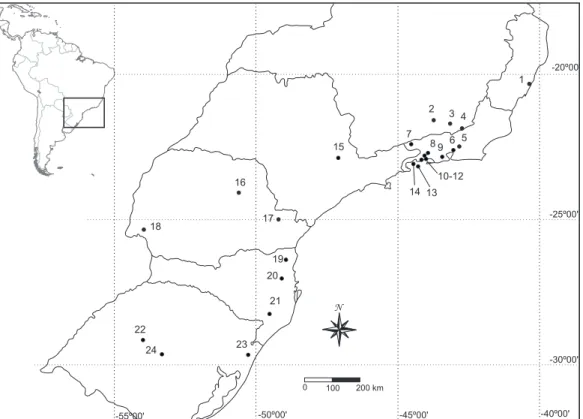
In the present study, 26 samples from 21 localities were analyzed within the sensu strictu Atlantic Forest Biome (URURAHY et al. 1983). Geographic coordinates and elevation of sampling sites are given in Tab. I and Fig. 1. The reproductive condition of females was assessed at the moment of capture and each specimen was assigned to one of the following categories: in-active female, female with palpable fetus and lactating female (e.g., COSTA et al. 2007).
-40º00' -45º00'
-50º00' -55º00'
-30º00' -25º00' -20º00'
22
24 23
21 20
19
18 17
16
15
7
14 13 10-12 2
8 9 6 5 4 3
1
0 100 200 km
N
Captures were grouped according to states and altitudinal bands (1-1,600 m a.s.l., in 200 m intervals). Each altitudinal band had at least 24 months of continuous sampling, with a mini-mum sampling effort of two nights per month, except for the bands over 1,200 m a.s.l., which were only occasionally sampled.
To test for differences in average temperatures between months when the species was present and months when the species was absent in the samples, we used a Student t test (␣ =
0.05). To test for the effect of rainfall on the local seasonality of P. bilabiatum a linear regression between average rainfall and
Table I. Percentage of captures of Pygodermabilabiatum in different municipalities and states in southeastern and southern Brazil. For each site we inform its geographical coordinates, elevation (m), sampling period, and number of sampling nights. Parentheses indicate years with sampling at monthly intervals; other years were sampled irregularly.
Municipality (States) Sampling Sites Coordinates Elevation (m) Sampling period Nights %
Guarapari (ES) Paulo Cesar Vinha 20°34.0’S, 40°24.5’W 1 2004-2005 28 0.56
Angra dos Reis (RJ) Ilha Grande 23°09.4’S, 44°14.3’W 1-120 1997-2003 58 0.06
Angra dos Reis (RJ) Ilha Grande 23°09.4’S, 44°14.3’W 240 2004-2006 35 2.86
Angra dos Reis (RJ) Ilha da Gipóia 23°02.4’S, 44°22.3’W 1-40 2003-2010 40 0.05
Nova Iguaçu (RJ) Reserva Biológica do Tinguá – 1-1,270 2000-2006 31 1.53
Nova Friburgo (RJ) 22°16.9’S, 42°31.9’W 790 – – –
Guapimirim (RJ) Estação Ecológica Paraíso 22°29.8’S, 42°54.5’W 80 1996, 1997-1998, 2000, 2004 43 0.65
Itaguaí, Mangaratiba, Seropédica, Cacaria (RJ)
Banana plantations and
surrounding forests – 1-120 2008-2010 48 0.17
Mangaratiba (RJ) Reserva Rio das Pedras 22°59.7’S, 24°06.3’W 40 1995, 1997-1998, 2004-2008, 2009 41 0.08
Mangaratiba (RJ) Fazenda Portobello 22°56.5’S, 44°00.9’W 1-110 1994,1995, 2005-2010 19 0.18
Petrópolis (RJ) Reserva Biológica de Araras 22°26.0’S, 43°15.2’W 1,100 1993-1995 47 1.28
Rio de Janeiro (RJ) Parque Nacional da Tijuca 22°57.4’S, 43°17.7’W 535 1995-1997, 1998-2002 46 0.29
Rio de Janeiro (RJ) Alto da Boa Vista 22°54.2’S, 23°15.6’W 565 2001-2003 7 0.67
Rio de Janeiro (RJ) Parque Penhasco Dois Irmãos 22°59.1’S, 43°14.1’W 440 1996-1997, 1999-2001 21 0.12
Teresópolis (RJ) Parque Nacional da Serra dos
Órgãos 22°29.5’S, 43°00.8’W 410 – – –
Seropédica (RJ) 22°45.9’S, 43°41.3’W 40 – – –
Rio de Janeiro (RJ) Parque da Cidade 23°58.8’S, 43°14.8’W 480 1992-1994,1995 – 1999 31 0.10
Valença (RJ) Serra da Concórdia 22°22.2’S, 43°47.2’W 600 2005 and 2010 15 1.69
Rio Preto (MG) 22º01.7'S, 43º52.5'W 400-900 1997 56 –
Descoberto (MG) 21º 27’S, 42º58.0’W 400-500 – – –
Lima Duarte (MG) 21º50’S, 43º48.0’W 750-800 – – –
Juiz de Fora (MG) 21°46.3’S, 43°22.1’W 900 2003-2010 104 –
Lima Duarte (MG) Parque Estadual do Ibitipoca 21º51’S, 43º48’W 1,430 2010-2011 14 –
Campinas (SP) Santa Genebra 22°49.2’S, 47°07.0’W 650 1994* 35 6.16*
Telêmaco Borba (PR) Fazenda Monte Alegre 21°13.4’S, 50°32.5’W 885 2004-2007 84 2.97
Céu Azul (PR) Parque Nacional do Iguaçú 25°23’S, 54°09’W 200-400
Tunas do Paraná (PR) Parque Estadual de Campinhos 25°02.2’S, 49°05.5’W 890 2003-2004 24 2.13
Florianópolis (SC) Nascentes do Garça 27°03.6’S, 49°06.7’W 320 2004-2006 81 6.68
Florianópolis (SC) Nascentes do Garça – 640 2004-2006 81 27.3
Joinville (SC) – 1-200 1989-1997 –
Pedra Grande (SC) – 330 2009-2010 39 2.27
Doutor Pedrinho (SC) Reserva de Sassafrás 26°42.7’S, 49°40.5’W 915 2010-2011 21 10.77
Derrubadas (RS) Parque Estadual do Turvo 27°11.5’S, 53°56.0’W 485 1990-1992 31 4.16
Maquiné (RS) 29°40.5’S, 50°12.4’W 83 – – –
Agudos (RS) 29º 38.7’S 53º15.0’W 50 – –
the number of months when the species was captured was cal-culated for the 11 localities with higher number of captures.
To test whether males and females prefer different eleva-tions, we calculated a linear regression between sex ratio, expressed as the total number of males divided by the total number of fe-males, and elevation for nine samples with at least ten captures.
RESULTS
For the entire dataset the total sampling effort was 1,141 nights and 9,296 hours in 24 localities (Fig. 1); 529 specimens of P. bilabiatum were captured (0.47 specimens/night and 0.06 speci-mens/hour), at elevations that varied from 1 to 1,430 m a.s.l.
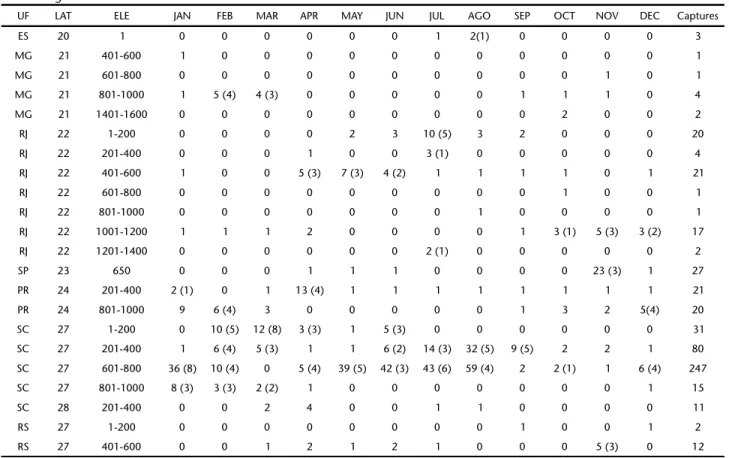
In Espírito Santo, three individuals were captured in July and August 2005: two males and one female (Tab. II). In 16 lo-calities of Rio de Janeiro, P. bilabiatum was observed in all altitu-dinal bands. Three bands had few captures: 601-800 m a.s.l., 801-1,000 m a.s.l. (one capture each) and 1,200-1,400 m a.s.l. (two captures). At 1,001-1,200 m a.s.l., 17 animals were collected from January to April and from September to December, a rate of 0.03 captures/hour. In the intermediate bands, the presence
of P. bilabiatum was confirmed by 21 captures at 401-600 m a.s.l. (0.010 captures/hour) and four captures at 201-400 m a.s.l. (0.01 captures/hour). Bats were captured during all months, except for February, March, June and November. At the lower band, the species was only captured in March and from May to Sep-tember, with a total of 20 individuals (0.006 captures/hour).
During the dry season, P. bilabiatum was absent from el-evation bands at 1,100 m a.s.l. or higher (six months), except for two individuals captured in July at 1,270 m a.s.l. However, it was found during the same period at 1-200 m a.s.l.; at this elevation there are also dry months (five months), but they are warmer. The sex ratio was 1.00 males/females at 1-200 m a.s.l, but at the other bands there was a higher frequency of females: 0.50 males/females at 201-400 m a.s.l., 0.63 males/females at 401-600 m a.s.l. and 0.42 males/females at 1,001-1,200 m a.s.l. Out of 62 individuals analyzed, 10 females were repro-ductive and among them, four were pregnant: one in Septem-ber, two in October and one in November. Five lactating females were found: one in August, one in October, two in November and one in December. None of the females captured at 1-200 m a.s.l. were reproductive.
Table II. Captures of Pygodermabilabiatum in the states (UF) of Espírito Santo, Minas Gerais, Rio de Janeiro, São Paulo, Paraná, Santa Catarina, and Rio Grande do Sul, according to month and elevation. Latitude (LAT) is given in degrees and elevation (ELE) in meters above sea level. Numbers in parentheses represent the number of nights in which the species was captured, when it differed from the total of nights.
UF LAT ELE JAN FEB MAR APR MAY JUN JUL AGO SEP OCT NOV DEC Captures
ES 20 1 0 0 0 0 0 0 1 2(1) 0 0 0 0 3
MG 21 401-600 1 0 0 0 0 0 0 0 0 0 0 0 1
MG 21 601-800 0 0 0 0 0 0 0 0 0 0 1 0 1
MG 21 801-1000 1 5 (4) 4 (3) 0 0 0 0 0 1 1 1 0 4
MG 21 1401-1600 0 0 0 0 0 0 0 0 0 2 0 0 2
RJ 22 1-200 0 0 0 0 2 3 10 (5) 3 2 0 0 0 20
RJ 22 201-400 0 0 0 1 0 0 3 (1) 0 0 0 0 0 4
RJ 22 401-600 1 0 0 5 (3) 7 (3) 4 (2) 1 1 1 1 0 1 21
RJ 22 601-800 0 0 0 0 0 0 0 0 0 1 0 0 1
RJ 22 801-1000 0 0 0 0 0 0 0 1 0 0 0 0 1
RJ 22 1001-1200 1 1 1 2 0 0 0 0 1 3 (1) 5 (3) 3 (2) 17
RJ 22 1201-1400 0 0 0 0 0 0 2 (1) 0 0 0 0 0 2
SP 23 650 0 0 0 1 1 1 0 0 0 0 23 (3) 1 27
PR 24 201-400 2 (1) 0 1 13 (4) 1 1 1 1 1 1 1 1 21
PR 24 801-1000 9 6 (4) 3 0 0 0 0 0 1 3 2 5(4) 20
SC 27 1-200 0 10 (5) 12 (8) 3 (3) 1 5 (3) 0 0 0 0 0 0 31
SC 27 201-400 1 6 (4) 5 (3) 1 1 6 (2) 14 (3) 32 (5) 9 (5) 2 2 1 80
SC 27 601-800 36 (8) 10 (4) 0 5 (4) 39 (5) 42 (3) 43 (6) 59 (4) 2 2 (1) 1 6 (4) 247
SC 27 801-1000 8 (3) 3 (3) 2 (2) 1 0 0 0 0 0 0 0 1 15
SC 28 201-400 0 0 2 4 0 0 1 1 0 0 0 0 11
RS 27 1-200 0 0 0 0 0 0 0 0 1 0 0 1 2
In Minas Gerais, 22 specimens from three localities were analyzed, at elevations that varied from 400 to 1,430 m a.s.l. However, only at 801-1,000 m a.s.l. more than two captures of P. bilabiatum were obtained. There was a predominance of fe-males: 0.47 males/females in the entire sample and 0.42 males/ females at 801-1,000 m a.s.l. (N = 17 individuals). Reproduc-tive activity was observed in February, March and April, with pregnant and lactating females captured at 900 m a.s.l. and a lactating female captured at 1,430 m a.s.l. in October.
In Campinas, state of São Paulo, 27 animals were cap-tured; 19 were captured during a single night close to a M. tinctoria in fruit. Captures were carried out from April to June and from November to December. Lactating (N = 16) and preg-nant (n = 5) females were observed in November.
In the Parque Nacional do Iguaçú, state of Paraná, 21 specimens were captured every month except for February (12 females and 9 males). Lactating females were observed in Janu-ary, March and April. In the Fazenda Monte Alegre, a total of 20 specimens were collected at 885 m a.s.l. (nine males and 11 females), with captures concentrated from January to March and from October to December (0.06 captures/hour). Pregnant females were observed in January and lactating females in March. In the Parque Estadual de Campinho, nine individuals were captured in September, January, February and March.
In Santa Catarina, 91 individuals were captured at 201-400 m a.s.l. and 241 animals at 601-800 m a.s.l., resulting in rates of 0.12 and 0.50 captures/hour, respectively. This species was present in all months at these elevation bands. In Joinville and surround-ings, 31 animals were captured at 1-200 m a.s.l. from February to June, and in the Reserva Estadual de Sassafrás 14 animals were captured from January to April. Reproductive females were ob-served in March, April and June at 1-200 m a.s.l.; in January, July and August at 201-400 m a.s.l.; in September, October and De-cember at 601-800 m a.s.l.; and from January to April at 915 m a.s.l. The sex ratio observed was 0.81 males/females at 1-200 m a.s.l., 0.89 males/females at 320 m a.s.l., 0.63 males/females at 640 m a.s.l., and 0.56 males/females at 915 m a.s.l.
In Rio Grande do Sul, 12 specimens were collected at 401-600 m a.s.l. (sex ratio = 0.50 males/females) in March, April, May, June, July and November; a pregnant female was observed in November.
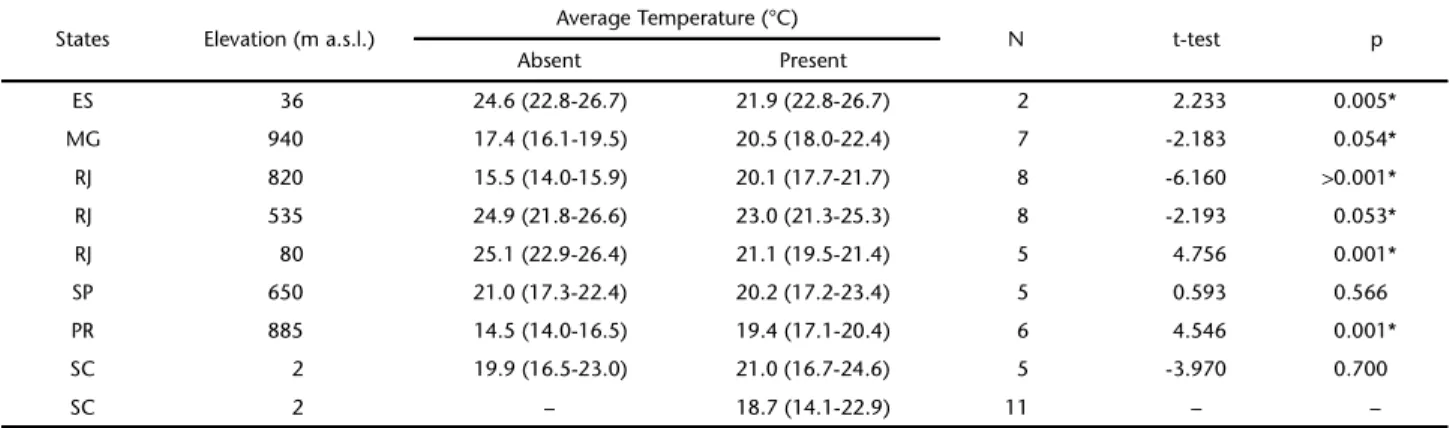
Pygoderma bilabiatum was present in higher sites in months with temperatures over 16°C, as shown in Tab. III for Araras (Rio de Janeiro), Telêmaco Borba (Paraná) and Juiz de Fora (Minas Gerais). At intermediate elevations in Campinas and Rio de Janeiro (401-800 m a.s.l.) there were no differences in average temperature between months when the species was present or absent. In these localities the low density of this species probably results from the lack of specimens captured in other months of the year. At low elevations, such as Rio de Janeiro at 80 m a.s.l. and Espírito Santo at 1 m a.s.l., the species was present in months with temperatures below 23°C. In Santa Catarina, where the species was present throughout the year, it occurred at average temperatures below 21°C.
All localities at intermediate and high elevation (over 600 m a.s.l.) have high rainfall (over 1,500 mm). We observed a positive relationship between the number of months in which the species was captured in each locality and its average rain-fall (N = 11 localities, r2 = 0.41, F = 6.361, p = 0.033, occurrence = 0.0928*rainfall – 4.3539).
Sex ratio varied with elevation. It was skewed towards males at lower elevations (N = 9, r2 = 0.60, F = 12.311, p = 0.008, Sex ratio = 0.0004*elevation + 0.976), though females predomi-nated at all elevation bands and in all states analyzed (Fig. 2).
DISCUSSION
Pygoderma bilabiatum seems to be more frequent at inter-mediate and high elevations (over 80% of all captures were observed above 250 m a.s.l.) and at latitudes above 22°S, where rainfall is high (over 1,500 m) and temperatures are mild (16-23°C). For instance, in the state of Santa Catarina (27°S), where it was the third most frequent frugivorous bat in the Parque Nacional Serra de Itajaí (313 out of 2,252 captures) at 320 and
Table III. Temperature (average value and variance) in sites in different states and at different elevations, where Pygodermabilabiatum was present of absent, number of months when the species was captured (N) and t test results.
States Elevation (m a.s.l.) Average Temperature (°C) N t-test p
Absent Present
ES 36 24.6 (22.8-26.7) 21.9 (22.8-26.7) 2 2.233 0.005*
MG 940 17.4 (16.1-19.5) 20.5 (18.0-22.4) 7 -2.183 0.054*
RJ 820 15.5 (14.0-15.9) 20.1 (17.7-21.7) 8 -6.160 >0.001*
RJ 535 24.9 (21.8-26.6) 23.0 (21.3-25.3) 8 -2.193 0.053*
RJ 80 25.1 (22.9-26.4) 21.1 (19.5-21.4) 5 4.756 0.001*
SP 650 21.0 (17.3-22.4) 20.2 (17.2-23.4) 5 0.593 0.566
PR 885 14.5 (14.0-16.5) 19.4 (17.1-20.4) 6 4.546 0.001*
SC 2 19.9 (16.5-23.0) 21.0 (16.7-24.6) 5 -3.970 0.700
640 m a.s.l. In Paraguay (24°S), it was also the third most fre-quent species (522 out of 7,725 captures (GORRESEN & WILLIG 2004, STEVENS et al. 2004), and it was more frequent in sites located between 100 and 300 m a.s.l. (WILLIGet al. 2000). At latitudes below 22°S, this species has been rarely captured (PERACCHI & ALBUQUERQUE 1993, OPREA et al. 2007, FARIA et al. 2006). All these sites have high average temperatures and low fall. In Santa Catarina and Rio Grande do Sul, where total rain-fall is high and monthly variations are small, this species can be found at all elevations throughout the year.
Vertical migration can only be proved through recaptures of previously marked animals. However, inferring from these data, P. bilabiatum probably moves from higher regions during colder months in the states of Rio de Janeiro and Paraná; it is found at intermediate elevations throughout the year and also at sea level in the months when it is absent from the high-lands. These movements of P. bilabiatum may not cover large distances, since from the base to the top of Serra do Mar in Rio de Janeiro the linear distance is shorter than 30 km. Similarly, smaller densities of Sturnira lillium (E. Geoffroy, 1810) were observed in a high locality in southeastern Brazil during the colder months, though food-plant availability was not reduced when temperatures were lower (MELLO et al. 2008).
Although the inferred partial migration (CHAPMANet al. 2001) of P. bilabiatum populations of southeastern Brazil and Paraná from highlands to lowlands occurs during the driest four months of the year, when less than 25% of the annual rainfall occurs, rainfall seems to be less important than tem-perature at this latitude (22 to 24°S). Phenology of food-plants and foraging strategies of bats seem to be more important than rainfall (MELLO 2009).
If P. bilabiatum moves to intermediate or low elevations, it finds higher average temperatures of up to 9.0°C in southeast-ern Brazil (RAMOS et al. 2009). Pygoderma bilabiatum seems to pre-fer elevations with average temperatures equal or above 16-17°C
and to avoid temperatures above 22-23°C in southeastern Brazil and Paraná. In Santa Catarina, the t test did not show signifi-cant differences; minimum temperatures were around 16°C both in months with and without captures. Migration to lowlands in this state would lead the population to areas with temperatures only 2°C higher. Temperature has been pointed out as a critical factor for frugivorous (SPEAKMAN & THOMAS 2003) and non-fru-givorous phyllostomids (MCNAB 1973). Temperature shortens the reproductive season at higher elevations (MELLOet al. 2009). Capture rates are directly related to local density of bats (e.g., FLEMING 1988), and lower rates are observed in the coldest months, in winter (e.g., MELLO et al. 2009).
There is probably latitudinal variation in migration; it may not occur in localities with high average temperatures or it may last longer in colder climates, such as in high eleva-tions. Further data are needed to test for latitudinal variation. There are differences between data collected in Santa Catarina and in southeastern Brazil and Paraná, as P. bilabiatum shows no seasonality at lower elevations, whereas captures in low-lands of Paraná and Rio de Janeiro were restricted to the period between March and September.
Our evidence on migration in P. bilabiatum is only cir-cumstantial. However, the low capture frequency of P. bilabiatum observed above 800 m a.s.l. in Rio de Janeiro during the coldest months together with its high capture frequency observed at 1-200 m a.s.l. during the same period may be con-sidered as indirect evidence of migration. The absence of P. bilabiatum above 800 m a.s.l. in winter should not be attrib-uted to insufficient sampling effort, since even in the least sampled altitudinal band in Rio de Janeiro (1,000-1,200 m a.s.l.) sampling comprised more than 42 nights and 550 hours, and at 1-200 m a.s.l. it comprised more than 2,500 hours.
Similar migration patterns are known for birds, such as Turdus albicollis Vieillot, 1818, Platycichla flavipes (Vieillot, 1818) and Aburria jacutinga (Spix, 1825), which exchange highlands in summer for lowlands in winter (SICK 1997). The pattern de-scribed here fits the model dede-scribed by COHEN (1967), in which migration is motivated by less favorable climate and by lower local food availability.
The lower the elevation the more the sex ratio is skewed towards males. This is evidence that males and females use dif-ferent strategies, be it vertical migration in difdif-ferent seasons or preference for different elevations. Other bat species exhibit simi-lar patterns, with samples skewed towards one sex in different seasons and in different localities, as was observed in Lasiurus cinereus (Beauvois, 1796) and Lasionycteris noctivagans (La Conte, 1831) (e.g., CRYAN 2003, KURTA 2010). Among bats there are spe-cies in which females move more than males; one explanation is that females have higher nutritional requirements and need environments with proper conditions to breed (CRYAN 2003). Elevation segregation has been already described in some insec-tivorous bat species (BARCLAY 1991, CRYAN et al. 2000). In the Rocky Mountains, male Myotis lucifugus (Le Conte, 1831) are more
fre-y = -0,0004x + 0,9748
0 0
200 400 600 800 1000 1200 1400
Elevation (m)
Sexual
proportion
(males/females)
1.2
1.0
0.8
0.6
0.4
0.2
quent in summer at proportions that reach 93% of the popula-tion, whereas females predominate in the lowlands (BARCLAY 1991). In P. bilabiatum, males seem to be more abundant at low elevations and females at intermediate and high elevations.
Different strategies adopted by each sex can be of advan-tage if mating occurs at lower elevations, where males are more abundant, as observed in the present study. Migration can only be considered an evolutionary advantage for the species if the benefit obtained is higher than the costs (e.g., costs of the movement itself, search for new roosts, time spent to adapt to a new foraging site) (RICHTER & GUMMING 2006).
ACKNOWLEDGEMENTS
We acknowledge the support of: the Centro de Primato-logia da Fundação Estadual de Engenharia do Meio Ambiente, the Parque Nacional da Tijuca, the Prefeitura da cidade do Rio de Janeiro, the Reserva Biológica de Araras, the Reserva Biológica do Tinguá, the Centro Estadual de Desenvolvimento Sustentável da Universidade do Estado do Rio de Janeiro, the Fazenda da Gipóia – SOGIM, the Club Méd, the Santuário Serra da Concórdia, Klabin S/A (Fazenda Monte Alegre), the Parque Estadual de Ibitipoca, the Parque Nacional Serra de Itajaí, the Parque Nacional do Iguaçu and the Reserva Biológica Estadual de Sassafrás. The Fundação de Amparo à Pesquisa no Estado do Rio de Janeiro (FAPERJ) and Conselho Nacional de Desenvolvi-mento Científico e Tecnológico (CNPq) funded the field work (Processes E-16/170.449/07 and 471983/2007-1) of C.E.L. Esbérard. The CNPq granted C.E.L. Esbérard a research produc-tivity fellowship (Process 301061/2007-6); FAPERJ granted C.E.L. Esbérard a ‘Jovem Cientista do Nosso Estado’ fellowship; FAPERJ granted I.P. de Lima a PhD and a Postdoctoral fellow-ship (Processes E-26/152.621/2005 and E-26/100.021/2009). The CNPq granted D. Dias a PhD scholarship (141602/2003-1); The Coordenação de Aperfeiçoamento de Pessoal de Nível Superior (CAPES) granted T. Jordão-Nogueira and F. Carvalho Master’s scholarships; FURB granted S. L. Althoff a permission for completing his PhD; CNPq/PIBIC/FURB granted A. S. Sobrinho an undergrad scholarship; Fazenda Monte Alegre and Empresa de Pesquisa Agropecuária e Extensão Rural de Santa Catarina provided us with meteorological data; Deborah Faria (UESC), Monik Oprea (UFG), Dayana Bolzan (UFRRJ), Adriano L. Peracchi (UFRRJ), Ricardo Moratelli (FIOCRUZ), Júlia L. Luz (UFRRJ) and Luciana M. Costa (UFRRJ) shared unpublished data with us; L.M. Costa revised early versions of this paper. Field assistants participated in data collection for the projects of T. Jordão-Nogueira (UFRJ), Fernando Carvalho (UFRGS) and Margareth L. Sekiama (UEL), I.P. Lima (UFRRJ), P.H. Nobre (UFJF), S.L. Althoff (UFRS), D. Dias (UFRRJ) and C.E.L. Esbérard (UERJ). The study in the state of Rio de Janeiro was authorized under a special collection license from Instituto Brasileiro de Meio Ambiente (processes 1755/89-SUPES/RJ/IBAMA and 4156/ 95-46 AC-SUPES/DF/IBAMA), and a permanent collection
li-cense from SISBIO (10356-1) was granted to C.E.L. Esbérard. A special collection license for Reserva Biológica do Tinguá (027/ 2000, 042/2004 and 239/2005) was granted to D. Dias. In Minas Gerais, collection was carried out under the special licenses (19510-2, 14882-2, 14882-3, 22213-1, and 10767-2) granted to P.H. Nobre. The fieldwork in Santa Catarina was authorized under the special collection license (24580-1) for S.L. Althoff.
LITERATURE CITED
AGUIAR, L.M.S. & J. MARINHO-FILHO. 2004. Activity patterns of nine phyllostomid bat species in a fragment of the Atlantic Forest in southeastern Brazil. Revista Brasileira Zoologia 21 (2): 385-390.
ALERSTAM, T. & A. HEDENSTRÖM. 1998. The development of bird migration theory. Journal of Avian Biology29: 343-369. ALVES, M.A.S. 2007. Sistemas de migrações de aves em
ambien-tes terrestres no Brasil: exemplos, lacunas e propostas para o avanço do conhecimento. Revista Brasileira de Ornito-logia 15 (2): 231-238.
BARCLAY, R.M.R. 1991. Population structure of temperate zone bats in relation to foraging behaviour and energy demand. Journal of Animal Ecology60 (1):165-178. BISSON, I-A; K. SAFI & R.A. HOLLAND. 2009. Evidence for Repeated
Independent Evolution of Migration in the Largest Family of Bats. PLoS ONE 4 (10): e7504.
CAMARGO, G.; E. FISCHER; F. GONÇALVES; G. FERNANDES & S. FERREIRA. 2009. Morcegos do Parque Nacional da Serra da Bodoquena, Mato Grosso do Sul, Brasil. Chiroptera Neotropical 15 (1): 417-424.
CHAPMAN, B.B.; C. BRÖNMARK; J. NILSON & L. HANSSON. 2011. The ecology of partial migration. Oikos 120: 1764-1775. COHEN, D. 1967. Optimization of seasonal migratory behavior.
American Naturalist 101: 5-17.
COSTA L.M.; J.C. ALMEIDA & C.E.L. ESBÉRARD. 2007. Dados de re-produção de Platyrrhinus lineatus em estudo de longo prazo no estado do Rio de Janeiro. Iheringia, Série Zoologia 97 (2): 175-176.
CRYAN, P.M. 2003. Seasonal distribution of migratory tree bats (Lasiurus and Lasionycteris) in North America. Journal of Mammalogy 84 (2): 579-593.
CRYAN, P.M.; M.A. BOGAN & J.S. ALTENBACH. 2000. Effect of elevation on distribution of female bats in the Black Hills, South Dakota. Journal of Mammalogy81 (3): 719-725. FARIA, D. 1997. Reports on the diet and reproduction of the
Ipanema fruit bat (Pygoderma bilabiatum) in a Brazilian forest fragment. Chiroptera Neotropical3 (2): 65-66.
FARIA, D.; B.S. SOARES-SANTOS & E. SAMPAIO. 2006. Bats from the Atlantic rainforest of Southern Bahia. Biota Neotropica 6 (2): 1-13.
FENTON, M.B. & T.H. KUNZ. 1977. Movements and behavior, p. 351-364. In: R.J. BAKER; J.K. JONES & D.C. CARTER (Eds). Biology
II. Lubbock, Texas Tech University Museum, Special Publications, vol. 13, 364p.
FLEMING, T.H. 1988. The short-tailed fruit bat: a study in plant-animal interactions. Chicago, Chicago University Press, 365p. FLEMING, T.H. & P. EBY. 2003. Ecology of bat migration, p. 156-208. In: T.H. KUNZ, & M.B. FENTON, (Eds). Bat ecology. Chi-cago, University of Chicago Press, 779p.
GARDNER, A.L. 1977. Feeding habits. In Biology of bats of the New World family Phyllostomidae, p. 293-350. In: Biology of bats of the New World Family Phyllostomatidae. Part II. Lubbock, Texas Tech University Museum, Special Publications, vol. 13, 364p.
GORRESEN, P.M. & M.R. WILLIG. 2004. Landscape responses of bats to habitat fragmentation in Atlantic forest of Paraguay. Journal of Mammalogy85 (3): 688-697.
KURTA, A. 2010. Reproductive timing, distribution, and sex ratios of tree bats in Lower Michigan. Journal of Mammalogy 91 (3): 586-592.
MAIA-GOUVÊA, E.R.; E. GOUVÊA & A. PIRATELLI. 2005. Comunidade de aves de sub-bosque em uma área de entorno do Parque Nacional do Itatiaia, Rio de Janeiro, Brasil. Revista Brasilei-ra de Zooogia22 (4): 859-866.
MARINHO-FILHO, J.S. & I. SAZIMA. 1989. Activity patterns of six Phyllostomidae bat species in Southeastern Brazil. Revista Brasileira de Biologia 49 (3): 777-782.
MCNAB, B.K. 1973. Energetics and distribution of vampire bats.
Journal of Mammalogy 54 (1): 131-144.
MELLO, M.A.R. 2009. Temporal variation in the organization of a Neotropical assemblage of leaf-nosed bats (Mammalia: Chiroptera). Acta Oecologica 35 (2): 280-286.
MELLO, M.A.R.; E.K.V. KALKO & W.R. SILVA. 2009. Ambient temperature is more important than food availability in explaining reproductive timing of the bat Sturnira lillium (Mammalia: Chiroptera) in a montane Atlantic Forest. Canadian Journal of Zoology 87: 239-245.
MELLO, M.A.R.; W.R. SILVA & E.K.V. KALKO. 2008. Diet and abundance of the bat Sturnira lilium (Chiroptera: Phyllostomidae) in a Brazilian Montane Atlantic Forest. Journal of Mammalogy 89 (2): 485-492.
MCCRACKEN, G.F.; M. K. MCCRACKEN & M.A.T. VAWTER. 1994. Genetic Structure in Migratory Populations of the Bat Tadarida brasiliensis mexicana. Journal of Mammalogy 75 (2): 500-514.
OPREA, M.; M. POLIANA; T.B. VIEIRA; V.T. PIMENTA, D. BRITO & A.D. DITCHFIELD. 2007. Mammalia, Chiroptera, Phyllostomidae, Phyllostomus hastatus and Pygoderma bilabiatum: First
occurrence in the Brazilian coastal shrubland ecosystem. Check List 3 (3): 175-179.
PASSOS, F.C.; W.R. SILVA; W.A. PEDRO & M.R. BONIN. 2003. Frugivoria em morcegos (Mammalia, Chiroptera) no Parque Estadual Intervales, sudeste do Brasil. Revista Brasileira de Zoolo-gia 20 (3): 511-517.
PEDRO, W. & V.A. TADDEI. 2002. Temporal distribution of five bat species (Chiroptera, Phyllostomidae) from Panga Reserve, South-eastern Brazil. Revista Brasileira de Zoologia 19 (3): 951-954.
PERACCHI, A.L. & S.T. ALBUQUERQUE. 1971. Lista provisória dos quirópteros dos Estados do Rio de Janeiro e Guanabara, Brasil (Mammalia: Chiroptera). Revista Brasileira de Biologia 31 (3): 405-413.
PERACCHI, A.L. & S.T. ALBUQUERQUE. 1993. Quirópteros do municí-pio de Linhares, Estado do Espírito Santo, Brasil (Mammalia, Chiroptera). Revista Brasileira de Biologia 53 (4): 575-581. RAMOS, A.M.; L.A.R. SANTOS & L.T.G. FORTES. 2009. Normais Climatólogicas do Brasil 1961-1990. Brasilia, Instituto Nacional de Meteorologia, 465p.
RICHTER, H.V. & G.S. CUMMING. 2006. Food availability and annual migration of the straw-colored fruit bat (Eidolon helvum). Journal of Zoology 268: 35-44.
RUSSEL, A.L.; R.A. MEDELLÍN & G.F. MCCRAKEN. 2005. Genetic variation and migration in the Mexican free-tailed bat (Tadarida brasiliensis mexicana). Molecular Ecology 14 (7): 2207-2222.
SICK, H. 1997. Ornitologia Brasileira. Rio de Janeiro, Nova Fron-teira, 827p.
SPEAKMAN, J. & D. THOMAS. 2003. Physiological ecology and energetics of bats, p. 430-492. In: T.H. KUNZ & M.B. FENTON (Eds).
Bat ecology. Chicago, University of Chicago Press, 779p. STEVENS, R.D.; M.R. WILLIG & I.G. DE FOX. 2004. Comparative
community ecology of bats in Eastern Paraguay: taxonomic, ecological, and biogeographic perspectives. Journal of Mammalogy 85 (4): 698-707.
URURAHY, J.C.C.; J.E.R. COLLARES; M.M. SANTOS & R.A.A. BARRETOS. 1983. As regiões fitoecológicas, sua natureza e seus re-cursos econômicos. Estudo fitogeográfico. Rio de Janei-ro, Projeto RadamBrasil, vol. 4, 780p.
WEBSTER, D. & R.D. OWEN. 1984.Pygoderma bilabiatum. Mammalian
Species220: 1-3.
WILLIG, M.R.; S.J. PRESLEY; P.D. OWEN & C. LOPEZ-GONZALEZ. 2000. Composition and structure of bat assemblages in Paraguay: A subtropical-temperate interface. Journal of Mammalogy 81 (2): 386-401.