MACRO AND MICROMORPHOLOGIC INDICATORS OF PHYSICAL
CLAYEY RED LATOSOL CULTIVATED WITH SUGARCANE
Indicadores Macro e Micromorfológicos da Qualidade Física de um Latossolo Vermelho Cultivado com Cana-de-Açúcar
Adriana Aparecida Silva*
Selma Simões de Castro **
Resumo
O sudoeste do estado de Goiás se destaca no processo de expansão recente do cultivo da cana-de-açúcar, em especial a microrregião de Quirinópolis, onde inicialmente foram substituídas áreas de cultura anual, sobretudo soja, e em seguida áreas de pastagem, sobre Latossolo Vermelho distroférrico argiloso (LVdf), que apresenta alto potencial de compactação. O objetivo desse trabalho foi avaliar o processo de compactação de tais solos cultivados com cana-de-açúcar, considerando que os peris selecionados foram descompactados, corrigidos e fertilizados antes do plantio da cana. Tais peris apresentam diversas formas de usos anteriores à cana (soja/cana, pasto/cana e sucessão pasto/soja/cana), além do manejo com e sem fertirrigação com vinhaça, e tiveram como referência área remanescentes de vegetação natural. Foram avaliados indicadores macro e micromorfológicos, ensaios de resistência mecânica à penetração e análises físico-hídricas em laboratório. Os resultados indicaram compactação supericial e subsupericial dos peris estudados, independente dos usos anteriores, sendo os principais indicadores a presença de estrutura tendendo a laminar pouco porosa nos níveis compactados, além de aumento da densidade do solo e da resistência mecânica à penetração.
Palavras-chave: Saccharum spp; Estrutura; Compactação; Micromorfologia.
Abstract
The southwest of Goiás stands out in the process of the recent expansion of sugarcane plantation, especially in micro-region of Quirinópolis, where previously areas of annual crops were replaced, especially soybeans, and then pasture areas on clayey dystroferric Red Latosol (LVdf) which has a high potential for compaction. The aim of this work was to evaluate the process of compaction such soils cultivated with sugarcane, con-sidering the selected proiles were decompressed, corrected and fertilized before planting sugarcane. Such proiles have along with the current use of sugarcane varying in relation to previous use (soybean/sugarcane, pasture/sugarcane and pasture succession/soybean/sugarcane), and the management with and without ferti-gation with vinasse, and an area of remaining natural vegetation as control. Macro and micromorphological indicators, followed by tests evaluated in laboratory as penetration resistance and physic-hydric analysis. The results indicated surface and subsurface compaction of the soil proile studied, regardless of previous uses, being the main indicators the presence of structure tending to laminar few porous in compaction levels, and increased of soil density and of penetration resistance.
Key words: Saccharum spp; Structure; Compaction; Micromorphology.
Resumen
El sudoeste del estado de Goiás se destacó en la reciente expansión del cultivo de caña-de-azúcar, en particular la microrregión del Quirinópolis donde fueron sustituidos áreas de cultivos anuales, sobre todo soja, y luego áreas de pastoreo, en los Oxisol distróico arcilloso (LVdf), que tiene un alto potencial para la compactación. El objetivo de este estudio fue conocer el proceso de compresión de tales suelos cultivados con caña-de-azúcar, mientras que los periles seleccionados fueran descomprimidos, corregidos y fertilizados antes de lo plantío de caña. Estos periles presentan diversas formas de uso antes de la caña de (soja/caña, pasto/caña y sucesión pasto/soja/caña), y el manejo con y sin fertirrigacion con vinaza, y se basaron en área de vegetación natural. Se evaluaron indicadores macro y micromorfológicos, pruebas de la resistencia mecánica a penetración y análisis físico-hidro del laboratorio. Los resultados indicaron compactación supericial y subsupericial de los periles estudiados, independientemente de los usos anteriores, los principales indicadores la presencia de estructura tendiendo a laminares y ligeramente porosa en los niveles comprimidos y el aumento de la densidad aparente del suelo y de la resistencia a la penetración.
Palabras clave: Saccharum spp; Estructura; Compresión; Micromorfología.
(*) Lecturer on the Geography Postgraduate Programme at the Universidade Estadual de Goiás - Av. Juscelino Kubitschek,
146, CEP: 75.110-390. Anápolis (GO), Brasil. Tel.: (+55 62) 3328 - 1128 - [email protected]
170
INTRODUCTION
The expansion process of sugarcane has intensiied in the state of Goiás since the late 1990s,
achieving in 2012 a planted area of about 730 thousand ha, highly concentrated in the portion center/south of the State, particularly on the southwest planning region (SEPLAN, 2006). In this Micro-Region of Quirinópolis (MRQ), that stands out by presenting three of the ten municipalities with large areas of sugarcane production in the state: Quirinópolis with 48,233 ha, Gouvelândia
with 23,245 ha and Caçu with 20,261 ha, respectively the irst, sixth and tenth in the ranking (CA -NASAT, 2012).
The sugarcane planting in MRQ began in 2004, induced by the implementation of two large
Plants in the region (São Francisco Plant and Boa Vista PLant). The irst crop was harvested in
2006/2007 on a planted area of 5,688 ha, this area has expanded rapidly reaching 125,896 thousand ha in 2011/2012 (CANASAT, 2012). The initial planting occurred in the best soil on the region, the clayey dystroferric Red Latosol (LVdf), until then cultivated with grains especially soybean and maize, replacing pastures areas, in some cases replacing by successional sequence of the pasture/ soybean/sugarcane, aiming a recovery of degraded soil by pasture. However, the area with LVdf is relatively small and mainly concentrated on basaltic land in northeast, where grains were cultivated later was quickly occupied by sugarcane. This cultivation began to expand on other soils, among them the dystrophic Red Latosol occupy larger areas on sandstones towards the center of the MRQ resulting in textures with less clay, therefore destined to pastures (SILVA; CASTRO, 2011).
The LVdf is characterized by presenting homogeneous proile, texture clayey to very clayey
and being associated with a plan relief until smooth wavy, is therefore considered of elevated agri-cultural potential for intensive cultivations, even if liable to correction and fertilization. Clayey soils are highly susceptible to compaction (DIAS JÚNIOR, 2000; REICHERT, et al. 2007.; TRINDADE
et al., 2008), which is potentially maximized when associated with a techniied management by
heavy machinery use, as on case of sugarcane cultivation in the MRQ. Thus, there is a need to adopt criteria to assess the current conditions of soils quality, especially considering the compaction potential and the fact that the expansion of sugarcane cultivation is recent on this area.
The Soil Quality (SQ) is understood as the soil ability to exercise functions within the limits of land use capacity, as environmental quality parameter, excluding the soil just as a production factor (DORAM; PARKIN, 1994). The compaction prejudice the soil quality for reduce your
macroporosity, increases your density and resistance, because diicult roots penetration and your
proper breathing and mineral nutrition (REICHERT et al., 2007).
This study propose was evaluate the physical quality of LVdf with emphasis on the structure, since from the point of view of agricultural use is considered the most important of soil properties, by condition the porosity and water supply and air for plants (SCHNEIDER et al., 2007; PEDROT-TI; MÉLLO JÚNIOR, 2009). According to Soares et al. (2005a) the mechanical practices that
most afect soil structure, result of traic of heavy machinery and the intensive use of agricultural
implements modifying the size of the aggregates and reduce porosity. What causes an increase in the proportion of small pores (micropores) in relation to large (macropores), as also modify your
forms and connectivity (morphoporosity). Several authors highlight these transformations afect
particularly the monoculture of sugarcane, due to heavy machinery, promoting deformation on structure (changing from aggregate to laminar), increased soil density and mechanical resistance to roots penetration (OLIVEIRA et al., 2003; SEVERIANO et al., 2008; OTTO et al., 2011; PA-CHECO; CANTALICE, 2011).
171
fertirrigated with vinasse) and previous uses, aiming to characterize and discuss comparatively the compaction process. For this, the study was developed in six areas specially selected, representing previous uses (succession soybean/sugarcane, pasture/sugarcane and pasture/soybean/sugarcane) and current management with or without fertigation with vinasse, having for control purposes an area with natural vegetation.
MATERIALS AND METHODS
Study Area
The MRQ has a total area of 16,068 square kilometers equivalent to 1,606,803 ha, located on planning area referred as Goiás Southwest (SEPLAN, 2006), composed of nine municipalities, among them Quirinópolis and Gouvelândia, where concentrate large continuous areas of sugarcane cultivation. In 2004, before the arrival this monoculture, predominant use was extensive pasture, occupying 72.6% of the area, followed by natural vegetation with 15.4% and annual crops with 9.3%, the other uses sum less than 3% (SILVA; CASTRO, 2011). According those same authors, in 2010 the sugarcane already occupied 7.23% of the area, initially replacing areas annual crop (grains) and subsequently pasture area which reduced to 57.63. The annual crops, especially soybean, although it has been the main area of production, which showed an increase in area planted passing to 16.68% because was displaced on pasture area, as indicated by Castro et al. (2010), or was planted just for one crop cycle for the purpose to recover degraded pastures destined later planting sugarcane, in others words, succession implementation pasture/soybean/sugarcane is common practice in the soil preparation in this micro-region (SILVA; CASTRO, 2011).
The LVdf are considered the greatest soils of agricultural potential in the MRQ and all the South Goiás, in which were annual crops, besides that, its initial preparation was facilitated because, was ground of short and intensive cycle crops generally rotated (soybean/maize), therefore the lands were previously well prepared for sugarcane cultivation. Such soils are located mainly northeast in MRQ, composed of basalts from Serra Geral Formation/São Bento Group, that guarantee better texture and fertility condition (SOUZA JÚNIOR, 1983). In relation to relief, this area is part of the Regional Surface Planing IVB, with altitude quotas between 400 and 550m, associated with low slopes and poor dissection, besides favored by many drainage channels and the presence of lacustrine systems (LATRUBESSE; CARVALHO, 2006). Therefore, in addition to soils, the relief is also highly favorable to the sugarcane cultivation and also has abundance surface water supply. Six homogeneous sample areas was selected in same environmental conditions, among them,
ive areas with current use of sugarcane, which were submitted at the same initial preparation of
172
(soybean/sugarcane, pasture/sugarcane and pasture/soybean/sugarcane) (Box 1), plus a control area with natural vegetation preserved.
Box 1 - Soil preparation applied in region of Quirinópolis, Goiás.
Previous use/sugarcane
soil proile Nº
Soil preparaion and conservaion
Acivity Quanity month/year
soybean/sugarcane
1A
1B
pasture/sugarcane
2A
2B
pasture/soybean/sugarcane 6B
Construcion of terraces - Aug/2006
Subsoiling - Aug /2006
Heavy harrowing - Aug /2006
Calcareous 3 t/ha Sep/2006 - Jun/2009 Gypsum 1.5 t/ha Sep/2006 - Jun/2009 Phosohate 0.23 t/ha Sep/2006 Light harrowing - Sep/2006
Desiccaion (glyphosate) 5 l/ha Oct/2006 Sulcação and ferilizaion (05-25-25) 0.6 t/ha Nov/2006 Maing (regent 800 WG) 0.25 kg/ha Nov/2006 Break-backs - Feb/2007
Ferilizing of coverage (31-00-00) 0.20 t/ha Jun/2008- Jun/2009
Pre-emergent herbicide 0.14 kg/ha Jun/2008 - Jun/2009
soybean/sugarcane ferirrigated/1A pasture/sugarcane
ferirrigated/2A
Ferirrigaion (vinasse) 150 m3/ha Jun/2008
Number followed by letter A management fertirrigated; Number followed by letter B management not fertirrigated. Methodology
Morphological descriptions and samples were taken in conventional trench proile method,
based on Santos et al. (2005), emphasizing the thickness, texture, structure, consistency, porosity,
presence of compaction structures, its characteristics and efects. Samples were collected from
deformed and undeformed samples for tests of fertility and physical analysis. Also were collected for micromorphological study, rectangular boxes of white paperboard size 12x7x6 cm to collect monoliths of soil horizons, in addition to volumetric rings by density values.
On same level at a distance of 2m, adjacent the trenches, proceeded the test of mechanical resistance of soil penetration (PR), made by the vertical impact penetrometer (60 cm), IAA/Pla-nalçucar model (STOLF 1983), which simulating the penetration of roots in soil. The penetration transformation of the equipment stem on soil (cm/impact) in PR values were obtained by following equation, in which for the conversion of kgf/cm-2 to MPa multiply the result obtained in the equa-tion by the constant 0.0981 (STOLF, 1991).
R(kgf/cm2) = 5.6 + 6.89N
Where: R = soil resistance or cone index and N = penetration unit by one impact.
173
dispersed in water, locculation degree, gravimetric humidity and organic matter content (Sodium
Dichromate) (EMBRAPA, 1997). Already the undeformed samples, collected in volumetric rings, served the determination of bulk density (volumetric ring method), particle density (volumetric
lask method) and calculation of total porosity (EMBRAPA, 1997). Other undeformed samples, the
monoliths, were sent for laboratory, where were dried at 40°C, after under vacuum then impregnated with polyester resin for later cut, glued and polished to achieve a thickness of 25µm (CASTRO et al., 2003). The micromorphological parameters observed were: fabric, matrix components, micros-tructure, porosity and dominant pedological features. Descriptions were made according to Stoops’s (2003) instructions, with support of the binocular petrographic microscope (Olympus model BX40), in which was coupled digital camera for taking photomicrographs.
RESULTS AND DISCUSSION
Macromorphological Attributes
The results in Box 2 show that the 1A proile (succession soybean/sugarcane fertirrigated), 1B proile (soybean/sugarcane not fertirrigated), 2A proile (pasture/sugarcane fertirrigated) and 6B proile (pasture/soybean/sugarcane not fertirrigated) developed structure in small to medium
subangular blocks on surface horizons (A, AB and BA), as contrasted with the small granular structure to very small, typical of the Red Latosols, from subsurface horizons Bw1 and Bw2. In
the 2B proile (pasture/sugarcane not fertirrigated) the structure already shows large laminar in the horizons A and AB, in subangular blocks in Bw1 and only granular in the Bw2. The 7C proile
(natural vegetation) presents a granular structure for lumpy on the A horizon and granular small to very small in the AB, BA and Bw. Such structures allow determine that, in general, there is a
predominance of structures in small to medium blocks on the surface horizons from proiles with
sugarcane, whose consistency is in general hard when dry, but friable to very friable when moist
and not indicative of compaction, except in 2B proile that continues more consistent (very irm),
indicating compaction. However, the blocks indicate change in original granular structure, which may indicate low compression that is not enough to promote limitations on growth of roots.
The consistency when presented irm becomes friable to very friable in subsurface horizons, except for the AB horizon of the 2B proile, where consistency is still very irm, indicating probable efect of the type “pé-de-grade”. The plasticity and stickiness, concerning the wet consistency, indi
-cate that it is very plastic and sticky when managed soil at ield capacity, allowing the evaluation that it is high potential for compaction, as is the case of 2B proile (pasture/sugarcane not fertirrigated), 1A proile (soybean/sugarcane fertirrigated) and 1B proile (soybean/sugarcane not fertirrigated).
In general the morphological features presented suggest that already occurs structural degrada-tion, although incipient, compatible with soil compacdegrada-tion, by the presence of developed blocks from the granular structure, typical of these soils, evolving to laminar, besides the dry hard consistency
to very hard and very irm when moist in 2B proile, that already indicate compaction. Studying similar soils, Kertzman (1996) deined the consistencies hard at very hard, when in the dry state, as indicators of medium to high degree of compaction. Applying this interpretation of the proiles now studied, the biggest structural change is observed in the 2B proile on the replacement pasture/
sugarcane not fertirrigated, due to the presence of very hard laminar structure on the horizons A
and AB, and irm to very irm in the moist state, however in the other proiles the presence of hard
consistency already indicate compaction. Such characteristics were attributed to intensive heavy
machinery management of sugarcane in clayey soils and very plastic, besides the case 2B proile,
174
Box 2 - Morphological attributes of dystroferric Red Latosol.
horizon
cm
Structure
Consistency
Transiion dry moist wet
1A proile- soybean/sugarcane fertirrigated
A 0 – 13 Small subangular blocks H FI FPL, FST G, W
AB 13 – 50 Medium to small subangular blocks SH FI PL, VST D, W
BA 50 – 90 Small subangular blocks H FR PL, VST C, W
Bw1 90 – 110 Small granular SH FR PL, VST D, W
Bw2 110–
150+ Small granular S VFR PL, STI
1B proile- soybean/sugarcane not fertirrigated
A 0 – 23 Medium subangular blocks H FI FPL, FST G, W
AB 23 – 65 Medium to small subangular blocks MD FI PL, STI D, F
BA 65 – 88 Small subangular blocks MD FI PL, VST D, F
Bw1 88 – 116 Small subangular blocks SH FR PL, VST D, W
Bw2 116 –
150+ Small granular S VFR PL, VST
2A proile- pasture/sugarcane ferirrigated
A 0 – 33 Small subangular blocks S VFR PL, SST G, F
AB 33 – 47 Medium to small subangular blocks SH FR PL, STI C, F
BA 47 – 77 Small subangular blocks SH FR PL, STI G, I
Bw1 77 – 115 Small granular S FR LPL, SST D, F
Bw2 115 –
150+ Small granular S VFR SPA, SST
2B proile- pasture/sugarcane not ferirrigated
A 0 – 15 (20) Large laminar MD VFI LPL, SST D, W
AB 15 – 53
(65) Large laminar MD VFI LPL, FST D, F Bw1 53 – 102 Medium subangular blocks SH VFR LPL, VST G, W
Bw2 102 –
150+ Small granular SH VFR VPL, VST
6B proile- succession pasture/soybean/sugarcane not ferirrigated
A 0 – 28 Small subangular blocks SH FR NPL, SST C, W
AB 28 – 56 Small subangular blocks SH FR LPL, SST A, F
Bw1 56 – 90 Small subangular blocks SH VFR LPL, SST A, F
Bw2 90 –
150+ Small granular S VFR LPL, SST
7C proile- natural vegetation
A 0 – 20 Small to lumpy granular H VFR VPL, STI G, F
AB 20 -53 Small granular SH VFR PL, STI G, F
BA 53 – 90 Large angular blocks that break into small granules SH VFR LPL, STI C, W
Bw1 90- 130 Large angular blocks that break into small granules S VFR FPL, FST C, F
Bw2 130 –
150+ Small angular blocks S VFR PL, STI
Dry consistency: S = soft, SH = slightly hard, H = hard, VH = very hard; Moist consistency: VFR = very friable,
FR = friable, FI = irm; VFI = very irm; Wet consistency: NPL = not plastic, FPL = few plastic, SPA = slightly
plastic, PL = plastic, VPL = very plastic; FST = few sticky; SST = slightly sticky, STI = sticky, VST = very sticky;
Transition: A = abrupt, C = clear, G = gradual, D = difuse; F = lat; W = wavy, I = irregular, D = discontinuous.
Considering a comparison between the six proiles, the 7C proile is the only one who was un
-compacted, as expected. Among managed, the least degraded was the 2A proile (pasture/sugarcane
fertirrigated) that presents a structure in small blocks with soft consistency on the horizons A, Bw1 and Bw2, and slightly hard in AB and BA, but very friable at friable in the wet state. Can say that
the proiles 1A, 1B, 2A and 6B show low compaction and 2B proile presents strong compaction in the surface horizons. In none of them was afected Bw horizon, at maximum until the BA horizon,
because is surface compaction.
Even having gone through the same mechanical preparation process of the decompaction (subsoiling, heavy harrowing and light harrowing, according box 1), which would have greatly reduced or even eliminated the acquired compaction of crops and previous managements, can be
175
Physic-hydric Attributes and Organic Matter Content
The Table 1 shows analytical results relacional the texture, water dispersible clay (WDC), soil density (SD), particle density (PD), total porosity (TP) and organic matter content (OMC) of
studied soils. Corroborating the ield observations, the texture is clayey for all proiles studied with
relatively low water dispersible clay (WDC). This can be explained by the high amounts of iron oxides, common feature of soils derived from basaltic rocks as the LVdf. The highest content of
WDC occurs only in the A horizon of 1A proile (soybean/sugarcane fertirrigated) and 2A proile (pasture/sugarcane fertirrigated), but curiously also in the 7C proile (vegetation) which may indicate
that the soil itself would already have this feature.
At all events, in the other horizons of this 7C proile and in others, the dispersion is too low (< 4%), it is zero in all the horizons of the 6B proile (succession pasture/soybean/sugarcane not
fertirrigated). Some authors consider that the vinasse improves soil aggregation which would allow
greater water iniltration and decreased WDC, varying in relation to its constitution, amounts of
OMC and of cations K+, Ca2+ e Mg2+ (RIBEIRO et al., 1983). However, not was observed notable
diference between fertirrigated proiles and not fertirrigated. It must be noted that is the total OMC,
which corrected for organic C will indicate low levels, except for horizons A and AB, as expected, probably due to the cultivation on sugarcane straw.
Inversely proportional to WDC, the locculation degree (FD) shows higher values in subsur
-face horizons in relation to the sur-face horizons, as expected, because they were little afected by the management. The 6B proile presented all horizons with clay 100% locculated, as is proper
this type of soil.
Datas relating to physic-hydric attributes and of the OMC, comparing the proiles of the su -garcane with the control area indicate that occured changes in the physical quality of the soil. The indices presented by Kertzman (1996), were considered as parameters for soils with same charac-teristics, which the SD values between 1,2 and 1,39 g cm-3 are indicative of average compacting, and values higher than 1,40 for high compacting, the latter value considered critical by Reynolds et
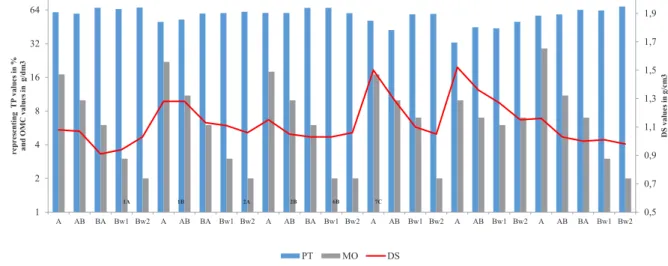
al. (2002). In the analyzed proiles, compatible values with high compaction were found in horizons A and AB of the 2B proile (pasture/sugarcane not fertirrigated) and medium compaction for the proile 1B (soybean/sugarcane not fertirrigated). In relation to TP, even according to these same
authors, values less than 54% are indicative of high compaction, as found in horizons A and AB of
the proiles 2B, 1B and 6B all related to management not fertirrigated (igure 1).
Considering the cultivation of sugarcane on straw, which provides OMC to soils, all horizons A
of the proiles 1A, 1B, 2A and 2B showed high values of OMC, but even so lower to values proile 7C as reference. This did not occur in 6B proile that is much lower, with traditional management,
without wastes, which also causes the low TP values found. It was observed that the irrigation with
vinasse have not signiicantly increased the OMC content of the proiles 1A and 2A, or because
of vinasse have been applied only once (150 m3/ha) and below the allowed volume 700 m3/ha by years. However, there is relationship between fertirrigation and lower SD values and higher to TP
on fertirrigated proiles compared to other, what it has been explained by fertigation due to vinasse
capacity to contribute to OMC and thus improve soil aggregation and size of aggregates, giving it
greater stability structural and porosity (macro and micro). These results conirm what was observed
176
Table 1 - Physical attributes and organic matter content of the dystroferric Red Latosol.
Proile/Horizon
Depth in cm
Texture
g kg -1
Textural class
WDC FD Density
TP OMC Soi
g cm-3 %
Part.
g cm-3 %
Sand Silt Clay % g dm-3
(Proile 1A) soybean/sugarcane fertirrigated
A 0-13 420 110 470 Clayey 10 81 1,08 2,78 61 17 AB 13–50 400 100 500 Clayey 4 93 1,07 2,64 59 10 BA 50–90 370 120 510 Clayey 4 93 0,91 2,77 67 6 Bw1 90–110 500 100 400 Sandy clay 0 100 0,94 2,70 65 3
Bw2 110-150+ 570 90 340 Sandy clay 2 96 1,03 3,14 67 2
(Proile 1B) soybean/sugarcane not fertirrigated
A 0-23 470 110 420 Sandy clay 2 96 1,28 2,60 50 22
AB 23–65 450 110 440 Clayey 2 97 1,28 2,70 53 11
BA 65–88 390 110 500 Clayey 0 100 1,13 2,79 59 6
Bw1 88-116 370 120 510 Clayey 2 96 1,11 2,78 60 3
Bw2 116–150+ 420 110 470 Clayey 0 100 1,06 2,77 62 2 (Proile 2 A) pasture/sugarcane ferirrigated
A 0-33 540 90 370 Sandy clay 10 79 1,15 2,88 60 18
AB 33–47 470 110 420 Sandy clay 0 100 1,05 2,64 60 10 BA 47–77 460 110 430 Sandy clay 4 92 1,03 3,11 67 6
Bw1 77–115 570 90 340 Sandy clay 0 100 1,03 3,11 67 2
Bw2 115–150+ 690 70 240 Sandy clay loam 0 100 1,06 2,63 60 2 (Proile 2B) pasture/sugarcane not ferirrigated
A 0–15 (20) 300 130 570 Clayey 2 95 1,50 3,08 51 17
AB 15–53 (65) 350 120 530 Clayey 2 96 1,29 2,24 42 10
Bw1 53–102 450 110 440 Clayey 2 96 1,10 2,65 59 7
Bw2 102–150+ 500 100 400 Sandy clay 2 96 1,05 2,58 59 2 (Proile 6B) sucessão pasture/soybean/sugarcane not ferirrigated
A 0–28 470 110 420 Sandy clay 0 100 1,22 2,25 33 10
AB 28–56 400 120 480 Clayey 0 100 1,36 2,46 45 7 Bw1 56–90 420 110 470 Clayey 0 100 1,27 2,27 44 6 Bw2 90-150+ 420 110 470 Clayey 0 100 1,15 2,30 50 7
(Proile 7C) natural vegetation
A 0–20 500 100 400 Sandy clay 8 88 1,16 2,70 57 29 AB 20-53 470 110 420 Sandy clay 10 83 1,03 2,48 58 11
BA 53–90 370 120 510 Clayey 4 94 1,00 2,78 64 7 Bw1 90-130 360 120 520 Clayey 4 92 1,01 2,77 63 3
Bw2 130–150+ 390 110 500 Clayey 0 100 0,98 3,13 69 2
WDC= water dispersible clay; FD = locculation degree; TP = total porosity; OMC = organic matter content.
0,5 0,7 0,9 1,1 1,3 1,5 1,7 1,9 1 2 4 8 16 32 64
A AB BA Bw1 Bw2 A AB BA Bw1 Bw2 A AB BA Bw1 Bw2 A AB Bw1 Bw2 A AB Bw1 Bw2 A AB BA Bw1 Bw2
D S v al ue s i n g /c m 3 re pr es en tin g T P va lu es in % an d O M C v al ue s i n g /d m 3
1A 1B 2A 2B 6B 7C
PT MO DS
Figure 1 - Distribution of values of the SD, TP and OMC in the proiles of the dystroferric Red Latosol.
SD= soil density; OMC = organic matter content; TP = total porosity.
Draws attention high PD values, sometimes exceeding three, indicating the presence of heavy minerals or also by the high content of iron nodules, as expected for these soils Already the fact of
the SD values are all < 1, including 7C proile, highlighting for proiles 2B and 6B, and secondarily
is indicative characteristic of compaction, this, however, still does not reveal very severe after six
years of cultivation. Only two proiles 2B and 6B, suggest more care and secondarily the 1A and
2A, which are beginning to stand out. Therefore, the WDC and FD still have relatively satisfactory values, although longer surface reveal structural changes. The vinasse, although it has been applied
177
Mechanical resistence to penetration of the LVdf
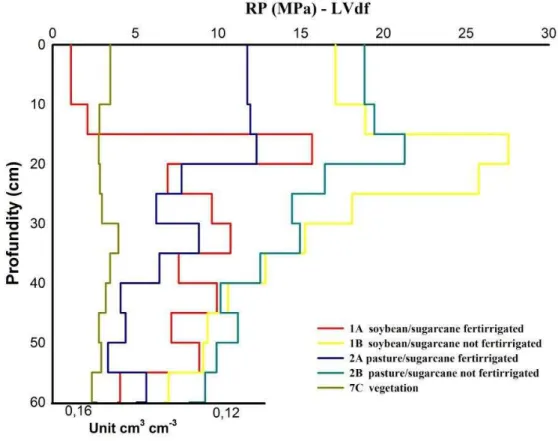
The results of the penetration resistance tests (PR) show higher values in subsurface (Figure
2), highlighting the 1B proile (soybean/sugarcane not fertirrigated) with ~15 to 25MPa, 2B proile (pasture/sugarcane not fertirrigated) with ~15 to 20MPa and 1A proile (soybean/sugarcane fertirri
-gated) relative a 15MPa, both between 15 and 20/25cm of depth. The 2A proile (pasture/sugarcane fertirrigated) is diferent from the previous ones have higher resistance surface, between 0 and 20 cm (~ 12 MPa) of depth. The proile 7C (vegetation) has the lowest PR values, as expected. The proile 6B was disregarded in this comparative analysis, because the ield have occurred in the wet season (early November) distinct period of other proiles with ield during the dry season (early
September).
Figure 2 - PR values in profundity of dystroferric Red Latosol.
These values can be considered high and indicative of extremely high compaction, if not for the fact that the data collection was conducted in dry season, when the gravimetric humidity varies
among ~0,12 to ~0,16 cm3cm-3, without signiicant changes between proiles. According Kertzman (1996) when the humidity is below ield capacity, depending on the type of soil and the collection
period, a 5% increase in humidity and increases from 3 to 4 times the values of PR. Vaz et al. (2002) also found for LVdf resistance values ranging from 15MPa for humidity of 0,2 cm3cm-3 until < 5MPa for humidity values 0,4 cm3cm-3. These data demonstrate the dependence of moisture and PR explaining the high resistance found, because the humidity values were much lower than those detected by these authors. Proceeding to a correction in values even so stand out by the fact that PR be relatively high, reaching depths of up to 60cm, especially between 40 and 60 cm, which worries due to low moisture retention of these soils, where the roots would be dependent on it.
Other factors inluencing the results of PR are content of OMC, SD and texture, since the clay
178
representative between 15 and 25cm, relative to 1B proile (soybean/sugarcane) and 2B (pasture/ sugarcane), both not fertirrigated, precisely where the SD are higher in all proiles.
In all case, in general there was a decrease in the physical quality of the soils, with slight
do-wnside to the proiles where it does not received fertigation management with vinasse, especially in the 2B proile, that was prepared during the rainy season, as already explained, period of high
humidity and maximum deformation. This process is compatible with high levels to moderate of soil compaction, in the surface horizons (type shallow compaction), which can be considered as a
result of heavy machinery traic, typical of the techniied management of sugarcane.
These data also reinforce the idea of initial change in conditions on the physical quality of soil
observed in MRQ after 6 years of cultivation and before the irst reform of the sugar cane ield.
It is clear that the current use is associated with sugarcane as similar results by Silva and Cabeda (2006), Silva et al. (2009), Severiano (2010) and by Pacheco and Cantalice (2011), among others, for cultivated soils for longer, which indicates the intensity of the process in the MRQ. About the
proiles with fertirrigated management with vinasse, these showed slightly better performance relative to the physical quality, speciically with regard to the structural indicators, SD, TP e PR,
even if the treatment has not elevated substantially the OMC in the soil.
Micromorphological characterization of LVdf
Micromorphological characterization is presented in Table 2 and reveals that the proiles stu
-died has the soil matrix composed predominantly of clay-ferruginous ine material formed by small
rounded aggregates (granular structure) and, sometimes, small subrounded blocks, both separated by huddling pore inter-aggregates in subsurface Bw horizon, as expected. Already in the surface horizons perceive an increase of the small blocks at medium, also constituted from clay-ferruginous
ine material, but cementing coarse grains separated by issure pores, generally ine. However was
perceived a little contribution of coarse material (sand, silt), but the presence of opaque ferruginous minerals (magnetite type) and of abundant ferruginous hematite nodules found on coarse material function. These characteristics are typical of LVdf (EMBRAPA, 2006).
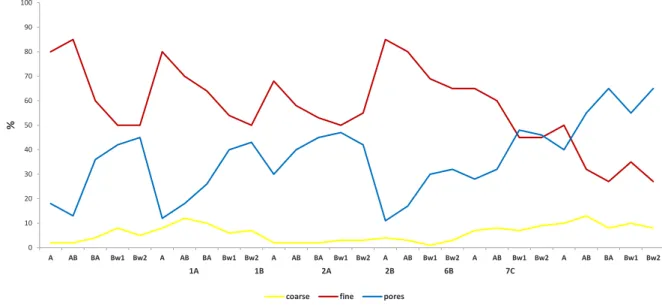
In all proiles currently with sugarcane the ine material occupies the largest area in the soils layers, as in the horizons A and AB, corresponding to about 80% in the proiles 1A (soybean/sugarcane
fertirrigated), 1B (soybean/sugarcane not fertirrigated) and 2B (pasture/sugarcane not fertirrigated).
In the proiles 2A (pasture/sugarcane fertirrigated) and 6B (succession pasture/soybean/sugarcane
not fertirrigated) represents about 60%. These values decrease in depth up to the average of 50%
for horizons BA, Bw1 and Bw2 in the proiles 1A and 1B, fact associated with increase of porosity. In the proiles 2A and 6B this reduction is less signiicant, even then getting between 50 to 55%.
In the surface horizons of proiles 1A, 1B and 2B, the visible pores on slides are few about 15%, inding the double (30%) in proiles 2A and 6B. The porosity is increased in depth, inding 30% in area from slides in the Bw horizons of the proile 2B, and 40% in the proiles 1A, 1B, 2A and 6B. The reference proile 7C (vegetation) has higher porosity compared to proiles with sugar
-cane cultivation, although also with lower values surface (A, AB) (~ 50%) and larger on subsurface (BA, Bw1, Bw2) (~ 65%). In this proile, the ine material is reduced from <50% on the surface to approximately 20% in depth. In the set of proiles the coarse material is distributed equally and represents approximately 10% of the total area of the slide of each horizon of all proiles. The Figure
179 0
10 20 30 40 50 60 70 80 90 100
A AB BA Bw1 Bw2 A AB BA Bw1 Bw2 A AB BA Bw1 Bw2 A AB Bw1 Bw2 A AB Bw1 Bw2 A AB BA Bw1 Bw2
%
1A 1B 2A 2B 6B 7C
coarse fine pores
Figure 3 - Distribution of the sizes of the coarse and ine components of the matrix components and pores in thin sections of the proile of dystroferric Red Latosol (LVdf).
Table 2 - Micromorphological characterization of dystroferric Red Latosol.
Hor
cm
Microstructure/
pedality
Porosity (dominant): type and dimension
Features: types (%)
PROFILE 1A- soybean/sugarcanefertirrigated
A
0-13
BSA mm, S to M IA, Th to VT; Cn and Cv mm NFe (18) and Nco mm (5); Cnfomh (28)
AB
13–50
BSA mm, S to M IA, Th to Me; Cn and Fi mm NFe (15) and Nco mm (8); Cnfomh (45)
BA
50–90 BSR and BSAmm, S to M IA, Th to VT; Cn mm NFe (10) and Nco mm (5); Cnfomh (50) Bw1
90–110
BSR and BSA mm, S IA, Me to Th ; Cn and Fi mm NFe (10) and Nco mm (3); Cnfomh (45)
Bw2 110- 150+ BSR mm, S IA, Me to Th ; Cn mm NFe (8) and Nco mm (2); Cnfomh (46) PROFILE 1B- soybean/sugarcane not ferirrigated
A
0-23 BSR mm, W IA, Th to VT; Fi mm NFe (20) and Nco mm (10); Cnfomh (2)
AB
23–65 BSA mm, M to W IA, Th to Me; Cn and Cv mm NFe (10) and Nco mm (5); Cnfomh (20)
BA
65-88
BSA mm, M to S IA, Th to Me; Cn and Fi mm NFe (10) and Nco mm (3); Cnfomh (40) Bw1
88–116
BSA and BSR mm, S IA, Th to VT; Cn and Fi mm NFe (10) and Nco mm (2); Cnfomh (18)
Bw2
116- 150+
BSA and BSR mm, S IA, Me to Th ; Cm and Cv mm NFe (8) and Nco mm (2); Cnfomh (26)
PROFILE 2A- pasture/sugarcaneferirrigated
A
0-33
BSA mm, S to M IA, Th to VT; Cn and Fi mm NFe (10) and Nco mm (8); Cnfomh (30)
AB
33–47
BSR mm, S to M IA, Th to VT; Cv mm NFe (10) and Nco mm (8); Cnfomh (23)
BA
47–77 BSA mm, S to M IA, Th to VT; Cn and Cv mm NFe (10) and Nco mm (8); Cnfomh (22) Bw1
77– 115
180
Bw2
115- 150+
BSR and BSA mm, S IA, Th to VT; Cn and Cv mm NFe (8) and Nco mm (5); Cnfomh (27)
PROFILE 2B- pasture/sugarcane not fertirrigated
A
0–15 (20) BSA mm, M to W IA, Th ; Fi mm NFe (10) and Nco mm (7); Cnfomh (5)
AB
15–53 BSA mm, W IA, Th ; Cv and Fi mm NFe (8) and Nco mm (5); Cnfomh(12), Ex Bw1
53–102
BSA mm, S to M IA, Th; Ca, Cm and Fi mm NFe (10) and Nco mm (5); Cnfomh (45) Bw2 102– 150+ BSA and BSR mm, S IA, Th ; Fi, Cn and Cv mm NFe (10) and Nco mm (3); Cnfomh (43)
PROFILE 6B- succession pasture/soybean/sugarcane not ferirrigated A
0-28 BSR mm, S to M IA, Th to VT; Cn and Fi mm NFe (10) and Nco mm (3);Cnfomh(13),Ex
AB
28–56
BSR mm, S IA, Th to VT; Cv and Fi mm NFe (10) and Nco mm (3); Cnfomh (42)
Bw1
56–90
BSA and BSR mm, S IA, Th to Me; Cn and Cv mm NFe (8) and Nco mm (3); Cnfomh (35)
Bw2
90–150+ BSR mm, S to M IA, Me to Th ; Cn and Cv mm NFe (8) and Nco mm (5); Cnfomh (23)
PROFILE 7C- natural vegetation
A
0–20 BSR mm, S to W IA, Me; Cn, Cv and Fi mm NFe (15) and Nco mm (8); Cnfomh (50)
AB
20-53
BSR mm, S to M IA, Me to Th ; Cn and Cv mm NFe (15) and Nco mm (8); Cnfomh (60)
BA
53–90
BSR mm, S to M IA, Me to Th ; Cm mm NFe (10) and Nco mm (8); Cnfomh (55) Bw1
90-130 BSR mm, S to M IA, Me to Th ; Cn and Cv mm NFe (10) and Nco mm (5); Cnfomh (48) Bw2
130–150+
BSR mm, S IA, Th to VT; Cn and Cm mm NFe (8) and Nco mm (3); Cnfomh (37)
Microstructure/Pedality: BSR = blocks subrounded, BSA = blocos subangular, S = strong, M = moderate, W = weak; Porosity: IA = inter-aggregates, Me = medium, Th = thin, VT = very thin, Cn = channels, Cv = cavities, Cm =
chambers, Fi = issures; Features: NFe = nodules ferruginous, Nco = nodules of coal, Cnfomh = channels illed with
its own material of the horizon, Ex = excrement.
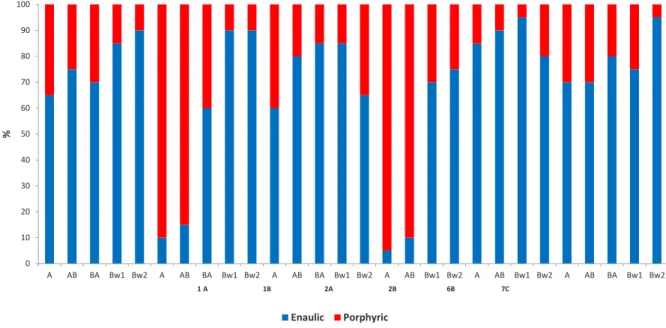
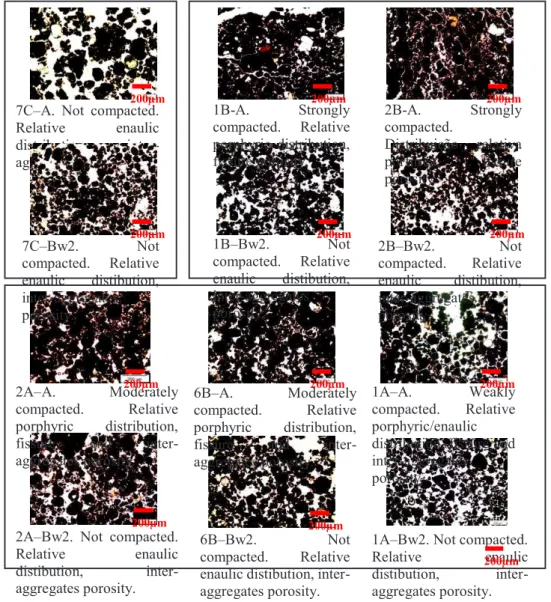
Occur two types of relative distribution, an enaulic and a porphyric. The 7C proile (vegeta -tion) presents a distribution relative enaulic dominant in all horizons (about 80%), with small zones densely porphyric well distributed, corresponding to around 20% of the slides area, as expected for
LVdf. Already in the other proiles 1A (soybean/sugarcane fertirrigated) and 2A (pasture/sugarcane
fertirrigated) also dominates the relative distribution continues enaulic in the surface horizons A,
AB and BA, composing about 60% of the slides area. The densiied zones corresponding to por
-phyric distribution representing in these proiles about 30% of the slide area in the surface horizons, decreasing to about 20% in Bw horizons, therefore reducing signiicantly in depth. Deserve to be highlighted proiles 1B and 2B that show in the horizons A and AB predominance of relative dis
-tribution of the porphyric type (~90%), but in the horizons BA and Bw resume the predominance of enaulic relative distribution (~80%). The Figure 4 illustrates the exposed.
Overall, Figure 4 allows observe the predominance of enaulic distribution with lower percen-tages of porphyric, however these are compaction indicator. Nevertheless, as the porphyric
distri-butions do not appear continuously in the horizons of all proiles, except the horizons A and AB of the proiles 1B (soybean/sugarcane not fertirrigated) and 2B (pasture/sugarcana not fertirrigated),
in which predominate, in practice indicate poor compaction or incipient. What corroborates the
181
0 10 20 30 40 50 60 70 80 90 100
A AB BA Bw1 Bw2 A AB BA Bw1 Bw2 A AB BA Bw1 Bw2 A AB Bw1 Bw2 A AB Bw1 Bw2 A AB BA Bw1 Bw2
%
1 A 1B 2A 2B 6B 7C
Enaulic Porphyric
Figure 4 - Relative distribution of horizons of LVdf.
The enaulic distribution appears very small to small, subrounded, with strong pedality to
mo-derate (micro-aggregation indicator), in which the ine material kaolinitic-ferruginous is dissociated of coarse materials quartzose ine, with macroporosity inter-aggregate of medium stacking to ine.
The Bw horizons are similar to the previously described, which dominate an enaulic distribution
and thin intergranular porosity, as well as channels and/or millimetric cavities. The proiles also have features of illed with its own material of the horizon (table 2).
The proiles 1B (soybean/sugarcane not fertirrigated) and 2B (pasture/sugarcane not fer -tirrigated) present the horizons A and AB as subangular blocks and large subrounded, related to porphyric distribution with weak pedality to moderate, compound of an association between the
kaolinitic-ferruginous ine fraction and the medium quartzous gross fraction, and predominance of ine issured porosity to very thin. In the horizons B and Bw dominates enaulic distribution, strong
pedality (micro-aggregated), with small zones porphyric densely in small subrounded blocks. Predominant an intergranular macroporosity of stacking, with canals, cavities and/or millimetric
chambers associated with mesofauna, besides, features ill with its own material of the horizon. The 7C proile (vegetation) also presents kaolinitic-ferruginous fraction, with dominant enaulic distribution and well developed throughout on all the proile. Presents intergranular pores and medium
inter-aggregate to thin with the presence of numerous canals, cavities and chambers millimetric to subcentimeters indicative of good biological activity (roots and mesofauna) throughout of all the
proile. Thin fasciculate roots occur in the larger pores, in various stages of decomposition. This proile also presents ill features with its own material of the horizon (table 2).
The micromorphological study revealed, that enaulic distribution dominates in the Bw horizons
of all proiles, regardless of land use with sugarcane and in all horizons of 7C proile (vegetation).
Such relative distribution is typical of Latosols in general and in particular of LVdf, with high iron content. Also was showed that this distribution changes to porphyric, composing small dense
zones in the surface horizons mainly in soil with sugarcane, highlighting the proiles 1A (soybean/
sugarcane fertirrigated) and 2A (pasture/sugarcane fertirrigated), associated with small blocks to medium, which is compatible with the compaction process, as observed by Silva et al. (1998) and
by Soares et al. (2005b). In these proiles the compaction was interpreted as moderate due to the
discontinuation of these compacted zones.
182
indicating surface compaction strong. The proile 7C shows no signs of compaction, as expected.
These types of structures are denominated by Bullock et al. (1985) as complex structures (enaulic) and structures in subangular blocks (porphyric). The Figure 5 illustrates the relative distributions,
porosity and the iller features, observed in diferent studied proiles.
In summary, the changes in soil microstructure mainly afect the surface horizons, corrobora
-ting ield observations, beyond of resitence tests and analytical data of the studied soil proiles, as exposed. In them the efects of direct compression of heavy machinery are responsible for porosity reducing and his change of intergranular for issured, as well as by changes in those horizons of enaulic relative distribution (micro-aggregate) to porphyric, although in most part of proiles yet discontinuous, except in 2B, corroborating the indings of other authors, such as Kertzman (1996)
and Silva et al. (1998).
It was observed that the LVdf already in the beginning of the compacting process after six years
of cultivation, and even before of the irst reform of the sugarcane ield. It is about incipient com
-paction, discontinuous and supericial clearly associated with soil management by heavy machinery,
typical of sugarcane, however with less degradation when combined with vinasse fertirrigation. It
was not observed diferences attributable to previous uses (soybean and pasture) between proiles.
7C–A. Not compacted.
Relative enaulic distribution,
inter-aggregates porosity .
200µm
7C–Bw2. Not
compacted. Relative enaulic distibution, inter-aggregates porosity. 200µm 1B-A. Strongly compacted. Relative porphyric distribution, fissure porosity.
1B–Bw2. Not
compacted. Relative enaulic distibution, inter-aggregates
porosity.
2B–Bw2. Not
compacted. Relative enaulic distibution, inter-aggregates porosity. 2B-A. Strongly compacted. Distribuição relativa porfírica, fissure porosity.
200µm 200µm
200µm 200µm
1A–Bw2. Not compacted.
Relative enaulic distibution,
inter-aggregates porosity.
2A–Bw2. Not compacted.
Relative enaulic distibution,
inter-aggregates porosity.
6B–Bw2. Not
compacted. Relative enaulic distibution, inter-aggregates porosity.
1A–A. Weakly
compacted. Relative porphyric/enaulic
distribution, fissure and inter-aggregates porosity.
2A–A. Moderately
compacted. Relative porphyric distribution, fissure and inter-aggregates porosity.
6B–A. Moderately
compacted. Relative porphyric distribution, fissure and inter-aggregates porosity.
200µm
200µm
200µm 200µm
200µm 200µm
Figure 5 - Photomicrographs of thin sections of representative horizons of LVdf proiles. Notes that the solid phase
183
Was observed that no visible diferences were found in plants under ield, nor testimonials
of the Plant managers to disclose preoccupation with the phenomenon, despite ground monitoring practiced regularly, as usual. Also there was no evidence of erosion process or other process resulting from compaction. Thus the process still not revealed disturbing of the production point of view.
CONCLUSIONS
1. The macromorphological and analytical indicators that best illustrates the compaction process were: structure, dry consistency, soil density and penetration resistance. Already the
micromorpho-logical indicator more eicient was the presence of porphyric microstructure, associated to incipient soil compaction with subangular blocks in ield, contrary to the enaulic fabric (micro-aggregates) that indicate no compaction, typical of Bw horizons, associated with granular structure in ield. The indicative values of compaction were: SD ~ 1,50 g cm-3; PD > 3,08 g cm-3; PR > 15 MPa; TP <
50%.
2. The proiles fertirrigated with vinasse showed better physical quality, with lower values of SD (~1,10 g cm-3) and PR (< 5 MPa), related to horizons surface, besides having better preservation
of granular structure (micro-aggregated) and macroporosity.
3. The observed compaction was associated with strongly techniied management of the su -garcane, with heavy machinery use in all stages of the cultivation process. Result independent of
the previous usage, although proiles with previous use as pasture have presented more evidence of compaction, especially the 2B Proile, when compared to proiles previously cultivated with
soybean, which was explained by inadequate preparation of soil before planting.
ACKNOWLEDGEMENTS
To CNPq – Conselho Nacional de Pesquisa Cientíica by inancing of research program. The FAPEG - Fundação de Amparo à Pesquisa em Goiás, by fellowship training.
LITERATURE CITED
BULLOCK, P.; FEDOROFF, N.; JONGERIUS, A.; STOOPS, G.; TURSINA, T. Handbook for soil the
section description. Waine research publications, 1985.
CAMARGO, O. A.; ALLEONI, L. R. F. Compactação do solo e o desenvolvimento de plantas. Piracicaba: 1997.
CANASAT – Mapeamento da cana via imagens de satélite de observação da Terra. INPE – Instituto
Nacional de Pesquisas Espaciais. Disponível em: <http://www.dsr.inpe.br/canasat/ > Acesso em 17 jan. 2012. CARVALHO, J. M. de; CREMON, C.; MAPELI, N. C.; NUNES, M. C. M.; SILVA, W. M. da; MAGA-LHÃES, W. de A.; SANTOS, A. D. Análise micromorfométrica de agregados de um Latossolo Vermelho
distroférrico sob diferentes sistemas de cultivo. Revista Agrarian, v. 3, n. 10 p. 275-285, 2010.
CASAGRANDE, A. A. Compactação e manejo do solo na cultura da cana-de-açúcar. In: MORAES, M. H.;
MULLER, M; M. L.; FOLONI, J. S. S. (Coord). Qualidade física do solo: métodos de estudo – sistema de
preparo e manejo do solo. Jaboticabal: Funep, 2002. p. 150 – 197.
CASTRO, S. S. de; ADBALA, K.; SILVA, A. A.; BORGES, V. M. S. A expansão da cana-de-açúcar no
Cerrado e no Estado de Goiás: elementos para uma análise espacial do processo. Boletim Goiano de
Geo-graia, Goiânia, V.30, nº 1. p. 171 – 191, jan/jun, 2010.
CASTRO, S. S.; COOPER, M.; SANTOS, M.C. P. VIDAL TORRADO. Micromorfologia do solo: Bases e
Aplicações. Tópicos de Ciências do Solo, 3: p.107-164. 2003.
DIAS JUNIOR, M. de S. Compactação do Solo. Viçosa: Sociedade Brasileira de Ciência do Solo. Tópicos
184
DORAN, J.W.; PARKIN, T. B. Deining and assessing soil quality. In: DORAN, J.W.; COLEMAN, D.C.;
BEZDICEK, D.F.; STEWART, B.A. (ed.). Deining soil quality for a sustainable environment. SSSAJ,
Madison, (Publication Number 35), 1994. p.3-22.
EMBRAPA. Sistema Brasileiro de Classiicação de solos. Centro Nacional de Pesquisas de Solos, 2ª edição.
Rio de Janeiro: EMBRAPA, 2006.
EMBRAPA. Manual de métodos de análise de solos. Centro Nacional de Pesquisas de Solos, 2ª ed. Rio
de Janeiro: Embrapa, 1997.
KERTZMAN, F. F. Modiicações na estrutura e no comportamento de um latossolo roxo provocadas
pela compactação. Tese (Doutorado). Universidade de São Paulo, 1996. p.152
LATRUBESSE, M. E.; CARVALHO, M. T. Geomorfologia do Estado de Goiás e Distrito Federal.
Se-cretaria da Indústria e Comércio, Superintendência de Geologia e Mineração Goiânia, 2006.
OLIVEIRA, G.C.; DIAS JÚNIOR, M.S.; RESCK, D.V.S.; CURI, N. Alterações estruturais e comportamento
compressivo de um Latossolo Vermelho distróico argiloso sob diferentes sistemas de uso e manejo. Pesquisa
Agropecuária Brasileira. Brasília, v.38, n.2, p.291-299, 2003.
OTTO, R.; SILVA, A. P.; FRANCO, E. C. A.; TRIVELIN, P. C. O. High soil penetration resistance reduces
sugarcane root system development. Soil & Tillage Research, n. 117, p. 201–210, 2011.
PACHECO, E. P.; CANTALICE, J. R. B. Compressibilidade, resistência a penetração e intervalo hídrico
ótimo de um Argissolo Amarelo cultivado com cana-de-açúcar nos tabuleiros costeiros de Alagoas. Revista
Brasileira de Ciências do Solo, Viçosa, v. 35, p. 403-415, 2011.
PEDROTTI, A.; MÉLLO JÚNIOR, A. V. Avanços em ciência do solo: a física do solo na produção agricola
e qualidade ambiental. São Cristovão, 2009.
REICHERT, J.M. et al. Compactação do solo em sistemas agropecuários e lorestais: identiicação, efeitos,
limites críticos e mitigação. Tópicos Ciência Solo, v.5 p.49-134, 2007.
REICHERT, J. M.; REINERT, J. D.; SUZIKI, L. E. A. S.; HORN, R. Mecânica do solo. In: LIER, Q. J. V.
(editor) Física do solo. Viçosa: Sociedade Brasileira de Ciência do Solo, 2010. p. 29 – 102.
REYNOLDS, W. D.; BOWMAN, B. T.; DRURY, C. F.; TAN, C. S. & LU, X. Indicators of good soil physical
quality: density and storage parameters. Geoderma, 110:131-146, 2002.
RIBEIRO, A. C.; NOVAIS, R. F. de. BAHIA FILHO, A. F. de C. Efeitos da vinhaça sobre a dispersão de
argila de amostras de Latossolos. Revista Ceres. Ceres, v.30, n.167, p.12-18, 1983.
SANTOS, R. D. dos; LEMOS, R. C. de; SANTOS, H. G. dos; KER, J. C.; ANJOS, L. H. C. dos. Manual
de descrição e coleta de solo no campo. EMBRAPA. 5ª Ed. Viçosa, 2005.
SCHNEIDER, P.; KLAMT, E. GIASSON, E. Morfologia do solo: subsídio para caracterização e inter
-pretação de solos a campo. Guaíba: Agrolivros, 2007.
SEPLAN, Secretaria de Planejamento do Estado de Goiás. Regiões de planejamento do Estado de Goiás.
Goiânia: SEPLAN, 2006.
SEVERIANO, E. da C.; OLIVEIRA, G. C. de; DIAS JÚNIOR, M. de S.; CASTRO, M. B. de; OLIVEIRA, L. F. V. de. Compactação de solos cultivados com cana-de-açúcar: I modelagem e quantiicação da
com-pactação adicional após as operações de colheita. Engenharia Agrícola, Jaboticabal, v.30, n.3, p.404-413,
maio/jun. 2010.
SEVERIANO, E. da C.; OLIVEIRA, G. C. de; DIAS JÚNIOR, M. de S. OLIVEIRA, L. F. C. de; CASTRO, M. B. de Pressão de preconsolidação e intervalo hídrico ótimo com indicadores de alterações estruturais
de um Latossolo e de um Cambissolo sob cana-de-açúcar. Revista Brasileira de Ciências do solo, v.32,
p.1419-1427, 2008.
SILVA, A. A.; CASTRO, S. S. Dinâmica de uso da terra e expansão da cana-de-açúcar entre os anos de 2004
a 2010, na microrregião de Quirinópolis, Goiás. In: PIETRAFESA, J. P.; SILVA, S. D. de (org.). T
rans-formações no Cerrado: progresso, consumo e natureza. Goiânia: Ed. Da PUC Goiás, 2011. p. 155-170.
SILVA, A. J. N. RIBEIRO, M. R. MERMUT, A. R. BENKE, M. B. Inluência do cultivo contínuo da
cana--de-açúcar em latossolos amarelos coesas do Estado de Alagoas: propriedades micromorfológicas. Revista
185
SILVA, R. B.; LANÇAS, K. P.; MIRANDA, E. E. V.; SILVA, F. A. M.; BAIO, F. H. R. Estimation and evaluation of dynamic properties as indicators of changes on soil structure in sugarcane ields of São Paulo
state – Brasil. Soil & Tillage Reserch. V. 103 p. 265-270, 2009.
SILVA, A. J. N. DA; CABEDA, M. S. V. Compactação e compressibilidade do solo sob sistemas de manejo
e níveis de umidade. Revista Brasileira de Ciência do solo. n. 30 p. 921-930, 2006.
SILVA, M. A. S. da; GRIEBELER, N. P.; BORGES, L. C. Uso de vinhaça e impactos nas propriedades do
solo e lençol freático. R. Bras. Eng. Agríc. Ambiental, v.11, n.1, p.108–114, 2007.
SOARES, J. L. N.; ESPÍNDOLA, C. R.O; CASTRO, S. S. de. Alteração física e morfológica em solos
cultivados sob sistema tradicional de manejo. Revista Brasileira de Ciências do Solo, v. 29. p. 1005-1014,
2005 (a).
SOARES, J. L. N.; ESPINDOLA, C. R.; FOLONI, L. L. Alteração física e morfológica em solos cultivados
com citros e cana-de-açúcar, sob sistema tradicional de manejo. Ciência Rural, Santa Maria, v. 35, n.2, p.
353-359, 2005 (b).
SOUZA JUNIOR, J. J. Mapa de Geologia. In: Projeto RADAMBRASIL. Levantamento de Recursos
Naturais, 31. Folha SE.22. Rio de Janeiro: 1983.
STOLF, R. Teoria e teste experimental de fórmulas de transformação dos dados de penetrômetro de impacto
em resistência do solo. Revista Brasileira de Ciência do Solo, Campinas, v.15, n.2, p.229-35, 1991.
STOLF, R.; FERNANDES, J. & FURLANI NETO, V. Recomendação para uso do penetrômetro de im
-pacto modelo IAA/Planalsucar-Stolf. R. STAB - Açúcar, Álcool e Subprodutos, 1:18-23, 1983.
STOOPS, G. Guidelines for analysis and description of soil and regolith thin section. Soil Science Society
of America. Madison, Wisconsin, 2003.
TRINDADE, T. P. da; CARVALHO, C. A. B. de; LIMA, D. C. de; BARBOSA, P. S. de A.; SILVA, C. H. de C.;
MACHADO, C. C. Compactação dos solos: fundamentos teóricos e práticos. Viçosa: Ed. UFV, 2008. 95 p.
VAZ, C. M. P.; PRIMAVESI, O.; PATRIZZI, V. C.; IOSSI, M. de F. Inluência da umidade na resistência
do solo medida com penetrômetro de impacto. Comunicado técnico 51. MAPA. São Paulo, 2002.