
Adsorption Mechanisms in Layer-by-Layer Films
MariaRaposo1;2
and Osvaldo N. Oliveira Jr 1 1Instituto de Fsica de S~ao Carlos,
Universidade de S~ao Paulo, CP 369 - 13560-970 S~ao Carlos, SP, Brazil FAX: +55 16 2713616, e-mail: [raposo,chu]@ifsc.sc.usp.br
2Departamento de Fsica, Faculdade de Ci^encias e Tecnologia,
Universidade Nova de Lisboa, 2825 Monte Caparica, Portugal
Received 08 September, 1998
Adsorption processes in layer-by-layer lms are discussed using poly(o-methoxyaniline) (POMA) as a case study and also comparing with results for other polymers from the litera-ture. This follows a brief overview of the materials and characterization techniques employed for self-assembled lms, including their possible applications. The original paradigm of the self-assembly method is associated with spontaneous adsorption of oppositely charged poly-mer layers. While this rationale has been successful in explaining adsorption mechanisms for some polyelectrolytes, for polyanilines other interactions must be included. For POMA, in particular, at least three types of interactions are identied, namely van der Waals forces, ionic interactions and H-bonding. Furthermore, H-bonding is responsible for a number of eects even for charged POMA where electrostatic attraction was expected to predomi-nate. Such eects include POMA dedoping upon contact with a glass substrate at early stages of adsorption, and the non-linear increase in the adsorbed amount with the num-ber of POMA/poly(ethenesulfonic acid) (PVS) bilayers deposited in a multilayer structure. Adsorption of a POMA layer on a glass substrate or on an already formed POMA/PVS lm occurs in two steps: a fast, rst-order kinetics process with a characteristic time of a few seconds and a slower process represented by a Johnson-Mehl-Avrami function with a characteristic time of hundreds of seconds. These correspond basically to nucleation and growth mechanisms which is corroborated by atomic force microscopy measurements. The amount of material adsorbed in any given layer depends on experimental parameters, espe-cially polymer concentration and pH, owing to the dierent extents of H-bonding that may allow POMA to adsorb on itself or on PVS molecules.
I. Introduction
The search for novel materials with molecular con-trol has prompted worldwide research on organic mate-rials that oer a variety of electrical, optical and mag-netic properties to be exploited in molecules based de-vices and sensors. The Langmuir-Blodgett (LB) tech-nique [1,2,3,4] has been perhaps the most extensively employed for such purposes, in particular because it al-lows multilayer architectures to be produced with con-trollable thickness at the nanometer level and high de-gree of order depending on the organic material used. The self-assembly (SA) methods [2,3] appeared as an
be-fore by Nicolau [8] for growing polycrystalline epitaxial thin lms of metals via the alternating adsorption of cations and anions from solutions containing the re-spective salts [8,9], and also for building layer-by-layer lms of polypyrrole and polyaniline polymerizedinsitu
[10]. Decher applied this approach to polyelectrolytes, in which alternating layers of polycations and polyan-ions were spontaneously adsorbed on a solid substrate, with the resulting lms resembling LB lms as far as the molecular architecture and thickness control was concerned. Rubner [11-14] was among the rst to real-ize the potential of Decher's approach and extended the method to conjugated polymers. A tremendous upsurge of interest in this self-assembly (SA) method followed which is now used for building multilayers of a large variety of materials, stemming from poly-mers [11-18], to proteins [19-22]. Furthermore, it has been demonstrated [17] that interactions other than the electrostatic attraction can be exploited in build-ing self-assembled lms, thus openbuild-ing up new possi-bilities of molecular architectures. For example, Shi-mazaki et al [23] prepared layer-by-layer lms based on the charge-transfer (CT) interaction between electron-donating carbazolyl groups and electron-accepting 3,5-dinitrobenzoyel groups in the side chains of two kinds of methacrylate polymers [23].
The immense potential for applications has driven the vast majority of research work to be concen-trated on the fabrication and characterization of self-assembled lms that display the properties of inter-est. For instance, SA lms have been successfully used in producing light emitting diodes (LEDs) [24,25] from poly(p-phenylene vinylene) (PPV) for which the molecular engineering possibilities have been essential. The electroluminescence can be enhanced by choos-ing adequate materials to be alternated with PPV [24,25]. Less attention has been paid to the physics of the adsorption processes involved in building the multilayers. It is on this topic that we have focused our work. We rst started [15,18] by producing SA lms of poly(o-methoxyaniline) (POMA), a polyani-line derivative, alternated with polyanions such as sulphonated polystyrene (SPS) and poly(ethene sul-fonic acid) (PVS), with the aim of investigating the electrochromic properties of POMA. While searching for optimized deposition conditions, we noted however
that the lm properties could vary substantially if the experimental conditions were varied. This prompted us to extend investigations to the adsorption processes, including kinetics of adsorption, substrate dependency and interaction energies involved [18,26-28]. The main ndings of this 4-year research project are reported here.
The paper is organized as follows. In Section II an overview is presented of the materials that have been reported for building SA lms, also including the tech-niques for lm characterization and possible applica-tions of such lms. Section III discusses the buildup of multilayer self-assembled lms, with emphasis on sub-strate eects that must be considered while analyzing lm properties. The mechanisms of adsorption are dis-cussed in Section IV, where we also elaborate on the importance of H-bonding as the driving force for the adsorption of polyaniline self-assembled lms.
II. Self-assembly (SA) or layer -by-layer lms
lay-ers, i.e. by adsorbing alternatively anionic and cationic polyelectrolytes on solid supports [5-7]. The formation of these multilayers is based on the tendency of pairs of oppositely charged polyelectrolytes to form complexes [33]. An advantage of this technique is that the adsorp-tion processes are independent of the substrate size and topology, with lm thickness increasing linearly with the number of adsorbed bilayers [5-7]. Another
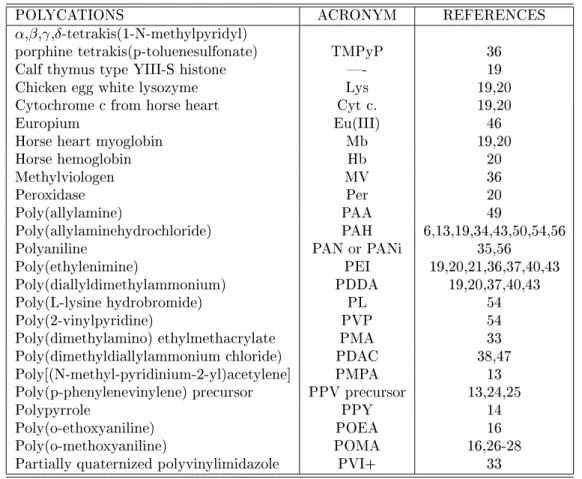
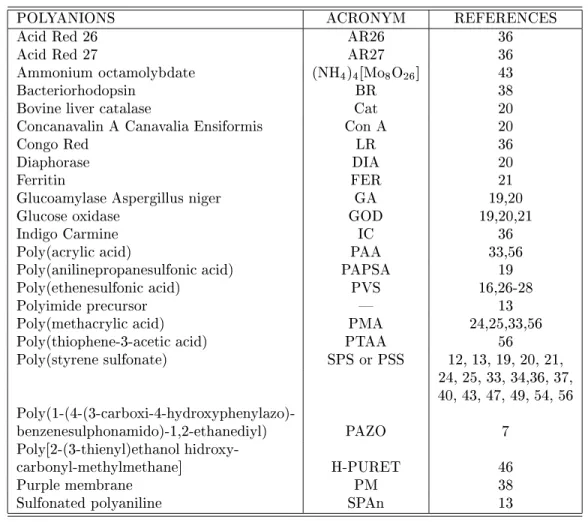
advan-tage lies in the possibility of building up heterostruc-tures with dierent materials with a specied function-ality. The potential of this method may be illustrated by the wide range of materials that have been employed, such as polyelectrolytes [5-7,33,34], polymers [11-18, 24, 25, 35], polymers containing dyes [36-39], biological ma-terials [19-22], and ceramics [40,41]. A summary of sev-eral materials used is shown in Tables I and II.
Table I. Polycations used in the buildup of layer-by-layer lms
POLYCATIONS ACRONYM REFERENCES
,,,-tetrakis(1-N-methylpyridyl)
porphine tetrakis(p-toluenesulfonate) TMPyP 36
Calf thymus type YIII-S histone |- 19
Chicken egg white lysozyme Lys 19,20
Cytochrome c from horse heart Cyt c. 19,20
Europium Eu(III) 46
Horse heart myoglobin Mb 19,20
Horse hemoglobin Hb 20
Methylviologen MV 36
Peroxidase Per 20
Poly(allylamine) PAA 49
Poly(allylaminehydrochloride) PAH 6,13,19,34,43,50,54,56
Polyaniline PAN or PANi 35,56
Poly(ethylenimine) PEI 19,20,21,36,37,40,43
Poly(diallyldimethylammonium) PDDA 19,20,37,40,43
Poly(L-lysine hydrobromide) PL 54
Poly(2-vinylpyridine) PVP 54
Poly(dimethylamino) ethylmethacrylate PMA 33 Poly(dimethyldiallylammonium chloride) PDAC 38,47 Poly[(N-methyl-pyridinium-2-yl)acetylene] PMPA 13 Poly(p-phenylenevinylene) precursor PPV precursor 13,24,25
Polypyrrole PPY 14
Poly(o-ethoxyaniline) POEA 16
Poly(o-methoxyaniline) POMA 16,26-28
Table II. Polyanions used in the buildup of layer-by-layer lms.
POLYANIONS ACRONYM REFERENCES
Acid Red 26 AR26 36
Acid Red 27 AR27 36
Ammonium octamolybdate (NH4)4[Mo8O26] 43
Bacteriorhodopsin BR 38
Bovine liver catalase Cat 20
Concanavalin A Canavalia Ensiformis Con A 20
Congo Red LR 36
Diaphorase DIA 20
Ferritin FER 21
Glucoamylase Aspergillus niger GA 19,20
Glucose oxidase GOD 19,20,21
Indigo Carmine IC 36
Poly(acrylic acid) PAA 33,56
Poly(anilinepropanesulfonic acid) PAPSA 19
Poly(ethenesulfonic acid) PVS 16,26-28
Polyimide precursor | 13
Poly(methacrylic acid) PMA 24,25,33,56
Poly(thiophene-3-acetic acid) PTAA 56
Poly(styrene sulfonate) SPS or PSS 12, 13, 19, 20, 21, 24, 25, 33, 34,36, 37, 40, 43, 47, 49, 54, 56
Poly(1-(4-(3-carboxi-4-hydroxyphenylazo)-benzenesulphonamido)-1,2-ethanediyl) PAZO 7 Poly[2-(3-thienyl)ethanol
hidroxy-carbonyl-methylmethane] H-PURET 46
Purple membrane PM 38
Sulfonated polyaniline SPAn 13
An equally wide variety of experimental techniques have been employed in the analysis of SA lm proper-ties. Perhaps the most extensively used is UV-visible-near-infrared spectroscopy since most candidate mate-rials for the SA method absorbs light in this wavelength region, and this spectroscopy provides a direct means of estimating the amount of material adsorbed and also the multilayer buildup. The multilayer thickness can be measured by prolometry, ellipsometry and atomic force measurements. Photoluminescence and electrolu-minescence have also been measured for the SA lms made from luminescent polymers such as PPV [24,25]. The order of SA lms has been probed by neutron ectivity measurements [42] and small angle X-ray re-ectivity (SAXR) [6], as will be commented upon later. The quartz crystal microbalance has been used for ob-taining the adsorbed amount which is determined from the frequency shift of the quartz resonator and using the
Sauerbrey equation [35,43]. Atomic force microscopy (AFM) [18,21,38], scanning angle reectometry [44], second harmonic generation [38,39] and thermally stim-ulated desorption [27] have also been employed for in-vestigating SA lm properties.
As for the possible applications of SA lms, the rst extensive eorts have been made by Rubner's group in the fabrication of light emitting diodes (LEDs) employing PPV initially [24,25] and then ruthenium II complexes (Ru(bpy)32+ polyester) [45]. Polymer
features, exploiting the ability of reverting the polyelec-trolyte deposition on the self-assembled monolayer sur-faces at very high salt concentration, thus creating a negative to the original positive structure. This may lead to fabrication of more complex structures, and then applied to optical or electrical devices [47].
III. Multilayer buildup
In the layer-by-layer or self-assembly (SA) method, the substrate is immersed in a beaker containing either a polycationic or polyanionic solution for a given pe-riod of time (usually a few minutes). The substrate is then washed in a solution of approximately the same pH of the polymeric solutions, in order to remove non-adsorbed molecules, and usually dried as well. The sub-strate+lm system is now charged which allows adsorp-tion of an oppositely charged layer upon immersion in the other polymeric solution. Following adsorption of this second layer, the substrate is again washed and dried. Multilayer structures can then be built by re-peating the steps above as long as required. Apparently, there are no limitations in the number of bilayers that can be deposited; lms with hundreds of layers have been reported. Even though data from the literature will be used in illustrations and comparisons, we shall base our analysis on results with the POMA/PVS lms. The experimental procedures adopted for producing such SA lms have been described in ref. [18], and therefore only a short description is given here. POMA was synthesized with ammonium peroxydisulfate in a 1.0 M HCl aqueous solution at 0C. The monomer to
oxidant ratio was 4:1. The resulting precipitated poly-mer was ltered and washed with a 1.0 M HCl solution. POMA has a weight average molecular weight (Mw) of
30,800 g/mol [48]. Poly(ethenesulfonic acid) (PVS) was purchased from Aldrich Chemical. These polymers are, respectively, cationic and anionic at low pHs, and there-fore multilayer structures can be built via electrostatic interaction of alternating layers.
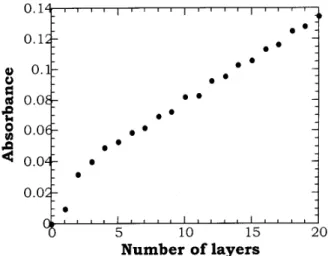
An important feature of layer-by-layer lms is the linear increase in thickness or in the adsorbed amount per unit area with the number of bilayers. Fig. 1 shows the dependence with the number of bilayers of both total thickness, calculated from the distance
Figure 1. Total thickness and the optical absorbance at 225 nm of layer-by-layer lms of polystyrenesulfonate and polyallylamine adsorbed onto a fused quartz as a function of the number of polystyrenesulfonate layers [5].
Figure 2. Maximum absorbance versus number of bilayers of POMA/PVS lms adsorbed on: Teon FEP, ITO, glass I and glass II [18].
Figure 3. Absorbance and wavelength at maximum ab-sorbance of adsorbed POMA on hydrophilized glass as a function of immersion time [18].
An opposite behavior was observed in layer-by-layer lms from poly(o-methoxyaniline) alternated with poly(thiophene acetic acid) (POMA/PTAA). Interest-ingly, the amount of material adsorbed is very large in
the rst bilayers but then it becomes constant, leading to a linear increase from the fourth layer (2 bilayers) on, as shown in Fig. 5. The reason for this lies in the strong attractive interaction between the glass substrate and PTAA molecules. Similar results where obtained by Ferreira et al [11] in a similar polymer system. Ow-ing to the importance of substrate eects for the rst few bilayers, results in the literature now tend to fall in these categories of non-linear buildup, with either a superlinear or a sublinear increase in the amount of material adsorbed with the number of layers. A linear increase from zero has become scarce.
Figure 4. The adsorbed amount and mean roughness of POMA/PVS SA lms versus the number of bilayers [28].
The buildup of multilayers has so far been dis-cussed with no mention to the time allowed for ad-sorption, whether it was sucient for the formation of a complete layer or not. In fact, a linear build up may be observed even when the time allowed is not enough for saturation of the adsorption process for a given layer. This occurs provided that the pe-riod of adsorption is maintained constant for all lay-ers, as illustrated in Fig. 6 for self-assembled lms of ammonium octamolybdate ((NH4)4[Mo8O26]) and
poly(allylaminehydrochloride)(PAH) [43]. The amount of adsorbed material was estimated using a quartz crystal microbalance whose frequency shift was plotted against the immersion time. The time period of adsorp-tion of(NH4)4[Mo8O26] is varied for the three series of
multilayer structure may be obtained using a constant immersion time of three minutes for each layer.
Figure 5. Maximum absorption (at 430 nm) as a function of the number of POMA/PTAA bilayers. Here both POMA and PTAA absorb at 430 nm.
The layer-by-layer method was conceived with the aim of fabricating organized structures. This is prob-ably more likely to be achieved in the perpendicular direction to the substrate, owing to the layered struc-ture [5,6,7]. Nevertheless, some ordering in the plane may also be obtained if adequate materials are em-ployed, as demonstrated by Lvov [37] for polymers with side chain nonlinear optical dyes. They obtained orien-tation of chromophore side-chain groups of the poly-mer poly[1-[4-(3-carboxyl-4-hydroxyphenylazo)benzene sulfonamide]-1,2-ethenediyl, Na salt] (PAZO) alter-nated with poly(dimethyldiallylammonium chloride) (PDDA), which was conrmed by second harmonic gen-eration (SHG) measurements. A maximum of orienta-tion was obtained for 4 PDDA/PAZO bilayers. Another example of molecular organization was obtained by He et al [38] who produced layer-by-layer lms of pur-ple membrane (PM), isolated from Halobacterial halo-bium R1M1, and poly(dimethyldiallylaminonium chlo-ride) (PDAC). Using second harmonic generation, the latter authors measured the second-order susceptibility of PDAC/PM layer-by-layer lms (12 bilayers) and ob-tained a larger value compared with electrophoretically sedimented lms [38].
IV. Adsorption processes
Adsorption is the nal result of the
competi-tion among several interaccompeti-tions that include poly-mer/substrate, polymer/polymer, polymer/solvent and solvent/substrate interactions. Furthermore, polymer molecules may adopt a completely dierent conforma-tion when adsorbed as compared to that in soluconforma-tion. Consequently, as far as experimental conditions are con-cerned, the adsorption process depends on the concen-tration, pH and ionic strength of the polymeric solu-tions, type of substrate and immersion time. No the-ory has been developed specically for SA lms, and the complexity of the molecules involved and the de-pendency on so many parameters make it dicult to adapt existing adsorption theories. One may neverthe-less analyze separate aspects of adsorption in a phe-nomenological way in order to gain insights into the physical mechanisms involved. This is precisely what we have tried to do, focusing on the POMA/PVS sys-tem, though other systems from the literature are also analyzed for comparison. We rst investigated the ki-netics of adsorption of the rst layer on a bare substrate and then of an nth layer on an already deposited lm. By varying the polymer concentration and carrying out experiments at dierent temperatures, we could obtain adsorption isotherms which may allow estimation of the thermodynamic energies of the system. This is done, however, by using extremely simplied models of ad-sorption while interpreting the data. The limitations of such analysis are commented upon in Section 4.2. Fi-nally, attempts have been made to distinguish between electrostatic interactions and hydrogen bonding as the driving force for adsorption of polyaniline multilayers.
4.1-Kinetics ofadsorption
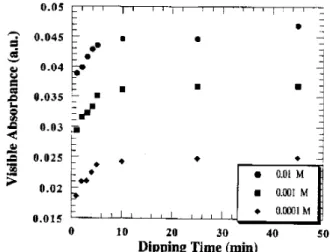
adsorption processes. The rst systematic investiga-tion of kinetics in SA lms is due to Ferreira and Rub-ner [13] who carried out a number of experiments with various concentrations and types of substrate for the poly(thiofene-3-acetic acid) (PTAA) and PAH system. Their data for adsorption of PTAA on 5 PTAA/PAH bilayers deposited on a positively charged substrate are shown in Figure 7 for various PTAA solution concentra-tions. Light absorption was measured at 420 nm [13], corresponding to the absorption peak for PTAA. These results reveal that PTAA has a high anity for the lm-covered substrate since the adsorbed amount increases rapidly with time. After the rst minute of immersion the adsorbed amount is 72%, 78% and 80% of the nal adsorbed amount value, respectively for concentrations of 10,4M, 10,3M and 10,2M. These results show also
that the concentration plays an important role, a point that will be considered later on. Their results were interpreted as being due to a diusion-controlled ad-sorption process, at least in the initial stages of adsorp-tion. However, the eective diusion coecients var-ied widely with the concentration, which made Ferreira and Rubner [13] conclude that the Langmuir-Schaefer relationship is not valid for PTAA in the time regime accessible by UV-vis experiments.
Figure 6. Frequency shift in a quartz crystal microbal-ance as a function of adsorption time: (open square) (NH4)4[Mo8O26] adsorption; (full circle) PAH adsorption
[43].
In the initial investigation by Ferreira and Rubner [13] there was no concern in distinguishing between the kinetics of adsorption of the rst layer and that of a subsequent layer. Such a distinction is made here for
the POMA/PVS system, since our experiments indi-cated a strong dependence on substrate eects. Fig. 8 shows the kinetics curves for the rst POMA layer on bare hydrophilized glass substrates. An interesting eect was observed when the number of interruptions for washing the lm and taking the UV-vis. absorption measurement was varied. In curve I the substrate was immersed in the polymeric solution for a few times and the absorbance of the sample was measured. In curve II the time of each immersion was 5 s, and therefore a much larger number of points were obtained. In curve III several substrates were used and each one was im-mersed only once in the polymer solution. Note that in curve III the concentration of POMA solution was 0.35 g/L while for curves I and II the concentration was about 0.8 g/L. The adsorbed amount changes drasti-cally with the number of immersions. Therefore, one may conclude that the "true" kinetics of adsorption must be obtained by immersing the substrate only once in the polymeric solution, as in curve III. In spite of the dierences in the adsorbed amount, the data of all three curves in Fig. 8 can be tted by the following empirical equation [18]:
A=k 1
1,exp , t 1 +k 2
1,exp , t 2 n (1) whereAis the absorbance at the peak which is
propor-tional to the POMA adsorbed amount per unit area,k 1
and k
2 are constants,
1 and
2 are the characteristic
times and n is a constant. Therefore, POMA adsorption may be attributed to two types of process: an initial, fast rst order kinetics with characteristic times of a few seconds, followed by a much slower process that is tted with a Johnson-Mehl-Avrami function with much higher characteristic times (hundreds of seconds). The latter function is generally believed to occur in pro-cesses of diusion; when 1.5<n<2.5 the process occurs
nuclei appeared all over the sample, and for longer im-mersion times larger domains were observed.
Figure 7. Kinetics of adsorption of PTAA onto 5 bilayers of PTAA/PAH for various concentrations. The absorbance was measured at 420 nm [13].
Figure 8. Kinetics of adsorption of poly(o-methoxyaniline) onto a glass substrate: I- Few points were taken using only one substrate. II- Points were taken at every 5 s using only one substrate. III- Several substrates, immersed only once for distinct periods of time.
As for the kinetics of a POMA layer onto an already formed POMA/PVS lm, it was originally thought [18] that adsorption would become faster as the number of bilayers increased. However, this conclusion was based on experiments in which the substrate was immersed several times in the polymeric solution for the data points to be obtained. When the true kinetics was measured, i.e. with substrates immersed only once in the polymeric solution for that given layer, we noticed that the kinetics of adsorption of the nth layer also fol-lowed Eq. (1) [18]. The only major dierence was that the characteristic time for the second process (domain
growth) was much longer because a larger quantity of material was adsorbed in the nth layer, as will be dis-cussed later.
A two-stage adsorption process was also proposed by Tsukruk et al [49] for layer-by-layer lms of poly-(styrenesulfonate) (PSS) and poly(allylamine) (PAA). They based this proposal on surface morphology changes. During the rst stage (1-2 minutes) of lm formation the polymer chains are inhomogeneously ad-sorbed on selected sites of the substrate (in this case an oppositely charged self-assembled monolayer), which had a high local charge concentration as in scratches, holes, edges and foreign microparticles. At the second stage, for longer deposition times (10-30 minutes) the polymer islands are gradually spread out and the rough-ness decreases. This feature was interpreted as caused by the high charge concentration in macromolecular chains [49]. In the case of POMA/PVS samples the sample roughness increased with the number of bilay-ers, tending to a constant value [28]. Even though Fer-reira and Rubner [13] did not mention the possibility of a two-stage kinetics process, a close inspection in their data (Figure 7) points to a small plateau starting at ap-proximately 2 minutes of adsorption, which could also be interpreted as the appearance of a second adsorption process.
Figure 9. Variation of the quartz crystal microbalance fre-quency in the NH4)4[Mo8O26] adsorption. Each point is an
average frequency shift of four to six repeated adsorption processes within one series of experiments. [43].
onto lms of (NH4 )4 Mo8O26 /PAH by plotting the
quartz crystal microbalance frequency shift as a func-tion of the immersion time as shown in Fig. 9. In contrast to the examples above no saturation occurred for the observed period of time (30 minutes).
4.2 Adsorption Isotherms
The concentration of the polymeric solution is an important parameter to be controlled in the fabrica-tion of SA lms. By varying the concentrafabrica-tion, one may obtain the so-called adsorption isotherms such as those shown for POMA onto glass in Fig. 10 ad-sorbed at 25 and 40C [26].The increase in the adsorbed
amount at 25C for concentrations higher than 0.25
g/L was attributed to the increase of POMA aggrega-tion in the aqueous soluaggrega-tion. For concentraaggrega-tions lower than 0.25 g/L the data can be tted with a Langmuir isotherm, from which thermodynamic energies are es-timated. The adsorption energy was -35 kJ/mol, the
enthalpy of adsorption was 202 kJ/mol, while the
en-tropy of adsorption was 183 J/Kmol. From these values one could conclude that POMA adsorption onto glass is controlled by entropy, that is, the increase in entropy in the solvent makes the polymer adsorption favorable, in spite of the positive enthalpy. It must be stressed that a positive adsorption enthalpy does not mean that the interactions between the substrate and the solute are repulsive. It simply means that energy must be sup-plied for adsorption to occur. By analyzing substrate eects we concluded that such energy is spent in break-ing hydrogen bonds between substrate sites and water molecules that are immediately adsorbed upon contact of the substrate with the aqueous solution [28]. One of the consequences of these substrate eects is that the polymer adsorbed in the initial stages is less doped than in solution, as shown by the shift in the absorption peak depicted in Fig. 3. POMA at pH=3 is 50% positively charged and has an absorbance peak at about 720 nm. Upon losing some of its charge the peak shifts towards lower wavelengths. The shift occurs during the nucle-ation phase, but the peak returns to higher wavelengths after 200 s of immersion time, when the polymer being adsorbed probably does not interact with the substrate directly.
Figure 10. Adsorption isotherms of poly(o-methoxyaniline) onto glass at dierent temperatures:I-25C and II-40C [26].
consistent with the increase in the amount of adsorbed material with the number of bilayers deposited. Never-theless, before independent calorimetric measurements of enthalpy are made, experimenters should be aware of the strong reservations expressed by Fleer [51] in the analysis, even if phenomenological, of their adsorption data.
4.3 Mechanisms for polymer adsorption
Adsorption of any given layer depends on energetic factors such as electrostatic forces, van der Waals forces, hydrogen bonds, solvent quality, and entropic factors. Analogously to the analysis of adsorption isotherms mentioned above, the identication of the mechanisms responsible for polymer adsorption is also a complex task because theoretical models are at an embrionic stage as far as heterodisperse polymers are concerned. Several models have been proposed, mainly for poly-electrolytes, but they usually require knowledge of ex-perimental parameters that is not available. For in-stance, even though the enthalpy of adsorption can be measured directly using calorimetric methods, the en-tropy and the free energy of adsorption cannot be mea-sured easily. Additional diculties are associated with the large variety of experimental conditions that aect the adsorption processes. Each trio of solute-solvent-substrate represents a new case, and in layer-by-layer lms it is necessary to investigate the processes for at least two materials that form the alternating layers.
A phenomenological analysis may be successful, however, if one manages to distinguish between the various types of interaction. For instance, in the self-assembled (SA) lms, whose paradigm is based on the electrostatic attraction of oppositely charged layers, electrostatic interactions are expected to predominate. Using the surface force apparatus, Lowack and Helm [53] investigated the solute/substrate interactions be-tween negatively charged PSS onto a positively charged PAH monolayer, when they noted that only one third to one half of the positive charges are neutralized by PSS molecules. These results were interpreted via a Cohen-Stuart model [53] which states that polyelec-trolyte molecules adsorb only until they are electro-statically repelled from the surface and not until the binding places are saturated, which would correspond
to a "true equilibrium". The Cohen-Stuart model also justies the diculty of removing adsorbed polyelec-trolytes from a surface under adverse conditions such as during the washing process. Indeed, no desorption is observed when POMA/PVS layer-by-layer lms are placed in aqueous solutions for several days at room temperature. Hoogeveen et [33] showed that the multi-layer stability is largely determined by both the electro-static interactions of the anionic-cationic polymer pair and the polymer charge densities. They concluded that when the polymer with a very low charge (<5%) is
ad-sorbed onto a surface, practically all polymer charges are bonded to the substrate. Only few remain avail-able for further adsorption, so that no adsorption of the next layer occurs as the attraction between poly-mer molecules is too weak. When the polypoly-mer charge is between 5-20% the next layer may be formed but the conformation of the rst layer will somewhat adjust it-self to the new layer. In some cases, during such adjust-ment bonds between the rst layer and the substrate are broken, with both layers being desorbed. When the polymer charge is even higher (>20%) the bonds
be-tween polymer-substrate and polymer layers are strong, and stable multilayers can be formed [33].
Another adsorption mechanism was proposed for amphoteric polymers by Kaniyama and Israelachvili [54] in which the number of discrete ionic bonds that can be formed between the charged groups on the poly-mer and on the surface plays an important role. In sum-mary, adsorption would be determined by the details of the charge distribution and not simply by the average charge of the polymer and the surface, and therefore adsorption is assumed to be dependent on short-range electrostatic (coulombic) interactions rather than on a long-range or continuum-type interaction.
the POMA/PVS system at pH=3.0 where POMA is protonated (i.e. charged) and also at higher pHs where POMA is neutral. Even at pH=3.0, thermally stimu-lated desorption data showed three types of interaction in the POMA/PVS multilayers, namely van der Waals forces, hydrogen bonds and ionic interactions [27]. The presence of H-bonding was conrmed by FTIR spec-troscopy of such lms. That H-bonding was essential for POMA adsorption was demonstrated by the pH de-pendence of the adsorbed amount. For the rst layer as well as for the nth POMA layer the maximum ad-sorbed amount occurred for apH
= 6, at which POMA is completely dedoped, and therefore ionic attraction is vanishing. The ability of polyaniline molecules to form H-bonds among themselves, in addition to the PVS molecules, also explains why the amount of adsorbed POMA increases with the number of layers already de-posited [28]. The probability of adsorption increases in sites where some polymer is already adsorbed, which also causes the roughness to increase with the number of layers, as observed by AFM measurements. This is in contrast to the results of Lowack and Helm [53] where defects and roughness of surface polyelectrolyte multi-layer lms were found to be unimportant for the ad-sorption processes. As mentioned before, in their lms the electrostatic attraction was the predominant factor.
V. Conclusions
Adsorption processes for the fabrication of layer-by-layer lms have been analyzed, using POMA as a case study but also discussing data from other polymers. It was shown that H-bonding plays a fundamental role in the adsorption of polyanilines on a glass substrate or on a PVS layer, even when the polymers were charged and electrostatic attraction was expected to predominate. The implications for adsorption kinetics and adsorp-tion isotherms were discussed. Because several types of interaction may contribute to adsorption, the fabrica-tion of SA usually depends on a number of experimental parameters that may be varied for the required molec-ular control. While this dependence represents a rich variety of possibilities for applications, it also calls for more systematic studies in the fundamental physics of the processes involved.
Acknowledgements
The authors acknowledge the nancial support from FAPESP and CNPq (Brazil) and FCT - "Sub-Programa Ci^encia e Tecnologia do 2 Quadro
Comu-nitario de Apoio" (Portugal). They are also thankful to Dr. Ernesto C. Pereira for providing them with the PTAA polymer.
References
[1] G.G. Roberts, Langmuir-Blodgett lms, (Plenum-Press, 1990).
[2] A. Ulman,An introduction to ultrathin organic lms: from Langmuir-Blodgett to self-assembly, (Academic Press, 1991).
[3] R. H. Tredgold, Order in thin organic lms, (Cam-bridge University Press, 1994).
[4] M. C. Petty,Langmuir-Blodgett lms: an introduction, (Cambridge University Press 1996).
[5] G. Decher, J.D. Hong and J. Schmitt, Thin Solid Films,
210/211, 831 (1992).
[6] Y. Lvov, H. Haas, G. Decher and H. Mohwald, J. Phys. Chem.97, 12835 (1993).
[7] Y. Lvov, G. Decher, H. Mohwald, Langmuir 9, 481
(1993).
[8] Y. F. Nicolau, Application of Surface Science22/23,
1061, (1985).
[9] Y. F. Nicolau and J.C. Menard, J. of Crystal Growth
92, 128 (1988).
[10] Y. F. Nicolau and M. Nechtschain inElectronic Prop-erties of Conjugated Polymers III, Springer Series in Solid-State Sciences, Vol 91, edited by H. Kuzmany, M. Mehring and S. Roth (Springer-Verlag Berlin, Hei-delberg, 1989) p. 461.
[11] M. Ferreira, J.H. Cheung and M.F. Rubner, Thin Solid Films244, 806 (1994).
[12] J. H. Cheung, A.F. Fou and M. F. Rubner, Thin Solid Films244, 985 (1994).
[13] M. Ferreira and M.F. Rubner, Macromolecules 28,
7107 (1995).
[14] A.F. Fou and M.F. Rubner, Macromolecules28, 7115
(1995).
[15] L.H.C. Mattoso, V. Zucolloto, L.G. Patterno, R. van Griethuijsen, M. Ferreira, S.P. Campana and O. N. Oliveira Jr, Synth. Met.71, 2037 (1995).
[16] L.H.C. Mattoso, L.G. Patterno, S.P Campana and O.N. Oliveira Jr., Synth. Met.84, 123 (1997).
[17] W.B. Stockton and M.F. Rubner, Macromolecules30,
[18] M. Raposo, R.S. Pontes, L.H.C. Mattoso and O.N.Oliveira Jr., Macromolecules30, 6095 (1997).
[19] Y. Lvov, K. Ariga, I. Ichinose and T. Kunitake, J. Am. Chem. Soc.117, 6117 (1995).
[20] Y. Lvov, K. Ariga, I. Ichinose and T. Kunitake, Thin Solid Films284, 797 (1996).
[21] M. Onda, Y. Lvov, K. Ariga and T. Kunitake, Jpn. J. Appl. Phys.36L1608 (1997).
[22] C.E. Borato, P.S.P. Herrmann, L.A. Colnago, O.N. Oliveira Jr., L.H.C. Mattoso, Braz. J. Chem. Eng.14,
367 (1997).
[23] Y. Shimazaki, M. Mitsuishi, S. Ito and M. Yamamoto, Langmuir14, 2768 (1998).
[24] A.C. Fou, O. Onitsuka, M. Ferreira, M.F. Rubner and B. R. Hsieh, J. Appl. Phys.79(10), 7501 (1996).
[25] O. Onitsuka, A.C. Fou, M. Ferreira, B. R. Hsieh and M.F. Rubner, J. Appl. Phys.80(7), 4067 (1996).
[26] M. Raposo and O.N. Oliveira Jr., Thin Solid Films,
327/329, 739 (1998).
[27] M. Raposo and O.N. Oliveira Jr., \Hydrogen-bond con-trol of polymer adsorption in layer-by-layer lms", sub-mitted.
[28] M. Raposo and O.N. Oliveira Jr., Adsorption of poly(o-methoxyaniline) in layer-by-layer lms, submitted. [29] N. Tillman, A. Ulman and T. L. Penner, Langmuir5,
101 (1989).
[30] J. Richer, L. Stolberg and J. Lipkowski, Langmuir2,
630 (1986).
[31] R. Maoz and J. Sagiv, Langmuir3, 1045, (1987).
[32] S.D. Evans, E. Urankar, A. Ulman and N. Ferris, J. Am. Chem. Soc. 113, 4121 (1991).
[33] N.G. Hoogeveen, M. A. Cohen-Stuart, G. J. Fleer and M.R. Bohmer, Langmuir12, 3675 (1996).
[34] G. Decher, Y. Lvov and J. Schmitt, Thin Solid Films
244, 772 (1994).
[35] J.H. Cheung, W.B.Stockton and M. F. Rubner, Macro-molecules30, 2712 (1997).
[36] K. Ariga, Y. Lvov and T. Kunitake, J. Am. Chem. Soc.
119, 2224, (1997).
[37] Y. Lvov, S. Yamada and T. Kunitake, Thin Solid Films
300, 107 (1997).
[38] J. A. He, L. Samuelson, L. Li, J. Kumar and S. K. Tripathy, Langmuir14, 1674 (1998).
[39] A. Laschewsky, E. Wischerho, M. Kauranen and A. Persoons, Macromolecules30, 8304 (1997).
[40] Y. Lvov, K. Ariga, I. Ichinose and T. Kunitake, Lang-muir12, 3038 (1996).
[41] Y. Lvov, K. Ariga, M. Onda, I. Ichinose and T. Kuni-take, Langmuir13, 6195 (1997).
[42] G. J. Kellogg, A. M. Mayes, W. B. Stockton, M. Fer-reira, M. F. Rubner, S.K. Satija, Langmuir 12, 5109
(1996).
[43] I. Ichinose, H. Tagawa, S. Mizuki, Y. Lvov and T. Ku-nitake, Langmuir14, 187 (1998).
[44] E.S. Pagac, D. C. Prieve and R.D. Tilton, Langmuir
14, 2333 (1998).
[45] A. Wu, J. Lee and M.F. Rubner, Mat. Res. Soc. Symp. Proc. Vol-488, (Materials Research Society 1998), p.63. [46] J. Kim, K.G. Chittibabu, M. J. Cazeca, W. Kim, J. Kumar and S.K. Tripathy, Mat. Res. Soc. Symp. Proc. Vol-488, (Materials Research Society 1998), p. 527. [47] S. L. Clark, M. F. Montague and P. T. Hammond,
Macromolecules 30, 7237 (1997).
[48] L.H.C. Mattoso, R. M. Faria, L.O.S. Bulh~oes and A.G. Macdiarmid, J. Polymer Science: Polymer Chemistry
322147 (1994).
[49] V. V. Tsukruk, V. N. Bliznynk, D. Visser, A. L. Camp-bell, T. J. Bunning and W. W. Adams, Macromolecules
30, 6615 (1997).
[50] G.J. Fleer and J. Lyklema, inAdsorption from solution at the solid/liquid interface, edited by G.D. Partt and C.H. Rochester, (Academic Press, 1983), p. 153. [51] G.J. Fleer, Personal Communication.
[52] M.A. Awan, V.L. Dimonie, L.K. Filippov and M.S. El-Aasser, Langmuir13, 130 (1997).
[53] K. Lowack and C. A. Helm, Macromolecules 3, 823
(1998).
[54] Y. Kaniyama and J. Israelachvili, Macromolecules 25,
5081 (1992).
[55] I. Benjamim, H. Hong, Y. Avny, D. Davidov and R. Neumann, J. Mater. Chem.8, 919 (1998).
![Figure 3. Absorbance and wavelength at maximum ab- ab-sorbance of adsorbed POMA on hydrophilized glass as a function of immersion time [18].](https://thumb-eu.123doks.com/thumbv2/123dok_br/18978413.456130/7.918.100.428.333.548/figure-absorbance-wavelength-sorbance-adsorbed-hydrophilized-function-immersion.webp)
![Figure 6. Frequency shift in a quartz crystal microbal- microbal-ance as a function of adsorption time: (open square) (NH 4 ) 4 [Mo 8 O 26 ] adsorption; (full circle) PAH adsorption [43].](https://thumb-eu.123doks.com/thumbv2/123dok_br/18978413.456130/9.918.99.412.588.865/figure-frequency-microbal-microbal-function-adsorption-adsorption-adsorption.webp)
![Figure 10. Adsorption isotherms of poly(o-methoxyaniline) onto glass at dierent temperatures:I-25 C and II-40 C [26].](https://thumb-eu.123doks.com/thumbv2/123dok_br/18978413.456130/11.918.489.811.15.260/figure-adsorption-isotherms-poly-methoxyaniline-glass-dierent-temperatures.webp)
