1 Psicologia: Teoria e Pesquisa
Vol. 33, pp. 1-8 doi: http://dx.doi.org/10.1590/0102.3772e33422
e33422
Psicologia C línica e C ultur a
Predicting C ondom Use: A C ompar ison of the T heor y of R easoned A ction, the
T heor y of Planned B ehavior and an E xtended M odel of T PB
A lexandra Isabel C abral da S ilva Gomes 1
Maria C ristina Salgado Nunes
Research C entre for Spatial and Organizational Psychology Universidade do Algarve
A B S T R A C T - It was our goal to give a contribution to the prediction of condom use using socio-cognitive models, comparing classic theories to an extended model. A cross-sectional study was conducted using a questionnaire of self-reported measures. F rom the students who agreed to participate in the study, 140 were eligible for the full study. A confi rmatory analysis was used to assess the predictive value of the researched model.
T he model tested had slightly better fi t indexes and predictive value than classic T heories of R easoned A ction and Planned B ehaviour. A lthough the results found, discussion continues to understand the gap between intention and behaviour, as further investigation is necessary to fully understand the reasons for condom use inconsistency.
K eywor ds: HIV /A ID S, T heory of R easoned A ction, T heory of Planned A ction, C ondom use extended model
Predizendo o Uso de Preser vativo: Uma C ompar açã o entre a T eor ia da A çã o
R acionalizada, a T eor ia do C ompor tamento Planej ado (T C P) e um M odelo
E stendido de T C P
R E S U M O - T ivemos como objetivo contribuir para a prediçã o do uso de preservativo utilizando modelos sociocognitivos, comparando teorias clássicas a um modelo estendido. Um estudo transversal foi conduzido com o uso de questionário de auto-relato. E ntre os estudantes que aceitaram participar do estudo, 140 mostraram-se elegíveis a participar do estudo em sua totalidade. Uma análise confi rmatória foi utilizada para acessar o valor preditivo do modelo pesquisado. O modelo testado apresentou melhores índices de ajustamento e valor preditivo que as clássicas teorias da A çã o R acionalizada e do C omportamento Planejado. A pesar dos resultados obtidos, continua a discussã o para entender as discrepâncias entre intençã o e comportamento, assim como sã o necessários mais estudos que permitam melhor compreender a inconsistê ncia nas razões para o uso de preservativos.
Palavr as-C have: HIV /A ids, Teoria da A çã o R acionalizada, Teoria do C omportamento Planejado, Modelo estendido do uso de preservativo
1 A ddress for correspondence: Universidade do A lgarve, C ampus de Gambelas, E df. 1, F aculdade de C iê ncias Humanas e Sociais, Gambelas, F aro, Portugal. C E P: 8005-139. E -mail: asgomes@ ualg.pt
In Portugal , H IV cases i ncrease ev ery y ear among the heterosexual popul ati on, wi th y oung adul ts bei ng particularly aff ected ( Instituto Nacional de S aúde, 2016) , due to inconsistent use of condoms. In order to design and implement interventions capable of preventing the increase of HIV infection and other sexually transmitted infections, we should know which variables aff ect condom use behaviour.
T he T heory of R easoned A ction (T R A ; F ishbein & A jzen, 1975) and its extension, the T heory of Planned B ehaviour ( T PB ; A jzen & Madden, 1986) , have been widely used in the health behaviour investigation, including condom use, among several samples ( A ndrew et al., 2016; A rmitage & C onner, 2001; Noar & Z immerman, 2005).
F or both model s, the best i ndi cator of behav i our i s i ntenti on, whi ch i s predi cted by the atti tude tow ards behaviour and by the subjective norm. Problems with the volitional nature of behaviour, such as condom use, lead to
the introduction of the perceived behavioural control (PB C ) on T PB model (A jzen & Madden, 1986) .
sometimes use a condom, the most important determinants were the characteri sti cs of the i nteracti on between the sexual partners and the state- l i ke characteristics of the individuals concerned. B eadnell et al. ( 2008) also noted that psychological distress, the risk of contracting sexually transmitted diseases, and male gender-role attitudes might increase the predictive value of the models. Participants’ age, sex and religiosity may also have an impact on condom use intention and behaviour (A jzen & Manstead, 2007). C ondom use i nconsistency or non-use was associ ated wi th ol der college students ( A defuye, A biona, B alogun, & L ukobo-D urrel, 2009) and men (G alvez-B uccollini, ukobo-D elea, Herrera, Gilman, & Paz-S oldan, 2009; S hearer, Hosterman, Gillen, & L efkowitz, 2005) . A more positive attitude towards condoms is associated with greater religiosity ( McC ree, Wingood, D iC lemente, D avies, & Harrington, 2003). T he number of sexual partners and the existence of a steady partner should also be considered (B ogart et al., 2005).
Self-esteem also infl uences aspects of health behaviour. Students with low self-esteem consume more alcohol, have more sexual partners and are at a higher risk of contracting HIV ( Gullete & L yons, 2006). Women with low self-esteem and negative mood-states were also more likely to report engagement in unprotected sex (M acD onald & Martineau, 2002). L ow self-esteem directly infl uences rates of sexual activity without protection (E thier et al., 2006) .
Sexual fulfi lment is negatively related to condom use ( Sunmola, 2005) . One of the major barriers to condom use is the accompanying lack of sensation and consequential lack of sexual contentment ( K aneko, 2007). More recently, He, Hensel, Harezlak, and F ortenberry ( 2016) observed that relationship and sexual satisfaction decreases condom use frequency, especially among women.
“monogamous sex is safe sex” negativ el y infl uence the decision to use a condom ( Ayala, R ivas, & B ingham, 2005). Moreover, to believe that “knowing your partner makes him or her safe” was also negatively associated with condom use and pregnancy prevention behaviours ( T hornburn, Harvey, & Ryan, 2005).
S ome studi es hav e poi nted out the i mportanc e of parental communication. A satisfactory mother-daughter discussion about the topic was associated with higher rates of protected sexual activity (Hutchinson, J emmott, J emmott, B raverman, & F ong, 2003). Moreover, boys with a greater ability to communicate with their parents used condoms more consistently (Halpern-F elsher, K ropp, B oyer, Tschann, & E llen, 2004) . B irth control use was also enhanced by talking to parents about sexual behaviour ( A spy et al., 2007) . A dolescents were more likely to use condoms when parental communication about sex had happened prior to their fi rst experience of sexual intercourse ( C lawson & R eese-Weber, 2003).
F inally, the use of substances which can alter conscience states and behav i our was also related with condom use inconsistency. A lcohol consumption has a negative eff ect on condom use (Galvez-B uccollini et al., 2009; Walsh, F ielder, C arey, & C arey, 2013) .
D ue to the need to improve socio-cognitive models to explain and predict condom use, and to the inconsistency observ ed i n meta- anal y si s conducted on condom use predictive models, in this study we intended to extend the T PB model (F igure 1) including other variables in order to increase its predictive value. F it indexes were examined by using a pathway analysi s. In parti cul ar, a regression analysis was conducted to test if condom use intention and behaviour could be predicted. A cross-sectional study with self-reporting measures was, therefore, developed in order to assess this model’s predictive value.
3 Psic.: Teor. e Pesq., B rasília, Vol. 33 pp. 1-8
E xtended T PB Model
V ariable/measure
Number of Items
Sample R eliability D escriptive measures
A ge 1 (open question) _ _ _ _ M=20.79; SD = 1.980
A ge fi st intercourse 1 (open question) _ _ _ _ M=16.88; SD = 1.801
Partner’s age at fi rst intercourse 1 (open question) _ _ _ _ M=18.20; SD = 2.448
Number of partners 1 (open question) _ _ _ _ M=3.77; SD =4.48
Steady partner 1 D o you have a steady partner, at the moment? _ _ _ _ Mode=yes
Number of partners in the last 3 months
1 How many partners did you have in the last 3 months? _ _ _ _ M=1.09; SD =0.935
R eligion 1 (open question) _ _ _ _ Mode= C atholic
R eligiosity 1 In what extent do you consider yourself as a religious person? _ _ _ _ M=3.14; SD =1.581 A ttitudes 40 I would have no objection if my partner suggested that we
used a condom.
α =0.77 M=4.87; SD=0.967 HIV heuristics 3 If you love and trust someone, you don’t have to worry about
getting HIV from them
_ _ _ _ _ _ _ _
Sexual self-esteem 5 I derive a sense of self-pride from the way I handle my own sexual needs and desires
α =0.88 M=5.45; SD=1.084
Sexual satisfaction 5 I am satisfi ed with the way my sexual needs are being met α =0.92 M=5.33; SD=1.310 Perceived B ehavioural C ontrol 3 If you decide to have sex, how sure are you that you would
have a condom with you when you needed it?
α =0.59 M=5.43; SD=1.084
Subjective norm 1 To what extent do you feel that it is your partner who decides if you both use a condom in a sexual relationship?
_ _ _ _ M=5.32; SD =1.162 C ondom use 1 How often you use condoms in your sexual intercourse? _ _ _ _ M=4.99; SD =1.966 C ondom use intention 1 In what extent do you want to always use condoms in your
sexual intercourse?
_ _ _ _ M=5.21; SD =2.071
C ommunication with parents 1 In what extent you are satisfi ed with the parent-children discussions about sex?
_ _ _ _ _ _ _ _ A lcohol consumption 3 In what extent do you drink alcoholic drinks with the purpose
to relax before a sexual encounter?
α =0.94 M=2.53; SD=2.134 Table 1. Measures descriptive statistics
M ethods
Par ticipants
A hundred and sev enty - si x ( 176) students w ere approached to fi ll in the questionnaire. T he exclusion criteria were age ( between 18 and 25 years old) , sexual orientation ( only heterosexual individuals were considered) and sexual history ( subjects had to already had sexual intercourse) . 140 students from University of A lgarve ( Portugal) met the criteria, with a mean age of 20.79 years; 64% were female.
M easur es
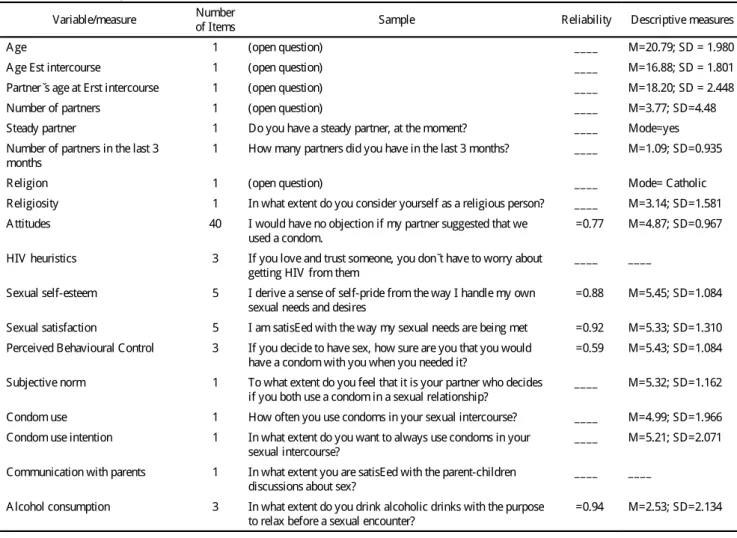
Table 1 describes the v ariables measured along with a sample item. R eliabi lity and descripti ve measures are presented.
I ntr aper sonal var iables. A tti tude towards condoms was measured by B rown’s A ttitude towards C ondom S cale ( B rown, 1984). T he original fi ve point scale was extended to include 1 ( never) to 7 ( always) . H euristics were assessed using three sentences that evaluated beliefs about HIV.
Perceived behavioural control was assessed by the S exual R i sk B ehaviour B eliefs and S elf-E ffi cacy S cales ( B asen-E ngquist, 1996).
Sexual satisfaction and sexual self-esteem were items of the Multi-dimensional S exual S elf-C oncept Questionnaire ( S nel l, 1995) . A sev en point scal e, from 1 ( never) to 7 ( always) was used.
T he subjective norm focused on the perception of the pressure a partner exerted to use or not condoms during sexual intercourse. A seven point scale, from 1 (never) to 7 ( always) was used.
I nterper sonal var iables. C ommunication was evaluated with a single question and one out of three answers was possible: 0 for non-existent; 1 for unsatisfi ed; and 2 for totally satisfi ed. T he age at which the communication started was assessed by an open-question. F inally, timing was calculated using C lawson and R eese-Weber’s (2003) recommended approach. If parents communicated about sex before the fi rst experience of sexual intercourse, it was considered to be on time. In contrast, if the topic had arisen after sex had taken place, it was regarded as being out of time.
Situational variables. T hree diff erent situations in which alcohol could be consumed were assessed: daily, socially ( hanging out with friends) , and relaxing before a sexual encounter. A seven point scale, from 1 ( never) to 7 (always) was used.
Procedure
Permission to collect data from students was sought from the University of A lgarve. T he students were approached in their classroom and their informed consent was requested. To ensure privacy and confi dentiality, a sealed box was placed in the classroom into which the completed questionnaires were placed by the students themselves.
D ata was introduced into the S PS S v.17 in respect of the descriptive measures. A MOS 7 was used to conduct the pathway analysis.
R esults
T he M odels’ F it
T he fi t indexes of the three models, the T R A , T PB and the extended version, were tested using a pathway analysis. To compare the adjustment of the data to the theoretical model, several statistical fi t indexes were used. T he relative chi-square statistic, as an absolute fi t, was applied, assuming that the minimum discrepancy degree between chi-square and freedom degrees should be less than three to be considered a reasonable fi t ( C armines & McIv er, 1983) , but should preferably approach or be below two (Hoelter, 1983). T he C F I, or comparative fi t index (B entler, 1990), and the G F I, or goodness of fi t ( J öreskog & Sörbom, 1986) , were also used, with values close to one indicating a good fi t. T he standardized root mean-square residual ( S R M R ) and the root square-mean error of approximation (R M SE A ) were used as well. F or the former, smaller values are indicative of a good fi t: those below 0.05 represent a good fi t, below 0.08 a reasonable fi t, below 0.10 a poor fi t, and above 0.10 equates to an unacceptable fi t (B rowne & C udeck, 1993) . Similarly, the standardized root square-mean residual should have values below 0.05.
Table 2 summarizes the fi t results of the T R A , the T PB and the extended model.
E xogenous β R
2
E ndogenous Β R
2
T R A A ttitude 0.310*** 17.5% *** Intention 0.878*** 77.1%***
Subjective Norm 0.198*
T PB A ttitude 0.288** 19.2%*** Intention 0.851*** 78.1%***
Subjective Norm 0.166* PC B 0.105*
PB C 0.140 ns
Table 3. The predictive value of the TRA and TP B
Note. *** p<0.000; **p<0.010; *p<0.050; ns – non signi fi cant; T R A – T heory of R easoned A ction; T PB – T heory of Planned Behav iour; PB C – Perceived B ehav ioural C ontrol;
β – regression weights; R 2 – Square C orrelation; Method used in the regression analysis: E nter
χ2 /(df) GF I C F I SR MR R MSE A
T R A 46.349/2 = 23.175* 0.175 0.642 0.0636 0.399
T PB 21.761/2=10.710* 0.946 0.932 0.0457 0.246
E xtended model 195.638/123=1.591* 0.880 0.887 0.0848 0.065
Table 2. Theory of Reasoned Action, Theory of Planned Behaviour and E xtended Model Measures descriptive statistics
Note. * p<0.001; χ2 /(df) – C hi-square statistic and overall fi t ; GF I – Goodness of fi t index; C F I – C omparativ e fi t index; R MR – R oot mean-square residual; R MSE A – R oot
mean-square error of approximation
In all of the three models, the discrepancies between the data and the theory were signifi cant ( p<0.050) . T he T R A version has a high degree of discrepancy, with the goodness of fi t and the comparative fi t index being low. Moreover, both the residual error ( S R MR ) and the approximation error ( R MSE A ) were well above the levels considered to be a plausible fi t.
T he T PB model had a good fi t according to the G F I, C F I and S R MR . However, the discrepancy, provided by the chi-square statistic and degrees of freedom, is higher than fi ve, and the R MS E A (<0.050) also failed to indicate a good fi t.
T he extended T PB model had a good discrepancy level, acceptable G F I and C F I measures of fi t, and a reasonable R MSE A . A ccording to these measures, we can thus report that the extended T PB model is a plausible fi t for the data used.
T he M odels’ Predictive V alue
T he predictive value of the three models was assessed by the regression weights.
W hen comparing the T R A and the T PB , the latter seems to have a better predictive value ( table 3). T he forecasting of intentions through the use of the attitude variable and subjective norm is increased by adding perceived behavioural control to the model. M oreov er, the predi ctiv e val ue of condom use intention over condom use behaviour is also enhanced by adding the perceived behavioural control factor.
T he predictive value of the extended model is presented in table 4.
It was assumed that attitude was predicted by religiosity and heuristics. In fact, only 7.9% of attitude variance was expl ai ned by those v ari abl es. H owev er, the i ndi v i dual regression weight was not signifi cant.
5 Psic.: Teor. e Pesq., B rasília, Vol. 33 pp. 1-8
E xtended T PB Model
V ariables predicting attitude V ariables predicting intention V ariables predicting condom use
β R2
β R2
β R2
E xtended model
7,9%
A ttitude 0.270**
33,2%
Intention 0.794***
80,6%
Subjective Norm 0.186* C om. E valuation -0.031 ns
R eligiosity 0.159 PB C 0,141 ns C om. A ge 0.064 ns
Heuristic1 - 0.162 Sexual satisfaction -0.085 ns T iming -0.088 ns
Heuristic2 - 0.118 Sexual self-esteem -0.054 ns A ge -0.056 ns
Heuristic3 0.094 Heuristic1 -0.049 ns Sex -0.025 ns
Heuristic2 0.106 ns Number of partners -0.040 ns
Heuristic3 0.019 ns Steady partner 0.070 ns
Steady partner 0.284* A lcohol -0.095*
PB C 0.131**
R eligiosity -0.024 ns Table 4. The predictive value of the E xtended TPB model
Note. p<0.000; **p<0.010; *p<0.050; ns – non signifi cant; T PB – T heory of Planned B ehaviour; PB C – Perceived B ehavioural C ontrol; β – regression weights; R 2 – Square
C orrelation; Method used in the regression analysis: E nter
individually in this proposed step of the extended model. L ikewise, all of the other contributions were not signifi cant in terms of the explanation of condom use intention variance. However, compared with the T R A and T PB models, we did produce a better approach with which to predict condom use intention.
C ondom use behaviour continues to be mainly predicted by i ntenti on and percei v ed behav i oural control, wi th a slight improvement in the measure being noted after the introduction of the alcohol consumption variable.
D iscussion
T he present research aims was to assess the predictive value and data fi t of an extended T heory of Planned Behaviour model, comparing it to the original T R A and T PB versions.
F it and Predictive V alue of T R A and T PB
T he results of the confi rmatory analysis enabled us to observe that the T PB model surpasses the T R A version; the fi t indexes are better in the T PB and it also has a better predictive value of condom use intention and behaviour. T he introduction of perceived behavioural control has enhanced the predictive value of the T PB model when it comes to condom use behaviour.
In both models, attitude was a better predictor of condom use intention than the subjectiv e norm, a fi nding that is consistent with the literature (A rmitage & C onner, 2001; B eadnell et al., 2008; B ennett & B ozionelos, 2000) .
In this study the introduction of perceived behavioural control i mprov ed the predi cti v e v al ue of both model s. However, this enhancement was not statistically signifi cant. Perceived behavioural control was also the variable with less weight when it came to the prediction of condom use behaviour. A ccording to the meta-analysis of condom use, the infl uence of perceived behavioural control was moderate and
its direct impact was considered to be minimal (A lbarracín et al., 2001). B oth intention and perceptions of behavioural control can make signifi cant contributions to the prediction of behaviour, but in any given application one may be more important than the other and, in fact, only one of the two predictors may be needed (A jzen, 1991).
However, perceived behavioural control was assessed by a sel f - eff i cacy measure, and PB C concept i mpl i es more than belief of control. It implies actual control over the behaviour. A ccording to A jzen ( 2002) a high level of perceived behavioural control should enhance a person’s intention to perform the behaviour, and when it is veridical it should also aff ect the behaviour itself. Nevertheless in this study we don’t observe a signifi cant impact over intention, as we would expect, but only over the behaviour.
T he self-effi cacy measure used asked about the belief of being able to use or to have a condom when needed. We didn’t measure the actual control over the situation, which might aff ect and partially explain the results.
A lso, the overall participants had a high mean of intention and condom use, which might hinder the eff ect of the self-effi cacy ov er the intention. In essence, parti cipants that already use condoms might have a high self-effi cacy on using them, and its intention of use may not rely on the ability to use them, but only on the control to perform the behaviour, which we have not measured.
In both T R A and T PB model s, participants with the intention to use a condom were more likely to do so, which is consistent with literature (A lbarracín et al, 2001; Sheeran & Orbell, 1998) .
F it and Predictive V alue of the E xtended T heor y of Planned B ehaviour
that adjusted better to the data, highlighting the need to include other variables in the socio-cognitive models that are used to assess condom use behaviour.
F rom the variables that were introduced in the model, the presence of a steady partner and alcohol consumption signifi cantly increased its predictive value.
T he existence of a steady partner reduced the intention to use a condom but didn’t directly infl uence condom use behaviour. Mercer et al. (2009) observed a statistical reduction on condom use in couples after 21 days of relationship. T his fact points out that individuals might consider a partner steady in less than a month, what might put these individuals at risk, with an average of 3 partners, more than a partner in the last three months, and with an inconsistent condom use. In order to promote safer sex behaviours, the belief of a steady partner should be considered and modifi ed, since steady relations have also been associated with ideas of trust, intimacy and romance, which are responsible for decreasing the odds of using a condom (C amargo & B ousfi eld, 2009; K irkman, R osenthal & Smith, 1998) .
T he existence of a steady partner didn’t aff ect condom use behaviour. T his was unexpected, since it was anticipated that this factor would have an impact on both variables ( B ogart et al., 2005) . T his null eff ect could be attributed to the extremely linear correlation between intention and behaviour, which could have diminished the relative weight of the variable to predict condom use behaviour. T he meta-analysis conducted on the issue of condom use evidenced strong but small er correl ati ons between these v ari abl es (r≈0.44; A lbarracín et al., 2001; S heeran & Orbell, 1998).T he use of a single question to assess condom use intention and behaviour probably led to this similar result. It is possible that participants tried to be consistent in the answers they gave to both questions, thereby producing analogous responses. A longitudinal study should contour this problem, since it would measure intention and behaviour in diff erent time sets.
T he prediction of condom use behaviour when the alcohol consumption variable was introduced is corroborated by some of the results found in the literature (Galvez-B uccollini, 2009) . T he fi ndi ngs herei n, therefore, contri bute to the discussion about the infl uence of alcohol on condom use inconsistency. A lcohol consumption does seem to be linked to the occurrence of several other factors, such as the type of sexual partner and beliefs about the impact of alcohol on sexual disinhibition ( L aB rie, E arleywine, S chi ff man, Pedersen, & Marriot, 2005). S ince we did evaluate whether al cohol was consumed to f aci l i tate sexual encounters, positive answers may indicate that participants believe that alcohol reduces sexual inhibition. T hese beliefs should be taken into account when intervention is designed.
A ll of the other variables in the model failed to predict condom use. However, they may be producing mediation effects through thei r correlation wi th the other factors. However it wasn’t our goal to assess those relations.
C onclusions
Our extended T PB model added both a socio-demographic and a si tuati onal v ariabl e, respecti v ely, hav ing a steady
partner and alcohol consumption. T he consequence was an increase in the predictive value of the model when compared to the ori gi nal T R A and T PB v ersi ons. T he extended model also seems to have medium fi t indexes, despite the inadequacy of the overall fi t measure. D espite the moderate success of the introduction of the two new variables referred to above, a gap continues to exist between trait-like variables, beliefs, and the intention to use a condom.
Several critiques of this type of model may, therefore, be valuable. V isser and Smith (1999) emphasised how important it is to reach an agreement with the sexual partner as a necessary step to being able to use a condom. W hen it comes to methodology, correlational research is criticized for being an inappropriate way of analysing causality. B ehavioural performance tends to produce perceptions that are supportive of the behaviour. However the correlational tests lead to the mi scl assi fi cati on of these percepti ons as promoting behaviour, forcing it in the direction proposed by theories ( Weinstein, 2007). On the other hand, individual analysis may be contrary to the nature of sexual relationships, since sex is not an individual behaviour, instead being a complex dynamic because of the fact that two people are involved ( J off e, 2002; K ashima, G allois, & McC amish, 1993) .
Since there is still a gap between individual characteristics and condom use behaviour, further studies are required if we are to reduce the levels of inconsistent condom use and, consequently, the rate at which the H IV infection is being spread.
R eferences
A defuye, A . S., A biona, T. C ., B alogun, J . A ., & L ukobo-Durrell, M. (2009). HIV sexual risk behaviors and perception of risk among college students: Implications for planning interventions. BMC Public Health, 9(1) , 281. doi:10.1186/1471-2458-9-281 A j zen, I., & Madden, T .J . ( 1986) . Predicti on of goal-directed
behav i or: A ttitudes, intentions and percei v ed behav ioral -control. J ournal of E xperimental Social P sychology, 22, 453-474. doi:10.1016/0022-1031(86)90045-4
A jzen, I., & Manstead, A .S .R . (2007). C hanging health-related behav i ors: A n approach based on the theory of pl anned behaviour. In K . B os, J . Hwestone, H. Wit., H. C hut, & M. S troebe (E ds), T he scope of social psychology: T heory and applications ( pp. 43-63). New Y ork: Psychology Press. A jzen, I. (1991). T he T heory of Planned B ehavior. Organizational
Behavior And Human D ecision P rocesses, 50, 179-211. doi: 10.1016/0749-5978(91)90020-T
A jzen, I. (2002). Perceived behavioral control, self-effi cacy, locus of control, and the T heory of Planned B ehavior. J ournal of Appl ied Social P sychology, 32( 4) , 665-683. doi : 10.1111/ j.1559-1816.2002.tb00236.x
7 Psic.: Teor. e Pesq., B rasília, Vol. 33 pp. 1-8
E xtended T PB Model
A ndrew, B . J ., Mullan, B . A ., de Wit, J . B . F., Monds, L . A ., Todd, J ., & K othe, E . J . ( 2016). Does the theory of planned behaviour explain condom use behaviour among men who have sex with men? A meta-analytic review of the literature. AID S Behavior, 20(12), 2834-2844. doi: 10.1007/s10461-016-1314-0. A rmitage, C ., & C onner, M. (2001). E ffi cacy of the theory of planned
behaviour: A meta-analytic review. British J ournal of Social Psychology, 40, 471-499. doi:10.1348/014466601164939 A spy, C .B ., V esely, S .K ., Oman, R .F., R odine, S ., Marshall, L ., &
McL eroy, K . (2007). Parental communication and youth sexual behaviour. J ournal of Adolescence, 30, 49–466. doi:10.1016/j. adolescence.2006.04.007
Ayala, G., R ivas, D ., & B ingham, T. (2003, J uly). H IV prevention heuristics and other factors that factors that facilitate heightened HIV risk for latino men who have sex with men in L os A ngeles county, 2003 [abstract] . National HIV Prevention C onference, A tlanta, GA .T 2-A 1502.
B asen-E ngquist, K ., Mâsse, L ., C oyle, K ., K irby, D ., Parcel, G., Banspach, S., & Nodora, J . (1998). Sexual risk behavior beliefs and self-effi cacy scales. In G. D avis, W. Y arber, R . B auserman, G. S chreer, & S . D avis ( E ds) , Handbook of sexuality related measures ( pp. 541-544). C alifornia: S age Publications. Beadnell, B ., Baker, S. A ., Gillmore, M. R ., Morrison, D . M., Huang,
B ., & Stielstra, S . ( 2008). T he T heory of R easoned A ction and the role of external factors on heterosexual men’s monogamy and condom use. J ournal of Applied Social Psychology, 38(1) , 97–134. doi:10.1111/j.1559-1816.2008.00298.x
B ennett, P., & B ozi onel os, G . ( 2000) . T he theory of pl anned behaviour as predictor of condom use: A narrative review. P syc hol ogy, H eal th & Medi c i ne, 5( 3) , 307- 326. doi : 10.1080/713690195
B entler, P.M. (1990). C omparative fi t indexes in structural models. P sychological Bulletin, 107, 238–246. doi :10.1037//0033-2909.107.2.238
B ogart, L . M., K ral, A . H., S cott, A ., A nderson, R ., F lynn, N., Gilbert, M. L ., & B luthenthal, R . N. ( 2005). C ondom attitudes and behav iors among injection drug users parti cipating in C alifornia syringe exchange programs. AID S and Behavior, 9(4) , 423-432. doi: 10.1007/s10461-005-9014-1
B rown, I.S. ( 1984). D evelopment of a scale to measure attitude toward the condom as a method of birth control. The J ournal of Sex Reseach, 20, 255-263. doi: 10.1080/00224498409551224 B rowne, M . W., & C udeck, R . ( 1993) . S i ngl e- sampl e cross-v alidati on indices for cocross-v ariance structures. Mul ti cross-vari ate Behavi or al R esearch, 24, 445–455. doi : http: //dx .doi . org/10.1207/s15327906mbr2404_ 4
C amargo, B. V., & Bousfi eld, A . B. (2009). Social representations, risk behaviors and A ID S. The Spanish J ournal of Psychology, 12(2), 565-575. link: http://europepmc.org/abstract/ME D /19899657/ reload=0;jsessionid=3lV E qE 7PGkyuz516OdmJ .2
C armines, E . G., & McIver, J . P. ( 1983). A n introduction to the anal y si s of model s wi th unobserv ed v ari abl es. P ol iti cal Methodology, 9, 51-102. R etrieved from http://www.jstor.org/ stable/25791175
C lawson, C . L ., & R eese-Weber, M. (2003). T he amount and timming of parent-adolescent sexual communication as predictor of late adolescent risk-taking behavior. T he J ournal of Sex Research, 40(3) , 256-265. doi:10.1080/00224490309552190
E spada, J ., Morales, A ., Guillén-R iquelme, A ., B allester, R ., & Orgilés, M. ( 2016). Predicting condom use in adolescentes: A test of three socio-cognitive models using a structural equation modeling approach. BMC Public Health, 16, 35. doi: 10.1186/ s12889-016-2702-0
E thier, K . A ., K ershaw, T. S., L ewis, J . B ., Milan, S., Niccolai, L . M., & Ickovics, J . R . ( 2006). S elf-esteem, emotional distress and sexual behavior among adolescent females: Inter-relationships and temporal effects. J ournal of Adol escent H ealth, 38, 268–274. doi:10.1016/j.jadohealth.2004.12.010
F armer, M. A ., & Meston, C . M. (2006). Predictors of condom use self-effi cacy i n a ethnically diverse university sample. Archives of Sexual Behavior, 35(3) , 313-326. doi:10.1007/ s10508-006-9027-5
F ishbein, M., & A jzen, I. (1975). Belief, attitude, intention and behavior: An introduction to theory and research. R eading, MA : A ddison-Wesley.
Galvez-Buccollini, J . A ., D elea, S ., Herrera, P. M., Gilman, R . H., & Paz-Soldan, V . ( 2009) . Sexual behavior and drug consumption among young adults in a shantytown in L ima, Peru. BMC Public Health, 9, 23. doi: 10.1186/1471-2458-9-23
Gullete, D . L ., & L yons, M. A . (2006). Sensation seeking, self-esteem, and unprotected sex in col lege students. J ournal of the Associ ation of Nurses in AID S C are, 17( 5) , 23-31. doi:10.1016/j.jana.2006.07.001
Halpern-F elsher, B ., K ropp, R ., B oyer, C ., Tschann, J ., & E llen, J . (2004). A dolescents self-effi cacy to communicate about sex: Its role in condom attitudes, commitment and use. Adolescence, 39( 155) , 443-456. R etrieved from http://search.ebscohost. com/login.aspx?direct=true& db=pbh& A N=15616702& lang =pt-br& site=ehost-live
He, F., Hensel, D . J ., Harezlak, J ., & F ortenberry, J . D . (2016). C ondom use as a function of number of coital events in new relationships. Sexually Transmitted D iseases, 43(2), 67-70. doi: 10.1097/OL Q.0000000000000390
H oel ter, J . W. ( 1983) . T he anal ysi s of cov ari ance structures: Goodness-of-fi t indices. Sociological Methods and Research, 11, 325–344. doi: 10.1177/0049124183011003003
Hutchinson, M. K ., J emmott, J . B ., J emmott, L . S ., B raverman, P., & F ong, G. T. ( 2003). T he role of mother–daughter sexual risk communication in reducing sexual risk behaviors among urban adolescent females: A prospective study. J ournal of Adolescent Health, 33, 98–107. doi:10.1016/S 1054-139X ( 03)00183-6 Instituto Nacional de S aúde. ( 2016) : Infecçã o V IH /SID A - A
situaçã o em P ortugal a 31 de D ezembro de 2015. L isboa: M i ni stéri o da S aúde. R etri ev ed from https: //reposi tori o. i nsa.pt/bitstream/10400.18/4101/3/R el at% C 3% B 3ri o% 20 V IH_ S ID A _ 2015.pdf.pdf
J of f e, H . ( 2 0 0 2 ) . S oc i al repres ent at i ons and heal th psy chol ogy. Soci al Sci ence Informati on, 4( 4) , 559- 580. doi:10.1177/0539018402041004004
J öreskog, K . G., & Sörbom, D . ( 1986). L ISRE L V II: analysis of linear structural relationship by maximum likelihood and least square method. Mooresville: Scientifi c Software.
K ashima, Y ., Gallois, C ., & McC amish, M. (1993). T he theory of reasoned action and cooperative behaviour: It takes two to use a condom. British J ournal of Social Psychology, 32 ( 3), 227-239. K i rk man, M . , R osenthal , D ., & S mi th, A . M . A . ( 1998) . A dolescent sex and the romantic narrative: W hy some young heterosexuals use condoms to prev ent pregnancy but not disease. Psychology, Health & Medicine, 3(4) , 355-370. doi: 10.1080/13548509808400610
L aB ri e, J ., E arl ey wi ne, M ., S chi ff man, J ., Pedersen, E ., & M arriot, C . ( 2005) . E ff ects of al cohol , expectanci es, and partner ty pe on condom use in college males: E vent-level anal y ses. T he J ournal of Sex R esearch, 42( 3) , 259- 266. doi:10.1080/00224490509552280
MacD onald, T. K ., & Martineau, A . M. ( 2002). Self-esteem, mood, and intentions to use condoms: W hen does low self-esteem lead to risky health behaviors? J ournal of E xperimental Social Psychology, 38, 299–306. doi:10.1006/jesp.2001.1505 McC ree, D . H., Wingood, G. M., D iC lemente, R ., D avies, S., &
Harrington, K . F. ( 2003) . R eligiosity and risky sexual behavior in A frican-A merican adolescent females. J ournal of Adolescent Health, 33(1) , 2-8. doi:10.1016/S1054-139X (02) 00460-3 M ercer, C . H., C opas, A . J ., S onnenberg, P., J ohnson, A . M.,
McManus, S ., E rens, B ., & C assel, J . A . ( 2009) . W ho has sex with whom? C haracteristics of heterosexual partnerships reported in a national probability survey and implications for S T I risk. International J ournal of E pidemiology, 38(1) , 206-214. doi: 10.1093/ije/dyn216
Muñ oz-Silva, A ., S ánchez-García, M., Nunes, C ., & Martins, A . ( 2007) . G ender diff erences in condom use prediction with T heory of R easoned A ction and Planned B ehaviour: T he role of self-effi cacy and control. AID S C are, 19(9) , 1177-1181. doi: 10.1080/09540120701402772
Noar, S . M. & Z immerman, R . S . (2005). K nowledge regarding health behaviors: A re we moving in the right direction? Health E ducation Research: Theory & Practice, 20(3) , 275–290. doi: 10.1093/her/cyg113
S hearer, C . L ., Hosterman, S . J ., Gillen, M. M., & L efkowitz, E . S . (2005). A re traditional gender roles associated with risky sexual behavior and condom-related beliefs? Sex Roles, 52(5-6), 311-324. doi:10.1007/s11199-005-2675-4
Sheeran, P., & Orbell, S. (1998). D o intentions predict condom use? Meta-analysis and examination of six moderator variables. Bri ti sh J ournal of Soci al P sychol ogy, 37, 231- 250. doi : 10.1111/j.2044-8309.1998.tb01167.x
S nell, W. E . (1998). Sexual risk behavior beliefs and self-effi cacy scales. In G. D avis, W. Y arber, R . B auserman, G. S chreer, & S . D avis (E ds) , Handbook of sexuality related measures (pp. 521-524) . C alifornia: S age Publications.
S unmola, A .M. ( 2005). E valuating the sexual behaviour, barriers to condom use and its actual use by university students in Nigeria. AID S C are, 17(4) , 457-465. doi:10.1080/09540120 412331319732
T horburn, S., Harvey, S .M., & R yan, E .A . (2005). HIV prevention heuristics and condom use among A frican-A mericans at risk for HIV . AID S C are, 17(3) , 335-344. doi:10.1080/09540120 412331299762
V isser, R . O., & S mith, A . M. A . (1999) . Predictors of heterosexual condom use: C haracteristics of the situation are more important than characteristics of the individual. Psychology, Health & Medicine, 4(3) , 265-279. doi:10.1080/135485099106207 V i sser, R .O., & S mi th, A .M .A . ( 2001) . Inconsi stent users of
condoms: A C hal l enge to tradi ti onal model s of heal th behaviour. Psychology, Health & Medicine, 6(1) , 41-46. doi: 10.1080/13548500123746
Walsh, J . L ., F ielder, R . L ., C arey, K . B ., & C arey, M. P. (2013). D o alcohol and marijuana use decrease the probability of condom use for college women? T he J ournal of Sex Research, 51(2) , 145-158. doi: 10.1080/00224499.2013.821442
Weinstei n, N. D . ( 2007) . M isl eading tests of heal th behav ior theories. Annals of Behavioral Medi cine, 33(1) , 1-10. doi: 10.1207/s15324796abm3301_ 1
Recebido em 04.03.2013 Primeira decisã o editorial em 03.03.2017 Versã o fi nal em 22.06.2017