Federal Police
Andrea Leite Rodrigues
Universidade de São Paulo / Escola de Artes, Ciências e Humanidades São Paulo / SP — Brazil
Alcides Barrichello
Universidade Presbiteriana Mackenzie / Centro de Ciências Sociais e Aplicadas São Paulo / SP — Brazil
Hélio Arthur Reis Irigaray
Fundação Getulio Vargas / Escola Brasileira de Administração Pública e de Empresas Rio de Janeiro / RJ — Brazil
Donaldson Resende Soares
Ministério da Justiça e da Segurança Pública do Brasil Distrito Federal / DF — Brazil
Estelle M. Morin
École des Hautes Études Commerciales — HEC-Montreal Quebec / Canada
One of the main challenges of human resources management in public administration is to make sure that civil servants are committed to and driven by values of the public ethos. Understanding the elements that give me-aning to their work can be a way to take pertinent action, leaving aside the stigma and misinterpretation of the relationship between individuals and their work in the public sector. his article aims to assess the antecedent factors of our central construct, meaning of work, and its relationships with psychological well-being, psycholo-gical distress and afective commitment for forensic experts in the Federal Police. It is a quantitative study that uses conirmatory factor analysis and structural equation modeling. he results show that forensic experts ind meaning in their work through its social utility and the opportunities they have to learn and develop. Meaning is positively related to psychological well-being and afective commitment, and negatively related to psychological distress. his study discusses the results of applying this model in light of a managerial accountability framework to develop the civil service and concludes that it ofers a good contribution to human resources management in the public sector, making it possible to discuss factors that favor the experience of commitment and psychological quality of life in the work environment.
Keywords: meaning of work; psychological well-being; psychological distress; organizational commitment; Federal Police.
O trabalho e seus sentidos: um estudo com peritos criminais da Polícia Federal
Servidores públicos comprometidos e orientados por valores do éthos público é um dos principais desaios da gestão de pessoas. Conhecer o que lhes dá sentido ao trabalho pode ser um caminho para ações pertinentes, fora de estigmas e más interpretações sobre a relação entre o indivíduo e seu trabalho no setor público. O propósito deste artigo é avaliar os fatores antecedentes da experiência de sentido do trabalho, bem como sua relação com bem-estar psicológico, sofrimento psicológico e comprometimento afetivo em peritos criminais da Polícia Federal.
DOI: http://dx.doi.org/10.1590/0034-7612159318
Article received on Feb. 1, 2016 and accepted on March 8, 2017.
[Translated version] Note: All quotes in English translated by this article’s translator.
Trata-se de pesquisa de natureza quantitativa, com uso de análise fatorial conirmatória e modelagem de equações estruturais. Os resultados indicam que os peritos veem sentido em seu trabalho, o qual advém de sua utilidade social e das oportunidades de aprendizagem e desenvolvimento. O sentido está positivamente relacionado com bem-estar psicológico e comprometimento afetivo e negativamente com sofrimento psicológico. São discutidos os resultados da aplicação do modelo à luz de um marco de responsabilidade gerencial para desenvolvimento da função pública e conclui-se que ele oferece boa contribuição para gestão de pessoas no setor público possibilitando discutir fatores que favorecem a experiência de comprometimento e qualidade de vida psíquica no ambiente de trabalho. Palavras-chave: sentidos do trabalho; bem-estar psicológico no trabalho; sofrimento no trabalho; comprometi-mento organizacional; Polícia Federal.
El trabajo y sus significados: un estudio con expertos en delitos de la Policía Federal
Servidores públicos comprometidos y guiados por los valores del ethos público es uno de los principales retos de la gestión de personas. Saber lo que les da sentido al trabajo puede ser una forma para acciones pertinentes, fuera de los estigmas y conceptos erróneos acerca de la relación entre el individuo y su trabajo en el sector público. Este estudio tiene como objetivo evaluar los factores de fondo de la experiencia de sentido en el trabajo y su relación con el bienestar psicológico, la angustia psicológica y el compromiso emocional a los expertos forenses de la Policía Federal. Se trata de una investigación cuantitativa, utilizando el análisis factorial conirmatoria y modelos de ecua-ciones estructurales. Utilidad social del trabajo y de aprendizaje y desarrollo de oportunidades eran la mayoría de los factores de fondo importantes. El signiicado del trabajo se relaciona negativamente con la angustia psicológica y positivamente con el compromiso afectivo y bienestar psicológico. Los resultados de la aplicación del modelo se discuten a la luz de un marco de responsabilidad de gestión para el desarrollo de la función pública. Se llegó a la conclusión de que ofrece una buena contribución a la gestión de personas en el sector público que permite analizar los factores que favorecen la experiencia del compromiso y de la calidad de la vida psíquica en el lugar de trabajo. Palabras clave: sentidos del trabajo; bienestar psicológico en el trabajo; sufrimiento en el trabajo; comprometimiento organizacional; Policía Federal.
1. INTRODUCTION
he modernization of human resources management is always one of the topics of greatest interest in the reform agenda for public administration. However, this topic brings with it a certain skepticism, given a dominant perception among public managers that combines a critique of current models and a strong conviction that it is diicult to change them. Ater more than two decades of reform of the Brazilian state, overall criticism persists in regard to the functioning and performance of the State (Abrucio, 2007).
he idea of a corps of professional bureaucrats or civil servants1 (Bacellar Filho, 2003; Longo, 2007) requires applying the topics that have usually been associated with private administration to the public sector. Skills, discretion, managerial development, customer service and performance are some of the terms that populate studies about the need for a technical corps that is able to deal with recent changes in the organizational models of the contemporary State (Secchi, 2009). his implies a laborious and tumultuous transition from a sluggish Taylorist system to what Bresser-Pereira and Spink (1998) call post-bureaucratic or managerial state models. Secchi (2009) presents the transitions between organizational models in Brazilian public administration. Among other sources of tension,
these changes require that public functionaries abandon a hostile, self-referential proile and an indif-ference to the public good (Junquilho, 2002) and instead become professionals with skills in decision making and teamwork with the ability to acquire knowledge, technical and human skills, and who are imbued with a desire to improve public well-being. hese changes in organizational models can only take root if they are accompanied by other ways of giving meaning to being a civil servant as well as better working conditions which increase the likelihood of psychological quality of life and positive experiences in the servant-work and servant-public organization relationships.
his work represents a contribution to the knowledge of what constitutes the meaning of work for civil servants, within the idea of the development of public services as a paradigm of human resource development in the Brazilian state.
Our speciic objective is to evaluate the antecedent factors of the meaning of work experience, as well as their relationship to psychological well-being, psychological distress and afective com-mitment among forensic experts working for the Federal Police. his issue is relevant to academia, the institution in question, all of its civil servants and Brazilian society as a whole. It is of interest to academia, because it marks the irst time that an integrated model with antecedents as well as central and consequential constructs has been used with research subjects in a Brazilian government orga-nization. It is of interest to the Federal Police, given that the results obtained will contribute to the advancement of knowledge in terms of civil servants and their work in this internationally renowned Brazilian government organization. For the servants, it is of interest in that it will help them relect on their work, outside of the polarizing views of public servants who consider their work a vocation
versus utilitarian. Finally, it is of interest to Brazilian society in order to understand the work of civil
servants outside of disqualifying stereotypes of unmotivated professionals.
In the ield of management studies, the meaning of work has been treated as being indicative of motivation, an idea that can be traced back to the Sociotechnical School (Trist, 1978, 1981) and Job Design heory(Hackman and Oldham, 1976). Both theoretical perspectives highlight that the worker relationship is not limited to rational and instrumental issues, and that it involves subjectivity and the generation of positive psychological states in the work itself, as well as the workplace environment. Other studies relate the meaning of work with engagement (May, Gilson and Harter, 2004), work satisfaction (Wrzesniewski et al., 1997), the reduction of stress (Elangovan, Pinder and McLean, 2010) and business ethics (Michaelson et al., 2014).
“What is the meaning of work to you?” was the question on which Morin (2001) based a qual-itative study of executives of various sectors, including public servants in the province of Quebec, Canada. Later Morin (2008) elaborated and tested six hypotheses relating antecedent constructs with the meaning of work. his study was replicated with Brazilian and Canadian university professors (Villas Boas and Morin, 2013), inspired the work of Rodrigues, Barrichello and Morin (2016), and is the model that we have chosen to employ in this present article.
2. THEORETICAL MODEL
he meaning of work has already appeared as an important variable in classic studies of the Socio-technical School (Trist, 1981) and Job Design heory(Hackman and Oldham, 1976; Sims, Szilagyi and Keller, 1976), with the latter proposing that considering one’s own work signiicant is part of a psychological state that leads one to have greater productivity (quantity of work delivered), better productivity (quality of work delivered), reduced levels of absenteeism, expected behavior that comes closer to the best it, and less turnover.
Studies of the meaning of work are frequently associated with the Meaning of Work Group (MOW), which was created at the end of the 1970s and developed comparative applied studies to identify the characteristics of the meaning of work in diferent countries. According to its results, it may be inferred that the meaning of work is a function of individual experience as much as the organizational and environmental context of the individual (MOW, 1987). Morin and Cherré (1999), inspired by the work of MOW, established an evaluation scale for the meanings of work with three antecedent factors related to individual experience, termed factors in the meaning of work — auton-omy, opportunities to develop and learn, and the work’s social utility — and three factors related to the environment, termed factors in meaning at work — cooperation and relationship with colleagues, recognition and moral rectitude.
he model presented here relates the six factors used by Morin and Cherré (1999) as antecedent constructs associated with the experience of meaning — autonomy, learning and development, social utility, recognition, moral rectitude and cooperation with peers — as its central construct, the meaning of work. he work of Morin (2003) has been followed for the deinition of the central construct, which uses the concept of the meaningfulness of work based on the deinition of May, Gilson and Harter (2004). he proposition of using these six constructs as antecedents is also in line with the statements of Ciulla (2000) regarding the meaning of work as containing an objective dimension (working conditions such as the environment and relationships) and a subjective dimension (worker perspectives in terms of autonomy and purpose). his idea has since been corroborated by Michaelson and partners (2014).
Table 1 summarizes the deinitions, hypotheses and references which have inspired the formulation of these six hypotheses about the antecedent factors to the meaning of work construct. In terms of the previous works that present the theoretical basis for the proposition of these six hypotheses, we have opted to list the arguments succinctly and the works on which they are based.
TABLE 1 HYPOTHESES ABOUT ANTECEDENT VARIABLES FOR THE MEANING OF WORK
Factors Hypothesis Reference
Social Utility The objective of work is
contributing to society. H1: The greater the social utility or perceived contribution to society, the greater the meaning.
Dik and Duffy (2009); Wrzesniewski et al. (1997)
Autonomy The realization of work
involves the capacity to make decisions about time, resources and results.
H2: The greater the perception of autonomy, the greater the meaning of work.
Isaksen (2000); Sims, Szilagyi and Keller (1976)
Factors Hypothesis Reference
Opportunities to Learn and Develop
Work involves the experience of acquiring knowledge and skills.
H3: The greater the perception of opportunities to learn and develop, the greater the meaning of work.
Isaksen (2000); Ketchum and Trist (1992)
Cooperation and Relationships with Colleagues
The realization of work involves experiences of solidarity in good and relevant relationships with colleagues and peers.
H4: The greater the perception of cooperation and relationships with colleagues at work, the greater the meaning of work.
Pratt and Ashforth (2003); Wrzesniewski (2003)
Recognition The realization of work
produces positive feedback from superiors and peers.
H5: The greater the perception of recognition, the greater the meaning of work.
Siegrist (1996); Siegrist, Li and Montano (2014)
Moral Rectitude Work is in keeping with the individual’s values (the ethical dimension).
H6: The greater the perception of moral rectitude, the greater the meaning of work.
Morin (2001)
Source: Elaborated by the authors.
Complementing this, it is understood that this central construct is related to three consequential constructs which are psychological well-being, its antithesis psychological distress, and afective commitment. hese three are considered to be indicators of the quality of psychological life at work, according to the experience of Vilas Boas and Morin (2013, 2014). hey sustain the idea that the experience of meaning is related to the experience of psychological health, associated not only with psychological well-being (Huppert, 2009; Veit and Ware, 1983), but also with an afective commit-ment to the organization (Meyer and Allen, 1991) and low levels of psychological distress (Veit and Ware, 1983).
he World Health Organization (WHO) deines mental health as a state of well-being in which an individual can realize his or her potential by working productively while coping with the normal stresses of life, thus contributing to his or her community (Organisation Mondiale de la Santé, 1999; World Health Organization, 2001). If on one hand possible antecedent factors have been deined and tested, the present article has also sought to understand whether meaning can be an indicator for other variables which are important in understanding the lives of people in the workplace. hus, we have sought to relate meaning with psychological well-being and commitment, both constructs related to the possibilities of a healthy and productive existence.
emotional ties and general positive afect. hey have all been constructed in such a manner that the greater the score, the greater the variable that it is named for. In this way, the greater the score in the subscales for anxiety, depression, and loss of behavioral/emotional control, the greater the level of psychological distress. he greater the score in the subscales for general positive afect and emotional ties, the better the individual’s psychological well-being.
he concept of psychological well-being incorporates not only the notion of positive emotions of contentment and happiness, but also others such as commitment, self-esteem and afection. Huppert (2009) points out that psychological well-being has evolved from a concept related to the notion of the absence of dysfunction or poor adaptation to the social environment, to notions related to the development of an individual’s potential, having control over one’s own life, and having plans and objectives to achieve as well as positive experiences in social relations. his being so, as Morin did on her own (2008) and jointly in Vilas Boas and Morin (2013, 2014), we will assume the hypothesis that meaning is an indicator of the presence of psychological well-being at work.
Hypothesis 7: he meaning of work positively inluences psychological well-being at work.
he notion of sustained well-being does not require that individuals feel well all the time. he experience of painful emotions (deception, failure, mourning, for example) is a normal part of life and being able to manage these negative or painful emotions is essential to long-term well-being. How-ever, it can be compromised when negative emotions are extreme or last a long time and interfere in the ability of a person to function in his or her daily life (Huppert, 2009). Massé and partners (1998) demonstrate that psychological well-being and psychological distress are diferent but complementary mental states. hus, we will assume the hypothesis that meaning negatively inluences psychological distress, which in the present article is evaluated through three MHI subscales: anxiety, depression and the loss of behavioral/emotional control.
Hypothesis 8: he meaning of work negatively inluences psychological distress.
he last aggregate construct of this study is commitment. It is the force that leads individuals to take actions that are pertinent to the achieving of one or more objectives. he dominant interest in studies of commitment to work is related to performance and employee retention policies.
organizational constructs such as low turnover and good performance (Meyer et al., 2002). hus we reach the ninth hypothesis.
Hypothesis 9: he meaning of work positively inluences afective commitment.
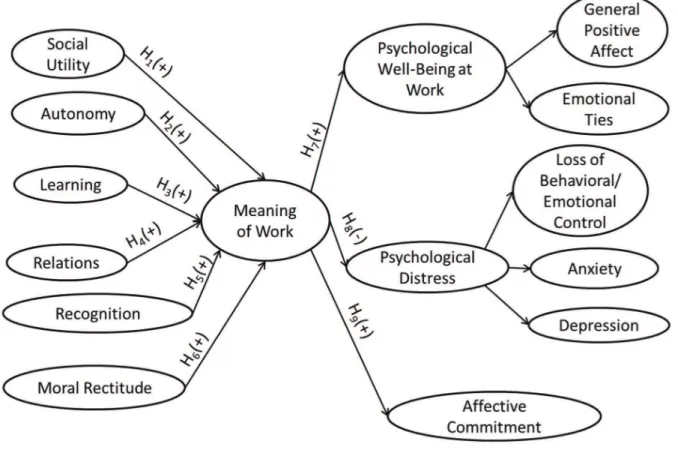
Now that we have presented the theoretical framework that governs this study as well as the nine underlying hypotheses, we display an illustrative schema for this model in Figure 1. he let side contains the six antecedent constructs of the central construct, the meaning of work. On the right, we have the consequent constructs of the meaning of work, and the use of the MHI enables us to identify irst order constructs (the constructs that cause the measured variables, the phrases of the questionnaire used in this study) — anxiety, depression, loss of behavioral/emotional control, gen-eral positive afect and emotional ties — and the second order constructs (the constructs that cause the irst order constructs, which would be psychological well-being and psychological distress). In presenting this composition, we can identify the need to verify possible alternative models which will show variations in the presence of irst and second order constructs, and these models will be addressed using the proposed theoretical model.
FIGURE 1 THEORETICAL MODEL AND HYPOTHESES
2.1 BRAZILIAN CIVIL SERVANTS: WHY DOES THE MEANING OF WORK MATTER?
he changes in the management of human resources in the twentieth century in the private sector as well as the public sector have brought great complexity to administration. he management models have been afected by the advent of the notion of lexibility in hiring, together with the decline of the idea that the adoption of a rigid bureaucratic organizational model can handle the new challenges that have come with factors linked to the globalization of markets, advances in technology and the augmented participation of services in the economy. Work remains the main factor that has been made lexible to minimize costs and generate results at the same time as the notion of hiring has made individuals focus on learning, skills and autonomy.
Work in the public sector has gone through marked changes in organizational models and proposals for management and governance (Secchi, 2009). Diferences between professionals who pursue careers in public and private sectors are the object of analysis and proposals of distinctions based on characteristics, and works like that of Lyons, Duxbury and Higgins (2006) assert that there are values that go beyond any identiication with a speciic sector. Even so, we can recognize that there are singular characteristics of careers in the public sector. As explained by Longo (2007), the concept of civil service elucidates the extent to which the management of public employment should be understood as singular territory.
Not every type of public employment constitutes civil service; it is only when the job occurs wi-thin given institutional contexts: those which make the existence and protection of professional administration possible. We will consider that these exist when public institutions have a series of attributes that enable them to have at their disposal the personnel with the aptitudes, attitudes and values necessary for the eicient and efective performance of their activities. Among other things, this means guaranteeing the public professionalism and objectivity on the part of public servants and conduct that respects democratic institutions; it also requires them to respect the principles of equality, merit, and capacity in their management. [Longo, 2007:58]
he professionalism of public administration is an attribute that is necessary for the efectiveness of public services, and it requires a group of institutional arrangements that preserve and protect it. With 20 years having passed since the reform of the State, many changes have occurred in the contracts, careers and proile of the public sector professional. he logic of loyalty and stability has sufered reverses such as multiple bidding being implemented as in business and the appearance new management tools such as public-private partnerships. his is why there is support for the idea that professional management of public systems requires a new framework of managerial accountability that Echebarria (2000) has deined in terms of four important pillars:
1) greater space for discretion on the part of public agents, given the need for decentralization, au-tonomy and accountability;
2) an increase in the control and transparency of spending on the part of public servants, and account-ability as an essential practice in democratic societies and a guarantee of trustworthy performance in the interests of society;
pro-motion and implementation of changes in the attraction of new talents to public administration, and ighting the overarching focus on passing the public service qualifying exams;
4) a regime of awards and sanctions, in which the idea of merit and recognition takes precedence over the old pattern of remuneration based on title description and length of service.
Considering the challenges of managing human resources in the public sector, there is a need for professionalized public administration, which is reduced in size and governed by democratic controls. his is why the concept of civil service seems pertinent and useful in thinking of what needs to be done to form a corps of civil servants that will be competent to handle the challenges of the contemporary State. Aspects such as meaning, autonomy, recognition, purpose and learning have to be included in a framework of accountability for technically and behaviorally competent public managers. In the face of this, the proposed theoretical model encompasses relevant constructs and the results may contribute to the advance of the management of human resources in the Brazilian public sector. he meaning of work construct, its six antecedents — autonomy, social utility, opportunities to learn and develop, cooperation with peers, recognition and moral rectitude — and the consequential constructs — psychological well-being, psychological distress and afective commitment — ofer content for the evaluation of the relationships between civil servants and their work and their organization. Using structural equation modeling makes it possible to analyze these constructs as a whole, contemplating aspects found in the four pillars of the managerial accountability framework proposed by Echebarria (2000) and presented by Longo (2007). his study ofers the opportunity to apply this model to a profession that falls within the concept of civil service, which is characterized by its relevance to the democratic rule of law: that of the forensic expert of the Federal Police. his study has been conduct-ed speciically with these professionals who perform duties that require highly qualiiconduct-ed skills and whose work is fundamental to the realization of trials of criminal threats to the rule of law in Brazil.
3. METHODOLOGICAL ASPECTS
3.1 CHARACTERIZATION OF THE RESPONDENTS
he federal forensics expert (FFE)2 is one of the civil servants of the Federal Police, being the profes-sional responsible for dealing with the crime scene and exams performed on the corpus delicti. his individual, like any other member of the police force, has to protect individual rights and collective national public security, investigate penal infractions, and prevent drug and contraband traicking among other functions. he Federal Police exercises typical activity of the State, wielding police powers on the national level to preserve public order, in accordance with Art. 144 of the Brazilian Constitution.
he list of FFE responsibilities includes directing, planning, coordinating, orienting, executing, controlling and evaluating forensics activities and those related to genetic proiles. hey work in the Central Government Body — the National Criminal Institute (INC) —, the Technical Scientiic Sec-tors (Setec) in state capitals, and as of recently the Technical Scientiic Units (Utec), created in some precincts in cities within the country’s interior.
he FFEs are professionals who have the task of understanding how a criminal act was commit-ted (the dynamics of the facts), and thus the duty to evolve their activities at the same rate or more rapidly than the specialization and sophistication of the advance of criminal activities, which is a very demanding challenge. hus, this professional’s main arm is research which depends upon the civil servant realizing his or her activities with eiciency and commitment.
All of the 1,111 FFEs of the Brazilian Federal Police were invited to participate in this study, which thus includes those posted in the states as well as Brasilia. Other professionals of the Federal Police, such as deputies, administrative personnel, agents and forensic scientists are not included in this study. It should also be noted that this study invited all FFEs, including those who are currently acting in the area as well as those who have since moved to other functions within the Federal Police.
3.2 DATA COLLECTION PROCEDURES
he data was collected through a structured questionnaire, sent by electronic mail to all forensic experts in the Federal Police, consisting of 1,111 professionals spread throughout Brazil. he data collection instrument was developed based on the scales used in the works of Meyer and Allen (1991) for the measurement of afective commitment, Veit and Ware (1983) for the measurement of psy-chological well-being and distress, Morin (2003) for the six constructs that determine the meaning of work (social utility, opportunities to learn and develop, autonomy, cooperation and relationships with colleagues, recognition and moral rectitude), and the contribution of May, Gilson and Harter (2004) for the central construct, the meaning of work.
he translation of the statements from the English language to Portuguese was submitted to two specialists in the construction of social science scales with doctorates in organizational behavior. he inal version of the questionnaire in Portuguese was sent to the respondents ater reconciling the evaluations and suggested alterations made by the specialists. he dimensions were measured using a Likert type scale of 1 to 6 (1 = “completely disagree”; 6 = “completely agree”), in which the respondent illed in his or her degree of agreement or disagreement with each presented statement. In addition to the scales used, questions qualifying the professional’s proile were inserted into the questionnaire.
he quantitative method adopted involved descriptive statistical analysis, conirmatory factor analysis and structural equation modeling, with all the calculations being realized using IBM SPSS Statistics 20.0 (descriptive analysis) and IBM SPSS Amos 22.0 (conirmatory factor analysis and structural equation modeling) sotware.
4. ANALYSIS OF THE RESULTS
Ater repeated interventions featuring invitations to all of the forensic experts, the study was inalized with 250 questionnaires answered completely, giving a total of 22.5% as our work sample. he number of respondents was close to the minimum value for achieving the quantity of ive respondents per item (Bentler and Chou, 1987), and falls within the range of 150 to 400 needed to use the maximum likelihood estimation technique (Hair Jr. et al., 2009), ensuring signiicance and representativeness for the collected sample.
cal-culated average was 44), and there is a good level of stability in the activity with a strong concentration of respondents (over 50%) with more than ive years in this position, and more than 15% with more than 10 years in this position (the calculated average was eight years).
A signiicant portion of the respondents (30%) have degrees in accounting/economics, followed by computer sciences (14%), with technical areas (chemistry, pharmacology and biochemistry, and chemical engineering) always below 10%.
TABLE 2 PROFILE OF THE RESPONDENTS
GENDER FREQUENCY %
Masculine 218 87.2%
Feminine 32 12.8%
AGE FREQUENCY %
From 32 to 35 21 8.4%
From 36 to 45 135 54.0%
From 46 to 55 82 32.8%
Over 55 11 4.4%
Did not respond 1 0.4%
TIME IN POSITION FREQUENCY %
From 0 to 5 years 83 33.2%
From 6 to 10 years 128 51.2%
From 11 to 15 years 14 5.6%
More than 15 years 25 10.0%
EDUCATION FREQUENCY %
Bachelor’s Degree in Chemistry 11 4.4%
Computer Science 35 14.0%
Biological/Biomedical Sciences 7 2.8%
Accounting/Economic Sciences 75 30.0%
Agronomic Engineering 13 5.2%
Cartographic Engineering 2 0.8%
Civil Engineering 18 7.2%
Mining Engineering 1 0.4%
Electrical Engineering 18 7.2%
Forest Engineering 9 3.6%
Mechanical/Mechatronic Engineering 3 1.2%
Chemical/Industrial Chemical Engineering 22 8.8%
Pharmacology and Biochemistry 16 6.4%
Physics 2 0.8%
Geology 7 2.8%
Medicine 2 0.8%
Veterinary Medicine 7 2.8%
Orthodontics 2 0.8%
In the conirmatory factor analysis, the measurement model estimation involved the variables afective commitment, anxiety, depression, loss of behavioral and emotional control, general positive afect, emotional ties, social utility, autonomy, opportunities to learn and develop, cooperation and relationships with colleagues, recognition, moral rectitude and the meaning of work, and was per-formed using the maximum likelihood method (Byrne, 2009; Marôco, 2014).
he measurement model presented healthy goodness-of-it indices: χ2 = 3254.333
(1756), p<0.001,
RMSEA = 0.059, CFI = 0.896, IFI = 0.897, TLI = 0.884, PCFI = 0.805, ECVI = 15.158 (Byrne, 2009; Marôco, 2014). he correlations found between items of the same construct were incorporated into the model, improving its it and did not compromise the performed analyses (Byrne, 2009).
In addition, the evaluation of the measurement model was performed using factor weight analysis for each item in its respective construct (factorial validity), composite reliability (CR) and average variance extracted (AVE — convergent validity) for each scale.
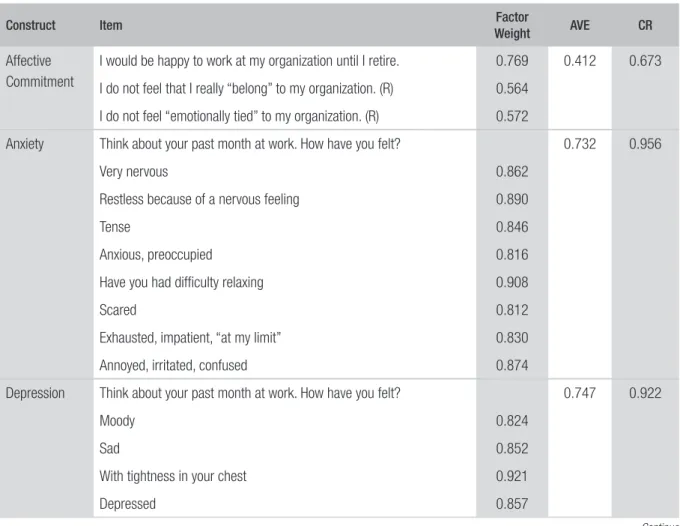
Tables 3 and 4 show the scales used with their items and respective factor weights, average variance extracted (AVE) and composite reliability (CR).
TABLE 3 CONFIRMATORY FACTOR ANALYSIS — PART 1
Construct Item Factor
Weight AVE CR
Affective Commitment
I would be happy to work at my organization until I retire. 0.769 0.412 0.673
I do not feel that I really “belong” to my organization. (R) 0.564
I do not feel “emotionally tied” to my organization. (R) 0.572
Anxiety Think about your past month at work. How have you felt? 0.732 0.956
Very nervous 0.862
Restless because of a nervous feeling 0.890
Tense 0.846
Anxious, preoccupied 0.816
Have you had difficulty relaxing 0.908
Scared 0.812
Exhausted, impatient, “at my limit” 0.830
Annoyed, irritated, confused 0.874
Depression Think about your past month at work. How have you felt? 0.747 0.922
Moody 0.824
Sad 0.852
With tightness in your chest 0.921
Depressed 0.857
Construct Item Factor
Weight AVE CR
Loss of Behavioral and Emotional Control
Think about your past month at work. How have you felt? 0.537 0.873
I’ve worried about “losing my head” 0.836
Nothing has turned out as I wanted 0.706
Like crying 0.744
I would be better off dead 0.557
Garbage 0.755
Nothing seems to interest me 0.769
General Positive Affect
Think about your past month at work. How have you felt? 0.659 0.945
Happy 0.895
Satisfied 0.870
I am leading a good life 0.840
Calm, at peace 0.858
Joyful, enthusiastic 0.910
Appreciating life 0.827
Relaxed, with no tension 0.714
Feeling refreshed when I wake up 0.593
Hopeful, optimistic 0.746
Emotional Ties Think about your past month at work. How have you felt? 0.476 0.727
Loved and wanted 0.753
Satisfied with my relationships with the people I love 0.761
Feeling the urge to be with my friends 0.532
Source: Elaborated by the authors. (R) Items inverted during the analyses.
he results presented in tables 3 and 4 were calculated and analyzed together. hey have been divided into two tables just to facilitate the presentation and formatting of the data.
Due to low factor loadings, some statements in this initial questionnaire were discarded. he evaluation of composite reliability (CR) showed that the latent variables, except for afective com-mitment, presented higher than recommended values (≥ 0.7), in the same way that the values for average variance extracted (AVE — converging validity) were above the recommended limit (≥ 0.5), except for afective commitment, emotional ties and autonomy (Byrne, 2009; Marôco, 2014). hese values were not considered great enough discrepancies to invalidate our proceeding with the study.
TABLE 4 CONFIRMATORY FACTOR ANALYSIS — PART 2
Construct Item Factor
Weight
AVE CR
Social Utility My work is useful to society. 0.904 0.823 0.933
My work makes a contribution to society. 0.914
My work is useful to other people. 0.904
Autonomy I have autonomy at work. 0.590 0.464 0.720
I can make decisions at work to be more effective. 0.733
I am free to perform my work. 0.711
Opportunities to Learn and Develop
My work enables me to reach my potential. 0.860 0.705 0.877
My work enables me to develop my abilities. 0.897
My work gives me the opportunity to learn. 0.755
Cooperation and Relationships with Colleagues
I have good relationships with my colleagues at work. 0.723 0.572 0.841
I collaborate with my colleagues to reach objectives. 0.779
I can count on support from my colleagues. 0.643
My colleagues and I work together as a team. 0.863
Recognition I receive recognition from my superiors. 0.805 0.545 0.825
I receive recognition from my colleagues at work. 0.705
I receive the recognition I deserve, considering my efforts at work. 0.819
My career perspectives are just, considering my efforts. 0.603
Moral Rectitude I work in an environment that pays attention to human dignity. 0.778 0.678 0.894
I work in an environment that respects human rights. 0.819
I work in an environment that values treating people equally. 0.790
I work in an environment that respects people. 0.902
Meaning of Work
The work that I do is very important to me. 0.686 0.666 0.947
The work I do here has value. 0.788
The work that I do in this organization has significance to me. 0.791
I feel that the work that I do in this organization has significance. 0.844
The work that I do in this organization is very important to me. 0.821
The work that I do in this organization has value. 0.898
The work that I do in this organization has meaning for me. 0.898
I feel that the work that I do in this organization is valued. 0.868
My work is important to this organization. 0.721
TABLE 5 AVES AND THE SQUARES OF THE CORRELATIONS OF THE LATENT VARIABLES
1. AC 2. Anx 3. Dep 4. LBEC 5. GPA 6. ET 7. SU 8. Aut 9. OLD 10. CRC 11. Rec 12. MR 13. MW
1. Affective Commitment 0.412
2. Anxiety 0.171 0.732
3. Depression 0.285 0.806 0.747
4. Loss of Behavioral and
Emotional Control 0.193 0.684 0.845 0.537
5. General Positive Affect 0.341 0.465 0.521 0.487 0.659
6. Emotional Ties 0.054 0.052 0.031 0.039 0.331 0.476
7. Social Utility 0.241 0.085 0.184 0.169 0.142 0.000 0.823
8. Autonomy 0.306 0.276 0.229 0.241 0.323 0.138 0.233 0.464
9. Opportunities to Learn
and Develop 0.429 0.100 0.199 0.178 0.321 0.052 0.468 0.349 0.705
10. Cooperation and Relationships with Colleagues
0.108 0.099 0.180 0.118 0.142 0.066 0.169 0.176 0.224 0.572
11. Recognition 0.415 0.231 0.301 0.231 0.371 0.097 0.194 0.489 0.497 0.341 0.545
12. Moral Rectitude 0.392 0.264 0.288 0.252 0.276 0.035 0.176 0.389 0.294 0.095 0.504 0.678
13. Meaning of Work 0.540 0.144 0.264 0.235 0.308 0.013 0.839 0.332 0.711 0.165 0.362 0.282 0.666
Source: Elaborated by the authors.
Note: he calculated AVE values are in bold and the other values are the squares of the correlations.
To evaluate the sensitiveness of the analysis performed in terms of the common method bias
(Podsakof et al., 2003), a Harman unique factor test was performed, adapted for conirmatory
It compares, through the χ2 diference test and evaluation of the goodness-of-it indices, a hypo-thetical single factor model (the common factor model) and the 13-factor model under study (af-fective commitment, anxiety, depression, loss of behavioral and emotional control, general positive afect, emotional ties, social utility, autonomy, opportunities to learn and develop, cooperation and relationships with colleagues, recognition, moral rectitude and the meaning of work), which had already yielded the following data: χ2 = 3254.333(1756), p<0.001, RMSEA = 0.059, CFI = 0.896, IFI = 0.897, TLI = 0.884, PCFI = 0.805, and ECVI = 15.158.
he single factor model presented the results χ2 = 7059.894(1834), p<0.001, RMSEA = 0.107, CFI = 0.636, IFI = 0.639, TLI = 0.613, PCFI = 0.598, and ECVI = 29.815. In addition to having good-ness-of-it index values below the minimum recommended by Byrne (2009) and Marôco (2014), the χ2 diference test demonstrated a signiicant distinction between the two models (Δχ2
(78) = 3805.561
> χ2
(critical) = 99.617, p<0.05), indicating that the it of the 13-factor model is signiicantly better than
that of the single factor, which provides evidence of our model’s robustness in relation to the variance of the common method.
his work’s hypotheses seek to verify the relationships between the central construct, the meaning of work, and the antecedent variables social utility, autonomy, opportunities to learn and develop, recognition, cooperation and relationships with colleagues and moral rectitude, as well as the con-sequential variables afective commitment, anxiety, depression, loss of behavioral and emotional control, general positive afect and emotional ties.
However, the fact that the proposal of Veit and Ware (1983) considers anxiety, depression and the loss of behavioral and emotional control to be component factors of a higher order construct termed psychological distress makes it necessary to verify which structure has a better it statistically. A similar situation occurs with general positive afect and emotional ties which are components of psychological well-being at work.
According to Hair and partners (2009), a construct is a latent variable that cannot be measured directly. Higher order constructs are those that are relected in other latent variables, other constructs, which are in turn the cause of the measured variables that make up the used scales. In one of the cas-es considered here, psychological well-being is a second order construct and the constructs general positive afect and emotional ties are irst order constructs, and thus are linked to the scales which were utilized for measurement.
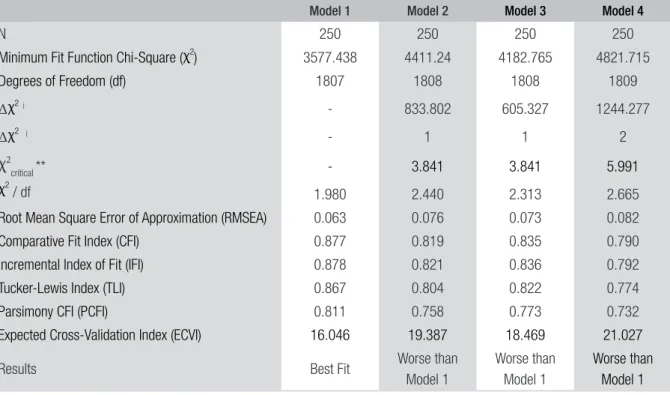
he use of structural equation modeling to study the relationships between constructs is based on the identiication of the goodness-of-it (Marôco, 2014). his is the same as saying that one should seek the model with the greatest explanatory capacity in terms of the studied phenomenon. hus, four possible models were considered: the theoretical model, henceforth termed Model 1, which considers all the second order factors, as was explained in the theoretical review, and three others in which one or none of the second order factors (psychological well-being and psychological distress) were considered (igure 2). he four structural models were tested and their respective goodness-of-it indicators can be found in table 6.
FIGURE 2 COMPARISON OF THEORETICAL MODELS
TABLE 6 GOODNESS-OF-FIT INDICATORS
Model 1 Model 2 Model 3 Model 4
N 250 250 250 250
Minimum Fit Function Chi-Square (χ2) 3577.438 4411.24 4182.765 4821.715
Degrees of Freedom (df) 1807 1808 1808 1809
Δχ2 i - 833.802 605.327 1244.277
Δχ2 i - 1 1 2
χ2
crítical ** - 3.841 3.841 5.991
χ2
/ df 1.980 2.440 2.313 2.665
Root Mean Square Error of Approximation (RMSEA) 0.063 0.076 0.073 0.082
Comparative Fit Index (CFI) 0.877 0.819 0.835 0.790
Incremental Index of Fit (IFI) 0.878 0.821 0.836 0.792
Tucker-Lewis Index (TLI) 0.867 0.804 0.822 0.774
Parsimony CFI (PCFI) 0.811 0.758 0.773 0.732
Expected Cross-Validation Index (ECVI) 16.046 19.387 18.469 21.027
Results Best Fit Worse than
Model 1
Worse than Model 1
Worse than Model 1
Source: Elaborated by the authors.
** p < 0.05 i: Diferences calculated in relation to the values of Model 1.
Following the evaluation of Model 1, an analysis of the signiicance of the relationships between the constructs was performed using regression coeicients (Byrne, 2009), also known as path coef-icients (Byrne, 2009), structural regression coecoef-icients (Byrne, 2009), a causal trajectory estimate (Marôco, 2014) or a structural parametric estimate (Hair et al., 2009) which can be found in table 7.
TABLE 7 REGRESSION COEFFICIENTS — MODEL 1
Relationships β p-value
Social Utility → Meaning of Work 0.613 < 0.001
Autonomy → Meaning of Work 0.026 0.633
Opportunities to Learn and Develop → Meaning of Work 0.357 < 0.001 Cooperation and Relationships with Colleagues → Meaning of Work -0.089 0.030
Recognition → Meaning of Work 0.118 0.121
Moral Rectitude → Meaning of Work 0.033 0.493
Meaning of Work → Affective Commitment 0.701 < 0.001
Meaning of Work → Psychological Distress -0.528 < 0.001 Meaning of Work → Psychological Well-Being at Work 0.563 < 0.001
From an analysis of the data presented it can be concluded that the constructs social utility and opportunities to learn and develop have a positive and signiicant (p < 0.05) relationship/association with the central construct meaning of work, with social utility being more important to function-aries (higher Beta) than opportunities to learn and develop, when considering what gives meaning to the work they perform. In the same manner, the data also showed that there was no signiicant relationship between autonomy, recognition, moral rectitude and the meaning of work (p > 0.05). It should be mentioned that this airmation means that the respondents demonstrated that they do not consider the relationship between one construct and another to the extent that it can be captured statistically. If the authors were to state that a relationship exists, they would be risking an error above an acceptable level for this study, namely 5% (p > 0.05).
In addition, the data showed a negative but signiicant (p < 0.05) relationship/association between the constructs cooperation and relationships with colleagues and the meaning of work. his result not only negates Hypothesis H4, it also appears to be a counter-intuitive result, given that it is plausible that the idea of cooperation and good relationships should contribute to the experience of the meaning of work. One possibility for understanding this result is to consider that the routines of the forensic expert lead to a working life of a solitary nature. Another hypothesis would be to consider this result an indicator of an environment with a low experience of coop-eration, which is illed with conlict and even hostile. he results of the consequent constructs that will be examined below may be able to contribute to the understanding of this apparently singular inding.
Moving on to the analysis of the consequent constructs and analyzing the meaning of work construct as an efects generator, it can be veriied that there is a signiicant (p < 0.05) relationship/ association between this construct and afective commitment and psychological well-being at work (positive relationship) and psychological distress (negative relationship). he relationship between the meaning of work and afective commitment is the strongest of them (highest Beta) and psychological distress is the weakest. he conclusion that one can make from this data is that the respondents considered that the greater the perception that their work has meaning, the greater their afective commitment to it is, reinforcing the idea that the FFE identiies with the organization and establishes a relationship that involves positive emotions (Meyer and Her-scovitch, 2001).
TABLE 8 COEFFICIENTS OF DETERMINATION
Construct R2
Meaning of Work 0.927
Affective Commitment 0.492
Psychological Distress 0.278
Psychological Well-Being at Work 0.317
Source: Elaborated by the authors.
Considering the analyses performed, we can airm that Hypotheses H1, H3, H7, H8 and H9, listed in table 9, have been statistically conirmed in this study.
TABLE 9 CONFIRMED HYPOTHESES
Hypothesis Content
H1 The greater the social utility or perceived social contribution at work, the greater its meaning.
H3 The greater the perception of opportunities to learn and develop, the greater the meaning of work.
H7 The meaning of work positively influences psychological well-being at work.
H8 The meaning of work negatively influences psychological distress.
H9 The meaning of work positively influences affective commitment.
Source: Elaborated by the authors.
5. DISCUSSION
Our discussion about the results of the application of this model will be made considering the four pillars of the managerial accountability framework proposed by Echebarria (2000), considering the development of a civil service as a pertinent goal in the formation of a speciic professional corps, oriented towards performing actions that maximize positive public policy.
im-portant path to inding meaning in it. Keyes (1998) argues that understanding that one’s work makes an important contribution to society makes individuals see themselves as people of value, which constitutes a process of identiication and strengthens their ties to their work and their organization.
Autonomy, recognition and moral rectitude are antecedent constructs which did not present a signiicant relationship with the central construct. For forensic experts, they ind meaning in their work, but it is not associated with any of these three variables.
According to Isaksen (2000), autonomy constitutes the experience of empowerment and the sensation of liberty, and is thus a way of inding meaning in work. he perception of the power to make decisions about one’s time, tasks and planning reinforce the experience of an alignment between the individual’s values and those of the organization. his also is related to discretion, which also is found among the pillars of the accountability framework for the development of the civil service. his result could be related to the history of the police bureaucracy, in which obedience and attention to hierarchy is always valued and never questioned in terms of giving meaning or not giving meaning to work. his deserves attention if we consider that discretion and making decisions are important skills for new organizational designs in forming a network or matrices, as has been occurring to the extent that the State includes organizations with these new models.
In terms of recognition, the questions involved relationships with superiors, peers, personal efort and career perspectives. Siegrist (1996) explains that recognition is related to the perception of re-ward which appears, in general, in the form of esteem and respect from one’s peers and superiors, or satisfaction with working conditions, remuneration or a positive perception of possibilities for career advancement. Our results suggest that these aspects do not exert an inluence on the perception of the meaning of work for the professionals in this study, and the only item that is outside this study is remuneration in the Federal Police, which is considered appropriate for the proile of civil servants, but which cannot, however, be the only cause of the lack of an identiied link. A lack of perceived recognition could be an indicator of low motivation and generate a negative efect on productivity even in the short term.
he fact that the moral rectitude construct does not present a signiicant relationship does not mean that we can conclude that forensic experts face a work environment with ethical issues or few positive experiences in terms of personal relationships between distinct hierarchical levels. he lack of statistical signiicance indicates that there is not a relevant relationship between our studied constructs and it is not necessarily a negative relationship. However, the analysis made for the previous construct is also valid here, or in other words, one can suggest the hypothesis that there is a low perception of values and human dignity. his requires further investigation.
attributes of a forensic expert at work are governed by study, research, data analysis, evidence and crime scenes, and that it is by nature solitary work. When evaluated from this perspective, this result may be considered more understandable and in keeping with the reality of the group of professionals under study, which suggests that the meaning of work for this sample of police professionals could be related more to individual realization than satisfactory or signiicant social relationships.
In relation to the results in terms of the relationships between the central construct and psycho-logical well-being or distress, our observations airm that the experience of meaning indicates the absence of distress and the presence of psychological well-being. Corroborating Vilas Boas and Morin (2014), this study has enabled us to conclude that the concept of the meaning of work is an absolute indicator of the quality of psychological life at work.
Finally, meaning has a signiicant relationship with afective commitment, or in other words, the experience of a positive tie to the organization, which reinforces the idea that the meaning of work can be a construct that reveals the force, priority and intensity of the relationships of individuals with their work and organizations. he forensic experts are shown to be professionals who value the organization where they work and perceive their work as being important to society.
6. CONCLUSIONS
he purpose of this article is to identify what gives meaning to the work of civil servants and whether the experience of meaning is associated with commitment and psychological well-being. his study has examined forensic experts in the Federal Police by the application of a model using conirmatory factor analysis and structural equation modeling. he results indicate that civil servants experience meaning in their work through their perception of social utility in their work and the opportunities to learn and develop that the Federal Police must ofer. he experience of meaning is associated with afective commitment and psychological well-being, a result that indicates the quality of psychological life at work. he fact that the variables of autonomy, recognition and moral rectitude did not have a signiicant relationship with the meaning of work leads to hypotheses about motivation and the characteristics related to the organizational climate.
Meaning of work studies such as this one are of value in the development of civil servants as part of the formation of a competent and committed technical corps which values public management and is dedicated to the well-being of citizens.
6.1 LIMITATIONS AND FUTURE STUDIES
Another point of interest resides in the fact that this study has presented counter-intuitive and unexpected results in terms of cooperation and relationships with colleagues, which is something as important from the theoretical point of view as it is from the managerial point of view. Oten policies and procedures are adopted in view of expected common sense and not empirical studies that are based on methodologies and procedures. hus, this suggests the need for research on organizational development policies to orient professionals based on structured experimental analyses that can relect the real positioning of people in organizational life.
REFERENCES
ABRUCIO, Fernando L. Trajetória recente da gestão pública brasileira: um balanço crítico e a renovação da agenda de reformas. Rev. Adm. Pública, Rio de Janeiro, v. 41, n. esp., p. 67-86, 2007.
BACELLAR FILHO, Romeu F. Proissionalização da função pública: a experiência brasileira. Revista de Direito Administrativo, Rio de Janeiro, v. 232, p. 1-10, Apr./June 2003.
BENTLER, Peter M.; CHOU, Chih-Ping. Practical issues in structural modeling. Sociological Methods and Research, v. 16, n. 1, p. 78-117, 1987.
BRESSER-PEREIRA, Luiz Carlos; SPINK, Peter.
Reforma do Estado e administração pública gerencial. 7. ed. São Paulo: FGV, 1998.
BYRNE, Barbara M. Structural equation modeling
with Amos: basic concepts, applications, and
pro-gramming. 2. ed. New York: Routledge, 2009.
CIULLA, Joanne B. he working life: the promise and betrayal of modern work. New York: hree Rivers Press, 2000.
DAVIES, Allyson R. et al. Scoring manual: adult he-alth status and patient satisfaction measures used in Rand’s Health Insurance Experiment. Santa Monica: Rand Corporation, 1998.
DIK, Brian J.; DUFFY, Ryan D. Calling and vocation at work: deinitions and prospects for research and practice. he Counseling Psychologist, v. 37, n. 3, p. 424-450, 2009.
DITEC. Competência da Diretoria Técnico-Cien-tíica do Departamento de Polícia Federal. 2016. Available at: <http://intranet.dpf.gov.br/ditec/orga-nizacao/competencia/>. Accessed on: 12 Aug. 2016.
ECHEBARRIA, Koldo E. Reivindicación de la reforma administrativa: signiicado y modelos con-ceptuales. Reforma y Democracia, Caracas, n. 18, p. 40-50, 2000.
ELANGOVAN, Anbalagan R.; PINDER, Craig C.; MCLEAN, Murdith. Callings and organizational behavior. Journal of Vocational Behavior, v. 76, n. 3, p. 428-440, June 2010.
FORNELL, Claes; LARCKER, David F. Evaluating structural equation models with unobservable va-riables and measurement error. Journal of Marketing Research, v. 18, n. 1, p. 39-50, Feb. 1981.
HACKMAN, J. Richard; OLDHAM, Greg R. Moti-vation through the design of work: test of a theory.
Organizational Behavior and Human Performance,
v. 16, n. 2, p. 250-279, Aug. 1976.
HAIR Jr., Joseph F. et al. Análise multivariada de
dados. 6. ed. Porto Alegre: Bookman, 2009.
HUPPERT, Felicia A. Psychological well-being: evidence regarding its causes and consequence.
Applied Psychology: Health and Well-Being, v. 1,
n. 2, p. 137-164, Mar. 2009.
ISAKSEN, Jesper. Constructing meaning despite the drudgery of repetitive work. Journal of Humanistic Psychology, v. 40, n. 3, p. 84-107, July 2000.
JUNQUILHO, Gelson S. Nem “burocrata” nem “or-gânico”: o gerente “caboclo” e os desaios do Plano Diretor de Reforma do Estado no Brasil do Real. In: ENCONTRO DE ESTUDOS ORGANIZACIO-NAIS, 2., 2002, Recife. Anais… Recife: Anpad, 2002. CD-ROM.
KETCHUM, Lyman D.; TRIST, Eric. All teams are
not created equal. How employee empowerment
really works. Newbury Park: Sage, 1992.
KEYES, Corey L. M. Social well-being. Social Psy-chology Quarterly, v. 61, n. 2, p. 121-140, June 1998.
LONGO, Francisco. Mérito e lexibilidade: a gestão das pessoas no setor público São Paulo: Fundap, 2007.
LYONS, Sean T.; DUXBURY, Linda E.; HIGGINS, Christopher A. A comparison of the values and commitment of private sector, public sector, and parapublic sector employees. Public Administration Review, v. 66, n. 4, p. 605-618, July 2006.
MARÔCO, João. Análise de equações estruturais: fundamentos teóricos, sotware e aplicações. 2. ed. Pero Pinheiro: Report Number, 2014.
MASSÉ, Raymond et al. he structure of mental health: higher order conirmatory factor analyses of psychological distress and well- being measures.
Social Indicators Research, v. 45, n. 1-3, p. 475-504, Nov. 1998.
MEYER, John P.; ALLEN, Natalie J. A three-ponent conceptualization of organizational com-mitment. Human Resource Management Review, v. 1, n. 1, p. 61-89, spring 1991.
MEYER, John P.; HERSCOVITCH, Lynne. Com-mitment in the workplace: toward a general model.
Human Resource Management Review, v. 11, n. 3,
p. 299-326, autumn 2001.
MEYER, John P. et al. Afective, continuance, and normative commitment to the organization: A meta-analysis of antecedents, correlates, and con-sequences. Journal of Vocational Behavior, v. 61, n. 1, p. 20-52, Aug. 2002.
MICHAELSON, Christopher et al. Meaningful work: connecting business ethics and organiza-tion studies. Journal of Business Ethics, v. 121, n. 1, p. 77-90, Apr. 2014.
MORIN, Estelle M. Os sentidos do trabalho. RAE —Revista de Administração de Empresas, v. 41, n. 3, p. 8-19, Jul. / Sept. 2001.
MORIN, Estelle M. Sens du travail. Définition, mesure et validation. In: VANDENBERGHE, Chris-tian; DELOBBE, Nathalie; KARNAS, Guy (Ed.).
Dimensions individuelles et sociales de
l’investisse-ment professionnel. Louvain la Neuve: UCL, 2003.
v. 2, p. 11-20.
MORIN, Estelle M. Sens du travail, santé mentale au travail et engagement organisationnel. Cahier de
recherche, n. 099-193. Montréal: École des Hautes
Études Commerciales, 2008.
MORIN, Estelle M.; CHERRÉ, Benoit. Les cadres face au sens du travail. Revue Française de Gestion, n. 126, p. 83-93, 1999.
MOW. International Research Team. he meaning
of work: an international view. London: Academic
Press, 1987.
ORGANISATION MONDIALE DE LA SANTÉ.
Rapport sur la santé dans le monde. Pour un réel
changement. Geneva: OMS, 1999.
PODSAKOFF, Philip M. et al. Common method biases in behavioral research: a critical review of the literature and recommended remedies. he Journal of Applied Psychology, v. 88, n. 5, p. 879-903, Oct. 2003.
PRATT, Michael G.; ASHFORTH, Blake E. Foste-ring meaningfulness in working and at work. In:
CAMERON, Kim S.; DUTTON, Jane E.; QUINN, Robert E. (Ed.). Positive organizational scholarship. San Francisco: Berrett-Koehler Publishers, Inc., 2003. p. 309-327.
RODRIGUES, Andréa L.; BARRICHELLO, Alcides; MORIN, Estelle. M. Os sentidos do trabalho para proissionais de enfermagem: um estudo multimé-todos. RAE — Revista de Administração de Empresas, v. 56, n. 2, p. 192-208, 2016.
SECCHI, Leonardo. Modelos organizacionais e re-formas da administração pública. Rev. Adm. Pública, Rio de Janeiro, v. 43, n. 2, p. 347-369, 2009.
SIEGRIST, Johannes. Adverse health efects of high efort — low reward conditions at work. Journal of Occupational Health Psychology, v. 1, n. 1, p. 27-41, 1996.
SIEGRIST, Johannes; LI, Jian; MONTANO, Diego.
Psycometric properties of the efort-reward imbalance
questionnaire. Department of Medical Sociology.
Duesseldorf: Faculdade de Medicina, Universidade de Duesseldorf, 2014.
SIMS, Henty; SZILAGYI, Andrew D.; KELLER, Robert. he measurement of job characteristics.
Academy of Management Journal, v. 19, n. 2, p. 195-212, 1976.
TRIST, Eric. Adapting to a changing world. Labour Gazette, v. 78, p. 14-20, 1978.
TRIST, Eric. he sociotechnical perspective. he evolution of sociotechnical systems as a conceptual framework and as an action research program. In: VEN, Andrew H. van de; JOYCE, Willian F. (Ed.).
Perspectives on organization design and behavior.
New York: Wiley, 1981. p. 19-75.
VEIT, Clairice; WARE, John. he structure of psy-chological distress and well-being in general popula-tions. Journal of Consulting and Clinical Psychology, v. 51, n. 5, p. 730-742, Oct. 1983.
VILAS BOAS, Ana Alice; MORIN, Estelle M. Bem -estar psicológico e sofrimento psicológico para professores no Brasil e no Canadá. Revista de Ad-ministração Mackenzie, v. 15, n. 6, p. 201-219, 2014.
professors. International Journal of Business and Social Science, v. 4, n. 12, p. 67-77, 2013.
WHO. World Health Organization. he World He-alth report. Mental health: new understanding, new hope. Geneva: WHO, 2001.
WRZESNIEWSKI, Amy. Finding positive meaning in work. In: CAMERON, Kim S.; DUTTON, Jane
E.; QUINN, Robert E. (Ed.). Positive organizational
scholarship. San Francisco: Berrett-Koehler
Pu-blishers, Inc., 2003.
WRZESNIEWSKI, Amy et al. Jobs, careers, and callings: people’s relations to their work. Journal
of Research in Personality, v. 31, n. 1, p. 21-33,
Mar. 1997.
Andrea Leite Rodrigues
PhD in Administration from FGV EAESP; Professor in the Masters Program in Public Policy Management at the Universidade de São Paulo, School of Arts, Sciences and Humanities — São Paulo — SP, Brazil. E-mail: [email protected].
Alcides Barrichello
PhD in Administration from the University Center of the Padre Saboia de Medeiro Ignatian Educational Fou-ndation; Professor at Universidade Presbiteriana Mackenzie, Center of Social and Applied Sciences. E-mail: [email protected].
Hélio Arthur Reis Irigaray
PhD in Business Administration from FGV EAESP; Professor at FGV EBAPE. E-mail: [email protected].
Donaldson Resende Soares
Masters in Business Administration from FGV EBAPE; Federal Public Servant in the Brazilian Ministry of Justice and Public Safety. E-mail: [email protected].
Estelle M. Morin