99
Resumo
O defeito de olho de peixe é geralmente observado em ferros fundidos nodulares. O mecanismo de formação desses defeitos não é totalmente compreendido e muito pouco tem sido publicado a esse respeito. Esse trabalho investiga o efeito de diferentes luvas na formação do defeito olho de peixe. Luvas exotérmicas e isolantes, com diferentes concentrações de lúor, foram trituradas e misturadas com areia a verde. A mistura foi usada como areia de faceamento dos moldes de fundição. A caracterização morfológica e química do defeito foi realizada por microscopia óptica (MO) e microscopia eletrônica de varredura com microanálise química por dispersão de raios X (MEV/EDS). Os resultados de EDS mostraram elevadas concentrações de alumínio e lúor na região do defeito.
Palavras-chave: Ferros fundidos nodulares, defeitos supericiais, olho de peixe, luvas exotérmicas.
Abstract
Fish-eye defects are usually observed in the surface of ductile iron casting. Their formation mechanism is not fully understood and very little has been published concerning the subject. This paper investigates the sleeve material effect on ish-eye defect formation in ductile cast irons. Unburnt exothermic and insulating sleeves with different luorine concentrations have been crushed and mixed in with green sand. These mixtures have been used as facing sands for the casting molds. The morphological and chemical characterization of the ish-eye defects have been performed by light optical microscopy (LOM) and scanning electron microscopy with energy-dispersive spectroscopy (SEM/EDS). Experimental results suggest that surface ish-eye defects on ductile cast irons are caused by the buildup of luorine-containing sleeve materials in the molding sand.
Keywords: Ductile cast iron, surface defect, ish-eye, exothermic sleeves.
Adriano Murilo Rosário
Mestre em Engenharia e Ciência de Materiais SCHULZ S.A., Departamento de Engenharia de Processos de Fundição, Diretoria Automotiva, Joinville, SC, Brasil.
Marcio Ferreira Hupalo
Professor Adjunto
Universidade Estadual de Ponta Grossa, Departamento de Engenharia de Materiais, Ponta Grossa, PR, Brasil.
Metalurgia e materiais
Metallurgy and materials
Characterization of surface
ish-eye casting defect
Metallurgical defects in ductile iron can be quite costly to foundries, not only because the elements have to be partly remade or rectiied, but due to the unfortunate fact that many defects are not revealed until after the expensive machining stage (Aufderheide, 1998). Common defects observed in ductile iron castings may be divided into two basic categories, i.e.: i) those related to the nodule shape and size, such as com-pacted graphite structures, exploded and chunky graphite, graphite loatation, spiky graphite and nodule alignment; and ii) those related to inclusions/dis-continuities within the matrix, such as lake graphite surfaces, slag inclusions, carbides and gases. Care through raw materials selection, good process con-trol during melting stage and proper metal handling procedures constitute effective methods for defect prevention. (Masoumi, 2005; Tiedje, 2010).
A casting set usually consists of a mold, gating system, pouring cup, riser, cores, and other components such as exothermic and/or insulating sleeves. To produce a metal casting, metal is poured into the pouring cup and passes through the gating system to the mold and cores
where it solidiies. Metal from the riser ills the voids in the casting when the metal contracts during solidification. Thus, the metal from the riser needs to remain in a liquid state for a longer period of time, so it can provide metal to the casting as it cools and solidiies (Käll-bom, 2005; Masoumi, 2005). Sleeves are used to surround or encapsulate the riser and other parts of the casting assembly in order to keep the molten metal in the riser as hot as possible, maintaining it in liquid state for a longer period of time. In order to serve their function, sleeves have exothermic or insulating properties. Exothermic sleeves function by liberating heat, providing part or all of the speciic heat requirements of the riser and so re-ducing the molten metal temperature loss. Ductile iron castings have unique riser requirements compared to the feeding of other metals. The volume changes in the casting are not a simple contraction as metal solidiies. For example, when the graphite nodules are formed, the metal actually expands, which can push metal back into the riser and gating system if these are not properly designed (Källbom, 2005). This, along with the metal subse-quent contraction during cooling, creates
a strong demand on the riser feeding capabilities, which is usually achieved by using suitable exothermic and/or insulat-ing sleeves (Showman, 2001).
Before the widening use of exother-mic sleeves, ish-eye defects were only occasionally seen in green-sand foundries when some excessive amount of clay had been present in sand. With the growing usage of exothermic riser sleeves, the presence of ish-eye defects has increased. Typical exothermic sleeve formulations contain aluminum as a combustible, metal oxides and/or nitrates as oxidizers, besides luorine containing compounds as luxing agents. These agents reduce the time taken by the exothermic sleeve to ignite and im-prove the propagation of the exothermic reaction. However, high luorine levels in the sleeve could cause ish-eye defects in ductile iron castings when the green sand is contaminated with luorine-containing sleeve materials (Aufderheide, 1998; Showman, 2001).
This paper presents the results obtained after casting tests using four different types of crushed unburnt sleeve materials mixed in with green sand. A de-tailed characterization of a ish-eye defect is also presented.
2. Experimental procedures
The tests presented in this work have been performed at Schulz S.A. company, located in Joinville city, Brazil. A mold assembly for a ductile iron piece (Figure 1) has been chosen for the experiments. Four different sleeves have been used in this study, i.e.: S1) a high-luorine exother-mic sleeve; S2) a low-luorine exotherexother-mic sleeve; S3) a low-luorine insulating sleeve; and S4) a non-luorine exothermic sleeve. The analyzed amounts (wt.-%) of alumi-num, luorine and sulfur in the sleeves are displayed in Table 1. The unburnt
sleeves have been crushed and mixed in with green sand in a laboratory mixer, following the same parameters used in the casting practice. The mixtures have been used as facing sand for the casting tests, as depicted in Figure 1.
The alloy used in present investiga-tion was a ferritic-pearlitic ductile iron (FE-5007), whose nominal chemical composition is given in Table 2. Melts have been prepared in a 12-ton, basic-lined induction furnace. Pouring temperatures were monitored through an immersed
thermocouple and has varied between 1385ºC-1410ºC for all castings. Each cast-ing was carefully examined upon shake-out. Visual surface casting inspection has been followed by macroscopic examina-tion using light optical microscopy (LOM) technique. Morphological and chemical characterization of a surface ish-eye de-fect was carried out in a SSX-550 model Shimadzu scanning electron microscope (SEM) equipped with an energy-dispersive spectroscopy (EDS) system, operating at 20 kV in the secondary electron mode.
Table 1
Chemical composition of exothermic (S1, S2, S4) and insulating (S3) sleeves (wt.-%).
Element S1 S2 S3 S4
Aluminum 16.98 18.69 17.06 13.65
Fluorine 0.737 0.378 0.377 N/A
Sulfur 0.89 1.24 1.56 1.54
Table 2
Nominal chemical composition of FE-5007 ductile iron (wt.-%).
C Si Mn P S Mg Al
101
Figure 1 Mold assembly showing examples of facing sands contaminated with crushed unburnt exothermic sleeves: (A) S1-sleeve, high-luorine. (B) S2-sleeve, low-luorine.
3. Results and discussion
Macroscopic examination
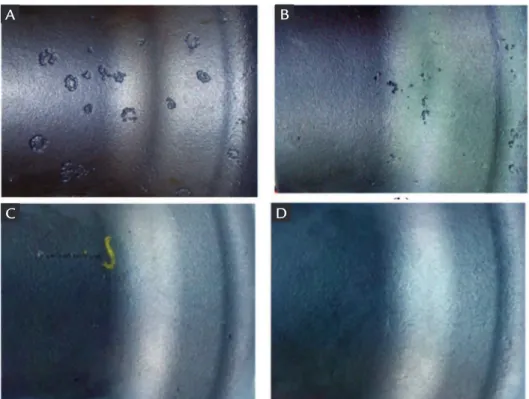
Experiments showed that the luorine presence in the exothermic or insulating sleeve formulations contrib-ute to the formation of surface ish-eye defects. Typical distributions of these defects can be seen in Figures 2(A) to 2(C), corresponding to S1, S2 and S3 sleeves. These macrographs show the extent of defects with increasing luorine content in the sleeves. However, when the luorine-containing sleeves are re-placed by a non-luorine sleeve (S4), no ish-eye defects were produced, as shown in Figure 2(D).
Aufderheide and co-workers
(Auf-derheide, 1998) reported similar results us-ing ive different contaminants, includus-ing cryolite and crushed unburnt and burnt riser exothermic and insulating sleeves. However, these authors have placed the contaminants directly on the pattern surface during the casting tests, instead of being mixed with the foundry sand. This procedure does not correspond to that performed in casting practice.
During the casting shakeout the mold sand is crushed and mixed in with riser burnt sleeves. This contaminated sand returns to the closed sand system and initiates a new preparation cycle,
renewing additives and receiving water, in order to acquire the properties of foundry sand. The silica sand is highly hygroscopic and absorbs water during the additivation cycle. When the molten metal is poured at high temperatures a metal-mold reaction takes place, dis-sociating hydrogen from free-water absorbed by the mold sand. Hydrogen tends to migrate towards the monoxide carbon bubbles nucleated on the mold surface, leading to the formation of a ish-eye defect. Further details concern-ing this mechanism will be discussed ahead.
Figure 2 Casting surfaces resulting from facing sands contaminated with: (A) S1 high-luorine exothermic sleeve. (B) S2 low-luorine exothermic sleeve. (C) S3 low-luorine insulating sleeve. (D) S4 non-luorine exothermic sleeve.
Microscopic examination
A closer inspection of a surface ish-eye defect has been carried out by scanning electron microscopy (SEM). Figure 3 shows typical morphologies
observed nearby and inside the defect. The same regions have been analyzed by EDS technique and the results are displayed in Table 3. SEM examination
revealed the presence of several oxidized areas (Figure 3A); most often located in cavities vicinity (point A). Figures 3(B) to 3(D) clearly show the progressive
con-A B
A B
ucts located in the border and inside the defect. The presence of higher amounts of luorine is noticeable in these regions (points B and C of Table 3), conirming that surface ish-eye defect is associated with luorine contamination.
In addition to high luorine con-centrations, EDS results of Table 3 also show smaller amounts of sodium, magnesium, aluminum and sulfur, as well as residual levels of other ele-ments such as calcium, potassium and chlorine. Some of these compounds are derived from aluminum dross, which is a by-product of aluminum manufac-ture. In the manufacturing process of
is intimately mixed with luorine and melted with aluminum, besides other oxidizable metals such as magnesium and silicon. Therefore, it provides a very eficient, fast igniting, and good propa-gating exothermic reaction. Exothermic sleeves containing aluminum dross, ine aluminum powder, potassium nitrate, and iron oxide are particularly eficient as riser sleeves in the casting of ductile iron (Showman, 2001).
Concentration profiles based on EDS results in Table 3 are presented in Figure 4, depicting higher concentrations of luorine within the defect, as well as the variations in carbon and aluminum
in carbon quantiication by EDS, results have shown that the concentration of this element reduces towards the defect, suggesting a nucleating mechanism of gas bubbles by carbon oxidation. Both the hydrogen dissolved in liquid metal as the one resulting from free-water disso-ciation migrate to the monoxide carbon bubbles, increasing the size of gas porosi-ties. Further details of this mechanism are reported elsewhere (OHNAKA, 2008). The aluminum concentration behaves similarly to the carbon. The smaller amounts of aluminum inside the defect suggest the occurrence of an intense alu-minothermic reaction.
Figure 3
Set of SEM micrographs depicting different morphologies nearby and inside a surface ish-eye defect (central image indicates the analyzed points).
Table 3
EDS results for the analyzed points showed in Figure 3 (wt.-%).
Elements A B C D
C 7.235 3.984 3.751 4.298
O 24.687 35.893 33.373 33.475
F 5.789 8.974 9.148 5.401
Na 0.633 0.360 0.337 0.262
Mg 0.239 0.129 0.127 0.107
Al 1.328 0.072 0.176 0.139
Si 6.686 1.938 3.311 3.996
S 0.000 0.762 0.000 0.486
Cl 0.510 0.146 0.043 0.083
K 0.235 0.123 0.182 0.126
Ca 0.169 0.140 0.040 0.000
Mn 0.710 0.240 0.200 0.274
103
Figure 4 Concentration proiles of luorine, carbon and aluminum.
5. Acknowledgments
The authors are grateful to Schulz S.A. company for technical and material support.
6. References
AUFDERHEIDE, R. C. et al. New developments in riser sleeve technology. ANNUAL MEETING OF THE AMERICAN FOUNDRYMEN’S SOCIETY, 102. Atlanta, USA, p.395-400, 1998.
KÄLLBOM, R. et al. On the solidiication sequence of ductile iron castings containing chunky graphite. Materials Science and Engineering A, v. 413-414, p. 346-351, 2005.
MASOUMI, M. et al. Effect of gating design on mold illing. Transactions of the American Foundry Society, v. 113, p. 185-196, 2005.
OHNAKA, I. et al. Mechanism and estimation of porosity defects in ductile cast iron.
International Journal of Cast Metals Research, v. 21, n. 1-4, p. 11-16, 2008. SHOWMAN, R. et al. Exothermic riser sleeves can cause lake graphite in ductile
iron. Transactions of the American Foundry Society, v. 109, p. 1115-1120, 2001. TIEDJE, N. S. Solidiication, processing and properties of ductile cast iron. Materials
Science and Technology, v. 26, n. 5, p. 505-514, 2010.
Artigo recebido em. Aprovado em 24 de fevereiro de 2013.
Position
A 0
1 2 3 4 5 6 7 8 9 10
B C
Fluorine Carbon Aluminum
D
C
o
n
c
e
n
tr
a
ti
o
n
(
in
w
t%
)
4. Conclusions
Experimental results suggest that surface ish-eye defects on ductile cast irons are caused by the buildup of luorine-containing sleeve materials in molding sand. This surface defect appears as
result-ing of an aluminothermic-type reaction, enhanced by the free-water absorbed by the foundry sand. EDS results have shown high amounts of luorine in the defect region, besides aluminum small