Thermomagnetic Study for Identiication of Mineral Phases
Anderson Alves Cunha a,c, Fabiane Leocádia da Silvaa*, Blênio Márcio Cunha Silva c, Jeferson
Januário Mendes a,b,c, Ruben Antonio Llobell Solé c, Fernando Gabriel da Silva Araújo a,c
Received: January 16, 2017; Revised: April 11, 2017; Accepted: May 01, 2017
The characterization of materials is an area of extreme importance for engineering, it uses a range of instrumental techniques to provide an information bank for material analysis and selection. In the treatment of iron ore the mineralogical characterization is done, almost exclusively, by optical
microscopy. However, materials with very ine granulometry, below 4 μm, make their preparation and
visualization restricted in this equipment. The present work aims to identify the minerals Hematite, Magnetite and Goethite in samples of tailings from the iron ore processing, employing a Bartington MS3 that evaluates the magnetic susceptibility as a function of the temperature. These measurements make it possible to identify Curie temperatures characteristic of Magnetite (580 °C) and Hematite (675 °C), as well as Goethite’s Neel temperature (120 °C). The results showed that the application of the
technique is of great value for the identiication of the magnetic bearing minerals and the quantiication
of the magnetic potential of the sample.
Keywords: Curie temperature, Néel temperature, thermomagnetic study, magnetic susceptibility.
* e-mail: [email protected]
1. Introduction
The materials can be classified according to an orientation of their magnetic moments in relation to the
external magnetic ield. These classes are: diamagnetic,
paramagnetic, ferromagnetic, antiferromagnetic and ferrimagnetic. The diamagnetic materials present negative magnetic susceptibility, whereas in the paramagnetic materials the susceptibility is positive. Diamagnetism is present to a greater or lesser extent in all materials, however, in most of them its intensity is very low and only persists as long
as an external magnetic ield is applied. In the absence of external ield, the atoms of a diamagnetic material have
zero momentum. The phenomenon of diamagnetism is often masked by stronger ones, such as paramagnetism and ferromagnetism1. According to Dunlop and Ozdemir (1997),
most non-ferrous minerals such as quartz, calcite and feldspar are purely diamagnetic, with small magnetic susceptibility and independent of temperature. Thus, if a sample contains a small amount of ferromagnetic and paramagnetic minerals, at high temperatures, the magnetic moment of a quartz sample
can be veriied2.The magnetic susceptibility of diamagnetic
materials is practically non-temperature dependent, due to the fact that the diamagnetism does not arise from the
interaction between the magnetic ield and the moment that
can be disordered with the temperature, but of the interaction
of the ield with the electronic charges altering its speed.
Since the speed of electrons is a function of electronic states,
and these are independent of temperature, this also makes the susceptibility not dependent on temperature3.
In paramagnetic materials, individual atoms have magnetic moments, but their random orientation results in null magnetization for a group of atoms, thus being
nonmagnetic in the absence of an external ield and magnetic on the inluence of an applied magnetic ield. The response to the external magnetic ield in paramagnetic materials is
much less intense than in ferromagnetic ones.
Ferromagnetic materials are magnetic in the absence of
an applied external magnetic ield. When a magnetic ield is
absent, the material has spontaneous magnetization, which is a result of ordered magnetic moments, in orther words, for ferromagnetism, the atoms are symmetrical and aligned
in the same direction, creating a permanent magnetic ield. When an external magnetic ield is applied to a ferromagnetic
material all its magnetic moments remain ordered, but now
in the same direction and direction of the applied ield. However, if the magnetic ield decreases, the magnetic lux will not reduce rapidly as the ield, since the ferromagnetic
materials has as characteristic the tendency of conservation of its magnetic properties even in the absence of the stimulus that generated them. The materials are only ferromagnetic below their corresponding Curie temperature - temperature at which the material becomes paramagnetic, because the atoms lose their ordered magnetic moments1. Analogously to the Curie temperature, the temperature of Neel is deined for the case of antiferromagnetic substances. When the magnetic moments cancel out altogether, the structure is classiied as
a REDEMAT - Universidade Federal de Ouro Preto, MG, Brasil b Instituto Federal de Minas Gerais - IFMG, MG, Brasil
antiferromagnetic. In a diferent way, when the moments
in one direction exceed those of the opposite direction, the
structure is classiied as ferrimagnetic2.
For ferrimagnetic materials, when it does not have an external
magnetic ield applied, the material has a spontaneous magnetism
which is the result of ordered magnetic moments. In this case, there are magnetic moments of an ion that are aligned in one direction with a certain magnitude, and others that are aligned in the opposite direction, with a smaller magnitude, because of this
there is a resulting magnetic ield present. For antiferromagnetic
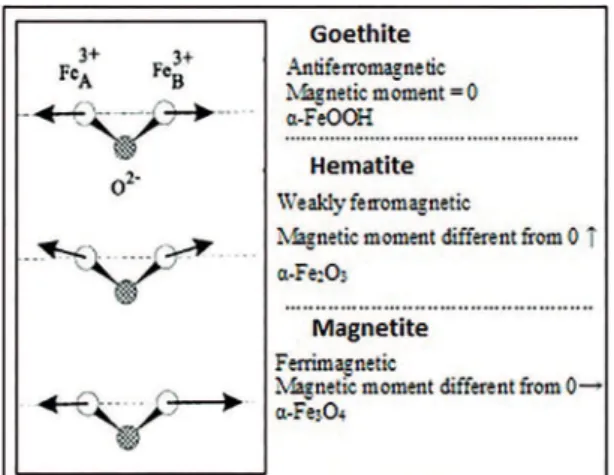
materials, the magnetic moments are the same and are aligned in opposite directions, resulting in a spontaneous magnetic moment null at all temperatures below the Neel temperature. These materials are also poorly magnetic in the presence of an
applied magnetic ield. Figure 1 shows the structure and magnetic classiication of the main iron ore in Brazil.
2. Materials and Methods
The methodology consisted, irstly, of characterizing four
types of tailings from iron ore processing by means of X-ray
difraction and X-ray luorescence and then performing tests
on the magnetic susceptibilime with ambient atmosphere (Air), varying the temperature between 30 and 710 ° C with rate of heating and cooling of 15 ° C / min. Figure 2 shows
the lowchart of the tests performed for each sample5,6.
Figure 1. Magnetic structure of the main iron ore in Brazil4.
The magnetic susceptibilimeter is a technique used to determine phase transformations, Curie and/or Neel temperatures and to identify magnetic bearing minerals from a sample. The equipment operates by generating a frequency,
low-intensity alternating current magnetic ield around a sensor. When the sample is inserted into the carrier, the resulting ield change is identiied by the system and converted into
magnetic susceptibility. It is an indestructible technique the samples do not need a special preparation. In order to target certain material for a given technology, it is essential to know
its speciic characteristics and properties. Hematite, Goethite
and Magnetite are the main ores containing iron and the iron ore minerals present in iron ore are: Quartz, Kaolinite and Gibbite. The present work aims to identify the minerals Hematite, Magnetite and Goethite in samples of tailings from the iron ore processing, using a magnetic susceptibility that evaluates the magnetic susceptibility as a function of temperature. These measurements make it possible to identify the Curie temperatures characteristic of Magnetite (580 °C) and Hematite (675 °C), as well as Goethita’s Néel temperature (120 °C).
Figure 2. Flowchart of the tests and the preparation stage carried out for each sample.
3. Results and Discussion
3.1 X-ray luorescence
The average chemical analysis for the compositions are
shown in Table 1. Note, higher silica contents in the lotation
tailings, for a while, In the mud there are higher iron contents, the other oxides, Even with low levels will be relevant for the
determination of the present phases. It is also veriied, higher loss on ignition (LOI) in ultraine tailings samples, mainly
due to the content of hydrated minerals, such as Goethite.
3.2. XRD analysis
Figures 3 and 4 show the X-ray difractograms for lotation tailings 01, 02 and ultraine 01, 02 respectively.
Note that the peak of the mineral quartz is the most evident
in the lotation tailings and in the ultraine the hematite is in higher concentration. The X-ray difractograms conirm
the chemical analyzes obtained for the tailings.
3.3 Thermomagnetic study
The thermomagnetic study involves thermal processing in the air and without addition of other chemical components, which determined Curie temperatures of magnetite (580 °C) and hematite (675 °C), evidenced by the increase of susceptibility near temperatures Magnetization critics, called
Table 1. Mean chemical analysis of tailings by X-ray luorescence.
Tailings FeO Fe SiO2 Al2O3 CaO MgO TiO2 Na2O K2O P Mn Fe2O3_O LOI
% % % % % % % % % % % % %
Flotation 1 <0.14 23.3 65 0.5 0.07 <0.1 0.1 <0.1 0.01 0.02 0.1 34.7 0.7
Flotation 2 0.43 12.8 80 0.6 <0.01 <0.1 0 <0.1 <0.01 0.01 0 18.9 0.8
Ultraine 1 <0.14 43.8 21 6 0.45 1.2 0.2 <0.1 0.06 0.14 1.7 65 4.7
Ultraine 2 <0.14 51 13 6 0.01 <0.1 0.2 <0.1 0.02 0.13 0.1 74.4 7.4
Figure 3. X-ray difraction for the tailings (ultraine 01 and 02).
Figure 5. Thermomagnetic curves of the tailings.
said to be reversible if mineralogical transformations do not occur during heating and are irreversible otherwise. Thus, from the comparison of the shape of the heating curve and the cooling curve, we can infer the possible structural chemical transformations. Figure 5 shows the thermomagnetic air tests of the tailings samples.
In the sample of ultraine tailing 2 it is observed the
characteristic of irreversibility of the curves, demonstrating that there was mineralogical transformation, which was also noticed
in the sample of ultraine tailing 1. As the ultraine tailings
sample contains high loss by calcination, at high temperatures the hydrated minerals undergo a dehydration process, modifying
its structure and inluenced the irreversible shape of the curves. In the sample of lotation tailing 1, it was identiied the
presence of magnetite (580 °C) and hematite (675 °C) by characteristic Hopkinson peaks, and at high temperatures the sample exhibited a characteristic diamagnetic behavior of quartz.
In the lotation tailing 2 the presence of magnetite and hematite was also identiied, as well as negative values of susceptibility to high temperatures due to the presence of quartz. In the lotation
tailing 1, a great geometric similarity of the heating and cooling curves is observed, evidencing a reversible curve7,8.
4. Conclusions
The thermomagnetic study revealed that the tailings present magnetic susceptibility curves characteristic of materials containing iron oxides. Flotation tailings presented negative
magnetic susceptibility indices evidencing the diamagnetic behavior due to the predominance of quartz. Materials subjected to high temperatures tend to present irreversible thermomagnetic curves, especially the samples with hydrated minerals, which show mineralogical transformations.
Ultraine tailings presented a higher magnetic potential than lotation tailings because of the amount of hematite
and magnetite present in the sample. The investigation of magnetic susceptibility is an important technique for the technological characterization of materials.
5. A
cknowledgments
This work was supported by the Universidade Federal de Ouro Preto (UFOP)/ REDEMAT, CAPES and Fundação Gorceix.
6. References
1. Callister WD. Ciência e Engenharia dos Materiais – Uma
Introdução. 8a ed. São Paulo: LTC; 2012.
2. Dunlop DJ, Özdemir Ö. Rock Magnetism Fundamentals and Frontiers. New York: Cambridge University Press; 1997.
3. Arantes FR. Estudo do comportamento magnético de nanopartículas
de magnetita e nanoios de níquel diluídos em cristais líquidos
4. Wolf AP, Costa GM, Dutra FC. A Comparative Study of Ultra-Fine Iron Ore Tailings from Brazil. Mineral Processing &
Extractive Metallurgy Review. 2011;32(1):47-59.
5. Da Silva FL, Araújo FGS, Teixeira MP, Gomes RC, von Krüger FL. Study of the recovery and recycling of tailings from the concentration of iron ore for the production of ceramic. Ceramics
International. 2014;40(10 Pt B):16085-16089.
6. Silva FL, Araújo FGS, Castro CG, Mendes JJ, von Krüger FL. Recycling of Concentration Tailings of Iron Ore for the Production of Concrete Block (Pavers). Materials Science
Forum. 2014;775-776:631-634.
7. Hunt CP, Moskowitz BM, Banerjee SK. Magnetic properties of rocks and minerals. In: Ahrens TJ, ed. Rock Physics and Phase Relations: A Handbook of Physical Constants, volume 3. Washington: American Geophysical Union; 1995. p. 189-204.