Future Network & MobileSummit 2010 Conference Proceedings Paul Cunningham and Miriam Cunningham (Eds)
IIMC International Information Management Corporation, 2010 ISBN: 978-1-905824-18-2
Context-Aware Multiparty Services
Delivery: Evaluation and Experimentation
Nuno COUTINHO1, Susana SARGENTO2, Tiago CONDEIXA3, Christophe JANNETEAU4, Jose SIMOES5, Christophoros CHRISTOPHOROU6, Filipe Cabral
PINTO7, Augusto NETO8, Nuno CARAPETO9
1
IT Aveiro, University of Aveiro, Campus Univers. Santiago, 3810 -193, Aveiro, Portugal Tel: +351 234377900, Fax: +351 234377901, Email: [email protected]
2
IT Aveiro, University of Aveiro, Campus Univers. Santiago, 3810 -193, Aveiro, Portugal
Tel: +351 234377900, Fax: +351 234377901, Email: [email protected]
3
IT Aveiro, University of Aveiro, Campus Univers. Santiago, 3810 -193, Aveiro, Portugal
Tel: +351 234377900, Fax: +351 234377901, Email: [email protected]
4
CEA, LIST, Communicating Systems Laboratory, BC 94, Gif-sur-Yvette, F-91191, France
Tel: +33 169089182, Fax: +33 169088395, Email: [email protected]
5
Fraunhofer FOKUS, Kaiserin-Augusta-Allee 31, 10589 Berlin, Germany
Tel: +493034637218, Fax: +493034638218, Email: [email protected]
6
University of Cyprus, 75 Kallipoleos Str., 1678 Nicosia, P.O.Box 20537, Cyprus
Tel: +35722892687, Fax: + 35722892701, Email: [email protected]
7
PT Inovação, SA, Rua Eng. José Ferreira Pinto Basto, 3810 -106 Aveiro, Portugal
Tel: +351 234 377 900, Fax: +351 234 377 900, Email: [email protected]
8
Informatics Institute, Federal University of Goiás, Brasil
Tel: +351 234377900, Fax: +351 234377901, Email: [email protected]
9
PT Inovação, SA, Rua Eng. José Ferreira Pinto Basto, 3810 -106 Aveiro, Portugal Tel: +351 234 377 900, Fax: +351 234 377 900, Email: [email protected]
Abstract: This paper addresses the challenge of enabling efficient multimedia group communications in today’s highly heterogeneous networking environment. In particular, such an environment calls for a multiparty delivery solution capable of finding an optimal balance between two apparently contradictory needs: on one hand personalizing the service delivery for each user based on his particular context to offer the desired quality of experience, and on the other hand optimizing network resources by maximizing the use of traffic aggregation techniques like IP multicast when possible. The proposed context-aware multimedia multiparty delivery architecture reaches this objective by optimizing the service delivery for each user through dynamic adaptations at the session, transport, and network layers. These adaptations encompass means for dynamic selection of the best user device (if multiple are available), media coding, access network, routing path, transport connection type, transport reliability scheme, and QoS support. Both the networking context of the user and his environmental context (typically acquired from sensors) are taken into account in that process. In particular, the architecture (a) enables dynamic clustering of users with similar contexts into subgroups receiving the same content but in different formats (e.g. different media codings); and (b) for each subgroup it builds a QoS-enabled multiparty transport overlay tree maximizing the use of IP multicast when available for efficient use of network resources. This architecture has been validated and evaluated both through simulation and prototyping; and the results obtained are presented hereunder.
1. Introduction
Given the popularity of nowadays mobile Internet applications, more and more users are willing to access multimedia services with strict and personalized requirements. Moreover, the increasing trend for group-based multimedia sessions with high resource requirements, such as video/audio conferencing or IPTV, unveiled the limitations intrinsic to current networking environments. In order to increase revenues, network/service providers must be able to efficiently use their resources while offering personalized and reliable services.
The FP7 Context Casting (C-CAST) project [1] proposes a novel architecture to enable context-awareness and consequently self-optimization in multiparty content delivery to multiple mobile users, aiming to provide personalized sessions independently of underlying network access and transport technologies, taking advantage of the context information available to optimize the content delivery. To enable this new type of transport, C-CAST includes a context detection and distribution framework to make context available to multiparty transport and applications. The knowledge acquired not only enables an intelligent network selection of the communication path (both in core and access network), but also allows the network to adapt at different levels to context changes. Also taking advantage of context, the concept of grouping and sub-grouping is introduced, consisting in composing sets of users that share interests and have other characteristics in common (e.g. device capabilities, location). This operation is performed at the Session and Network levels, supported by the session-related and network-related context.
This paper describes the main components and functionalities that enable a context-aware multiparty session content delivery with optimized transport through heterogeneous networks. An evaluation through simulation is also presented as well as the description of the implementation work that is being performed. The simulation results of the architecture show the advantages of the proposed multiparty transport scheme regarding overall delay and the scalability achieved by the introduction of overlay nodes, avoiding global network re-arrangements. The results also highlight the performance improvements of using context-aware mechanisms such as intelligent access selection and sub-grouping of users.
The remainder of this paper is organized as follows. Section 2 introduces the overall Context-aware Multiparty Network architecture, detailing its main components and functionalities. Section 3 presents the Context-aware Abstract Transport results obtained through the simulation of the proposed architecture. Section 4 describes the implementation and experimentation work developed, and Section 5 presents the main conclusions.
2. Context-Aware Multiparty Network Architecture
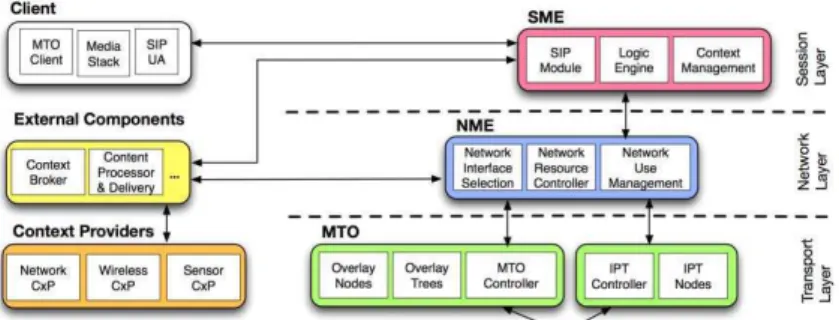
Figure 1: Context-aware Multiparty Delivery Architecture
Together, these components aim to allow context-aware session initiation, modification and termination, session mobility, user and network selection and triggered handover, user sub-grouping, personalized multimedia sessions, and transport reliability with QoS support. In a few words, it permits adaptation at the transport, network and session layers. A brief description of the entities enabling such scenarios can be found below.
x SME: The Session Management Enabler component handles context-aware session control of a multiparty session, more specifically its initiation, modification/renegotiation and termination.
x NME: The Network Management Enabler component is in charge of context-aware selections and decisions, including selecting and reserving the best multiparty delivery path towards group members.
x IPT: The IP Transport component is in charge of enforcing the routing path and QoS in the network for the multiparty session.
x MTO: The Multiparty Transport Overlay component is in charge of enforcing the creation, update and removal of overlay trees in the network, providing a generic, scalable, and efficient transport service for group communications by applying the overlay paradigm at the transport layer.
x NeworkCxP: The Terminal Network Context Provider provides the terminal’s view of
user networking context.
x CxP: Context Providers obtain contexts from sensors and networks, map them to information in an interpretable manner and deliver this information to the several components. These elements handle a large amount of heterogeneous information, and can be located in a distributed way in the network, to scalably handle the information.
2.1. Session Setup
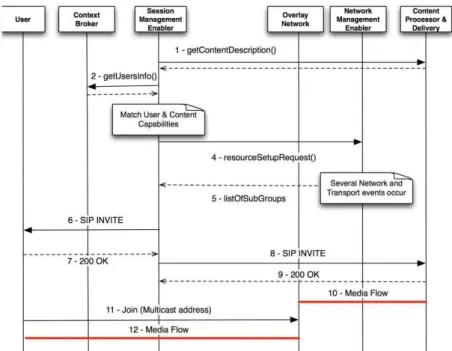
content available and the user device capabilities are identified (3), the SME requests the NME to reserve resources and to decide about the sub-grouping (4). Once this is done, the SME is informed and initiates a SIP session towards each user (6) and in parallel (or sequentially, depending on the implementation decision), it invites the content manager to start streaming to an overlay source node (responsible for distributing the media towards the overlay tree until the final users). Thus, one media session per sub-group is set and media is delivered to a multicast listening address for the multicast-capable users and to the users’ address, for unicast-only users. In this way, there is a balance between personalization and efficiency, as it is not required to create a sub-group per combination of medias and it still provides the user with the best combination available according to its current context.
Figure 2: Sequence diagram of Session Initiation
2.2. Network selection
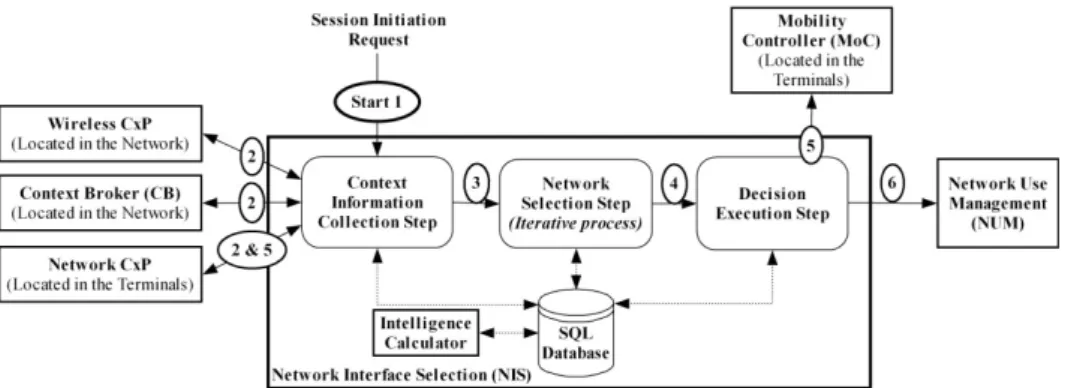
The network selection process is initiated upon a trigger from the SME, requesting the NME to reserve resources and decide over the sub-grouping. This request includes all the users’ IDs that belong to the service group and the content codings that each user can decode, based on its terminal’s capabilities. Once this request is received, the Network Interface Selection (NIS) module is triggered to select for each user, the Radio Access Technology (RAT) that will serve him. The whole process is illustrated in Figure 3. First, NIS collects and stores in the SQL Database all the necessary context information related to the users of the service group (i.e. RATs within reach, signal strength received, network preferences, etc.) and the network (i.e. available capacity and current load in the RATs, QoS that can currently be supported by the RATs, etc). Then, an iterative process is followed until an efficient network selection, for each user, is made. During this process all the context information collected is considered and a decision is made aiming to serve the users with the best possible QoS, use as less radio resources as possible and also obey all
Figure 3: Network selection process
Once the final decision is made, NIS notifies the users (through the Mobility Controller) to activate the selected interface, connect to the RAT and receive an IP Address. This IP
Address is reported back to NIS through the NetworkCxP. The final decision includes, for
each user, the RAT that will serve him, his IP Address and a suggestion of the content coding that he should receive (made based on the available radio resources in the RATs). The decision computed is also forwarded to the NME in order to select and establish the communication paths. The rules defined by the Intelligence Calculator, are dynamically generated and stored in the SQL Database. The aim of these rules is to assist NIS to select the RAT and suggest a content coding for each user in such a way that any undesirable event in the network (like congestion, overloading, QoS degradation, call drop, etc.) will be avoided. For example, by using some intelligence and considering the instantaneous and historical context information, trends to undesirable events in certain RATs are predicted and rules (i.e. rules like “do not use more than 60% of the RAT’s capacity”, etc.) that must be obeyed during the network selection process are generated.
2.3. Network and session-aware grouping and sub-grouping
The architecture aims at grouping and sub-grouping users taking into account the interest in the same content and considering the variety of context information available. This operation is performed at Session and Network levels, supported by the session-related and network-related context. As an example of session-related context, users may need to be sub-grouped in different sessions with different codecs but with the same content, once the terminals may have different codec capabilities. As an example of network-context, the best access technologies for the users in the same group may be different, since user context and environment is also taken into account. The different networks may have different guarantees, which may require the content to be delivered with different quality and codecs, hence requiring users sub-grouping.
The SME is the element that accepts context information through requests or triggers, and answers by creating/modifying/terminating the sub-group sessions. Once it determines the matching between available content formats and user capabilities in terms of supported content formats, it is responsible of first inviting the users to a session and then inviting the content provider to deliver the content to these users. When there is some relevant context change, the SME should be capable to adapt the user’s session accordingly (move a user to a different sub-group, and possibly create or delete sub-groups).
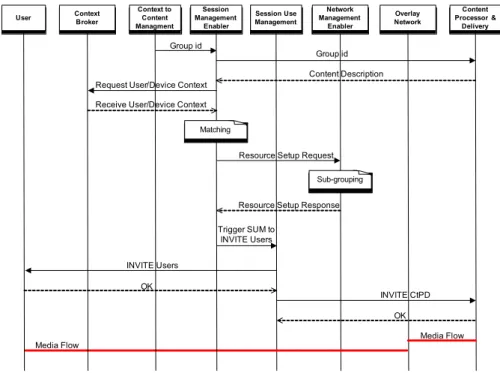
Figure 4 illustrates the messages exchanged during session initiation that are relevant to SME. It receives group identification and immediately requests group content information from the CxP. For each group user, the terminal capabilities and user preferences are collected from the Context Management System and particularly from the Context Broker entity. The matching between this information results in a list of users and corresponding available content codings, which is sent to the NME to proceed with more refined sub-grouping. The returned user list has one coding per user, with all users that support the same content coding to form a subgroup. Then, the SME opens a new session for each sub-group by inviting the users that belong to that sub-sub-group to join the session, and by inviting the Media Delivery function to deliver the particular content coding for that sub-group.
User
Group id
Context Broker
Overlay Network Session
Management Enabler
Content Processor &
Delivery Context to
Content Managment
Session Use Management
Network Management
Enabler
Group id
Content Description Request User/Device Context
Receive User/Device Context
Matching
Resource Setup Request
Sub-grouping
Resource Setup Response
Trigger SUM to INVITE Users
INVITE Users
OK
INVITE CtPD
OK
Media Flow Media Flow
Figure 4: Session Management related messages in session initiation for grouping and sub-grouping
2.4. Multiparty delivery and network re-configuration
Wi-Fi WiMax 3G U1 U2 U3 U4 U5 U6 ION3 ION2 ION1 EON3 EON2 EON 1 CN1 CN2 CN3 CON6 CN5 Session Source
SM + NUM
IPT IPT
IPT Sub-AMT 1 (unicast )
Cross-Layer Interaction Sub-AMT 2 (multicast)
ON-enabled
routers ON-disabledrouters IPT
CON4
Unicast Multicast SIP-message
MTO +IP T MTO+IP T MTO+IPT MTO+IPT MTO+IPT MTO+IPT MTO+IPT MTO+IPT
Figure 5: Multiparty service delivery
A scenario representing the multiparty transport framework is depicted in Figure 5. It presents an AMT connecting the Session Source to multiple users interested in the content. The AMT is divided in 2 sub-AMTs, the sub-AMT 1 and sub-AMT2, in order to hide the lack of multicast support in the nodes of the network between ION2 and CON4. The proper delivery of multiparty packets from the source to the receivers over the overlay tree is handled by the IPT component. The IPT selects a communication path (unicast or multicast) to connect ONs as well as further allocating network resources in the nodes between the ONs to allow a propagation of multiparty content sessions, with QoS guaranteed over the time, to a group of users. In order to deal with heterogeneous networks, IPT includes the support of scalable QoS control, IP multicast tree control, fast resilience operations and setup of network resources. In order to better understand the flexibility introduced by the AMT concept, consider that the user U2 is the only one using the 3G access technology to receive content. Then he moves, and the only access technology available is through Wi-Fi. In this case, and considering the advantages of the AMT concept, it is only required to establish a new sub-AMT between the CON4 and the EON1 in case of not having already established one. The Sub-AMT1 remains as intact and the Sub-AMT2 is eliminated if it does not have any more users associated.
3. Context-Aware Abstract Transport Evaluation
The architecture described so far was implemented in the Network Simulator 2 [9]. In order to assess its performance and robustness, it was created a flexible network topology regarding the number of ingress, egress and core nodes, core ON, access points (APs), mobile terminals (MTs), data sources and sessions. This way, it was easily evaluated the response of the architecture implemented by varying the input parameters, as the ones presented in Table 1, and generating different scenarios, as the one presented in Figure 6.
Figure 6 - Example of an evaluated scenario
The links in the core network were configured with a random delay between 1 and 2 ms, and a bandwidth ranging between 5 and 7 Mbps. The NS-2 network simulator has some limitations when dealing, in the same scenario, with multicast and wireless environments. To overcome this issue, it was considered the use of wired links between the APs and the MTs, with a dynamic error model to emulate wireless connections behaviour (delay and loss). Two different traffic generators were randomly used: exponential and constant bit rate. All flows have a packet size of 1000 bytes and an average rate of 100 Kbps. The class of service (CoS) of each flow is randomly chosen, but it is guaranteed that more than an half of the traffic is Best Effort (BE) to simulate a real network. Moreover, 6 CoS were considered: signalling, routing, Expedited Forwarding, BE, Assured Forwarding (AF) 1 and AF2.
Table 1: Input Parameters Configured in Simulations
Ingress Egress Core Core ONs Data Source MTs APs
Sessions Re-establish Time 2 3 6 0-6 5 10 6
Access Selection 2 2 5 2 4 10 7
Sub-grouping 2 2 6 3 2 15 7
3.1. Sessions Re-establish Time
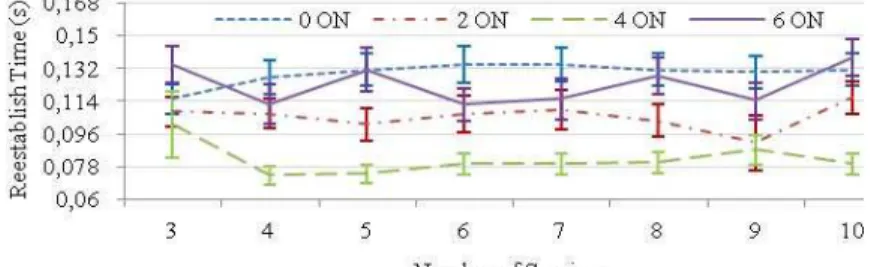
The number of ONs in the core can be chosen according to operator decision, from none to all. Due to this possible variation, it is important to study the impact of ONs in the sessions' re-establishment; it was created a scenario according to Table 1.
Session re-establishment time results (Figure 7) show better performance in the case of having a scenario with 4 ONs in the core network. This means that, increasing the number of ONs is only positive until a certain number of elements; above this number, the performance starts to drop. Generally, the re-establishment time is optimal in scenarios with about half ONs of the nodes in the core network, taking full benefit of its existence and avoiding the saturation of the core network with ONs that end up harming each other’s performance. On scenarios with a high number of core nodes, the time of travelling across the core becomes relevant for the session re-establishment time. Furthermore, since the presented scenario was not overloaded, sessions' re-establishment time does not depend on the load of the used AP. Typically, when a message notifying the MT movement, or its responses, is sent through an overloaded AP, the time of session re-establishment increases significantly mainly due to the intensive traffic load.
These results also show the importance of network planning when taking into consideration the amount and location of overlay node. A successful setup will provide a generally increase on the performance of the network and reduce the delay of its reconfiguration. Operator and network administrators must take these results in consideration when defining the guidelines for ONs setup.
3.2. Access Selection Methods
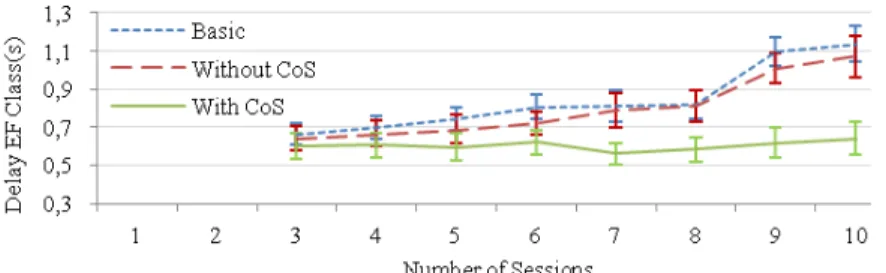
This section attempts to demonstrate the performance response of different access network selection methods. The "Basic" method represents the traditional AP selection based on the signal strength. The second one, "Without CoS", treats all traffic as equal using a load balancing mechanism, user preferences and cost. The last method, "With CoS", introduces the Sub-grouping and CoS in order to better manage traffic with different requirements. It also provides an admission mechanism to prevent high priority traffic to be impaired. The input parameters are the ones presented in Table 1.
Figure 8: EF Class Delay for different access selection methods
Considering the results obtained for the different access strategies, Figure 8 shows that the method "With CoS" is obviously the better choice when dealing with EF class traffic. Moreover, the delay value maintains nearly constant due to the above mentioned admission mechanism. Comparing the "Basic" approach with the "Without CoS" method, we may observe that there are lower delays in “Without CoS” approach for each one of the number of sessions simulated. These results show that, intelligently involving more information in the access selection process, it is possible to achieve better performance while maintaining, or even improving, user satisfaction.
3.3. Sub-grouping
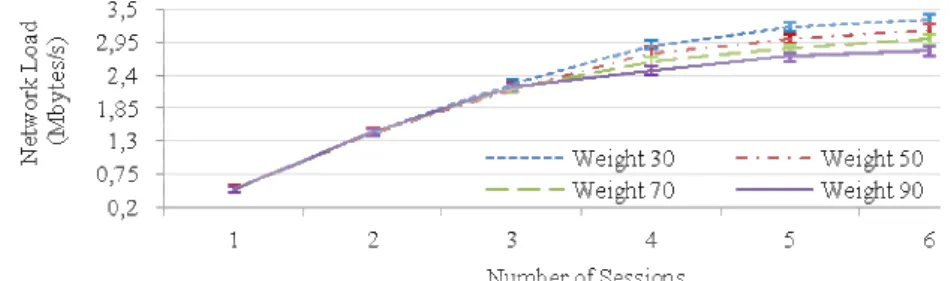
sub-grouping is also applied when a multicast group is divided to different APs in order to maintain the personalized delivery of content. In this evaluation, users have different preferences for the sub-grouping parameters, being the network performance evaluated for different values of the sub-grouping weight. A high sub-grouping value means more users receiving content in the same AP within the same group. The network topology parameters considered for these simulations are described in Table 1.
Figure 9 - Network Load varying sub-grouping weight
According to Figure 9, as the sub-grouping weight increases, the network load decreases, which is more evident for a number of sessions higher than 3. Despite not presented here, the overhead has a similar behaviour. Since the number of users per group is higher, the total number of sub-groups decreases and, consequently, the number of connections are lower. It is not problematic that some users may be grouped to receive in a lower, but near optimal codec format that satisfies a larger majority of users and increases the overall system performance, by reducing the number of different sub-groups for the same codec. Furthermore, having a higher value assigned to the sub-grouping property, the same AP has more chances to be chosen and consequently the same core path. Thus, it is avoided unnecessary content replication, as long as the QoS requirements are satisfied. In fact, the algorithm should be designed to achieve a good compromise between acceptable delays and network load.
4. Implementation and Experimentation
One important objective of the project is also to validate the technology developed through implementation, experimentation, and demonstration. Towards this objective, the detailed interfaces between the components forming the proposed context-aware multiparty services delivery architecture have been specified [4], allowing to implement the components and to successfully integrate them into a proof-of-concept platform. This integrated software platform makes use of networking and environmental context information to enable the optimal delivery of multimedia services to groups of heterogeneous receivers (e.g. terminal with different capabilities connecting through different access networks). In particular, the following aware adaptations, forming core functional capabilities of the context-aware multiparty services delivery architecture, have been successfully validated through the platform:
x adaptation in access network selection for each mobile terminal, based on
terminal and network contexts, and aiming at enhanced network capacity and performance.
x adaptation in routing path selection, consisting in selecting the best multiparty
delivery path based on network characteristics (bandwidth, load, delay, jitter, loss rate, multicast capabilities, etc.) and QoS needs from the session.
x adaptation in media coding selection (called sub-grouping), consisting in efficient
environmental context (e.g. by switching to a lower video quality when the user is running).
x adaptation in user device selection, with SIP-based session mobility between user
terminals triggered by environmental context (e.g. based on user location).
x adaptation in transport connection type, based on a multiparty transport overlay
(MTO) providing an efficient transport service for group communications by hiding heterogeneity of underlying networks in terms of IP multicast capabilities. MTO tree configuration and update is driven by characteristics of multiparty delivery paths to receivers.
x adaptation in transport reliability, through an adaptive FEC-based reliable
transport service well suited for streaming services with stringent latency constraints.
x adaptation in QoS support, through dynamic QoS enforcement along the
multiparty delivery tree (with unicast and multicast branches).
Beyond functional validation, this software platform is being used to assess the performance of the proposed architecture, in particular in terms of reactivity (response time) of the adaptations to context changes. Besides, performance of some specific parts of the components implemented have been validated too, such as the suitability of the proposed FEC-based reliable real-time transport service when implemented on typically constrained devices like smart-phones (e.g. like the Android terminals used in the project). This architecture has also been integrated with the other complementary components developed in the project, namely the context management architecture [5] and the context-aware content management architecture [6], forming the overall C-CAST integrated platform. In addition, three specific context-aware applications, exploiting the APIs provided by this integrated platform, have been developed to demonstrate (1) the simplicity of the context-aware application development framework enabled by the platform, and (2) illustrate the flexibility of the platform in terms of application supported. These are the “train company”, the “mall”, and the “party” applications specified in [7]. The platform will be publically demonstrated during the C-CAST final workshop [8].
7. Conclusions
Future Internet is expected to face massive new service deployments. Among them, growing demands for group communication and personalized services can already be observed. New architectures are needed to address such challenges. The work presented in this paper represents a step towards the support of future networks, as it provides the support for a context-aware personalized service in group based communications. Scalability issues are addressed in the architecture and context awareness and exploitation are key success factors for the support in future network architectures.
The context-aware multiparty delivery architecture presented in this paper provides a valuable first step towards enabling scalable and efficient support of pervasive mobile real-time mulreal-timedia communications to group of users. This is achieved by driving adaptations of the service delivery in the session, transport and network layers and taking into account not only the user’s networking context but also his environmental context. It has been shown that this architecture fulfils the dual objective of preserving quality of experience for each group member, while ensuring network efficiency.
simulation results. Moreover, the results also highlight the advantages of considering context in management and control decisions, providing intelligent network selection and treating users according to their context information.
As future work, we plan to complete the assessment of the efficiency and scalability of the implemented architecture in the C-CAST testbed supporting different context-aware scenarios.
Acknowledgments
This work has been supported by the European FP7 ICT project C-CAST [1] which aims at evolving mobile multimedia multicasting to exploit the increasing integration of mobile devices with our everyday physical world and environment.
References
[1] FP7 ICT-2007-216462, Context Casting, Funding, EU-FP7 ICT.
[2] J. Antoniou, C. Christophorou, A. Neto, S. Sargento, F. Pinto, N. Carapeto, T. Mota, J. Simoes, A. Pitsillides, “Context-Aware Self-Optimization in Multiparty Converged Mobile Environments”, Third International ICTS Conference on Autonomic Computing and Communication Systems (Autonomics 2009), September 2009. [3] J. Simoes, C. Janneteau, S. Sargento, N. Carapeto, J. Antoniou, C. Christophorou, A. Neto, “Context-aware
Control for Personalized Multiparty Sessions in Mobile Multihomed Systems”, Fifth International ICST Mobile Multimedia Communications Conference (Mobimedia 2009), September 2009.
[4] C. Janneteau (Editor) et al., “Specification of context detection and context-aware multiparty transport”, C-CAST project deliverable D13, June 2009.
[5] M. Zafar (Editor) et al, “Specification of Context Casting Service Enablers, Context Management & Context Brokering”, C-CAST project deliverable D12, June 2009.
[6] N. Ramati (Editor) et al., “Specification of Content Casting”, C-CAST project deliverable D14, June 2009.
[7] D. Gomes (Editor) et al., “Specification of test scenario and Selected ex-perimental/simulation environment”, C-CAST project deliverable D11, June 2009.