USE OF TEMEPHOS
LARVICIDE
IN SOLID FORM FOR THE
CONTROL
OF ONCHOCERCIASIS
IN GUATEMALA’**
Kikuo Matsuo3
The work reported here was pdormed as part of a coordinated onchocerciasis control program in Guatemala. Its aim was to find an appropriate way of
making and applying a solid formulation of larvicide for use against larvae of
the main vector species, Simulium ochraceum, which arefound exclusively in fast-moving mountain streams of the endemic zone.
Three onchocerciasis vectors are recognized in Guatemala: Simulium ochraceum, Simulium metallicurn, and Simulium callidum (1); but the most important species is S. ochraceum. Its larvae generally breed in streams that carry a small volume of water and run under a canopy of dense vegetation, but that move swiftly because of the steep slopes of the foothills through which they fall. The larvae occur along finite stretches of these watercourses, never throughout their length (2,3). Large numbers of such larval habitats are scattered about the area endemic for onchocerciasis.
Large-scale application of larvicides is ex- tremely difficult under these circumstances, it being very hard to transport and apply appro- priate materials. The rugged terrain precludes the use of motor vehicles, which are employed in Africa to combat S. damnosum (4). And since the elimination of simuliid larvae is a pro- tracted process, it is imperative to find an ef- fective application method that will also make
‘Also published in Spanish in the B&tin de la Of&a Sanitaria Panamericana, 95(5):412-417, 1983.
2This study was supported by the Ministry of Public Health of Guatemala and the Japanese International Cooperation Agency (JICA). (GJCRCPO-MENSAP Series No. 6.)
3Formerly a member of the Department of Medical Zoology, Kyoto Prefectural University of Medicine, Kyoto, Japan. Present address: Department of Medical Zoology, School of Hygiene, Fujita-Gakuen Universi- ty; Kutsukake-chyo, Toyo-ake City, Aichi Prefecture, Japan.
it possible to reduce the number of treatment sites and so save time and effort-particularly if the operation must cover the country’s en- tire endemic area.
A larvicide appropriate for this purpose should come in the form of solid pieces that are easily transported and will dissolve in a stream of water within 10 or 20 minutes. Such a product would reduce the effort required and would accelerate the application process, so that a larger area could be covered in a single day. We therefore performed a series of trials in August-December 1979 in order to develop an appropriate solid formulation of the larvicide temephos and to test the effects of that formulation on simuliid larvae in Guate- malan streams.
Materials, Methods, and Results
Production of a Solid Temephos Formulation
We began with three commercial forms of temephos (recognized as the larvicide most ef- fective against simuliids in Guatemala), these being a 5 per cent emulsion, 3 per cent gran- ules, and a 5 per cent wettable powder. To these we added a surface-active agent, poly- vinyl alcohol, animal fat, and in one case liquid soap. All of these ingredients were found to be available in the country.
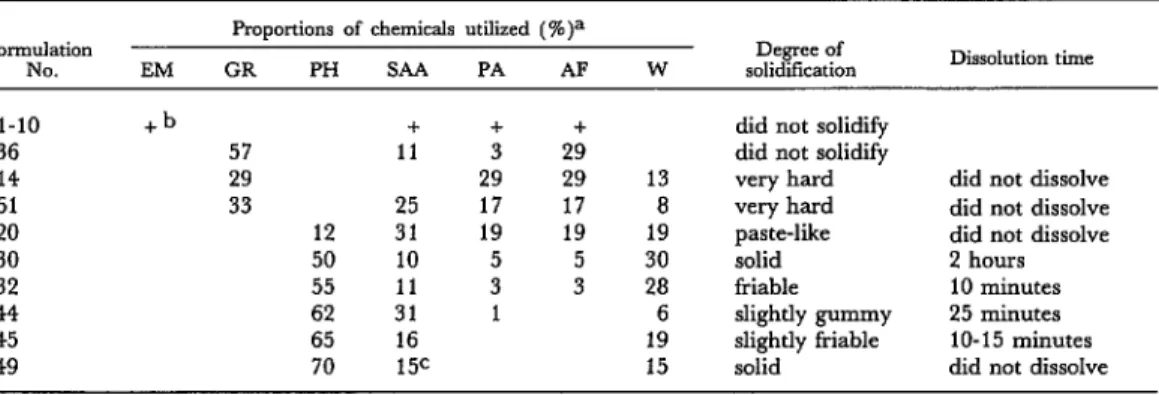
Table 1 shows the proportions of the chemi- cals used in a representative group of the 61 formulations tested, the extent to which the
Matsuo l LARVICIDE AGAINST ONCHOCERCIASIS IN GUATEMALA 59
Table 1. The relative amounts of ingredients used in the various temephos formulations tested, showing the degree to which these formulations solidified and the time that each needed to dissolve.
Proportions of chemicals utilized (%)a
Formulation Degree of
NO. EM GR PH SAA PA AF w solidiication Dissolution time
l-10
+b
36
57
1;
3 2:14 29 29 29 13
61 33 25 17 17 a
20 12 31 19 19 19
30 50 10 5 5 30
32 55 11 3 3 28
44 62 31 1 6
45 65 16 19
49 70 15c 15
did not solidify did not solidify very hard very hard paste-like solid friable slightly gummy slightly friable solid
did not dissolve did not dissolve did not dissolve 2 hours 10 minutes 25 minutes lo- 15 minutes did not dissolve aEM = 5 per cent temephos emulsion; GR = 3 per cent temephos granules; PH = 5 per cent temephos wettable powder; SAA = surfactant; PA = polyvinyl alcohol; AF = animal fat; and W = water.
b + = various proportions. CLiquid soap.
various mixtures solidified, and (for those that solidified) the dissolution time in water. The time of dissolution was found by the following method: A tablet of insecticide was inserted into a small metal screen cage and placed in an artificial stream of running water; a record was then made of the time it took the tablet to dissolve.
None of the formulations using the teme- phos emulsion solidified satisfactorily, despite numerous trials and use of many different proportions of the other ingredients. One for- mulation using temephos granules (formula- tion number 36) did not solidify; formulations 14 and 61 reached the desired solid state, but the resulting tablets failed to dissolve in two hours.
All six of the test formulations using the wettable powder solidified to some degree. Formulation 20 had a paste-like consistency and failed to dissolve in two hours; formula- tion 30 solidified and dissolved in two hours; formulation 32, containing smaller amounts of polyvinyl alcohol and fat, dissolved in 10 minutes but showed a tendency to crumble. Formulation 45, which used only the surface- active agent and water (no polyvinyl alcohol or fat) was less friable and dissolved in the stream of water in only 10 to 15 minutes. For-
mulation 49, which included liquid soap, so- lidified well but failed to dissolve in two hours.
Of the solid formulations tested in the lab- oratory, formulation 45 showed both effective solidity and appropriate solubility. Specifical- ly, it dissolved in running water in 10 to 15 minutes but did not crumble during transpor- tation from the laboratory to the point of ap- plication. This formulation was produced as follows: 20 grams of temephos wettable pow- der were mixed with 4.9 ml of surface-active agent and 5.8 ml of water. The resulting paste-like mass was placed in a shallow, rect-
. *
angular wooden mold until It solidified; it was then ready for application.
Field Trials
Table 2. Results of field trials with formulation 45. Except in stream “E,” all the treated streams received 1 part per million of temephos for 10 minutes.
No. of larvae collected before application/No. of larvae Vohme of collected 2 hours after application at the indicated
Water
Sites and streams water per second distances (in meters) from the point of application
(designated A-G) (liters) temperature ("C) 10 30 50 70 100 150 200 Simulium species collected A 0.5 20.5 3/o 28/O 73/1w S. metallicum, S. horacioi B 2.2 20.5 45/o 20/o 61/4a S. ochraceum, S. callidum, S. metallicum, S. horacioi C 7.3 21.0 51/o 30/o 24t4a S. ochraceum, S. callidum,
Medio Monte S. metallicurn, S. rubicun-
dulum
D 5.8 21.0 84/O 8910 8410 S. ochraceum, S. callidum, Eb
S. metallicurn, S. horacioi
0.08 21.5 12/o 56/12= 41162 S. ochramum, S. callidum,
S. metallicurn
Nimaya F 12.0 23.0 5010 4/O 121/ia 30/3= S. metallicurn, S. callidum G 8.3 23.0 5010 6410 59/l= 21lla S. ochraceum, S. callidum,
S. metallicurn ‘Moribund larvae.
dosage: 0.5 parts per million of temephos for 10 minutes.
minute period just before and two hours after the application (see Table 2).
In the Medio Monte streams, the larvi- tide’s impact was measured at distances up to
Figure 1. Onchocerciasis foci in Guatemala and the locales where the field trials of temephos
formulation 45 were performed.
100 meters from the point of application. Where the water-flow in the stream was be- tween 0.5 and 7.3 liters per second (see Table 2), and where a concentration of one part per million (ppm) was used, no larvae could be found 10 to 50 meters downstream two hours later. A few dying specimens were found be- tween 70 and 100 meters away. These results indicate that a dosage of 1 .O ppm for 10 min- utes was effective up to 100 meters away.
Matsuo l LARVICIDE AGAINST ONCHOCERCIASIS IN GUATEMALA 61
Formulation 45 was also applied at a con- centration of 0.5 ppm to a Medio Monte stream with a relatively small water-flow rate
of 0.08 liters per second. Two hours later, no larvae were found 10 meters downstream, but some moribund specimens were found 50 me- ters downstream and many live ones were found 100 meters away. This indicates that the ten-minute 0.5 ppm dosage was effective only at distances up to 50 meters away from the application site; but it should be noted that there are many tributary streams less than 50 meters long where that dosage could be used.
Discussion and Conclusions
Given the topography of the rivers that harbor the simuliid vectors of onchocerciasis
in Guatemala, a solid larvicide offers numer- ous advantages. Chief among these is that placing a metal screen cage containing the correct amount of solid larvicide in a stream takes very little time and much less effort than is required to apply liquid larvicide-because the liquid has to be added slowly to the run- ning water for 10 consecutive minutes. For this reason, a pair of workers who had been able to make only 25 liquid larvicide applica- tions in one day were able in the same time to make more than 75 solid larvicide applica- tions. The solid form is also light and easy to transport, and no additional receptacle need be taken along to make up the suspension. An added fringe benefit is that the mesh con- tainers used to hold the larvicide tablets pro- vide an easy way for supervisors to confirm that the larvicide has indeed been applied.
ACKNOWLEDGMENTS
The author wishes to express his thanks to mission of the Onchocerciasis Control Project Dr. Hector Godoy Bonilla, Director of the in Guatemala; and to the Guatemalan staff of National Malaria Eradication Services of the the Dr. Isao Tada Scientific Research Labora- Guatemalan Ministry of Public Health and tory of the National Malaria Eradication Ser- Social Welfare; to members of the Japanese vices.
SUMMARY The larvae of Simulium ochsaceum, the principal vector of onchocerciasis in Guatemala, inhabit small mountain streams. A trial of solid insecticide (temephos) formulations applied to control these larvae was made in August-December 1979. The most appropriate of various formulations produced in the laboratory was a solid mixture of 5 per cent temephos wettable powder (65 per cent), surface-
active agent (16 per cent), and water (19 per cent). This mixture was sufficiently solid for transporta- tion purposes and would dissolve reasonably fast (in
10 to 15 minutes) in running water.
Field tests of this formulation’s effectiveness against S. odraceum larvae were performed at a
number of streams in the endemic area. Applied so as to administer a dose of one part per million of temephos for 10 minutes, the formulation was found to control S. ochsaceum larvae up to a distance of 200 meters from the point of application.
REFERENCES
(I) Dalmat, H. T. The Black Flies (Dietera, Simu- liidae) of Guatwala and Their Role as Vectors of On- chocerciasis. Smithsonian Institution, Washington, D.C., 1955.
(2) Japanese Committee of Onchocerciasis Con- trol Project in Guatemala. First Report of Oncho- cerciasis Control Project in Guatemala. Japan In- ternational Cooperation Agency, Tokyo, 1978.
(3) Japanese Committee of Onchocerciasis Con- trol Project in Guatemala. Second Report of On- chocerciasis Control Project in Guatemala. Japan International Cooperation Agency, Tokyo, 1979. (4) Walsh, J. F., J. B. Davis, and R. LeBerre. Entomological aspects of the first five years of the onchocerciasis control programme in the Volta River Basin. Trojxmned Parasitol30:328-344, 1979.
WORLD HEALTH DAY-7 APRIL 1984-CELEBRATED AT THE PAN AMERICAN HEALTH ORGANIZATION
CHILDREN’S HEALTH/TOMORROW’S WEALTH
Detailed information on this World Health Day theme will be presented in the Bulletin’s next issue