INTRODUCTION
In 1969, the Human Genetics Committee of the World Health Organization recommended that genetic counseling programs perform “genetic counseling follow-up investiga-tions to determine the behavior of counselees” (WHO, 1969). The data obtained in these studies help counselors improve the effectiveness of the genetic counseling that they provide for the community, and this new contact with counselees becomes a valuable complement of genetic counseling (GC) sessions (Abramovsky et al., 1980). Evaluation of medical services based on clinical practice results is recognized to-day as an essential step in medicine (Delamothe, 1994).
Since the early seventies, several studies have been conducted to evaluate GC in different countries. Some concerned a single disease such as phenylketonuria (Sibinga and Friedman, 1971), Duchenne muscular dys-trophy (Emery et al., 1972) and mucoviscidosis (McCrae et al., 1973). Others concerned a small group of diseases such as mucoviscidosis, phenylketonuria, Down syndrome (Leonard et al., 1972), and congenital heart disease (Reiss and Menashe, 1972), or more frequently, groups of differ-ent types of disease, since most GC services indiscrimi-nately handle all types of genetic disease (Carter et al., 1971; Emery et al., 1973; Reynolds et al., 1974; Klein and Wyss, 1977; Briard et al., 1977; Abramovsky et al., 1980). Some reviews (Shaw, 1977; Evers-Kiebooms and van den Berghe, 1979) have emphasized difficulties in comparing the data obtained due to methodological differences among the various services both in the form and the objectives of
GC, as well as in the evaluation of results. Shaw (1977) also expressed concern about geneticists’ inadequacy in executing the operational phase of this work, since they are not trained in social or behavioral work. She also stated that evaluation, in order to be objective, should not be per-formed by the counselor himself.
The general objective of the present study was to evaluate a sample of families counseled at the Genetics Out-patient Clinic of the University Hospital of Ribeirão Preto, University of São Paulo, in order to understand the impact of GC on these families, and their objective and subjective reactions to the occurrence of genetic diseases, especially regarding their later reproductive life. Specific objectives were to evaluate: a) level of understanding (or recall) of GC, b) attitudes taken by the couple, especially with re-spect to family planning, c) knowledge, acceptance and use of contraceptive and abortive methods, d) reproductive life of counselees after GC, e) health status of children born after GC, and f) influence of factors such as socioeconomical and cultural level and religion on counselee behavior.
MATERIAL AND METHODS
Subjects
Sample selection criteria
1) Time interval between GC and follow-up interviews: fami-lies seen between two and a half and seven years after GC. 2) Types of disease: families with children affected by ge-netic, multifactorial or correlated (syndromes of unknown etiology) diseases.
Sample characterization
One hundred and thirteen families that fulfilled the above criteria were studied. Families were seen at the
Medi-GENETIC COUNSELING FOLLOW-UP – A RETROSPECTIVE STUDY WITH
A QUANTITATIVE APPROACH
João M. De Pina-Neto1 and Eucia Beatriz L. Petean2
A
BSTRACTThe impact of genetic counseling (GC) was evaluated in families, who were interviewed at least two and half years and at most seven years after GC at the Genetics Service of the University Hospital, Faculty of Medicine of Ribeirão Preto, University of São Paulo (HC, FMRP, USP). The 113 families interviewed in this study were asked 48 questions and all children born after GC were studied clinically. We evaluated the families for spontaneous motivation for GC and understanding of GC informa-tion, their reproductive decisions, changes in the family after GC and the health status of new children. The majority of families seen at the Hospital das Clínicas de Ribeirão Preto were not spontaneously motivated to undergo GC. They had a low level of understanding about the information they received during GC. Generally families were using contraceptive methods (even when at low genetic risk) with a consequent low rate of pregnancies and children born after GC. These families also had a very low rate of child adoption and divorces when compared to other studies.
1Departamento de Genética, Faculdade de Medicina de Ribeirão Preto, Universidade de São Paulo, Av. Bandeirantes, 3900, 14049-900 Ribeirão Preto, SP, Brasil. Send correspondence to J.M.P.-N. Fax: +55-16-633-0069. E-mail: [email protected]
cal Genetics Service of the University Hospital, Faculty of Medicine of Ribeirão Preto, University of São Paulo, and corresponded to 17% of the families seen during the study period. This sample included 54 different types of diseases: Down syndrome (39.8%), Duchenne muscular dystrophy (3.5%), achondroplasia, sickle-cell anemia and Marfan syndrome (2.6% each), congenital adrenal hyper-plasia, Prader-Willi syndrome, trisomy 13, ectrodactyly, Laurence-Moon syndrome and phenylketonuria (1.8% each), and 43 other types of diseases involving only one family. Eighty-four percent of the 113 families presented subjects affected by genetic diseases, 46% of which were chromosomal diseases and 38% monogenic diseases; 3.5% were diseases of multifactorial etiology, 9.8% were dis-eases of unknown etiology, and 2.7% were disdis-eases of heterogeneous etiology for which it was not possible to establish the exact cause of the disease. Among the chro-mosomal diseases, Down syndrome due to free trisomy 21 was the most frequent (35.4% of the total sample and 76.9% of the chromosomal diseases). Five families had chromosome translocations (4% of the total sample and 9.6% of the chromosomal diseases), with four inherited translocations and one de novo translocation. Among the monogenic diseases, the most frequent was autosomal re-cessive disease (18.5% of the total sample and 48.8% of the monogenic diseases), followed by dominant diseases (13.2% of the total sample and 34.9% of the monogenic diseases) and X-linked recessive diseases (5.4% of the to-tal sample and 13.9% of the monogenic diseases). In the sample studied, 48.7% of the fathers, 64.6% of the moth-ers and 56.5% of the couples were 34 years of age or less. Among the propositi, 83.1% were 12 years old or less, and only 2.7% were older than 20. Risk of recurrence was low (considered to be less than 10%) for most of the fami-lies studied (63.7%); 31.8% of the famifami-lies were at high risk, and 4.5% had doubtful risk due to etiologic heteroge-neity (variations in the causal mechanism).
We determined whether the family had sought GC, i.e., whether or not it was spontaneously motivated, and found that most families (69%) had been referred for di-agnosis and/or did not even know what Genetics is, i.e., they were not spontaneously motivated for GC; 23.9% of the families went to the service specifically to find out if they were at risk to have children with genetic disease, i.e., they were spontaneously motivated for GC. Families in the present sample were markedly concentrated in the lower social strata: 85% were classified as belonging to classes E, D and C; only 7% were classified as B and 8% as A. With respect to religion, most families (86.5%) de-clared themselves to be Roman Catholic, 9.5% were Prot-estant, 2% Spiritualist, and 1% simply Christian. Among the mothers, 1.9% stated that they had no religion, and the number of Spiritualist fathers (3.6%) was slightly higher than the number of Spiritualist mothers (1.0%). Most fami-lies declared that they did not practice their religion (63.6%), with mothers stating that they practiced their
re-ligion more than fathers (45.2% versus 25.4%). However, even among mothers the number of non-practicing subjects was higher (54.8%). In general, both parents were present during the GC interviews (61%) and the GC follow-up in-terview (69%). However, many times the mother attended the sessions alone (34.5% of the GC interviews and 25.7% of the follow-up interviews). The father was present alone in a much smaller number of families (3.6% of the GC in-terviews and 5.3% of the GC follow-up inin-terviews).
Methods
Data Survey
a) A special form was developed based on previ-ous GC follow-up studies, especially those of Carter et al. (1971), Leonard et al. (1972), Emery et al. (1972) and Reynolds et al. (1974), as well as the form developed by the Brazilian Center of Analysis and Planning (CEBRAP) for human reproduction studies (Berquó and Camargo, 1977; Berquó et al., 1977). The form consisted of 48 ques-tions covering the general objectives of the study. Sec-tions I, II and III concerned family identification. Section IV concerned data about family income, occupation, edu-cational level, religion and importance of religion for the parents. Section V aimed to determine the level of under-standing of the information provided during GC. Section VI questioned how the disease affected the reproductive behavior of the individual, the role risk of recurrence played in reproductive decisions and level of acceptance of adop-tion. Section VII concerned knowledge and use of contra-ceptive methods, acceptance of abortion methods in cases of severe fetal disease, and parents’ interpretation of their religion’s opinion of abortion, and section VIII evaluated the reproductive life of the couple after the GC process, i.e., whether they had children, if pregnancy was planned, if children were born during the study period (the children that were born were all evaluated clinically), whether they adopted children, if there were changes in the sexual be-havior of the couple as a function of the problem they were facing, and whether the couple separated.
b) Application of the form: parents from the se-lected families were interviewed at the Genetics Outpa-tient Clinic of the University Hospital, FMRP, USP. The interview was conducted by a main interviewer (a psy-chologist) and a secondary interviewer (a physician). Par-ents were interviewed jointly when possible, or separately if parents came on different days or only one spouse re-sponded to the call. The duration of each interview was approximately 1 h and 30 min.
c) Clinical examination of the children born after GC: all children born after GC were examined and photographed.
Data analysis
stratifica-tion was established based on family income, father’s or substitute father’s occupation and father’s or substitute father’s educational level by the method of Guidi and Duarte (1969). This method establishes a weight system for the three variables, attributing points for each stratum of each variable. The final score was: E stratum (lowest) = 13 to 22 points; D stratum = 23 to 34 points; C stratum = 35 to 44 points; B stratum = 45 to 55 points and A stratum (highest) = 56 to 65 points.
b) Evaluation of spontaneous motivation for GC: families that sought counseling at the Genetics Service and verbally expressed their concern about possible risks of disease repetition in other family members were consid-ered to show spontaneous motivation. Families looking for help who only expressed their concern about diagno-sis and/or treatment, or families simply referred without awareness of the purpose of the visit were considered not to have spontaneous motivation.
c) Evaluation of understanding level: GC under-standing was classified into three levels. A base level, called satisfactory understanding level, was assigned to people who were aware of the risk of disease repetition in his/her family, since the major objective of GC is to in-form about the risk of recurrence. An adequate level was assigned to those who, in addition to being aware of the risk, also knew the cause of the disease in the family (eti-ology) and the treatment required. An inadequate level was assigned to people who were unaware of the magnitude of risk, expressed verbally in the simplest form.
d) Evaluation of responses about causes and risks of disease repetition: we classified the responses accord-ing to the basis of the response. A - Scientific, when the responses were based on scientific laws and principles, with an A+ score when the scientific principle was cor-rectly employed and an A- score when the scientific prin-ciple was incorrectly employed. B - Mystical or religious, when the responses were based on religious principles. C -Popular belief, when the responses were based on folkloric culture. D - Anti-scientific, when the responses contested scientific principles without formulating any other explana-tion for the disease in the family. E - Empirical, when the responses were based on a trial and error process, with false deductions (e.g., the doctor said that this is due to age, but there are other women of my age who have normal chil-dren). F - Syncretic, when the responses were based on two or more of the above principles. G - unable to explain.
e) Classification of contraceptive methods: to fa-cilitate analysis we classified contraceptive methods based on the degree of ease of access. 1 - Medical, methods that require medical intervention for their use, i.e., intrauterine devices (IUD), tube ligation and ligation of the vas defer-ens. 2 - Paramedical, methods produced by an industrial process but that do not necessarily require medical guid-ance and/or intervention for their use in Brazil, i.e., con-traceptive pills, condoms, diaphragms, vaginal supposito-ries and gel. 3 - Popular, methods that do not need medical
guidance, are not produced by an industrial process and are popularly known and used, such as douching, coitus interruptus, sexual abstinence, rhythm and breast-feeding.
Statistical analysis
Data were analyzed statistically by the chi-square test, using contingency tables.
RESULTS
Evaluation of spontaneous motivation for genetic counseling
Most (74%) of the families studied were not spon-taneously motivated to seek GC. There was a clear rela-tionship between the family’s social level and spontane-ous motivation for GC. The frequency of spontanespontane-ous motivation was low for the lowest social levels (E = 1/35), and progressively increased for higher social levels (D = 8/36; C = 6/17; B = 5/7; A = 7/9). These differences were significant (chi-square = 166.5, P < 0.01).
Evaluation of GC understanding level
Analysis revealed a predominantly inadequate un-derstanding level in our sample (48.7%), with much lower frequencies of satisfactory (28.8%) and adequate (22.5%) understanding levels. Understanding level did not differ significantly between fathers and mothers (chi-square = 0.15). On the other hand, the interview played a clear role in the determination of understanding level, especially among fathers, with significant differences at the 1% level between fathers alone and fathers accompanied by the mother (chi-square = 23.3), and significant differences at the 5% level between mothers alone and mothers accom-panied by the father (chi-square = 8.0). Understanding of mothers alone was significantly better than that of fathers alone (chi-square = 8.9; P < 0.05), whereas the understand-ing of accompanied fathers was similar to that of accompa-nied mothers (chi-square = 0.55). This clearly shows that the understanding (or verbalization) of fathers alone was worse, and that the father’s performance improved when he was accompanied by his wife. Thus, there is an induction of response, especially in the woman-man direction.
Many parents identified the risk of repetition only as being low or high both in groups classified as having adequate understanding (37.2%) and satisfactory under-standing (51.7%). The proportion of subjects aware of the risk who mentioned the probability in a correct manner was 34.9% in the adequate group and 13.8% in the satis-factory group. The number of subjects who overestimated or underestimated the risk was similar in the two groups.
inad-equate understanding levels had a distorted understanding of the risk of repetition, while 23% knew nothing about the risk of repetition, and 10.4% gave responses that con-tradict the scientific principles involved in the formula-tion of the risk of repetiformula-tion.
Analysis of the relationship between understand-ing level and time elapsed between the GC interview and the follow-up interview showed a clear time effect. Knowl-edge about genetic diseases in their families became worse with time: the frequency of inadequate understanding was 28.2% after a 2-3-year interval between interviews, 59.8% after a 3-5-year interval and 61.2% after a 5-7-year inter-val. On the other hand, the frequency of adequate under-standing was 37.2% for a 2-year interval, 11.3% for a 3-5-year interval, and 27.7% for a 5-7-year interval, and the frequency of satisfactory understanding was 34.6% for a 2-3-year interval, 28.9% for a 3-5-year interval, and 11.1% for a 5-7-year interval. These differences are significant at the 1% level (chi-square = 39.6).
There was no significant difference in the inad-equate group in terms of presence or absence of spontane-ous motivation for GC. In contrast, differences were clear in the group with adequate understanding (36% with spon-taneous motivation and 19.5% with no sponspon-taneous moti-vation) and in the group with satisfactory understanding, in which the frequency of people with spontaneous moti-vation was lower (14%) than the frequency of individuals without spontaneous motivation (35.2%). Presence or ab-sence of spontaneous motivation for GC did not seem to be important for the understanding of the risk of repeti-tion, but it was important to understand the remaining prob-lems of the propositus (disease, cause, etc.).
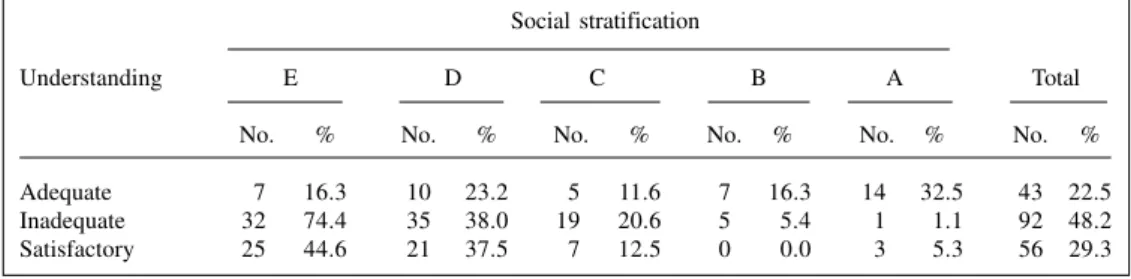
Adequate understanding was clearly related to fam-ily social class, with an increase from 11% for class E to 77.7% for class A (Table I). In the group with satisfactory understanding there was a decrease from class E (39%) to class B (0%). Although an increase to 16.8% was observed in class A, the general trend of a decreasing frequency of this understanding level with higher social classes was maintained. In the group with inadequate understanding there was an increase from class E (50%) to class C (61.3%), with a slight decrease in class B (41.6%) and a marked decrease in class A (5.5%). The differences in
understanding level according to social class were signifi-cant at the 1% level (chi-square = 188.8) (Table I).
The frequency of individuals who explained the disease at a scientific level was highest (51.3%), with a correct interpretation in 33% (A+) and an incorrect inter-pretation in 18.3% (A-). These groups were followed by those who did not know how to explain the disease (36.2%), and those who explained it on the basis of popu-lar belief (7.3%), syncretism (3.3%), religion (1.0%), or anti-scientifically (0.5%) (Table II). It is interesting to note the small number of people who explained the disease based on religious principles (1.0%), although part of these people were included in the syncretism group (also at a low frequency). These differences were significant at the 1% level (chi-square = 192.5 and 17.4).
The group with adequate understanding of GC con-sisted solely of subjects who based their understanding on a scientific explanation. Most had a correct interpretation (95.3%) and the remaining ones had an incorrect interpre-tation (4.7%). Most subjects in the group with inadequate understanding could not explain the information provided during GC (43%), followed by an explanation at the scien-tific level (39.7%), 29.0% with an incorrect interpretation and 10.7% with a correct interpretation, by popular belief (9.7%), syncretism (5.4%), and religion (2.2%). The distri-bution in the group with satisfactory understanding was simi-lar to that of the inadequate group, although there was a larger number of people who could not explain the cause of the disease (52.7%). Nobody explained the disease at the Table I - Distribution of families in terms of level of understanding of genetic counseling and social stratification.
Social stratification
Understanding E D C B A Total
No. % No. % No. % No. % No. % No. %
Adequate 7 16.3 10 23.2 5 11.6 7 16.3 14 32.5 43 22.5
Inadequate 32 74.4 35 38.0 19 20.6 5 5.4 1 1.1 92 48.2
Satisfactory 25 44.6 21 37.5 7 12.5 0 0.0 3 5.3 56 29.3
* Based on Guidi and Duarte (1969); for details see Material and Methods; A is the highest level.
Table II - Levels of explanation of the cause of the disease compared to genetic counseling understanding level in the families studied.
Levels of explanation*
Level A+ A- B C D E F G TOTAL
Adequate 41 2 0 0 0 0 0 0 43
Inadequate 10 27 2 9 0 0 5 40 93
Satisfatory 12 6 0 5 1 0 2 29 55
religious level (as observed in the group with adequate un-derstanding), and 1.8% of the people explained it at a nonsci-entific level. No person was classified as level E (empirical). Evaluation of the effect that social level had on how well the individual could explain the cause of the dis-ease showed a sharp correlation between these variables: the frequency of A+ explanation decreased from 88.8% in class A to 18.5% in class E; for an incorrect scientific ex-planation (A-) there was an increase in frequency from 0.0% in class A to 24.6% in class E; at the B, C, D and F levels the frequency increased with lowering of social class; at the G level (could not explain) the frequency increased until class C (46.6%) and then decreased to 36.2% in class E, which, however, was much higher than class A (11.2%). When the explanation levels of the disease cause were evaluated with respect to how religious the parents were, a scientific level was observed in 60.5% of those who de-clared a high degree of religiousness and in 44.4% of those who declared a low degree of religiousness. Religion played no role in determining B, C, D and F explanation levels. At the G level (could not explain) 23.9% were very religious, and 44.5% were relatively unreligious.
Evaluation of parental reproductive decision
The evaluation of parental reproductive decision revealed: a) a large number of couples decided not to have children regardless of risk (64.4% of the total sample), which was a decision of both fathers (65.5%) and mothers (63.5%); b) more high-risk couples (85.7%) decided to avoid having children than low-risk ones (52.9%). This difference was significant at the 1% level (chi-square = 28.9317). However, a large number of people at low risk also decided to avoid having children, whereas the num-ber of people at high risk who decided to have children was small (7.9%); c) there was no significant difference between the total number of fathers and mothers who de-cided to avoid having children regardless of the magni-tude of risk; d) understanding among high-risk parents was significantly different at the 1% level when the father or mother attended the session alone compared to when the father and mother came together. More couples that at-tended sessions together decided not to have more children than those that attended alone; e) in cases of low risk, these differences were not statistically significant (Table III).
Table III - Reproductive decision and risk of disease repetition according to family interview.
Father Mother Accomp. Accomp. Total Total alone alone father mother Father Mother
High risck
No. No. No. No. No. No. No.
To avoid 4 10 20 20 24 30 54
Not to avoid 1 0 2 2 3 2 5
No decision* 1 3 0 0 1 3 4
Total 6 13 22 22 28 35 63
Low risk
To avoid 7 13 21 22 28 35 63
Not to avoid 6 14 14 13 20 28 48
No decison* 1 2 3 3 4 5 9
Total 14 29 38 38 52 68 120
General total
Decision Father Mother Total
No. No. No.
To avoid 55 68 123
Not to avoid 24 30 54
No decision* 5 9 14
Total 84 107 191
*The father and/or mother had already been submitted to definitive sterilization or were not of reproductive age; disagreeing couples: high risk = 1 (mother alone: to avoid; father alone: not to avoid); low risk = 2 (mother alone: not to avoid; father alone: to avoid); 2 = accompanied father: accompanied mother: to avoid;
χ2 (total high risk x total low risk) = 28.9317 (P < 0.01; 2 d.f.); χ2 (low risk - fathers as a whole x mothers as
a whole = 0.0679 (NS; 2 d.f.). χ2 (high risk - fathers as a whole x mothers as a whole) = 3.5736 (NS; 2 d.f.);
χ2 (high risk - father alone x accompanied father) = 22.6879 (P < 0.01; 2 d.f.); χ2 (high risk - mother alone
x accompanied mother) = 33.3681 (P < 0.01; 2 d.f.). χ2 (low risk - father alone x accompanied father) =
When the decision to avoid children was consid-ered with respect to the level of GC understanding with-out a distinction between those who made the decision specifically because of the risk and those who made the decision for other reasons, no significant differences were detected between the various understanding levels, as fol-lows: high risk - decision to avoid children - adequate un-derstanding = 88.2%, inadequate unun-derstanding = 91.6%, satisfactory understanding = 100%; low risk - decision to avoid children - adequate understanding = 65.2%, inad-equate understanding = 50.0%, satisfactory understand-ing = 65.6%. Thus, the differences between high and low risk observed in Table I were maintained.
There was a clear correlation between understand-ing of the risk and motivation of the decision to avoid hav-ing children (Table IV): among those at a high risk, 93.7% of those with adequate understanding and 100% of those with satisfactory understanding stated that their decision was due to the risk. On the other hand, in subjects with inadequate understanding 54.5% stated that they would avoid having children due to the risk, while 45% said they would avoid having children due to other reasons. In cases of low risk, the frequency of subjects with adequate or satisfactory understanding who decided to avoid having children for other reasons (66.6% and 68.2%, respectively) was significantly higher (chi-square = 13.2, P < 0.01) than the frequency of subjects who decided to avoid having children because of the risk (33.3% and 31.8%, respec-tively). Among subjects with an inadequate understand-ing, the frequency of those who stated they would avoid having children due to the risk, even though it was low, was much higher (80%).
Evaluation of acceptance and use of contraceptives
A major problem that limited the evaluation of ac-ceptance and use of contraceptives in this sample was the fact that there were no clear records of the contraceptive methods used by the families before GC.
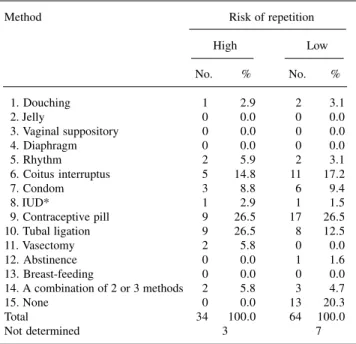
The analysis of the contraceptive use in the fami-lies showed (Table V): a) regardless of the risk of repeti-tion, the contraceptive pill was the method most exten-sively used by families (26.3%), followed by tubal liga-tion (16.5%), coitus interruptus (15.5%) and condoms (8.7%); b) among low-risk cases, about 20% of the fami-lies did not use any contraceptive method, while in cases of high risk, all couples used contraceptives; c) the differ-ence between high- and low-risk families infludiffer-enced the medical methods of birth control (IUD = 2.9% versus 1.6%; tubal ligation = 26.5% versus 12.5%; vasectomy = 5.9% versus 0%). No significant differences were observed with respect to paramedical and folk methods. No significant differences in access to the various contraceptive methods were observed among the different social classes.
When we evaluated the importance of religion on
contraceptive use, 40.6% felt that their religion is entirely against the use of contraceptive methods, 35.8% felt that their religion is fully in favor, 15.5% felt that their religion does not express an opinion on their use, 4.4% felt that their religion is in favor of responsible contraceptive use, and 3.7% felt that their religion is against their use but permits some exceptions.
When we evaluated the acceptance of definitive sterilization as a reproductive decision, we observed that: a) in high-risk cases, fathers who decided not to avoid
hav-Table V - Contraceptive methods currently used by the families studied according to risk of repetition of genetic defect.
Method Risk of repetition
High Low
No. % No. %
01. Douching 1 2.9 2 3.1
02. Jelly 0 0.0 0 0.0
03. Vaginal suppository 0 0.0 0 0.0
04. Diaphragm 0 0.0 0 0.0
05. Rhythm 2 5.9 2 3.1
06. Coitus interruptus 5 14.8 11 17.2
07. Condom 3 8.8 6 9.4
08. IUD* 1 2.9 1 1.5
09. Contraceptive pill 9 26.5 17 26.5
10. Tubal ligation 9 26.5 8 12.5
11. Vasectomy 2 5.8 0 0.0
12. Abstinence 0 0.0 1 1.6
13. Breast-feeding 0 0.0 0 0.0
14. A combination of 2 or 3 methods 2 5.8 3 4.7
15. None 0 0.0 13 20.3
Total 34 100.0 64 100.0
Not determined 3 7
* IUD = Intra-uterine devices.
Table IV - Reason for the decision to avoid pregnancy (due to the risk or not), risk of repetition and understanding level of genetic
counseling in the families studied.
YES NO
High risk
No. No.
Adequate 15 1
Inadequate* 12 10
Satisfactory 15 0
Low risk
No. No.
Adequate 5 10
Inadequate* 20 5
Satisfactory 7 15
Yes = Individuals who declared that they avoid pregnancy because of the risk. No = Individuals who declared that they avoid pregnancy due to other reasons. *There were 2 fathers alone, 2 mothers alone, and 1 accompanied father and 1 accompanied mother who had discordant opinions. χ2 (Yes
-high x low) = 44.9098 (P < 0.01; 2 d.f.). χ2 (No - high x low) = 102.0091
ing children do not accept vasectomy. Of those who de-cided not to have more children 47.8% accept vasectomy. These differences are significant at the 1% level (chi-square = 62.8); b) only 24% of the fathers who decided to avoid having children and 21.1% of those who decided not to avoid having them declared that they would accept a va-sectomy (nonsignificant difference); c) the difference in acceptance of vasectomy between high- and low-risk couples are significant at the 1% level (accept - chi-square = 28.9; does not accept - chi-square = 6.8838); d) in high-risk cases, 78.6% of the mothers who decided to avoid having children and 50% of those who decided not to avoid having them declared that they would accept tubal liga-tion (a significant difference at the 1% level - chi-square = 17.8); e) in low-risk cases, 67.6% of the mothers who de-cided to avoid having children and 57.7% of those who decided not to avoid having them declared that they would accept tubal ligation (nonsignificant difference - chi-square = 2.09); f) neither acceptance nor rejection of tubal liga-tion differed significantly between high- and low-risk women.
We observed that the acceptance or rejection of vasectomy among fathers was not related to the degree of religiousness. Among women there was a nonsignificant trend for greater acceptance of tubal ligation among very religious subjects and those accompanied by their husband during the interview. In general, the women of our sample wished to ligate their tubes. We also observed a relation-ship between high risk of recurrence and acceptance of definitive sterilization and a less marked relationship be-tween low risk of recurrence and acceptance of definitive sterilization.
Evaluation of the acceptance of abortion
In the present sample, 66.5% of the fathers and 74.5% of the mothers felt that their religion is entirely against abortion; 9.5% of the fathers and mothers as a whole felt that their religion is entirely in favor of abortion; 5.8% felt that their religion does not express an opinion, and the remaining parents felt that their religion accepts abortion depending on the reason for it.
High-risk couples accepted abortion better (57.1%) than low-risk ones (39.6%) (P < 0.05), with acceptance being higher among fathers alone (71.4%) and accompa-nied fathers (61.9%) than among mothers alone (53.8%) and accompanied mothers (50.0%) in the high-risk group. Among the mothers, a significant difference at the 5% level was observed between the high- and low-risk groups only for those that were alone during the interview. We also observed that the risk of repetition was more important for acceptance or rejection of abortion than the degree of reli-giousness, since in the high-risk group practicing fathers accepted abortion more frequently (85.7%) than non-prac-ticing fathers (57.15) and 68.7% of pracnon-prac-ticing mothers accepted abortion. In low-risk cases there was a
predomi-nance of fathers and mothers who did not accept abortion, regardless of whether they practiced their religion, or not.
Evaluation of the change in family composition after GC and health of the children born
With respect to the changes in family composition after GC and the risk of repetition, we observed that: a) the high-risk group had a significantly larger (chi-square = 158.2; P < 0.01) number of families in which no change in composition occurred (79.5%) compared to families at doubtful risk (60%) and families at low-risk (56.1%); b) high-risk families had fewer children (five children born in 36 families) compared to low-risk families (22 children born and two additional pregnancies during the evalua-tion from 72 families); c) only three children were adopted, all by high-risk families.
When we analyzed the number of children born, reproductive decision and risk of disease repetition (Table VI) we observed: a) 83.3% of the children born were from low-risk families, with 61.9% of the parents having de-cided not to avoid pregnancy, 19% to avoid having chil-dren, and 2.4% in which only the father had decided to avoid having children; b) 4.8% of the children born were from couples at doubtful risk, with 2.4% of parents hav-ing decided to avoid pregnancy and 2.4% of families in which only the father had decided to avoid having chil-dren.
With respect to the health of children born after GC, we observed that repetition of the disease of the pro-positus occurred only in high-risk cases. In one family con-sidered at genetic counseling in the low-risk group, we discovered later that the father was affected. The father has Marfan syndrome, and his four children and the proposita also have Marfan syndrome. We consider this family for analysis of recurrence of the disease in the high-risk group, and this fact explains why we considered for this analysis the 9 cases instead of the 5 cases born from the families originally considered in high-risk group. Then, in the high-risk group, among the 9 children that were born 4 were affected and all affected children belonged to the
Table VI - Combined number of children born after genetic counseling, reproductive decision and risk of disease repetition in the families studied.
No. of children/risk
Decision High Low Doubtful Total
To avoid 3 8 1 12
Not to avoid l 26 0 27
Discordant
(father decided to avoid) 0 1 1 2
Discordant
(mother decided to avoid) 1 0 0 1
same sibship. In low-risk cases, there was no repetition of the disease of the propositus, but other types of health prob-lems concerning the children born occurred in four fami-lies: isolated ear malformation, complex congenital heart disease, congenital hypotonia of undefined cause, and con-genital hypotonia, probably due to neonatal hypocalcemia.
Evaluation of acceptance and use of adoption
With respect to the acceptance of adoption, we observed that: a) most people declared that they did not accept adopting a child (59.1%); b) this rejection of adop-tion was higher among low-risk people (70.3%) than among high-risk people (50%); c) the frequency for women accepting adoption was always higher than that of men, independent of the magnitude of the repetition risk; d) the frequency of mothers alone who declared to accept adop-tion was higher than the frequency of accompanied moth-ers, whereas no important difference in acceptance of adop-tion was observed between fathers alone and accompa-nied fathers. Only two high-risk families adopted children, two children in one family and one child in the other.
Evaluation of couple separation or changes in their sexual relationship
Two couples separated. Both were at low risk for repetition.
With respect to changes in the sexual relationship of the couples after the birth of the propositus and magni-tude of the risk of disease repetition we observed that: a) most people declared that there was no change in their sexual relationship; b) the frequency of people who de-clared that there were changes in their sexual relationship was lower (father = 15.4%, and mother = 16.9%) among low-risk couples than among high-risk couples (father = 35.7%, and mother = 34.3%); c) only in high-risk cases there was a considerable difference in the frequency of fathers alone who declared that there was no change (50.0%) compared to accompanied fathers (31.8%).
DISCUSSION
Sample
We defined two and a half years as the minimum time between the GC consultation and follow-up interview to select families for this study, since reproductive behav-ior is the most objective parameter that can be evaluated in GC follow-up studies (Shaw, 1977). Two and a half years is enough time for families to have had another child (Carter et al., 1971; Emery et al., 1973). Maximum time between GC consultation and follow-up interview varies widely in the literature, ranging from about 28 years (Klein and Wyss, 1977) to about seven years, which was the maxi-mum interval for our sample.
In the present study, we only selected families whose propositus was affected by genetic or correlated diseases, since our aim was to study the objective and sub-jective reactions of families to the occurrence of a genetic disease in a relative. Studies also based on these criteria are available in the literature (Carter et al., 1971; Emery et al., 1973; Briard et al., 1977), as well as studies in which all families that received GC were evaluated indiscrimi-nately (Reynolds et al., 1974; Klein and Wyss, 1977) and studies in which the nature of the sample was not clearly described (Abramovsky et al., 1980).
Parental age in our sample was slightly different com-pared to the distribution reported by Berquó and Camargo (1977) among couples of reproductive age with a stable union living in the city of São Paulo, especially in terms of father’s age. In our sample, the frequency of fathers aged up to 29 years was 31.0%, as opposed to only 17.7% in the São Paulo sample. This tendency for younger fathers in our sample was also observed for mothers, although less marked, with a 41.6% frequency of mothers aged up to 29 years com-pared to 37.7% for the São Paulo mothers. Thus, parents in our sample were mostly young, and most propositi were children aged up to 12 years (83.1%).
In our sample there was a predominance of fami-lies at low genetic risk (63.7% as opposed to 31.8% high-risk families), a fact also observed in all studies reported in the literature, i.e., 40.8% high-risk families and 59.5% low-risk in the series of Carter et al. (1971), and 28.5% high-risk families and 71.5% low-risk families in the se-ries of Reynolds et al. (1974).
Income distribution of our sample compared to the 1980 IBGE census (IBGE, 1980) showed that our counselees were in a better socioeconomic situation com-pared to the country in general, but in a lower situation compared to the income distribution in the municipality of Ribeirão Preto reported by Mussia and Pereira (1980). The educational level of our counselees was slightly higher than that detected by Berquó and Camargo (1977) in the municipality of São Paulo, with this difference be-ing slightly more marked among women than men. When the educational level of our counselees is compared to that reported by Andrade and Pereira (1979) for the munici-pality of Ribeirão Preto, the situation is the same, i.e., our counselees have a higher educational level.
By comparing the distribution of our sample in terms of religion to the IBGE census (1980) for the Bra-zilian population, we can see a slightly lower frequency of Catholics (86.5% for our sample versus 88.9% for Brazil as a whole) and a higher frequency of Protestants (9.5% versus 6.6%) and Spiritists (2.0% versus 1.3%). The same differences are detected when comparing the present sample to that studied by Berquó and Camargo (1977) in the municipality of São Paulo, with a slightly lower num-ber of Catholics and a reasonably higher numnum-ber of Prot-estants. When comparing our sample to that of Berquó and Camargo (1977) in terms of the degree of religious-ness, the frequency of highly religious subjects (= practic-ing) was slightly lower in our sample (36.4% versus 43.0% for the São Paulo sample).
Spontaneous motivation
Our sample included families that sought counsel-ing at the Genetics Service motivated by the risk of recur-rence (considered to have spontaneous motivation), those that sought counseling for other reasons (such as diagno-sis) or were simply referred. The reason for this procedure was to evaluate the importance of this factor in the GC process and its determinants. Carter et al. (1971), Emery et al. (1972) and Abramovsky et al. (1980) selected their samples among people who sought counseling exclusively because of the risk of recurrence. Reynolds et al. (1974) reported that only 26% of the people in their sample sought counseling on their own, whereas all others were referred. However, the primary interest of 57% was to find out if abnormalities could be transmitted to their future children. Most of the remaining people listed this concern as sec-ondary. In our sample the total number of people who ver-bally expressed worries about the risk was very low (23.9%), with a highly significant correlation between spontaneous motivation for GC and social level, i.e., the higher the social level, the greater the desire to receive GC for the fear of having another child with similar prob-lems.
Understanding level of GC
In the present study, an adequate understanding level was observed in only 22.5% of the families and a satisfactory level in 28.8%. Therefore, if we consider that the main objective of GC is understanding the risk of re-currence, only 51.3% of the families verbalized this risk in a correct manner. This understanding level is one of the lowest in the literature. Clarke et al. (1996) stated that stud-ies published in European and American literature usually show a good level of understanding or recall of the infor-mation. Somer et al. (1988) reported in Finland that 80% of the families had a correct knowledge of the mode of inheritance and 74% of the risk of recurrence. Reynolds et al. (1974) detected adequate understanding in 84% of their
sample, with 28% of them knowing the risk exactly and 72% knowing whether it was high or low, and the remain-ing 16% presentremain-ing distortions or rejection of the infor-mation. Abramovsky et al. (1980) found that 91% remem-bered the diagnosis, 72% rememremem-bered the correct percent-age of risk and 56% remembered the mode of inheritance, i.e., 68% remembered the diagnosis and the risk and only 40% remembered the diagnosis, the risk and the mode of inheritance. However, studies showing a low understand-ing level of GC have also been published. To illustrate, Sibinga and Friedman (1971), in a study of parents of chil-dren with phenylketonuria, found that only 19% had an adequate understanding of GC information, and Reiss and Menashe (1972), in a study of parents of children with congenital heart disease conducted one to four months af-ter the authors had reinforced the information, noted that none knew about the risk before the reinforcement, and that only 25% knew about the risk after the reinforcement. Furthermore, 38.5% knew the name of the disease of their child before the reinforcement, and only 48.6% learned it after the reinforcement. Leonard et al. (1972), in a study of families with members affected by phenylketonuria, mucoviscidosis and Down syndrome, detected imperfect understanding of genetic information in 44% of the sample. In the present study we observed that understand-ing level depended on the characteristics of the interview, i.e., a significant induction of a response occurred from mother to father, with the mother’s presence improving the performance of the father. The only study in which sex-based (father and mother) differential understanding was evaluated was by Sibinga and Friedman (1971) with respect to phenylketonuria. These investigators showed that women understood better than men and also that the un-derstanding of one member of the couple may compen-sate for the lack of understanding of the other. They also observed that the better the understanding of the mother, the better the development of the child.
In the category of adequate understanding, 34.9% of the individuals verbalized the risk using the correct per-centage, 7.0% overestimated the percentage and 2.3% underestimated the risk. If we compare these data with those reported by Emery et al. (1972) considering the ex-act understanding of the risk, the difference is very high since these investigators found that 84.4% of their sample knew the percentage of risk. In the category of inadequate understanding, our sample showed a predominance of dis-tortions (66.6%) followed by people who had no knowl-edge (23.0%) and finally by rejection (10.4%). The only paper citing the basis of inadequate responses is that by Reynolds et al. (1974) in which 16% of the individuals distorted or rejected the information, with two people ac-tually rejecting the entire GC experience.
re-call, since there was a decrease in the frequency of ad-equate and satisfactory understanding and an increase in inadequate understanding level with time interval. Both were statistically significant (chi-square = 39.6). Only Reynolds et al. (1974) studied this factor in terms of the frequency of different understanding levels. They found no effect of time (example for understanding adequate: less than two years = 80%; two to five years = 84%; more than four years = 84%). In contrast, in the present sample this factor contributed to a reduction of adequate and sat-isfactory understanding level and to an increase in inad-equate understanding.
Another factor that decisively affected our sample in terms of reducing adequate understanding in favor of satisfactory understanding was spontaneous motivation (Table I). Considering this variable, there was a signifi-cant difference in adequate understanding level between those who were spontaneously motivated and those who were not (Yes = 36%; No = 19.5%). Paradoxically, this difference did not favor inadequate understanding (where the frequency of Yes = 50.8% was practically identical to the frequency of No = 45.3%), but rather satisfactory un-derstanding, which was more frequent among those with-out spontaneous motivation (Yes = 14%; No = 35.2%). Reynolds et al. (1974) also detected a correlation between adequate understanding level and source of referral to the GC service (which would be equivalent to what we would call spontaneous motivation). Those who sought the ser-vice on their own had a better understanding level (23 of 26 had adequate understanding) than those who were re-ferred (5 of 24 had adequate understanding). However, as discussed earlier, there was a strong correlation between spontaneous motivation and social stratification of the families in our sample (chi-square = 166.5). Based on these data and on those listed in Table I, we may con-clude that low socioeconomic-cultural level was the ma-jor factor reducing the level of GC understanding in our sample. Even in the US, Reynolds et al. (1974) showed a correlation between social class and understanding level, with an adequate understanding level in 91% of subjects belonging to classes I, II and III, and only a 68% level in classes IV and V. Other variables evaluated, such as level of recurrence risk and interview characteristics, were not important.
Thus, the fundamental factor in the reduction of understanding level in our sample was socioeconomic-cultural level, followed by time interval between the GC consultation and the follow-up interview. Spontaneous motivation was a reflex of socioeconomic-cultural level.
Levels of explanation of the cause and risk of repetition of the disease
None of the studies available in the literature con-cerned the levels of explanation of the cause and risk of repetition of the diseases. We found it to be of
fundamen-tal importance, especially under the conditions of Third World countries. In these countries, underdevelopment causes marked social differences and enhances the nature of the doctor-patient relationship as a social class relation-ship. Adequacy of GC techniques in underdeveloped coun-tries must necessarily be based on a better knowledge of folk culture, especially in terms of the health-sickness dyad and its position with respect to official medical practice and its interrelations with folk medicine (Boltanski,1979). The basis for parent’s explanation of the disease frankly depended on the social class to which they belong, clearly showing that the frontiers of penetration of scien-tific medicine really meet a barrier in the popular strata (Table II). Among these classes, there is less penetration of scientific medicine, more persistence of folk medicine and, causing even more concern, a large number of people who do not know how to explain what happened in their family. Why did this occur? Most of this lack of under-standing is probably due to inhibition in the presence of the doctor, who represents the “master of learning, and the upper classes”. People of lower socioeconomic level do not empathize with the doctor and therefore hide their feel-ings and thoughts. A much worse possible situation would be that these ignorant people are “lost”. They lost the folk medicine with which they identified and were unable to learn about scientific medicine due to their living condi-tions. The higher frequency of explanations with a scien-tific foundation among those who declared themselves very religious and the absence of an explanation based on reli-gious principles may reflect the evolution of the Catholic Church in terms of a greater acceptance of scientific prin-ciples, since most of those who were religious in our sample declared themselves Catholics.
Reproductive decision
appar-ent when the reproductive decision is compared only to understanding level without taking into account the rea-son for the decision to avoid having children, with no im-portant differences between the various understanding lev-els in terms of the decision.
Evaluation of the degree of religiousness clearly showed that this variable had no effect on the reproduc-tive decision of the couples. This aspect had been previ-ously emphasized by Berquó et al. (1977), who stated that “religion per se does not represent an important factor in the determination of reproductive behavior, with all data indicating that the population studied does not present re-ligious reasons as a foundation in this determination. The attenuation of the specific influence of religion in repro-ductive behavior reveals a doctrinal accommodation prob-ably as a function of economic and social factors. Although religion is not an irrelevant factor, its influence on fecun-dity is permeated by the social condition of its followers.” When social class and risk of repetition were ana-lyzed in relation to reproductive decision, the risk of rep-etition was found to be more important than the socioeco-nomic-cultural level of the individuals for their reproduc-tive decisions, since almost all high-risk couples decided to avoid having children, regardless of their social class. However, socioeconomic-cultural level is important since high-risk couples who decided not to avoid having chil-dren belonged to class D, and low-risk class A people de-cided more frequently not to avoid having children, while the other classes had a predominance of people who de-cided to avoid having children. We believe that these dif-ferences among the various classes in low-risk cases re-flect the understanding level (which is lower in the lowest classes) and ultimately the socioeconomic-cultural level of the individuals.
We observed that the number of existing children is important in the decision to avoid having more children in all social classes: among childless couples the predomi-nant decision was not to avoid pregnancy regardless of the risk, whereas the decision to avoid having children in-creases with the number of existing children in all social classes. However, risk is more important than the number of existing children or social level for the reproductive decision: among childless high-risk couples the predomi-nant decision was to avoid pregnancy in both classes A and E, whereas class D couples with children decided more frequently to avoid having children. Most low-risk couples decided to have at most two children. After the second child, most couples decided not to have more children re-gardless of their social class.
Between number of existing children and social class, the former was clearly more important for repro-ductive decisions. This is a fact that in reality must reflect the latter, since change in the concept of ideal family size is linked to the current life situation which affects all so-cial classes. The prominent role that risk of repetition had in changing the concept of ideal family size was clearly
observed when we analyzed the number of children be-fore GC, the risk of repetition and the reproductive deci-sion. Analysis showed that family size becomes much more limited in high-risk cases than in low-risk ones (a signifi-cant difference at the 1% level; chi-square = 28.6484). The question of the ideal family size exists, because in the present study low-risk couples with two to four children often decided to avoid pregnancy regardless of social class. As demonstrated by Berquó et al. (1977) in the munici-pality of São Paulo, the ideal family size was three chil-dren (38.7%), followed by two chilchil-dren (20.2%) and four children (17.9%).
The importance of the risk of repetition for repro-ductive decisions of couples at genetic risk has been shown by several investigators (Carter et al., 1971; Emery et al., 1972; Reynolds et al., 1974; Klein and Wyss, 1977; Abramovsky et al., 1980). The influence of religion, num-ber of children before GC, social class and ideal family size has never been previously studied.
Acceptance and use of contraceptives
contraceptive methods, their followers, practicing or not, allege legitimacy of their use, listing economic factors, woman’s health and number of existing children as rea-sons. In our sample there was a strong correlation between acceptance of tubal ligation and the number of women who actually submitted themselves to the procedure. Similarly, among the fathers there was a lower acceptance of vasec-tomy and a lower effective use of the procedure.
Acceptance of abortion
Despite the fact that most people (71%) thought their religion is fully against abortion, most high-risk people in our sample declared that they would accept the inter-ruption of pregnancy in the case of prenatal diagnosis of a severe disease in the conceptus, thus showing the impor-tance of risk of repetition. The frequency of accepimpor-tance was significant at the 5% level and more marked among fathers. This fact should be emphasized because our sample consisted mainly of Catholics who, as reported by Berquó et al. (1977), are considerably influenced by the position of the Church against abortion. However, as also empha-sized by the same authors, this does not prevent a minority (28.7%) of women, who define themselves as practicing Catholics, from accepting an ethical attitude formally con-tradicting their religion, and some women (7.3%) confessed to having induced an abortion at some time in the past. In our sample, only one couple was in a position to decide and opted for abortion.
Changes in family composition
Since we did not construct an internal control in the present study, we have no reliable parameters to evalu-ate birth revalu-ate. However, an approximation can be obtained by comparing the ratio of children born to high- and low-risk families in our sample and other reports in the litera-ture. In our sample, this ratio was 0.13 for high-risk fami-lies (five children born to 36 high-risk famifami-lies) and 0.50 for low-risk families (35 children born to 69 low-risk fami-lies). In the various reports in the literature, this ratio ranged from 0.24 to 0.67 for high-risk families (our 0.13 value was the lowest) and from 0.4 to 0.84 for low-risk families (our value was 0.50, i.e., only higher than the 0.40 ratio obtained by Abramovsky et al. (1980). Thus, it is our im-pression that our family sample practiced a considerably high level of birth control after GC, especially high-risk cases, in agreement with the reproductive decisions and the high use of contraceptive methods.
Health situation of the children born
The rate of repetition of the same disease among high-risk families ranges from 0 to 25% in the literature. In our sample there was a recurrence rate of 44.4% in high-risk cases. In low-high-risk families, the recurrence rate reported
in the literature ranges from 0 to 4%. In our sample, the rate of recurrence for low-risk couples was 0%; however, 12.9% of the children born (four children in 31 families) had another disease differing from that of the propositus. This has been previously reported in the literature (see, for example, Klein and Wyss (1977) who reported a 5.6% rate and Briard et al. (1977) who reported a 4.4% rate).
Evaluation of the acceptance of adoption
In our sample there was a low acceptance of adop-tion, with only three children being adopted by two out of 36 high-risk families (8.3%). Other investigators have re-ported much higher adoption rates: Carter et al. (1971) reported adoption by 21.1% of high-risk families and 8.3% of low-risk families; Reynolds et al. (1974) reported adop-tion by 13.8% of high-risk families and 1.4% of low-risk families.
Evaluation of separation of the couples
In our sample, the frequency of separation was low (two couples in 113 = 1.7%), as opposed to literature val-ues ranging from 3.8 to 6.6% (Carter et al., 1971; Reynolds et al., 1974; Klein and Wyss,1977; Briard et al., 1977).
CONCLUSIONS
The present study led to the following general con-clusions:
a) Most families were not spontaneously motivated for GC, with a positive correlation between spontaneous GC mo-tivation and social class.
b) A low understanding (or verbalization) level of the in-formation supplied during GC was observed. The main factor related to the low understanding level was socio-economic and cultural level.
c) There was a marked predominance of decisions to avoid pregnancy after GC, also present among individuals at low genetic risk. The risk of repetition was the most important factor in the reproductive decision of the fami-lies, followed by number of existing children and so-cial class as secondary factors.
d) A high use of contraceptives was observed, especially in families at high genetic risk.
e) A low birth rate was observed in the families after GC, especially among those at high genetic risk.
f) Rates of adoption and couple separation after GC were low.
ACKNOWLEDGMENTS
Desenvolvimento Científico e Tecnológico (CNPq) and Fundação de Amparo à Pesquisa do Estado de São Paulo (FAPESP) for financial support. Publication supported by FAPESP.
RESUMO
Neste trabalho tivemos por objetivo geral a avaliação do impacto do aconselhamento genético (GC) nas famílias atendidas no ambulatório de Genética do HC, FMRP, USP. Foram estudadas 113 famílias atendidas há no mínimo 2 anos e meio e no máximo há 7 anos no Serviço. O método utilizado foi o de entrevista ambulatorial através de formulário constituído por 48 perguntas; as crianças nascidas após o GC foram avaliadas clinicamente. As famílias foram avaliadas em relação à motivação espontânea para o processo de GC, quanto ao entendimento das informações do GC, às suas decisões reprodutivas, modificações na consti-tuição da família após o GC, e, também, quanto à saúde das crianças nascidas após o GC. Foi observado que a maioria das famílias atendidas no HCRP não são motivadas espontaneamente para o GC, que apresentam um baixo nível de entendimento (e/ ou verbalização) das informações recebidas, que as famílias estão na maioria evitando filhos (mesmo as em baixo risco genético), tendo conseqüentemente uma baixa taxa de gravidez e de crianças nascidas após o GC. Estas famílias apresentaram, também, baixas taxas de adoção de crianças e separação de casais, quando comparadas a trabalhos semelhantes.
REFERENCES
Abramovsky, I., Godmilow, L., Hirschhorn, K. and Smith Jr., H. (1980). Analysis of a follow-up study of genetic counseling. Clin. Genet. 17: 1-12.
Andrade, M.G.G. and Pereira, J.C.M. (1979). Relatório final referente à bolsa de iniciação científica da FAPESP.
Berquó, E.B. and Camargo, C.P.F. (1977). Diferenciais de Fertilidade. Cadernos CEBRAP. Editora Brasileira de Ciências, São Paulo.
Berquó, E.B., Oliveira, M.C.A.F. and Camargo, C.P.F. (1977). A Fecundidade em São Paulo. Características Demográficas, Biológicas e Sócio-Econômicas. CEBRAP, Editora Brasileira de Ciências, São Paulo.
Boltanski, L. (1979). As Classes Sociais e o Corpo. Edições Graal Ltda.,
Rio de Janeiro.
Briard, M.L., Frézal, J. and Kaplan, J. (1977). Le conseil genetique (resultats de dix années d’expérience). IV. Comportement des con-sultants et fiabilité du conseil. J Génét. Hum. 25: 157-176.
Carter, C.O., Fraser Roberts, J.A., Evans, K.A. and Buck, A.R (1971). Genetic clinic. A follow-up. Lancet 1: 281-285.
Clarke, A., Parsons, E. and Williams, A. (1996). Outcome and process in genetic counseling. Clin. Genet. 50: 462-469.
Delamothe, T. (1994). Using outcome research in clinical practice. Brit. Med. J. 308: 1583-1584.
Emery, A.E.H., Walt, M.S. and Clack, E.R. (1972). The effects of genetic counseling in Duchenne muscular dystrophy. Clin. Genet. 3: 147-150.
Emery, A.E.H., Walt, M.S. and Clack, E. (1973). Social effects of genetic counseling. Brit. Med. J. 1: 724-726.
Evers-Kiebooms, G. and van den Berghe, H. (1979). Impact of genetic counseling: A review of published follow-up studies. Clin. Genet. 15: 465-474.
Fundação Instituto Brasileiro de Geografia e Estatística (IBGE-1980). IX Recenseamento Geral do Brasil. Vol. 1 - Tomo 4 - No 1.
Guidi, M.L.M. and Duarte, S.G. (1969). Um esquema de caracterização sócio-econômica. Rev. Bras. Est. Pedag. 52: 65-83.
Klein, D. and Wyss, D. (1977). Retrospective and follow-up study of ap-proximately 1000 genetic consultations. J. Génét. Hum. 25: 47-57.
Leonard, C.O., Chase, G.A. and Childs, B. (1972). Genetic counseling: a consumer’s view. New Engl. J. Med. 287: 433-439.
McCrae, W., Cuul, A., Burton, L. and Dodge, J. (1973). Cystic fibrosis: parent’s response to the genetic basis of the disease. Lancet II: 141-143.
Mussia, M.M. and Pereira, J.C.M. (1980). Utilização de serviços de saúde segundo estratos sociais. Ciênc. Cult. 32: 66 (Abstract).
Reiss, J.A. and Menashe, V.D. (1972). Genetic counseling and congenital heart disease. J. Pediat. 80: 655-656.
Reynolds, B., Puck, M.H. and Robinson, A. (1974). Genetic counseling: an appraisal. Clin. Genet. 5: 177-187.
Shaw, M.W. (1977). Review of published studies of genetic counseling: A critique. In: Genetic Counseling (Lubs, H.A. and Cruz, F. de la, eds.). Raven Press, New York, pp. 35-52.
Sibinga, M.S. and Friedman, C.J. (1971). Complexities of parental under-standing of phenylketonuria. Pediatrics 48: 216-224.
Somer, M., Mustonen, H. and Norio R. (1988). Evaluation of genetic coun-seling: recall of information, post-counseling reproduction, and atti-tude of the counselees. Clin. Genet. 34: 352-365.
WHO Genetic Counseling (1969).Third Report of the WHO Expert Com-mittee on Human Genetics. World Health Organization Technical Report. Series No. 416, Geneva, Switzerland.