431 431 431 431 431 Mem Inst Oswaldo Cruz, Rio de Janeiro, Vol. 101(4): 431-435, June 2006
Anatomical studies of sibling species within Neotropical
lymnaeids, snail intermediate hosts of fascioliasis
JP Pointier/+, NJ Cazzaniga* , C González-Salas, A Gutiérrez* * , JA Arenas* * * , M D Bargues* * * * , S M as-Coma* * * *
Ecosystèmes Aquatiques Tropicaux et Méditerranéens, EPHE, Université, UMR 5555 du CNRS, 52 Avenue Paul Alduy, 66860 Perpignan, France *Departamento de Biología, Bioquímica y Farmacia, Universidad Nacional del Sur, Bahia Blanca, Argentina **Laboratorio de Malacología, Instituto Pedro Kouri, Ciudad de la Habana, Cuba ***Laboratorio de Investigacíon,
Facultad de Ciencias Biológicas, Universidad Ricardo Palma, Lima, Perú ****Departamento de Parasitología, Facultad de Farmacia, Universidad de Valencia, Valencia, España
Several anatomical parameters of the reproductive system have been used to distinguish Lymnaea cubensis from
L. viatrix, the snail hosts of fascioliasis in South America and the Caribbean area. Three samples have been collected in the type localities of L. cubensis (Cuba), L. viatrix var. A ventricosa (Argentina, Río Negro Lower Valley), and L. viatrix var. B elongata (Peru, Lima), respectively. Only one parameter, the relative lengths of the penis sheath and preputium, showed significant differences between L. viatrix var. ventricosa and the two other taxa. None of the studied parameters separated L. cubensis from L. viatrix var. elongata.
Key words: Neotropical lymnaeids - sibling species - Lymnaea cubensis - Lymnaea viatrix
Eleven species of lymnaeid snails have been described in the Caribbean area and South America. However, only six species are considered as valid by Hubendick (1951) and Paraense (1976, 1982a, 1983, 1984, 1986, 1994, 1995):
Lymnaea viatrix d’Orbigny, 1835; L. diaphana King, 1830;
L. cubensis Pfeiffer, 1839; L. cousini Jousseaume, 1887; L. rupestris Paraense, 1982 and L. columella Say, 1817. This last species has now a very large distribution in all tropi-cal countries particularly in the neotropitropi-cal area (see Malek & Chrosciechowski 1964, Paraense 1982b, Gomez et al. 1986). Two other species may be added to that list (i) L. truncatula (Müller, 1774) from Europe which recently in-vaded several Andean countries (Oviedo et al. 1995, Jabbour-Zahab et al. 1997, Mas-Coma et al. 2001, Durand et al. 2002, Bargues & Mas-Coma 2005); (ii) L. plicata
Hylton-Scott, 1953 from Chubut Province, Argentina which validity has not yet been confirmed.
The morphology of the shell and reproductive system of five of those species has been well studied and allows a clear identification (Paraense 1982a, 1984, 1986, 1995, Samadi et al. 2000, Pointier et al. 2004). However, the case of two taxa, L. viatrix and L. cubensis, remains unclear. Regarding L. viatrix, d’Orbigny (1835) described two va-rieties (i) var. A ventricosa from the Río Negro Lower Val-ley, Patagonia, Argentina, and (ii) var. B elongata from Lima, Peru. A first study carried out by Paraense (1976) on topotypic specimens from Argentina and Peru found them anatomically identical. In a subsequent paper, this author also considered L. cubensis from Soroa, Cuba, anatomi-cally indistinguishable from L. viatrix (Paraense 1982b).
+Corresponding author: [email protected]
Received 7 March 2006 Accepted 8 May 2006
Moreover, an analysis of the genetic variability based on 12 enzyme loci revealed different fixed alleles at nine loci between two syntopic samples of L. viatrix var. elongata
at the type locality in Lima, Peru (Durand et al. 2002). The absence of heterozygotes within this locality thus indi-cated the presence of isolated populations or cryptic spe-cies within the variety elongata. In the same study, Durand et al. (2002) also found significant genetic differences between the two taxa from Lima and another population sampled in Bahia Blanca, Argentina, located about 350 km to the north of the type locality for L. viatrix var. ventricosa. More recently, the use of several molecular markers (PCR-RLFP analysis of the ITS1 and ITS2 rDNA and 16S rDNAmt using 12 restriction enzymes) in a study of sev-eral populations morphologically identified as L. viatrix
from Brazil, Uruguay, and Argentina showed a high level of genetic polymorphism between populations which was interpreted as an intra-specific variation (Carvalho et al. 2004).
A morphological comparison of several populations of L. cubensis from the Caribbean area and several popu-lations of the introduced L. truncatula from Bolivia was carried out by Samadi et al. (2000) using several con-chological and anatomical characters of the reproductive system. The conchological study showed the presence of a large amount of variability within and between popu-lations that did not allow distinction between taxa. The analysis of anatomical parameters of the reproductive system also showed a high variability, but all these char-acters clearly separated L. cubensis from L. truncatula
independently from their geographical origin. In the present paper, we use these anatomical characters in the same way to see if it is possible to distinguish morpho-logically L. cubensis from L. viatrix. The material studied included samples from the type localities of L. cubensis
432 432 432 432
432 Sibling species w ithin Neotropical lymnaeids • JP Pointier et al.
MATERIALS AND METHODS
Snails from three populations were sampled in the type localities of L. cubensis, L. viatrix, var. A ventricosa, and
L. viatrix, var. B elongata, respectively. Regarding the type locality of L. cubensis, no specific region of Cuba was indicated by Pfeiffer (1839). A sample of 32 snails was collected in La Palma area, Cuba (N 22° 45’; W 83° 34’). The original locality of L. viatrix var. ventricosa was de-scribed by d’Orbigny as the banks of the Río Negro as far as 30-40 km before its mouth. In 1973, Paraense collected a sample from irrigation ditches at the city of Viedma (S 40° 49’; W 63° 00’), a place within the area of Patagonia indicated by d’Orbigny as the type locality for this snail (Paraense 1976). In 2004, these ditches did not exist any more and careful searches in this area resulted in the dis-covery of a single lymnaeid population in a locality named Teniente General Frías (S 40° 14’ 98; W 64° 10’ 85) on the Río Negro banks about 120 km to the west of Viedma. A total of 36 snails was sampled at this site. The Río Negro Lower Valley is a geographical space that centers on an ecologically homogeneous oasis subregion to the north of the Somuncurá plateau. Climate, physiography, soils, and vegetation are quite uniform from Choele Choel (S 39° 17’, W 65° 35’, 132 m above sea level) towards the east, through to the mouth of the Río Negro River. Annual rainfall is 230-325 mm, while potential evapotranspiration is 600-680 mm, so the hydric balance is always negative (Cuevas-Acevedo 1981). The original locality of L. viatrix
var. elongata was described by d’Orbigny as the sur-roundings of Lima, Peru. A total of 65 snails was thus collected along the banks of Río Lurin in the suburbs of Lima, Peru (S 12° 3’; W 77° 4’).
Snails collected in the field were allowed to relax
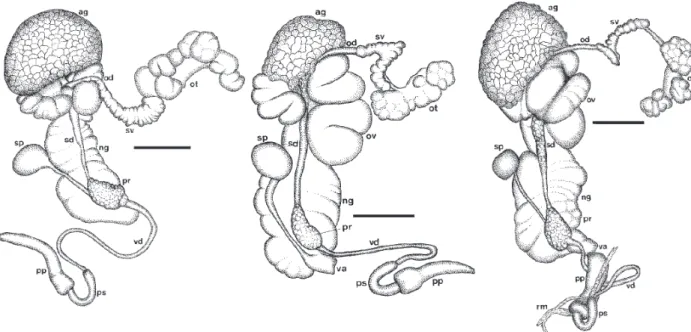
over-night using menthol. They were then immersed for 40 s in hot water (70°C), from which they were transferred to water at room temperature. The soft parts (under water) were drawn from the shells with forceps applied to the cephalopedal mass, and fixed in slightly modified Railliet-Henry’s fluid (distilled water 930 ml, sodium chloride 6 g, 40% formalin 50 ml, glacial acetic acid 20 ml). In order to compare the three samples without size/age bias, only adult snails of a similar size (6.5 to 7.8 mm) were used for anatomical studies. Snails were dissected under a stereo-scopic microscope and drawings of the reproductive sys-tem were made using a camera lucida attachment. The pictures obtained were digitalized with an ‘Apple Scan-ner’. The prostate surfaces (pr surf) were then measured on 18 specimens from Lima, Peru, 14 specimens from La Palma, Cuba and 10 specimens from Frías, Argentina. In addition, two other characters were measured: the ratio between preputium and penis lengths (pre/pen), and the ratio between the anterior and posterior width of the pe-nis sheath (ant/post; Fig. 1).
Anatomical data were tested for normality and homo-geneity of variances using Shapiro-Wilks W statistics and Bartlett’s test respectively. The anatomical parameters were then compared using an analysis of variance (ANOVA, Sokal & Rohlf 1995) for the three sites. When differences were detected by ANOVA, Bonferroni’ tests were used since the number of snails at each site were not the same. Canonical discriminant-function analyses (Blackith & Reyment 1971) were also used in support to the ANOVA to determine differences between sites. For this last analy-sis we used a data array of ‘pre/pen’, ‘ant/post’, and ‘pr surf’ as variables. Thus, each site was described by three variables.
Fig. 1: anatomy of the reproductive system of the three lymnaeid taxa studied. Left: Lymnaea viatrix var. ventricosa (Argentina); middle:
433 433 433 433 433 Mem Inst Oswaldo Cruz, Rio de Janeiro, Vol. 101(4), June 2006
RESULTS
Whatever anatomical parameter studied, no departures from normality and homogeneity of variances were found. The ANOVA results showed significant differences be-tween sites for only one anatomical character: the pre/ pen ratio (Table I). Multiple range test showed that the significant differences were found between La Palma and Frías and between Lima and Frías. No difference was ob-served between La Palma and Lima (Table II). Discrimi-nant analysis showed differences between sites (Fig. 2). The first eigenvalue (92.1%) is very large relative to the second (7.89%), indicating that the first axis captures most of the variance among sites. These two canonical dis-criminant functions account for more than 99% of the to-tal dispersion of the groups. The classification success of the discriminant analysis (Table III) indicates a high separation between Frías and the two other sites (Wilks’ statistic λ = 0.3048; p < 0.0001). Overall, 71% of individu-als were correctly classified (Table III).
DISCUSSION
Conchological studies of lymnaeid snails carried out by Samadi et al. (2000) showed the presence of a large amount of variability that did not allow distinction
be-tween L.truncatula samples from the Old World and Bo-livia on the one hand and L.cubensis samples from the Caribbean area on the other hand. However, those au-thors observed a clear anatomical distinction between the two taxa using charaters of the male reproductive system. All the selected anatomical parameters actually separated the two groups of samples, and confirmed the two ge-netic clusters that were previously obtained using allozyme electrophoresis (Jabbour-Zahab et al. 1997). The most rel-evant anatomical characters were the size of the prostate and the relative lengths of the penis sheath and prepu-tium. The choice of these parameters in our analysis on topotypic specimens of L. cubensis and L. viatrix also showed a great variability and only one parameter, the relative lengths of the preputium and penis sheath, al-lowed the distinction between L.viatrix var. ventricosa
on the one hand and L. viatrix var elongata and L. cubensis on the other hand. This statement is supported by the high classification success of the discriminant analysis carried out on these samples. None of the stud-ied parameters allowed a significant separation between the viatrix var. elongata and cubensis samples. However, it is noteworthy that the analysis of the genetic diversity of the same samples has shown that L. viatrix var.
elongata and L. cubensis are quite distinct genetic enti-ties (Durand et al. 2002).
TABLE I
Comparison of anatomical parameters among collection sites by ANOVA test. Differences between sites
Parameter Factors df F P
ant/post Between sites 2 3.07 0.056
pr surf Between sites 2 2.92 0.066
pre/pen Between sites 2 35.38 < 0.00001
The degree of freedom associated with the error terms is noted as
df. Three sites were included: La Palma, Cuba; Lima, Peru; and Frías, Argentina. ant/post: ratios between the anterior and posterior width of the penis sheath; pr surf: prostate surfaces; pre/pen: ratios between preputium and penis lengths.
TABLE II
Comparison of means ans standard deviations of the three selected parameters by post-hoc Bonferroni’s test
Parameter Sites Number Mean S.D.
ant/post
La Palma 14 1.20786 0.1345750
Lima 18 1.13556 0.0819772
Frías 10 1.24100 0.1393200
pr surf
La Palma 14 19177,9 4387.74
Lima 18 17225,5 3455.99
Frías 10 21127,4 4938.40
pre/pen
La Palma 14 1.05357 0.130656
Lima 18 1.16111 0.174790
Frías 10 1.62600a 0.213292
Mean values (± S.D.) of three parameters; ant/post: ratios between the anterior and posterior width of the penis sheath; pr surf: prostate surfaces; pre/pen: ratios between preputium and penis lengths; a: statistical difference between La Palma, Lima, and Frías (Bonferroni post-hoc test; p < 0.05).
Fig. 2: discriminant analysis of the genital system of topotypes of
Lymnaea viatrix var. A. ventricosa (Argentina), L. viatrix var. B.
elongata (Peru), and L. cubensis (Cuba).
TABLE III
Classification matrices of the discriminant analysis of the frequency of assigned cases in La Palma, Lima, and Frías used
to differentiate lymnaeids samples
La Palma Lima Frías % correct
La Palma 10 4 0 71
Lima 6 11 1 61
Frías 0 1 9 90
434 434 434 434
434 Sibling species w ithin Neotropical lymnaeids • JP Pointier et al.
These results point out the difficulty of correctly iden-tifying the species belonging to this group of lymnaeids using only anatomical characters and confirm the previ-ous studies carried out by Paraense (1976, 1982b). The relative lengths of the penis sheath and preputium appear as a relevant character, which could be used to differenti-ate some taxa but our study also showed that this charac-ter is of limited value for this group of lymnaeids. Further morphological and molecular studies carried out on much more populations covering the whole distribution area of these lymnaeids are necessary to a better understanding of the taxonomy of this group.
Lymnaeid snails identified as viatrix or cubensis are commonly cited in the literature as playing the role of intermediate host for the liver fluke Fasciola hepatica
(Morales & Pino 1981, Pino & Morales 1982, Lara et al. 1988, Larrea et al1993, Rangel-Ruiz 1993, Kleiman et al. 2004, Mas-Coma et al. 2005). Unfortunately, due to the difficulty of a clear morphological identification, it is quite impossible to know which species is actually involved in the transmission of the parasite in order to develop effec-tive measures of control. For example, Ueno et al (1975) reported the occurrence of two intermediate hosts of F. hepatica in the Bolivian Altiplano, L. viatrix, and L. cubensis. As a matter of fact, subsequent studies showed the role of a single species, the introduced L. truncatula
(Oviedo et al. 1995, Jabbour-Zahab et al. 1997, Mas-Coma et al.1999, Mas-Coma et al. 2001, Bargues & Mas-Coma 2005). Moreover, molecular studies using microsatellite markers revealed the presence of a single genotype of L. truncatula in the Bolivian Altiplano (Meunier et al. 2001). This discovery has important epidemiological conse-quences because the occurrence of a single species with an absolute lack of genetic variability could greatly facili-tate its control.
ACKNOWLEDGEMENTS
To Dr J Boissier for helpful revision of the manuscript.
REFERENCES
Bargues MD, Mas-Coma S 2005. Reviewing lymnaeid vectors of fascioliasis by ribosomal DNA sequence analysis. J Helminthol79: 1-11.
Blackith RE, Reyment RA 1971. Multivariate Morphometrics, Academic Press, London, 412 pp.
Carvalho PS, Cardoso PCM, Lira PM, Rumi A, Roche A, Berne E, Müller G, Caldeira RL 2004. The use of polymerase chain reaction and restriction fragment length polymorphism technique associated with the classical morphology for char-acterization of Lymnaea columella, L. viatrix, and L. diaphana (Mollusca: Lymnaeidae). Mem Inst Oswaldo Cruz 99: 503-507.
Cuevas-Acevedo H 1981. Patagonia. Panorama Dinámico de la Geografía Regional, Sociedad Argentina de Estudios Geográficos, Serie Especial, Buenos Aires, vol. 5, 330 pp.
Durand P, Pointier JP, Escoubeyrou K, Arenas J, Yong M, Amarista M, Bargues MD, Mas-Coma S, Renaud F 2002. Occurrence of a sibling species complex within neotropical lymnaeids, snail intermediate hosts of fascioliasis. Acta Trop 83: 233-240.
Gomez J, Vargas M, Malek EA 1986. Pseudosuccinea columella
(Lymnaeidae) in the Dominican Republic and transmission of fascioliasis in the Caribbean region. Nautilus 100: 66-68. Hubendick B 1951. Recent Lymnaeidae. Their variation, mor-phology, taxonomy, nomenclature and distribution. Kungl Svensk Vetenskapsakad Handlingar 3: 5-223.
Hylton-Scott MI 1953. Sobre Limnaeidae Argentinos. Physis 20: 401-408.
Jabbour-Zahab R, Pointier JP, Jourdane J, Jarne P, Oviedo JA, Bargues MD, Mas-Coma S, Angles R, Perera G, Balzan C, Khallaayoune K, Renaud F 1997. Phylogeography and ge-netic divergence of some lymnaeids snails, intermediate hosts of human and animal fascioliasis, with special reference to lymnaeids from the Bolivian Altiplano. Acta Trop 64: 191-203.
Kleiman F, Pietrokovski S, Paraense WL, Wisnivesky-Colli C 2004. Southernmost finding of Lymnaea viatrix Orbigny, 1835 (Pulmonata : Lymnaeidae), intermediate host of Fas-ciola hepatica (Linnaeus, 1758) (Trematoda : Digenea), in urban and rural areas of Patagonia, Argentina. Mem Inst Oswaldo Cruz 99: 23-24.
Lara SIM, Fernandez FG, Müller G Silveira P 1988. Biologia de
Lymnaea viatrix, Orb. 1835. II. Desenvolvimento, postura e longevidade. Arq Brasil Med Vet Zootec 40: 101-113. Larrea H, Vivar RG, Oviedo MLC, Huaman P, Pachas L 1993.
Tres estudios sobre la familia Lymnaeidae vectores de la fascioliasis en el Perú. Bol Lima 89: 85-96.
Malek E A, Chrosciechowski P 1964. Lymnaea (Pseudo-succinea) columella from Venezuela, and notes on distribu-tion of Pseudosuccinea. Nautilus 78: 54-56.
Mas-Coma S, Bargues MD, Valero MA 2005. Fascioliasis and other plant-borne trematode zoonoses. Int J Parasit 35: 1255-1278.
Mas-Coma S, Esteban JG, Bargues MD 1999. Epidemiology of the human fascioliasis: a review and proposed new classi-fication. Bull WHO 77: 340-346.
Mas-Coma S, Funatsu IR, Bargues MD 2001. Fasciola he-patica and lymnaeid snails occurring at very high altitude in South America. Parasitology 123: 115-127.
Meunier C, Tirard C, Hurtrez-Boussès S, Durand P, Bargues MD, Mas-Coma S, Pointier JP, Jourdane J, Renaud F 2001. Lack of molluscan host diversity and the transmission of an emerging parasitic disease in Bolivia. Mol Ecol 10: 1333-1340.
Morales GAC, Pino LA 1981. Lymnaea cubensis Pfeiffer, 1839 hospedador intermediario de F. hepatica en la zona alta de los Andes trujillanos, Venezuela. Bol Dir Malariol Saneam Amb 21: 39.
Orbigny A d’ 1835. Synopsis terrestrium et fluviatilium mol-luscorum, in suo per American Meridionalem itinere collectorum. Mag Zool 5: 1-44.
Oviedo JA, Bargues MD, Mas-Coma S. 1995. Lymnaeid snails in the human fascioliasis high endemic zone of the northern Bolivian Altiplano. Res Rev Parasit 55: 35-44.
435 435 435 435 435 Mem Inst Oswaldo Cruz, Rio de Janeiro, Vol. 101(4), June 2006
Paraense WL 1982a. Lymnaea rupestris sp. n. from Southern Brazil (Pulmonata : Lymnaeidae). Mem Inst Oswaldo Cruz 77: 437-443.
Paraense WL 1982b. Lymnaea viatrix and Lymnaea columella
in the neotropical region: a distributional outline. Mem Inst Oswaldo Cruz 77: 181-188.
Paraense WL 1984. Lymnaea diaphana: a study of topotypic specimens (Pulmonata : Lymnaeidae). Mem Inst Oswaldo Cruz 79: 75-81.
Paraense WL 1986. Lymnaea columella: two new Brazilian localities in the states of Amazonas and Bahia. Mem Inst Oswaldo Cruz 81: 121-123.
Paraense WL 1994. Limnaea peregrina Clessin, 1882, syn-onym of Lymnaea columella Say, 1817 (Gastropoda : Lymnaeidae). Mem Inst Oswaldo Cruz 89: 561-566. Paraense WL 1995. Lymnaea cousini Jousseaume, 1887, from
Ecuador (Gatsropoda : Lymnaeidae). Mem Inst Oswaldo Cruz90: 605-609.
Pfeiffer L 1839. Bericht über die Ergebnisse meine Reise nach Kuba im Winter 1838-1839. Arch Natur 5: 346-359. Pino LA., Morales GA 1982. Habitats de Lymnaea cubensis
Pfeiffer, 1839, hospedador intermediario de Fasciola he-patica, detectados el Estado Trujillo, Venezuela. Act Cient Venez 33: 61-65.
Pointier JP, Noya O, Amarista M, Théron A 2004. Lymnaea cousini Jousseaume, 1887 (Gastropoda : Lymnaeidae) : first record for Venezuela. Mem Inst Oswaldo Cruz 99: 567-569. Rangel-Ruiz LJ 1993. Fossaria viatrix Orbigny, hospedero intermediario de Fasciola hepatica Linnaeus en Tabasco, México. Walkerana 7: 29-37.
Samadi S, Roumégoux A, Bargues MD, Mas-Coma S, Yong M, Pointier JP 2000. Morphological studies of lymnaeid snails from the human fascioliasis endemic zone of Bolivia. J Moll Stud 66: 31-34.