Received: July 15, 2015 Accepted: September 24, 2015
ABSTRACT
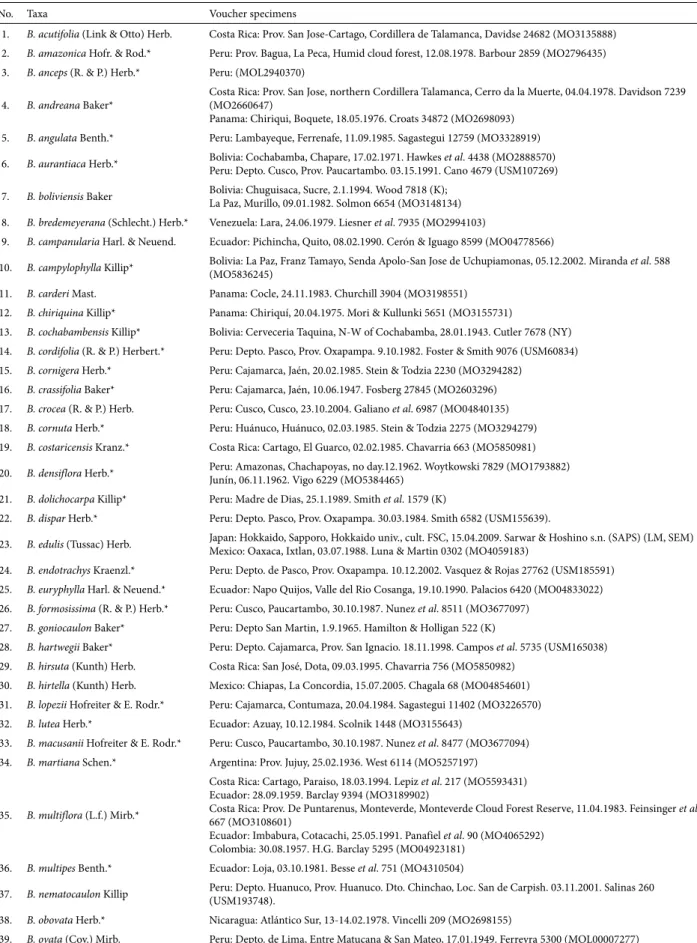
Pollen morphology of 52 species (out of c. 79) of the Bomarea subgenus Bomarea was examined using light microscopy and scanning electron microscopy (SEM), or using SEM alone. The studied species of Bomarea were stenopalynous, characterized by large, oblate, monosulcate monads with reticulate exine sculpture in most species. Wide variation was observed in quantitative palynological features. The studied taxa were divided into four major groups based on exine ornamentation observed under SEM: microreticulate, reticulate, coarsely rugulate, and psilate-perforate. The reticulate exine sculpture may be a plesiomorphic character state for the genus Bomarea, and the coarsely rugulate and finely rugulate-perforate or psilate-perforate exine sculptures may have evolved independently more than once. In agglomerative hierarchical clustering (AHC) analyses of the genus Bomarea using quantitative pollen data, the studied species were distributed in either two (similarity-based) or four (dissimilarity-based) major clusters. Neither the recent molecular phylogenetic analyses nor the AHC analyses of Bomarea have recovered clades/clusters that represent traditionally recognized subgeneric taxa for the genus. Therefore, the most reliable infrageneric classification of Bomarea can be achieved by combining morphological, palynological, and molecular data from more extentive sampling of all the species.
Keywords: agglomerative hierarchical clustering, Bomarea, exine sculpture, infrageneric classification, scanning electron microscopy
Pollen morphology and its taxonomic significance in the genus
Bomarea
Mirb. (Alstroemeriaceae) – II. Subgenus
Bomarea
Abul Khayer Mohammad Golam Sarwar
1,2*, Yoichiro Hoshino
1and Hajime Araki
11 Field Science Center for Northern Biosphere, Hokkaido University, Sapporo, Japan.
2 Present address: Department of Crop Botany, Bangladesh Agricultural University, Mymensingh 2202, Bangladesh. * Corresponding author: [email protected]
Introduction
Bomarea is the most diverse genus of
Alstroemer-iaceae, and it includes 100-120 species with a Neotropical
distribution from Mexico in the north to Argentina/Chile
in the south (Neuendorf 1977; Alzate 2005). The genus is
largely restricted to the Andean range and its continuation
in Central America (Hofreiter & Tillich 2002). Based on
morphological features, the genus Bomarea is divided into
four subgenera: Baccata (five spp.), Bomarea s. str. (c. 79
spp.), Sphaerine (12 spp.), and Wichuraea (18 spp.; Hofreiter
& Tillich 2002). The subgenus Bomarea is characterized
by a generally twining habit, with flowers pendulous and
actinomorphic or horizontally oriented and zygomorphic,
tepals deciduous, ovary inferior and dehiscent, and fruit
leathery. Baker (1888) divided this subgenus into four main
groups according to the structure of the inflorescence and
the relation of the inner and outer tepals, and Killip (1935)
later named these four groups Multiflorae,
Caldasianae,
Edules, and Vitellinae. Presently, four sections are
recog-nized within the subgenus Bomarea: Multiflorae,
Edules,
Goniocaulon, and Pardinae (Harling & Neuendorf 2003;
for details see Hofreiter 2008).
As part of a comprehensive survey of pollen morphology
in the genus Bomarea, pollen studies of three subgenera,
viz. Baccata, Sphaerine, and Wichuraea, have already been
published (Sarwar et al. 2015 and references therein).
Light microscopy (LM) was mainly employed in previous
palynological studies of this genus, and scanning electron
microscopy (SEM) was employed in a few cases (for details
see Sarwar et al. 2015). We describe here, using both LM
and SEM, the pollen morphological features of the subgenus
Bomarea, and evaluate their usefulness for the infrageneric
classification of this genus.
Materials and Methods
Table 1. List of Bomarea taxa used in this study along with their voucher specimens. * New palynological data. No. Taxa Voucher specimens
1. B. acutifolia (Link & Otto) Herb. Costa Rica: Prov. San Jose-Cartago, Cordillera de Talamanca, Davidse 24682 (MO3135888)
2. B. amazonica Hofr. & Rod.* Peru: Prov. Bagua, La Peca, Humid cloud forest, 12.08.1978. Barbour 2859 (MO2796435)
3. B. anceps (R. & P.) Herb.* Peru: (MOL2940370)
4. B. andreana Baker*
Costa Rica: Prov. San Jose, northern Cordillera Talamanca, Cerro da la Muerte, 04.04.1978. Davidson 7239 (MO2660647)
Panama: Chiriqui, Boquete, 18.05.1976. Croats 34872 (MO2698093)
5. B. angulata Benth.* Peru: Lambayeque, Ferrenafe, 11.09.1985. Sagastegui 12759 (MO3328919)
6. B. aurantiaca Herb.* Bolivia: Cochabamba, Chapare, 17.02.1971. Hawkes et al. 4438 (MO2888570) Peru: Depto. Cusco, Prov. Paucartambo. 03.15.1991. Cano 4679 (USM107269)
7. B. boliviensis Baker Bolivia: Chuguisaca, Sucre, 2.1.1994. Wood 7818 (K);
La Paz, Murillo, 09.01.1982. Solmon 6654 (MO3148134)
8. B. bredemeyerana (Schlecht.) Herb.* Venezuela: Lara, 24.06.1979. Liesner et al. 7935 (MO2994103)
9. B. campanularia Harl. & Neuend. Ecuador: Pichincha, Quito, 08.02.1990. Cerón & Iguago 8599 (MO04778566)
10. B. campylophylla Killip* Bolivia: La Paz, Franz Tamayo, Senda Apolo-San Jose de Uchupiamonas, 05.12.2002. Miranda et al. 588 (MO5836245)
11. B. carderi Mast. Panama: Cocle, 24.11.1983. Churchill 3904 (MO3198551)
12. B. chiriquina Killip* Panama: Chiriquí, 20.04.1975. Mori & Kullunki 5651 (MO3155731)
13. B. cochabambensis Killip* Bolivia: Cerveceria Taquina, N-W of Cochabamba, 28.01.1943. Cutler 7678 (NY)
14. B. cordifolia (R. & P.) Herbert.* Peru: Depto. Pasco, Prov. Oxapampa. 9.10.1982. Foster & Smith 9076 (USM60834)
15. B. cornigera Herb.* Peru: Cajamarca, Jaén, 20.02.1985. Stein & Todzia 2230 (MO3294282)
16. B. crassifolia Baker* Peru: Cajamarca, Jaén, 10.06.1947. Fosberg 27845 (MO2603296)
17. B. crocea (R. & P.) Herb. Peru: Cusco, Cusco, 23.10.2004. Galiano et al. 6987 (MO04840135)
18. B. cornuta Herb.* Peru: Huánuco, Huánuco, 02.03.1985. Stein & Todzia 2275 (MO3294279)
19. B. costaricensis Kranz.* Costa Rica: Cartago, El Guarco, 02.02.1985. Chavarria 663 (MO5850981)
20. B. densiflora Herb.* Peru: Amazonas, Chachapoyas, no day.12.1962. Woytkowski 7829 (MO1793882)
Junín, 06.11.1962. Vigo 6229 (MO5384465)
21. B. dolichocarpa Killip* Peru: Madre de Dias, 25.1.1989. Smith et al. 1579 (K)
22. B. dispar Herb.* Peru: Depto. Pasco, Prov. Oxapampa. 30.03.1984. Smith 6582 (USM155639).
23. B. edulis (Tussac) Herb. Japan: Hokkaido, Sapporo, Hokkaido univ., cult. FSC, 15.04.2009. Sarwar & Hoshino s.n. (SAPS) (LM, SEM) Mexico: Oaxaca, Ixtlan, 03.07.1988. Luna & Martin 0302 (MO4059183)
24. B. endotrachys Kraenzl.* Peru: Depto. de Pasco, Prov. Oxapampa. 10.12.2002. Vasquez & Rojas 27762 (USM185591)
25. B. euryphylla Harl. & Neuend.* Ecuador: Napo Quijos, Valle del Rio Cosanga, 19.10.1990. Palacios 6420 (MO04833022)
26. B. formosissima (R. & P.) Herb.* Peru: Cusco, Paucartambo, 30.10.1987. Nunez et al. 8511 (MO3677097)
27. B. goniocaulon Baker* Peru: Depto San Martin, 1.9.1965. Hamilton & Holligan 522 (K)
28. B. hartwegii Baker* Peru: Depto. Cajamarca, Prov. San Ignacio. 18.11.1998. Campos et al. 5735 (USM165038)
29. B. hirsuta (Kunth) Herb. Costa Rica: San José, Dota, 09.03.1995. Chavarria 756 (MO5850982)
30. B. hirtella (Kunth) Herb. Mexico: Chiapas, La Concordia, 15.07.2005. Chagala 68 (MO04854601)
31. B. lopezii Hofreiter & E. Rodr.* Peru: Cajamarca, Contumaza, 20.04.1984. Sagastegui 11402 (MO3226570)
32. B. lutea Herb.* Ecuador: Azuay, 10.12.1984. Scolnik 1448 (MO3155643)
33. B. macusanii Hofreiter & E. Rodr.* Peru: Cusco, Paucartambo, 30.10.1987. Nunez et al. 8477 (MO3677094)
34. B. martiana Schen.* Argentina: Prov. Jujuy, 25.02.1936. West 6114 (MO5257197)
35. B. multiflora (L.f.) Mirb.*
Costa Rica: Cartago, Paraiso, 18.03.1994. Lepiz et al. 217 (MO5593431) Ecuador: 28.09.1959. Barclay 9394 (MO3189902)
Costa Rica: Prov. De Puntarenus, Monteverde, Monteverde Cloud Forest Reserve, 11.04.1983. Feinsinger et al. 667 (MO3108601)
Ecuador: Imbabura, Cotacachi, 25.05.1991. Panafiel et al. 90 (MO4065292) Colombia: 30.08.1957. H.G. Barclay 5295 (MO04923181)
36. B. multipes Benth.* Ecuador: Loja, 03.10.1981. Besse et al. 751 (MO4310504)
37. B. nematocaulon Killip Peru: Depto. Huanuco, Prov. Huanuco. Dto. Chinchao, Loc. San de Carpish. 03.11.2001. Salinas 260 (USM193748).
38. B. obovata Herb.* Nicaragua: Atlántico Sur, 13-14.02.1978. Vincelli 209 (MO2698155)
39. B. ovata (Cov.) Mirb. Peru: Depto. de Lima, Entre Matucana & San Mateo, 17.01.1949. Ferreyra 5300 (MOL00007277)
No. Taxa Voucher specimens
40. B. pardina Herb. Ecuador: Carchi, 31.07.1989. Werff & Gudino 10794 (MO3805857)
41. B. patacocensis Herb. Ecuador: Imbabura, 08.11.1990. Luteyn et al. 14078 (MO5829477)
42. B. patinii Baker* Colombia: Antioquia, Salgar, 29.09.1987. J.L. Zarucchi et al. 5934 (MO3592494)
43. B. perglabra Harling & Neuendorf* Ecuador: Cotopaxi, 26.04.1979 Løjtnant & Ulf Molau 13708 (MO2982422)
44. B. peruviana Hofreiter* Peru: Cajamarca, Contumaza, 31.01.1985. Stein & Todzia 2033B (MO2384243)
45. B. purpurea (R. & P.) Herb. Peru: Amazonas, Chachapoyas, 21.02.1984. Smith 6118 (MO3473926)
46. B. rosea (R. & P.) Herb.* Bolivia: Santa Cruz, Manuel Maria Caballero, 10.04.2004. Ledezma et al. 710 (MO04829598)
47. B. salsilla (L.) Mirb. Chile: no. date.1914. Calvert s.n. (MO1612096)
48. B. setacea (R. & P.) Herb. Ecuador: Loja, 09.12.1994. Jorgensen et al. 1373 (MO04833026)
Peru: Depto. Amazonas, Prov. Chachapoyas, 5.2 – 2.4.97. Weigend et al. 97/405 (USM971405)
49. B. suberecta Gereau* Costa Rica: Limon, Cordillera de Talamanca, 11.09.1984. Devidse et al. 28957 (MO3211739)
50. B. superba Herb.* Peru: Depto. Cuzco, Prov. Calca, Dto. Lares, Rayampata, Bosque Primario. 20.02.2005. Farfan et al. 564 (USM00221035)
51. B. tarmensis Kraenzl. Peru: Junín, Chanchamayo, 08.03.1985. Stein & Todzia 2350 (MO3294277)
52. B. tribachiata Kraenzl. Peru: Depto. La Libertad, Prov. Otuzco, Road Otuzco-Usquil, 05.02 - 02.04.97. Weigend et al. 97/211b (USM178661).
53. B. trichophylla Killip* Venezuela: Lara, 03.01.1979. Berry 3273 (MO2725720)
54. B. weigendii Hofreiter & E. Rodr.* Peru: Depto. Ayacucho, Loc. Yanamonte, Aina. 20.12.1966. Tovar 5780 (USM161735)
Table 1. Continuation.
The pollen parameters studied and the LM and SEM
preparation methods used follow Sarwar et al. (2010).
Measurements were taken from at least 30 randomly
selected grains from each specimen (Tab. 2). To
visual-ize the relationships among the studied species of the
subgenera Baccata, Bomarea, Sphaerine, and Wichuraea,
agglomerative hierarchical clustering (AHC) analyses
were conducted using the XLSTAT 2009.3 program, based
on the quantitative characters polar length (P),
equato-rial diameter (E), P/E ratio, and exine thickness. The
palynological data for the subgenera Baccata, Sphaerine,
and Wichuraea were taken from Sarwar et al. (2015), and
dendrograms were built using AHC. Slides of all
speci-mens have been deposited in the Hokkaido University
Museum, Sapporo, Japan. Pollen size and shape classes
were defined using the criteria of Erdtman (1952), and
our descriptive terminology follows Punt et al. (2007)
and Hesse et al. (2009). The sectional classification of
subgenus Bomarea follows Harling & Neuendorf (2003)
and Hofreiter (2008).
Results
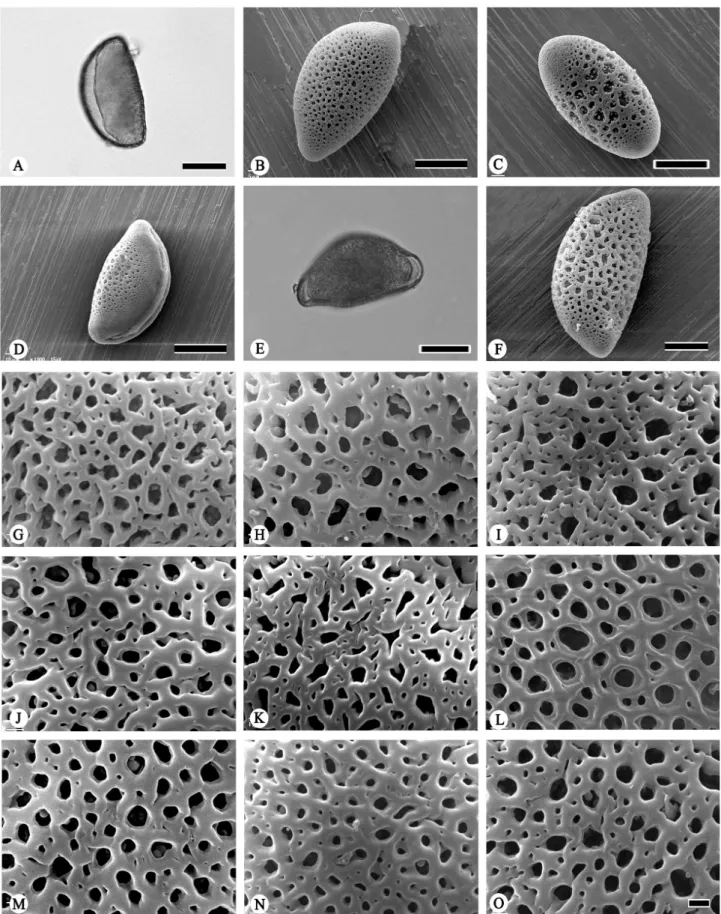
Based on LM and SEM observations, the Bomarea pollen
grains studied were monad, large, ellipsoid (boat-shaped),
heteropolar; monosulcate, sulcus on the convex part of the
grain, distinct, long, straight, wide at the equator, narrow
near the poles, sometimes extended to the proximal pole
(Fig. 1A-D); auriculae-like structures at the end of the sulcus
in B. acutifolia, B. amazonica, B. andreana (Croats 34872),
B. bredemeyerana, B. cornigera, B. crocea, B. dispar, B.
eu-ryphylla, B. formosissima, B. hirsuta, B. lutea, B. macusanii,
B. multiflora (Barclay 5295), B. suberecta,
B. multipes,
B. martiana, B. nematocaulon, B. pardina, and B. tarmensis
(Fig. 1E-F; Tab. 2); opercula-like structures present on the
sulcus in B. ovata (Fig. 1D). Symmetry is bilateral. Size
ranges from 25.26-38.82 μm (polar length P) × 47.18-69.30
μm (equatorial diameter E), P/E 0.43-0.62, peroblate to
oblate in shape, exine thickness 1.11-2.76 μm (Tab. 2).
The pollen grains of Bomarea
species were
character-ized by a semitectate exine sculpture. Four different exine
sculpture types were observed:
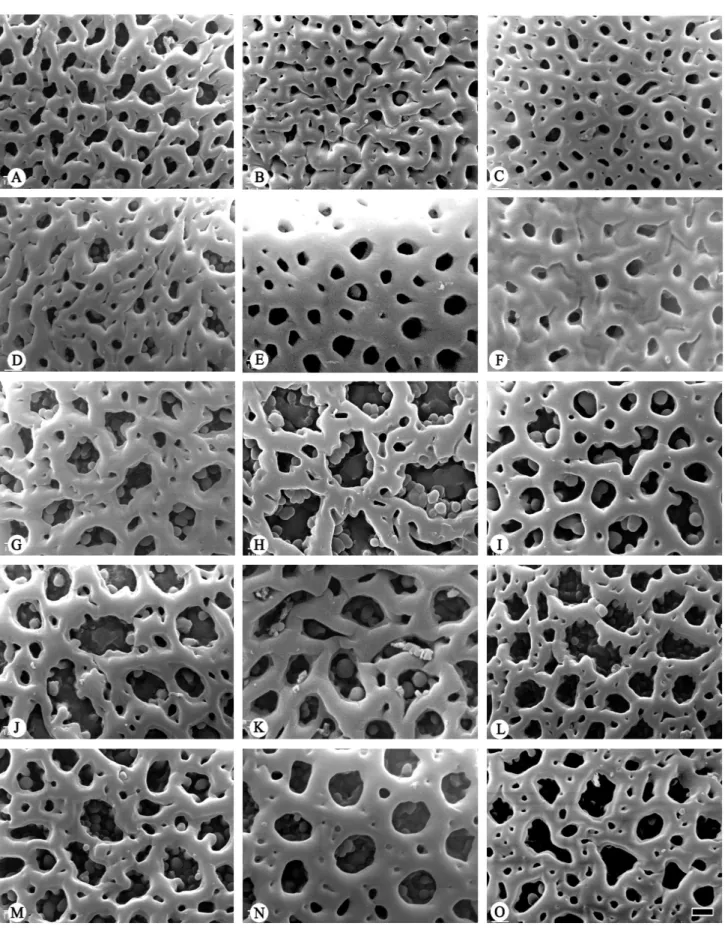
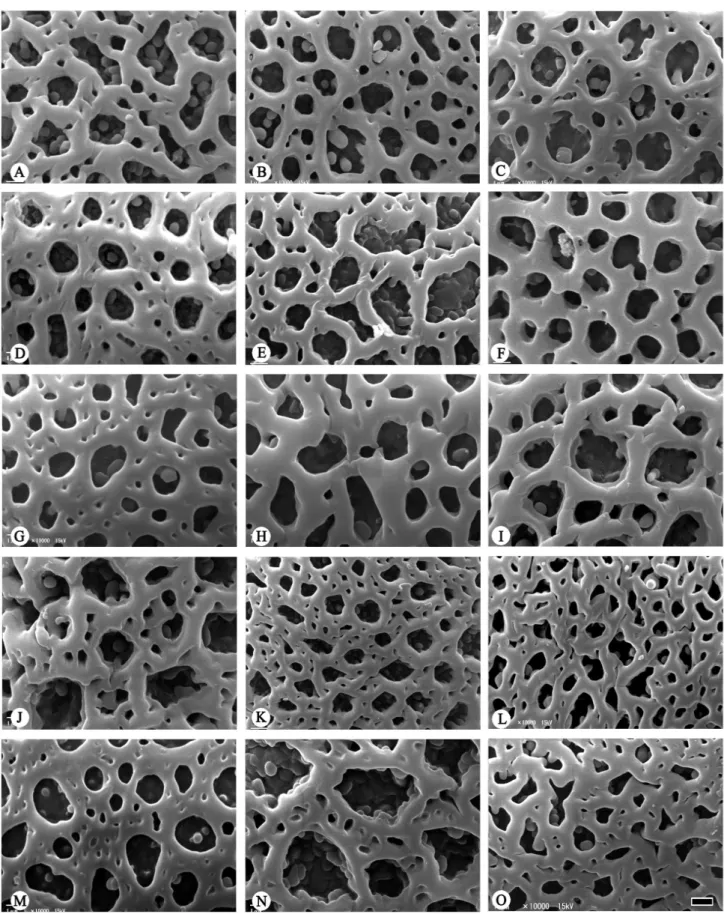
Type I – Microreticulate (Figs. 1G-O, 2A-F; Tab. 2),
with perforate muri, heterobrochate; lumina less than
or equal to 1 μm in length or diameter; observed in
B. amazonica,
B. andreana (Davidson 7239),
B. aurantiaca (Hawkes et al. 4438), B. boliviensis,
B. cornigera,
B. crassifolia, B. dispar,
B.
edulis,
B. endotrachys, B. hartwegii, B. hirtella,
B. martiana,
B. multiflora (Feinsinger et al. 667), B. multipes, B. rosea,
B. setacea (Jorgensen
et al. 1373), B. suberecta, and
B. peruviana.
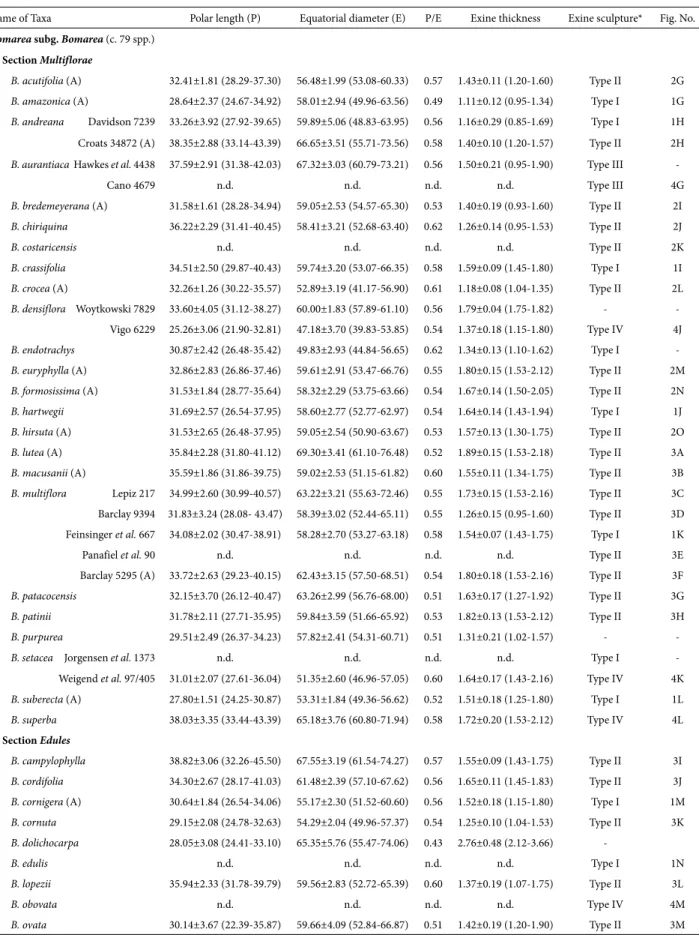
Table 2. Variation in pollen characters of Bomareasubg. Bomarea showing mean value in micrometer and standard deviation. Minimum – maximum values in micrometer in parenthesis. Taxa are arranged alphabetically within the group. (A) Pollen grains with auriculae-like structures; n.d. Not discern.
Name of Taxa Polar length (P) Equatorial diameter (E) P/E Exine thickness Exine sculpture* Fig. No.
Bomarea subg. Bomarea (c. 79 spp.)
Section Multiflorae
B. acutifolia (A) 32.41±1.81 (28.29-37.30) 56.48±1.99 (53.08-60.33) 0.57 1.43±0.11 (1.20-1.60) Type II 2G
B. amazonica (A) 28.64±2.37 (24.67-34.92) 58.01±2.94 (49.96-63.56) 0.49 1.11±0.12 (0.95-1.34) Type I 1G
B. andreana Davidson 7239 33.26±3.92 (27.92-39.65) 59.89±5.06 (48.83-63.95) 0.56 1.16±0.29 (0.85-1.69) Type I 1H
Croats 34872 (A) 38.35±2.88 (33.14-43.39) 66.65±3.51 (55.71-73.56) 0.58 1.40±0.10 (1.20-1.57) Type II 2H
B. aurantiaca Hawkes et al. 4438 37.59±2.91 (31.38-42.03) 67.32±3.03 (60.79-73.21) 0.56 1.50±0.21 (0.95-1.90) Type III
-Cano 4679 n.d. n.d. n.d. n.d. Type III 4G
B. bredemeyerana (A) 31.58±1.61 (28.28-34.94) 59.05±2.53 (54.57-65.30) 0.53 1.40±0.19 (0.93-1.60) Type II 2I
B. chiriquina 36.22±2.29 (31.41-40.45) 58.41±3.21 (52.68-63.40) 0.62 1.26±0.14 (0.95-1.53) Type II 2J
B. costaricensis n.d. n.d. n.d. n.d. Type II 2K
B. crassifolia 34.51±2.50 (29.87-40.43) 59.74±3.20 (53.07-66.35) 0.58 1.59±0.09 (1.45-1.80) Type I 1I
B. crocea (A) 32.26±1.26 (30.22-35.57) 52.89±3.19 (41.17-56.90) 0.61 1.18±0.08 (1.04-1.35) Type II 2L
B. densiflora Woytkowski 7829 33.60±4.05 (31.12-38.27) 60.00±1.83 (57.89-61.10) 0.56 1.79±0.04 (1.75-1.82) -
-Vigo 6229 25.26±3.06 (21.90-32.81) 47.18±3.70 (39.83-53.85) 0.54 1.37±0.18 (1.15-1.80) Type IV 4J
B. endotrachys 30.87±2.42 (26.48-35.42) 49.83±2.93 (44.84-56.65) 0.62 1.34±0.13 (1.10-1.62) Type I
-B. euryphylla (A) 32.86±2.83 (26.86-37.46) 59.61±2.91 (53.47-66.76) 0.55 1.80±0.15 (1.53-2.12) Type II 2M
B. formosissima (A) 31.53±1.84 (28.77-35.64) 58.32±2.29 (53.75-63.66) 0.54 1.67±0.14 (1.50-2.05) Type II 2N
B. hartwegii 31.69±2.57 (26.54-37.95) 58.60±2.77 (52.77-62.97) 0.54 1.64±0.14 (1.43-1.94) Type I 1J
B. hirsuta (A) 31.53±2.65 (26.48-37.95) 59.05±2.54 (50.90-63.67) 0.53 1.57±0.13 (1.30-1.75) Type II 2O
B. lutea (A) 35.84±2.28 (31.80-41.12) 69.30±3.41 (61.10-76.48) 0.52 1.89±0.15 (1.53-2.18) Type II 3A
B. macusanii (A) 35.59±1.86 (31.86-39.75) 59.02±2.53 (51.15-61.82) 0.60 1.55±0.11 (1.34-1.75) Type II 3B
B. multiflora Lepiz 217 34.99±2.60 (30.99-40.57) 63.22±3.21 (55.63-72.46) 0.55 1.73±0.15 (1.53-2.16) Type II 3C
Barclay 9394 31.83±3.24 (28.08- 43.47) 58.39±3.02 (52.44-65.11) 0.55 1.26±0.15 (0.95-1.60) Type II 3D
Feinsinger et al. 667 34.08±2.02 (30.47-38.91) 58.28±2.70 (53.27-63.18) 0.58 1.54±0.07 (1.43-1.75) Type I 1K
Panafiel et al. 90 n.d. n.d. n.d. n.d. Type II 3E
Barclay 5295 (A) 33.72±2.63 (29.23-40.15) 62.43±3.15 (57.50-68.51) 0.54 1.80±0.18 (1.53-2.16) Type II 3F
B. patacocensis 32.15±3.70 (26.12-40.47) 63.26±2.99 (56.76-68.00) 0.51 1.63±0.17 (1.27-1.92) Type II 3G
B. patinii 31.78±2.11 (27.71-35.95) 59.84±3.59 (51.66-65.92) 0.53 1.82±0.13 (1.53-2.12) Type II 3H
B. purpurea 29.51±2.49 (26.37-34.23) 57.82±2.41 (54.31-60.71) 0.51 1.31±0.21 (1.02-1.57) -
-B. setacea Jorgensen et al. 1373 n.d. n.d. n.d. n.d. Type I
-Weigend et al. 97/405 31.01±2.07 (27.61-36.04) 51.35±2.60 (46.96-57.05) 0.60 1.64±0.17 (1.43-2.16) Type IV 4K
B. suberecta (A) 27.80±1.51 (24.25-30.87) 53.31±1.84 (49.36-56.62) 0.52 1.51±0.18 (1.25-1.80) Type I 1L
B. superba 38.03±3.35 (33.44-43.39) 65.18±3.76 (60.80-71.94) 0.58 1.72±0.20 (1.53-2.12) Type IV 4L
SectionEdules
B. campylophylla 38.82±3.06 (32.26-45.50) 67.55±3.19 (61.54-74.27) 0.57 1.55±0.09 (1.43-1.75) Type II 3I
B. cordifolia 34.30±2.67 (28.17-41.03) 61.48±2.39 (57.10-67.62) 0.56 1.65±0.11 (1.45-1.83) Type II 3J
B. cornigera (A) 30.64±1.84 (26.54-34.06) 55.17±2.30 (51.52-60.60) 0.56 1.52±0.18 (1.15-1.80) Type I 1M
B. cornuta 29.15±2.08 (24.78-32.63) 54.29±2.04 (49.96-57.37) 0.54 1.25±0.10 (1.04-1.53) Type II 3K
B. dolichocarpa 28.05±3.08 (24.41-33.10) 65.35±5.76 (55.47-74.06) 0.43 2.76±0.48 (2.12-3.66)
-B. edulis n.d. n.d. n.d. n.d. Type I 1N
B. lopezii 35.94±2.33 (31.78-39.79) 59.56±2.83 (52.72-65.39) 0.60 1.37±0.19 (1.07-1.75) Type II 3L
B. obovata n.d. n.d. n.d. n.d. Type IV 4M
B. ovata 30.14±3.67 (22.39-35.87) 59.66±4.09 (52.84-66.87) 0.51 1.42±0.19 (1.20-1.90) Type II 3M
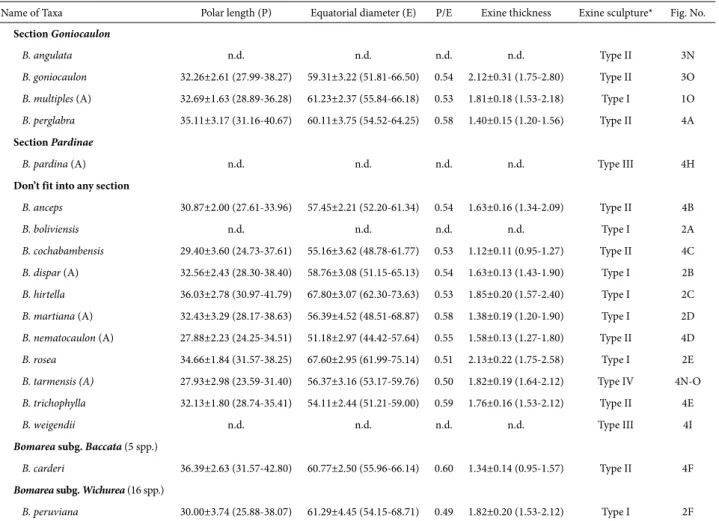
Name of Taxa Polar length (P) Equatorial diameter (E) P/E Exine thickness Exine sculpture* Fig. No.
SectionGoniocaulon
B. angulata n.d. n.d. n.d. n.d. Type II 3N
B. goniocaulon 32.26±2.61 (27.99-38.27) 59.31±3.22 (51.81-66.50) 0.54 2.12±0.31 (1.75-2.80) Type II 3O
B. multiples (A) 32.69±1.63 (28.89-36.28) 61.23±2.37 (55.84-66.18) 0.53 1.81±0.18 (1.53-2.18) Type I 1O
B. perglabra 35.11±3.17 (31.16-40.67) 60.11±3.75 (54.52-64.25) 0.58 1.40±0.15 (1.20-1.56) Type II 4A
SectionPardinae
B. pardina (A) n.d. n.d. n.d. n.d. Type III 4H
Don’t fit into any section
B. anceps 30.87±2.00 (27.61-33.96) 57.45±2.21 (52.20-61.34) 0.54 1.63±0.16 (1.34-2.09) Type II 4B
B. boliviensis n.d. n.d. n.d. n.d. Type I 2A
B. cochabambensis 29.40±3.60 (24.73-37.61) 55.16±3.62 (48.78-61.77) 0.53 1.12±0.11 (0.95-1.27) Type II 4C
B. dispar (A) 32.56±2.43 (28.30-38.40) 58.76±3.08 (51.15-65.13) 0.54 1.63±0.13 (1.43-1.90) Type I 2B
B. hirtella 36.03±2.78 (30.97-41.79) 67.80±3.07 (62.30-73.63) 0.53 1.85±0.20 (1.57-2.40) Type I 2C
B. martiana (A) 32.43±3.29 (28.17-38.63) 56.39±4.52 (48.51-68.87) 0.58 1.38±0.19 (1.20-1.90) Type I 2D
B. nematocaulon (A) 27.88±2.23 (24.25-34.51) 51.18±2.97 (44.42-57.64) 0.55 1.58±0.13 (1.27-1.80) Type II 4D
B. rosea 34.66±1.84 (31.57-38.25) 67.60±2.95 (61.99-75.14) 0.51 2.13±0.22 (1.75-2.58) Type I 2E
B. tarmensis (A) 27.93±2.98 (23.59-31.40) 56.37±3.16 (53.17-59.76) 0.50 1.82±0.19 (1.64-2.12) Type IV 4N-O
B. trichophylla 32.13±1.80 (28.74-35.41) 54.11±2.44 (51.21-59.00) 0.59 1.76±0.16 (1.53-2.12) Type II 4E
B. weigendii n.d. n.d. n.d. n.d. Type III 4I
Bomarea subg. Baccata (5 spp.)
B. carderi 36.39±2.63 (31.57-42.80) 60.77±2.50 (55.96-66.14) 0.60 1.34±0.14 (0.95-1.57) Type II 4F
Bomarea subg. Wichurea (16 spp.)
B. peruviana 30.00±3.74 (25.88-38.07) 61.29±4.45 (54.15-68.71) 0.49 1.82±0.20 (1.53-2.12) Type I 2F
* Exine ornamentation type by SEM. Type I, microreticulate, lumina less than or equal 1 μm in size; Type II, reticulate, lumina larger than 1 μm in size; Type III, coarsely rugulate; Type IV, psilate-perforate. For details see text.
Table 2. Continuation.
Type III – Coarsely rugulate (Fig. 4G-I; Tab. 2); observed
in B. aurantiaca (Cano 4679), B. pardina, and B. weigendii.
Type IV – Psilate-perforate (Fig. 4J-O; Tab. 2); observed
in
B. densiflora (Vigo 6229), B. obovata,
B. setacea
(Weigend et al. 97/405), B. superba, and B. tarmensis.
Granula were sometimes visible at the bottom of the
lumina; these may correspond to “free standing columellae”
(e.g. Fig. 1G; Hesse et al. 2009). The exine sculpture along
with sulci was similar to that appearing at the equatorial
position, but had relatively smaller lumina.
In agglomerative hierarchical clustering (AHC) analyses
of the genus Bomarea using quantitative pollen data, the
spe-cies studied were distributed in either two (similarity-based)
or four (dissimilarity-based) major clusters (Fig. 5). Among
these clusters, three include at least one species from each
subgenus; cluster 1 (blue) comprises most of the taxa studied
(41), cluster 2 (pink) comprises 12 taxa, cluster 3 (brown)
comprises 16 taxa, and cluster 4 (black) comprises the single
species B. ampayesana from the subgenus Wichuraea.
Discussion
Figure 1. Light and scanning electron micrographs of Bomarea pollen. Pollen grains (A-F); exine sculpture (G-O). A. B. rosea (Ledezma et al. 710); B. B. crocea
(Galiano et al. 6987); C. B. cochabambensis (Cutler 7678); D. B. ovata (Ferreyra 5300); E. B. multiflora (Barclay 5295); F. B. andreana (Croats 34872); G. B. amazonica
Figure 2. Scanning electron micrographs of Bomarea pollen. Exine sculpture (A-O). A. B. boliviensis (Wood 7818); B. B. dispar (Smith 6582); C. B. hirtella (Chagala 68); D. B. martiana (West 6114); E. B. rosea (Ledezma et al. 710); F. B. peruviana (Stein & Todzia 2033B); G. B. acutifolia (Davidse 24682); H. B. andreana (Croats 34872); I. B. bredemeyerana (Liesner et al. 7935); J. B. chiriquina (Mori & Kullunki 5651); K. B. costaricensis (Chavarria 663); L. B. crocea (Galiano et al. 6987); M.
Figure 3. Scanning electron micrographs of Bomarea pollen. Exine sculpture (A-O). A. B. lutea (Scolnik 1448); B. B. macusanii (Nunez et al. 8477); C. B. multiflora
(Lepiz 217); D. B. multiflora (Barclay 9394); E. B. multiflora (Panafiel et al. 90); F. B. multiflora (Barclay 5295); G. B. patacocensis (Luteyn et al. 14078); H. B. patinii
Figure 4. Scanning electron micrographs of Bomarea pollen. Exine sculpture (A-O). A. B. perglabra (Løjtnant & Ulf Molau 13708); B. B. anceps (MOL2940370); C.
B. cochabambensis (Cutler 7678); D. B. nematocaulon (Salinas 260); E. B. trichophylla (Berry 3273); F. B. carderi (Churchill 3904); G. B. aurantiaca (Cano 4679); H.
significant differences between two B. andreana specimens,
one of which had smaller pollen grains with a thinner exine
(Davidson 7239, collected from the warmer region of Costa
Rica), while the other had larger pollen grains with a thicker
exine (Croats 34872, collected from the cooler region of
Panama) (Tabs. 1, 2).
A wide and generally continuous pattern of variation
in P, E, P/E ratio, and exine thickness was observed at both
the infra- and inter-species level (Tab. 2). Among the
sec-tions of Bomarea subgenus Bomarea, section Goniocaulon
produces pollen grains with relatively consistent P/E ratios
(0.53-0.58) (Tab. 2). Pollen grain size within a genus is
influenced by internal (chromosome number and floral
character) and external (temperature, mineral nutrition,
and water conditions) factors (Stanley & Linskens 1974).
However, no correlation between ploidy level and
pa-lynological features was observed in Bomarea. The only
tetraploid species of Bomarea, B. hirtella, produced pollen
grains similar in size to or slightly smaller than the diploid
species (Tab. 2; Cave 1967).
Auricula-like structures in pollen grains have been
pre-viously reported from only four Bomarea species, namely,
B. brachysepala, B. bracteolata, B. glaucescens, and B.
hua-nuco (Sarwar et al. 2015). In the present study, pollen with
auricula-like structures was observed in 19 taxa (Fig. 1E;
Tab. 2), including in B. ceratophora (Neuendorf 1977) in the
subgenus Bomarea. These auricula-like structures may have
some taxonomic importance for the genus Bomarea since
they are relatively common in the subgenus Bomarea, but are
completely absent in members of the southern group of the
subgenus Wichuraea (Tab. 2; Sarwar et al. 2015). Auriculate
pollen grains are not common among extant plant taxa, and
diverse Cretaceous pollen-bearing auriculate appendages
have been variously described as gymnospermous and
monocotyledonous (Elsik 1974). As the term “auriculae” is
only applicable to the spores’ structure (Punt et al. 2007),
the term “apex” has sometimes been used for these
auricula-like pollen structures (see Martín et al. 2012 for detailed
terminological discussion).
A recent molecular phylogenetic analysis of Bomarea
(Alzate et al. 2008) identified three major clades, but none
of them correspond to traditionally recognized subgeneric
taxa (Hofreiter & Tillich 2002). Only seven of the species
we studied were included in that molecular analysis, and
these seven are positioned in two different clades (Fig. 2 in
Alzate et al. 2008). Exine sculpture was found to be the most
important palynological character possessing phylogenetic
importance. In the molecular phylogenetic analysis, four
members of section Multiflorae (B. vestita syn. B. multiflora;
Hofreiter 2008) were included in clade C; this was also
sup-ported and confirmed by palynological characters, especially
exine sculpture Type II (Figs. 2I, O, 3C-F; Tab. 2). The other
species of section Multiflorae (B. setacea) are sister to clade
B and are characterized by exine sculpture Type IV (Fig. 4K;
Tab. 2), although wide variation was observed in the exine
sculpture of two specimens of B. setacea (Type I vs. Type IV;
Tab. 2), which may be due to polymorphism. Bomarea setacea
is polymorphous taxon, especially in its general stature and
in the shape and size of the leaves and inflorescence (Harling
& Neuendorf 2003). Of the two other species of the subgenus
Bomarea,
B. edulis was included in clade A, and B. salsilla was
sister to B. straminea (Fig. 2 in Alzate et al. 2008).
Pollen grains of Bomarea species are characterized by
their (micro-)reticulate exine sculptures (Figs. 1G-O, 2,
3, 4A-F; Sarwar et al. 2015), although coarsely rugulate
and finely rugulate-perforate or psilate-perforate exine
sculptures are also observed in a few Bomarea species (Fig.
4G-O; Hofreiter 2008; Sarwar et al. 2015). This may give
additional support to the supposition that (micro-)reticulate
exine sculptures might be a plesiomorphic character state
for Bomarea and the coarsely rugulate and finely
rugulate-perforate or psilate-rugulate-perforate exine sculptures might have
evolved independently more than once (Alzate et al. 2008;
Sarwar et al. 2015). These results may also confirm the
major evolutionary trend in exine sculpture in the family
Alstroemeriaceae from reticulate through rugulate-psilate
to striate-reticulate, or vice-versa (Aagesen & Sanso 2003;
Sarwar et al. 2010; 2015).
Among the quantitative pollen characters analyzed,
equatorial diameter had the greatest influence on the
posi-tion of taxa in the AHC cladogram (Fig. 5; Tab. 2; Sarwar
et al. 2015). The members of cluster 1 commonly produced
pollen grains 52.67-62.93 μm in size; cluster 2 produced
relatively larger pollen grains (63.93-69.30 μm); cluster 3
produced the smallest pollen grains (44.46-55.30 μm). The
large pollen grains of B. ampayesana (subgenus Wichuraea)
might be one of the reasons for its very distinct position
in cluster 4 (black) of the AHC (Fig. 5; Tab. 2; Sarwar et
al. 2015). The greatest variation in pollen morphological
features was observed in the subgenus Wichuraea (Fig. 5;
Hofreiter & Tillich 2002), which also exhibited the greatest
variation in other morphological features.
There were significant differences in the species
com-position of the different subclades/clusters recovered from
both the molecular phylogenetic analysis (based on a few
species; Alzate et al. 2008) and the AHC (based on
quan-titative pollen features; Fig. 5). Moreover, analyses based
on different genomes (nuclear vs. plastid) not only lead to
disagreements in the evolutionary relationships of taxa, but
also greatly affected other phylogeny-based inferences and
interpretations relating to taxonomy, morphological
evolu-tion, historical biogeography, and phylogenetic diversity
(Zhang
et al. 2015). Therefore, the most reliable
infrage-neric classification of Bomarea will be achieved through
combined analyses of morphological, palynological, and
molecular data from more extentive sampling- of all the
species in the genus.
Acknowledgements
We thank the directors and curators of the consulted
herbaria for allowing us to examine or borrow specimens of
polliniferous material. The first author is especially grateful
to the Japan Society for the Promotion of Science (JSPS) for
a Postdoctoral Fellowship for Foreign Researchers during
the period of this study.
References
Aagesen L, Sanso M. 2003. The phylogeny of the Alstroemeriaceae based on morphology, rps 16 intron, and rbcL sequence data. Systematic Botany 28: 47-69.
Alzate F. 2005. Three new species of Bomarea (Alstroemeriaceae) from the Andean region of Colombia. Novon 15: 253-258.
Alzate F. 2007. Two new species of Bomarea (Alstroemeriaceae) from Colombia. Novon 17: 141-144.
Alzate F, Mort ME, Ramirez M. 2008. Phylogenetic analyses of Bomarea (Alstroemeriaceae) based on combined analyses of nrDNA ITS, psbA-trnH, rpoB-trnC and matK sequences. Taxon 57: 853-862. Baker JG. 1888. Handbook of Amaryllideae. London, George Bell & Sons. Cave MS. 1967. In: Documented chromosome numbers of plants. Madroño
19: 134-136.
Elsik WC. 1974. Fossil auriculate pollen. Pollen Spores 16: 507-533. Erdtman G. 1952. Pollen morphology and plant taxonomy – Angiosperms.
Leiden, E. J. Brill.
Harling G, Neuendorf M. 2003. Alstroemeriaceae. In: Harling G, Andersson L. (eds). Flora of Ecuador.Vol. 71. Stockholm, Göteborg University. p. 3-108.
Hesse M, Halbritter H, Zetter R, Weber M, Buchner R, Frosch-Radivo A, Ulrich S. 2009. Pollen terminology: an illustrated handbook. New York, Springer.
Heusser CJ. 1971. Pollen and spores of Chile. Tucson, University of Ari-zona Press.
Hofreiter A. 2008. A revision of Bomarea subgenus Bomarea s. str. sec-tion Multiflorae (Alstroemeriaceae).Systematic Botany33: 661-684. Hofreiter A, Tillich H-J. 2002. The delimitation, ecology, distribution and
infrageneric subdivision of Bomarea Mirbel (Alstroemeriaceae). Fed-des Repertorium 113: 528-544.
Killip EP. 1935. New species of Bomarea from the Andes. Journal of the Washington Academy of Science25: 370-377.
Kosenko VN. 1994. Pollen morphology of the family Alstroemeriaceae. Botanischesky Zhurnal 79: 1-8.
Martín J, Raymúndez MB, Vallès J, Garnatje T, Raimúndez E. 2012. Palynological study of the Venezuelan species of the genus Hymenocal-lis (Amaryllidaceae). Plant Systematics and Evolution 298: 695-701. Meltsov V, Poska A, Saar M. 2008. Pollen size in Carex: the effect of dif-ferent chemical treatments and mounting media. Grana 47: 220-233. Neuendorf M. 1977. Pardiniae, a new section of Bomarea
(Alstroemer-iaceae). Botanical Notiser 130: 55-60.
Punt W, Hoen PP, Blackmore S, Nilsson S, Le Thomas A. 2007. Glos-sary of pollen and spore terminology. Review of Palaeobotany and Palynology 143: 1-81.
Sanso AM, Xifreda CC. 2001. Generic delimitation between Alstroemeria and Bomarea (Alstroemeriaceae). Annals of Botany 88: 1057-1069. Sarwar AKM Golam, Hoshino Y, Araki H. 2010. Pollen morphology and
infrageneric classification of Alstroemeria L. (Alstroemeriaceae). Grana 49: 227-242.
Sarwar AKM Golam, Hoshino Y, Araki H. 2015. Pollen morphology and its taxonomic significance in the genus Bomarea Mirb. (Alstro-emeriaceae) – I. Subgenera Baccata, Sphaerine, and Wichuraea. Acta Botanica Brasilica 29: 425-432.
Schols P, Es K, d’Hondt C, Merckx V, Smets E, Huysmans S. 2004. A new enzyme-based method for the treatment of fragile pollen grains col-lected from herbarium material. Taxon 53: 777-782.
Schulze W. 1978. Beitragezur Taxonomie der Liliifioren III. Alstro-emeriaceae. Wissenschaftliche Zeitschrift der Friedrich-Schiller-Universitat Jena/Thüringen, Mathematisch-naturwissenschaftliche Reihe 27: 79-85.
Stanley RG, Linskens HF. 1974. Pollen: biology, biochemistry and manage-ment. Berlin, Springer-Verlag.
Thiers B. 2007. Index Herbariorum: a global directory of public herbaria and associated staff. New York Botanical Garden’s virtual herbarium. http://sweetgum.nybg.org/ih/. 27 Jan. 2015.