www.reumatologia.com.br
REVISTA BRASILEIRA DE
REUMATOLOGIA
R E V B R A S R E U M A T O L . 2 0 1 3 ;5 3 ( 6 ): 4 6 0 – 4 6 3
* Corresponding author.
E-mail: [email protected] (J.E. Martinez).
0482-5004/$ - see front matter. © 2013 Elsevier Editora Ltda. All rights reserved. http://dx.doi.org/10.1016/j.rbre.2013.04.002
Original article
Correlation between demographic and clinical variables and
i bromyalgia severity
José Eduardo Martinez*, Pâmela de Melo Casagrande, Paula Pratti Rodrigues Ferreira,
Bruno Luigi Giaccio Rossatto
Department of Medicine, Faculdade de Ciências Médicas e da Saúde, Pontifícia Universidade Católica de São Paulo (PUC-SP), São Paulo, SP, Brazil
a r t i c l e i n f o
Article history:
Received 3 January 2013 Accepted 7 April 2013
Keywords: Fibromyalgia Depression Pain
Quality of life
a b s t r a c t
Introduction: Fibromyalgia (FM) is a rheumatic condition characterized by a picture of gener-alized chronic pain, hyperalgesia, and allodynia. Symptoms such as fatigue, sleep disorders, morning stiffness, headache, and paresthesia can also be present. It is also associated with other comorbidities, such as depression, anxiety, irritable bowel syndrome, myofascial pain syndrome, and nonspecii c urethral syndrome. Few studies have addressed the evolution of FM, especially regarding medium- and long-term evolution, such as why some patients fare better than others, despite being submitted to the same treatment.
Objective: To determine whether there is a correlation between demographic and clinical variables and FM severity.
Material and methods: Sixty women who met the 1990 FM classii cation criteria of the Ameri-can College of Rheumatology were divided into three groups, according to the severity es-tablished by the Fibromyalgia Impact Questionnaire (FIQ): mild (0 to 50), moderate (50 to 70), and severe (70-100).
Results: Nine demographic and clinical variables were assessed; a signii cant difference (p < 0.05) was observed only in the groups showing higher FIQ scores with the presence of depression and workers’ compensation interests.
Conclusion: The impact of FM measured by the FIQ is directly correlated with the severity of depression and the presence of workers’ compensation interests.
© 2013 Elsevier Editora Ltda. All rights reserved.
Correlação entre variáveis demográi cas e clínicas, e a gravidade da i bromialgia
Palavras-chave: Fibromialgia Depressão Dor
Qualidade de vida
r e s u m o
461
R E V B R A S R E U M A T O L . 2 0 1 3 ;5 3 ( 6 ): 4 6 0 – 4 6 3Objetivo: Determinar se há correlação entre variáveis demográi cas e clínicas, e a gravidade da FM.
Material e métodos: Sessenta mulheres que preencheram os critérios de classii cação para FM do American College of Rheumatology de 1990 foram divididas em três grupos, de acor-do com a gravidade estabelecida pelo Questionário de Impacto da Fibromialgia (FIQ): severa (70-100); moderada (50-70) e leve (0-50).
Resultados: Foram analisadas nove variáveis demográi cas e clínicas, sendo observada dife-rença signii cativa (P < 0,05) apenas nos grupos de maiores escores do FIQ, com a presença de depressão e interesses trabalhistas.
Conclusão: O impacto da FM medido pelo FIQ se correlaciona diretamente com a intensida-de da intensida-depressão e a presença intensida-de interesses trabalhistas.
© 2013 Elsevier Editora Ltda. Todos os direitos reservados.
Introduction
Fibromyalgia (FM) is a rheumatic condition characterized by chronic generalized pain, hyperalgesia, and allodynia. Symp-toms such as fatigue, sleep disorders, morning stiffness, headache, and paresthesia can also be present.1 It is also
as-sociated with other comorbidities, such as depression, anxi-ety, irritable bowel syndrome, myofascial pain syndrome, and nonspecii c urethral syndrome.2
This syndrome has an etiology and pathogenesis that are yet to be fully clarii ed, and the basis of its physiopathology is the amplii cation of painful stimulus transmission, altering the perception of pain.1,3 Although few Brazilian
epidemiologi-cal studies have been published, its prevalence is estimated at around 2.5% in the adult Brazilian population. The vast major-ity of patients are female and aged between 35 and 44 years.2,4
The negative impact of FM on quality of life has been well established by qualitative and quantitative studies.5,6 This
impact is global and involves personal issues such as difi -culty to perform professional or everyday tasks, uncertainty regarding personal performance, and reduced quality of work, with consequent effects on work, family and social life, and even family income.7
The treatment should be multidisciplinary, with a drug and non-drug therapy combination tailored to each patient’s needs.1
Few studies have addressed the evolution of FM, especially regarding medium and long-term evolution. The literature re-ports symptom stability over time.8,9 The possible causes of
this stability can be found in the syndrome itself or in the ineffectiveness of the recommended therapeutic measures to date.10
Although the musculoskeletal complaint is the most prev-alent, the non-evolution to deformities leads to the conclu-sion that the disability is due to pain and fatigue.11 Since the
therapy is ineffective in the long-term control of symptoms, the stability in the degree of disability is somewhat expected. It is noteworthy that, despite treatment failure, most patients remain in treatment, focusing on improving quality of life.10
Why do some patients evolve better than others, despite being submitted to the same treatment? Why is symptom in-tensity and its impact on daily life so variable? Which aspects inl uence this diversity? These questions have not been fully
answered yet. The aim of this study was to determine wheth-er thwheth-ere is a correlation between demographic and clinical variables and FM severity, when measured by its impact on quality of life using the Fibromyalgia Impact Questionnaire (FIQ).
The aim of this study was to determine whether there is a correlation between demographic and clinical variables and the impact of FM.
Material and methods
Drawing
This was an epidemiological, descriptive, and cross-sectional study of patients from the outpatient rheumatology clinic of the Conjunto Hospitalar de Sorocaba (CHS), Sorocaba, Brazil.
Casuistry
The sample consisted of female patients who met the 1990 i bromyalgia classii cation criteria of the American College of Rheumatology (ACR) and were treated in outpatient rheuma-tology clinic of the CHS.
Data collection tools and variables
Data were obtained from the patients’ i les and through in-terviews conducted during the application of the assessment tools for the following variables:
1 – duration of the disease (symptom onset); 2 – age at onset;
4 – family income;
7 –previous diagnosis of depression;
8 – presence of workers’ compensation interests (sick leave, retirement, accident at work, labor claims);
11 – clinical concomitant diseases; 12 – osteoarticular concomitant diseases;
13 – impact on quality of life measured by the FIQ;
14 – pain intensity measured by the visual analog scale (VAS);
462
R E V B R A S R E U M A T O L . 2 0 1 3 ;5 3 ( 6 ): 4 6 0 – 4 6 316 - intensity of anxiety perception.
Demographic and clinical data were obtained using a spe-cii c questionnaire. The intensity of pain, anxiety, and other symptoms were measured by the numeric analog scale. This scale ranges from 0 to 10 – where0 indicates absence of the symptom and 10 represents the maximum possible intensity. Depression was assessed by the BDI. This scale consists of 21 self-administered, multiple-choice questions, which can de-termine the degree of depression. It comprises questions re-garding the patients’ perception of their state of joy or sorrow, failure and guilt, and questions about their decision-making abilities, interest in people, health concerns, and sexual drive.
The presence of workers’ compensation interests was de-i ned as recede-ivde-ing sde-ick leave from the Brazde-ilde-ian Instde-itute of Social Security or tetirement due to disability.
The impact on quality of life was measured by the FIQ questionnaire, consisting of ten items that assess the impact of FM on functional capacity and professional activities, and that quantii es the main symptoms. The FIQ has a score rang-ing from 0 to 100, with 0 correspondrang-ing to no impact and 100 to maximum impact.
Patients were divided into three groups, according to the FIQ total score:
Group A – 0 to 50 (mild impact); Group – 50 to 70 (moderate impact); Group C – 70 to 100 (severe impact).
Demographic and clinical data were described as mean and standard deviation, or as number and percentage of pres-ence of the studied variable. Association tests (chi-squared or Fisher’s exact test) were performed between the different variables studied and subgroups, as well as tests (Student’s
t-test, analysis of variance [ANOVA]) to compare between the different quantitative variables studied and the subgroups.
Results
Table 1 presents the demographic data. No difference was observed among the three groups for any of the studied vari-ables. There was a statistically signii cant difference in the isolated comparison of groups A and B regarding the presence of workers’ compensation interests.
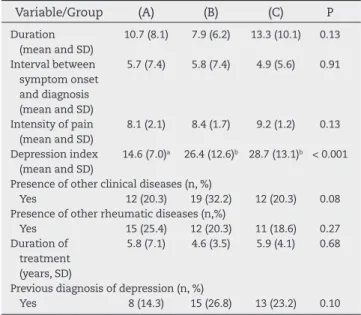
Table 2 shows the comparisons among the groups regard-ing the clinical variables. A signii cant difference was ob-served only for the presence of depressive symptoms in the groups with greater impact on quality of life.
Discussion
The analysis of demographic data disclosed no statistically signii cant difference among the groups, and demonstrated that they were matched for age, symptom onset, family come, education, and presence of workers’ compensation in-terests, among others.
A signii cant difference was observed regarding the pres-ence of workers’ compensation interests when comparing the
groups with greater impact with the group with mild impact. This result was somehow expected, since cessation of work implies a greater impact of the disease.
The patients had a mean age of 48.6 years. The mean age of symptom onset was 36 years. This i nding is higher than those observed in other studies.12,13 The service where this
study was conducted is tertiary and has a series that cannot be generalized to the entire population of i bromyalgia patients. The mean age of onset was compatible with other studies, in which this variable ranged between 12 and 55 years.14
Regarding family income, the patients had a mean of 1.4 Brazilian minimum wages - slightly below the value described by Costa et al.,15 i.e., between 1.5 and 2.0 Brazilian minimum
wages. The level of education in the present sample was simi-lar to that in the studies by Berber et al.13 and Martins et al.16
Table 2 – Comparison among the groups regarding clinical variables.
Variable/Group (A) (B) (C) P
Duration (mean and SD)
10.7 (8.1) 7.9 (6.2) 13.3 (10.1) 0.13
Interval between symptom onset and diagnosis (mean and SD)
5.7 (7.4) 5.8 (7.4) 4.9 (5.6) 0.91
Intensity of pain (mean and SD)
8.1 (2.1) 8.4 (1.7) 9.2 (1.2) 0.13
Depression index (mean and SD)
14.6 (7.0)a 26.4 (12.6)b 28.7 (13.1)b < 0.001
Presence of other clinical diseases (n, %)
Yes 12 (20.3) 19 (32.2) 12 (20.3) 0.08 Presence of other rheumatic diseases (n,%)
Yes 15 (25.4) 12 (20.3) 11 (18.6) 0.27 Duration of
treatment (years, SD)
5.8 (7.1) 4.6 (3.5) 5.9 (4.1) 0.68
Previous diagnosis of depression (n, %)
Yes 8 (14.3) 15 (26.8) 13 (23.2) 0.10 SD, standard deviation; n, number.
Table 1 – Comparação entre os grupos em relação às variáveis demográi cas.
Variable/Group (A) (B) (C) P
Age (mean, SD) 49.7 (7.7) 49.6 (7.7) 46.7 (10.2) 0.47 Age at onset (mean,
SD)
36.9 (11.5) 35.4 (14.6) 35.8 (11.1) 0.93
Family incomea 1,807.63
(1,233.65)
1,336.85 (993.55)
1,175.79 (1,004.58)
0.18
Schooling (n, %)
Group I 13 (23.6) 9 (16.4) 13 (23.6) 0.42b
Group II 4 (7.3) 8 (14.6) 2 (3.6) Group III 1 (1.8) 2 (3.6) 1 (1.8) Group IV 1 (1.8) 0 (0.0) 1 (1.8) Workers’
compensation interests (n, %)
Yes 6 (11.8) 11 (21.6) 11 (21.6) 0.07 SD, standard deviation; n, number.
aMean family income (Brazilian reais).
463
R E V B R A S R E U M A T O L . 2 0 1 3 ;5 3 ( 6 ): 4 6 0 – 4 6 3The analysis of clinical variables demonstrated a mean du-ration of disease of 126 months, higher than the mean found in another study by the authors, conducted in 2006.14 The time
to diagnosis was 65 months (> 5 years) in the present study study. This interval was higher than that reported by Berber et al.13 and Martins et al.,16 who showed a time interval < 2 years.
Regarding the intensity of pain, the patients studied had a mean of 8.5, slightly higher than that reported in literature.17
The most signii cant i nding was the association between the intensity of depressive symptoms and FM impact. The hy-pothesis that patients with emotional disorders would con-stitute a subgroup with greater severity has already been pre-sented in the medical literature. Santos et al.18 concluded that a
group of FM patients had worse quality of life and higher levels of depression when compared with a control group, suggesting an association between FM and depression, and that this could be regarded as a secondary symptom of the syndrome.
Giesecke et al. proposed the distribution of i bromyalgia patients into subgroups based on pain sensitivity and vari-ous emotional factors that included affective disorders. Ac-cording to the authors, the groups with increased pain sen-sitivity and poor self-control over their symptoms included patients with higher levels of mood disorders.19 The current
study supported the hypothesis that the presence of depres-sion is a more important factor that the other variables. Oth-er authors have associated highOth-er pain intensity with the presence of depression.20
The presence of other diseases associated with FM did not reach statistical signii cance, although they were present in all three groups (64.3% to 72.8%). Ribeiro et al.21 found a high
prevalence of active comorbidities associated with FM (4.05 per patient).
Therefore, it is concluded that the level of depression and presence of workers’ compensation interests are correlated with the impact of FM, and may be prognostic factors.
Conl icts of interest
The authors declare no have conl icts of interest.
R E F E R E N C E S
1. Carville SF, Arendt-Nielsen S, Bliddal H, Blotman F, Branco JC, Buskila D, Silva JAP, Danneskiold-Samsoe B, Dincer F, Henriksson C, Sarzi-Puttini P, Silman A, Säth M, Choy EH. EULAR - Evidence-Based Recommendations for the Management of Fibromyalgia Syndrome. Ann Rheum Dis 2008;67:536 - 541
2. Heymann RE, Paiva, ES, Helfenstein MJ, Pollak DF, Martinez, JE, Provenza JR, Paula AP, Althoff AC, Souza EJR, Neubarth F, Lage, LV, Rezende MC, Assis MR, Lopes MLL, Jennings F, Araujo RLC, Cristo VV, Costa EDG, Kaziyama HHS, Yeng LT, Iamamura M, Saron TRP, Nascimento OJM, Kimura LK, Leite VM, Oliveira J, Fonseca MCM, Araujo GTB. Consenso
Brasileiro do Tratamento de Fibromialgia. Rev Bras Reumatol 2010; 50(1):56-66.
3. Aryeh AM, Pillinger MH, Solitar BM, Abeles M. Narrative Review: The Pathophysiology of Fibromyalgia. Ann Intern Med. 2007; 146:726-734.
4. Costa SRR, Pereira Neto MS, Tavares Neto J, Kubiak I, Dourado MS, Araújo AC, Albuquerque LC, Ribeiro PC. Características de pacientes com síndrome da i bromialgia atendidos em um hospital de Salvador BA-Brasil. Rev Bras Reumatol 2005; 45 (2): 64-70.
5. Testa MA, Simonson, DC. Assessment of quality of life outcomes. New England J Medicine 1996; 334 (13): 835-849. 6. Buckhardt CS, Goldenberg D, Crofford L, Gerwin R, Gowens S,
Jackson K, Kugel P, McCarberg W, Rudin N, Schanberg L, Taylor J, Turk D. Guideline for the management of i bromyalgia syndrome pain in adults and children. Glenview (IL): American Pain Society (APS); 2005.109 p.
7. Martinez JE, Cruz CG, Aranda C, Boulos FC, Lagoa LA. Diseases perceptions of Brazilian i bromyalgia patients: do they resemble other countries patients perceptions. International Journal of Rehabilitation Research 2003; 26: 223-227. 8. Ledingham J, Doherty S, Doherty M: Primary i bromyalgia
syndrome-an outcome study. Br J Rheumatol 1993; 33:139-42. 9. Felson DT, Goldenberg DL. The natural history of i bromyalgia.
Arthritis Rheum 1986; 29:1522-26.
10. Martinez JE, Cruz CG , Aranda C, Lagoa LA , Boulos FC. Estudo qualitativo da percepção das pacientes sobre a i bromialgia. Rev Bras Reumatol 2002; 42: 30-36.
11. Martinez JE, Barauna FIS, Kubokawa K, Pedreira IS, Machado LAM, Cevasco G: Análise crítica de parâmetros de qualidade de vida de pacientes com Fibromialgia. Acta Fisiátrica 1998; 5: 116-20.
12. Martinez JE, Panossian C, Gavioli F. Estudo comparativo das características clínicas e abordagem de pacientes com i bromialgia atendidos em serviço público de reumatologia e em consultório particular. Rev Bras Reumatol 2006; 46 (1): 32-36.
13. Berber JSS, Kupek E, Berber SC. Prevalência de depressao e sua relacao com a qualidade de vida em Pacientes com sindrome da i bromialgia. Rev Bras Reumatolol 2005; 45 (2): 47-54.
14. Martinez JE. Fibromialgia: um desai o clinico. Rev Fac Ciências Médicas de Sorocaba 2006; 8: 1-3.
15. SEM REFERÊNCIA
16. Martins MRI, Polvero LO, Rocha CE, Foss MH, Santos RJ. Uso de questionários para avaliar a multidimensionalidade e a qualidade de vida do i bromiálgico. Rev Bras Reumatol 2011; 52(1):16-26.
17. Salvetti, MG. Auto-ei cácia e sintomas depressivos em doentes com dor crônica. Rev Psiq Clín 2007; 34 (3): 111-117. 18. Santos AMB, Assumpção A, Matsutani LA, Pereira CAB, Lage LV, Marques AP. Depressão e qualidade de vida em pacientes com i bromialgia. Rev Bras Fisioter 2006; 10 (3):317-324. 19. Giesecke T, Williams DA, Harris RE, Cupps TR, Tian X, Tian
TX,Gracely RH, Clauw DJ. Subgrouping of i bromyalgia patients on the basis of pressure - pain thresholds and psychological factors. Arthritis Rheum 2003; 48 (10): 2916 - 2922
20. Buckelew SP, Parker JC, Keefe FJ, Deuser WE, Crews TM, Conway R, et al. Self-efi cacy and pain behavior among subjects with i bromyalgia. Pain 1994;59:377–84.