Licenciado sob uma Licença Creative Commons DO): http://dx.doi.org. . / - . . .AO
[T]
Effects of cold water immersion on variables of balance
in healthy subjects with open and closed eyes
[)]
Efeito da crioimersão nas variáveis de equilíbrio em
indivíduos saudáveis com olhos abertos e fechados
[A]
Simone Sayomi Tano[a], Karen Barros Parron Fernandes[a],
Auristela Duarte Lima Moser[b], Deise Aparecida de Almeida Pires-Oliveira[a],
Andre Wilson Oliveira Gil[a], Rodrigo Franco de Oliveira[a]*
[a] Universidade Norte do Paraná Unopar , Londrina, PR, Brazil [b] Pontifícia Universidade Católica do Paraná, Curitiba, PR, Brazil
[R]
Abstract
Introduction: Cryotherapy is the use of cold as therapeutic approach. Although often used, its impact on
the postural balance is not well-known. Objectives: To analyze the effects of cold water immersion in the
postural balance on single-leg balance in healthy subjects through the variables of center-of-pressure, ve-locity anteroposterior and medial-lateral oscillations, comparing conditions open and closed eyes in the moments before, immediately, and minutes after cold water immersion. Material and methods:
Cross-sectional study with male subjects, cold water immersion at °C during minutes assessed in a force platform, protocol of trials of seconds each with seconds of rest, the average of the trials
468
was used for analysis. The software GraphPad Prisma . was used for statistical analysis, with the ANOVA test for repeated measures and comparisons with test of Friedman and post-test of Dunn. Results: )t was
observed improvement of the balance by the results of the following variables: in the condition Open Eyes OE it was observed significant difference only in the velocity anteroposterior AP in the moment before immersion when compared to the -minute moment. Significant differences were observed in the condition Closed Eyes CE in the following comparisons: in the Center-of-Pressure COP only at the immediate moment when compared to the -minute moment; in the velocity AP in the moment before when compared to the -minute moment, in the immediate moment when compared to the -minute and -minute moments; and in the medial-lateral velocity Vel-ML in two comparisons: in the moment before immersion when compared to the -minute and -minute moments after cryotherapy. Results show safety in performing activities after cryotherapy. Conclusion: )mprovement of the postural balance
after cold water immersion on the predetermined conditions of this study.
[P]
Keywords: Cryotherapy. Postural balance. Balance.
]
[B]Resumo
Introdução: A crioterapia consiste na utilização local do frio como abordagem terapêutica. Embora frequen-temente utilizada, seu impacto no equilíbrio corporal é pouco explorado. Objetivos: Analisar a influência da crioimersão no equilíbrio estático em apoio unipodal em indivíduos saudáveis por meio de variáveis do centro de pressão, oscilações da velocidade anteroposterior e médio-lateral, comparando condições olhos abertos e fechados nos momentos prévios, imediatamente, 20 e 40 minutos após crioimersão. Materiais e métodos: Estudo transversal realizado com 30 sujeitos do gênero masculino: crioimersão a 5 °C durante 15 minutos; avaliação na plataforma de força, protocolo de 3 tentativas de 30 segundos cada, com 10 segundos de des-canso; média das 3 medidas foi adotada para análise. Utilizou-se o programa GraphPad Prisma 5.0, ANOVA de medidas repetidas e comparações com teste de Friedman e pós-teste de Dunn. Resultados: Verificou-se melhora do equilíbrio por meio dos resultados das seguintes variáveis analisadas: na condição Olhos Abertos (OA) observou-se diferença significativa apenas na velocidade anteroposterior (Vel-AP) no tempo pré-imersão comparado com 40 minutos. Com Olhos Fechados (OF) observou-se diferenças significativas nas seguintes com-parações: no Centro-de-Pressão (COP) apenas no momento imediato comparado com 40 minutos; na veloci-dade AP no momento pré-comparado com o tempo de 40 minutos e no momento imediato comparado com 20 e 40 minutos após; e na velocidade médio-lateral (Vel-ML) no tempo pré-imersão comparado com 20 e 40 minutos após. Os resultados demonstram segurança na realização de atividades após crioterapia. Conclusão: Verificou-se melhora do equilíbrio postural após crioimersão nas condições predeterminadas neste estudo. [K]
Palavras-chave: Crioterapia. Equilíbrio postural. Equilíbrio.
Introduction
Cryotherapy consists of using cold location as a therapeutic approach , , ; contributing to re-duce pain, tissue temperature, metabolism, edema, circulation, muscle spasm, it also may cause de-crease in venous flow, affecting the articular func-tion. )t is one of the most commonly used treatment method applied in conditions of acute soft tissue injuries , .
)n sports, it is frequently used in acute muscu-loskeletal lesions with the objective of bringing a fast comeback of the athlete to their sport activities, considering that its effects and applicability in body segments such as knees and ankles, frequent target of lesions, have been widely studied , .
The use of cryotherapy in sports practice and in rehabilitation centers has been considered as a popu-lar method of treatment for acute and chronic lesions
cryotherapy application, its capacity of reducing the tissue temperature, decrease of nerve conduction speed and also report about its influence in postural
balance , , .
The modality, the time of application and the cooling time, may cause negative effects due to the
decrease of conduction speed of afferent fibers .
This, alters both the sense of articular perception and the decrease of functional performance, with the possibility of causing undesired effects in ar-ticular stability and postural balance alterations
, compromising the sport performance, favor-ing the occurrence of lesions when athletes resume
their activities right after ice application , ,
. Although cooling may bring bigger tolerance to motor activities through sedation, the increase of postural oscillation may occur due to the decrease
of proprioception , .
Proprioception is the mechanism of body percep-tion in which the peripheral receptors send informa-tion to Central Nervous System CNS relating the
body movements to the position sense .
Posture control is built up by a set of assembled segments, each with its own mass, that are linked together by flexible joints controlled by the neuro-muscular system and involves interactions between
external and internal strengths making use of
balance strategies, being the main strategies used in
static posture, the hip and ankle strategies . )t is
possible to observe that the postural balance also may be affected by the use of cryotherapy, and researchers
recommend , prudence in immediate return
situations to activities after cryotherapy.
Even though it is widely used in clinical practice and sport, there is no certainty about the impact of its effects on postural balance, not even if its appli-cation may bring lesion risks. Besides, it also occurs the lack of a statement in relation to the safe time of recovering to resume physical activities.
)n face of these facts, the present study has as an objective to analyze the influence of cold water im-mersion in the static balance in single-leg stance in healthy young people, through the area of center-of-pressure, oscillations of anteroposterior velocity Vel-AP and medial-lateral Vel-ML variables, comparing open eyes OE and closed eyes CE conditions in before moment, immediately, and minutes after cold water immersion.
Materials and methods
Ethical procedures
The study was realized at the Research Center in (ealth Studies of University Norte do Paraná Unopar in the (uman Motor Performance and Functional Evaluation LA(UF laboratory after the Ethic and Research Committee CEP consent, under
record number . . All the research processes
followed the ethical principles in the Resolution
num-ber / from National (ealth Council, from
Ministry of (ealth, guaranteeing to the participants, among other rights, the inform consent form, privacy and safe keeping of information.
Design and population of study
)t is a cross-sectional study. (ealthy individuals between and years old were included, male gender, no history of musculoskeletal injuries in the last six months and that were not professional ath-letes. Subjects were excluded with Body Mass )ndex
BM) bigger then , with allergy to cold, dermatitis in the area of ankles and feet, with the presence of lesions, injuries or skin rashes in the area of ankles and feet, visual or vestibular impaired relevant and advanced diabetes.
)t was used the sample size calculation in the program PASS . , using as parameters the data
obtained in the study of Kernozek et al. , which
observed difference in cold water immersion in
rela-tion to balance parameters F = . and p = . .
Considering these data in conjunction with the confi-dence interval of %, alpha level of % and power test of %, it was determined that the minimum sample of this study was individuals. Considering possible losses during the evaluation, individuals were recruited.
Data collection
The subjects were analyzed in the period between
May and July , realized always in the same period
470
with no footwear, nor socks before the beginning of collection; all the experimental procedures were realized always by the same evaluators.
The temperature measuring of the ankle was verified in an area of about five millimeters below the most protuberant point of the lateral malleolus where the laser pointer )ncoterm™ output < mW,
Wavelength - mm was positioned
perpen-dicularly to the area, about five centimeters of dis-tance from the skin.
For cold water immersion procedures it was used a plastic recipient oval bucket , capacity of liters, containing liters of water with the room at environ-ment temperature being introduced cubed ice. The temperature of cooled water was kept in a medium temperature of ºC, verified by the laser thermom-eter above mentioned being constantly verified, this way it was added ice for the temperature main-tenance when necessary, with the individual sat with the angle of hip and knee close to degrees with immersion of the lower limb preference completely covering the foot in contact with the bucket, with a water blade of centimeters above the lateral mal-leolus during minutes. Just one member prefer-ence member was evaluated in this group, it being subjected to cold water immersion and it was used to assess balance measurements on the force platform. For the count the time it was used a chronometer Casio (s- Digital Professional Lap Split Wr , and the environment temperature was verified by an acrylic room thermometer )ncoterm, ecological filling [TA)
. ] .
To evaluate postural balance it was used the force
platform Biomec produced in Brazil by EMG
system of Brazil, validated by da Silva et al. ,
which is able to quantify the distribution of
verti-cal force in four points, its size is x x
mm. Considered gold-standard instrument , the
reaction of the platform signals, after filtered, are analyzed by routines from the program MatLab with their own software which extracts the main
param-eters of postural balance .
The data collection was realized in controlled environment with an acclimatized room mean temperature of ºC where the individuals were familiarized with the equipment and the experimen-tal protocol. For the Postural Balance PB , the indi-viduals were oriented to remain in single-leg stance
lower limb preference on the force platform ,
with no footwear nor socks, loose arms and relaxed
along the body and with cephalic segment positioned vertically to the ground plan. The test was initially realized, from the experimental protocol, OE, asking participants to watch a target black cross = . cm x . cm x cm fixed on a white wall, at the same height of the eyes with frontal distance of meters from their eyes. Next, the individuals were oriented to realize the test with CE. Three attempts of sec-onds with secsec-onds of rest were realized and the
average of the three trials was used for analysis .
The measurements of static balance and skin temperature were measured in four moments: in condition of before immersion; immediately after immersion; minutes; and minutes after cold water immersion. The evaluated parameters were COP, Vel-AP, and Vel-ML.
Statistical analysis
The entire statistic procedures were realized through the software GraphPad Prism . , being es-tablished a confidence interval of % and
signifi-cance level of % for the applied tests p < . . )t
was used the Shapiro-Wilk test to analyze the dis-tribution of data. Considering that the variables of balance did not present normal distribution, the data were presented in median and interquartile ranges [ - %]. The comparisons were verified using the Friedman test with post-test of Dunn. The anthropometric data presented normal distribution; therefore, they were presented as average and stan-dard deviation.
Results
Participated in this research, individuals of male gender, aged between and years old age
average: . ± . , weight: . kg ± , ,
height: . cm ± . and BM) . kg/m²
± . .
Among the individuals, adopted the right lower limb as the preference member, and adopted the left lower limb.
The average temperature of the cooling water
used for immersion was . ºC ± . while the
room temperature was , ºC ± . .
the moment of before cold water immersion were
. ºC ± . . )mmediately after cryotherapy the
temperature was reduced to . ºC ± . . )n
the period of and minutes after cryotherapy it was observed a tendency to reheating
present-ing an average of . ºC ± . and . ºC
± . respectively. Differences on the surface
tem-perature of the ankle skin in the lateral region were observed in different experimental periods before immersion, immediately after immersion, and minutes post immersion .
Analysis of variables of single-leg balance with open eyes
Differences were observed in the AP direction speed during pre-immersion period compared to speed after minutes Friedman’s test, post-test of Dunn, p < . , Table and Figure . (owever, statistically significant differences were not observed to COP Friedman’s test, post-test of Dunn, p = . , Table and Figure , and not even for medial-lateral
velocity direction Friedman’s test, post-test of Dunn, p = . , Table and Figure .
Analysis of variables of single-leg balance with closed eyes
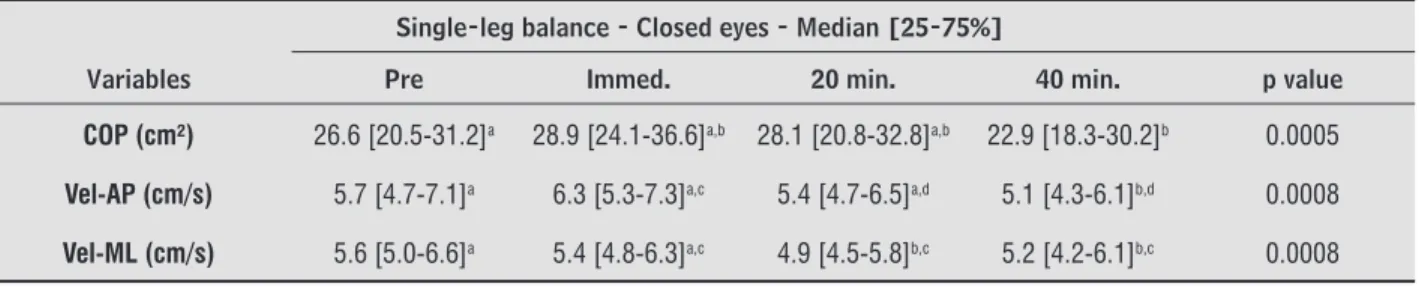
The single-leg balance data in CE condition showed statistically significant differences indicating an improvement in balance for the following condi-tions: for COP in immediate period compared to the area after minutes Friedman’s test, post-test of Dunn, p < . , Table and Figure , for AP velocity in pre-immersion velocity period compared to minutes and the immediate period compared to and minutes Friedman’s test, post-test of Dunn,
p = . , Table and Figure ; for medial-lateral
velocity in the period of pre-immersion compared to the speed minutes and also minutes after cold water immersion Friedman’s test, post-test of
Dunn, p = . , Table and Figure . For other
comparisons, there were not statistically signifi-cant differences.
Table 1 - Descriptive values of the parameters of single-leg balance – open eyes
Single-leg balance - Open Eyes - Median [25-75%]
Variables Pre Immed. 20 min. 40 min. p value
COP (cm²) 8.1 [7.1-9.6]a 9.2 [7.6-11.8]a 8.5 [7.1-10.9]a 7.9 [6.8-9.8]a 0.22
Vel-AP (cm/s) 2.6 [2.3-3.0]a 2.4 [2.1-2.8]a, b 2.3 [2.2-2.7]a, b 2.3 [2.1-2.7]b 0.02
Vel-ML (cm/s) 2.5 [2.3-2.9]a 2.3 [2.1-2.9]a 2.5 [2.1-2.8]a 2.4 [2.1-2.7]a 0.07
Note: Pre = before immersion; Immed. = immediately after immersion; 20 min. = 20 minutes after immersion; 40 min. = 40 minutes after immersion; COP = center-of-pressure; Vel-AP = anteroposterior velocity; Vel-ML = medial-lateral velocity. Different letters represent dif-ferent groups (Friedman’s test, Post-test of Dunn).
Table 2 - Descriptive values of the parameters of single-leg balance – closed eyes
Single-leg balance - Closed eyes - Median [25-75%]
Variables Pre Immed. 20 min. 40 min. p value
COP (cm²) 26.6 [20.5-31.2]a 28.9 [24.1-36.6]a,b 28.1 [20.8-32.8]a,b 22.9 [18.3-30.2]b 0.0005
Vel-AP (cm/s) 5.7 [4.7-7.1]a 6.3 [5.3-7.3]a,c 5.4 [4.7-6.5]a,d 5.1 [4.3-6.1]b,d 0.0008
Vel-ML (cm/s) 5.6 [5.0-6.6]a 5.4 [4.8-6.3]a,c 4.9 [4.5-5.8]b,c 5.2 [4.2-6.1]b,c 0.0008
472
therapeutic effects providing the decrease of Nerve Conduction Velocity NCV .
The temperature data measured during the four periods of this research before immersion, immedi-ately, and minutes after cold water immersion indicate that after minutes of cold water immer-sion the skin temperature of the ankle did not return to the same temperature values before immersion. These data corroborate with the study of Costello et al. in which they assert that, in all the articles included in their systematic review, the temperature of the skin had not returned to the levels of pre-im-mersion in the monitoring period of data collection. Through our results, it is possible to affirm that even if the temperature of the skin had not returned to the previous values before cold water immersion, the static balance has not been affected.
Some relevant data showed by Jutte et al. which must be taken into consideration, is the one that says that standardized cold water immersion does not produce the same physiologic results in all patients indicating the necessity of individual adjust-ments, and it also indicates that the lack of standard-ized treatments cause different physiologic effects and may express inconsistent results. The present study presented an average temperature of .
ºC ± . and variability in the values of cooling in
the immediate period after immersion . ºC to
Figure 1 – Comparison of center-of-pressure data (COP/ cm2) in different experimental periods in
single-leg balance with open eyes (OA) and closed eyes (OF)
Note: Pre = before immersion; Imed. = immediately after immer-sion; 20 min. = 20 minutes after immerimmer-sion; 40 min. = 40 minutes after immersion.
Figure 2 – Anteroposterior velocity (Vel-AP) (cm/s) in dif-ferent experimental periods in single-leg bal-ance with open eyes (OA) and closed eyes (OF)
Note: Pre = before immersion; Imed. = immediately after immer-sion; 20 min. = 20 minutes after immerimmer-sion; 40 min. = 40 minutes after immersion.
Figure 3 – Medial-lateral velocity (Vel-ML) (cm/s) in dif-ferent experimental periods in single-leg bal-ance with open eyes (OA) and closed eyes (OF)
Note: Pre = before immersion; Imed. = immediately after immer-sion; 20 min. = 20 minutes after immerimmer-sion; 40 min. = 40 minutes after immersion.
Discussion
According to different modalities of cryotherapy
application, studies of (errera et al. report that
cold water immersion is the most used to induce Pre
Immed. 20 min. 40 min. Pre
Immed. 20 min. 40 min.
OA
COP (cm
2)
0 10 20 30 40 50
OF
Pre
Immed. 20 min. 40 min. Pre
Immed. 20 min. 40 min.
OA
Vel-AP (cm/s)
15
10
5
0
OF
Pre
Immed. 20 min. 40 min. Pre
Immed. 20 min. 40 min.
OA
Vel-ML (cm/s)
10
8
6
4
2
0
. ºC . This variability may occur due to individual characteristics from each subject in the research since
some authors , report that the metabolic
ac-tivity, body temperature and the individual adipose thickness may interfere in the cooling capacity. This way, it is possible to notice the difficulty regarding to cryotherapy standardize.
Still on the cooling temperature, the study of
Chesterton et al. shows that with the tissue
cooled in a temperature of . ºC there might be a decrease of % of NCV. Knight and Uchio et al. affirm that temperatures below ºC provide fail in NCV. This way, we can affirm that the reached temperature in this study in the immediate after
im-mersion moment . ºC ± . ºC was enough
to produce NCV reduction.
According to Rougier to occur this balance,
there is the necessity of control of the center-of-gravity on the support base besides and appropri-ate command from the CNS for the maintenance of stability through the integration of mechanisms that surround several sensory-neural systems. The author says that when the visual impulses are avail-able, the center-of-pressure and the oscillation area of the COP tend to decrease when compared to CE conditions. Similarly, our data presented a quantita-tive difference between the OE and CE conditions showing reduced values of COP, anteroposterior ve-locity and medial-lateral veve-locity, in the eyes open condition when compared to one another. (orak et
al. and Mallau et al. report about the visual
contribution for the balance and mention that the closed eyes condition decreases the body stability.
Studies from Sá and Bim evaluated children
with impaired vision and normal vision on the force platform and concluded that the impaired vision interferes in the static and dynamic balance of the children and affirm that therapeutic exercises in-fluenced in the improvement of impaired children. )n this research, it was observed an improvement in the moment after minutes, mainly in CE con-dition. Despite the present study presents bigger postural oscillations in CE condition, the obtained results in OE condition showed similar results in-dicating that regardless the presence or absence of visual component there was improvement in the bal-ance parameters.
)t was not observed negative influence of cryo-therapy in balance in the immediate moment after
cold water immersion. No similar researches were found that indicate improvement in balance after cryotherapy of immersion evaluated in the force
plat-form. Studies from Duarte and Freitas and Lund
et al. demonstrate that measurements which
demand cooperation of the patient, most of the times, present an improvement in the result when repeated in short intervals of time. This way, it is not possible to affirm if the obtained improvement in the present study may have occurred due to learning effect.
Results were found with no significant statistics, such as the case of the research of Cassolato et al. whose reports infer that cryotherapy by immer-sion has not influenced in the postural control in the static erect posture condition of healthy individuals through the COP evaluation. With similar results, (art
et al. evaluated the effect of cryotherapy using
a plastic bag filled with ice cubes involved by elastic bandage for minutes in the region of the knee so that they could verify the effects of single-leg stance and concluded that alterations were not observed in the ground reaction force parameters.
Still, Jameson et al. affirm that immediately
after minutes of treatment with cryotherapy using crushed ice, there was no significant difference in the force of vertical reaction produced during the land, supporting the use of cryotherapy immediately
be-fore activities. A study made by Douglas et al. did
not observe significant differences in the static bal-ance with fifteen participants evaluated with Biodex. These authors evaluated the balance also in the dy-namic condition, which showed significant difference and concluded that fifteen minutes of cryotherapy affect to medial-lateral velocity.
To avoid bias, the present research evaluated healthy individuals only with the male gender, since
some researches , suggest that men and
wom-en have differwom-ent body compositions and differwom-ent patterns of distribution of adipose tissue, being this
one, a temperature insulator usually most found
bigger thickness in the female gender .
This study evaluated individuals without injuries, therefore effects in individuals with lesions is
un-known. The study of Kernozek et al. evaluated
474
Final considerations
From the results obtained, we can infer that it was not observed direct interference of cryotherapy of im-mersion in the variables of postural balance in static situation in the present study. So, the application of cold water immersion as a technique of treatment may be recommended in activities which demand balance in static conditions, however, studies are nec-essary regards to the effect of cryotherapy in dynamic activities, analyzing its influence on the mechanisms of neuromuscular control and its relation with pos-tural balance.
References
. Tomchuk D, Rubley M, (olcomb W, Guadagnoli M, Tarno JM. The Magnitude of tissue cooling during cryotherapy with varied types of compression. J Athl Train. ; : - .
. Costello J, Mc)nerney C, Bleakley C, Selfe J, Donnelly A. The use of thermal imaging in assessing skin tem-perature following cryotherapy : a review. J Therm Biol. ; : - .
. Gutierrez-Espinoza (, Lavado-Bustamante ), Mé-ndez-Perez S. Revisión sistemática sobre el efecto analgésico de la crioterapia en el manejo del dolor de origen músculo esquelético. Rev Soc Esp Dolor.
; : - .
. Knight KL. Crioterapia no tratamento das lesões es-portivas. São Paulo: Manole; .
. Bleakley CM, O’Connor S, Tully MA, Rocke LG, Ma-cauley DC, McDonough SM. The PR)CE study Pro-tection Rest )ce Compression Elevation : design of a randomised controlled trial comparing standard versus cryokinetic ice applications in the manage-ment of acute ankle sprain. BMC Musculoskelet Dis-ord. ; : .
. Tremblay F, Estephan L, Legendre M, Sulpher S. )nflu-ence of local cooling on proprioceptive acuity in the quadriceps muscle. J Athl Train. ; : - . . (ubbard TJ, Aronson SL, Denegar CR. Does Cryo-therapy hasten return to participation? A systematic review. J Athl Train. ; : - .
. Khanmohammadi R, Someh M, Ghafarinejad F. The ef-fect of cryotherapy on the normal ankle joint position sense. Asian J Sports Med. ; : - .
. Merrick MA, Jutte LS, Smith ME. Cold modalilities with different thermodynamic properties produce differ-ent surface and intramuscular temperatures. J Athl Train. ; : - .
. Algafly AA, George KP. The effect of cryotherapy on nerve conduction velocity, pain threshold and pain tolerance. Br J Sports Med. ; : - . . Thieme (A, )ngersoll CD, Knight KL, Ozmun JC.
Cool-ing does not affect knee proprioception. J Athl Train. ; : - .
. Surenkok O, Aytar A, Akman MN. Cryotherapy impairs knee joint position sense and balance. )sokinet Exerc Sci. ; : - .
. Uchio Y, Ochi M, Fujihara A, Adachi N, )wasa J, Sakai Y. Cryotherapy influences joint laxity and position sense of the healthy knee joint. Arch Phys Med Reha-bil. ; : - .
. Schmid S, Moffat M, Gutierrez GM. Effect of knee joint cooling on the electromyographic activity of lower extremity muscles during a plyometric exercise. J Elec-tromyogr Kinesiol. ; : - .
. Cabral AS, Corea BS, )garashi Y. Efeito da aplicação do frio na sensação de posicionamento articular do tornozelo. Rev Para Med. ; : - .
. Wassinger CA, Myers JB, Gatti JM, Conley KM, Leph-art SM. Proprioception and throwing accuracy in the dominant shoulder after cryotherapy. J Athl Train.
; : - .
. Kernozek TW, Greany JF, Anderson DR, (eel VAN, Youngdahl RL, Benesh BG, et al. The effect of immer-sion cryotherapy on medial-lateral postural sway variability in individuals with a lateral ankle sprain. Physiother Res )nt. ; : - .
. Baldaço FO, Cadó VP, de Souza J, Mota CB, Lemos JC. Análise do treinamento proprioceptivo no equilí-brio de atletas de futsal feminino. Fisioter Mov.
; : - .
. Lund (, Søndergaard K, Zachariassen T, Christensen R, Bülow P, (enriksen M, et al. Learning effect of isokinet-ic measurements in healthy subjects, and reliability and comparability of Biodex and Lido dynamometers. Clin Physiol Funct )maging. ; : - . . Cassolato KM, Artifon EL, Evans A, Bonfim DO, Cristina
J. )nfluência da crioterapia no controle postural da postura ereta em indivíduos saudáveis. Rev Bras Clin Med. ; : - .
. (art JM, Leonard JL, )ngersoll CD. Single-leg landing strategy after knee-joint cryotherapy. J Sport Rehabil.
; : - .
. Jameson AG, Kinzey SJ, (allam JS. Lower-extremity-joint cryotherapy does not affect vertical ground-re-action forces during landing. J Sport Rehabil. ;
: - .
. Douglas M, Bivens S, Pesterfield J, Clemson N, Castle W, Sole G, et al. )mmediate effects of cryotherapy on static and dynamic balance. )nt J Sport Phys Ther.
; : - .
. Otte JW, Merrick MA, )ngersoll CD, Cordova ML. Sub-cutaneous Adipose tissue thickness cooling time during cryotherapy. Arch Phys Med Rehabil. ;
: - .
. Jutte LS, Merrick MA, )ngersoll CD, Edwards JE. The relationship between intramuscular temperature, skin temperature, and adipose thickness during cryotherapy and rewarming. Arch Phys Med Rehabil.
; : - .
. Kennet J, (ardaker N, (obbs S, Selfe J. Cooling effi-ciency of common Cryotherapeutic Agents. J Athl Train. ; : - .
. Yanagisawa O, Fukubayashi T. Diffusion-weighted magnetic resonance imaging reveals the effects of different cooling temperatures on the diffusion of water molecules and perfusion within human skeletal muscle. Clin Radiol. ; : - .
Received: / /
Recebido: / /
Approved: / /
Aprovado: / /
. (orak FB. Postural orientation and equilibrium : what do we need to know about neural control of balance to prevent falls? Age Ageing. ; Suppl :ii -ii . . Weimar W, Campbell B. The influence of ankle cryo-therapy on unilateral balance. Med Sci Sport Exerc.
; :S .
. da Silva RA, Bilodeau M, Parreira RB, Teixeira DC, Amorim CF. Age-related differences in time-limit performance and force platform-based balance mea-sures during one-leg stance. J Electromyogr Kinesiol.
; : - .
. Moreira A, Okano A(, Ronque ERV, Souza M, Oliveira PR. Reprodutibilidade dos testes de salto vertical e salto horizontal triplo consecutivo em diferentes etapas da preparação de basquetebolistas de alto rendimento. Rev Bras Cineantropom Desemp (um.
; : - .
. Duarte M, Freitas SMSF. Revisão sobre posturografia baseada em plataforma de força para avaliação do equilíbrio. Rev Bras Fisioter. ; : - . . (errera E, Sandoval MC, Camargo DM, Salvini TF.
Motor and sensory nerve conduction are affected differently by ice pack, ice massage, and cold water immersion. Phys Ther. ; : - .
. Jutte LS, (awkins J, Miller KC, Long BC, Knight KL. Skinfold thickness at common cryotherapy sites in various athletic populations. J Athl Train. ;
: - .
. Chesterton LS, Foster NE, Ross L. Skin temperature response to cryotherapy. Arch Phys Med Reabil.
; : - .
. Rougier P. The influence of having the eyelids open or closed on undisturbed postural control. Neurosci Res. ; : - .
. (orak FB, Nashner LM, Diener (C. Postural strategies associated with somatosensory and vestibular loss. Exp Brain Res. ; : - .
. Mallau S, Vaugoyeau M, Assaiante C. Postural strate-gies and sensory integration: no turning point be-tween childhood and adolescence. PLoS One. ;
:e .