Effects of manual rib-cage compression versus
PEEP-ZEEP maneuver on respiratory system
compliance and oxygenation in patients receiving
mechanical ventilation
Efeitos da compressão torácica manual versus a manobra de
PEEP-ZEEP na complacência do sistema respiratório e na
oxigenação de pacientes submetidos à ventilação mecânica invasiva
INTRODUCTION
Patients unable to perform respiratory functions may be submitted to in-vasive mechanical ventilation (IMV) to provide them with a ventilation and oxygenation system for adequate alveolar ventilation, restore acid-base bal-ance and reduce respiratory work.(1)
hese patients present various features that hinder clearance of lung se-cretion such as inadequate humidiication, high fractions of oxygen, use of sedatives and or analgesics, basal lung disease and presence of an artiicial airway mechanically hampering elimination of secretion next to the trachea.
(2) Secretion retention contributes to episodes of hypoxemia, atelectasis and
ventilator-associated pneumonia.(3) It is believed that bronchial hygiene may
improve compliance of the respiratory system through increase of dynamic
Flavio Renato Antunes dos Santos1,
Luiz Carlos Schneider Júnior2, Luiz
Alberto Forgiarini Junior3, Jeferson
Veronezi4
1. Physiotherapist Graduate from the Centro Universitário Metodista IPA. Porto Alegre (RS), Brazil.
2. Physiotherapist from the Intensive Care Unit of the Hospital São Francisco at the Irmandade Santa Casa de Misericórdia de Porto Alegre. Porto Alegre (RS), Brazil.
3. Physiotherapist Postgraduate (Doctorate) in Lung Sciences at the Universidade Federal do Rio Grande do Sul – UFRGS - Porto Alegre (RS), Brazil. Researcher from the Hospital de Clinicas de Porto Alegre. Porto Alegre (RS), Brazil.
4. Master, Physiotherapist and Professor from the Centro Universitário Metodista IPA – Porto Alegre (RS), Brazil.
ABSTRACT
Objectives: Patients unable to per-form breathing functions may be sub-mitted to invasive mechanical ventila-tion. Chest physiotherapy acts directly on the treatment of these patients for the purpose of improving their lung function. he objective of this study was to evaluate the efects of manual rib-cage compression versus the positive end expiratory pressure-zero end expira-tory pressure (PEEP-ZEEP) maneuver, on compliance of the respiratory system and oxygenation in patients under inva-sive mechanical ventilation.
Methods: A double centric,
prospec-tive, randomized and crossover study, with patients under invasive mechani-cal ventilation, in controlled mode for more than 48 hours was carried out. he protocols of chest physiothe rapy were rando mly applied at an interval of 24 hours. Data of respiratory system com-pliance and oxygenation were collected
before application of the protocols and 30 minutes after.
Results: Twelve patients complet-ed the study. Intragroup analysis, for both techniques showed a statistically signiicant diference in tidal volume (p=0.002), static compliance (p=0.002) and dynamic compliance (p=0.002). In relation to oxygenation, in the group of manual rib-cage compression, peripheral oxygen saturation increased with a sig-niicant diference (p=0.011).
Conclusions: Manual rib-cage
compression and PEEP-ZEEP ma-neuver have positive clinical efects. In relation to oxygenation we found a favorable behavior of peripheral oxygen saturation in the group of manual rib-cage compression.
Keywords: Continuous positive
air-way pressure; Positive-pressure respira-tion; Physical therapy modalities; Res-piration, artiicial/methods; Respiratory therapy/methods
Received from the Centro Universitário Metodista IPA - Porto Alegre (RS), Brazil.
Submitted on October 10, 2008 Accepted on May 26, 2009
Author for correspondence:
compliance (Cdyn) and static compliance (Cst).(4,5)
he airway clearance technique has been widely used in the treatment of patients under IMV aiming to im-prove their pulmonary function by bronchial clearance, expansion of collapsed lung areas and consequent balance of the ratio ventilation/perfusion. Currently, some stud-ies have shown eiciency of physiotherapy for resolution of actelactasis and promotion of bronchial hygiene.(6,7)
he physiotherapy techniques more often used to foster bronchial hygiene are postural drainage (PD), manual rib-cage compression (MRC), manual hyperinlation (MH) and tracheal suctioning, among others.(8)
In the positive end expiratory pressure - zero end-expiratory pressure (PEEP-ZEEP), theoretically when PEEP rises, gas is redistributed through collateral ven-tilation, reaching adjacent alveoli previously collapsed by mucus. his redistribution eases reopening of small airways by removing the mucus adhering to their walls. Later, when PEEP is reduced to 0 cmH2O, the expirato-ry low pattern is changed aiding transport of secretions from smaller airways to those more central.(9,10)
Recent studies have not found a statistically signii-cant diference when comparing MRC to isolated tra-cheal suction. hese studies however, presented some limitations.(11-13) To the contrary, Stiller et al.(14-15)
con-cluded that this technique, associated to body position-ing, sighs and suctioning increases eicacy of treat-ment, for resolution of acute lobar actelactasis. Com-parison of MRC with PEEP-ZEEP was elected because both techniques aim for airway clearance by changing the airlow. Furthermore, MRC requires physical efort from the physiotherapist while the other makes use of changes in the ventilator parameters, to displace bron-chial secretions.
In this study it was hypothesized that MRC and PEEP-ZEEP may improve compliance of the respiratory system and oxygenation of patients under IMV. As such, Cdyn and Cst, tidal volume (TV) and peripheral oxygen saturation (SpO2) were measured. his study proposed to assess behavior of the respiratory system compliance and of oxygenation for use of the MRC and PEEP-ZEEP techniques in patients under mechanical ventilation.
METHODS
his study was carried out from January to May 2008 in the Intensive Care Unit (ICU) of the Policlínica Santa Clara da Irmandade Santa Casa de Misericórdia de Porto Alegre and in the ICU of the” Hospital Parque Belém. Research was approved by the Resarch Ethics
Commit-tee of the Centro Universitário Metodista IPA and of the hospitals mentioned. Family members or those respon-sible signed an informed consent.
Inclusion criteria were patients under IMV in con-trolled mode for more than 48 hours. Exclusion criteria were rib fracture, presence of thoracic tube, hemody-namic instability (mean arterial pressures < 89 mmHg), severe bronchospasm, intracranial hypertension (intrac-ranial pressure > 10mmHg), non drained pneumothorax, tracheostomy, use of ventilation support with high PEEP levels (above 12 cmH2O) and closed suction system. No change in the individual adjustment of the ventilator was carried out for the proposed study.
Study design
A bicentric, prospective, randomized and crossover study was carried out. Patients were randomly chosen for the two types of treatment: MRC and PEEP-ZEEP, both followed by endotracheal suction.
After patient inclusion in the study the sequence of application of MRC and PEEP-ZEEP were randomly deined. Brown envelopes were used for allotment in blocks of 10. he interval between application of each protocol was set at 24 hours, to avoid interference with the irst protocol used. Body hygiene, chest X-rays, ad-ministration of drugs, bronchodilators and tracheal suc-tion procedures were not performed for at least one hour prior to application of the techniques. To avoid interfer-ence in the various measurements, the same criteria were used until the last data was recorded (thirty minutes after application of the technique). Protocols were analyzed separately (intragroup) and also together (intergroup) for comparison of the two protocols.
Physiotherapy techniques
Manual rib-cage compression
Manual compression at expiratory phase of the venti-latory cycle on the anterolateral region of the chest at the level of the six last ribs was carried out. .Each compres-sion was interrupted at the end of each expiratory stage to release inspiration. he maneuver was performed for 10 minutes.
PEEP-ZEEP maneuver
in-spiration phase, PEEP was returned to the previously adjusted values. After waiting for two ventilatory cycles, the maneuver was repeated for 10 minutes.
Procedures
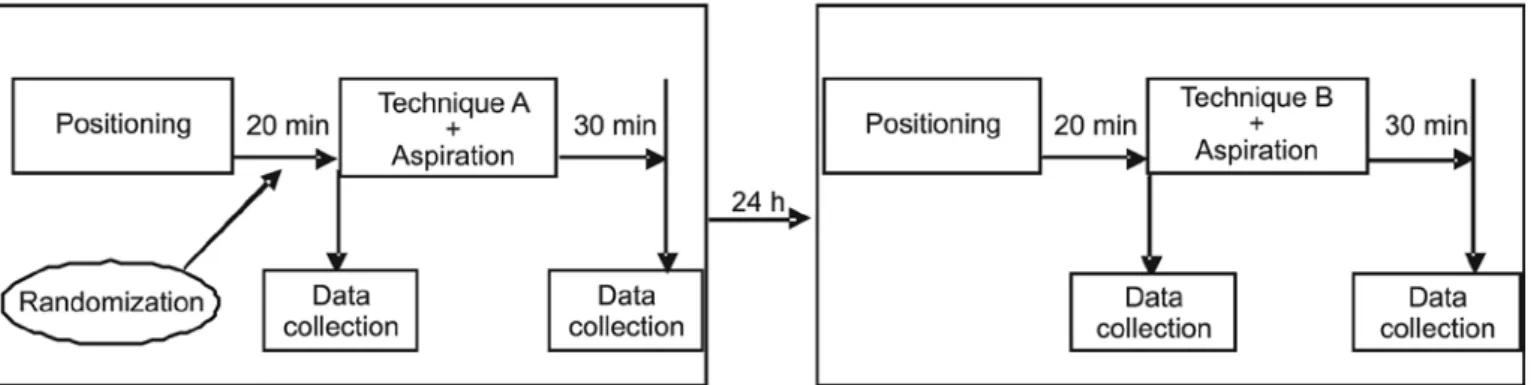
Initially all individuals in the sample were placed in supine position with the head at zero degrees with head, trunk and lower limbs stretched and in neutral position, this instant was deined as moment zero (MO). While patients were in this position for twenty minutes vari-ables of respiratory system compliance and oxygenation were collected. his irst data collection was deined as moment one (M1).
Next, patients were submitted to one of the physio-therapy techniques, with an approximate duration of ten minutes. Afterwards a tracheal suction was carried out according to recommendations of the American Asso-ciation of Respiratory Care.(16) hirty minutes after end
of the procedure a new data collection was made and deined as moment two (M2).
Twenty four hours later the patient was submitted to the other technique, according to the random order es-tablished at study onset following the model (Figure 1).
After conclusion of this study all patients received the physiotherapeutic care prescribed by the physician ac-cording to the ICU routine, without changes due to the survey.
Data collection
Collection of ventilatory parameters, vital signs and physiotherapeutic care was carried out by a single re-searcher, for standardization. he variables of compliance of the respiratory and cardiorespiratory systems: minute volume (MV), TV, PEEP, intrinsic positive end-expira-tory pressure (iPEEP) controlled pressure (CP) peak of inspiratory pressure (PIP) plateau pressure (PlateauP), heart rate (HR), mean arterial pressure (MAP) and SpO2 were collected.
Value of MV was collected, coupling the ventiloter (Ohmeda RM 121) to the expiratory valve of the me-chanical ventilator and an arithmetic mean of the three consecutive means was determined. TV was calculated by dividing MV by respiratory rate (RR), measured dur-ing MV collection. PEEP and PIP were collected on the manometer of the mechanical ventilator. PEEP was col-lected by occlusion of the expiratory valve of the ventila-tor, immediately before start of the next inspiration and PlateauP was collected by occluding the expiratory valve for ive seconds at end- inspiration, both shown on the ventilator manometer.
For calculation of Cdyn and Cst the following for-mulas were used: TV divided by the result of PIP sub-tracted from PEEP and iPEEP; TV divided by the result of PlateauP subtracted by the PEEP and iPEEP.
All patients who participated in the study were venti-lated with Servo 900C (Siemens-Elema, Solna, Sweden) or Sechrist 2200B (Anahein, California). Vital signs were collected by the non-invasive method, with a mul-tiparametric modular monitor model Compact Monitor Eagle 1000 (Marquete Hellige Medical System, Germa-ny). A module of the pulse oxymeter with sensor to read SpO2 was used, placed on the extremity of one of the upper limbs; a module with chest electrodes placed on the patient was used to read HR also, a module to mea-sure non- invasive arterial presmea-sure, placing a cuf on the proximal end of one of the upper limbs.
Statistical Analysis
Data with normal distribution was presented as mean ± standard deviation (SD) or absolute frequency (n) and percentage (%). he variable with asymmet-ric distribution (time of MV) was presented as median (minimum-maximum). For intragroup and intergroup comparison, the Wilcoxon test was used for paired sam-ples. Were considered as statistically signiicant p<0.05 values.
RESULTS
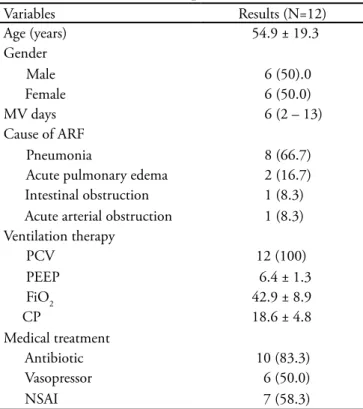
From January to May 2008, 14 patients were selected, 2 were excluded due to change of the ventilation mode, therefore 12 completed the study. Table 1 shows the ini-tial characteristics of studied patients.
Essentially, the reason for mechanical ventilation was pneumonia in eight patients (66.7%). Among
comor-bidities, chronic obstructive pulmonary disease was the most common, found in six patients (50%). Variables related to ventilation mode and to drug therapy at the moment prior to application of the physiotherapy tech-niques did not present a signiicant diference among groups (p=1.0). None of the patients made use of bron-chodlitaors.
Variables related to compliance of the respiratory system, TV, Cst and Cdyn did not signiicantly change in intergroup analysis at any of the assessed moments. Yet, intergroup analysis shows statistically signiicant changes 30 minutes after application of the techniques. In both groups there was an increase of TV, Cst and Cdyn (Table 2).
Hemodynamic variables, when analyzed between groups did not present a statistically signiicant difer-ence at any of the assessed moments (Table 3).
Table 3 – Hemodynamic variation in the manual rib-cage compression and the PEEP-ZEEP maneuver
HR (bpm) MAP (mmHg) MRC PEEP-ZEEP MRC PEEP-ZEEP Before 88±12 86±14 82±18 84±16 30 min 92±14 88±15 84±16 88±14
HR – heart rate; MAP mean arterial pressure; MRC manual rib-cage compression; PEEP-ZEEP - PEEP-ZEEP maneuver Values expressed in mean ± SDDP * p <0,05 when compared with the moment before protocol application.
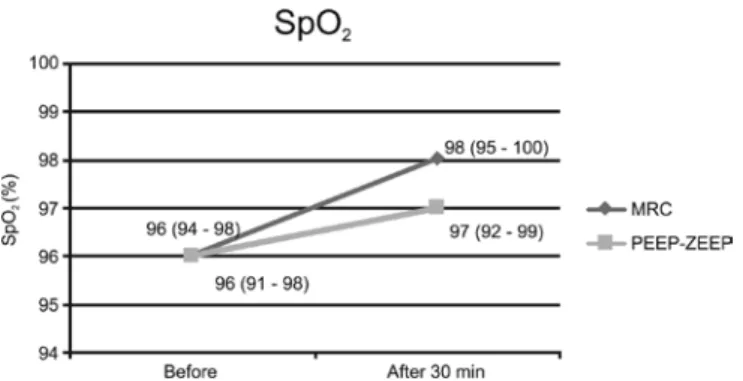
Regarding oxygenation, SpO2 did not present a signiicant diference when analyzed between groups, at the moment before (p=0.469) or 30 minutes after (p=0.191). In the MRC group, SpO2 increased with a signiicant diference and in the PEEP-ZEEP group it increased, however with no statistically signiicant dif-ference (Figure 2).
Table 2 – Variables of the respiratory system compliance
Before (N=12) After30 min (N=12) p Value** TV (mL) MRC 547 (380 – 705) 615 (427 – 842) 0.002
PEEP-ZEEP 561 (336 – 661) 610 (446 – 689) 0.002 p* 0.248 0.209
Cst (L/cmH2O) MRC 51.5 (29 – 68) 62 (36 – 71) 0.002 PEEP-ZEEP 49 (34 – 69) 54.5 (45 – 74) 0.002
p** 0.683 0.637
Cdyn (L/cmH2O) MRC 39.5 (20 – 47) 47 (25 – 53) 0.002 PEEP-ZEEP 35 (19 – 46) 41 (25 – 52) 0.002
p** 0.455 0.373
TV – tidal volume; Cst – static pulmonary compliance; Cdyn – dynamic pulmonary compliance; MRC – manual rib-cage compression; PEEP-ZEEP = positive end expiratory pressure/zero end expiratory pressure. p* - paired Wilcoxon test intragroups (before and after 30 min). p** - Paired Wilcoxon test between groups (MRC and PEEP-ZEEP).
Table 1 – Characteristics of the patients studied
Variables Results (N=12)
Age (years) 54.9 ± 19.3
Gender
Male 6 (50).0
Female 6 (50.0)
MV days 6 (2 – 13)
Cause of ARF
Pneumonia 8 (66.7)
Acute pulmonary edema 2 (16.7) Intestinal obstruction 1 (8.3) Acute arterial obstruction 1 (8.3) Ventilation therapy
PCV 12 (100)
PEEP 6.4 ± 1.3
FiO2 42.9 ± 8.9
CP 18.6 ± 4.8
Medical treatment
Antibiotic 10 (83.3)
Vasopressor 6 (50.0)
NSAI 7 (58.3)
Figure 2 – Peripheral oxygen saturation (SpO2). Values ex-pressed in median (minimum- maximum). p=0.011 when com-pared with the moment before application of manual rib-cage compression. MRC - manual rib-cage compression; PEEP-ZE-EP – positive end expiratory pressure-zero end expiratory pres-sure maneuver.
DISCUSSION
Techniques o bronchial clearance are often used in patients under IMV to prevent hypoxemia, atelectasis, and ventilator- associated pneumonia.(3) However, some
techniques such as MRC, continue to be controversial about their efects. Regarding PEEP-ZEEP, although it is disseminated among Brazilian physiotherapists, it was found in few publications on standardization of the methods and inluence on compliance of the respiratory and cardiovascular systems.(9,10)
When using the open suction system, no loss of lung volume and hypoxemia were disclosed at the collection carried out after thirty minutes. Furthermore, prior to suctioning patients were hyperoxygenated at a hundred percent during thirty seconds.(16) Studies have shown
that after suction there is a quick decrease in the airway pressures and consequent loss of lung volume due to the negative pressure generated in the airway that may also cause hypoxemia.(17-19)
In this study MRC and PEEP-ZEEP were carried out for 10 minutes, without a statistically signiicant difer-ence of TV between maneuvers. Diferently from our outcome, Unoki et al.(13) made a crossover study in 31
patients with various diseases, compared endotracheal suction with and without association of MRC for 5 min-utes, concluding that there was no signiicant diference in the intragroup analysis of MRC (p=0.93) in Cdyn, possibly due to the short time of application of the tech-nique. Another study did not detect a signiicant difer-ence of Cdyn after application of MRC, which may be associated to the variety of base diseases.(20)
he Cst increased signiicantly after 30 minutes of
ap-plication of both techniques (p=0.002), when compared to the respective MO. Another study that used PEEP-ZEEP found a decrease of Cst after 30 minutes. However, the ma-neuver was carried out waiting for ive ventilatory cycles and only then PEEP was reduced to a zero pressure level, associ-ated to MRC. hen, the patient was disconnected from the ventilator and endotracheal suctioning was performed. he maneuver was then repeated three times.(9)
In our study, for the intergroup analysis there was no statistically signiicant diference of TV between maneu-vers, nevertheless, at intragoup analysis there was a statis-tically signiicant increase (p=0.002) in both techniques. In another study, using MRC for 10 minnutes, TV did not signiicantly change, however, patients were submit-ted to diferent ventilation modes.(20)
SpO2 increased signiicantly after MRC, and did not exhibit the same behavior when carried out with PEEP-ZEEP. Likewise, Rodrigues(9) did not ind signiicant
change after application of PEEP-ZEEP in patients with bronchial hypersecretion. Rosa et al.(20) carried out MRC
for tem minutes and MH, disclosing a signiicantly in-creased SpO2 (p=0.01) immediately after application of the technique, remaining above the base value for 120 minutes. Although values obtained in our study showed a signiicant increase after application of MRC, this dif-ference was not clinically relevant considering that values are in accordance with the normality of SpO2 parameters. However, this increase may have taken place due to air-way clearance, fostering expansion of the collapsed areas and consequently, better oxygenation
It was decided to standardize PEEP-ZEEP with PEEP levels up to 15 cmH2O for ive ventilation cycles. Values above 15 cmH2O would induce alveolar hyperdistension and therefore drop of compliance.(21) PEEP-ZEEP was
performed for ten minutes to avoid hemodynamic varia-tions., Pressurization with 15 cmH2O for 15 minutes may change the cardiac index in patients at postoperrative of cardiac surgery.(22) PIP did not exceed the recommended
safe threshold values, patients did not present clinical evi-dence of injury to the respiratory system, since no case of barotrauma was found in our study notwithstanding use of PIP up to 40 cmH2O. he 3rd Brazilian Consensus on
Mechanical Ventilation (2007) advocated the PIP<50 cm-H2O and PlateauP<35 cmH2O values as maximum safety thresholds, capable of minimizing risk of barotrauma.(23)
removed by tracheal suctioning. In literature no studies analyzing the deleterious efects and the complications derived from application of the techniques were found.
Our study presents some limitations, that made gen-eralization of results unfeasible. Collection was not per-formed by a single evaluator who did not know to which group the patients belong. Base diseases were varied and may have interfered in the outcomes. Furthermore, it was not possible to analyze the subgroup according to base dis-ease, due to the small number of the sample, which also may have biased results. It must be taken into consider-ation that pulse oxymetry for parameters above 94% of SpO2 an approximate variation of 4% may take place.(21)
Consequently, comparison between efects of MRC versus PEEP-ZEEP according to diagnosis or mechanical venti-lation mode must be clariied in the future. herefore, care must be taken in an attempt to generalize our assumptions for all patients under mechanical ventilation.
CONCLUSION
MRC and PEEP-ZEEP have positive efects on the respiratory function and do not difer one from another in relation to compliance of the respiratory system, ex-pressed by Cdyn, Cst and TV after 30 minutes of ap-plication of the techniques. Regarding oxygenation a favorable behavior of SpO2 was found in the MRC group however not in the PEEP-ZEEP. Studies about each technique are needed for a better understanding of their efects thereby allowing consensus regarding the techniques that may be used and which are the expected beneits of their application.
RESUMO
Objetivos: Os pacientes com incapacidade de desempenhar suas funções ventilatórias podem ser submetidos à ventilação mecânica in-vasiva. A isioterapia respiratória atua no tratamento destes pacientes com a inalidade de melhorar sua função pulmonar. O objetivo do estudo foi avaliar os efeitos da compressão torácica manual versus a manobra de pressão expiratória inal positiva-pressão expiratória inal zero (PEEP-ZEEP) na complacência do sistema respiratório e na oxi-genação de pacientes em ventilação mecânica invasiva.
Métodos: Foi realizado um estudo bicêntrico, prospectivo, randomizado e crossover, incluindo pacientes em ventilação me-cânica invasiva em modo controlado por um período superior a 48 horas. Os protocolos de isioterapia respiratória foram reali-zados de forma aleatória, com intervalo de 24 horas entre eles. Dados da complacência do sistema respiratório e da oxigenação foram co letados antes da aplicação dos protocolos e 30 minutos após a aplicação dos mesmos.
Resultados: Doze pacientes completaram o estudo. Na
aná-lise intragrupo, em ambas as técnicas houve aumento estatistica-mente signiicativo do volume corrente (p=0,002), da complacên-cia estática (p=0,002) e complacêncomplacên-cia dinâmica (p=0,002). Com relação à oxigenação, no grupo compressão torácica manual, a saturação periférica de oxigênio aumentou com diferença signi-icativa (p=0,011).
Conclusões: A compressão torácica manual e a manobra de
PEEP-ZEEP têm efeitos clínicos positivos e não diferem entre si. Em relação à oxigenação encontramos um comportamento fa-vorável da saturação periférica de oxigênio no grupo compressão torácica manual.
Descritores: Pressão positiva contínua nas vias aéreas; Respi-ração com pressão positiva; Modalidades de isioterapia; Respira-ção artiicial/métodos; Terapia respiratória/métodos
REFERENCES
1. Knobel E, Barbas CSV, Scarpinella-Bueno MA, Rodrigues Júnior M. Terapia intensiva: pneumologia e isioterapia respi-ratória. 2a ed. São Paulo: Atheneu; 2004.
2. Scanlan CL, Wilkins RL, Stoller JK. Fundamentos da terapia respiratória de Egan. 7a. ed. São Paulo: Manole; 2000. 3. Judson MA, Sahn SA. Mobilization of secretions in ICU
pa-tients. Respir Care. 1994;39(3):213-26.
4. Ciesla ND. Chest physical therapy for patients in the intensi-ve care unit. Phys her. 1996;76(6):609-25.
5. Selsby D, Jones JG. Some physiological and clinical aspects of chest physiotherapy. Br J Anaesth. 1990;64(5):621-31. Com-ment in: Br J Anaesth. 1991;66(1):146-7.
6. Berney S, Denehy L, Pretto J. Head-down tilt and manual hyperinlation enhance sputum clearance in patients who are intubated and ventilated. Aust J Physiother. 2004;50(1):9-14.
7. Paratz J, Lipman J, McAulife M. Efect of manual hype-rinlation on hemodynamics, gas exchange, and respiratory mechanics in ventilated patients. J Intensive Care Med. 2002;17(6):317-24.
8. Stiller K. Physiotherapy in intensive care: towards and eviden-ce-based practice. Chest. 2000;118(6):1801-13.
9. Rodrigues MVH. Estudo do comportamento hemodinâmico, da troca gasosa, da mecânica respiratória e da análise do muco brônquico na aplicação de técnicas de remoção de secreção brônquica em pacientes sob ventilação mecânica. [tese]. São Paulo: Faculdade de Medicina da Universidade de São Paulo; 2007.
gas exchange in mechanically ventilated rabbits with induced atelectasis. Respir Care. 2004;49(8):896-901. Comment in: Respir Care. 2004;49(8):894. Respir Care. 2005;50(3):387; author reply 387-8.
12. Unoki T, Mizutani T, Toyooka H. Efects of expiratory rib cage compression and/or prone position on oxygenation and ventilation in mechanically ventilated rabbits with induced atelectasis. Respir Care. 2003;48(8):754-62.
13. Unoki T, Kawasaki Y, Mizutani T, Fujino Y, Yanagisawa Y, Ishimatsu S, et al. Efects of expiratory rib-cage compression on oxygenation, ventilation, and airway-secretion removal in patients receiving mechanical ventilation. Respir Care. 2005;50(11):1430-7.
14. Stiller K, Jenkis S, Grant R, Geake T, Taylor J, Hall B. Acute lobar atelectasis: a comparison of ive physiotherapy regimens. Physiother heory Pract. 1996;12:197-209.
15. Stiller K, Geak T, Taylor J, Grant R, Hall B. Acute lobar atelectasis. A comparison of two chest physiotherapy regi-mens. Chest. 1990;98(6):1336-40. Comment in: Chest. 1991;100(6):1741.
16. AARC clinical practice guideline. Endotracheal suctioning of mechani cally ventilated adults and children with artiicial airways.American Association for Respiratory Care. Respir Care. 1993;38(5):500-4.
17. Maggiore SM, Lellouche F, Pigeot J, Taille S, Deye N, Durr-meyer X, et al. Prevention of endotracheal suctioning-induced
alveolar derecruitment in acute lung injury. Am J Respir Crit Care Med. 2003;167(9):1215-24.
18. Cereda M, Villa F, Colombo E, Greco G, Nacoti M, Pesen-ti A. Closed system endotracheal sucPesen-tioning maintains lung volume during volume-controlled mechanical ventilation. Intensive Care Med. 2001;27(4):648-54.
19. Fernández MD, Piacentini E, Blanch L, Fernández R. Changes in lung volume with three systems of endotrache-al suctioning with and without pre-oxygenation in patients with mild-to-moderate lung failure. Intensive Care Med. 2004;30(12):2210-5.
20. Rosa FK, Roese CA, Kusiak F, Savi A, Dias AS, Monteiro MB. Comportamento da mecânica pulmonar após a aplicação de protocolo de isioterapia respiratória e aspiração traqueal em pacientes com ventilação mecânica invasiva. Rev Bras Ter In-tensiva. 2007;19(2):170-5.
21. Presto B, Presto LDN. Fisioterapia respiratória: uma nova vi-são. 2a. ed. Rio de Janeiro: Bruno Presto; 2005.
22. Auler JO Jr, Carmona MJ, Barbas CV, Saldiva PH, Mal-bouisson LM. he efects of positive end-expiratory pressu-re on pressu-respiratory system mechanics and hemodynamics in postoperative cardiac surgery patients. Braz J Med Biol Res. 2000;33(1):31-42.