Acute bag-valve breathing maneuvers plus manual
chest compression is safe during stable septic
shock: a randomized clinical trial
INTRODUCTION
Sepsis is a continuum of events that are triggered by serious infection.(1) he interaction between pro-inlammatory, anti-inlammatory and apoptotic mediators leads to circulatory failure, myocardial depression, increased metabolic rate and abnormalities in the oxygen demand/reserve ratio, contributing
Clarissa Netto Blattner1, Rafael Saldanha dos
Santos2, Fernando Suparregui Dias2,3, Alexandre
Simões Dias4, Régis Gemerasca Mestriner1,
Silvia Regina Rios Vieira5
1. Faculdade de Enfermagem, Nutrição e Fisioterapia, Pontifícia Universidade Católica do Rio Grande do Sul - Porto Alegre (RS), Brazil. 2. Hospital São Lucas, Pontifícia Universidade Católica do Rio Grande do Sul - Porto Alegre (RS), Brazil.
3. Intensive Care Unit, Hospital Pompeia - Caxias do Sul (RS), Brazil.
4. Department of Physical Therapy, Hospital das Clínicas de Porto Alegre, Faculdade de Medicina, Universidade Federal do Rio Grande do Sul - Porto Alegre (RS), Brazil.
5. Intensive Care Unit, Hospital das Clínicas de Porto Alegre, Faculdade de Medicina, Universidade Federal do Rio Grande do Sul - Porto Alegre (RS), Brazil.
Conflicts of interest: None
Submitted on June 30, 2016 Accepted on November 3, 2016
Corresponding author:
Clarissa Netto Blattner
Faculdade de Enfermagem, Nutrição e Fisioterapia da Pontifícia Universidade Católica do Rio Grande do Sul
Avenida Ipiranga, 6690
Zip code: 90619-900 - Porto Alegre (RS), Brazil E-mail: [email protected]
Responsible editor: Alexandre Biasi Cavalcanti
Uso da hiperinsulação manual combinada com pressão
expiratória positiva e compressão torácica é seguro durante o
choque séptico estável: um estudo clínico randomizado
DOI: 10.5935/0103-507X.20170004
Objective: To evaluate the efects of bag-valve breathing maneuvers combined with standard manual chest compression techniques on safety, hemodynamics and oxygenation in stable septic shock patients.
Design: A parallel, assessor-blinded, randomized trial of two groups. A computer-generated list of random numbers was prepared by an independent researcher to allocate treatments.
Setting: he Intensive Care Unit at
Hospital São Lucas, Pontifícia Universidade Católica do Rio Grande do Sul.
Participants: Fifty-two subjects were assessed for eligibility, and 32 were included. All included subjects (n = 32) received the allocated intervention (n = 19 for the Experimental Group and n = 13 for the Control Group).
Intervention: Twenty minutes of bag-valve breathing maneuvers combined with manual chest compression techniques (Experimental Group) or chest compression, as routinely used at our intensive care unit (Control Group). Follow-up was
performed immediately after and at 30 minutes after the intervention.
Main outcome measure: Mean artery pressure.
Results: All included subjects completed the trial (N = 32). We found no relevant efects on mean artery pressure (p = 0.17), heart rate (p = 0.50) or mean pulmonary artery pressure (p = 0.89) after adjusting for subject age and weight. Both groups were identical regarding oxygen consumption after the data adjustment (p = 0.84). Peripheral oxygen saturation tended to increase over time in both groups (p = 0.05), and there was no signiicant association between cardiac output and venous oxygen saturation (p = 0.813). No clinical deterioration was observed.
Conclusion: A single session of bag-valve breathing maneuvers combined with manual chest compression is hemodynamically safe for stable septic-shocked subjects over the short-term.
ABSTRACT
to global tissue hypoxia.(2,3) herefore, hemodynamic changes must be strictly monitored to minimize clinical complications.(4)
Currently, physiotherapy is widely used in intensive care units (ICUs) because it has positive efects in critically ill patients. hese beneits may result from the physiological efects of early mobilization and improved clearance of bronchial secretions.(5-7) Moreover, a previous Brazilian trial showed increased oxygen consumption (VO2) and decreased venous oxygen saturation (SvO2) due to an increase in the oxygen extraction rate (ERO2) after early mobilization in critically ill patients.(8)
However, animal studies have shown that manual hyperinlation leads to harmful efects, such as reduced cardiac output, compensatory vasoconstriction and increased systemic vascular resistance.(9) hus, hemodynamic changes that are inherent to the procedure might contraindicate chest physiotherapy in some clinical conditions, such as septic shock.
To address this issue, our research group recently evaluated the acute efects of chest manual compression techniques on hemodynamics, inlammatory proile and oxidative stress in septic shock patients; in the study, we observed increased oxygenation as well as reduced lactate levels and oxidative stress, with no changes in hemodynamics.(10) However, it remains unclear whether vigorous chest physiotherapy techniques, such as acute bag-valve breathing maneuvers combined with manual chest compression, afect hemodynamics and oxygenation in septic-shock patients.
he research questions asked were the following: What are the short-term efects of acute bag-valve breathing maneuvers (manual hyperinlation associated with positive end-expiratory pressure valve) combined with standard manual chest compression techniques on hemodynamics and oxygenation in stable septic-shock subjects? Is this procedure clinically safe over the short term?
he aim this study to evaluate the efects of bag-valve breathing maneuvers combined with standard manual chest compression techniques on safety, hemodynamics and oxygenation in stable septic shock patients.
METHODS
his study is a parallel, assessor-blinded, randomized trial of two groups (Experimental and Control Groups).
Participants were recruited from the ICU. Outcomes were measured before, immediately after and at 30 minutes after the intervention. Because the registration of clinical trials has become mandatory in Brazil since 2012, the current study was registered retrospectively in he Brazilian Clinical Trials Registry under the number RBR-283ZTS. he Pontifícia Universidade Católica do Rio Grande do Sul Ethics Committee approved this study. All participants gave their written informed consent before data collection began.
Eligible participants included all adults aged between 19 and 80 years with septic shock, using a pulmonary artery catheter (Swan-Ganz), and receiving mechanical ventilation. he exclusion criteria were pregnancy; acute myocardial infarction occurring less than three months before the study; previous chronic pulmonary disease; severely ill cardiac disease (heart ejection fraction < 30%); life expectancy of less than 24 hours; and impossibility of the family member or guardian signing the free, informed consent form. Overall, 52 subjects were assessed for eligibility, and 32 were included (Figure 1). he study took place at the ICU of the Hospital São Lucas, Porto Alegre, Brazil from August 2009 to February 2013. Hospital São Lucas is a reference hospital for sepsis treatment in South Brazil.
Intervention
Control Group subjects received 20 minutes of physiotherapy according to the hospital’s standard routine care (chest vibrocompression, passive manual expiratory therapy and compression-decompression maneuvers, promoting bronchial clearing and pulmonary re-expansion). he endotracheal tube was suctioned with a similar system and for an equivalent length of time to that applied in the Experimental Group.
All subjects remained in dorsal decubitus with the head of the bed at 40° to avoid bias during data collection. Mechanical ventilation values were adjusted in both groups according to the ICU’s routine: controlled volume setting, a tidal volume of 6 - 7mL/kg, and a fractional inspired oxygen concentration (FiO2) of 0.45 - 0.8.
For ethical reasons, we did not evaluate an additional Control Group (without physiotherapy care). Critically ill subjects usually receive daily chest compression as standard care in this ICU.
Outcome measures
In the current study, we tested the hypothesis that bag-valve breathing maneuvers (manual hyperinlation associated with positive end-expiratory pressure valve) plus manual chest compression would (1) not induce deleterious efects on hemodynamics and oxygenation in stable septic shock subjects and (2) be clinically safe over the short term, considering hemodynamics. he primary outcome was mean arterial pressure (MAP). Secondary outcomes were heart rate (HR); mean pulmonary artery pressure; pulmonary vascular resistance index; cardiac index; right ventricular ejection fraction; end diastolic volume index; arterial oxygen saturation (SpO2); central venous oxygen saturation (ScvO2); oxygen consumption rate (VO2); oxygen extraction rate; and oxygen delivery rate. All endpoints were measured before, immediately after, and 30 minutes after the intervention.
Randomization
Participants were randomly assigned following simple randomization procedures (based on computerized random numbers) to receive the experimental or control procedures. he computer-generated list of random numbers was prepared by an independent researcher. he allocation sequence was concealed from the researcher who enrolled and assessed the participants in sequentially numbered, opaque, sealed and stapled envelopes. After obtaining the patient’s consent, the researcher called a contact who was independent of the recruitment process for allocation consignment.
Blinding
he patients, physicians and physiotherapists were aware of the patient’s allocation (to the Experimental or Control Group), and the outcome assessors and data analysts were kept blinded to the allocation.
Data analysis
Sample size was calculated using previously published data from an animal model.(9) hese data were chosen because, to the best of our knowledge, the study from which it came was the most similar to ours at the time of the study design. Heart rate, MAP, and pulmonary artery pressure were used as the main endpoints. Twenty-six subjects were required (13 in each group) for a signiicance level of 5% and power of 85%, with one standard deviation as the expected efect size. Six extra subjects were recruited to allow for the possibility of losses or dropouts. Normally distributed data were expressed as the means ± standard deviation. Qualitative endpoints were described using absolute and relative frequencies. To evaluate group homogeneity before the intervention, the independent Student t-test or the Mann-Whitney test were applied, depending on the data proile. Pearson’s Chi-square test was applied to compare qualitative parameters between the groups. Analysis of Variance (ANOVA) or repeated measures ANOVA were used for inter and intragroup comparisons. Bonferroni post hoc tests were performed as indicated. Analysis of Covariance (ANCOVA) for repeated measures was used to control for confounding factors. he results were considered signiicant when p ≤ 0.05. SPSS
Table 1 - General characteristics of the patients
Variables
Experimental Group (N = 19)
Control Group (N = 13)
p value
Age 46.4 ± 18.6 61.2 ± 15.4 0.025 Weight 75.6 ± 12.3 86.7 ± 15.9 0.034 Height 170.5 ± 8.6 171.2 ± 11.9 0.863
Sex 0.770
Male 8 (42.1) 7 (53.8)
Feminino 11 (57.9) 6 (46.2) Mechanical
ventilation duration
7.00 ± 4.48 6.31 ± 2.63 0.587
Type of sepsis
0.261 Urinary 4 (21.1) 5 (38.5)
Pulmonary 10 (52.6) 3 (23.1) Abdominal 4 (21.1) 5 (38.5)
Liver 1 (5.3) 0 (0.0)
SOFA 13.61 ± 4.7 14.21 ± 3.9 0.210 Vasopressor
(mc/kg/minuto) 0.20 ± 0.09 0.22 ± 0.09 0.647
Death 10 (52.6) 9 (69.2) 0.567
SOFA - Sequential Organ Failure Assessment Score. The results are expressed as number (%) and means ± standard deviation.
18.0 (Statistical Package for the Social Sciences, Inc., Chicago, USA) was used to analyze the data.
RESULTS
Flow of participants, therapists, and centers through the study
Recruitment and data collection were carried out between August 2009 to February 2013.
Overall, 52 subjects were assessed for eligibility, of which 32 were included. Nineteen subjects were allocated to the Experimental Group, and 13 were allocated to the Control Group. No complications occurred during the control or the intervention procedures. All included subjects (n = 32) received the allocated intervention (n = 19 for the Experimental Group; n = 13 for the Control Group) and were included in the data analysis. he baseline characteristics of the subjects are shown in table 1.
he intervention group consisted of younger subjects who weighed less. Repeated measures ANCOVA was performed to control for any sample bias (adjustments for age and weight factors). As expected, no signiicant diferences were detected after ANCOVA adjustment.
Mean arterial pressure, the primary outcome, did not signiicantly difer (p > 0.05) between the Experimental (baseline: 84.0 ± 9.3mmHg; 30 minutes later: 84.7 ± 12.8mmHg) and Control (baseline: 76.7 ± 14.1mmHg; 30 minutes later: 78.8 ± 13.0mmHg) Groups. Because the groups did not signiicantly difer, an efect size was not calculated. No adverse events or side efects occurred. his inding was expected the because hemodynamic changes induced by septic shock and the Swan-Ganz catheter indication are usually independent of age and body mass index. We found diferences in MAP when testing “group main efects” (adjusted for age and weight) (p = 0.029). However, there were no additional time-point main efects (before, immediately after, or at 30 min after the intervention) (p = 0.647) or “time-point” and “group” interaction efects (p = 0.318), suggesting this MAP diference was unrelated to the experimental procedures. he baseline values of oxygen saturation (SaO2)(94.2 ± 3.6), HR (106.1 ± 13.7), MAP (84.0 ± 9.3) and VO2 (146.0 ± 70.3) showed that the subjects were hemodynamically stable at baseline.
Hemodynamic impact of the procedures
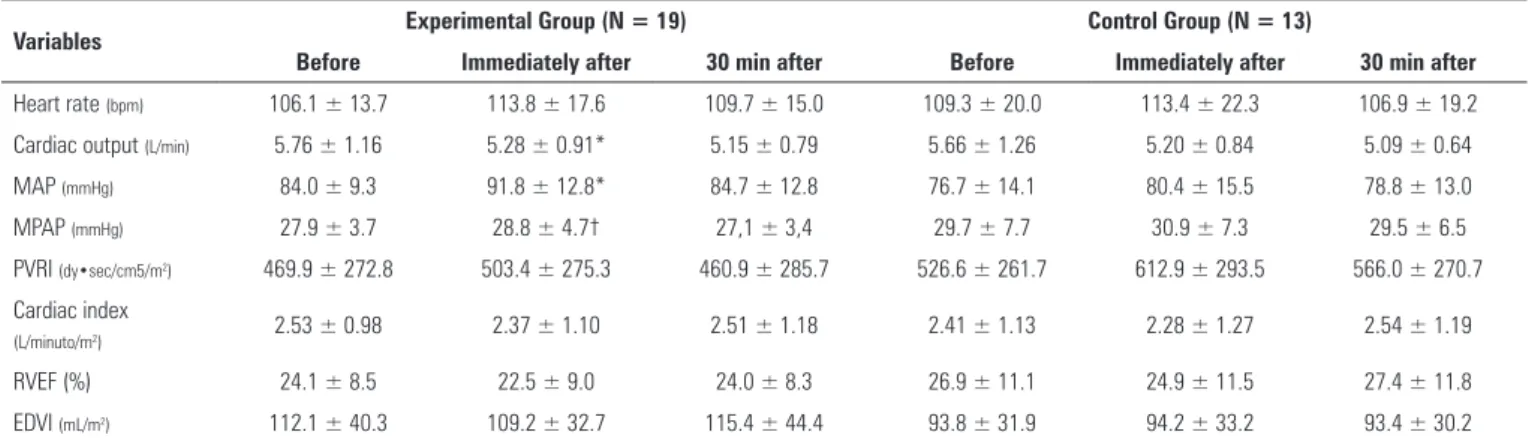
he intragroup comparison (repeated measures) is shown in table 2. We found a hyperacute “time efect” in HR, cardiac output, MAP and mean pulmonary artery
pressure values. However, these diferences were not found to be signiicant when the data were adjusted for subject age and weight (Table 2). Subtle diferences are expected because suctioning usually impacts hemodynamics acutely. In addition, there was a subtle transient rise in MAP after bag valve maneuver, which returned to values similar to those at baseline and those of the control group within 30 minutes. No clinically relevant changes were observed in the analyzed data.
Oxygenation impact of the procedures
Oxygenation data are shown in table 3. here was an isolated “time efect” on SAO2 (p < 0.001), which remained signiicant after ANCOVA adjustments (for age and weight, p = 0.05). his inding showed that oxygen saturation tended to increase over time in both groups. However, no diferences between groups were found (p > 0.05). Our data showed a signiicant increase in VO2 at 30 minutes after the intervention (p = 0.01). No diferences were found in the Control Group (p = 0.39). However, these efects were not signiicant after ANCOVA adjustments for age and weight (Table 3). Moreover, no signiicant association was found between cardiac output and ScvO2 (p = 0.813).
DISCUSSION
Physiotherapy has been shown to have several beneits for critically ill patients. Bronchial clearance, the prevention and resolution of atelectasis, increased gas exchange, and improved inspiratory muscle performance are examples of physiotherapy goals in ICUs.(11-14) his
Table 2 - Hemodynamic variables according to group and moment evaluated
Variables Experimental Group (N = 19) Control Group (N = 13)
Before Immediately after 30 min after Before Immediately after 30 min after
Heart rate (bpm) 106.1 ± 13.7 113.8 ± 17.6 109.7 ± 15.0 109.3 ± 20.0 113.4 ± 22.3 106.9 ± 19.2 Cardiac output (L/min) 5.76 ± 1.16 5.28 ± 0.91* 5.15 ± 0.79 5.66 ± 1.26 5.20 ± 0.84 5.09 ± 0.64 MAP (mmHg) 84.0 ± 9.3 91.8 ± 12.8* 84.7 ± 12.8 76.7 ± 14.1 80.4 ± 15.5 78.8 ± 13.0 MPAP (mmHg) 27.9 ± 3.7 28.8 ± 4.7† 27,1 ± 3,4 29.7 ± 7.7 30.9 ± 7.3 29.5 ± 6.5 PVRI (dy•sec/cm5/m2) 469.9 ± 272.8 503.4 ± 275.3 460.9 ± 285.7 526.6 ± 261.7 612.9 ± 293.5 566.0 ± 270.7
Cardiac index
(L/minuto/m2) 2.53 ± 0.98 2.37 ± 1.10 2.51 ± 1.18 2.41 ± 1.13 2.28 ± 1.27 2.54 ± 1.19
Table 3 - Oxygenation variables according to group and moment evaluated
Variables Intervention Group (N = 19) Control Group (N =13)
Before Immediately after 30 min after Before Immediately after 30 min after
SaO2 94.2 ± 3.6 94.2 ± 3.6* 97.6 ± 2.1 94.5 ± 3.8 96.1 ± 3.9 97.1 ± 2.4 SvO2 69.8 ± 7.5 71.8 ± 9.8 75.7 ± 7.8 72.7 ± 12.0 72.7 ± 12.0 71.9 ± 8.3 VO2 146.0 ± 70.3 147.1 ± 70.8† 165.9 ± 72.9 158.1 ± 101.8 145.9 ± 60.8 156.1 ± 56.7
ERO2 24.1 ± 6.6 25.8 ± 7.9 26.2 ± 9.8 24.1 ± 11.6 26.5 ± 8.9 27.0 ± 8.5 DO2 512.8 ± 120.3 536.3 ± 119.7 538.2 ± 120.3 516.2 ± 195.2 492.2 ± 141.6 491.7 ± 135.4
SaO2 - arterial oxygen saturation; SvO2 - venous oxygen saturation; VO2 - oxygen consumption rate; ERO2 - oxygen extraction rate; DO2 - oxygen delivery rate; min - minutes. Values expressed as the means ± standard deviation. *p < 0.001; †p = 0.030.
study was conducted in an ICU in which all mechanically ventilated patients usually receive respiratory and motor physiotherapy procedures three times per day.
his study showed that both procedures, chest compression or bag-valve breathing maneuvers combined with chest compression, tend to increase SaO2 in stable septic-shock subjects without short-term clinically relevant changes in hemodynamics. Although our main goal was to test acute hemodynamics safety, the lack of diferences in the results obtained between the two techniques is important to highlight. his interesting inding may be explained by two hypotheses. First, to ind clinically relevant diferences between the used chest physiotherapy techniques after applying both in a single session is unlikely.(7,11) Second, while previous studies have suggested that chest physiotherapy induces beneicial efects on airway clearance, preventing ventilation-associated pneumonia, pulmonary complacence and resistance,(15-18) the studied protocols applied a wide combination of techniques. hus, the clinical beneits of chest physiotherapy might be provided when using techniques in combination.(11) Regardless, it seems premature to draw conclusions regarding the clinical efectiveness of the studied techniques based only on the current trial data. Further research is needed to clarify the previously mentioned hypotheses.
Hemodynamic monitoring has been the subject of studies in critical care research.(4,9,19) A previous randomized clinical trial has shown that the use of a positive expiratory pressure (PEP) mask can signiicantly increase mean arterial pressure, mean pulmonary artery pressure, central venous pressure and pulmonary artery occlusion pressure. However, these diferences were considered not to have a relevant harmful clinical impact on hemodynamic stability. Indeed, positive expiratory pressure might provide several
beneits to patients, such as lung re-expansion and airway clearance optimization.(20,21) In similar studies, increased PaO2 and SaO2 with decreased PaCO2 were observed. An improvement in respiratory mechanics and bronchial clearance was correlated with this efect.(10)
Our indings are in agreement with these studies. We showed that the bag-valve breathing maneuvers combined with manual chest compression induced no relevant hemodynamic changes or clinical deterioration. he subtle hyperacute diferences that were observed immediately after the control and intervention procedures were probably similar to those observed during routine standard care, i.e., airway suctioning, decubitus change or body hygiene care. Although we tested the efects of the bag-valve breathing maneuver on acute hemodynamics safety, a possibleprocedure-related secondary lung injury(16) was not assessed. However, we adopt acute bag-breathing maneuvers only up to 40cmH2O (manometer-controlled) as a protective strategy to avoid lung injury as suggested in the literature.(15) his study limitation represents a possible subject for further investigation. Cardiovascular complications in sepsis are associated with poor outcome.(1) In septic shock, the oxygen consumption/delivery rate is critical. hus, hemodynamic proile should be strictly controlled to support patient metabolic demand.(22)
Septic patients have a high VO2 and are highly dependent on its supply. he increase in VO2 associated with the reduction in oxygen extraction through the peripheral tissues can impair the microcirculation and result in tissue hypoxia. In addition, the diminished venoarterial diference suggests that oxygen is not able to reach the peripheral tissues.(24)
Our results showed that oxygen saturation tended to increase over time in both groups in agreement with the literature.(25) Moreover, we found no important efects on VO2 when the data were adjusted for age and weight. his inding suggests that short-term physiotherapy efects are unrelated to harmful VO2 increases.(24) Furthermore, bag-valve breathing maneuvers did not promote additional beneits over the short term when compared to conventional chest physiotherapy. Because only one session was applied, further trials are necessary to clarify the long-term efects of bag-breathing maneuvers on hemodynamics safety as well as its therapeutic efects.
his study has several limitations. he Swan-Ganz catheter, an invasive device for monitoring, provides accurate hemodynamics data.(26) Contrariwise, to the best of our knowledge, few studies have used this catheter to assess the efects of physiotherapeutic techniques, a fact that can be explained by the restricted medical indication of the Swan-Ganz catheter. Paradoxically, while the catheter provides high-quality data, it is important to consider limitations in its external validity. For example, our ICU cares for an average of 12 Swan-Ganz monitored subjects every year. herefore, our indings cannot be extrapolated to all critically ill patients.
Furthermore, the inclusion of subjects with distinct septic foci might have resulted in selection bias. In addition, metabolic parameters, such as plasmatic lactate and calorimetric measures, were not assessed. hese endpoints could be the subject of further clinical trials that are designed to clarify the biochemical mechanisms that are related to chest physiotherapy procedures.
Because the included septic-shocked subjects were critically ill,(1) secondary measurements (i.e., mortality rate, number of days under mechanical ventilation, length of stay in the ICU and ventilator-associated pneumonia) were highly inluenced by organ dysfunction/failure
(data not shown). hus, it was impossible to establish the statistical weight (contribution) of the physiotherapy techniques (applied in a single session) on hard outcomes using the present sample size. Further trials are needed to elucidate this point.
CONCLUSION
In conclusion, a combination of acute bag-valve breathing maneuvers with chest compression techniques was safe and had no deleterious hemodynamic efects over the short term. Subtle diferences at baseline were not clinically relevant. Finally, oxygen saturation tended to increase over time in both groups, demonstrating that the evaluated techniques produced a signiicant beneit. Long-term trials are required to elucidate the size efect and biochemical mechanisms of diferent chest physiotherapy protocols in septic-shocked subjects.
Overall, we conclude that a single session of bag-valve breathing maneuvers combined with manual chest compression is hemodynamically safe for stable septic-shocked subjects over the short term. However, no acute beneits were observed compared to the usual care given.
ACKNOWLEDGEMENTS
he authors would like to thank the intensive care staf of Hospital São Lucas, Pontifícia Universidade Católica do Rio Grande do Sul. his study was inanced by the Brazilian funding agencies Conselho Nacional de Desenvolvimento Cientíico e Tecnológico (CNPq), Coordenação de Aperfeiçoamento de Pessoal de Nível Superior (CAPES), and
Fundação de Amparo à Pesquisa do Estado do Rio Grande do Sul (FAPERGS).
Author contributions
Objetivo: Avaliar os efeitos de manobras de hiperinsulação manual combinadas com pressão expiratória positiva associadas com técnicas padrão de compressão manual do tórax, com rela-ção à segurança, à hemodinâmica e à oxigenarela-ção em pacientes com choque séptico estável.
Delineamento: Este foi um estudo com dois grupos pa-ralelos, randomizado e com avaliador cego. Um pesquisador independente preparou uma lista de randomização gerada por computador para alocação dos tratamentos.
Local: Unidade de terapia intensiva do Hospital São Lucas, Pontifícia Universidade Católica do Rio Grande do Sul.
Participantes: Foram avaliados 52 indivíduos quanto à elegibilidade e, destes, 32 pacientes foram incluídos no estudo. Todos os indivíduos incluídos (n = 32) receberam a intervenção alocada (n = 19 para o Grupo Experimental e n = 13 para o Grupo Controle).
Intervenção: Vinte minutos de manobras de hiperinsula-ção manual combinadas com pressão expiratória positiva as-sociadas com técnicas padrão de compressão manual do tórax (Grupo Experimental) ou compressão do tórax, conforme o uso
RESUMO
Descritores: Terapia respiratória; Exercícios respiratórios; Choque séptico; Unidades de terapia intensiva; Controle das vias aéreas
rotineiro de nossa unidade de terapia intensiva (Grupo Contro-le). Foi realizado seguimento imediatamente após e 30 minutos após a intervenção.
Principal métrica de desfecho: Pressão arterial média.
Resultados: Todos os indivíduos inscritos concluíram o es-tudo (n = 32). Não identiicamos efeitos relevantes na pressão arterial média (p = 0,17), frequência cardíaca (p = 0,50) ou pres-são média da artéria pulmonar (p = 0,89) após ajuste quanto à idade e ao peso do participante. Após ajuste dos dados, ambos os grupos foram idênticos com relação ao consumo de oxigênio (p = 0,84). A saturação periférica de oxigênio tendeu a aumentar com o tempo em ambos os grupos (p = 0,05), e não ocorreu as-sociação signiicante entre o débito cardíaco e a saturação venosa de oxigênio (p = 0,813). Não se observou deterioração clínica.
Conclusão: Uma única sessão de manobras de hiperinsu-lação manual combinadas com pressão expiratória positiva as-sociadas com técnicas padrão de compressão manual do tórax é hemodinamicamente segura em curto prazo para pacientes com choque séptico estável.
Quick Look
Current Knowledge: Chest physiotherapy techniques show positive efects in critically ill patients. However, the safety and efectiveness of chest compressions and bag-valve breathing maneuvers are unknown in septic-shock subjects.
What this paper contributes to our knowledge: his randomized clinical trial shows that manual chest compression combined or not combined with bag-valve breathing maneuvers are hemodynamically safe over the short term in stable septic-shocked subjects.
REFERENCES
1. Dellinger RP, Levy MM, Rhodes A, Annane D, Gerlach H, Opal SM, Sevransky JE, Sprung CL, Douglas IS, Jaeschke R, Osborn TM, Nunnally ME, Townsend SR, Reinhart K, Kleinpell RM, Angus DC, Deutschman CS, Machado FR, Rubenfeld GD, Webb S, Beale RJ, Vincent JL, Moreno R; Surviving Sepsis Campaign Guidelines Committee including The Pediatric Subgroup. Surviving Sepsis Campaign: international guidelines for management of severe sepsis and septic shock, 2012. Intensive Care Med. 2013;39(2):165-228.
2. Maddirala S, Khan A. Optimizing hemodynamic support in septic shock using central and mixed venous oxygen saturation. Crit Care Clin. 2010;26(2):323-33, table of contents.
3. Otero RM, Nguyen HB, Huang DT, Gaieski DF, Goyal M, Gunnerson KJ, et al. Early goal-directed therapy in severe sepsis and septic shock revisited: concepts, controversies, and contemporary findings. Chest. 2006;130(5):1579-95.
4. Cutts S, Talboys R, Paspula C, Prempeh EM, Fanous R, Ail D. Adult respiratory distress syndrome. Ann R Coll Surg Engl. 2017;99(1):12-6. 5. Wong WP, Paratz JD, Wilson K, Burns YR. Hemodynamic and ventilatory
effects of manual respiratory physiotherapy techniques of chest clapping, vibration, and shaking in an animal model. J Appl Physiol (1985). 2003;95(3):991-8.
6. Zeppos L, Patman S, Berney S, Adsett JA, Bridson JM, Paratz JD. Physiotherapy in intensive care is safe: an observational study. Aust J Physiother. 2007;53(4):279-83.
7. Ciesla ND. Chest physical therapy for patients in the intensive care unit. Phys Ther. 1996;76(6):609-25.
8. Savi A, Maia CP, Dias AS, Teixeira C. Hemodynamic and metabolic effects of passive leg movement in mechanically ventilated patients. Rev Bras Ter Intensiva. 2010;22(4):315-20.
10. dos Santos RS, Donadio MV, da Silva GV, Blattner CN, Melo DA, Nunes FB, et al. Immediate effects of chest physiotherapy on hemodynamic, metabolic, and oxidative stress parameters in subjects with septic shock. Respir Care. 2014;59(9):1398-403.
11. Stiller K. Physiotherapy in intensive care: towards an evidence-based practice. Chest. 2000;118(6):1801-13.
12. Borghi-Silva A, Mendes RG, Costa Fde S, Di Lorenzo VA, Oliveira CR, Luzzi S. The influences of positive end expiratory pressure (PEEP) associated with physiotherapy intervention in phase I cardiac rehabilitation. Clinics (Sao Paulo). 2005;60(6):465-72.
13. Pasquina P, Tramèr MR, Walder B. Prophylactic respiratory physiotherapy after cardiac surgery: systematic review. BMJ. 2003;327(7428):1379. 14. Denehy L, Berney S. The use of positive pressure devices by
physiotherapists. The Eur Respir J. 2001;17(4):821-9.
15. Lobo DM, Cavalcante LA, Mont’Alverne DG. Applicability of bag squeezing and zeep maneuvers in mechanically ventilated patients. Rev Bras Ter Intensiva. 2010;22(2):186-91.
16. Moreira FC, Teixeira C, Savi A, Xavier R. Changes in respiratory mechanics during respiratory physiotherapy in mechanically ventilated patients. Rev Bras Ter Intensiva. 2015;27(2):155-60.
17. Hodgson C, Denehy L, Ntoumenopoulos G, Santamaria J, Carroll S. An investigation of the early effects of manual lung hyperinflation in critically ill patients. Anaesth Intensive Care. 2000;28(3):255-61.
18. Ntoumenopoulos G, Presneill JJ, McElholum M, Cade JF. Chest physiotherapy for the prevention of ventilator-associated pneumonia. Intensive Care Med. 2002;28(7):850-6.
19. Jellema WT, Groeneveld AB, van Goudoever J, Wesseling KH, Westerhof N, Lubbers MJ, et al. Hemodynamic effects of intermittent manual lung hyperinflation in patients with septic shock. Heart Lung. 2000;29(5):356-66.
20. Santos Sena AC, Ribeiro SP, Condessa RL, Vieira SR. Expiratory positive airway pressure in postoperative cardiac hemodynamics. Arq Bras Cardiol. 2010;95(5):594-9.
21. AARC clinical practice guideline. Use of positive airway pressure adjuncts to bronchial hygiene therapy. American Association for Respiratory Care. Respir Care. 1993;38(5):516-21.
22. Rangel-Frausto MS, Pittet D, Hwang T, Woolson RF, Wenzel RP. The dynamics of disease progression in sepsis: Markov modeling describing the natural history and the likely impact of effective antisepsis agents. Clin Infect Dis. 1998;27(1):185-90.
23. Krafft P, Steltzer H, Hiesmayr M, Klimscha W, Hammerle AF. Mixed venous oxygen saturation in critically ill septic shock patients. The role of defined events. Chest. 1993;103(3):900-6.
24. Troskot R, Simurina T, Zizak M, Majstorovic K, Marinac I, Mrakovcic-Sutic I. Prognostic value of venoarterial carbon dioxide gradient in patients with severe sepsis and septic shock. Croat Med J. 2010;51(6):501-8. 25. Berney S, Denehy L. The effect of physiotherapy treatment on oxygen
consumption and haemodynamics in patients who are critically ill. Aust J Physiother. 2003;49(2):99-105.