184e
Rev Bras M ed Esporte _ Vol. 12, Nº 4 – Jul/Ago, 2006 1. Corpo & Água Sports Center – Petrópolis, RJ.2. Programa de Pós-Graduação em Saúde Coletiva – Instituto de M edicina Social – UERJ. Laboratório de Atividade Física e Promoção da Saúde – LABSAU / UERJ. Universidade Católica de Petrópolis (UCP), Instituto de Desenvolvimento e Pesquisa em Atividades Físicas – IDEATIVA. Received in 3 / 8 / 05. Final version received in 26/ 10/ 05. Approved in 17 / 4 / 06. Correspondence to: M ichele Heinen Alves da Silva, Rua Duarte da Silvei-ra, 415, Bingen – 25665-470 – Petrópolis, RJ. E-mail: micheleheinen@ig. com.br
Development of the running test in shallow w ater for
w omen engaged in w ater exercises: reliability and
norms for evaluation of the distance covered
M ichele Heinen Alves da Silva1 and Geraldo de Albuquerque M aranhão Neto2
O
RIGINALA
RTICLEKeyw ords: Aerobic exercise. Physical fitness. Fitness assessment.
ENGLISH VERSION
ABSTRACT
An increasing number of people have been looking for w ater exercises w ith the purpose of improving overall physical fitness. How ever, only a limited number of tests assess aerobic fitness, as w ell as evaluate the performance of practitioners of different age groups in w ater. The main goals of the present study is to intro-duce a running test for shallow w ater to evaluate w omen of differ-ent age groups according to the maximal distance covered during 12 minutes, and to investigate the test-retest reliability of this pro-cedure. Our sample consisted of 135 w omen betw een 21 and 84 years of age, w ho w ere already adapted to the w ater. Seventeen w omen w ere randomly selected for the test-retest reliability study, and w ere retested w ithin one w eek. We observed a high Intrac-lass Correlation Coefficient (ICC) for the test-retest reliability (ICC = 0.91), suggesting a high degree of consistence betw een mea-surements. We also observed an inverse and significant relationship betw een age and distance covered during the test (r = –0.69). The distance covered during the test w as also significantly correlated w ith the heart rate at the end of the test (FC12). This association w as not influenced by age, according to the multiple regression and partial correlation analyses conducted (r = 0.35). We ordered the results for the distance covered during the test for each age group in quintiles, w hich are proposed as norms for the evaluation of the performance. Although the test results w ere not compared w ith data obtained from a gold-standard measure of cardiorespira-tory fitness (i.e. direct maximal oxygen uptake assessment), they are consistent w ith literature reports on the topic. This suggests that the proposed test has a good content validity. This manuscript provides evidence that the 12-min-run test in shallow w ater is reli-able. It may also serve as a reference for future studies on criteri-on validity and ccriteri-oncurrent validity. Future studies criteri-on the sensitivity of the test in detecting training adaptations are also granted.
INTRODUCTION
Water exercises have been expressively spreading in the last decades and the number of practitioners of this kind of exercise is still increasing. Such fact may be due to the low er incidence of ostearticular and muscle lesions in the w ater medium(1) and the
easi-ness that people w ith thiscondition find in exercising in w ater. How ever, many healthy people are searching for w ater exercises,
remarkably the w ater gymnastics, as a physical activity option and w ith the aim to improve overall physical fitness-health related(2).
Among the components of overall physical fitness, the cardio-respiratory fitness is one of the most important and its improve-ment is related to health(3-4). M aximal or submaximal effort tests,
mainly done in ergometers such as treadmills or bicycles, are nec-essary to assess it. How ever, the lack of specificity of these ergo-meters for the w ater gymnastics practitioners is a limiting factor, and may be inaccurate in the evaluation and consequently in the control of its evolution.
Since it is a cycle activity, as sw imming and running, it is not simple to develop a test to specifically and reliably evaluate the cardiorespiratory fitness in w ater gymnastics. In order to minimize such problem, some researchers proposed running tests in w ater and verified the criterion related validity comparing the results to maximal effort tests and using the direct measure of the maximal oxygen consumption(5-8). Some studies w ere able to generate
equa-tions to predict the VO2max considering variables such as body fat, w eight and height. Although these studies have been validated(7-8),
none of them proposed gender or age group classification that could indicate the level of cardiorespiratory fitness. Probably, such fact is related to the reduced number of participants in these studies.
M oreover, the age group verified (up to 30 years of age) limits the results generalization, since the w ater gymnastics is one of the most w anted activity among the elderly(9). The lack of studies
specifically developed for individuals in this age group is a reason w hy not even proposals of results classification according to age are suggested.
Another noticed limitation in the mentioned studies lies on the lack of movements standardization. The w ater running could be done using many different combinations of arms and legs move-ments, w hich may facilitate or make the dislocation difficult.
Thereby, the aim of the present study w as to propose a 12 minute-running test for shallow w ater w ith standardized move-ments, that may generate a classification of the distance covered, for w omen of different age groups and that is close to the charac-teristics of the considered activity. Furthermore, the test-retest reliability w as verified in order to demonstrate the accuracy and stability of the found results.
M ETHODOLOGY
Rev Bras M ed Esporte _ Vol. 12, Nº 4 – Jul/Ago, 2006
185e
Six instructors previously trained applied the test in a 12 m long, 4 m w ide and around 116 and 132 cm deep pool, w hich left the volunteers w ith w ater at their xiphoid process level during the exercise. The w ater temperature varied from 30,5°C to 31,0°C. Weight and height (Welmy®scale w ith stadiometer) w ere
mea-sured, w ith all participants w earing bathing suits comfortable for the physical activity in w ater medium. No specific foot gear w as used; all volunteers took the test bare feet. Afterw ards, they w ere all informed about the movements’ standardization. The running performances w ith the arms outside the pool or pushing the edg-es of the pool w ith hands or feet w ere not allow ed. The partici-pants could only touch the edge w ith one of the hands and return in the same depth. The heart rate w as checked at the end of the 12 min (HR12) using Polar A1 frequency meters.
The running movements w ere standardized so that the knees w ould not surpass the hip line and the upper body w ould be slight-ly leaned over. The arms w ere submerse and w ere moved similar-ly to the breast style sw imming stroke.
This standardization is due to fact that a previous pilot study had been conducted to verify w hich movements w ould favor the verti-cal dislocation, giving more balance and security to the volunteers. Another reason, w as to give priority to movements that w ould use the highest possible number of muscular groups, once the main muscular groups are used in the majority of the classes, and for that reason, standard movements w ere tried for a more specif-ic test.
The decision w hether foot gear w ould be used w as part of the pilot study as w ell. Since the participants show ed adaptation prob-lems to the slippers, it w as decided to have them bare feet. It w as preestablished that the test w ould be interrupted in case disloca-tion difficulty for any reason w as characterized.
All volunteers w ould get in the pool and stay at the edge in the given depth (w ith w ater at the xiphoid process level). A w arm-up lap w as conducted w ith the movements that w ould be later used The intensity for this lap w as established as Poor (2), according to the Borg Subjective Effort Scale (CR-10). After this lap, the 12 min-utes of uninterrupted running w ere timed, in the highest possible speed.
The pool’s edges w ere marked at every meter in order to verify if the distance w as being correctly measured. Besides the distance marking, the movements w ere controlled to assert correction and verbal motivation w as given so that the volunteers w ould run as fast as they could.
17 participants w ere randomly selected in order to verify the test-retest reliability of the covered distance. These participants took the test tw o times, w ith a w eek interval. The Intra-Class Cor-relation Coefficient w as used for the calculation (ICC).
The Pearson Correlation w as initially used to analyze the associ-ation betw een age and HR12 and betw een w eight and height in the completed distance. The calculations of a stepw ise forw ard multiple regression equation and partial correlation w ould be later done, if necessary, the latter to verify the association of a variable w ithout interference of the former.
M oreover, the quintiles (division in five parts) of the distribution of the results by age group w ere calculated in order to establish a possible classification of the performance by age.
All analyses, besides the descriptive statistics, w ere conducted through the Stata Standard Edition 8.0 softw are, taking a signifi-cance level of p < 0,05.
RESULTS
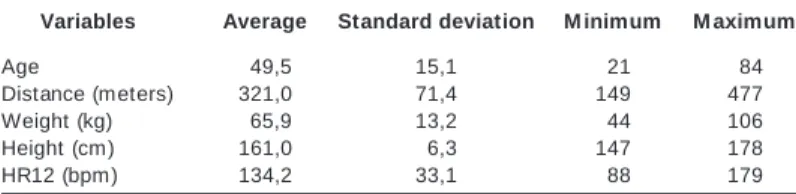
Table 1 presents the descriptive statistics related to age, com-pleted distance, w eight, height and 12 HR.
In the test-retest reliability analysis, the ICC obtained w as of 0,91, w hich demonstrates a good agreement betw een the com-pleted distance in the tw o tests, suggesting that it is able to present
quite stable results in a w eek period. The descriptive statistics related to the tw o tests can be found in table 2.
TABLE 1
Descriptive statistics of the collected variables
Variables Average Standard deviation M inimum M aximum
Age 049,5 15,1 021 084
Distance (meters) 321,0 71,4 149 477 Weight (kg) 065,9 13,2 044 106 Height (cm) 161,0 06,3 147 178 HR12 (bpm) 134,2 33,1 088 179
TABLE 2
Descriptive statistics of the tw o tests used in the reliability analysis
Completed distance (mts) Average Standard deviation
Test 1 352,8 76,1
Test 2 362,2 66,9
It is possible to verify the associations in the many collected variables, besides the statistical significance through the Pearson correlation matrix (table 3). The strongest relation seems to be betw een completed distance and age (–0,69), suggesting that the older the age group, the smaller the obtained distance w ithin the 12 minutes of the test. In the dispersion figure (graph 1), such relation can be better seen.
TABLE 3
Correlation matrix in the collected variables
Distance Age HR12 Height
Age –0,69 (p < 0,001)
HR12 0,58 –0,53 (p < 0,001) (p < 0,001)
Height 0,45 –0,26 0,26 (p < 0,001) (p = 0,001) (p = 0,002)
Weight 0,06 0,15 –0,06 0,36 (p = 0,48) (p = 0,07) (p = 0,46) (p < 0,001)
In table 3, a higher HR in the end of the test in the w omen w ho completed a longer distance tends to appear. Taller w omen also tend to complete longer distances. As a principle, such evidence w ould be somehow harmful to the test, once one of the main
Graph 1 – Relation betw een completed distance in the running test in
w ater and age
Dis
tanc
e (m
et
ers
)
186e
Rev Bras M ed Esporte _ Vol. 12, Nº 4 – Jul/Ago, 2006concerns related to methodology w as to decrease the influence of height for a better performance during the 12 minutes.
In table 3, the associations betw een HR12 and age; height and age; and HR12 and height can be observed. Older w omen reached a smaller HR at the end of the test, w hich is according to the literature(10), and older w omen (in the present sample) w ere
shor-ter. These tw o factors w ould interfere in the association w ith the completed distance in the test, once it is unclear if the height in-fluence in the final result w ould not be caused by the fact that the tallest w omen w ere also the youngest.
A stepw ise forw ard multiple regression, considering age, HR12 and height, w as applied w ith the purpose to verify w hich variables better explain the reached distance in test, generating the equa-tion:
Completed Distance in meters = 360,8 – 2,52(age) + 0,63(HR12) This equation presented a R2 = 0,54 and a Standard Error of
Estimate of = ± 48,7 meters. Analyzing the contribution of each of these variables to the explanation of the completed distance in the test, age contributes w ith 48% and the HR12 w ith the remain-ing 6% .
Although it w as not a strong prediction, the equation w as able to verify that only the age and HR12 variables remained, show ing that age group w as the main determining factor in the running test in w ater and w ith no height influence.
The association betw een distance and HR12 though, may suf-fer age influence, once w ith aging a reduction of the maximal HR is observed. An analysis of partial correlation w as conducted in order to verify w hether the association betw een HR12 and dis-tance remains w ithout age influence.
The partial correlation consists of the removal of the age effect in the dependent variable (distance) and in the other independent (HR12) through the residues analysis(11). In other w ords, a
correla-tion betw een the residues of an age and distance regression and the residues of an age and HR12 regression is done. After this analysis, the partial correlation coefficient found w as of 0,35 for a significance level of p < 0,001.
The association betw een HR12 and distance decreased com-paring to the result of the Pearson correlation (table 3), but such association existed even w ithout age influence.
A classification of the performance is proposed according to age group, from the quintiles division, as w ell as the sample number obtained in each age group (chart 1), having as reference the dis-tribution of the test results. It is interesting to observe the very different values found for the many age groups in the same classi-fications.
Although height did not present significant correlation w ith dis-tance, other authors found opposite results. Kaminsky(7) verified in
his study better performance in the running test in w ater in taller subjects. How ever, the methodological control of the depth w as not strict, w hich allow ed the test being done w ith w ater betw een the navel and the xiphoi process. Thus, the individuals w ith w ater at the xiphoid process (shorter) probably w ere in disadvantage in relation to the ones w ho ran w ith w ater at the w aist line (taller).
In the present study, no significant correlation betw een body w eight and completed distance w as found. How ever, M cComb et al.(8) suggest that the body fat percentage may be a good indicator
of the results in running test in w ater. Further studies considering variables related to body structure and not only body w eight are suggested to reinforce these findings.
Although the results w ere not compared to the ones obtained through the gold-standard tests (w ith the oxygen maximum con-sumption measure), or even to other existing aerobic tests, hence being the main limitations to the present study, w e believe that it can contribute as starting point for future research for the 12 m running test in w ater.
A fact that reinforces the such idea is some aerobic tests found in the literature that use the completed distance in a predetermined time(12-15) as indicator of cardiorespiratory fitness. A straight
associ-ation betw een completed distance and theVO2 max. is observed in these tests.
M oreover, the inverse associations found betw een age and com-pleted distance in track tests of 12 minutes(16), w hich make the
categorization according to age group possible, make this variable considered to explain the test results that had been conducted in samples of different ages.
We believe that these findings suggest that the obtained re-sults in the present study agree w ith the information found in the scientific literature characterizing, according to the definitions by M orrow et al.(17), content validation. Although the criterion related
validity has not been verified yet, it can be used as initial study for new research.
CONCLUSION
The present study show ed that the running test in shallow w a-ter seems to generate a classification of the completed distance for w omen of different age groups, demonstrating reliable results. This test seems to be the only one devised in a representative sample of w ater gymnastics practitioners and of different age groups so far.
It is suggested that the age group classification here presented should be used by other w ater exercise centers, or even that the present study should be reproduced by these centers in order to propose new classifications, especially for men.
New studies w ill be able to support the present findings, mainly verifying:
• The criterion related validity w hen comparing the results to the ones obtained by the gold-standard test or even the concur-rent validity, w hen comparing these results to other obtained by know n aerobic tests;
• Differences betw een the pre and post-training phases.
ACKOWLEDGEM ENTS
We thank Professors M arcos Doederlein Polito and Vitor Agnew Lira for the contribution to the text; Doctor Antonio Ponce de Leon for the sugges-tions in the statistics field and Corpo e Água Sports Center for making the study conduction possible.
All the authors declared there is not any potential conflict of inter-ests regarding this article.
CHART 1
Result classification (in meters) in the running test in w ater according to age
Age group Poor Average Quite Good Very
good good
20-29 years (n = 15) < 285 > 285-384 > 384-408 > 408-441 > 441 30-39 years (n = 24) < 252 > 252-321 > 321-369 > 369-417 > 417 40-49 years (n = 24) < 246 > 246-287 > 287-336 > 336-371 > 371 50-59 years (n = 34) < 241 > 241-268 > 268-312 > 312-336 > 336 > 60 years (n = 38) < 168 > 168-232 > 232-297 > 297-327 > 327
DISCUSSION
Rev Bras M ed Esporte _ Vol. 12, Nº 4 – Jul/Ago, 2006
187e
1. Baum G. Aquaeróbica: manual de treinamento. Ed. M anole, 2000. 2. Case L. Condicionamento físico na água. Ed. M anole, 1998. 3. Nieman DC. Exercício e saúde. Ed. M anole, 1999.
4. Pollock M L, Wilmore JH. Exercícios na saúde e na doença. Ed. M edsi, 1993. 5. Black M , Abadie BR, Schuler PB, Boling R, Dickey J, Nabors J. Estimation of
treadmill maximal oxygen consumption from a 12-minute shallow w ater run in highly conditioned college male and female subjects. M ed Sci Sports Exerc 1997; 29:S49.
6. Dow zer CN, Reilly T, Cable NT, Nevill A. M aximal physiological responses to deep and shallow w ater running. Ergonomics 1999;42:275-81.
7. Kaminsky LA, Wehrli KW, M ahon AD, Robbins GC, Pow ers DL, M itchell HW. Evaluation of a shallow w ater running test for the estimation of peak aerobic pow er. M ed Sci Sports Exerc 1993;25:1287-92.
8. M cComb JR, Daesung R, Williams J. The prediction of maximal oxygen con-sumption from a submaximal w ater running test. M ed Sci Sports Exerc 2004; 36:S90.
9. M atsudo SM , M atsudo VK. Hidroginástica: prática corporal voltada à promoção de saúde do idoso. Rev Bras Ciênc M ov 1992;6:19-30.
10. Sheffield LT, M aloof JA, Saw yer JA, Roitman D. M aximal heart rate and treadmill performance of healthy w omen in relation to age. Circulation 1978;57:79-84. 11. Altman D. Practical statistics for medical research. London: Chapman and Hall,
1995.
12. Balke B. A simple field test for the assessment of physical fitness. Rep Civ Ae-romed Res Inst US 1963;53:1-8.
13. Cooper KH. A means of assessing maximal oxygen uptake. JAM A 1968;203: 201-4.
14. Bernstein M L, Despars JA, Singh NP, Avalos K, Stansbury DW, Light RW . . . Reanal-ysis of the 12-minute w alk in patients w ith chronic obstructive pulmonary dis-ease. Chest 1994;105:163-7.
15. Cahalin L, Pappagianopoulos P, Prevost S, Wain J, Ginns L. The relationship of the 6-min w alk test to maximal oxygen consumption in transplant candidates w ith end-stage lung disease. Chest 1995;108:452-9.
16. Heyw ard VH. Advance fitness assessment & exercise prescription. 3rd ed. Cham-paign, Illinois: Human Kinetics, 1998.
17. M orrow JR, Jackson AW, Disch JG, M ood DP. M easurement and evaluation in human performance. Champaign, Illinois: Human Kinetics, 1995.