63
ABSTRACT
BACKGROUND AND OBJECTIVES: Neuropathic pain is present in 37 to 55% of cases of low back pain. Neuropathic pain is associated with more intense pain, more severe comorbidities and worse quality of life. In addition, costs are 67% higher when compared to other etiologies. he purpose of this article is to review this issue that has signiicant impact on quality of life.
CONTENTS: Pain radiating to the lower limb may be radicular or referred pain. Radiation paths of lumbar roots and myofascial trigger points may be very simi-lar, as the root of L5 and gluteus minimus trigger point. hus, it is essential to use a tool for neuropathic pain assessment, such as: Douleur neuropathique 4 questionnaire,Leeds Assessment of Neuropathic Symptoms and Signs Pain Scale epainDETECT.Clinical history and physical evaluation should formulate diag-nostic hypotheses, which should be conirmed with complementary tests when necessary. Guidelines for the treatment of neuropathic pain consider as the irst line drugs: anticonvulsants (gabapentin and pregabalin), tricyclic antidepressants (amitriptyline, imipramine, clomipramine and nortriptyline), selective serotonin and norepinephrine reuptake inhibitor (duloxetine and venlafaxine). Second line drugs are: 5% lidocaine patches in localized neuropathic pain and opioids. Surgi-cal treatment of lumbar radiculopathy should be indicated when there is limited or low eicacy of multimodal conservative treatment.
CONCLUSION: In low back pain, diagnosis of neuropathic component is criti-cal. Multimodal treatment is imperative, as well as other strategies to rehabilitate and improve the patient’s quality of life.
Keywords: Back pain, Low back pain, Neuralgia, Sciatica, Spinal diseases, Trig-ger points.
RESUMO
JUSTIFICATIVA E OBJETIVOS: A dor neuropática está presente em 37 a 55% dos casos de lombociatalgia, a dor neuropática está relacionada com dor mais intensa, comorbidades mais graves e piora da qualidade de vida. Além disso, os custos são 67% maiores quando comparada a outras etiologias. O objetivo deste artigo foi fazer uma revisão sobre este tema que causa impacto importante na qualidade de vida dos pacientes.
CONTEÚDO: A dor irradiada para o membro inferior pode ser de origem ra-dicular ou referida. Os trajetos de irradiação para o membro inferior de raízes lombares e de pontos-gatilhos miofasciais podem ser muito parecidos, como a raiz L5 e ponto-gatilho do glúteo mínimo. Assim, é essencial a utilização de um instrumento para avaliação da dor neuropática, como: Douleur neuropathique 4 questionnaire,Leeds Assessment of Neuropathic Symptoms and Signs Pain Scale e Pain DETECT. Os dados da anamnese e do exame físico devem formular
hipó-Low back pain
Lombociatalgia
Patrick Raymond Nicolas André Ghislain Stump1, Ricardo Kobayashi1, Alexandre Walter de Campos2
1. Universidade de São Paulo, Faculdade de Medicina, Hospital de Clínicas, Grupo de Dor do Departa-mento de Neurologia, Instituto de Ortopedia e Traumatologia, São Paulo, SP, Brasil.
2. Complexo Hospitalar Heliópolis, Serviço de Neurocirurgia, São Paulo, SP, Brasil.
NOTE 1. Conlict of interest: none - Sponsoring sources: According to Rule 1595/2000 of the Federal Coun-cil of Medicine and Resolution RDC 102/2000 of the Health Surveillance Agency declare that this article was not sponsored and which has already been paid or am by consultancy contracts or fees of the following pharma-ceutical companies: Boehringer - Ingelheim Corp., Eli Lilly and Company, Pizer Inc., Novartis SA, Cristália. NOTE 2. Conlict of interest: none - Sponsoring sources: According to Rule 1595/2000 of the Federal Council of Medicine and Resolution RDC 102/2000 of the Health Surveillance Agency declare that this article was not sponsored and are unpaid or own contract with pharmaceutical companies.
Correspondence to:
Patrick Raymond Nicolas André Ghislain Stump R. Alves Guimarães, 461 AP 94
05410-020 São Paulo,SP, Brasil. E-mail: [email protected]
© Sociedade Brasileira para o Estudo da Dor
teses diagnósticas, que devem ser conirmadas com os exames complementares quando necessário.As diretrizes para o tratamento da dor neuropática consid-eram como primeira linha: anticonvulsivantes (gabapentina e pregabalina), anti-depressivos tricíclicos (amitriptilina, imipramina, clomipramina e nortriptilina), inibidores seletivos da receptação de serotonina e de noradrenalina (duloxetina e venlafaxina). As medicações de segunda linha são: emplastros de lidocaína a 5% em dor neuropática localizada e os opioides. O tratamento cirúrgico da radicu-lopatia lombar deve ser indicado quando existir limitação ou baixa eicácia no tratamento conservador multimodal.
CONCLUSÃO: Na lombalgia o diagnóstico do componente neuropático é fun-damental. O tratamento multimodal é imperativo, assim como outras estratégias para reabilitar e melhorar a qualidade de vida do paciente.
Descritores: Ciática, Doenças da coluna vertebral, Dor lombar, Dor nas costas, Neuralgia, Pontos-gatilho.
INTRODUCTION
According to systematic review of 2105, annual prevalence of back pain af-fects more than 50% of adults and chronic cases may affect between 4.2% and 14.7% of Brazilian population. In addition it is major reason for ab-senteeism at work1.
Low back pain is defined as pain and discomfort localized between the costal margin and inferior gluteal fold, with or without leg pain2. In 60%
of cases there might be pain irradiated to lower limb and this presentation is called lumbosciatic pain, which may be of radicular (e.g., compression by herniated disc) or referred (e.g., myofacial pain) origin3.
Neuropathic pain (NP) is present in 37 to 55% of patients with pain ir-radiated to lower limb. According to the International Association for the Study of Pain (IASP), it is defined as that appearing as direct consequence of injury of disease affecting the somatosensory system. Neuropathic char-acteristic is correlated to more severe pain, more severe comorbidities and poorer quality of life (QL). In addition, costs are 67% higher as compared to pain of other etiologies3-6.
Many references consider that acute nonspecific low back pain is self-limit-ed, with recovery rate of 90% in the period of 4 to 7 weeks, and chronicity rate of 2 to 7%. However, more recent studies have shown much higher chronicity rate, of 40 to 44%. So, adequate treatment and initial follow up of acute low back pain are extremely important to prevent chronic cases7.
ETIOLOGIY
Major lumbosciatic pain etiologies are: 1. Disc protrusion
Approximately 90% of lumbosciatic pain cases are related to an inflamma-tory process on nervous root caused by inflammainflamma-tory reaction induced by increased intra-disc pressure and intervertebral disc protrusion inside the spinal canal8.
2. Herniated disc
Condition where, in addition to the inflammatory process on nervous root there is mechanical compression of this root by the intervertebral disc, with prevalence of 5%. Such condition has higher incidence between the third and fourth decades of life. This because in this stage of life, the de-generative process of the intervertebral disc is at a point where there is still pressure inside the nucleus pulposus, however fibrous annulus already has decreased capacity to resist to this internal pressure. With this, there are fibrous annulus ruptures and consequent compression of a nervous root inside the spinal canal or in the intervertebral foramen9,10.
3. Spinal canal stenosis
Condition which may be congenital in a minority of cases, and degenera-tive in most cases, where spinal canal diameter is between 10 and 12mm, secondary to bone thickening of joint laminae and facets, yellow ligament
Rev Dor. São Paulo, 2016;17(Suppl 1):S63-6
REVIEW ARTICLE
64
Stump PR, Kobayashi R and Campos AW
Rev Dor. São Paulo, 2016;17(Suppl 1):S63-6
hypertrophy, posterior longitudinal ligament ossification and hyperlordo-sis. Such condition is related to mechanical nervous compression and also to vascular insufficiency and relative ischemia10.
4. Post-laminectomy syndrome
Approximately 10 to 40% of patients submitted to lumbar spine surgery for pain relief, regardless of the surgical technique, evolve with chronic neuropathic pain in lower limb which is responsible for poorer quality of life. Such condition is multifactorial and is related to pre, intra and post-surgery events11,12.
5. Piriformis syndrome
Approximately 6% of lumbosciatic pain cases may be related to pirifor-mis syndrome13. Such condition is related to sciatic nerve compression by
piriformis muscle or even by the tendon of this muscle in pelvic floor. This happens when there is muscle hypertrophy, inflammation or anatomic variation14.
CLINICAL PRESENTATION
Accurate diagnosis of pain pattern is essential for a good therapeutic result, since the drug has to be specific for each type of pain: nociceptive, neuro-pathic or mixed. The identification of the neuroneuro-pathic component depends on thorough history and physical evaluation, in addition to complementary exams15.
NP is spontaneous and may have specific clinic characteristics, such:
• Hyperalgesia: exaggerated pain (disproportionate) to a normally painful stimulus;
• Hyperpathia: exaggerated reaction to severe or repetitive pain stimuli ap-plied to hypoesthesic regions;
• Allodynia: pain to a normally painless stimulus16.
Physical evaluation should include static and dynamic inspection, gait, special provocative maneuvers, palpation (bony parts and soft parts), in addition to the evaluation of myofascial trigger-points (TP). TP are pres-ent in 85% of patipres-ents evaluated in pain cpres-enters and are major causes of chronic pain17.
Neurological exam shall evaluate mobility, sensitivity (tactile, painful, ther-mal and vibratory) and deep tendinous reflexes in patellar (L4) and Achilles (S1) tendon. Most commonly used provocative maneuver is the extended leg raising test, which is considered positive for sciatic nerve involvement when reproducing radicular symptoms at a height between 35o and 70o 18,19.
NEUROPATHIC PAIN EVALUATION TOOLS
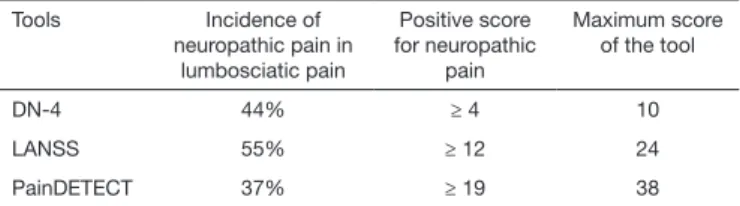
Irradiation pathways of lumbar roots and TP to lower limb are very similar (e.g., root L5 and gluteus minimum TP). So, it is critical to use an NP evaluation tool to evaluate the type of pain.
Table 1 shows the incidence of neuropathic component in lumbosciatic pain, in addition to the score considered positive and maximum score of major tools: Douleur neuropathique 4 questionnaire (DN-4)5,Leeds
As-sessment of Neuropathic Symptoms and Signs Pain Scale (LANSS)4 ePain
DETECT 6.
Table 1. Major neuropathic pain evaluation tools showing its incidence in lum-bosciatic pain, positive score for neuropathic pain and maximum score of the tool
Tools Incidence of
neuropathic pain in lumbosciatic pain
Positive score for neuropathic
pain
Maximum score of the tool
DN-4 44% ≥ 4 10
LANSS 55% ≥ 12 24
PainDETECT 37% ≥ 19 38
COMPLEMENTARY EXAMS
History and physical evaluation data should formulate diagnostic hypoth-eses, which are to be confirmed by complementary exams, when needed. Red flags are indicators of investigation with imaging exams and should be considered to try to rule out cases of fractures, infections, tumors and cauda equina syndrome20.
Currently, complementary exams are widely used to justify patients’ pain,
however, altered exams not always are related to pain etiology, since degen-erative alterations are common even in asymptomatic patients. However, they should be indicated according to history/physical evaluation and be appreciated when compatible with clinical presentation17.
1. Disc protrusion and herniated disc
Computerized tomography (CT) may show intervertebral disc protrusion to inside the spinal canal, however the golden standard is nuclear magnetic reso-nance (MRI) which shows intervertebral disc degeneration process, in addi-tion to ibrous annulus ruptures and migrated nucleus pulposus fragments10.
2. Spinal canal stenosis
Spine X-rays and CT show bone hypertrophy. They also show spinal canal narrowing. MRI, in turn, adds information related to soft tissues, such as ligamentous hypertrophy10.
3. Post-laminectomy syndrome
Post-surgery X-rays, CT and MRI may not show abnormalities. Possible abnormalities: insufficient decompression, hematomas, infection, vertebral instability, inadequate positioning of orthoses and vertebral fractures21.
4. Piriformis syndrome
Pelvic MRI shows piriformis muscle and its relation with the sciatic nerve22.
CONSERVATIVE TREATMENT
he objective of chronic pain treatment is to rehabilitate patients, improve QL and promote social reintegration, since complete pain elimination is not always feasible. Satisfactory results depend on accurate diagnosis and tailored treatment, in addition to patients’ adhesion to proposed therapies17.
Most studies of pharmacological neuropathic pain treatments were per-formed with models of diabetic polyneuropathy and post-herpetic neural-gia. Pharmacological treatment is still the most important therapy to treat chronic neuropathic pain (chronicity is defined as persistent pain for more than 3 months). Different classes of drugs are used to treat neuropathic pain. The choice of the right drug for each case still has some difficulties due to the inefficacy of some drugs or to adverse effects associated to effec-tive drugs in recommended doses. Many patients need more than one drug, but the correct choice of the drug to be associated, as well as the sequential order of its introduction is still not clear23.
Guidelines to treat neuropathic pain consider as first line treatments with efficacy proven by best consistency experimental or observational studies (level A) These drugs are:
• Voltage-gated calcium channels α 2δ subunits modulator anticonvul-sants: gabapentin and pregabalin;
• Tricyclic antidepressants (TAD): amitriptyline, imipramine, clomip-ramine and nortriptyline;
• Selective serotonin and norepinephrine reuptake inhibitors (SSNRI): du-loxetine and venlafaxine23.
Second line drugs are:
• 5% lidocaine plasters as a function of their localized action. These have precise indication for post-herpetic neuralgia23. This presentation may be
mistaken by lumbosciatic pain when lumbar or sacral ganglia are involved;
• Opioids due to risk of addiction23-25. In addition, there are evidences of
cognitive disorders in patients with chronic lumbosciatic pain under opi-oids for a long period26.
Aiming at acting in different pain mechanisms, as well as in comorbidities present in chronic lumbosciatic pain patients, such as sleep and mood dis-orders. The association of drugs with pharmacokinetics and pharmacody-namics of synergistic potency may benefit patients’ QL27. The association
of gabapentin and tricyclics or opioids was more effective than the use of isolated treatment and allows decreasing the dose of each molecule27-29.
In addition to analgesia, pregabalin is effective to improve sleep quality and anxiety disorder30. All TAD have proven efficacy to treat depression and
anxiety, however, in higher doses than that used to treat pain, amitriptyline may also improve sleep. Dual receptors are effective to treat anxiety and de-pression25. The efficacy of tramadol, even in association with paracetamol,
was shown in sensory polyneuropathies (level A)31-33 (Table 2).
1st stage
Start treatment with one or more first line drugs:
• α 2δ ligants (gabapentin, pregabalin);
• SSNRI (duloxetine, venlafaxine);
65
Low back pain Rev Dor. São Paulo, 2016;17(Suppl 1):S63-6
2nd stage
• If there is partial pain relief, add another first line drug;
• If there is inadequate or no pain relief, replace by different first line drug.
3rd stage
• If first line drugs, alone or in combination, fail, consider second line drugs (opioids, tramadol);
• Or refer to a pain specialist34.
SURGICAL TREATMENT
Surgical treatment of lumbar radiculopathy should be indicated when there is limitation or low efficacy of multimodal conservative treatment. In this sense, one may divide surgical treatment to be indicated in: acute phase, up to 12 weeks after symptoms onset and chronic lumbar radicu-lopathy.
Surgical treatment may also be divided in antalgic treatment, in situations when there is motor neurological and deep reflexes preservation and sur-gical treatment aiming at maintaing spinal nerve integrity.
1. Acute lumbar radiculopathy with motor preservation a) Foraminal infiltration with steroid
It may be indicated for pain relief in patients with insatisfactory response to systemic pharmacological therapy and physiotherapy35,36.
2. Chronic lumbar radiculopathy with motor preservation
a) Application of pulsed radiofrequency in dorsal root ganglion of af-fected spinal nerve
Outpatient procedure under aseptic conditions with local anesthesia and in operating center with the aid of radioscopy. Dorsolateral percutaneus access is performed to reach intervertebral foramen corresponding to the affected dermatome. When the upper third of the intervertebral foramen is reached, impedance is checked, which should be less than 400 ohms. Sensory stimulation is performed to 50 hertz with up to 0.5 volts to obtain referred paresthesia to the dermatome to be treated. Motor stimu-lation with 2 hertz to 5 hertz should be obtained with at least twice the voltage obtained to get this sensory response.
Pulsed radiofrequency is applied with temperature limitation at 42o
Cel-sius and exposure time of at least 120 seconds37,38.
b) Spinal cord stimulation
In patients with pharmacological treatment limitation and insatisfactory
response to percutaneous interventionist treatment, the surgical option is spinal electrode implant to stimulate spinal cord above the conus. Per-manent implant is conditioned to an initial test phase with external pulse generator.
Spinal electrode implant may be percutaneous for cylindrical electrodes or by microlaminectomy for plate electrodes. Risk of electrode migration is higher for cylindrical electrode. After electrode implant, a pulse genera-tor is implanted in subcutaneous pouch. This pulse generagenera-tor creates an electric field on spinal cord dorsal region which acts to relieve NP. The conformation of this electric field is based on the combination of stimu-lus frequency, electromagnetic wave length and electric field potency, pa-rameters which are established by the assistant physician.
This is a well established therapy with evidence level I, which improves QL and functional capacity39-41.
3.Acute lumbar radiculopathy with loss of deep reflexes and/or motor defficiency in patients without previous surgical treatment
a) Nerve decompression a.1. Open discectomy
This treatment modality is indicated for herniated lumbar disc with nerve compression inducing dermatomeric symptoms compatible with affected nervous root and when conservative treatment fails42.
a.2. Laminectomy
Indicated in clinical neurogenic lameness conditions when there is spinal canal stenosis evidenced by complementary exams.
a.3. Foraminotomy
When there is intervertebral foramen narrowing.
a.4. The combination of above-described procedures depends on comple-mentary imaging exams results (CT or MRI).
a.5. Endoscopic microdiscectomy
Transmuscular percutaneous minimally invasive treatment modality using optic system. It is indicated for symptomatic herniated disc, however its results are not better than open discectomy and it is more expensive42,43.
CONCLUSION
For chronic back pain patients, the diagnosis of the neuropathic compo-nent and of comorbidities (sleep disorder, anxiety, depression) is critical. Therapeutic strategy with the association of more than one drug is man-datory, as well as the use of all tools (physical medicine, cognitive therapy, etc.) to improve QL of patients in its highest biopsychosocial spectrum.
REFERENCES
1. Nascimento PR, Costa LO. [Low back pain prevalence in Brazil: a systematic review]. Cad Saude Publica. 2015;31(6):1141-56. English, Portuguese.
2. Andersson JA. Problems of classiication of low-back pain. Rheumatol Rehabil. 1977;16(1):34-6. 3. Konstantinou K, Dunn KM, Ogollah R, Vogel S, Hay EM. Characteristics of patients with low back
and leg pain seeking treatment in primary care: baseline results from the ATLAS cohort study. BMC Musculoskelet Disord. 2015;16:332.
4. Bouhassira D, Lantéri-Minet M, Attal N, Laurent B, Touboul C. Prevalence of chronic pain with neuropathic characteristics in the general population. Pain. 2008;136(3):380-7.
5. Attal N, Perrot S, Fermanian J, Bouhassira D. he neuropathic components of chronic low back pain: a prospective multicenter study using the DN4 Questionnaire. J Pain. 2011;12(10):1080-7. 6. Freynhagen R, Baron R, Gockel U, Tölle TR. painDETECT: a new screening questionnaire to identify
neuropathic components in patients with back pain. Curr Med Res Opin. 2006;22(10):1911-20. 7. Itz CJ, Geurts JW, van Kleef M, Nelemans P. Clinical course of non-speciic low back pain: a
syste-matic review of prospective cohort studies set in primary care. Eur J Pain. 2013;17(1):5-15. 8. Valat JP, Genevay S, Marty M, Rozenberg S, Koes B. Sciatica. Best Pract Res Clin Rheumatol.
2010;24(2):241-52.
9. Kramer J. Intervertebral Disc Disease: Causes, Diagnosis, Treatment and Prophylaxis, 2nd ed. New York: hieme Medical; 1990.
10. Youmans neurological surgery, 5th ed. 2004.293.
11. Wilkinson HA: he Failed Back Syndrome: Etiology and herapy. 2nd ed. Philadelphia: Harper & Row; 1991.
12. North RB, Kidd D, Shipley J, Taylor RS. Spinal cord stimulation versus reoperation for failed back surgery syndrome: a cost efectiveness and cost utility analysis based on a randomized controlled trial. Neurosurgery. 2007;61(2):361-9.
13. Parziale JR, Hudgins TH, Fishman LM. he piriformis syndrome. Am J Orthop. 1996;25(12): 819-23. 14. Silver JK, Leadbetter WB. Piriformis syndrome: assessment of current practice and literature review.
Orthopedics. 1998;21(10):1133-5.
15. Santos JG, Brito JO, de Andrade DC, Kaziyama VM, Ferreira KA, Souza I, et al. Translation to Por-tuguese and validation of the Douleur Neuropathique 4 questionnaire. J Pain. 2010;11(5):484-90. 16. Yeng LT, Mattar Júnior R, Kobayashi R, Cantara MG, Teixeira MJ. Síndrome complexa de dor
regional. In: Bispo Júnior RZ, Mello Júnior CF. Ortopedia básica. Rio de Janeiro: Revinter; 2014. 294-301p.
17. Yeng LT, Kobayashi R, Kobayashi CBC, Rossi Junior J, Loduca A, Muller BM, et al. Avaliação funcional do doente com dor crônica, in: Martins MA, Carrilho FJ, Alves VAF, Castilho EA, Cerri
Table 2. IASP recommended drugs to treat neuropathic pain and available in Brazil23
Total daily dose Recommendation
Strongly recommended
Gabapentin 1200 to 3600mg, divided in 3 x a day
1st line
Pregabalin 300 to 600mg, divided in 2 x a day 1st line
Dual serotonin ndnorepine-phrine reup-takers
60 to 120mg, 1 x a day (Duloxetin) 150 to 225mg, 1 x a day (exten-ded action venlafaxine)
1st line
Tricyclic anti-depressants
25 to 150mg in 1 or 2 x a day 1st line
Weak recommendation
5% lidocaine plaster
1 to 3 plasters in the painful área during 12h with interval of 12hs
2nd line
Peripheral neuropathy
Tramadol 200 to 400mg, 2 x in slow release formulation or 3 x a day
2nd line
Botulinum toxin
50 to 200 units in painful area every 3 months
3rd line
Peripheral neuropathy
Strong opioids Individual titration according to opioid
3rd line
66
Stump PR, Kobayashi R and Campos AW
Rev Dor. São Paulo, 2016;17(Suppl 1):S63-6
GG. Clínica Médica do HCFMUSP. Barueri: Manole; 2015. 38-44p.
18. Delino HLA. Coluna Lombar. In: Barros Filho TEP, Lech O. Exame físico em ortopedia. São Paulo: Sarvier; 2001. 37p.
19. van der Windt DA, Simons E, Riphagen II, Ammendolia C, Verhagen AP, Laslett M, et al. Physical examination for lumbar radiculopathy due to disc herniation in patients with low-back pain. Co-chrane Database Syst Rev. 2010;17;(2):CD007431.
20. van Tulder M, Becker A, Bekkering T, Breen A, del Real MT, Hutchinson A, et al. Chapter 3. Euro-pean guidelines for the management of acute nonspeciic low back pain in primary care. Eur Spine J. 2006;15(Suppl 2):S169-91.
21. Bordoni B, Marelli F. Failed back surgery syndrome: review and new hypothesis, J Pain Res. 2016:9:17-22.
22. Arooj S, Azeemuddin M, Pirirformis syndrome – a rare cause of extraspinal sciatica. J Pak Med Assoc. 2014:64(8):949-51.
23. Finnerup NB, Attal N, Haroutounian S, McNicol E, Baron R, Dworkin RH, et al. Pharmaco-therapy for neuropathic pain in adults: a systematic review and meta-analysis. Lancet Neurol. 2015;14(2):162-73.
24. Attal N, Cruccu G, Baron R, Haanpaa M, Hansson P, Jensen TS, et al. EFNS guidelines on the pharmacological treatment of neuropathic pain: 2010 revision. Eur J Neurol. 2010;17(9):1113-e88. 25. Dworkin RH, O’Connor AB, Backonja M, Farrar JT, Finnerup NB, Jensen TS, et al. Pharmacologic management of neuropathic pain: evidence-based recommendations. Pain. 2007;132(3):237-51. 26. Shiltenwolf M, Akbar M, Hug A, Pfüller U, Gantz S, Neubauer E, et al. Evidence of speciic
cogniti-ve deicits in patients with chronic low back pain under long-term substitution treatment of opioids. Pain Physician. 2014;17(1):9-20.
27. Gilron I, Bailey JM, Tu D, Holden RR, Jackson AC, Houlden RL. Nortriptyline and gabapentin, alone and in combination for neuropathic pain: a double- blind, randomised controlled crossover trial. Lancet, 2009;374(9697):1252-61.
28. Gilron I, Bailey JM, Tu D, Holden RR, Weaver DF, Houlden RL. Morphine, gabapentin, or their combination for neuropathic pain. N Engl J Med. 2005;352(13):1324-34.
29. Gilron I, Jensen TS, Dickenson AH. Combination pharmacotherapy for management of chronic pain: from bench to bedside. Lancet Neurol. 2013;12(11):1084-95.
30. Rosenstock J, Tuchman M, LaMoreaux L, Sharma U. Pregabalin for the treatment of painful diabe-tic peripheral neuropathy: a double-blind, placebo-controlled trial. Pain. 2004;110(3):628-38. 31. Hollingshead J, Dühmke RM, Cornblath DR. Tramadol for neuropathic pain. Cochrane Database
Syst Rev. 2006;3:CD003726.
32. Eisenberg E, McNicol ED, Carr DB. Eicacy and safety of opioid agonists in the treatment of neu-ropathic pain of nonmalignant origin: systematic review and meta-analysis of randomized controlled trials. JAMA. 2005;293(24):3043-52.
33. Freeman R, Raskin P, Hewitt DJ, Vorsanger GJ, Jordan DM, Xiang J, et al. Randomized study of tramadol/acetoaminophen versus placebo in painful diabetic peripheral neuropathy. Curr Med Res Opin. 2007;23(1):147-61.
34. Dworkin RH, O’Connor AB, Audette J, Baron R, Gourlay GK, Haanpää ML, et al. Recommenda-tions for the pharmacological management of neuropathic pain: an overview and literature update. Mayo Clin Proc. 2010;85(3 Suppl):S3-14.
35. Manchikanti L, Buenaventura RM, Manchikanti KN, Ruan X, Gupta S, Smith HS, et al. Efecti-veness of therapeutic lumbar transforaminal epidural steroid injections in managing lumbar spinal pain. Pain Physician. 2012;15(3):E199-245.
36. van Helvoirt H, Apeldoorn AT, Ostelo RW, Knol DL, Arts MP, Kamper SJ, et al. Transforaminal epidural steroid injections followed by mechanical diagnosis and therapy to prevent surgery for lumbar disc herniation. Pain Med. 2014,15(7):1100-8.
37. Koh W, Choi SS, Karm MH, Suh JH, Leem JG, Lee JD, et al. Treatment of chronic lumbosacral radicular pain using adjuvant pulsed radiofrequency: a randomized controlled study. Pain Med. 2015;16(3):432-41.
38. Van Boxem K, Cheng J, Patijn J, van Kleef M, Lataster A, Mekhail N, et al. Lumbosacral radicular pain, Pain Pract. 2010;10(4):339-58.
39. Kumar K, Taylor RS, Jacques L, Eldabe S, Meglio M, Molet J, et al. Spinal cord stimulation versus conventional medical management for neuropathic pain: a multicenter randomised controlled trial in patients with failed back surgery syndrome. Pain. 2007;132(1-2):179-88.
40. Kumar K, Taylor RS, Jacques L, Eldabe S, Meglio M, Molet J, et al. he efects of spinal cord stimulation in neuropathic pain are sustained: a 24 month follow-up of the prospective rando-mized controlled multicenter trial of the efectiveness of spinal cord stimulation. Neurosurgery. 2008;63(4):762-70.
41. Grider JS, Manchikanti L, Carayannopoulos A, Sharma ML, Balog CC, Michael E. et al. Efec-tiveness of spinal cord stimulation in chronic spinal pain: a systematic review, Pain Physician. 2016;19(1):E33-54.
42. Gibson JN, Waddell G.) Surgical interventions for lumbar disc prolapse. Cochrane Database Syst Rev. 2007;2:CD001350