EVASION OF PATIENTS IN HEARING HEALTH SERVICES:
RESEARCH ON THE REASON AND OUTCOMES AFTER
ADAPTATION OF HEARING AIDS
Evasão dos pacientes nos acompanhamentos nos serviços
de saúde auditiva: identiicação sobre o motivo e resultados
pós-adaptação de aparelho de ampliicação sonora individual
Pricila Reis Jokura (1), Tatiana Mendes de Melo (2), Maria Cecília Bevilacqua (3)
(1) Speech Language Pathologist graduated by the
Depart-ment of Speech Language Pathology from the Dentistry School in Bauru – University of São Paulo – FOB-USP, Bauru, São Paulo, Brazil.
(2) Speech Language Pathologist, Professor from the Speech
Language Pathology course at the University of Guarulhos – UnG, Guarulhos, São Paulo, Brazil; PhD in Sciences by the Postgraduate Program of Experimental Pathophysio-logy, Medicine School from the University of São Paulo.
(3) Speech Language Pathologist, Professor from the
Depart-ment of Phonoaudiology of the Dentistry School in Bauru – University of São Paulo – FOB-USP, Bauru, São Paulo, Brazil; PhD in Human Communication Disorders.
Funding: CNPq
Conlict of interest: non-existent
hearing loss (higher than 40 dB) and need hearing aids (HA) or cochlear implant.
The National Policy on Hearing Health Care guarantees assistance to the person with hearing loss, so there can be the best possible use for their residual hearing. Therefore, the hearing health services enabled by the Ministry of Health should provide an intervention process that contemplates
the audiological diagnosis, selection and itting of
hearing aids and audiological features suited to acoustic needs of the individual, the audiological
follow up (hearing loss and ampliication) and
speech therapy for the development of auditory skills and language user.
Under the scientiic assumption3 and clinical
practice of health professionals, the attention given in the adaptation phase of the hearing aid may be
insuficient to improve the quality of life of these
ABSTRACT
Purpose: to identify the reason for absence of the patients from the Uniied Health System who use hearing aids at the audiology follow up and analyze the the device adaptation in this population. Method: 27 absent patients were interviewed with opened questions about their absence and the implementation of the International Outcome Inventory for Hearing Aids, a self-assessment questionnaire for post adaptation evaluation. Comparison of absent patients’ post adaptation was performed from a random selection of 30 questionnaires from patients who attended the audiologic follow-up at the Institution (control group) who were registered in a database. Descriptive and inferential statistics (Mann-Whitney
test – signiicance level of 5%) were applied for data analysis. Results: the majority of absent patients
(25.92%) say they didn’t remember the return date for follow up. The questionnaire’s comparative results between the absent and non-absent groups showed statistically signiicant differences in almost every area of self-assessment questionnaire, except on beneit items, participation restriction
and quality of life. Conclusion: among the reasons for not attending the service, we can highlight: forgetting the appointment, health problems and work reasons. It was observed that patients who did
not attend the audiologic follow-up showed statistically signiicant post-adaptation results inferior when
compared to the patients who attended the follow-up.
KEYWORDS: Hearing Loss; Hearing Aids; Uniied Health System; Patient Dropouts; Questionnaires
INTRODUCTION
Epidemiological studies1, 2 indicate that 4.8%
patients when compared with patients who were present at the follow-up.
METHOD
Randomized trial study, which included the participation of 57 patients, selected as follows: • Experimental group – represented by 27 patients
randomly selected from the list of patients who did not show up in any follow-up care of the multicenter study.
• Control group – 30 randomly selected patients who attended the proposed follow ups (three and nine months) in multicenter, registered in a database.
All patients in this study were adults, with ages ranging from 18 years to 64 years and 11 months old, from both genders. They presented either sensorineural unilateral or bilateral hearing loss and had no previous experience with hearing aids. Patients with associated impairment to the hearing disorder were excluded from this study.
For a randomization of the sample, it was used lottery system in excel10 using the registration
number of the individual in the multicenter survey.
Instruments
For this study, two instruments were applied. They are:
1. Interview script – Composed by the following open questions: Why didn’t you attend the scheduled follow up? Are you making use of hearing aids? If not, why aren’t you using the device? – Applied only in the experimental group.
2. International Questionnaire of Personal Sound Ampliication Device (IOI-HA)11,12 validated for
the Portuguese language. This questionnaire consists of seven items, each being directed to
one aspect: daily use, beneit, activity limitation,
satisfaction, participation restrictions, impact on
others and quality of life. Each item has ive
response options ranging from the worst score to the best score. Items are scored from one
(worst score) to ive (best score), so a higher
score indicates better performance. At the end, the sum of the scores obtained on each question corresponds to the total score of the questionnaire. The patient is instructed to choose only one answer, one that best charac-terizes the result of adaptation of their device. individuals. Thus, it is important to continue the
treatment with periodic audiological follow ups of
the patients who made the itting of hearing aids in
the services, to facilitate the process of (re) habili-tation and thus optimizing the use of the adapted electronic device4.
The audiological follow up of the patients of
hearing health services of the Uniied Health
System (Sistema Único de Saúde – SUS) involves a broad work, from the monitoring of hearing loss, to the improvement of the adjustment of hearing aids to maximize their utilization and research on the
beneit that the device brought to the quality of life
of patients.
Whereas the hearing health services require considerable investment in professionals, structure and equipment, analysis of the quality of service from the result obtained with patients is important for optimum enhancements of public funds dispensed as well as to better understand the process by which patients undergo5.
It is found that from 30% to 47%6,7 of patients
seen in hearing health services in the SUS do not follow up the audiological consultations in the hearing health services in which it was held the
hearing aid itting, making it necessary research
on the reason for the avoidance by these patients,
and the post-hearing aid itting results as a way to
evaluate the results of intervention8.9.
In 2006, the National Council for Scientiic and
Technological Development (CNPq) approved the
granting of inancial assistance for the development
of the multicenter project “Indicators and proposal of quality evaluation of the audiology services from the
Uniied Health System” (case number 409613/2006
–1), which counted with the participation of hearing health services in the South, Southeast, Northeast and Center-west of the country. One of the prelim-inary results of this study referred to the avoidance of
patients in clinical post-hearing aid itting follow-up,
both in care for three to nine months, on all services participating in the research.
From the problems exposed, it becomes necessary to investigate the causes of evasion
of patients after the hearing aid itting in order to reverse this situation or even scientiically support
possible changes in the Policy of Hearing Health Care in relation to audiological follow up. This is of fundamental importance as it deals with the
optimi-zation of inancial resources from the public health
new follow up at any hearing health services which were participants in the research to continue the started audiological intervention process.
Statistical Analysis
Data on demographic and audiological charac-teristics of the groups, as well as information obtained in the open questionnaire and IOI-HA were tabulated and applied to descriptive statistics and later inferential statistics to compare the pattern of answers and information from the groups (except open questionnaire which was applied only in the group of absent patients). Both analyzes were performed by the STATA statistical program.
To compare the demographic and audiological characteristics between groups we used the statis-tical Fisher test. To compare the areas of IOI-HA
questionnaire (use, beneit, limited residual activity,
satisfaction, residual participation restrictions, impact on others and quality of life) of the study and the control group we used the statistical test of Mann-Whitney and comparison of data on the total score of the questionnaire, we used the Student t
test, both with signiicance level of 5%.
RESULTS
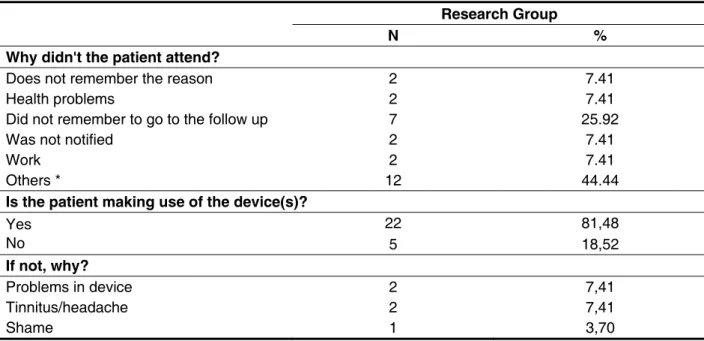
As informações obtidas por meio do questio-nário aberto podem ser visualizadas na Tabela 1.
A maioria dos pacientes entrevistados justiicou
a ausência no dia do retorno por ter esquecido
o compromisso (25.92%). Information obtained through the open questionnaire can be viewed in
Table 1. Most patients interviewed justiied their
absence on the day of return for having forgotten
the commitment (25.92%).
The demographic and audiological data from the patients in the study group and the control group are presented in Tables 2 and 3.
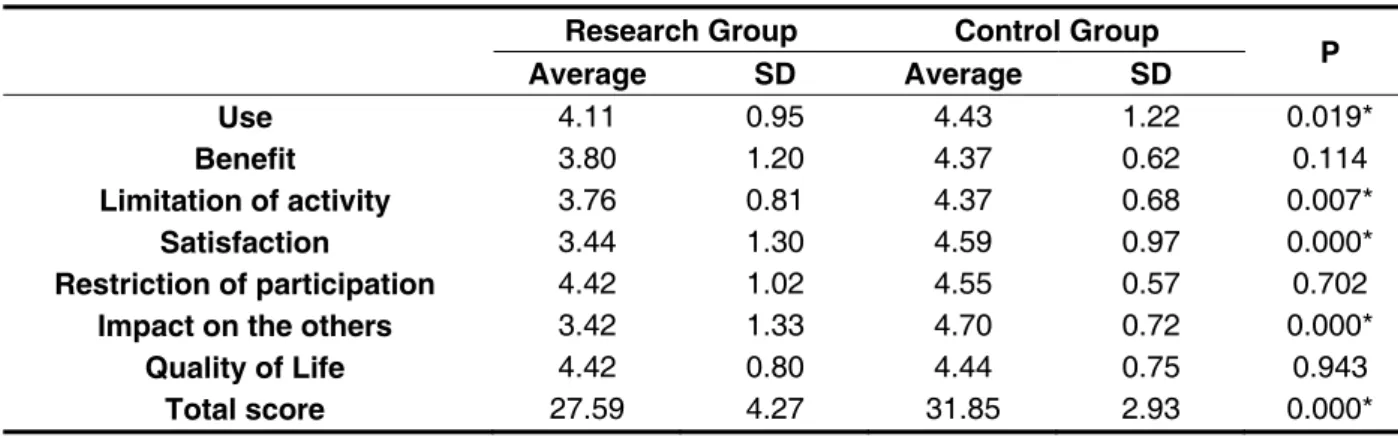
The results of the descriptive analysis of the IOI-HA questionnaire as well as the comparison between the results of the instrument in both groups
is shown in Table 4. As results, only in the beneit
domain, restriction of participation and quality of life
had no statistically signiicant difference between
groups. instrument was applied in the audiological follow
up, made three and nine months after the hearing
aid itting. The results were entered into a speciic
database.
In addition to the data collection instruments for this study, it was also raised the socio-demographic information of the patients in both groups. Such
information was obtained through the speciic
database of the multicenter project.
Procedures
Experimental Group – Contact was made with the
missing patients via letter and/or telephone to inform
them about the study. After signing the Term of Free and Informed Consent Form (ICF), the researcher applied the IOI-HA and the open questionnaire via telephone.
To apply the questionnaire the questions to be answered were read. In the IOI-HA questionnaire,
questions arose as the patient’s speciic question
was reworded so that there was better
under-standing. As each question has ive answer choices,
the researcher sought to present them in a didactic way, making him imagine a ruler numbered from one
to ive, each number representing a response on an
increasing scale, seeking to obtain the answer that best identify the reality from such patient.
Control Group –The IOI-HA questionnaire was
applied in audiological follow up, in interview format, by a phonoaudiologist. The results of the instrument were registered in the database of the multicenter survey.
Respeitando os aspectos éticos o presente estudo foi aprovado pelo Comitê de Ética em Pesquisa do Hospital de Reabilitação de Anomalias Craniofaciais da Universidade de São Paulo
(processo nº. 009/2007) e ao inal das entrevistas
os pacientes foram convidados a marcar um novo atendimento nos serviços de saúde auditiva participantes da pesquisa para dar andamento ao processo de intervenção audiológica já iniciado.
Respecting ethical aspects, the present study was approved by the Ethics Committee of the Hospital for Rehabilitation of Craniofacial Anomalies, University
of São Paulo (process number 009/2007) and at the
Research Group
N %
Why didn't the patient attend?
Does not remember the reason 2 7.41
Health problems 2 7.41
Did not remember to go to the follow up 7 25.92
Was not notified 2 7.41
Work 2 7.41
Others * 12 44.44
Is the patient making use of the device(s)?
Yes No
22 81,48
5 18,52
If not, why?
Problems in device 2 7,41
Tinnitus/headache 2 7,41
Shame 1 3,70
Table 1 – Distribution of patients according to reasons for absence and use of hearing aids (n = 27)
* Others – reasons related to travel, moving out of city temporarily and lack of time to attend the follow up.
Research Group Control Group TOTAL
P N % N % N %
Patients 27 47.37 30 52.63 57 100.00
Gender
Female 17 62.96 16 53.33 33 57.89
0.593
Male 10 37.04 14 46.67 24 42.11
Ethnicity
White 17 85.00 21 80.77 38 66.67
1.000
Black 2 10.00 3 11.54 5 8.77
Others 1 5.00 2 7.69 3 24.65
Socio-economic assessment
A2 (RMF R$ 4648,00) 0 0.00 1 3.33 1 5.20
0.923
B1 (RMF R$ 2804,00) 0 0.00 1 3.33 1 5.20
B2 (RMF R$ 1669,00) 3 13.04 5 16.67 8 14.10
C (RMF R$ 927,00) 17 73.91 18 60.00 35 61.40
D (RMF R$ 424,00) 3 13.04 5 16.67 8 14.10
Level of schooling
Illiterate 4 16.00 6 23.08 10 19.61
0.747
Completed Elementary 8 32.00 12 46.15 20 39.21
Completed Middle School 5 20.00 3 11.54 8 15.68
Completed high school 7 28.00 4 15.38 11 21.58
University Graduation 1 4.00 1 3.85 2 3.92
Table 2 – Distribution of patients according to socio-demographic characteristics
Experimental
Group Controle Group TOTAL
P
Patients N % N % N %
27 47.37 30 52.63 57 100.00
Localization of hearing loss
Unilateral 7 25.93 2 2.67 9 15.80
0.070
Bilateral 20 74.07 28 93.33 48 84.20
Fitting of hearing aids
Unilateral 11 40.74 5 16.67 16 28.10
0.075
Bilateral 16 59.26 25 83.33 41 71.90
Type of HA
Retroauricular 21 77.78 24 80.00 45 78.90
0.340
Intra-auricular 1 3.70 0 0.00 1 1.75
Intracanal 3 11.11 1 3.33 4 7.01
Microchannel 2 7.41 5 16.67 7 12.34
Technological category - HA
A 4 14.81 7 23.33 11 19.31
0.400
B 15 55.56 11 36.67 26 45.61
C 8 29.63 12 40.00 20 35.08
Classification of hearing loss (better ear)
Normal 9 33.33 3 10.00 12 21.05
0.161
Mild 4 14.81 7 23.33 11 19.30
Moderate 11 40.74 12 40.00 23 40.35
Severe 3 11.11 7 23.33 10 17.54
Profound 0 0.00 1 3.33 1 1.76
Attends phonoaudiological therapy
Yes 2 7.41 4 14.29 6 10.91
0.427
No 25 92.59 24 85.71 49 89.09
Table 3 – Distribution of patients according to the auditory characteristics
Research Group Control Group
P Average SD Average SD
Use 4.11 0.95 4.43 1.22 0.019*
Benefit 3.80 1.20 4.37 0.62 0.114
Limitation of activity 3.76 0.81 4.37 0.68 0.007*
Satisfaction 3.44 1.30 4.59 0.97 0.000*
Restriction of participation 4.42 1.02 4.55 0.57 0.702
Impact on the others 3.42 1.33 4.70 0.72 0.000*
Quality of Life 4.42 0.80 4.44 0.75 0.943
Total score 27.59 4.27 31.85 2.93 0.000*
Table 4 – Descriptive and inferential analysis of the questionnaire IOI-HA
functioning of hearing aids, among others, aspects that should be addressed during audiologic follow-up sessions4. In this context, the data obtained by this
study are noteworthy, as the goal of the Policy of Hearing Health Care are often not being met in full,
that is, from the time that the patient is not beneiting
from the HA satisfactorily.
Thus, it emphasizes the importance of audio-logic follow up from the patients with hearing aids, because this time the patient has the opportunity to share their opinions and complaints about the hearing aid so that the professional can assist them in the audiologic intervention4. Therefore, it is
necessary for hearing health service professionals
enhance, at the time of hearing aid itting, the impor -tance of periodic follow-ups to optimize the settings
of the devices and explain to patients that the itting
of hearing aids is only one step in a process inter-vention with the aim of improving the quality of life of the patient.
The dificulty of the patient treated by SUS in
expressing his right as a citizen makes him not to contact the hearing health service seeking to solve his problem and ends up not making use of the HA8, 13-16. In this perspective it is important that the
hearing health service works with different ways to contact the patient for follow up, such as the use of the internet for the screening of the hearing aid users17.
The question of evasion of patients from the
hearing health services after hearing aid itting
highlights again the importance of the network of reference and counter-reference of hearing health. A primary hearing health is an important point, because this level of care professionals can act in orientation on the need for audiological follow up, which may assist to the patient’s adherence to all steps of audiological intervention18. We also stress
the need to develop strategies to rescue the absent patients of hearing health services.
It is worth noting the dificulties found in dealing
with the absent patients in the present study. Downgrading of the patients’ contacts and the lack of cooperation of individuals to respond the instrument were limiting points for this research. In turn, some patients interviewed by telephone had
dificulty in communicating with their device, due to
the fact of not knowing how to hold the phone near the microphone of the hearing aid, which may be
a relection of non-adherence to the attendance of
audiologic.
Yet it is noteworthy that, although there are many
DISCUSSION
When considering the evasion of patients in the audiological follow up is also important to analyze the reason for this lack of adherence to treatment
after the hearing aid itting, and the results after itting
of this population. This information is extremely important for the enhancement of the actions proposed in the Policy of Hearing Health Care, thus optimizing dispensed public funds5.
Thus, the present study was aimed to inves-tigate such issues, important for the improvement of the National Hearing Health Care in the country. Anecdotal reports of professionals point out that many times the patients attended by hearing health
services believe that only the itting of hearing aids will help them minimize the dificulties experienced
as a result of hearing loss.
Among the reasons related to the absence of these patients in audiologic follow up, most of them state to have forgotten it (Table 1). According to the logistics of the multicenter study of which this work was inserted, returns for audiologic follow up were already marked on the same day of the hearing aid
itting, i.e., the patient has left the health service with
the date of the next hearing follow up. This line of working may have contributed to the forgetting of the return date of the follow up by the patient, as at the
time of itting of hearing aids there are handed out a
lot of information about the use, care and cleaning of the device, which may not favor the retention other important information.
It is important to consider that 81.48% of inter -viewed absent patients respondents (Table 1) are making use of their devices dispensed by SUS, thus indicating the use of hearing aids in the daily life of these patients. However the responses obtained in the IOI-HA items by the patients of the study group fell short when compared with the control group,
relecting a statistically signiicant difference in the
total score of the questionnaire in both groups (Table 4). Considering the questionnaire domains IOI-HA
veriies that the items “use”, “activity limitation”, “satisfaction” and “impact on others” was signii -cantly lower for absent patients, when compared to scores obtained by participants who attended the audiological follow up.
assessed by IOI-HA questionnaire, except beneit,
restriction of participation and quality of life.
ACKNOWLEDGEMENTS
To the National Council of Scientiic and
Technological Development (CNPq), for granting
the scientiic initiation scholarship (process number110014/2009-0) and inancial assistance for
making the development of the multicenter project “Indicators and proposal of evaluating of the quality
of audiology services of the Uniied health” (process number409613/2006-1) possible.
proposal in order to further understand the dynamics of the service of the hearing impaired within these services.
CONCLUSION
From the analyzed data it can be concluded: Among the reasons for non-attendance at the service, it can be pointed out: forgetfulness of care, health problems and work reasons;
Patients who did not attend the audiologist’s
follow up present post-hearing aid itting results (statistically signiicantly) below the results of
patients who came to the follow ups in most areas
RESUMO
Objetivo: identiicar o motivo da ausência no acompanhamento audiológico dos usuários de apare
-lhos de ampliicação sonora individual do Sistema Único de Saúde e analisar o resultado da adapta -ção do dispositivo nesta popula-ção. Método: entrevista com 27 pacientes faltosos, realizando
ques-tões abertas sobre o motivo da ausência no atendimento e aplicação do Questionário Internacional de Aparelho de Ampliicação Sonora Individual, para avaliação dos resultados pós-adaptação. A
comparação dos resultados pós-adaptação dos pacientes faltosos foi realizada a partir da seleção aleatória de 30 questionários, de pacientes que compareceram no acompanhamento audiológico da Instituição, cadastrados em um banco de dados. Para análise dos resultados foi aplicada estatística descritiva e inferencial. Resultados: a maioria dos faltosos (25,92%) refere não ter lembrado da data do retorno. Os resultados comparativos do questionário entre os grupos de faltosos e não faltosos
evidenciam diferenças estatisticamente signiicantes em quase todos os domínios do questionário de
auto-avaliação, exceto nos itens benefício, restrição da participação e qualidade de vida. Conclusão: dentre os motivos do não comparecimento ao serviço, destacam-se: esquecimento do atendimento, problemas de saúde e motivos de trabalho. Foi observado que os pacientes que não compareceram
ao acompanhamento audiológico apresentam resultados pós-adaptação de aparelho de ampliicação
sonora individual aquém aos resultados dos pacientes que compareceram ao acompanhamento, de
forma estatisticamente signiicante.
DESCRITORES: Perda Auditiva; Auxiliares de Audição; Sistema Único de Saúde; Pacientes
Desistentes do Tratamento; Questionários
REFERENCES
1. Bevilacqua MC. Levantamento das alterações auditivas da população urbana de Monte Negro
– Rondônia/Brasil. Bauru: Universidade de São
Paulo, Faculdade de Odontologia de Bauru; 2007.
Relatório Final: Processo CNPq nº479793/2004-2.
2. Béria JU, Raymann BCW, Gigante LP, Figueiredo ACL, Jotz G, Roithman R et al. Hearing impairment and socioeconomic factors: a population-based survey of an urban locality in southern Brazil. Panam J Public Health. 2007;21(6):381-7.
3. Tsakiropoulou E, Konstantinidis I, Vital I,
Konstantinidou S, Kotsani A. Hearing aids: Quality
of life and socio-economic aspects. Hippokratia. 2007; 11(4):183–6.
4. Manoel RR, Motti TFG, Andrade ABS. A orientação continuada aos novos usuários de AASI. INES – Arqueiro. 2006;14(2):11-6.
5. Bevilacqua MC, Melo TM, Morettin M, Lopes AC. A avaliação de serviços em Audiologia: concepções e perspectivas. Rev Soc Bras Fonoaudiol. 2009;14(3):421-6.
11. Cox RM, Stephens D, Kramer SE. Translation of the international outcome inventory for hearing aids. Int. J. Audiol. 2002;41(1):3-26.
12. Gasparin M, Menegotto IH, Cunha CS. Propriedades psicométricas do questionário
interna-cional – aparelho de ampliicação sonora individual.
Braz. j. otorhinolaryngol. 2010;76(1):85-90.
13. Jenkinson C, Coulter A, Bruster S, Richards N, Chandola T. Patients’ experiences and satisfaction with health care: results of a questionnaire study
of specif aspects of care. Qual Saf Health Care.
2002;11:335-9.
14. Esperidião M, Trad LAM. Avaliação de satisfação dos usuários. Ciênc. Saúde Coletiva. 2005;10(suppl):303-12.
15. Vaitsman J, Andrade GRB. Satisfação e responsividade: formas de medir a qualidade e humanização da assistência à saúde. Ciênc. Saúde Coletiva. 2005;10(3):599-613.
16. Carvalho JSA. Satisfação de idosos com aparelhos auditivos concedidos no Estado de Tocantins. Arq Int Otorrinolaringol. 2007;11(4):416-26.
17. Swanepoeli DW, Clark JL, Koekemonr D, Hall JW, Krumm M, Ferrari DV et al. Telehealth in audiology: The need and potential to reach underserved communities. Int J Audiol. 2010;49:195-202.
18. Alvarenga KF, Bevilacqua MC, Martinez MANS,
Melo TM, Blasca WQ, Taga MFL. Proposta para
capacitação de agentes comunitários de saúde em saúde auditiva. Pro Fono. 2008;20(3):171-6.
auditivas em crianças surdas. Rev CEFAC. [periódico na Internet]. 12(3):360-70. [citado
2010 Jul 04]. Disponível em: http://www.scielo. br/scielo.php?script=sci_arttext&pid=S1516-18462010005000014&lng=pt. Publicado 2010.
Epub02-Abr-2010.
7. Morettin M. Avaliação dos benefícios e satisfação
dos usuários de Aparelhos de Ampliicação Sonora
Individuais nos serviços de audiologia do SUS [dissertação]. São Paulo: Universidade de São Paulo – Faculdade de Saúde Pública; 2008.
8. Armigliato ME, Prado DGA, Melo TM, Martinez MANS, Lopes AC, Amantini RCB et al. Avaliação de serviços de saúde auditiva sob a perspectiva do usuário: proposta de instrumento. Rev Soc Bras Fonoaudiol. 2010;15(1):32-9.
9. Rossi-Barbosa LAR, Vieira SMFV, Manzoni CRT, Caldeira AP, Honorato-Marques R, Ribeiro JA et al. Processo de construção de indicadores em saúde auditiva. Rev. CEFAC [periódico na Internet]. 13(1):102-1. [citado 2010 Jul 04]. Disponível em:
http://www.scielo.br/scielo.php?script=sci_arttext& pid=S1516-18462010005000061&lng=pt.
10. Andrade AG. Sistema de Sorteio em Excel [Base de dados na Internet]. c2006 [atualizada em 2008 nov]; acesso em 2009 nov 29]. Disponível em:
http://superdownloads.uol.com.br/download/169/ sistema-de-sorteios-excel/.
Received on: Februay 13, 2012 Accepted on: May 30, 2012
Mailing Address:
Tatiana Mendes de Melo