INTERFERENCE OF THE EARLY AND LATE DRUG THERAPY
IN PARKINSON DISEASE IN THE MANAGEMENT OF DYSPHAGIA
Interferência do tratamento medicamentoso imediato e tardio na
doença de parkinson no gerenciamento da disfagia
Paula Pinheiro Gerszt(1), Cintia Rodrigues Baltar(2),
Anderson Evangelista dos Santos (3), Adriana Leico Oda(4)
(1) Phonoaudiologist; Administrative Technician in Education
of the Federal University of the Espírito Santo; Skilled in Dysphagia by CEFAC-RJ.
(2) Phonoaudiologist by Federal University of the Rio de
Janeiro, Phonoaudiologist in the Clementino Fraga Filho Universitary Hospital - CFFUH and in the Getulio Vargas State Hospital; Skilled in dysphagia by CEFAC - RJ. (3) Phonoaudiologist; PhD Student in Sciences by Department
of Anatomy of the Federal University of the Rio de Janeiro - FURJ.
(4) Phonoaudiologist of the ABRAMI (Brazilian Association of Myasthenia Gravis) and ABRELA (Brazilian Association of Amyotrophic Lateral Sclerosis); Teacher of the CEFAC; Staff of the Skilling, Rehabilitation and Neurology Course of the Federal University of São Paulo - Paulista School of Medicine, PhD Student in Neurosciences by Federal Uni-versity of São Paulo.
Conlict of interest: non-existent
INTRODUCTION
The Parkinson disease is the second
neurode-generative inirmity more common after Alzheimer
disease, affects mainly of the third age population1,2,
with incidence,principally in the population up to 65 years old, and prevalence of 1 to 2% in the world and 3% in the Brazil3.
Of unknow etiology, is characterized by presence of multiple monoaminergic dysfunction, including the
deicit of dopaminergic2, cholinergic, serotonergic
and noradrenergic systems, that may to explain
the symptoms called non-motors (disturbs of sleep, cognitive and depression dysfunctions), which can be associated with several brain regions injured4.
ABSTRACT
Parkinson’s disease shows a higher incidence in the elderly population generating progressive motor impairment, which affects several functions, among which stands out swallowing. The purpose of this study is to correlate the dysphagia in Parkinson’s disease with immediate and / or late effect of the drug treatment, which directly or indirectly, will interfere with speech therapy management. We carried out a literature review in electronic databases Lilacs, Scielo, Medline and Pubmed from 2001 to 2011, using the free terms “Parkinson Disease” (Parkinson Disease), “swallowing” (deglutition), “dysphagia” (dysphagia), “pharmaceutical preparations” (pharmaceutical preparations), “levodopa”,
“videoluoroscopy” (videoluoroscopy), a government document (OPAS, 2002), relevant articles and
copies of American and Brazilian literature about the theme. The literature appointments levodopa as the main pharmacological treatment of the Parkinson’s disease. However, the resolution of the motor symptoms must be balanced in function of important collateral effects, being immediate or later. Actually, there aren’t consistent answers in favour of the resolution of the dysphagia in consequence of pharmacological treatment, wich effects may interfere, direct or indirectly, on the dysphagic manifestations and of several ways. In this way, turns fundamental the record of the medications like part of the anamnese, considering that, such data may help orientation/reorientation of the
phonoaudiologic management, specially interdisciplinary context. In despite of possibility of Parkinson’s
patient to answer inconsistently to pharmacological therapy, is noteworthy that professional must pay
attention to presence of collateral effects like modiiers factors of the dysphagia oropharyngea proile
in the idiopatic Parkinson’s disease.
classic and/or secondary manifestations to the use of dopaminomimetic drugs, a relevant subject to the clinical thinking in the phonoaudiologic evaluation and management, considering the risks of broncho-aspiration, dehydration and/or proteic-caloric desnu-trition in the Parkinson disease. Such necessity
constitutes one of the irst steps for differentiated
and more effective therapeutic approach.
Thereafter, the intention of the present study is to relate the dysphagia in the Parkinson disease to the early and/or late effects of drug therapy, that, direct or indirect manner, will interfer in the phonoaudio-logic management.
METHOD
Retrospective study, with bibliographic revision beginned at June 2011 and conducted by search in the eletronic data bases Lilacs, Scielo, Medline and PubMed in the period between 2001 and 2011. Were used the free terms “Parkinson disease”, “deglu-tition”, “dysphagia”, “pharmaceutical preparations”,
“levodopa”, and “videoluoroscopy”. The works
were analyzed since adoption of metodology of systematic review. Were found 140 articles, of which, 29 were chosen for to be related with deglutition function, Parkinson disease and drug treatment in the Parkinson disease. Were considered the articles published in portuguese, spanish and english, in according to the limits “humans”, “adults above than 19 years old” and “male and female genre”. Since the previous knowledge that such works
propor-tionated help to basic explaining of the theme,
were added to searched literature a governmental document (OPAS, 2002), articles (Korchonouv, 2010; Bedin and Ferraz, 2003), thesis (Carrara-de-Angelis E, 2000; Gasparim AZ, 2007) and issues of the american literature (Kandel, Schwartz and Jessell, 2000; Schapira and Olanov, 2005; Purves, 2004) that discuss about dopaminergic system and dopaminomimetics drugs, totalizing 42 publications in this study.
REVIEW OF LITERATURE
The neurochemistry organziation and the neuro-muscular integration are in the base of the motor control, including several parallel pathways among cortical and subcortical areas, specially the basal ganglia. The functional diversity of the motor control
is underlying to the complex organization of the
mesolimbic, mesocortical and, principally, mesos-triatal dopaminergic systems, whose functional
network results from a extent integration between
dopaminergic, glutamatergic and gabaergic neurons, such as from repertoire of the receptors Usually of easy diagnostic if of idiopathic-type, but
with atypic components, the variety of differential diagnostics is great. Presents slow progression and clinical manifestations predominantly asymetrics3.
The cardinal signals are: rest tremor, bradyki-nesia, plastic muscular rigidity (presenting or not dentate wheel signal) and postural instability4,5.
Other important clinical data include deambu-lation disturbs, masked facies, alterations of the
voice, dysarthria, drooling, sexual dysfunction,
cramps, pains, paresthesia, dysphagia, urinary incontinence, intestinal obstipation, micrograph, disturbs of the sleep, bradyphrenia, depression, dementia, cognitive alterations and sensory disturbs4,5. Logeman et al., 1973, suggest in study
that the parkinsonian patients are affected for larynx
stiffness, important postural disorders, associated involuntary movements and irregular and weak breathing4.
Considering to stiffness and bradykinesia, are regularly found in Parkinson disease alterations in the voice, in the articulation of words and in the oropharyngeal deglutition6. There are autors that
refer, in initial and intermediary stages, are more evident alterations in the phonation and in the articu-lation of the speech, and in advanced stages arise reports about complaint in the deglutition. Other say that injuries of the deglutition can to appear as initial stages as advanced stages and that the predominant factor refer to apparent symptomato-logic board3.
The treatment of Parkinson disease may to involve non-pharmacological measures, like phonoaudiologic therapy, actions that help the patients to compensate the limitations imposed by disease, besides fundamentals, inclusive, to delay the evolution itself. The pharmacological approach involve a group of drugs that possess symptomatic
action and, in despite of improve signiicantly
the life quality of the patients, involve a myriad of adverse effects5,7. The surgery treatment will not be
discussed here.
Being the deglutition a complex motor activity
indispensable to health and survive of the individuals, which commitment is present in the Parkinson disease, this study, in particular, compelling us to better knowledge about the theme. By the way elucidation of informations about Parkinson disease and its manifestations, powerfully succeded from drug treatment, we seek to understand positive and negative effects of the antiparkinsonian drugs about the dysphagic board, besides about general health state of the patient, in a manner to make up bases that support apropriately the phonoaudiologic work.
addition, with the begin of the moviment, the
micro-molar index of dopamine necessary for activation
of the normal motor act are not reached in the D2 system, culminating in reduction of the capacity of to produce moviment (bradykinesia). Without dopaminergic repair therapy, the progressive loss of the production and release of dopamine induces, each time more, a injuried stimulation of the type D1 and D2 receptors and worst of the rigidity and bradykinesia in the disease progression12.
In addition to modulation of the motor actions, injuries of the basal ganglia, also are associated to neuropsychiatry, cognitive and behavioural
disorders, relecting its role in several functions of the
frontal lobe, not only associated to the moviment9.
Parallel conections originated from upper regions of
the cortex engage prefrontal and limbic regions, for example. Suggests that this modulation is seemed
to classic motor pathway, in allusion to the function of to modulate origin and end of functions, such as, planning, working memory and attention, emotional regulation of the behavior and motivation. This may
to explain the occurrence of cognitive deicits in the
Parkinson disease.
The dopamine, noradrenaline and adrenaline belong to chatecolamine (biogenic amines) group,
substances classiied like little neurotransmitters. The
synthesis occurs inside of the presynaptic terminals from the tyrosine amino acid, which is converted,
by tyrosine hydroxylase enzime, to dihydroxyphe -nylalanine (levodopa), in a reaction that depends of
oxygen like cosubstrate and the tetrahydrobiopterin like cofactor. The levodopa is, so, decarboxylated by aromatic amino acid, the DOPA decarboxylase,
and yet are produced dopamine and carbonic gas. As supracited, after released, the dopamine links
to speciic dopaminergic receptors and the some β-adrenergic receptors. The dopamine is removed of the synaptic cleft by recaptation to inside of
nervous terminals or inside of next glial cells by
one Na-dependent transporter (the main involved in
catabolism are monoamine oxydase and chatecol
o-methyltransferase). Though dopamine do not cross easily the blood-brain barrier, it is possible to levodopa. The levodopa is absorbed in the small intestine, but is rapidly catabolized in the gastroin-testinal tract and peripheral tissues.
The process of degeneration of nigrostriatal dopaminergic neurons induces reduction of the striatal dopamine modulation and, consequently, motor alterations. This model preconize that, increasing the dopaminergic stimulation or reducing the cholinergic or glutamatergic stimulation, the symptom resolve. The drug treatment would must, at least, to include the neuroprotection (reduction of the progression of the disease) and the symptomatic correlates8-10. Two classic pathways known help
in comprehension of the functioning of the basal ganglia. In the named direct pathway, the upper motor neurons are free from continous tonic inhibition
exerced by inner globus pallidus and by substantia
nigra pars reticulata on the thalamus; in the indirect
pathway, this index of tonic inhibition increases
consequently to the activity of subthalamus, thereby, injurying the action of the thalamocortical neurons on the upper motor neurons8-10. The substantia
nigra pars compacta and the ventral tegmental area send dopamine to striate. The synapses among this substantia nigra pars compacta and the ventral tegmental area self contact in the base of the spine dendritic of the striate cells, near to the synapses between striatal cells and cortical projections, and, consequently, capable to modulate its glutamatergic effects8. Thereby, is easy to conclude that, with
destruction of the cells of the substantia nigra pars compacta, the inhibitory discharge stays abnormally high, in consequence of the spontaneous activity of the globus pallidus, and the thalamic activation is less probable to occur. In despite of intrincate dopaminergic circuitry involved in the basal ganglia, the signaling initialized bydifferent receptors corre-lates, underlying to the direct and indirect pathways,
relect the modulatory complexity of the basal
ganglia on the upper motor neurons.
Among dopaminergic receptors localized in the
striatal cells, there are 5 identiied human subtypes:
type D1 dopaminergic receptors (D1 e D5) and type D2 dopaminergic receptors (D2, D3 e D4). This
receptors are deined by capacity to stimulate (type
D1) or to inhibit (type D2) the adenylciclase. This
capacity relects its different interactions with the
G-protein, wich can to possess the sequences of
different amino acids, tha justiies the speciicity of
each receptor11. A nigral axon can to inluence both
types of receptors in the group of striatal neurons responsible for muscular contraction agonist-antagonist, proportionating the dopaminergic effect on the agonist (acceleration of the contraction) and antagonist (reduction of the tonus) skeletal muscle during the moviment12.
The parkinsonism is characterized by coexis -tence of brady- or hypokinesia with reduction of the acceleration of the agonist muscle contraction and increase of the tonus and rigidity. Type D1 receptors mediate the inhibition of the muscular tonus and the type D2 receptors promote or accelerate the contraction of synchronized manner during motion under action agonist-antagonist. In the Parkinson
disease, with the nanomolar index of dopamine
(type D1) low at striatal synaptic cleft, the tonus
symptomatology up to date, occurrence of side effects, age of patient, besides of the medications in practice and the cost of the ones. Thereby, there are, actually, several ways of symptomatic
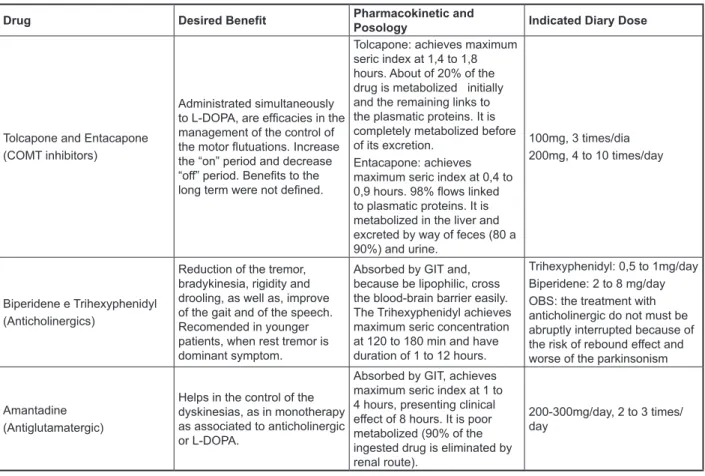
pharma-cologic intervention. The igure 1 shows a resume
of all described medications in the guideline of the
OPAS (2002), associating beneits, pharmacokinetic
and recommended diary dose: treatment (control of the symptoms). The
neuropro-tection is a objective yet not achieved, because the randomized and controlled clinical symptoms
are insuficient to show that such drug has this
property. Thereby, the symptomatic treatment is the choose for parkinsonian patients and with resultant incapacities7.
The selection of the accepted drug must to consider the stage of the disease, the
Drug Desired Beneit Pharmacokinetic and
Posology Indicated Diary Dose
Levodopa (release pattern)
Alleviate of the motor symptoms.
Eficacy deined in 30 years of use.
Achieves maximum seric index in 15 to 45 min. Needs association to dopadecarboxylase inhibitors (carbidopa or benserazide). Half-life: 60 to 120min.
Available commercially: L-Dopa/carbidopa(ID): 100/10mg, 100/ 25mg/ and 250/25mg;
L-Dopa/benserazide (ID): 50/12,5mg, 100/25mg and 200/50mg;
Ajdustments as clinical performance.
Levodopa (controlled release)
Like pattern L-DOPA, however, there are not evidences of eficacy in the prevention and control of motor complications. The use before to sleep, in one dose, is importante to alleviate nocturnal and diurnal incapacity and during awake..
Absorbed in the GIT of control mode.
Maximum concentration: 45 to 90 min.
Needs dose higher than pattern L-DOPA by presenting low bioavailability.
Available commercially: L-Dopa/carbidopa: 100/25mg and 200/50mg; L-Dopa/benserazide: 100/25mg;
Adjustments as clinical performance
Pergolide (AD) (D1 and D2 receptors predominants in D2 receptor)
Symptomatic improvement in initial phase at monotherapy, in patients without previous treatment; at advanced phase, when associated to L-DOPA, are eficacies in the control of the motor complications and dyskinesias.
Achieves plasmatic index in 60 to 120 min.
Half-life: 24h.
1,5 - 3,5 mg/day dealed in 3 times to day
Bromocriptine (AD) (higher afinity to receptor D2 and partial afinity to D1 receptor). Also shows afinity to noradrenergic and serotoninergic receptors.
Achieves seric index at 70 to 100 min;
bioavailability: 10% (90% suffer irst passage metabolism in thte liver).
Half-life: 6 to 8 hours.
7,5 to 70 mg/day, necessiting be increased as clinic response and tolerability.
Pramipexole (AD) (preferential afinity to D3 receptors, acting in D2 and with low afinity to non-dopaminergic receptors).
Achieves maximum seric index at 60 to 180 min. Bioavailability: 10% (90% suffer irst passage metabolism in the liver). Nearest half-life: 10h.
2-4,5mg/day 3 times/day with criteriously gradual increase.
Cabergoline (AD)
(selective to D2 receptors, with afinity to noradrenergic and serotoninergic receptors)
Achieves maximum seric index at 2,5 hours. Metabolized in several metabolites. Half-life: 65 hours (enables diary dose regimen)
2-5mg/day
Selegiline (MAO inhibitors)
Eficacy in the symptomatic control of the disease at monotherapy: associated to levodopa, there are not suficient evidence the prevents or control motor complications of the Parkinson disease.
Absorbed by GIT and rapidly metabolized in liver. Its principal metabolites have weak central activity and achieves maximum seric index at 30 to 120 min after oral dose.
Drug Desired Beneit Pharmacokinetic and
Posology Indicated Diary Dose
Tolcapone and Entacapone (COMT inhibitors)
Administrated simultaneously to L-DOPA, are eficacies in the management of the control of the motor lutuations. Increase the “on” period and decrease “off” period. Beneits to the long term were not deined.
Tolcapone: achieves maximum seric index at 1,4 to 1,8 hours. About of 20% of the drug is metabolized initially and the remaining links to the plasmatic proteins. It is completely metabolized before of its excretion.
Entacapone: achieves maximum seric index at 0,4 to 0,9 hours. 98% lows linked to plasmatic proteins. It is metabolized in the liver and excreted by way of feces (80 a 90%) and urine.
100mg, 3 times/dia 200mg, 4 to 10 times/day
Biperidene e Trihexyphenidyl (Anticholinergics)
Reduction of the tremor, bradykinesia, rigidity and drooling, as well as, improve of the gait and of the speech. Recomended in younger patients, when rest tremor is dominant symptom.
Absorbed by GIT and, because be lipophilic, cross the blood-brain barrier easily. The Trihexyphenidyl achieves maximum seric concentration at 120 to 180 min and have duration of 1 to 12 hours.
Trihexyphenidyl: 0,5 to 1mg/day Biperidene: 2 to 8 mg/day OBS: the treatment with anticholinergic do not must be abruptly interrupted because of the risk of rebound effect and worse of the parkinsonism
Amantadine (Antiglutamatergic)
Helps in the control of the dyskinesias, as in monotherapy as associated to anticholinergic or L-DOPA.
Absorbed by GIT, achieves maximum seric index at 1 to 4 hours, presenting clinical effect of 8 hours. It is poor metabolized (90% of the ingested drug is eliminated by renal route).
200-300mg/day, 2 to 3 times/ day
Source: Clinical Protocol and Therapeutic Guide, created by Health Panamerican Organization, at 2002.
Legenda: GIT, Gastrintestinal Tract; PD, Parkinson Disease; MAO, Monoamine Oxydase; COMT, Chatecol-O-Methyltransferase; D1, D2 e D3, Dopaminergic Receptors; DI, Dopadecarboxylase Inhibitor; DA, Dopaminergic Agonist.
Figure 1 – Medications utilized in the treatment of the Parkinson disease.
The principal substances utilized in the treatment of the PD:
Among available drug therapies for Parkinson disease, the levodopa therapy, also called L-DOPA,
have demonstrated better eficacy13,14 and low
mortality, receiving large indication in the Parkinson disease treatment14 .
In despite of the therapeutic beneits achived
with the use of the L-DOPA, its peripheral metabo-lization (outside of central nervous system) by
decarboxylases-type enzimes prejudices the
dopamine biodisponibility (product from the L-DOPA metabolization) and produces side effects, specially gastrointestinal ones. Thereby, the administration of
L-DOPA associated with decarboxylase inhibitors
(considering that such inhibitors don’t cross the blood-brain barrier) improve the dopamine biodis-ponibility in the central nervous system, demanding lower doses, besides of to reduce undesirable effects13-15. Noteworthy that the use of the L-DOPA
associated with such inhibitors provides more stable and longer effects, and, consequently, the treatment
can to extend to months or years14, retarding the
appearing of motor complications that regularly follow itself to the prolonged use of the L-DOPA. Regularly, individuals with Parkinson disease under
prolonged use of the L-DOPA present motor lutua -tions and dyskinesias16,17, presenting the known
phenomenon like wearing off (shorter duration of medication effect), sudden/random on-off (gravely sudden of the symptoms of the Parkinson disease) and delayed ons or dose failures (initial later of the drug action)13,17. Thereby, with the progression of the
disease, events of the freezing, postural instability, besides autonomic dysfunctions and dementia are presented and such patients don’t answering more to the treatment of the desirable manner7.
the severity of the disease23,24. Suggests that the
patients can to experiment symptoms of dysphagia
later at the course of the disease in comparison with the others parkinsonian disorders. In despite of this, because of the poor correlation between the related symptoms and the instrumental evaluations, presymptomatic dysphagia can be present anad
not identiied23. Azevedo and Cardoso (2009) refer
that the parkinsonian individuals present complaints related to disorders in the deglutition at advanced stages and hypothesized that this occurs because reduction of the sensibility in the aero-digestory tract5.
The respiratory insuficient because dysphagia
and aspiration is considered thte principal cause of death of the disease3,5,22,23,25, that can be related with
the presence of the dysphagia, associated to the
dificult that the patients possesses in to locomote23.
They can be more susceptible to swallowing at
insuf-icient times of the respiratory cycle, that is, during
the inspiration or during the production of poor
subglotic lux. Also, there is tendency to inspiring
after deglutition, independent of to swallowing at
inspiratory stage. If the larynx is considered like
a organ with regulatory capacities associated to function of deglutition, the stimulation of subglotic
mechanoreceptors by expiratory aereo lux before of
the deglutition sends signals to a “pattern generator”, localized in the brainstem. This answer in velocity and muscle strength of proportional manner to
the subglotic pression exerted. Such thinking may explain partially why the antiparkinsonian drugs do
not improve consistently the deglutition function or do not prevent the progression of the dysphagia26.
Considering the capacity of the protection of the air pathway, studies discuss that, in some patients, the hability in to produce effective voluntary cough is compromised because of the rigidity of the thoracic wall, culminating in reduction of the pulmonary capacity and perturbing the production of the
subglotic air pressure necessary to delagration
of the cough27. Miller (2011) veriied in your assay
that some patients with Parkinson disease did not present cough during and after repeated degluti-tions, speculating that the same patients did get
reducing the index of ingest through shorter and
frequent deglutitions, or simply stopping the ingest, waiting to avoid penetration and/or aspiration21. Vey
times, like occur wih the dysphagia, the individuals are unconscious of the injuried pulmonary function, thereby, such problems are not perceived until that appear more several disorders26.
Dentary problems may occur because the lack of orofacial muscle control, reduced saliva and compromised manual control, having also relating
to cognitive deicit29. Bloem et cols. (2009) related
anticholinergic, antiglutamatergics and monoamine
oxydase (MAO) inhibitors7.
Dyskinesias, motor lutuations and psychiatric
symptoms are common complications in Parkinson patients in more advanced stages and with prolonged use of the L-DOPA17. The clozapine, neuroleptic and
antipsychotic drug and with inhibitory action on the dopaminergic receptors showed positive effects in the control of the symptoms ones, without, however,
to interfer in the motor deiciency board16,18. The
amantadine, like classically described, exertes
pre- and postsynaptic dopaminergic action, mild antiparkinsonian activity and come being used like antidyskinetic agent19.
Noteworthy that, in despite of the advantages of the symptomatic treatment, all this substances bring themselves undesirable side effects. Such effects can be motors or non-motors17 and some
of this ones achieved the point of to limit the use
of the substance. The clozapine, for example, may
to cause a myriad of effects that limit the use, like
excessive sedation, drooling, dry mouth, vomit,
weakness or muscle spasm, dyspnea, tremor, neutropenia, thrombocytopenia, urinary inconti-nency, epigastric pain and diarrhoea, sickness and grave intestinal constipation, diplopia, hallucination and agitation16,18. Among cholinergic adverse effects,
include deicits of memory, hallucinations, sedation
and ailment. Secondary dyskinesias, when occur, are focal, resulting in blepharospasm, oromandibular dystonia, torticollis and essential tremor. Other muscarinic effects include dry mouth, constipation, sickness, blear sight, urinary retention, disorders of transpiration and tachycardia. In according to antiglutamatergics, its side effects generally are mild
and include insomnia, anxiety, dizziness, disorders
of motor coordenation, nervousness, sickness and vomit. Vocal myoclonus and peripheric neuropathy occur scarcely20.
Motor aspects of the deglutition in the PD:
Several authors airm that the incidence of
dysphagia is variable in the Parkinson disease, characterized by no symptoms21 and rarely
refered by patients, that limits the early knowledge
for approach. Monte et col., 2005, expose that
dysphagia in the Parkinson disease presents of
silence manner or refered with asphyxia, multiple
deglutitions and regurgitation, being related in up to 70% of the cases22.
Lim (2008), airm that the literature not have
agree about the relation between the severity of the Parkinson disease and presence/severity
of the dysphagia. Some studies did not ind any
closing, multiple deglutitions, terciary contractions
of the esophageous and gastroesophageal relux32.
When qualitatively analyzed, was observed compat-ibility of the complaint of sensation of food stopped in the throat, remaining in valleculae and piriform recess, as well as necessity of successive degluti-tions. The results of the Sung et al. (2010) suggests
that the existence of pharyngeal and esophageal
dysfunction, same before clinical manifestations
of the dysphagia, may to relect involvement as of the brainstem as of the myoenteric plexus at early
stages of the disease23. Gasparim (2007) analyzed
the eficacy of the deglutition and the cough relex
in cases of laryngeal penetration and/or tracheal aspiration by food, in different stages of severity of the Parkinson disease and observed that deglutition
was eficacious for the foods with liquid and solid
consistency in parkinsonian patients at 1 to 2,5 stages of the staging scale of Hoehn & Yahr (1976); and the pasty consistency in parkinsonian patients
at stages 1 to 4; the cough relex was eficacious for
the pasty food at stages 1 to 434.
There are still other reports about alterations in the oral, pharyngeal and esophageal phases of the deglutition24,25,31,35, such as: 1) the prejudice
of the ejection power, producing increase of the oropharyngeal transit time or swallowing of the
oral content in two steps (in the irst step, the swallowing of little alimentary bolus in the pharynx
is followed by rest mass in continous act)31; 2)
more time in the oral transit attributed to the tongue festination phenomenon, described by Troche (2008), suggesting that such phenomenon may be asociated to the bradykinesia, rigidity and voluntary behaviour of the oral phase of the deglutition25;
3) abnormal increase of the rest pressure of the
pharynxesophageous transition, which, in despite
of do not be the main factor of the dysphagia, may be present in some patients preceding the others alterations of deglutition and, maybe, to result in stop of the bolus at piriform sinus, culminating in
larynxtracheal aspiration35.
Bramble et al, cited by Fuh et col. (1997), that focalize in to study the esophageous, suggests that cholinergic mechanisms and not only dopaminergic ones, are important to deglutition control36. Scarce
studies have demonstrated, objectively, the drug treatment effects in the functions of deglutition and
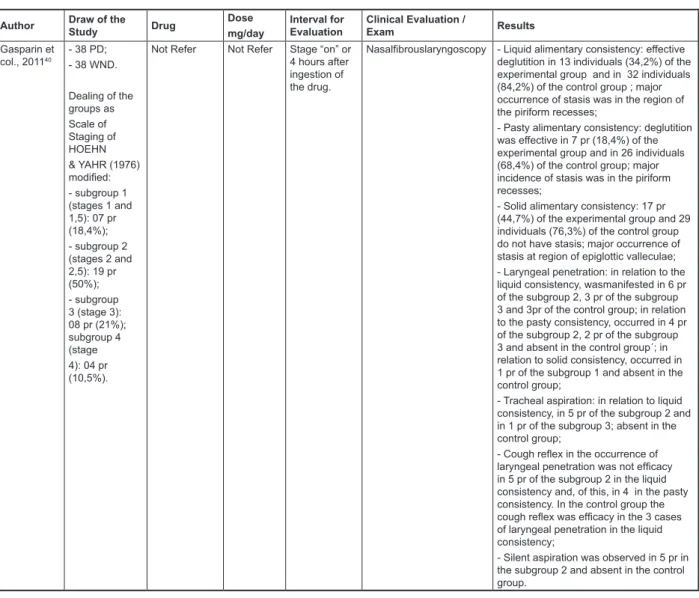
speech, as is showed in igure 2 3,19,22,23,36-40.
the case of a patient of 71 years old with increased salivation and drooling, conducting to perioral lesions29. Lamonica (2003) shows, in research
about clinical manifestations in the Parkinson disease, dysphagia related by 50% of the patients and drooling in 70% of the interviewed patients30.
The dependence to eat and take a oral care, eating by tube, several medical diagnostics, smoking and quality of teeth are important predictors25.
At 1983 Logeman proposes the swallowing
videoluoroscopy, with possibility of to evaluate the
dynamic of the full process of the oropharingeal deglutition, being analyzed disorders of oral phase,
like tremor of phonoarticulatories organs, dificulties
in the initial production of the alimentary bolus,
reduction of the salivar secretion index, increase of
the deglutition time, limitation of the projection of the tongue and mandible during chewing and presence of the repeated anteroposterior moviments of the tongue for propulsion of the bolus (“festination of the tongue muscle”); in the pharingeal phase observed start delayed, with stop of the bolus in the vallecula space and in the piriform sinus, with
risk of larynx penetration and aspiration, altera
-tions of pharynx motility and of the cricopharynx
function; in the esophageal phase occurred peristalsis reduction, with shorter transit time3. All
this disorders discussed relect the desintegration
of the automatic and voluntary moviments caused by akinesia, bradykinesia and rigidity, characters of the Parkinson disease. In study with sample of 15 parkinsonian patients, 15 cerebral vascular accident-suffered patients and 14 health control
patients, followed in videoluoroscopy exam, the
parkinsonian patients presented alterations in the dynamic of the deglutition oral phase, probable to culminate in penetration and/or aspiration. As parkinsonian patients ascerebral vascular accident-suffered patients showed reduced ejection power (demanding more time of oropharingeal transit) or so, the called “ejection in two times”, which oral content is swallowed with penetration of little content
in the pharynx followed by swallowed rest bolus in
continous act31.
During videoluoroscopy evaluation of the deglu -tition of elder parkinsonian patients, Bigal et cols. (2007) observed seemed manifestations to the
found for Logemann (1983), including the dificulties
however, other studies shows that dysphagia is predominantly refratary to dopaminergic drug action and there are cases that worsenes with levodopa administration. Absent of clear association between motor dysfunction and abnormality of the
deglu-tition, added to lack of beneit of the levodopa in
some cases, brings to think about the involvement of other neurotransmission system with the deglu-tition disorders found in the Parkinson disease.
By the other hand, other side effects can interfer of direct or indirect manner in the swallowing.
Excessive sedation, diurnal sleepness, depression
and psychotic disturbs, whether not limit the patients
of to go the sessions, are suficient to dificult ever
therapeutic planning. The lack of adequate alert may to conduct the individual to do not feed adequately, compromising the nutritional board and, also, to get capsules by oral administration. Sickness and vomit maybe limit the access to phonoarticulatory organs during evaluation or therapy. Dizziness, postural hypotension and balance disorders certainly will Dysphagia and medicamentous treatment in
the PD.
In despite of rare evidences about the effects of the levodopa during swallowing23, afirms
that oropharyngeal dysphagia in the idiopathic Parkinson disease is inconsistently responsive to pharmacologic therapy26. Some researchers
already examined the deglutition process in a group
of patients in different periods (in whatever moment, under dopaminergic effect; in other moment, without use of dopaminergic drugs) and discovered that the abnormalities, generally persist after administration of drugs, in despite of the increase of dose26, or
demonstrate only low improve in dysphagia in a group of participants, with decline of the function in other23. Other research only shows low improve
in the dysphagia in a group of participants and worsen of the dysphagic board in other one23. There
are studies that relate reduction of the full time of the deglutition and improve of the buccal lingual
facial motricity in patients treated with apomorine,
Author Draw of the
Study Drug
Dose mg/day
Interval for Evaluation
Clinical Evaluation /
Exam Results
Hunter et col., 199737
15 parkinsonian patients (12 FG and 3 MG)
Levodopa + Apomorphine
Not Refer Was removed
Levodopa/ Apomorphine 8h before and after fasting of 4h.
In the irst day was
realized motor evaluation (to walk/ to sit) + evaluation of deglutition with barium (“off” motor). Already after, administrates a dose of Levodopa 250mg/Carbidope 25mg and re-evaluatesthe deglutition (“on” motor). In the second day, the procedure is repeated, but uses dose of 3,5mg of Apomorphine.
- improves of the motor response as with the use of L-DOPA as of Apomorphine; - In respect to deglutition, do not observed
signiicative difference;
- after the use of Apomorphine observed decrease of accumulate in valleculae and of pharyngeal transit time for semiliquid consistency;
- with the use of levodopa was seen decrease of the number of deglutitions for clearance, decrease of the time of preparatory oral phase for semiliquid and liquid consistencies and increase of the time of oral phase and total time of the deglutition for solids.
Fuh e col., 1997 36
19 pr with PD Levodopa Not Refer Before
and after administration of L-DOPA (60-90 min.)
Videoluoroscopy (VDF)
with liquidpasty and solid consistencies
- alteration of the deglutition in 12 pr (63,2%), having improvement of the symptoms in 50% of this patients after administration of the Levodopa; - the oral phase was alterated in 6 pr: oral transit increased (4 pr), elevation of the lingual base decreased (3 pr), anterior-posterior moviment of the tongue decreased (1) and oral tremor (2), in a such way 3 pr presented better performance after L-DOPA (2 pr presented better performance of the tremor of tongue and 1 pr presented better elevation of the lingual base) and 11 pr presented alteration of pharyngeal phase, in a such way 1 pr worsened after L-DOPA; - the laryngeal aspiration was observed in 3 (15,8%) pr, with 2 pr after Levodopa and 1 pr during and after the deglutition. Of these 3 pr, 2 did not aspirate after L-DOPA;
Author Draw of the
Study Drug
Dose mg/day
Interval for Evaluation
Clinical Evaluation /
Exam Results
Carrara-de Angelis,
200038
24 pr with PD: - 18 MG; - 06 FG; Hoehn & Yahr: 2 a 4
Not Refer Not Refer - - Phonoarticulatoryclinical
evaluation;
- Computerized acoustical evaluation of the voice; - Videolaryngeal estroboscopy;
- Videoluoroscopy of the
oropharyngeal deglutition;
- PD Pr – more symptoms and more awareness of the alterations of the oral communication than of the alterations of the deglutition;
- Alterations of the phonoarticulation more frequent – reduction of the loudness and articulatory imprecision, both correlated to the decrease of the speech inteligibility;
- The larynx presented glottic cleft predominantly fusiform, tremor of larynx and of vocal folds and mixed supraglottic
constriction. Besides, the acoustic measures of perturbation and of noise showed values over of the normality; - Alterations of the deglutition – evidents in all the phases of the deglutition, with 33% of the patients presenting silent aspiration; - Measures of the perturbation of the
fundamental frequency showed signiicant association, with the larynx penetration;
Monte et col,
200522
15 DP 12 NDP 07 control
L-Dopa DP:
977,2± 386,5
NDP: 513,8± 261,0
After 1-2h. administration
Hoehn & Yahr staging and UPDRS II (“on” períod) and III;
VDF with liquid and lot of bread contrasted with barium.
- pharyngeal retention of liquid and solid
and lower eficiency of the deglutition in
non-dyskinetic patients when compared with the controls.
- dyskinetic patients tend to a better global performance of the deglutition (however, with adjusted dose, the difference tend to disappear) and the lower time of the oral transit because of the higher doses of Levodopa, when compared to the non-dyskinetic patients.
- the Levodopa improves the deglutition in only some patients.
Belo et col, 20093
Elder: 15 without neurological disease (EWND); 15 with PD.
Not Refer Not Refer After 3h
administration
Electromyogram of the right and left supra-hyoid-digastric musculature - 10 ml of water;
- 10 ml of ine pasty diet;
- deglutition under command (03 times)
- the medium of the amplitude RMS*was lower in the elder with PD than in the ISDN;
- was observed that the right side was higher than left side in the two groups;
- signiicative differences among
consistencies;
- To the separating the individuals with PD in according to sides higher and lower injuried by neurologic disease were found lower media in the lower injuried side, as
in the liquid (water) as in the ine pasty
(yogurt) consistencies. This difference was little, when compared to the data separated in right and left sides; - the medium found for the duration of the muscle contraction during deglutition of pasty foods was longer than liquids in both groups of individuals. And the medium duration of the contraction in the elder individuals with PD was mildly longer than in the ISDN. However, this difference do
not achieved the signiicance.
Lim, 200823 10 PD in the
“on” and “off” periods
Levodopa - UPDRS;
- Coordenation breathing
x deglutition;
- Test of the deglutition time;
- Test of pulmonary function;
- Qualitative evaluation of the deglutition;
LEVODOPA “ON”:
- Minor volum per deglutition (NS); - Reduction of the pulmonary function (S);
- Reduction of the deglutition eficiency,
but without apparent increase of the risk of aspiration;
LEVODOPA “OFF”:
- Increase of the score of the motor exam
(S);
Author Draw of the
Study Drug
Dose mg/day
Interval for Evaluation
Clinical Evaluation /
Exam Results
Gomide et col, 200819
43 patients: 17 DP; 15 psychotics; 11 DP and psychotics.
MA= 64 years old;
Medium UPDRS: 55 points. .
Clozapine Medium
of the
maximum
dose: 70 mg/day
-26 patients used the medication during
approximately
3,5 years
- Clinical observation - improve of the clinical board in 29
patients; 9 remained with stable clinical board. The treatment was stopped in 20 individuals, being 9 for adverse effects. – lower tolerability: 26 individuals (60,5%) presented adverse clinical effect after beginning of the treatment ; of this, 9 refer over of 1 side effect, such as,
excessive sedation(13), drooling (7),
neutropenia (3), thrombocytopenia (1), urinary incontinency (1), epigastric pain and diarrhea (1), sicknesses, vomits and obstipation (1), diplopia (1), hallucination (1) and agitation; (1);
- 22 (51,2%) patients presented partial
improve, while 7 (16,3%) had signiicative
improve of the clinical board with the use of Clozapine. 9 (20,9%) did not have improve and the last 5 had the treatment stopped before that the result was correctly evaluated;
- improve of the psychotic and motor symptoms was observed in 65,4% and 64,3% of the participants, respectively. Coriolano et
col, 201039
2 without PD, FG
1 healthy indvidual of 60 years old
Age: 63 years old
Hoehn Yarh = 3 at “off” period
Not Refer Not Refer Not Refer SURFACE
ELECTROMYOGRAM (orbicularis oris, masseter , suprahyoid and infrahyoid)
-1st condition – single
deglutition of a volum offered for non-reusable plastic syringe. The subject was oriented to maintain the content inside the mouth and to swallow after command: water – 10ml and 20ml; yogurt of hard consistency - 5ml and 10ml.
-2nd condition – free
swallow of water: non-reusable plastic glass containing 100ml. After record of 2s of the EMG, the researcher announced he command to swallow.
- the normal subject made a single degluttion of 20ml of water, while the subject with PD needed of two deglutitions for the same condition; in the free deglutition, the normal subject made 6 deglutitions in 10s, while the subject with PD made 4 deglutitions (6 versus 4) in the same condition;
- In the subject with PD was necessary a longer time than 10s for free deglutition of the 100ml of water. Still, observed a longer time interval among 4 deglutitions realized by subject with PD in the condition of free deglutition at time of 10s in relation to the normal subject. - The medium of amplitude RMS of the normal subject was higher in all the channels than the medium of amplitude RMS of the two deglutitions of the PD subject; this characteristic was observed in the single deglutition of the volumes of 10ml and 20ml of water.
- The duration of the electromyographic activity of the normal subject was lower in all the channels than the duration of the two deglutitions realized by subject with PD in the single deglutition of 10ml and 20ml of water;
- In the volumes of 5ml and 10ml of consistent yogurt, in both subjects, have only one deglutition;
- The duration of the electromyographic activity in the single deglutition of 5ml and 10ml of consistent yogurt in the normal subject was lower than the duration of the deglutition of the PD subject in the same condition;
Author Draw of the
Study Drug
Dose mg/day
Interval for Evaluation
Clinical Evaluation /
Exam Results
Gasparin et col., 201140
- 38 PD; - 38 WND.
Dealing of the groups as Scale of Staging of HOEHN & YAHR (1976)
modiied:
- subgroup 1 (stages 1 and 1,5): 07 pr (18,4%); - subgroup 2 (stages 2 and 2,5): 19 pr (50%); - subgroup 3 (stage 3): 08 pr (21%); subgroup 4 (stage 4): 04 pr (10,5%).
Not Refer Not Refer Stage “on” or
4 hours after ingestion of the drug.
Nasalibrouslaryngoscopy - Liquid alimentary consistency: effective deglutition in 13 individuals (34,2%) of the
experimental group and in 32 individuals
(84,2%) of the control group ; major occurrence of stasis was in the region of the piriform recesses;
- Pasty alimentary consistency: deglutition was effective in 7 pr (18,4%) of the
experimental group and in 26 individuals
(68,4%) of the control group; major incidence of stasis was in the piriform recesses;
- Solid alimentary consistency: 17 pr
(44,7%) of the experimental group and 29
individuals (76,3%) of the control group do not have stasis; major occurrence of stasis at region of epiglottic valleculae; - Laryngeal penetration: in relation to the liquid consistency, wasmanifested in 6 pr of the subgroup 2, 3 pr of the subgroup 3 and 3pr of the control group; in relation to the pasty consistency, occurred in 4 pr of the subgroup 2, 2 pr of the subgroup 3 and absent in the control group´; in relation to solid consistency, occurred in 1 pr of the subgroup 1 and absent in the control group;
- Tracheal aspiration: in relation to liquid consistency, in 5 pr of the subgroup 2 and in 1 pr of the subgroup 3; absent in the control group;
- Cough relex in the occurrence of laryngeal penetration was not eficacy
in 5 pr of the subgroup 2 in the liquid consistency and, of this, in 4 in the pasty consistency. In the control group the
cough relex was eficacy in the 3 cases
of laryngeal penetration in the liquid consistency;
- Silent aspiration was observed in 5 pr in the subgroup 2 and absent in the control group.
Subtitles: PD, dyskinetic patients; PND, non-dyskinetic patients; im, average age; SF, female; SM, male; DP, Parkinson Disease; S, signiicant; NS, non-signiicant; pr, patient; ppvv, vocal folds; *RMS is the square root of arithmetic average of the square values of the digital electromyogram in a time frame. This average is used in all cases of those that there are variations of negative and positive values. From this calculus negative data become positive.
Figure 2 - Comparison of 9 studies that relate drug actions to the deglutition disorders found in Parkinson Disease
induce the examiner/therapist worries in put the
patient at confortable and apropriate postural, avoiding falls and proportionating him security. Weakness, muscle spasm, increase of tremors,
coordenation disorders, ataxies, diskinesias, involving the appendicular or axial musculature,
will can to have interference with major or minor punctuality. Mainly for the neurologic patients, the body postural maintenance is indispensable during
the meals. In this context, is simple to understand that to assume different speciic postures may to
injury the swallowing. Motor alterations involving
speciic muscular groups of the deglutition may
interfer directly in its performance. The drooling and sensation of dry mouth generally cause discomfort
to patient, however, in the impossiblity of to change of the medication, we can help him to control major volume of the saliva or betake to measures that alleviate the sensation of dry mouth.
Is important to emphasize, also, that a diet rich
in protein may to inluence the distribution of the
one hour after of the meals, in times away from protein ingestion (and this , two hours after the
levodopa ingestion or to the inal of the day), with
empty stomach, or, still, simultaneously to the diet rich in carbohydrates, which will facilitate the intes-tinal absorption5. Juri and Chaná (2006) suggests
the levodopa administration, at least, thirty minutes before of the meals like a important measure to optimize the kinetic of the drug2. Thereby, in the
desire to utilize, in a evaluation or therapy, a meal rich in protein, may be necessary to adjust the time of the intended attendance.
The proissional must to know the medication that
is being administrated to the patient, to familiarize yourself with “on” and “off” periods, besides to pay attention to “wearing off”, “sudden/random ‘on-off” and “delayed ons” phenomena. It is possible that the patients avoid to feed themselves at “off” state.
Still, the extending of this interval will may to reduce
the total quantity of diary alimentary ingestion, culminating in desnutrition. This fact induces us to think that would have difference in the moment of to care of the patient, that is, at “on” or “off” periods, obtaining, during “on” period, the better global motor rebound.
In general, at irst contact with the patient, must
be collected data, such as, disease duration, hour desired of the patient to realize your meals, medica-tions in use and its posology and diary activity.
Besides of the detailed investigation of the existence
of symptoms and/or signals of dysphagia, must be asked whether the patient is under one or more effects of the administrated drugs. Such approach will stimulate the clinician to analyze the collected data with desire to distinguish the origin of the
disorders. Besides, will can to deine a corrective or
attenuater therapeutic approach of the problem.
Besides of choice of the adequated exercises,
maneuver and consistencies for each case, is needed to consider the possibility to readjust of the food options with a nutrition professional, with the
inality of bypass the incompatibility between protein
and levodopa in the gastrointestinal tract, as cited. Other important aspect is that the patient can to feel better performance when is at “on” period of the
medication and such fact to culminate in absences to the therapies when the same be with grave
rigidity and dificulties of locomotion at combined
hour to attendance. However, must give preference,
specially in the irst attendances, to the period that
medication present itself active.
Considering the prevalent age group in the Parkinson disease, would be interesting to value
the prevention of cognitive deicits, inclusive, by exposed in this review, about the relation between
the basal ganglia and cortical and limbic areas. For
example, since that perceives that the effects of the
medication contribute for the limitation of the diary life activities, this must be related to the clinician (mainly because of the major frequency of contact between therapist and patient). Besides, other more
speciic approaches may be executed, obviously, as
a therapy of group focalized to cognitive stimulation.
CONCLUSION
The discussions in the literature occur principally in turn of the levodopa, pointing it like a main pharma-cologic treatment of the Parkinson disease. Several drugs are utilized in the treatment of this disorder. Until moment there are not consistent answers in favour of resolution of the dysphagia like result of pharmacologic treatment. The drugs alleviate the characteristic motor symptoms, however, at costs, of imediate or later, motor or non-motor side effects. Some of the non-motor effects present direct or indirect interferences about the dysphagic manifestations; motor effects may interfer in ever
deglutition phase and to potentiate the existing difi -culties; there are, yet, the risk of interferences about cognitive aspects, limiting ingestion by oral pathway, because of the voluntary and aware aspect of the some deglutition phases. Suggests the record of the medication utilized by the patient (and respective
posology) and relection about possibility of interfer -ences of the pharmacologic therapeutic about the dysphagic board and general health state of the patient, intending bypassing it or removing it, since
6. Felix VN, Corrêa SMA, Soares RJ. A therapeutic maneuver for oropharyngeal dysphagia in patients with Parkinson’s disease. Clinics. 2008;63(5):661-6. 7. Protocolo Clínico e Diretrizes Terapêuticas. Doença de Parkinson - Levodopa/ Carbidopa, Levodopa/ Benserazida, Bromocriptina, Pergolida,
Pramipexol, Cabergolina, Amantadina, Biperideno, Triexifenidil, Selegilina, Entacapona, Tolcapona.
OPAS. Nov, 2002. Disponível em http://www.opas. org.br/medicamentos/docs/pcdt/do_d12_01.pdf 8. Purves D, Augustine GJ, Fitzpatrick D, Hall WC, LaMantia A-S, McNamara JO, Williams SM. Neuroscience. 3rd ed. Massachusetts: Sinauer Associated; 2004.
9. Kandel ER, Schwartz JH, Jessell TM. Principals of Neural Science. 4th ed. New York: McGraw-Hill; 2000.
10. Bedin S, Ferraz AC. Organização Funcional dos Circuitos dos Núcleos da Base Afetados na Doença de Parkinson e na Discinesia Induzida pela Levodopa. Saúde em Revista. 2003;5(9):77-88. 11. Poewe W. Drug Therapy: Dopamine Agonists. In: Schapira e Olanow. Principles of treatment in Parkinson’s disease. Philadelphia: Elsevier; 2005. p. 25-47.
12. Korchounov A, Meyer MF, Krasnianski M. Postsynaptic nigrostriatal dopamine receptors and
REFERENCES
1. Chaná P, Fierro A, Reyes-Parada M, Sáez-Briones P. Comparación farmacocinética de Sinemet y Grifoparkin (levodopa/carbidopa 250/25 mg) en pacientes con enfermedad de Parkinson avanzada: un estudio con dosis única. Rev.Méd. Chile. 2003;131(6):623-31.
2. Juri C, Chaná P. Levodopa en la enfermedad de Parkinson. ¿Qué hemos aprendido? Rev Méd Chile. 2006;134:893-901.
3. Belo LR, Lins SC, Cunha DA, Lins O, Amorim
CF. Eletromiograia de superfície da musculatura
supra-hióidea durante a deglutição de idosos sem doenças neurológicas e idosos com parkinson. Rev. CEFAC. 2009;11(2):268-80.
4. Palermo S, Basto ICC, Mendes MFX, Tavares EF, Santo DCL, Ribeiro AFC. Avaliação e intervenção fonoaudiológica na doença de Parkinson: análise clínica-epidemiológica de 32 pacientes. Rev Bras Neurol. 2009;45(4):17-24.
5. Azevedo LL, Cardoso F. Ação da levodopa e
sua inluência na voz e na fala de indivíduos com
doença de Parkinson. Rev Soc Bras Fonoaudiol. 2009;14(1):136-41.
RESUMO
A Doença de Parkinson apresenta grande incidência na população idosa, gerando comprometimento
motor progressivo, que afeta várias funções, dentre as quais se destaca a deglutição. Esse trabalho teve como objetivo relacionar a disfagia na Doença de Parkinson aos efeitos imediatos e/ou tardios do tratamento medicamentoso, que de forma direta ou indireta interferirá no gerenciamento fonoau-diológico. Fizemos uma revisão de literatura nas bases de dados eletrônicas Lilacs, Scielo, Medline e Pubmed no período de 2001 a 2011, utilizando os termos livres “Doença de Parkinson” (Parkinson Disease), “deglutição” (deglutition), “disfagia” (dysphagia), “preparações farmacêuticas” ( pharmaceu-tical preparations), “levodopa”, “videoluoroscopia” (videoluoroscopy), além de um documento
gover-namental (OPAS, 2002), artigos relevantes e exemplares da literatura americana e brasileira sobre
o tema. A literatura aponta a Levodopa como o principal tratamento farmacológico da doença de
Parkinson. Contudo, a melhora dos sintomas motores deve ser ponderada em função da ocorrência
de efeitos colaterais importantes, sejam imediatos ou tardios. Até o momento não há respostas con-sistentes a favor da melhora da disfagia como resultado do tratamento farmacológico, cujos efeitos podem interferir direta ou indiretamente sobre as manifestações disfágicas e de várias formas. Assim, torna-se fundamental o registro das medicações como parte da anamnese, considerando que tais
dados possam auxiliar na orientação/reorientação da conduta fonoaudiológica, especialmente em contexto interdisciplinar. A despeito da possibilidade do doente de Parkinson responder de forma inconsistente à terapia farmacológica, vale ressaltar que o proissional deve estar atento à presença de efeitos colaterais como fatores modiicadores do quadro de disfagia orofaríngea na Doença de Parkinson idiopática.
breathing and swallowing in Parkinson’s disease. Dysphagia. 2008;23(2):136-45.
27. Pitts T, Troche M, Mann G, Rosenbek J, Okun MS, Sapienza C. Using Voluntary cough to detect penetration and aspiration during oropharyngeal swallowing in patients with Parkinson Disease. Chest. 2010;138(6):1426-31.
28. Bakke M, Larsen SL, Lautrup C, Karlsborg M. Orofacial Function and oral health in patients with Parkinson’s disease. Eur J Oral Sci. 2011;119(1):27-32.
29. Bloem BR, Kalf JG, van de Kerkhof PC, Zwarts MJ. Debilitanting consequences of drooling. J Neurol. 2009;256(8):1382-3.
30. Lamônica DAC, Saes SO, Paro PMM, Brasolotto AG, Barbosa AS. Doença de Parkinson: proposta para um protocolo de anamnese. Salusvita. 2003;22(3):363-71.
31. Yamada EK, Siqueira KO, Xerez D, Koch HA,
Costa MMB. A inluência das fases oral e faríngea
na dinâmica da deglutição. Arq Gastroenterol. 2004;41(1):18-23.
32. Bigal A, Harumi D, Luz M, De Luccia G, Bilton
T. Disfagia do idoso: estudo videoluoroscópico de
idosos com e sem doença de Parkinson. Disturb Comun. 2007;19(2):213-23.
33. Sung HY, Kim JS, Lee KS, Kim YI, Song IU, Chung SW, Yang DW, Cho YK, Park JM, Lee IS, Kim SW, Chung IS, Choi MG. The prevalence and patterns of pharyngoesophageal dysmotility in patients with early stage Parkinson’s disease. Mov Disord. 2010;25(14):2361-8.
34. Gasparim AZ. Eicácia da deglutição e do relexo de tosse na doença de Parkinson [dissertação]. Curitiba (Paraná): Universidade Tuiuti do Paraná; 2007.
35. Higo R, Tayama N, Watanabe T, Niimi S. Abnormal elevation of resting pressure at the upper esophageal sphincter of Parkinson’s disease patients. Eur Arch Otorhinolaryngol. 2001; 258(10):552-6.
36. Fuh JL, Lee R, Wang SJ, Lin CH, Wang P,
Chiang J et al. Swallowing dificulty in Parkinson
Desease. Clin Neurology and Neurosurgery. 1997;99(2):106-12.
37. Hunter PC, Crfameri J, Austin S, Woodward MC, Hughes AJ. Response of Parkinsonian swallowing dysfunction to dopaminergic stimulation. J Neurol Neurosurg Psychiatry 1997;63:579-83.
38. Carrara-de Angelis E. Deglutiçäo, coniguraçäo laríngea, análise clínica e acústica computadorizada da voz de pacientes com doença de Parkinson [tese]. São Paulo (SP): UNIFESP; 2000.
their role in movement regulation. JNeural Transm. 2010;117(12): 1359-69.
13. Niremberg MJ, Stanley F. The role of levodopa and cathecol-o-metyltransferase inhibitors. In: Schapira AH e Olanow CW. Principles of treatment in Parkinson’s disease. Philadelphia: Elsevier; 2005. p. 3-24.
14. Venegas PF. Consideraciones sobre las
complicaciones motoras y neurotoxicidad de la
levodopa en la enfermedad de Parkinson. Rev Chil Neuro-Psiquiat. 2005;43(3):231-5.
15. Scorza FA, Henriques LD, Albuquerque M. Doença de Parkinson – Tratamento medicamentoso e seu impacto na reabilitação de seus portadores. Mundo Saúde. 2001;25(4):365-70.
16. Dicionário de Administração de Medicamentos na Enfermagem 2005/2006. Rio de Janeiro: EPUB; 2004. P. 504-5.
17. Souza RG, Borges V, Sila SMCA, Ballalai, H. Quality of life scale in Parkinson’s disease PDQ-39 - (Brazilian Portuguese version) to assess patients
with and without levodopa motor luctuation. Arq
Neuropsiquiatr. 2007;65(3-B):787-91.
18. Gomide L, Kummer A, Cardoso F, Teixeira AL. Use of clozapine in Brazilian patients with Parkinson’s disease. Arq Neuropsiquiatr. 2008;66(3-B):611-4. 19. Ziliani J, Rosa MN de. Enfermedad de Parkinson. Amantadina en discinesias por Levodopa. Rev Med Plata. 2003;37(3):19-22.
20. Cersosimo MG, Koller WC. Other Drug Therapies for Parkinson’s disease. In: Schapira AH e Olanow CW. Principles of treatment in Parkinson’s disease. Philadelphia: Elsevier; 2005. p.49-66. 21. Miller N, Allcock L, Hildreth AJ, Jones D, Noble E, Burn DJ. Swallowing problems in Parkinson Disease: frequency and clinical correlates. J Neurol Neurosurg Psychiatry. 2009;80(9):1047-9.
22. Monte FS, Silva-Junior FP, Braga-Neto P. Swallowing abnormalities and dyscinesia in Parkinson’s Disease. Moviment Disorders. 2005;20(4):457-62.
23. Lim A, Leow L, Huckabee ML, Frampton C, Anderson T. A pilot study of respiration and swallowing integration in Parkinson’s disease: “on” and “off” levodopa. Dysphagia. 2008;23(1):76-81. 24. Potulska A, Friedman A, Królicki L, Spychala A. Swallowing disorders in Parkinson’s disease. Parkinsonism Relat Disord. 2003;9(6):349-53. 25. Troche MS, Sapienza CM, Rosenbeck JC. Effects of bolus consistency on timing and safety of swallow in patients with Parkinson’s disease. Dysphagia. 2008;23 (1):26-32.
40. Gasparim AZ, Jurkiewicz AL, Marques JM, Santos RS, Marcelino PCO, Herrero JF. Deglutição e tosse nos diferentes graus da doença de Parkinson. Arq. Int. otorrinolaringol. 2011;15(2):181-8.
39. Coriolano MGWS, Lins OG, Belo LR, Menezes DC, Moraes SRA, Asano AG, et al. Monitorando a
deglutição através da eletromiograia de superfície.
Rev. CEFAC. 2010;12(3):434-40.
Received on: June 06, 2012 Accepted on: January 07, 2013
Mailing Address: Paula Pinheiro Gerszt
Departamento de Educação Integrada em Saúde Avenida Marechal Campos, n. 1468 - Maruípe Vitória - Espírito Santo
CEP: 29040-090