https://doi.org/10.1590/0004-282X20170103
CLINICAL SCALES, CRITERIA AND TOOLS
Translation and validation of the Life
Satisfaction Index for Adolescents scale with
neuromuscular disorders: LSI-A Brazil
Tradução e validação da escala de qualidade de vida para adolescentes com doenças
neuromusculares para português do Brasil: LSI-A Brasil
Valdecir Antonio Simon1, Edmar Zanoteli1, Margarete Andreozzi Vaz Pereira Simon2,
Maria Bernadete Dutra de Resende1, Umbertina Conti Reed1
1Universidade de São Paulo, Faculdade de Medicina, Departamento de Neurologia, São Paulo SP, Brasil;
2Universidade de São Paulo, Faculdade de Medicina, Hospital das Clínicas, Instituto da Criança, Departamento de Distúrbios de Aprendizagem, São Paulo SP, Brasil.
Correspondence: Valdecir Antonio Simon; Av. Dr. Eneas de Carvalho Aguiar, 255 / sala 5083; 05403-000 São Paulo SP, Brasil; E-mail: [email protected]
Conlict of interest: There is no conlict of interest to declare.
Support: Higher Education Personnel Improvement Coordination (Coordenação de Aperfeiçoamento de Pessoal de Nível Superior - CAPES). It was carried out in the Department of Neurology, School of Medicine, University of São Paulo and in the João Pinheiro School.
Received 06 December 2016; Received in inal form 02 April 2017; Accepted 11 May 2017.
ABSTRACT
Objective: To validate the Life Satisfaction Index for Adolescents (LSI-A) scale, parent version and patient version, for Duchenne muscular dystrophy (DMD), spinal muscular atrophy (SMA) and limb-girdle muscular dystrophy (LGMD). Methods: The parent version of the instrument was divided into Groups A, B, C and D; and the patient version, divided into B, C and D. For the statistical calculation, the following tests were used: Cronbach’s α, ICC, Pearson and the ROC Curve. Results: The parent and patient versions of the instrument are presented, with the following results in the overall score, respectively: Cronbach’s α, 0.87 and 0.89; reliability, r 0.98 and 0.97; reproducibility, ICC 0.69 and 0.80; sensitivity, 0.78 and 0.72; speciicity, 0.5 and 0.69; and accuracy, 64% and 70.4%. Conclusion: According to the validity and reproducibility values, the LSI-A Brazil parent and patient versions, are clinically useful to assess quality of life in DMD, SMA or LGMD and may also be useful for other neuromuscular disorders.
Keywords: validation studies; quality of life; neuromuscular disorders.
RESUMO
Objetivo: Validar a escala Life Satisfaction Index for Adolescents (LSI-A) versão pais e versão paciente para doenças neuromusculares.
Método: O instrumento versão pais foi dividido nos Grupos A,B, C e D; e paciente, em B, C e D. Para cálculo estatístico utilizou-se os testes α de Cronbach, CIC, Pearson e Curva ROC. Resultados: Valor de Cronbach versão pais e paciente no escore geral, 0.87 e 0.89; coniabilidade,0.98 e 0.97;reprodutibilidade,entre 0.59 e 0.69 e, entre 0.58 e 0.80; sensibilidade, 0.78 e 0.72; especiicidade, 0.5 e 0.69; e acurácia, 64% e 70.4% respectivamente. Conclusão: Conforme a validade e reprodutibilidade, o LSI-A Brasil versão pais e paciente é útil clinicamente para avaliar a Qualidade de Vida da Distroia Muscular de Duchenne, Amiotroia Espinhal Progressiva ou Distroia Muscular tipo Cinturas e pode ser usado para outras doenças neuromusculares.
Palavras-chave: estudos de validação; qualidade de vida; doenças neuromusculares.
he importance of quantifying the quality of life of subjects with neuromuscular disorders (NMD) by use of appropriate instruments is a relevant health issue because of the lack of speciic questionnaires. his study dealt with the translation and validation of a questionnaire for NMD patients. In this study, three NMDs were considered: two dystrophies and one atrophy: Duchenne muscular dystrophy (DMD), limb-girdle muscular dystrophy (LGMD) and spinal muscular atrophy (SMA), respectively. he dystrophies are characterized by irreversible degeneration of muscular ibers, which leads to
muscular weakness and motor disability, originating from mutations in diferent genes1
. he atrophy is characterized by degeneration of the spinal cord motor neurons, i.e., secondary muscular atrophy1
.
here is scientiic consensus that the health-related qual-ity of life (HRQOL) involves subjective and multidimensional values, either negative or positive, according to individual per-ception and expectation, and to the cultural inluence of the individual2
. he quality of life can be reported by the child or by a related caregiver3
which complement the clinical assessment of the patient and the conducting of clinical tests4
, and to assess the magnitude of longitudinal changes and, mainly, to evaluate the impact of certain interventions with the purpose of modifying the symptoms and the functionality of the patient through time5
. For this relevant task, the Life Satisfaction Index for Adolescents (LSI-A) scale was selected as more efective in assessing the HRQOL of patients with NMDs, as it is broader than the usual emphasis on psychosocial, behav-ioral, psychological and educational aspects of HRQOL, and includes a few items that deal with physical aspects that contribute to the precise establishment of the HRQOL. As already mentioned, HRQOL depends on the patient’s per-ception of their life domains. his analysis was a longitudinal study applied to 95 children diagnosed with DMD6
. According to authors Reid and Renwick7
, the LSI-A aims to assess the HRQOL perception of adolescents, between the ages of 12 and 19 years old, diagnosed with DMD7
. he authors7 considered that further studies may expand the application of the LSI-A to the other NMDs. Parrish.8 also veriied, with psychometric properties, that the LSI-A instrument was ade-quate for the expansion to other NMDs. herefore, the goal of this study was to translate to Brazilian Portuguese, and validate, the patient version of the LSI-A scale and to create and validate a parent version, for patients with DMD. As well, the LSI-A was expanded to include LGMD and SMA. he age range of the patient version (with previous authorization by the authors) was also expanded, from the previous 12 to 19 years old, to embrace the ages eight to 18 years old. he parent version created in this study is capable of embracing children and adolescents between ive and 18 years old.
As the LSI-A instrument has a high level of efectiveness in the assessment of HRQOL and, due to its importance in the neuromuscular ield, this scale was validated for the Brazilian Portuguese language in this study, creating the Life Satisfation Index for Adolescents (LSI-A Brazil) parent ver-sion and patient verver-sion (Appendix).
METHODS
his study was approved by the Ethics Committee for Analysis of Research Projects (CAPPesq) of the Hospital Clinical Board, number 0505/2010. For the validation of the LSI-A Brazil instrument parent version and patient version for patients with DMD, LGMD or SMA, the patients were recruited from the Neurology Clinic of the Clinics Hospital of the University of São Paulo Medical School. he healthy group was recruited from João Pinheiro School, São Paulo, Brazil.
Instrument
he LSI-A is self-administered and is used to assess HRQOL for patients with NMDs. It broadly covers subjective and multidimensional aspects and contains 45 questions
with a Likert scale ranging from 0 to 5 (with 1 meaning “fully disagree”, 2 meaning “disagree”, 3 meaning “neither agree nor disagree”, 4 meaning “agree”, 5 meaning “fully agree” and 0 meaning “not applicable”). he instrument covers ive domains: general well-being, interpersonal relationship, devel-opment, personal satisfaction, leisure and recreation, with nine
questions for each domain, and a higher score representing a better index7
. he same characteristics made up both the parent version and patient version of the LSI-A Brazil.
Participants
his protocol included 82 participants, 43 (52.4%) of whom were diagnosed with DMD, 18 (22%) with LGMD, and 21 (25.6%) with SMA. heir age means and standard deviation were: DMD 11.4 ± 3.38, LGMD 10.58 ± 3.48 and SMA 10.95 ± 2.98. he diagnoses were veriied by molecu-lar test (DMD and SMA) or by immunohistochemical analy-sis of dystrophin and other muscle proteins through muscle biopsy (DMD and LGMD).
he inclusion criteria for NMD patients were: individuals with a conirmed diagnosis of DMD, LGMD or SMA, between ive and 18 years old; without cognitive deicit and intelligence quotient (IQ) above 80; who were reliable patients, whose par-ents agreed to take part in this research protocol and signed the Free and Informed Consent Form. he exclusion criteria were: patients without a conirmed diagnosis of the referred NMDs, under the age of ive and above 18 years old; with a cog-nitive deicit and IQ below 80; who were not reliable on the scheduled days or who had interrupted clinical supervision.
he inclusion criteria of the healthy group consid-ered healthy participants age-matched to the NMD sample ( ive to 18 years old), IQ above 80, whose parents agreed to take part in this research protocol and signed the Free and Informed Consent Form.
he patients and healthy participants answered the LSI-A Brazil patient version, and the parents of these participants answered the parent version of the LSI-A Brazil question-naire. his was part of the validation of both versions.
Protocol
he translation of the LSI-A scale into Brazilian Portuguese, the validation of the LSI-A Brazil patient version and the creation and validation of the LSI-A Brazil parent version was carried out between October 2012 and July 2013. For this process, the versions were applied by intra-observer for 33% of the participants. he average duration of the appli-cations was seven minutes each.
Description of the validation steps
he process of validation of the LSI-A patient version translated to Brazilian Portuguese had the prior authorization (Step 1) of Ted Myerscough, from the Quality of Life Research Unit of the University of Toronto, Canada. he questionnaire was translated by an native English language professional translator and by a certiied translator (Step 2). After the com-parison of both translations, it was noted that the translation made by the English language native translator was non-literal and, therefore, culturally more appropriate, closer to colloquial language and more efective for the process of linguistic adap-tation than the certiied translation. he Probe10 technique was included in the third step. his technique is used to achieve a satisfactory comprehension level, which should be above 85%. Its application was directed to three groups of 20 patients, in three phases. During this process, there was an improve-ment in the linguistic quality of the instruimprove-ment through cul-tural adaptation using the following criteria: semantic, idiom-atic, conceptual and experimental equivalences.
he Portuguese language version, resulting from the Probe technique was re-translated into the English language by a native English language translator and compared to the original (Step 4). he analysis of this retranslation allowed the veriication of linguistic equivalence. After this step, the version resulting from the Probe technique was submit-ted for assessment by the revision committee (comprising three neuropediatricians, one pedagogue and one phonoau-diologist), which suggested some technical changes in the resultant version (Step 5).
After the LSI-A Brazil patient version reached a high, and satisfactory level of comprehension, the parent version was created through pronoun changes and semantic modiica-tion of some terms to better suit the adult proile. he parent version passed through the 5th and 6th steps.
Step 6 was divided into two periods: irst, the reapplica-tion of the Probe technique in order to achieve the satisfac-tory comprehension level for the patient version (n = 18) and the parent version (n = 18) after the changes suggested by the revision committee; secondly, there was application of the inal version of the LSI-A Brazil parent version and patient ver-sion for psychometric evaluation, obtained by statistical cal-culation of the quantiication of the HRQOL of the patients. Note that the serial applications did not inluence the result because the questionnaire is appropriate for longitudinal stud-ies. he psychometric evaluation was distributed accordingly: internal consistency (reliability of questions), parent version n = 15 and patient version n = 21; external consistency (inter-observer correlation), parent version n = 22 and patient version n = 32; external consistency (test-retest reproducibility – twice with an interval of three months), parent version n = 05 and patient version n = 10; sensitivity and speciicity, parent version n = 15 and patient version n = 32.
For the cutof point, the Receiver Operating Characteristic (ROC) Curve test was applied to healthy participants and to
children and adolescents with DMD, LGMD or SMA, with 82 patients in total. he same was carried out with the ent version, which was applied to the healthy children’s par-ents (n = 82) and the patipar-ents’ parpar-ents (n = 82).
To establish the cutof for age range, the patients with DMD, LGMD and SMA were distributed equally into four age groups: Group A, n = 19, 5–7 years old; Group B, n = 21, 8–10 years old; Group C, n = 20, 11–13 years old; Group D, n = 22, 14–18 years old. he parent version was divided into A, B, C, and D groups, while the patient version was divided into B, C, and D groups.
Statistics
For the validation of the questionnaire, the gold standard was adopted as a series of tests that expressed the accuracy value. Firstly, the statistical description – mean and standard deviation of healthy subjects and those with NMDs – was cal-culated. he calculation of internal consistency, item reliability, was made using the Cronbach’s alpha Coeicient test. For the calculation of external consistency – the inter-observer cor-relation – Pearson’s Linear Corcor-relation (r) test was applied11
. Reproducibility was analyzed through the scores of two appli-cations, with an interval of three months, using the Intraclass Correlation Coeicient test (ICC)12,13. he ROC Curve test was used for the assessment of sensitivity, speciicity, cutof, and accuracy. For cutof of the age category, the ROC Curve test compared patients with DMD, LGMD and SMA and the healthy group, both groups divided into their age ranges.
For the graphical analysis of the ROC Curve test, values above the curve were considered satisfactory14
. he level was considered signiicant when p < 0.5.
he SPSS Statistics version 2.2 was used for Cronbach’s alpha and the BioStat version 5.3 package for the Pearson’s, ICC, and ROC Curve tests.
RESULTS
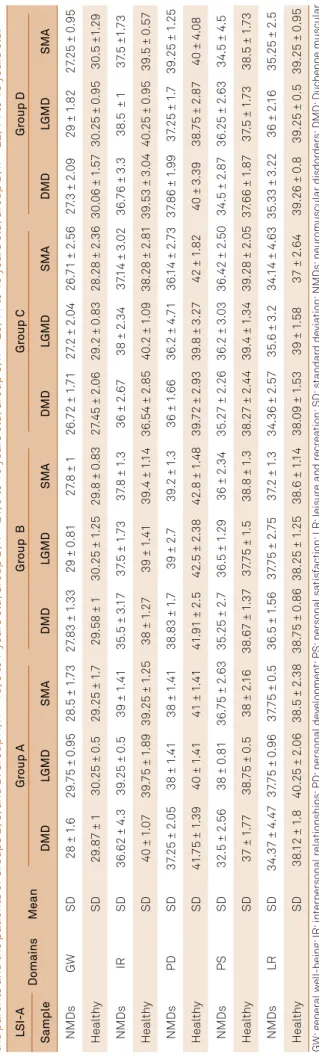
he level of comprehension reached via the inal Probe tech-nique was 97% for the parent version and 95% for the patient ver-sion, which is above the minimum of 85% required. he averages and standard deviations of the domains can be seen in Table 1.
Cronbach’s alpha test was used to assess the reliability of the items in the LSI-A Brazil parent version and patient ver-sion and it showed a overall score of α = 0.87 for the parent version and α = 0.89 for the patient version. hese values and the values of the other domains, the values of which guarantee moderate/high psychometric reliability, are shown in Table 2.
he reproducibility data for the LSI-A Brazil were assessed through the ICC test. he patient version showed ICC values ranging from 0.58 and 0.80; the parent version showed ICC values from 0.59 and 0.69. All domains showed a signiicant diference. Both versions indicated a satisfactory reproducibility (Table 3).
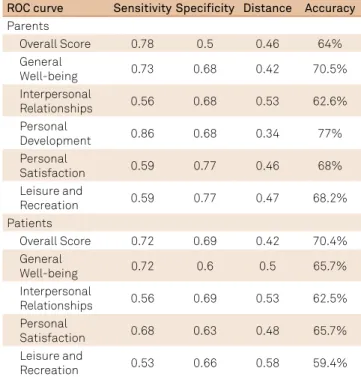
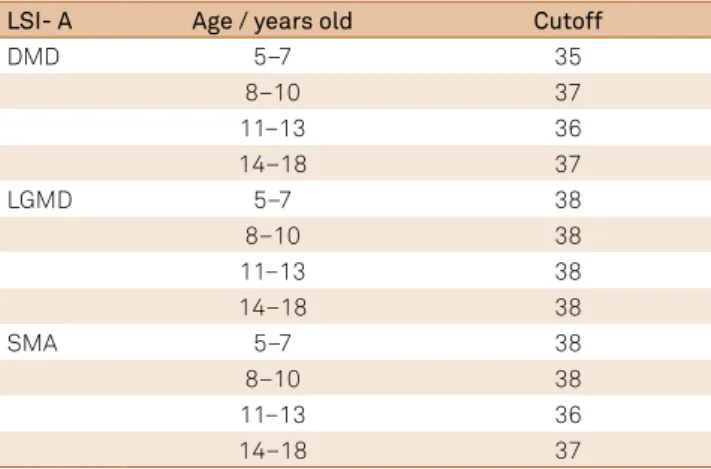
he ROC Curve test showed satisfactory results above the diagonal line. Due to signiicant diferences in all domains for both versions as a result of its application for groups with DMD, LGMD and SMA, and for the healthy group, the LSI-A Brazil parent version overall score showed the following results: sensitivity = 0.78, speciicity = 0.5, cutof = 35.8 and accuracy = 70.35%; and the LSI-A Brazil patient version overall score showed sensitivity = 0.72, speciicity = 0.69, cutof = 37 and accuracy = 70.4%. he remaining results of the diferent domains are presented in Table 4 and Figures A and B. he cutof value of the LSI-A Brazil parent version, and the patient version, was standardized according to age groups (Table 5). Note: as the variance was not signiicant between the two versions in all domains, the cutof remains the same for both.
DISCUSSION
According to the authors, the original LSI-A is promising15 , since it obtained satisfactory psychometric data and proved sensitive to the perception of changes in the domains of HRQOL of patients with DMD16
; that is, even a year after its application, the instrument showed reliable results due to its good replica-bility17
. Equally, in this study, the validation of the LSI-A Brazil
Tabl
e 1
.
Mean and s
tandar
d de
via
tion o
f the scor
es o
f the L
SI-A Br
azil ap
plied onl
y t
o the par
ents o
f Gr
oup A
, and the mean and s
tandar
d de
via
tion o
f the scor
es o
f the L
SI-A Br azil ap plied t o the par
ents and the pa
tients o
f Gr
oups B
, C
, and D
. Gr
oup A
, n = 19,
5 t
o 7 y
ear
s ol
d;
Gr
oup B
, n = 21
, 8 t
o 10 y
ear
s ol
d;
Gr
oup C
, n = 20
, 11 t
o 13 y
ear
s ol
d;
Gr
oup D
, n = 22,
14 t
o 18 y
ear s ol d. L SI-A Domains Mean Gr oup A Gr
oup B
Gr oup C Gr oup D Sampl e DMD LGMD SMA DMD LGMD SMA DMD LGMD SMA DMD LGMD SMA NMDs GW SD
28 ± 1
.6
29.
75 ± 0
.95
28.5 ± 1
.73
27
.83 ± 1
.33
29 ± 0
.81
27
.8 ± 1
26.
72 ± 1
.71
27
.2 ± 2.
04
26.
71 ± 2.56
27
.3 ± 2.
09
29 ± 1
.82
27
.25 ± 0
.95
Health
y
SD
29.87 ± 1
30
.25 ± 0
.5
29.25 ± 1
.7
29.58 ± 1
30
.25 ± 1
.25
29.8 ± 0
.83
27
.45 ± 2.
06
29.2 ± 0
.83
28.28 ± 2.36
30
.06 ± 1
.57
30
.25 ± 0
.95 30 .5 ±1 .29 NMDs IR SD
36.62 ± 4.3
39.25 ± 0
.5
39 ± 1
.41
35.5 ± 3.
17
37
.5 ± 1
.73
37
.8 ± 1
.3
36 ± 2.67
38 ± 2.34
37
.14 ± 3.
02
36.
76 ± 3.3
38.5 ± 1
37 .5 ±1 .73 Health y SD
40 ± 1
.07
39.
75 ± 1
.89
39.25 ± 1
.25
38 ± 1
.27
39 ± 1
.41
39.4 ± 1
.14
36.54 ± 2.85
40
.2 ± 1
.09
38.28 ± 2.81
39.53 ± 3.
04
40
.25 ± 0
.95
39.5 ± 0
.57
NMDs
PD
SD
37
.25 ± 2.
05
38 ± 1
.41
38 ± 1
.41
38.83 ± 1
.7
39 ± 2.
7
39.2 ± 1
.3
36 ± 1
.66
36.2 ± 4.
71
36.
14 ± 2.
73
37
.86 ± 1
.99
37
.25 ± 1
.7
39.25 ± 1
.25 Health y SD 41
.75 ± 1
.39
40 ± 1
.41
41 ± 1
.41
41
.91 ± 2.5
42.5 ± 2.38
42.8 ± 1
.48
39.
72 ± 2.93
39.8 ± 3.27
42 ± 1
.82
40 ± 3.39
38.
75 ± 2.87
40 ± 4.
08
NMDs
PS
SD
32.5 ± 2.56
38 ± 0
.81
36.
75 ± 2.63
35.25 ± 2.
7
36.5 ± 1
.29
36 ± 2.34
35.27 ± 2.26
36.2 ± 3.
03
36.42 ± 2.50
34.5 ± 2.87
36.25 ± 2.63
34.5 ± 4.5
Health
y
SD
37 ± 1
.77
38.
75 ± 0
.5
38 ± 2.
16
38.67 ± 1
.37
37
.75 ± 1
.5
38.8 ± 1
.3
38.27 ± 2.4
4
39.4 ± 1
.34
39.28 ± 2.
05
37
.66 ± 1
.87
37
.5 ± 1
.73
38.5 ± 1
.73
NMDs
LR
SD
34.37 ± 4.47
37
.75 ± 0
.96
37
.75 ± 0
.5
36.5 ± 1
.56
37
.75 ± 2.
75
37
.2 ± 1
.3
34.36 ± 2.57
35.6 ± 3.2
34.
14 ± 4.63
35.33 ± 3.22
36 ± 2.
16
35.25 ± 2.5
Health
y
SD
38.
12 ± 1
.8
40
.25 ± 2.
06
38.5 ± 2.38
38.
75 ± 0
.86
38.25 ± 1
.25
38.6 ± 1
.14
38.
09 ± 1
.53
39 ± 1
.58
37 ± 2.64
39.26 ± 0
.8
39.25 ± 0
.5
39.25 ± 0
.95 GW: g ener al w ell -being; IR: int erper sonal r ela tionships; PD: per sonal de vel opment; PS: per sonal sa tis fac tion; LR: l eisur
e and r
ecr ea tion; SD: s tandar d de via tion; NMDs: neur omuscular disdor der s; DMD: D uc henne muscular dis tr oph y; L GMD: limb-gir dl
e muscular dis
tr
oph
y;
SMA:
spinal muscular a
tr
oph
y.
Table 2. Cronbach alpha and Pearson’s test of the LSI-A Brazil parent version and patient version.
LSI-A Item Parent Patient Parent Patient Domains n Cronbach’s α Cronbach’s α r Pearson r Pearson
OS 45 0.87 0.89 0.98 0.97
GW 9 0.65 0.75 0.89 0.84
IR 9 0.65 0.73 0.96 0.96
PD 9 0.65 0.78 0.93 0.96
PS 9 0.71 0.70 0.98 0.97
LR 9 0.78 0.80 0.96 0.98
OS: overall score; GW: general well-being; IR: interpersonal relationships; PD: personal development; PS: personal satisfaction; LR: leisure and
recreation;Conidence interval: 95%.
Table 3. Intraclass correlation test of the LSI-A Brazil parent version and patient version applied at two different times.
ICC GW IR PD PS LR
Parent ICC 0.59 0.58 0.46 0.56 0.69
Parent test power 0.08 0.08 0.14 0.09 0.04
Conclusion MR MR MR MR MR
Patient ICC 0.78 0.58 0.72 0.67 0.8
Patient test power 0.001 0.024 0.004 0.008 0.001
Conclusion ER MR MR MR ER
showed signiicant values for all domains in the three NMDs, indicating that the patient version and the later-created par-ent version prespar-ented with satisfactory indexes, indicating its eicacy and trustworthiness in capturing the perception of HRQOL of patients between ive and 18 years old with DMD, LGMD and SMA. Note that the age range of the NMD patients was expanded from the original version. Due to the valida-tion process that used a cross-cultural adaptavalida-tion strategy, also adopted by other studies18,19, the resultant versions had
Table 4. Values of the ROC Curve of the LSI-A parent version and patient version.
ROC curve Sensitivity Speciicity Distance Accuracy
Parents
Overall Score 0.78 0.5 0.46 64%
General
Well-being 0.73 0.68 0.42 70.5%
Interpersonal
Relationships 0.56 0.68 0.53 62.6%
Personal
Development 0.86 0.68 0.34 77%
Personal
Satisfaction 0.59 0.77 0.46 68%
Leisure and
Recreation 0.59 0.77 0.47 68.2%
Patients
Overall Score 0.72 0.69 0.42 70.4%
General
Well-being 0.72 0.6 0.5 65.7%
Interpersonal
Relationships 0.56 0.69 0.53 62.5%
Personal
Satisfaction 0.68 0.63 0.48 65.7%
Leisure and
Recreation 0.53 0.66 0.58 59.4%
Receiver operating characteristic - ROC curve. Conidence interval considered was of 95%.
accessible language and easy comprehension and applica-tion. herefore, the LSI-A Brazil is capable of quantifying the HRQOL with precision. Beyond this, it preserves the subjec-tive content, psychological and social aspects, as well as physi-cal20,21 features, which makes it a tool with positive diferences above other scales.
he items in this questionnaire obtained high reliability of internal consistency across the application of Cronbach’s alpha in both versions; the same occurred in the original patient version7
. here was proximity of values in both stud-ies, which reinforces the quality of this validation.
he external consistency in the original patient version, measured through Pearson’s Linear Correlation Test, was considered moderate7
. his study showed, in both patient version and parent version, high correlation values with a signiicance of p < 0.0001 in all domains. he statistical data revealed the concordance between observers during the interviews, which gave greater psychometric quality to this validation.
he external consistency was shown in the ICC. By test-retest, the LSI-A Brazil reached satisfactory values regarding replicability, indicating that it qualiies as repro-ducible. he values of the ICC test obtained in this study were moderate, that is, both versions of the questionnaire retained the same reference values in applications under diferent circumstances and places without changes of results, which made it trustworthy. However, the values resulting from the application may vary in relation to the clinical characteristics of each situation.
he gold standard originated from the application of many psychometric tests used in this validation, indicating the accu-racy of the LSI-A Brazil, also shown in the ROC Curve test, which is used to assess the quality of a given clinical test22,23.
Figure. A. The ROC Curve of the Overall Score of LSI-A Brazil parent version. B. The ROC Curve of the Overall Score of LSI-A Brazil patient version
Sensitivity
Specificity 0.80
1.00
d
0.60
0.40
0.20
0.00
0.2 0.4 0.6 0.8 1.0
Sensitivity
Specificity 0.80
1.00
d
0.60
0.40
0.20
0.00
0.2 0.4 0.6 0.8 1.0
his indicated, in both versions, signiicant sensitivity and spec-iicity above the reference line. he accuracy, remaining above 60%, also indicated a good measurement of what the study aimed for with the instrument – guaranteeing good eicacy24
. Table 5. Cutoff of age group of the LSI-A Brazil parent version and patient version.
LSI- A Age / years old Cutoff
DMD 5–7 35
8–10 37
11–13 36
14–18 37
LGMD 5–7 38
8–10 38
11–13 38
14–18 38
SMA 5–7 38
8–10 38
11–13 36
14–18 37
Receiver operating characteristic - Curve ROC. Conidence interval: 95%. Group A, n = 19, 5 to 7 years old; Group B, n = 21, 8 to 10 years old; Group C, n = 20, 11 to 13 years old; Group D, n = 22, 14 to 18 years old. DMD: Duchenne muscular distrophy; LGMD: limb-girdle muscular dystrophy; SMA: spinal muscular atrophy.
he ROC Curve test also established the cutof value of the instrument, which is capable of indicating changes in clinical practice and serves as a reference for routine applica-tions25
. hrough standardization of the cutof related to age range and pathology, it is possible to assess the HRQOL with greater precision, given that values higher than the cutof value indicate an increase in HRQOL2,26.
According to psychometric data for internal and exter-nal consistency (reliability and reproducibility), sensitivity, speciicity, and accuracy, the LSI-A Brazil parent version is useful to assess the quality of life of patients between ive and 18 years old and the patient version is also helpful for patients between eight and 18 years old for DMD, LGMD or SMA. he LSI-A Brazil can easily be expanded to evaluate the HRQOL of other neuromuscular disorders, but further stud-ies are needed to conirm that.
Acknowledgement
We thank all patients, students, parents, teachers and all individuals who participated in this study.
References
1. Reed UC. [Neuromuscular disorders].
J Pediatr (Rio J). 2002;78(1 Suppl 1):89-103. https://doi.org/10.1590/S0021-7557200200070001
2. Bullinger M, Anderson R, Cella D, Aaronson N. Developing
and evaluating cross-cultural instruments from minimum requirements to optimal models. Qual Life Res. 1993;2(6):451-9. https://doi.org/10.1007/BF00422219
3. Eiser C, Morse R. A review of measures of quality of life for
children with chronic illness. Arch Dis Child. 2001;84(3):205-11. https://doi.org/10.1136/adc.84.3.205
4. Gill T, Feinstein AR. A critical appraisal of the quality of
quality-of-life measurements. JAMA. 1994;272(8):619-25. https://doi.org/10.1001/jama.1994.03520080061045
5. Guyatt GH, Feeny DH, Patrick DL. Measuring health-related
quality of life. Ann Intern Med. 1993;118(8):622-9.
https://doi.org/10.7326/0003-4819-118-8-199304150-00009
6. Simon VA, Resende MBD, Simon MA, Zanoteli E,
Reed UC. Duchenne muscular dystrophy: quality of life among 95 patients evaluated using the Life Satisfaction Index for Adolescents. Arq Neuropsiquiatr. 2011;69(1):19-22. https://doi.org/10.1590/S0004-282X2011000100005
7. Reid DT, Renwick RM. Preliminary validation of a new
instrument to measure life satisfaction in adolescents with neuromuscular disorders. Int J Rehabil Res. 1994;17(2):184-8. https://doi.org/10.1097/00004356-199406000-00009
8. Parrish RK 2nd. Visual impairment, visual functioning, and quality of
life assessments in patients with glaucoma. Trans Am Ophthalmol Soc. 1996;94:919-1028.
9. Guillemin F, Bombardier C, Beaton D. Cross-cultural adaptation
of health-related quality of life measures: literature review and proposed guidelines. J Clin Epidemiol. 1993;46(12):1417-32. https://doi.org/10.1016/0895-4356(93)90142-N
10. Clark P, Lavielle P, Martínez H. Learning from pain scales: patient
perspective. J Rheumatol. 2003;30(7):1584-8.
11. Pearson K, Fisher R, Inman HF. Karl Pearson and R. A. Fisher
on statistical tests: a 1935 exchange from nature. Am Stat. 1994;48(1):2-11. https://doi.org/10.2307/2685077
12. Shrout PE, Fleiss JL. Intraclass correlations: uses in
assessing rater reliability. Psychol Bull 1979;86(2):420-8. https://doi.org/10.1037/0033-2909.86.2.420
13. Fayers PM, Machin D. Quality of life: assessment, analysis and
interpretation. New York: Wiley; 2000.
14. Cronbach LJ. Coeficient alpha and the internal
structure of tests. Psychometrika. 1951;16(3):297-334. https://doi.org/10.1007/BF02310555
15. Melo ELA, Valdés MTM, Pinto JMS. Qualidade de vida em crianças
e adolescentes com distroia muscular de Duchenne. Pediatria (São Paulo). 2005;27(1):28-37.
16. Solans M, Pane S, Estrada MD, Serra-Sutton V, Berra S,
Herdman M et al. health-related quality of life measurement in children and adolescents: a systematic review of generic and disease-speciic instruments. Value Health. 2008;11(4):742-64. https://doi.org/10.1111/j.1524-4733.2007.00293.x
17. McDougall J, Servais M, Sommerfreund J, Rosen E, Gillett J,
Gray J et al. An evaluation of the paediatric acquired brain injury community outreach programme (PABICOP). Brain Inj. 2006;20(11):1189-205. https://doi.org/10.1080/02699050600975541
18. Barbosa TS, Tureli MC, Gavião MB. Validity and reability of the Child
Perceptions Questionnaires applied in Brazilian children. BMC Oral Health. 2009;9(1):13. https://doi.org/10.1186/1472-6831-9-13
19. Bandeira M, Calzavara MGP, Costa CS, Cesari L. Avaliação
20. Boström K, Ahlström G. Quality of life in patients with muscular dystrophy and their next of kin. Int J Rehabil Res. 2005;28(2):103-9. https://doi.org/10.1097/00004356-200506000-00002
21. Boyer F, Drame M, Morrone I, Novella JL. Factors
relating to carer burden for families of persons with muscular dystrophy. J Rehabil Med. 2006;38(5):309-15. https://doi.org/10.1080/16501970600731578
22. Zhou XH, Obuchowski NA, McClish DK. Statistical methods in
diagnostic medicine. New York: Wiley-Interscience; 2002.
23. Silva AC, Carvalho PCP, Gattass M. Diagnosis of solitary lung
nodule using texture and geometry in computerized tomography
images: preliminary results. IEEE Latin America Transactions. 2004;2(2):75-80. https://doi.org/10.1109/TLA.2004.1468623
24. Sabbatini RME. Um programa para o cálculo da acurácia,
especiicidade e sensibilidade de testes médicos. Revista Informédica. 1995;2(12):19-21.
25. Heneghan C, Badenoch D. Ferramentas para medicina baseada em
evidências. 2a ed. Porto Alegre: Artmed; 2007.
26. Yamaguchi N, Poudel KC, Poudel-Tandukar K, Shakya D,
APPENDIX
Qualidade de Vida para crianças e adolescentes com doenças Neuromusculares - LSI-A Neuromuscular Brasil Distroias Musculares de Duchenne e de Cinturas e Amiotroia Espinhal Progressiva
Versão Pais Idade 5 a 18 anos
Instruções
Neste questionário lhe pedem que responda a várias declarações, as quais tratam do grau de satisfação da vida se seu ilho/a. Cada declaração é seguida por ícones de avaliação. Leia cada declaração cuidadosamente, então circule o número correspon-dente ao ícone de avaliação que melhor descreve o quanto você concorda ou discorda com a declaração à respeito de seu ilho/a.
Por favor, leia o exemplo abaixo antes de você começar.
Exemplo:
Meu ilho/a tem bastante energia.
Discordo Plenamente Discordo Não concordo Nem discordo Concordo Concordo Plenamente Não aplicável
Se você concordar com esta declaração, você marcará um X no número 4. Se você discordar plenamente, você assinalará um X no número 1, e assim por diante.
LEIA CADA QUESTÃO E MARQUE SOMENTE UMA RESPOSTA PARA CADA ITEM.
As informações que você der icarão em sigilo.
LSI-A Neuromuscular Brasil versão pais
Considerando a última semana, responda
Discordo
Plenamente Discordo
Não concordo
nem discordo
Concordo Concordo Plenamente
Não Aplicável Meu ilho (a) ...
1.Tem bastante energia 1 2 3 4 5 0
2. Muitas vezes se sente mal 1 2 3 4 5 0
3. Está feliz com sua aparência 1 2 3 4 5 0
4. Tem amigos para conversar 1 2 3 4 5 0
5. Está feliz com seus familiares 1 2 3 4 5 0
6. Não gosta de pedir ajuda às pessoas 1 2 3 4 5 0
7. Gosta da escola 1 2 3 4 5 0
8. Gosta do que faz quando não está na escola 1 2 3 4 5 0
9. Acredita que pode melhorar o mundo 1 2 3 4 5 0
10. Está feliz com sua vida 1 2 3 4 5 0
11. Gosta de si mesmo 1 2 3 4 5 0
12. Quando as coisas vão mal,acha que podem
melhorar 1 2 3 4 5 0
13. Está feliz com tudo o que fez na sua vida até agora 1 2 3 4 5 0
14. Gostaria de mais tempo livre 1 2 3 4 5 0
15. Quando está entediado, sabe arrumar o que fazer 1 2 3 4 5 0
16. Tem tempo livre para fazer o que quer 1 2 3 4 5 0
17. Está feliz com os momentos de lazer que ele têm 1 2 3 4 5 0
18. Ir ao médico o atrapalha no que quer fazer 1 2 3 4 5 0
19.Fala que cadeira de rodas não o atrapalha para
fazer o que quer 1 2 3 4 5 0
20. Está feliz com seus amigos 1 2 3 4 5 0
21. Acha que nós o apoiamos em suas decisões 1 2 3 4 5 0
22. Está feliz com as chances que tem para tentar
fazer coisas novas 1 2 3 4 5 0
24. Consegue esperar pelo dia de amanhã 1 2 3 4 5 0
25. Não tem tempo para se divertir 1 2 3 4 5 0
26. Fica triste por não poder fazer o que quer em
seu tempo livre 1 2 3 4 5 0
27. Fica chateado facilmente 1 2 3 4 5 0
28. Sente que sua situação física o atrapalha
naquilo que faz 1 2 3 4 5 0
29. Durante as aulas, seus professores o deixam
falar o que acha 1 2 3 4 5 0
30. Pensa que as pessoas que cuidam de sua saúde (médicos, enfermeiras, isioterapeutas etc) o entendem
1 2 3 4 5 0
31. Tem chance de ajudar os outros 1 2 3 4 5 0
32. Procura informações sobre o que cada
proissão faz 1 2 3 4 5 0
33. Pensa que ele nunca será quem ele gostaria de ser 1 2 3 4 5 0
34. Tem planos para o futuro 1 2 3 4 5 0
35. Pensa que a escola é importante para ele ter
uma proissão 1 2 3 4 5 0
36. Está feliz com sua saúde 1 2 3 4 5 0
37. Tem diiculdade para fazer o que quer 1 2 3 4 5 0
38. Diverte se com a nossa família 1 2 3 4 5 0
39. Está feliz com as chances que tem para passear 1 2 3 4 5 0
40. Acha difícil relaxar 1 2 3 4 5 0
41. Se sente bem entre as pessoas 1 2 3 4 5 0
42. Está feliz com a amizade que tem com as
meninas ou com os meninos 1 2 3 4 5 0
43. Acha que nós nos esforçamos para entender
seus sentimentos 1 2 3 4 5 0
44. Faz coisas que ele se sente orgulhoso de fazer 1 2 3 4 5 0
45. Sabe o que quer ser quando crescer 1 2 3 4 5 0
Qualidade de Vida para crianças e adolescentes com doenças Neuromusculares - LSI-A Neuromuscular Brasil Distroias Musculares de Duchenne e de Cinturas e Amiotroia Espinhal Progressiva
Versão Paciente Idade 8 a 18 anos
Instruções
Neste questionário lhe pedem que responda a várias declarações, as quais tratam do grau de satisfação de vida. Cada decla-ração é seguida por ícones de avaliação. Leia cada decladecla-ração cuidadosamente, então circule o número correspondente ao ícone de avaliação que melhor descreve o quanto você concorda ou discorda com a declaração.
Por favor, leia o exemplo abaixo antes de você começar.
Exemplo:
Tenho bastante energia.
Discordo Plenamente Discordo Não concordo Nem discordo Concordo Concordo Plenamente Não aplicável
Se você concordar com esta declaração, você marcará um X no número 4. Se você discordar plenamente, você assinalará um X no número 1, e assim por diante.
LSI-A Neuromuscular Brasil versão paciente
Considerando a última semana, responda
Discordo
Plenamente Discordo
Não Concordo
nem Discordo
Concordo Concordo Plenamente
Não Aplicável Eu...
1. Tenho bastante energia 1 2 3 4 5 0
2. Muitas vezes eu me sinto mal 1 2 3 4 5 0
3. Estou feliz com minha aparência 1 2 3 4 5 0
4. Tenho amigos para conversar 1 2 3 4 5 0
5. Estou feliz com minha família 1 2 3 4 5 0
6. Não gosto de pedir ajuda às pessoas 1 2 3 4 5 0
7. Gosto da escola 1 2 3 4 5 0
8. Gosto do que faço quando não estou na escola 1 2 3 4 5 0
9. Acredito que posso melhorar o mundo 1 2 3 4 5 0
10. Estou feliz com minha vida 1 2 3 4 5 0
11. Gosto de mim mesmo 1 2 3 4 5 0
12. Quando as coisas vão mal, acho que podem melhorar 1 2 3 4 5 0
13. Estou feliz com tudo o que iz na minha vida até agora 1 2 3 4 5 0
14. Gostaria de mais tempo livre 1 2 3 4 5 0
15. Quando estou entediado, sei arrumar o que fazer 1 2 3 4 5 0
16. Tenho tempo livre para fazer o que quero 1 2 3 4 5 0
17. Estou feliz com os momentos de lazer que tenho 1 2 3 4 5 0
18. Ir ao médico me atrapalha para fazer o que quero 1 2 3 4 5 0
19. Usar cadeira de rodas não me atrapalha para eu fazer o
que quero 1 2 3 4 5 0
20. Estou feliz com meus amigos 1 2 3 4 5 0
21. Acho que meus pais me apoiam em minhas decisões 1 2 3 4 5 0
22. Estou feliz com as chances que tenho para tentar
fazer coisas novas 1 2 3 4 5 0
23. Consigo me acalmar após ter me assustado 1 2 3 4 5 0
24. Consigo esperar pelo dia de amanhã 1 2 3 4 5 0
25. Não tenho tempo para me divertir 1 2 3 4 5 0
26. Fico triste por não poder fazer o que quero em meu
tempo livre 1 2 3 4 5 0
27. Fico chateado facilmente 1 2 3 4 5 0
28. Sinto que minha situação física me atrapalha naquilo
que faço 1 2 3 4 5 0
29. Tenho professores que me deixam falar o que eu
acho nas aulas 1 2 3 4 5 0
30. Penso que as pessoas que cuidam de minha saúde (médicos, enfermeiras, isioterapeutas etc) me entendem
1 2 3 4 5 0
31. Tenho chance de ajudar os outros 1 2 3 4 5 0
32. Procuro informações sobre o que cada proissão faz 1 2 3 4 5 0
33. Penso que eu nunca serei quem eu gostaria de ser 1 2 3 4 5 0
34. Tenho planos para o futuro 1 2 3 4 5 0
35. Penso que a escola é importante para eu ter uma
proissão 1 2 3 4 5 0
36. Estou feliz com minha saúde 1 2 3 4 5 0
37. Tenho diiculdade para fazer o que quero fazer 1 2 3 4 5 0
38. Me divirto com minha família 1 2 3 4 5 0
39. Estou feliz com as chances que tenho para passear 1 2 3 4 5 0
40. Acho difícil relaxar 1 2 3 4 5 0
41. Me sinto bem entre as pessoas 1 2 3 4 5 0
42. Estou feliz com a amizade que tenho com as meninas
ou com os meninos 1 2 3 4 5 0
43. Acho que meus pais tentam entender meus
sentimentos 1 2 3 4 5 0
44. Faço coisas que me deixam eu me sentir orgulhoso
de fazê-las 1 2 3 4 5 0