1
Original Article
The Role of Echocardiography as an Isolated
Method for Indicating Surgery in Patients
With Congenital Heart Disease
Lilian Maria Lopes, Ana Paula Damiano, Gláucia Neusa Oliveira Moreira,
Terezinha J. F. Azevedo, Célia Toshie Nagamatsu, Gláucia Maria Penha Tavares,
Victor Coimbra Guerra, José Pedro da Silva, Gláucio Furlanetto,
André Bavaresco Cristóvão Salvador
São Paulo, SP - Brazil
Hospital Beneficência Portuguesa de São Paulo
Mailing address: Lilian M. Lopes - Al. Santos, 211, Cj. 1307 Cep 01419-000 - São Paulo, SP, Brazil
E-mail: [email protected] Received for publication: 07/02/2003 Accepted for publication: 09/03/2004
Objective
To determine the diagnostic accuracy of echocardiography for indicating surgery without catheterization in patients with congenital heart disease through a prospective analysis and com-parison of the echocardiographic diagnosis with the intraopera-tive findings, or invasive study, or both.
Methods
From February 2000 to January 2001, 493 patients with congenital heart diseases indicated for surgery were followed up. They underwent echocardiography with color-flow mapping for a therapeutic decision. The results were compared with the findings of surgery or catheterization, or both, when the latter were performed for diagnostic reasons.
Results
Of the patients studied, 94.3% (465 cases) underwent conge-nital heart disease correction based only on echocardiographic findings, without a diagnostic catheterization. The invasive study was performed for diagnostic reasons in 28 (5.6%) patients, the surgical treatment was performed in more than 95% of the pa-tients, and therapeutic catheterization was performed in 3.6%. The echocardiographic findings were confirmed in 464 (94.1%) patients, which showed the high accuracy of the method. False-positive findings occurred in 8 (1.6%) patients, and false-negative findings in 39 (7.9%). According to surgeons, no diagnostic error led to complications or adversely affected the surgical results.
Conclusion
Echocardiography proved to be a sensitive and safe method for indicating surgery, making catheterization, often, unneces-sary. The invasive study was restricted to diagnostic or therapeutic uses.
Key words
echocardiography, noninvasive diagnosis, congenital heart disease
The preoperative diagnosis of congenital heart disease from both the functional and anatomical points of view should be per-formed to provide enough data to allow the surgeon to plan the surgical approach, avoiding unpleasant surprises during the pro-cedure. Some years ago, adequate assessment was only possible by use of cardiac catheterization, an invasive method with greater risk for patients, mainly children; in addition, several complications related to that procedure have been reported 1-5.
Advances in the field of imaging have allowed the development of increasingly more sophisticated devices that have improved the quality of the images obtained, allowing a detailed assessment of the heart and great vessels. In several services, echocardiography has become the first-line approach for preoperative study, cathete-rization being reserved for diagnostic backup. However in the lite-rature, controversy still exists about the indication for surgery with no invasive study for all patients with complex cardiac defects 6-15,
an approach adopted by some institutions only for the simple defects, such as isolated lesions with intracardiac shunt and heart diseases with single ventricle physiology that require palliative surgery.
This study aimed at analyzing the accuracy of echocardiography in the preoperative assessment of patients with congenital heart diseases, by comparing the echocardiographic diagnosis with in-traoperative or catheterization findings, or both.
Methods
From February 2000 to January 2001, of 2,004 patients studied through echocardiography with color-flow mapping in our service, 493 were indicated for corrective or palliative surgical treatment and were prospectively followed up during the in-hospital phase. The results of preoperative echocardiography were compared with the intraoperative anatomic description developed by the attending surgeon. Patients with previous cardiac surgery were excluded from the study.
2
patients, sedation, when necessary, was performed through the oral or rectal route with 8% chloral hydrate at the dosages re-commended for the pediatric age group.
The transthoracic echocardiographic study was performed by pediatric cardiologists and comprised the following: evaluation of the thoracic and abdominalsitus; determination of the presence of 2 atria and 2 ventricles, superior vena cava, inferior vena cava, pulmonary veins, and their respective drainage sites; assessment of the integrity of the atrial and ventricular septa, of the morphology and location of the atrioventricular valves, right and left ventricular outflow tract, arterial ventricular connection, morphology of the pulmonary artery and branches, and morphology of the aortic arch. Doppler and color-flow mapping were used to assess the flows in the pulmonary artery, its branches, and the aorta, as well as the intracavitary and transvalvular flows, in addition to researching septal defects. Our study did not aim at a comparison with transesophageal echocardiography as a diagnostic method, although that examination was used as a complementary technique in adult patients with atrial septal defects and an inadequate trans-thoracic echocardiographic window.
Catheterization was performed when echocardiography did not clarify all anatomic details of the heart disease and of diagnostic complementation or when discordance existed between the clinical and echocardiographic findings. The adult patients aged < 40 years underwent surgery without catheterization when no doubts existed on echocardiography.
The patients were analyzed in regard to the distribution of their congenital heart diseases and classified as having an isolated lesion (only one defect) or as having a major lesion (associated with 2 or more defects). In the cases of associated lesions, the major lesion was established according to the greatest severity or hemodynamic repercussion.
Accuracy of the transthoracic echocardiography was deter-mined by comparing the data obtained on the preoperative echo-cardiography and the findings of the surgery and catheterization, when the latter was performed. The divergences found were divided into false-positive (when the echocardiogram showed a finding not confirmed on surgery or catheterization, or both) and false-negative (when the echocardiogram did not show a feature observed on catheterization or surgery, or both). The errors were subdivided into major errors, when they led to a significant modification in the surgical procedure or affected the surgical risk or postoperative evolution, and minor errors, when the preceding aspects were not observed.
For the description of quantitative variables, the median and standard deviation were used; for qualitative variables, the absolute and relative frequencies were used, and the values were expressed as proportions. For comparing the groups, the Student t test was used in the independent continuous samples. For the samples expressed as proportions, the chi-square test with Yates correction and the Fisher exact test were chosen. The results whose des-criptive level (P) was lower than 0.05 were considered statistically significant.
Results
Of the 493 patients prospectively followed up during the in-hospital phase, 447 (90.6%) underwent cardiac surgery without
catheterization, and 46 required invasive study. The patient’s ages ranged from one day to 64 years (mean, 5 years and 110 days; median, 365 days). The female sex accounted for 48% of the sample and the male sex for 52%.
The echocardiographic finding was confirmed neither on surgery, nor on catheterization in 8 patients (false-positive, 1.6%) as follows: 1) 3 patients had atrial septal defect: one patient had an associated significant enlargement in the right chambers and an increase in tricuspid regurgitation due to valvular dysplasia, and 2 patients had associated partial anomalous pulmonary venous drai-nage; 2) 2 patients had systemic-pulmonary collaterals in tetralogy of Fallot; 3) one patient had mild pulmonary valvular stenosis; 4) one patient had type I truncus arteriosus comunis; and 5) one patient had pulmonary atresia with a ventricular septal defect.
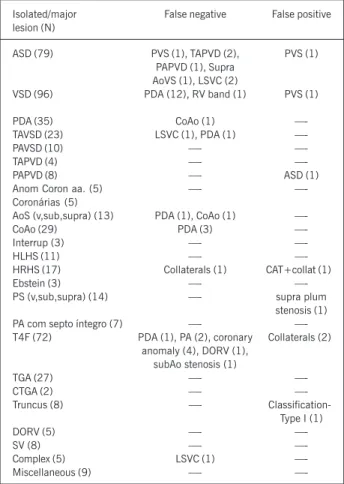
In 39 patients, the echocardiogram did not show some aspect observed on catheterization or surgery, or both, (false-negative, 7.9%), persistence of the ductus arteriosus (18) being the most common in diseases with pulmonary hypertension or increased blood flow, such as ventricular septal defect, coarctation of the aorta, and atrioventricular septal defect. The following were not also diagnosed: coronary artery anomaly (4); persistence of the left superior vena cava (4); anomalous pulmonary venous drainage (3); coarctation of the aorta (2); pulmonary atresia (2); pulmonary valvular stenosis (1); aortic supravalvular stenosis (1); aortic sub-valvular stenosis (1); anomalous right ventricular band (1); double-outlet right ventricle (1); and presence of systemic-pulmonary collaterals (1). The comparison of the false-positive results in simple and complex diseases was not statistically significant, but that of the false-negative results was statistically significant (P < 0.004). Table I shows the totally correct results, the false-positive and false-negative results related to each heart disease, as well as the number of patients in whom catheterization was performed in each disease. Table II shows the false-negative and false-positive results (discrepancies) identified for each type of congenital heart disease diagnosed on echocardiography, both in the isolated and associated form.
The accuracy of the echocardiographic diagnosis was deter-mined by comparison with the results of catheterization, surgical or autopsy findings, or both. The echocardiographic diagnosis was completely correct in 464 (94.1%) patients. The accuracy rate for the major associated lesions on the echocardiogram was greater than that for the lesions considered in isolation, and this difference was statistically significant (P < 0.001). In our hospi-tal, the accuracy rate of the method was 94.1%. According to the surgeons, the diagnostic errors neither led to complications nor had an adverse effect on the surgical results.
Diagnostic catheterization was performed in 28 (5.6%) patients and complemented the investigation more frequently in more com-plex diseases; however, no statistical significance was observed when that frequency was compared with the number of times catheterization was performed in less complex diseases, such as atrial septal defects, for assessing pulmonary pressure (5 cases); for assessing pulmonary pressure and the presence of coronary heart diseases in adults > 40 years (2 cases); and due to age > 40 years (2 cases). Systolic pressure in the pulmonary artery in these patients ranged from 60 mmHg to 100 mmHg.
3
placement in atrial septal defect (2); coil placement in persistent ductus arteriosus (1); and pulmonary valvuloplasty (7). In 8 patients, balloon catheterization was performed for the atrial septostomy procedure [transposition of the great arteries (4), tricuspid atresia (2), pulmonary atresia with intact ventricular septum (1), and tetralogy of Fallot with pulmonary atresia (1)].
Discussion
In this study, the echocardiogram proved to be highly reliable as a method of preoperative assessment of patients with congenital heart disease undergoing their first surgical procedure. The sensi-tivity and specificity of the echocardiographic diagnosis in the preoperative assessment of those patients has already been inves-tigated in some centers of cardiac surgery and echocardiography, and similarly to the findings in our study, a significant concordance was observed between the echocardiographic diagnosis and the surgical findings or the findings of catheterization, when performed, or both 16-18. However, most studies cited in the literature do not
separately consider the patients undergoing the surgical procedure first, including also the patients undergoing surgery for correction of the univentricular type, in which catheterization is frequently required for preoperative assessment of pulmonary pressure.
Catheterization has been progressively restricted to thera-peutic use, and several studies in the literature have confirmed satisfactory results with fewer risks for the patients with closure of atrial septal defects, patent ductus arteriosus, dilation of the
pulmonary valve, coarctation of the aorta, and recoarctation of the aorta 19-21. Jarrar et al 22 reported a rate of pulmonary restenosis
after a 10-year follow-up of only 4.8% in patients undergoing valvuloplasty with a balloon catheter. Diagnostic catheterization is more frequently performed in patients with complex heart di-seases, who have several associated lesions 9,15.
Concomitantly with the reduced number of diagnostic cathe-terization, we observed a low incidence of flaws in the echocar-diographic diagnosis. The most frequent causes of diagnostic error or incomplete diagnosis occurred due to the lack of adequate detection of the extracardiac structures, mainly the presence of patent ductus arteriosus in patients with ventricular septal defect, atrioventricular septal defect, and coarctation of the aorta. This has already been described by D’Orsogna et al 23 and may be due
to the difficulty in assessing the extracardiac structures on echo-cardiography, because such structures have similar echodensities. In the cases of ductus arteriosus, the low flow between the aorta and the pulmonary trunk occurs due to equalization of the pressures between those chambers due to pulmonary hypertension or increased flow, which may hinder its visualization. Because the suprasternal section is mandatory in routine echocardiographic examination of congenital heart diseases, the assessment of ex-tracardiac structures through that window is known to be difficult, mainly in small children. That limitation, undoubtedly contributes to the incomplete diagnosis in patients with persistent left supe-rior vena cava, mainly when no dilation of the coronary sinus is observed, which may suggest anomalous systemic venous drainage.
Table I - Distribution of the congenital heart diseases according to the echocardiographic diagnosis
Lesion (N) Echo diagnosis isolated lesion Isolated (N) Echo diagnosis major lesion Major (N) Echo + cathet
C F+ F- C F+
F-ASD (79) 52 1 7 60 18 1 —- 19 9
VSD (96) 50 —- 13 63 33 —- —- 33 1
PDA (35) 34 —- 1 35 —- —- —- —- 1
TAVSD (23) 13 —- 2 15 8 —- —- 8 1
PAVSD (10) 7 —- —- 7 3 —- —- 3
—-TAPVD (4) 4 —- —- 4 —- —- —- —-
—-PAPVD (8) 6 —- —- 6 1 1 —- 2 1
Anom Coron aa. (5) 5 —- —- 5 —- —- —- —- 3
AoS (13) 8 —- 2 10 3 —- —- 3
—-CoAo (29) 6 —- 3 9 20 —- —- 20 1
Interrup. (3) —- —- —- —- 3 —- —- 3
—-HLHS (11) 10 —- —- 10 1 —- —- 1
—-HRHS/TA (17) 14 1 1 16 1 —- —- 1 5
Ebstein (3) 3 —- —- 3 —- —- —- —-
—-PS (14) 10 1 —- 11 3 —- —- 3 7
PA w/ intact VS (7) 6 —- —- 6 1 —- —- 1 2
T4F (72) 34 2 8 44 27 —- 1 28 5
TGA (27) 18 —- —- 18 9 —- —- 9 4
CTGA (2) 1 —- —- 1 1 —- —- 1
—-Truncus (8) 7 1 —- 8 —- —- —- —- 1
DVSVD (5) 1 —- —- 1 4 —- —- 4 1
SV (8) 2 —- —- 2 6 —- —- 6 1
Complex (5) 4 —- 1 5 —- —- —- —- 2
Miscellaneous (9) 9 —- —- 9 —- —- —- —- 1
Total (493) 304 6 38 348 142 2 1 145 46
4
or fibromuscular ring. However, due to the presence of a ventricular septal defect, the transvalvular gradient may not be perceived on Doppler, even when very significant, and the 2-dimensional mode assessment acquires extreme importance.
To conclude the discussion about the negative and false-positive results found in tetralogy of Fallot, the literatureis still controversial about the differentiation between tetralogy of Fallot and double-outlet right ventricle 26. Some authors consider the
presence of complete bilateral double infundibulum essential for the diagnosis of double-outlet right ventricle. We agree with Tynan et al 27, who consider that that criterion hinders the diagnosis of
double-outlet right ventricle with tetralogy of Fallot. They chose to define as double-outlet right ventricle the cases in which more than 50% of the circumference of the aorta relates to the right ventricle, independently of the nature of the structures that support it 28. Thus, some examples of double-outlet right ventricle also
have tetralogy of Fallot. We believe that that differentiation is interesting for surgical planning without invasive study, because the extension of the patch used to close a ventricular septal defect is greater in the cases of double-outlet right ventricle of the “Fallot type,” with a greater risk of postoperative obstruction of the left ventricular outflow tract. Knowing that the long parasternal axis is the most recommended for assessing the degree of aortic over-ride, one patient had double-outlet right ventricle of the “Fallot type” interpreted as classic tetralogy of Fallot. The patient had a significant chest deformity that did not allow the adequate perfor-mance of that section and the correct alignment in regard to the septum, underestimating its override.
Assessment of the coronary arteries proved to be adequate on echocardiography, because, in 27 patients with transposition of the great arteries, no coronary anomaly was missed, and, in 72 patients with tetralogy of Fallot, only 4 (5.5%) false-negative results occurred. We recommend the systematic assessment of the co-ronary arteries during the echocardiographic examination, including the use of color Doppler, because that anomaly may be present in up to 31% of the patients with tetralogy of Fallot, whose most common form is represented by a dilated right coronary artery (indirect signal) from which the anterior descending artery origi-nates, crossing anteriorly the right ventricular outflow tract 29. In
the 4 patients with false-negative results in our case series, the diameter of the right coronary artery was normal, and that valuable indirect signal that would raise that hypothesis was not observed. A false-positive and a false-negative diagnosis occurred in the patients with truncus arteriosus. In the false-positive case, the pulmonary artery was not defined because it was very hypoplastic, and the pulmonary arteries seemed to originate directly from the aorta, considered a common arterial trunk. During the surgical act, pulmonary atresia with important hypoplasia of the proximal pulmonary artery and ventricular septal defect were observed. In the false-negative case, an error occurred in the classification of a type III truncus, which was interpreted as type I. The intraope-rative findings showed 2 individualized pulmonary arteries with a long left pulmonary artery and a much smaller right pulmonary artery. The error may be explained by the fact that the right pulmonary artery was not visualized, and the long left branch was interpreted as the pulmonary trunk. That difficulty occurs in type III truncus because the pulmonary arteries are not usually visualized together in the same parasternal plane, the origin of one pulmonary We found some false-positive and false-negative results in the
assessment of valvular stenoses in heart diseases with increased pulmonary flow, such as atrial and ventricular septal defects. Those findings were considered secondary to an over- or underestimated assessment of the relative valvular stenosis due to increased pul-monary flow. In these cases, we suggest a more detailed evaluation of the valvular morphology for the correct differential diagnosis, as well as the analysis of the sub- and postvalvular pulmonary flow, which will appear with different velocities.
Assessment of the pulmonary valve may also be hindered in the cases of tetralogy of Fallot with a significant obstruction of the right ventricular outflow tract, in which the pulmonary valve is usually very hypoplastic 24. In that case, the analysis with the
pulsed Doppler located right after the pulmonary valve could help to differentiate the functional pulmonary atresia from the anatomic pulmonary atresia. Still regarding tetralogy of Fallot, the presence of subaortic stenosis, as an associated lesion, has already been reported by Snider et al 25, and it may be present as a thin membrane
Table II - Distribution of the isolated and major defects and their respective discrepancies
Isolated/major False negative False positive
lesion (N)
ASD (79) PVS (1), TAPVD (2), PVS (1)
PAPVD (1), Supra AoVS (1), LSVC (2)
VSD (96) PDA (12), RV band (1) PVS (1)
PDA (35) CoAo (1)
—-TAVSD (23) LSVC (1), PDA (1)
—-PAVSD (10) —-
—-TAPVD (4) —-
—-PAPVD (8) —- ASD (1)
Anom Coron aa. (5) —-
—-Coronárias (5)
AoS (v,sub,supra) (13) PDA (1), CoAo (1)
—-CoAo (29) PDA (3)
—-Interrup (3) —-
—-HLHS (11) —-
—-HRHS (17) Collaterals (1) CAT+collat (1)
Ebstein (3) —-
—-PS (v,sub,supra) (14) —- supra plum
stenosis (1)
PA com septo íntegro (7) —-
—-T4F (72) PDA (1), PA (2), coronary Collaterals (2) anomaly (4), DORV (1),
subAo stenosis (1)
TGA (27) —-
—-CTGA (2) —-
—-Truncus (8) —-
Classification-Type I (1)
DORV (5) —-
—-SV (8) —-
—-Complex (5) LSVC (1)
—-Miscellaneous (9) —-
5
References
1. Cohn HE, Freed MD, Hellebrand WF, Fyler DC. Complications and mortality asso-ciated with cardiac catheterization in infants under one year: A prospective study. Pediatr Cardiol 1985;6:123-31.
2. Brus F, Witsenburg M, Hofhuis WJD, Hazelzet JA, Hess H. Streptokinase treat-ment for femoral artery thrombosis after arterial cardiac catheterization in infants and children. Br Heart J 1990;63:291-4.
3. Klys HS, Salmon AP, De Giovanni JV. Paradoxical embolization of catheter frag-ment to a coronary artery in an infant with congenital heart disease. Br Heart J 1991;66:320-1.
4. Casidy SC, Schmidt KG, Van Hare GF, Stanger P, Teitel DF. Complications of manage-ment cardiac catheterization: A 3-year study. J Am Coll Cardiol 1992;91: 1285-93. 5. De Bono D. Complications of diagnostic cardiac catheterization: Results from 34,041 patients in the United Kingdom confidential enquire into cardiac catheter complications. Br Heart J 1993;1:297-300.
6. Gutgesell HP, Huhta JC, Latson LA, Huffines D, McNamara DG. Accuracy of two-dimensional echocardiography in the diagnosis of congenital heart disease. Am J Cardiol 1985;55:514-8.
7. Carotti A, Marino B, Bevilacqua M et al. Primary repair of isolated ventricular septal defect in infancy guided by echocardiography. Am J Cardiol 1997;79:1498-1501. 8. Currie PJ, Seward JB, Hagler DJ, Tajik AJ. Two-dimensional/Doppler
echocardio-graphy and its relationship to cardiac catheterization for diagnosis and manage-ment of congenital heart disease. Cardiovasc Clin 1986;17:301-22.
9. Davis JT, Allen HD, Cohen DM et al. Use of cardiac catheterization in pediatric car-diac surgical decisions. Thorac Cardiovasc Surg 1994;42:148-51.
10. Krabill KA, Ring WS, Foker JE et al. Echocardiographic versus cardiac catheteri-zation diagnosis of infants with congenital heart disease requiring cardiac surgery. Am J Cardiol 1987;60:351-4.
11. Zellers TM, Zehr R, Weinstein E, Leonard S, Ring WS, Nikaidoh H. Two-dimensio-nal and Doppler echocardiography alone can adequately define preoperative ana-tomy and hemodynamic status before repair of complete atrioventricular septal de-fect in infants < 1 year old. J Am Coll Cardiol 1994;4:1565-70.
12. Bash SE, Huhta JC, Vick GM, Gutgessel HP, Ott DA. Hypoplastic left heart syndro-me: is echocardiography accurate enough to guide surgical palliation? J Am Coll Cardiol 1986;7:610-6.
13. Glasow PF, Huhta JC, Yoon GY, Murphy DJ, Danford DA, Ott DA. Surgery without an-giography for neonates with aortic arc obstruction. Int J Cardiol 1988;18:417-25. 14. Huhta JC, Glasow P, Murphy DJ et al. Surgery without catheterization for
congeni-tal heart defects: management of 100 patients. J Am Coll Cardiol 1987;9:823-9. 15. Marek J, Skovranek J, Hucin B et al. Seven-year experience of noninvasive
preope-rative diagnostics in children with congenital heart defects: comprehensive analysis of 2,788 consecutive patients. Cardiology 1995;86:488-95.
16. M. Saraçlar, E. Cil, S. Özkutlu. Echocardiography for the Diagnosis of Congenital Cardiac Anomalies with Multiple Lesions. Pediatr Cardiol 1996;17:308-13. 17. Tworetzky W, McElhinney DB, Brook MM et al. Echocardiographic diagnosis
alone for the complete repair of major congenital heart defects. J Am Coll Cardiol. 1999;33:228-33.
18. Furletti A, Barbosa MM, Katina T et al. Diagnóstico Ecocardiográfico Pré-operatório em Cardiopatia Congênita: erros e acertos. Arq Bras Cardiol 1994;63(sup I): 100. 19. Suarez De Lezo J, Median A, Pan M et al. Transcatheter occlusion of complex atrial
septal defects. Catheter Cardiovasc Interv 2000;51:33-41.
20. Cowley CG, Lloyd TR. Interventional cardiac catheterization advances en nonsur-gical approaches to congenital heart disease. Curr Opin Pediatr 1999;11:425-32. 21. Pihkala J, Nykanen D, Freedom RM et al. Interventional cardiac catheterization.
Pediatr Clin North Am 1999;46:441-64.
22. Jarrar M, Betbout F, Farhat MB et al. Long-term invasive and noninvasive results of percutaneous balloon pulmonary valvuloplasty in children, adolescents, and adults. Am Heart J 1999;138(5 Pt 1):950-4.
23. D’Orsogna L, Sandor GGS, Patterson MWH et al. Influence of echocardiography in pre-operative cardiac catheterization in congenital heart disease. Int J Cardiol, 1989;24:19-26.
24. Suzuki A, Ho SY, Anderson RH et al. Further morphologic studies on tetralogy of Fallot, with particular emphasis on the prevalence and structure of the membra-nous flap. J Thorac Cardiovasc Surg 1990;19:528-35.
25. Snider AR, Serwer GA, Ritter SB. Defects in cardiac septation. In Snider AR, Se-rwer GA, Ritter SB, Echocardiography in Pediatric Heart Disease-2nd ed. Missouri, Mosby, 1997. p.265-277.
26. Baron MG. Radiologic notes in cardiology: angiographic differentiation between tetralogy of Fallot and double outlet right ventricle. Circulation 1971;43:451-5. 27. Tynan MJ, Becker AE, Macartney FJ. Nomenclature and classification of
congeni-tal heart disease. Br Heart J 1979;41:544-53.
28. Wilcox Br, Ho SY, Macartney FJ. Surgical anatomy of double-outlet right ventricle with situs solitus and atrioventricular concordance. J Thorac Cardiovasc Surg 1981;82:405-17.
29. Jureidini SB, Appleton RS, Nouri S. Detection of coronary artery abnormalities in tetralogy of Fallot by two-dimensional echocardiography. J Am Coll Cardiol 1989;14:960-7.
30. Rice MJ, Seward JB, Hagler DJ et al. Definitive diagnosis of truncus arteriosus by two-dimensional echocardiography. Mayo Clin Proc 1982;57:476-81. artery being seen in the short parasternal axis and the origin of
the other pulmonary artery being more difficult to observe in the suprasternal plane 30.
The diagnostic impression of atrial septal defects may often occur in adult patients due to the difficulty of the echocardiographic window, because the atrial septum is located very far away from the transducer, resulting in lack of definition of the tissue of the oval foramen, which is much thinner than the rest of the septum. Two of the false-positive results in our case series occurred in association with partial anomalous pulmonary venous drainage, which may be explained by the fact that most partial drainages are associated with atrial septal defect, which may have influenced the echocardiographer when interpreting the dubious image. The third unconfirmed diagnosis of atrial septal defect occurred in a young female patient who had an image suggestive of septal dis-continuity associated with important tricuspid regurgitation and right chamber dilation. The surgery revealed isolated tricuspid
valve dysplasia corrected with valvuloplasty and reduction of the valvular ring.
In a patient with ventricular septal defect, an anomalous right ventricular band was not identified, being interpreted as dynamic reactive hypertrophy, also known as jet lesion.