1
Arquivos Brasileiros de Cardiologia - Volume 84, Nº 6, Junho 2005
Original Article
Analysis of the Intra-Hospital Attending of Ventricular
Fibrilation/Ventricular Taquicardia Simulated Events
Miguel Antônio Moretti, André Moreira Bento, Ana Paula Quilici, Márcia Martins,
Luís Francisco Cardoso, Sérgio Timerman
InCor of Hospital das Clínicas - FMUSP - São Paulo, SP - Brazil
Mailing address: Miguel Antonio Moretti - Rua Marina Crespi, 195/1181 - 03112-090 - São Paulo, SP - Brazil
E-mail: [email protected] Sent for publishing on 03/21/2004 Accepted on 11/08/2004
Objective
To analyze the time intervals between the beginning of the Ventricular Fibrilation/Ventricular Taquicardia (VF/VT) and the main procedures made.
Methods
Twenty VF/VT simulations were performed and filmed in a hospital environment, using a static mannequin, on random days at random times. All teams had the same level of skills. The times (in sec.) related to basic life support (BLS) – arrival of the team (AT), confir-mation of the arrest (CAT), beginning of the CPR (IT) and the times related to the advanced life support (ALS) – 1st defibrillation (DT), 1st dose of adrenalin (AT) and orotracheal intubation (OTIT). The variables were analyzed and compared in two groups: intensive care unit (ICU) and wards with telemetry (TLW).
Results
The table
shows the comparison of the average times between the two groups.
Conclusion
The differences noted in relation to DT, AT and OTIT favorable to ICU are associated to the facility of performance of the ALS maneuvers in such environment. The BLS-related times were si-milar in both groups, which reinforce the need for the use of semi-automatic defibrillators, even in a hospital environment.
Key words
intra-hospital attending, simulated events, VF/VT
The sudden death resulting from malign arrhythmias, ventricular fibrillation or ventricular tachycardia (VF/VT), is an important cause of morbid-mortality, even in a hospital environment1-3. The
fre-quency of such events in about 5% of hospitalized patients, has led to the creation of special units and ways of monitoring for greater risk patients4.
Keeping a trained and prepared team for those situations im-proves the success rate in attempts of reversion of sudden death5.
Other factors also contribute for the success: etiology and mecha-nism of the cardio-respiratory arrest, place where the event took place, presence of witnesses, time interval for the beginning of the maneuvers of cardiopulmonary resuscitation6. However the
no-pul-se VF/VT precocious defibrillation has been that of major impact on the patients’ evolution, which is measured through the time interval between the beginning of the VF/VT and the first shock7. In a
hospital environment, the time interval between the beginning of the VF/VT and the first shock is 60s for patients monitored in intensive care units and 300s for those who are not monitored8-10.
The present study has as an objective to measure the time inter-val between the beginning of an event and the beginning of the treatment and how it is performed in simulated situations in a hospital.
Methods
Twenty cardio-respiratory arrest simulations, followed by at-tending, were performed in a tertiary university hospital and sectors were selected where the patients were monitored and had or did not have the presence of 24-hour physicians (Hospitalization Units with Telemetry, Intensive Care Units and Emergency Unit). All simulations were filmed, with the written authorization by the people involved and its realization authorized by the board of the hospital after the approval of the project by the scientific and ethics in research commission. The staff of each sector was in-formed on the day of the event, but not on the time it would take place. Sectors, days, times were cast and up to three simulated events were realized for each sector.
A semi-automatic Ambú® static mannequin able to reproduce
arrhythmias, allow for mechanic ventilation (including endotracheal intubation - EI) and venous access. Through its computer-based programming, the same parameters were used in all simulations. The mannequin was kept under ventricular fibrillation for 15min, regardless of the attitudes of the attending team, simulating a refractory ventricular fibrillation.
Every team member who assisted the simulated
cardio-respi-AT CAT IT DT AT OTIT
TLW 70.2± 89.4± 166.8± 282.5± 401.4± 470.3± 38.7 57.1 81.1 142.8 161.7 150.6 ICU 38.6± 71± 142± 108.4± 263.3± 278.8±
2
Arquivos Brasileiros de Cardiologia - Volume 84, Nº 6, Junho 2005
Analysis of the Intra-Hospital Attending of Ventricular Fibrilation/Ventricular Taquicardia Simulated Events
ratory arrest had to answer a questionnaire with the following queries: profession, specialty, age, sex, graduation time, whether he/she attended the Basic Support (BLS) or Advanced Support (ALS) courses and when. The attending was recorded based on the model of Utestein11.
The time intervals between the beginning of the ventricular fibrillation and the beginning of the main procedures were analyzed and divided between: the ones related to the BLS (team arrival, confirmation of the arrest, beginning of the maneuvers of cardio-pulmonary resuscitation) and to the ALS (1st defibrillation, 1st adrenalin and EI).
The statistic analysis was based on the simple (t-student) compa-rison of the values (means and SD) of time observed and their relationship with the place where the simulated event took place.
Results
There were 10 simulated events in general hospitalization units (wards) with patient monitored through telemetry and 10 in intensive care hospitalization units (ICUs, Coronary Units and Emergency Units).
The average number of people in the attending team was four, and at least two of them had training in BLS and/or ALS, done for more than 6 and less than 18 months. Also in accordance to the questionnaire, all participants thought such kind of action valid and important, for its capacity of recycling and training, and that it should be repeated periodically. There was no difference between the teams that acted either in the general hospitalization units or intensive care units, regarding the prior training in BLS or ALS (tab. I).
The most common mistakes, made by all teams during the cardiopulmonary resuscitation maneuvers were related to the tho-racic compression maneuvers (hand position and frequency) and ventilation (efficacy and frequency). Most participants, regardless of the place of the simulation, did not do such maneuvers following the American Heart Association (AHA) guidelines and there was not a predominance of occurrence of those mistakes in the begin-ning or in the end of the maneuvers.
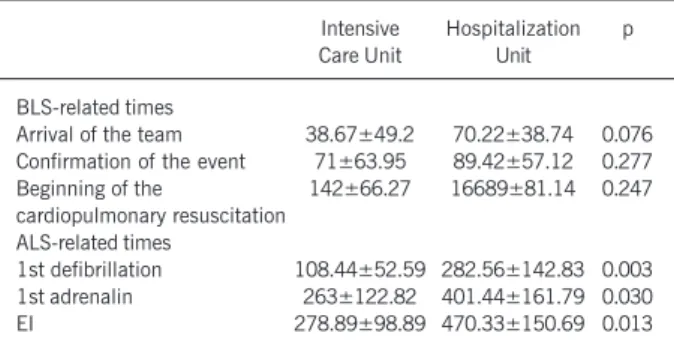
The time intervals and the comparison between the simulation places are on table II.
Discussion
The many groups that studied cardiopulmonary resuscitation have generated information which, up to the moment, has been confluent as for the importance of attending structuring to the cardio-respiratory arrest in a hospital environment. The subject has been already explored of many ways and with many approaches, such as training, team structuring, introduction of attending stan-dards, and even the creation of systems, such as the blue code and specific teams for this kind of attending12-15. So, even for
intra-hospital events, the time of attending and beginning of pro-cedures has been as important as in the extra-hospital events. In general that delay is due to the necessary time for the identification of the event, the decision making, the transport of the defibrillator to the place, the handling and preparation of the apparatus and, finally the realization of the defibrillation.
With the aim of minimizing the factors that corroborate for
such delay, our service uses the AHA courses as a training base for the hospital teams 7, 15. Even that the introduction of such
courses and methods of standardization are relatively recent in Brazil16, it is already possible to note their effects when it is
certified that the real time interval between the beginning of a ventricular fibrillation and its defibrillation, in our ICU, is 47s.
According to the present study we note that with the teams on the same skill level on BLS and ALS, despite the times being within the standards suggested as ideal, there is a delay in the defibrillation, as well as in the procedures, which require the presence of a physician, especially where that professional is not present 24 hours a day. This study also shows that the times that depend on the first attending are within the expected, which emphasizes the importance of an able and attending-trained ward staff, suggested in accordance to published data17, that the use of
the DEA in a hospital, especially in places where there is no physician all the time, can be useful and efficient to reduce dra-matically the time interval for defibrillation.
The kind of simulation used in the current study innovates what there is in terms of assessment and retention of learning, as instead of being performed in an specific room, it was in fact done in the working environment itself, along with all usual conditions of the activity. A greater care was taken concerning the non-coincidence of simulation with real events. Another important characteristic of the simulation was keeping the mannequin under ventricular fibrillation, which decreases the chance of the profes-sional facing the event as a simulation, as some minutes after observing the involvement of the professional, at some moment it is forgotten that it is a simulation, which gives more credibility to the data obtained and it is faced as a real attending. Maybe this
Table I - Characteristic of the teams concerning the presence of previous BLS or ALS training
Hospitalization Intensive Total unit care unit
ALS no 10 10 20
> 6 m 5 6 11
< 6 m 5 1 6
BLS no 12 8 20
> 6 m 5 8 13
< 6 m 3 1 4
total 40 34 74
ALS - advanced life support; BLS - basic life support.
Table II - Time intervals, in seconds, between the beginning of the ventricular fibrillation and the procedures carried out by the team
Intensive Hospitalization p Care Unit Unit
BLS-related times
Arrival of the team 38.67±49.2 70.22±38.74 0.076 Confirmation of the event 71±63.95 89.42±57.12 0.277 Beginning of the 142±66.27 16689±81.14 0.247 cardiopulmonary resuscitation
ALS-related times
1st defibrillation 108.44±52.59 282.56±142.83 0.003 1st adrenalin 263±122.82 401.44±161.79 0.030 EI 278.89±98.89 470.33±150.69 0.013
3
Arquivos Brasileiros de Cardiologia - Volume 84, Nº 6, Junho 2005
Analysis of the Intra-Hospital Attending of Ventricular Fibrilation/Ventricular Taquicardia Simulated Events
1. Bedell SE, Delbanco TL, Cook EF et al. Survival after cardiopulmonary resuscita-tion in the hospital. N Eng J Med 1983; 309: 569-76.
2. Kaye W, Mancini ME. Improving outcome from cardiac arrest in the hospital with a reorganized and strengthened chain of survival: an american view. Resuscitation 1996; 31: 181-6.
3. Thel MC, O´Connor CM. Cardiopulmonary resuscitation: historical perspective to recent investigators. Am Heart J. 1999; 137:39-48.
4. Chiriboga D, Yarzebski J, Goldberg RJ, Gore JM, Alpert JS. Temporal trends (1975 through 1990) in the incidence and case-fatality rates of primary ventricular fibrilla-tion complicating acute myocardial infarcfibrilla-tion: a community wide perspective. Cir-culation 1994; 89: 998-1003.
5. Moretti MA. Eficácia do treinamento em SAV nos resultados das manobras de RCP. Tese Doutorado, Cardio-Pneumologia, Cardiologia. USP - 2001.
6. Dunn HM, McComb JM, MacKenzie G, Adgey J. Survival to leave hospital from ventricular fibrillation. Am Heart J 1986; 112: 745-51.
7. The American Heart Association in collaboration with the International Liaison Committee on Resuscitation (ILCOR). Guidelines 2000 for CPR and ECC. Circula-tion 2000; 102: I-1/I-341.
8. Wright D, Bannister J, Mackintosh AF. Automatic recording and timing of defibrilla-tion on general wards by day and night. Eur Heart J 1994;15:631-6. 9. Lazzam C, McCans J. Predistors of survival of in-hospital cardiac arrest. Can J
Cardiol 1991;7:113-6.
References
10. Martens P, Vandekerckhove Y. The Belgian CPR Study Group. Optimal defibril-lation strategy and follow-up of out-of-hospital cardiac arrest. Resuscitation 1996; 3: 125-32.
11. Cummins RO et al. Recommended guidelines for reviewing, reporting and conduct-ing research on in-hospital resuscitation: the in-hospital “Utstein Style”. Resusci-tation 1997; 34: 151-83.
12. Henderson SO, Ballesteros D. Evaluation of a hospital-wide resuscitation team: does it increase survival for in-hospital cardiopulmonary arrest? Resuscitation 2001; 48: 111-6.
13. Spearpoint KG, Mclean CP, Zideman DA. Early defibrillation and the chain of survival in “in-hospital”adult cardiac arrest; minutes count. Resuscitation 2000; 44: 165-9.
14. Andréasson AC, Herlitz J, Bang A et al. Characteristics and outcome among patients with a suspected in-hospital cardiac arrest. Resuscitation 1998; 39: 23-31.
15. Cummins RO et al. Textbook of Advanced Cardiac Life Support. Texas – USA. Ame-rican Heart Association 1997.
16. Timerman S, Quilici AP, Paiva E et al. Cursos de suporte cardíaco básico e avança-do de vida: experiência em centro de treinamento no Brasil. Arq Brás Cardiol 2001; 77 (supl. II): 5.
17. Soar J and McKay V. A revised role for the hospital cardiac arrest team? Resuscita-tion 1998; 38: 145-9.
is an interesting aspect to be analyzed in future studies, as it may be supposed that the mistakes made at the beginning of the maneuvers had happened because it was a simulation with a mannequin. However, the same mistakes made at the end of the simulation, when the participants were more immersed in the