Health promotion in supplementary health care: outsourcing,
microregulation and implications for care
Promoção da saúde no setor suplementar: terceirização, microrregulação e implicações no cuidado
Promoción de la salud en la salud suplementaria: la externalización, microregulación
y las implicaciones para la atención
Kênia Lara Silva
I, Roseni Rosângela Sena
I, Andreza Trevenzoli Rodrigues
I, Fernanda Lopes Araújo
I,
Stephanie Marques Moura Franco Belga
I, Elysângela Dittz Duarte
II Universidade Federal de Minas Gerais , School of Nursing, Center for Studies and Research on Education and Nursing Practice. Belo Horizonte-MG, Brazil.
How to cite this article:
Silva KL, Sena RR, Rodrigues AT, Araújo FL, Belga SMMF, Duarte ED.
Health promotion in supplementary health care: outsourcing, microregulation and implications for care. Rev Bras Enferm. 2015;68(3):423-9. DOI: http://dx.doi.org/10.1590/0034-7167.2015680315i
Submitted: 02-09-2015 Approved: 04-11-2015
ABSTRACT
Objective: to analyze health promotion programs in the supplementary health care. Methods: This was amultiple case study with a qualitative approach whose data were obtained from interviews with coordinators of providers contracted by the corporations of health insurance plans in Belo Horizonte, Minas Gerais. The data were submitted to Critical Discourse Analysis. Results: Home care has been described as the main action in the fi eld of health promotion transferred to the providers, followed by management of patients and cases, and the health education.groups. The existence of health promotion principles is questionable in all programs. Outsourcing is marked by a process with a division between cost and care management. Implications of this process occur within admission and interventions on the needs of the benefi ciaries. Conclusions: Statements revealed rationalization of cost, restructuring of work, and reproduction of the dominant logic of capital accumulation by the health insurance companies.
Key words: Outsourced Services; Supplemental Health; Health Promotion.
RESUMO
Objetivo: analisar programas de promoção da saúde no setor suplementar. Método: estudo de caso múltiplo de abordagem qualitativa, cujos dados foram obtidos em entrevistas com coordenadores de prestadoras contratadas pelas operadoras de planos de saúde de Belo Horizonte, submetidos à Análise Crítica do Discurso. Resultados: a atenção domiciliar foi apresentada como a principal ação no campo da promoção da saúde transferida para as prestadoras, seguida de gerenciamento de doentes e de casos e dos grupos de educação em saúde. Em todos os programas é questionável a existência dos princípios da promoção da saúde. A terceirização é marcada por um processo micro-regulatório restritivo, com cisão entre a gestão dos custos e a gestão do cuidado. Há implicações desse processo na captação e intervenção sobre as necessidades dos benefi ciários. Conclusão: os discursos foram reveladores da racionalização de custos, reestruturação do trabalho e reprodução da lógica de acumulação do capital dominante na saúde suplementar.
Descritores: Serviços Terceirizados; Saúde Suplementar; Promoção da Saúde.
RESUMEN
Objetivo: analizar programas de promoción de la salud en los sistemas privados. Método: estudio de caso múltiplos con un enfoque cualitativo, cuyos datos fueron obtenidos de entrevistas con los coordinadores de los proveedores contratados por los operadores de los planes de salud de Belo Horizonte. Los datos fueran presentados al Análisis Crítico del Discurso. Resultados:
INTRODUCTION
The Supplementary Health Care sector is composed of the actions and health services provided by the complementary private sector to the public Unified Health System in Brazil.It is characterized as a sustainable organization that is permeat-ed by an economic logic and compospermeat-ed of actors with antago-nistic interests. It can be stated that the care model practiced is medical-hegemonic and procedure-centered, with few actions of health promotion and disease and risk prevention, leading to an uncritical consumer of technologies(1).
In recent years, through incentives of the National Health Agency – (Agência Nacional de Saúde – ANS), the corpora-tions have tried to review the paradigms and build a quality care model with investment in health promotion(2). The health
promoting actions can be considered as a very important het-erogeneous set of strategies for the consolidation of policies for people’s health, and must be used in the implementation of health care models based on the production of comprehen-sive and autonomized care(3-4).
In this sense, different strategies and health promotion programs were incorporated by companies and appear to re-spond to the demand for modernization and cost savings by implementing a new health care logic that operates with other professionals and other care strategies(4). The proposal of
in-centives for promotion programs also meets the expectations of the beneficiary, for the possibility of preventing disease and improving quality of life as well as by obtaining discounts and rewards offered by the company(4).
It recognizes the interests at stake in promoting health in supplementary care and displays, as well, a component in imbricated restructuring programs that is revealed in the out-sourcing of supply and action management. Thus, it is consid-ered that the health promotion investment in supplementary health can be a device that includes new working relation-ships, changes in hiring methods and services, and substitut-ability in health practices.
Outsourcing and other forms of organizational transforma-tions in the working world make up the complex scenario of corporate restructuring. In health, both in the public and the private system, outsourcing is a trend, especially in hospitals, which is manifested by two movements: one aimed directly to-ward professionals, by hiring worker cooperatives, and another by allocation and provision of services in support activities(5).
In public service, outsourcing has been used with the jus-tification of maintaining quality, quantity and price of goods and services provided by individuals with government regula-tion(6). This regulation, however, seems to be the subject of
disputes in supplementary health care, where user assistance is established from the corporation-provider-user relationship,
but dictated by an external regulation determined by ANS(2).
The stresses in the field of supplementary health care are not new, and are characterized by a profound process of ratio-nalization, with the submission of health institutions to an eco-nomic logic, outsourcing of services, increasing automation of diagnostic processes, dismemberment of the global medical act on multiple diagnostic and therapeutic acts performed by various professionals, whether or not they are physicians(7).
Considering that the ANS has the corporation’s ability to remain in the market, the rights of users, and the products, values and coverage of the programs as targets of the regula-tion(2), it is understood that there are aspects of the programs of
health promotion offered that cross the relationship between corporation-provider-user, and which are on the margins of the macro-regulatory process. Thus, the question is how this offer is processed and the relationships are established in the outsourcing, as well as the implications in the delivery of care, understanding that this is a microregulation field.
Microregulation is a group of induction and control mech-anisms exercised by an economic agent over another. In the relationship between corporations and providers, these mecha-nisms are manifested in the form of contracts, payment and non-financial instruments of regulation, such as the existence and availability of professionals, restrictions on the use and access to certain intermediary services, in the adoption of prior autho-rizations, in auditing procedures, among other mechanisms(8).
Microregulation also focuses on the relationship between pro-viders and users with devices that influence the “choices” and the utilization of users about the professional and health facilities; as well as in the care delivery space with the relationships that are established in the encounter between workers and beneficiaries(7).
The implications of this relationship that is established be-tween providers and users is marked by the interests in dispute of the actors in the outsourcing of supplementary care, and are not always explicit. Thus, the aim of the study was to analyze health promotion programs in the supplementary health sector, revealing discourse on the delivery of care, focusing on out-sourcing and microregulation practiced within the industry.
METHOD
This was a qualitative approach, using multiple case study. Six contractors who provided health promotion services to 19 private insurance providers in the city of Belo Horizonte, Minas Gerais provided the setting for the study. The contact with the providers was obtained by corporation indication or key informants in the field of health insurance.
Data collection was conducted from July of 2012 to July of 2013. Interviews were conducted using a semi-structured guide with coordinators of health promotion programs of
Kênia Lara Silva E-mail: [email protected]
CORRESPONDING AUTHOR
Conclusiones: los discursos fueron reveladores de racionalización de costos, la reestructuración del trabajo y la reproducción de la lógica dominante de la acumulación de capital.
six providers that maintained a relationship of service provi-sion for the studied corporations. At this stage of the study, it was decided to analyze the outsourcing processes in Supple-mentary Health Care by capturing the perspective of service providers, although it is acknowledged that such an option is limited to one of the actors disputing the provision of health promotion programs. In another phase of the study, the per-ceptions of corporations and beneficiaries were analyzed.
The interviews were recorded and then transcribed, fol-lowed by the analysis of empirical data, which was based on Critical Discourse Analysis. From this perspective, it is under-stood that the statement reflects entities and social relationships and also construct or develop them as key entities of different ways of positioning people in different ways as social subjects(9).
The three-dimensional model of discourse analysis(9)
dis-tinguishes three dimensions in statement - text, discursive and social practice - according to analytical purposes, bringing to-gether three analytical traditions essential to discourse analysis. In an approximation of the categories for discourse analy-sis(9), these dimensions are used in this paper: intertextuality,
interdiscursivity and representation of events/social actors. Intertextuality refers to the voices present in statement; inter-discursivity points to the articulated statements in the text, usually evidenced by use of metaphors. The third dimension demonstrates the position of the subjects that emit the state-ment (active, passive, impersonal, collective) and the repre-sented processes.
In accordance with ethical principles, the research was ap-proved by the Ethics Committee of the Minas Gerais Federal University, Number CAAE 0581.0.203.000-11. Participants were informed about the purpose of the study and signed the Terms of Free and Informed Consent.
RESULTS
The results indicate that outsourcing of health promotion programs in supplementary care is a complex reality, marked by disputing actors.
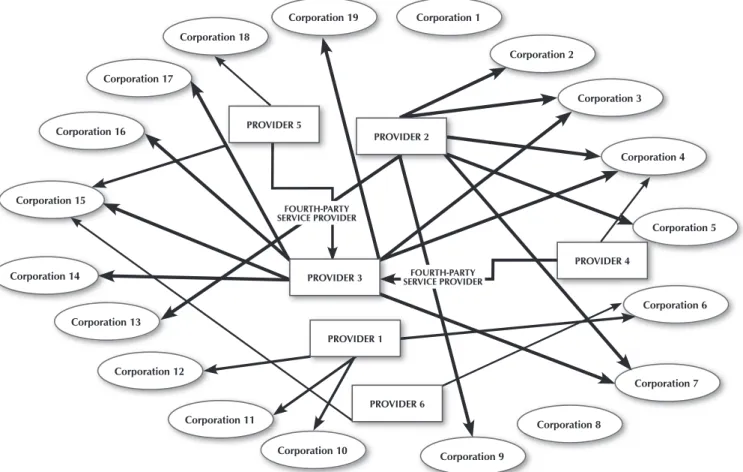
Figure 1 illustrates the scheme of relationships between cor-porations and providers. Six companies that provide services to corporations in the city were investigated. There were two health plans corporations in the city that provided assistance to beneficiaries exclusively using their own services. The remain-ing 17 corporations employ services of other providers. Some providers offer services to more than one corporation, includ-ing those that compete with each other. In the reverse flow (of the relationship of corporations with the providers), the inverse is also true, with purchase of services by corporations of differ-ent outsourced companies, competitors in the market.
The investigated providers began their activities in the healthcare market in the period between 1996 to 2010, and the findings indicate that health promotion outsourcing arises by demand from corporations. In this sense, those being inter-viewed explained that investing in outsourced companies by
Figure 1 - Relationships between providers and corporations studied
Corporation 19 Corporation 1
Corporation 2
Corporation 3
Corporation 4
Corporation 5
Corporation 6
Corporation 7
Corporation 8
Corporation 9 Corporation 10
Corporation 11 Corporation 12
Corporation 13 Corporation 14
Corporation 15 Corporation 16
Corporation 17
Corporation 18
PROVIDER 4 PROVIDER 2
PROVIDER 3
PROVIDER 1
PROVIDER 6 PROVIDER 5
FOURTH-PARTY SERVICE PROVIDER
professionals who had experience in health plans or private services helps to meet the demands of a growing market.
The employment of professionals with public health experi-ence is revealed as the opportunity to bring health promotion to supplementary care. In this context, there is evidence of the growth of providers, with allusion to the expansion of actions and programs and the expansion of a customer portfolio demon-strated by the metaphors “stepping down” and “gaining ground”.
Provider 3 has ten years, is a company that began with a group from Hospital 1, with the intention of discharging the patients of Hospital 1. In this context, they received greater care, which was from Corporation 15, which is currently
the biggest client of Provider of 3. (Coordinator, Provider 3)
For it [starting the health promotion program], we invested in
a larger proposal, then it was a full team from physician to oc-cupational therapist, so that the corporation hired according
to CLT (Consolidation of Brazilian Labour Laws), at that time
was also complicated, it was heavy. So, at that time we al-ready had a reasonable experience, so we proposed, “Then I will open the company to care initially for you,” this is a good opportunity because Provider 2 was born, already having a first client and a loyal customer with a significant demand for us to manage. The management of chronic cases is only one of the fronts because we are stepping down. And Provider 2 was born, so we were initially serving Provider 9, and later we
were gaining ground in the market. (Coordinator, Provider 2)
Then the companies, when we talk about any corporation that has several enterprises in its portfolio, such group-oper-ative work, we welcome demand, the company pokes the corporation that knows this is available by competition and
requests. (Coordinator, Provider 2)
The transfer of the benefit, by the use of the metaphor “it was heavy”, is revealed to be a cost-saving alternative sustain-ing a discourse of economic rationality and the purpose of outsourcing.
Home care was indicated by the participants as the main activity included by corporations in the health promotion role, and its implementation was transferred to the outsourced providers. The six providers analyzed provide home care ser-vices either through a home care modality (Corporation 6), specific intervention (Provider 5), or home care (Providers 1, 2, 3, 4 and 5). They even offer chronic case management pro-grams for corporations (Corporation 2 and 6); managing com-plex cases (Corporation 3); health education groups aimed at groups with chronic conditions, pregnant women and adoles-cents (Providers 2 and 3); vaccination campaigns (Provider 2); courses and events (Providers 4 and 5); ambulance services and patient transport (Providers 1 and 4).
The statements of participants in the study are permeated by the representation of home care as a form of hospital care trans-fer - materialized in its technologies and practices - for the home.
Our differential is that we do what we do in hospital, the procedures, I will not say all of that, but most of what is possible. We do the same at home. So we avoid hospital-ization, we reduce the number of consultations. ... And
sometimes it depends on the situation, until the exams are completed. Why have the doctor at home, then the patient sometimes does not need to have so many tests, unless
nec-essary. (Coordinator, Provider 1)
In the previous report, the Coordinator of Provider 1 em-phasizes that activities which have been made in the hospital are performed in home care, in a statement indicating the re-production of processes and relationships at home, but with simplification of care.
Others interviewed expressed that home care is a locus of building new relationships and requiring from professionals the expression of new skills, since it begins to deal with other demands, not only those that are specific to those traditional performed by health institutions at the home locus.
The everyday life with families is quite overwhelming, so sometimes the contacts are very close. You’re very close
there, inside the house. [...] The families become close, they
take freedoms, then they call all the time, they request all
the time. [...] This, I think is a big challenge, mediating
fami-lies is a major challenge of home care. You do not have a
companion, you have a family. [...] It is an intelligent
hospi-tal that states that only one companion is allowed at a time.
(Coordinator, Provider 3)
The statement of the Coordinator of Provider 3 reports a major contradiction of care in home care that is revealed in the frequency and intensity of contacts and experiences at home. The use of adverbs and the repetition of the expres-sions that emphasize the challenges for care in home care (“quite crushing”, “big challenge”) are confronted with the proximity of established relationships declared as “very close” and “all of the time”.
The intertextuality present in the statements are emblem-atic and reveal the centrality of assistance in professional and technical conduct, often ignoring the subjectivity that perme-ates and crosses care relationships at home:
Because, in addition to people assuming these attitudes and behaviors, we also have the question of the technique;
in-side technique we work a lot with SOPs (standard operating
procedures). [...] It is not the guy throwing the keys there, not [referring to the professional who comes in the home and drops the key on the table], there is hand washing, the polite and ethical posture of introducing yourself. It is the profile that I am presenting to you; of SOPs, ethics, posture, support. You place yourself in a position like, “I am a quali-fied professional, I am here to take care of your father. Even if your father has any complications here and dies, the only one who can help you here at the moment is me, I cannot
leave his side now. “(Coordinator, Provider 4)
[...] Then, we work with the patient that we approach, “Look, you have this ...” You say what the diagnosis is, explain what it is, and why he takes that medicine. … You explain to him what that medicine is. Because otherwise, the patient does not take it, he is resistant to the treatment. So, our goal is to educate him to follow the treatment. So, we can work on this
The position assumed by professionals in determining the plan of care contradicts the assumptions of autonomy, em-powerment and accountability, the assumptions of health promotion. Even in an educative function, there is a transfer of knowledge, supported by authoritarianism and, in the pre-scription of correct ways of acting, it is indicated by verbs in the imperative function. Outsourcing adds crossings in the provision of care, with implications for capture and interven-tion of needs and user demands.
Some health insurance agrees with our assessment [the
de-termination of frequency of home visits]. So, we go there and evaluate and think that that patient must receive visits
throughout the month. So, they [coordinators of the
corpo-rations] authorize or do not authorize. Some health insur-ance determines: “look at this patient; I want this and this and this.” Then, for example, “I want nurses during the en-tire month, physician for the enen-tire month, physical therapy
three times a week.” (Coordinator, Provider 1)
When the health insurance approves, we do everything [full
and necessary support for home care]. (Coordinator, Cor-poration 6)
Another thing that makes it difficult is when the corpora-tions release the care plan to the patients; sometimes cer-tain patients need equipment, but it is not authorized by the
health insurance [...]. (Coordinator, Corporation 6)
The outsourcing of home care tends to be used for users whose care has higher cost or for those who are more depen-dent on care, revealing the understanding that there is a lack of accountability by the corporation for this care.
So, for example, Corporation 11; it evaluates according to the degree of need of the patient. So depending on the patient dependency, itshe sends for us. If it is an easier patient, it
provides care with its own team. (Coordinator, Provider 1).
Understanding the supply of home care and other pro-grams in supplementary care, the cost reduction logic was revealed as the primary motivation for investment and growth of the actions that corporations refer to as health promotion. The intertextualities, metaphors and emphatic intonations of the words “awesome” and “without a doubt” present in the following reports confirm the explicit interest in capital ac-cumulation for the provision of health promotion programs:
For real? The health insurance companies invest in chronic case management to decrease their cost. For the beneficia-ry; we do not open it; so we put it as, “we want to give you a better quality of life; we want to teach you to live with your disease that is incurable, and progressive in some cases, in the best way possible,” but the goal of the company is to
reduce the use of resources. [...] The initiative, we did not
see this in any of the Corporations 15, 9 or 2, the initiative to offer services to you because I am worried about your
future. [...] We do not think like that: “let’s work now on
Smoking Cessation to prevent lung cancer, emphysema” ... No! It happened; they had cancer, emphysema; it is a high
cost patient; let´s take him home or “let´s work on obesity because it predisposes people to chronic diseases; there is a marriage of things,” no, that’s morbidity, let´s act on the
morbidity. (Coordinator, Provider 2)
[...] After I came here [to the provider], I had another view. When I worked in the corporation, I had a little bit of utopia about it. I really believed it was best for the patient, the quality ... this is unquestionable, we realize that it is much better, families are more satisfied, the home care condition is very resolving. But what happens is that the cost
reduc-tion is AWESOME. [...] This happened as a matter of cost;
WITHOUT A DOUBT! (Coordinator, Provider 3)
Other respondents recognize that the cost rationalization is the determinant of the supply of health promotion programs and home care; but they do so with a critical discourse that recognizes the need for cost containment; but they do not deny that there are other interests – the family; the hospital corporation, the beneficiary - that comprise this relationship.
[...] The health insurance company wins because the hospi-tal’s cost is too high; this outsourced company gains even hiring a physician, a nurse; the family wins because it has a greater comfort in the home, of being there with that patient, to be able to sleep at his side; the whole situation of bein
within your living space [...] the issue of caring is focused on
humanization because this client of that company we have gained; one minute sitting, listening and talking to that
pa-tient, listening to his complaints [...]. (Coordinator, Provider 4)
Based on these findings, we can say that outsourcing of health promotion in supplementary care acts as a device that responds at the same time to the corporation´s interests, the provider, the beneficiaries. “Everybody wins” is the discourse which portrays this understanding; although in many aspects it demonstrates the supremacy of the rational logic of costs that meets the interests of capital accumulated in the health sector.
However, it should be considered that the new health care modalities employed as health promotion by corporations, while not addressing all dimensions and principles in this field, are important strategies that also respond to the interests of ben-eficiaries and families in a logic of the production of freedom in the care practices - whether at home or in other spaces - that capture the health demands and needs, although in the form of prevention, clinical management and biopolitical intervention.
DISCUSSION
Deregulation of a set of actions in the list of procedures of the regulatory agency in supplementary health induces the allocation of those actions not traditionally offered by the sec-tor as health promotion. The fact of health promotion being considered a field characterized as heterogeneous in concepts and methods is associated with this understanding(10).
Furthermore, it should be considered that the more used ini-tiatives can reveal a movement for change in the health insur-ance that formerly proved to be an incipient field of intervention or one that was almost absent from health insurance providers as managers of clinical care management systems, risk preven-tion, disease and disorder, rehabilitation and recovery.
The elements identified in the study do not allow us to characterize home care as health promotion, but the fact that this care modality occupies a special place in supplementary health, defined as a alternative care that exceeds the dominant mode, centered on consultations and medical care(10-12),
repre-sents an important fissure that can compete in the overcoming of the current health care model.
Furthermore, from the perspective of social practices, other studies show that home care has mainly been used as an alter-native to rationing and cost transfer(10-12).
This finding reveals a contradiction in the provision of the so called health promotion programs in supplementary health that present themselves as devices of cost rationalization in contrapo-sition to the prospect of a change in the care model in the industry. A change in the care model requires new forms of care produc-tion operating in the amplificaproduc-tion of autonomy and the possibil-ity of live work in action by the teams, in order to rescue coopera-tion, complementarity and solidarity in professional practice(12-13).
This singularity reinforces the importance of light technologies to overcome the challenges facing the delivery of care.
However, the findings of the study indicate that even in programs that are supported by educational activities, there is little possibility for the user and family to debate their deci-sions and choices about the offer and performance of care, thus assuming the representation of a passive person facing the impositions placed upon them by the team/professional. In particular, in home care, the care is permeated by a re-lationship of dispute between the technical and scientific knowledge of health professionals, and the know-how of the family about the user’s care, producing stress that interferes directly in the plan of care, since in most cases, family care is not legitimated by the hegemonic medical and professional-centered model represented by the home care team(14-15).
We see an exercise of disciplinary power whose passivity of the user/family is based upon strategies of “awareness” to follow the plan of care. In this case, the prescription of care and the dis-tribution of guidance often confronts a dispute that is established between the power of professional/staff and the users/family. In this process, the user and family compete for power and cannot accept some regulation of professionals. If he does not want to, he does not follow the prescribed diet, does not do some physi-cal therapy, does not follow the recommended treatment plan(4),
and is characterized as an undisciplined or rebel user/family. It should be considered that the statement of humaniza-tion is also present in the interviews as a consequence of the
transfer of care to the home. However, it turned out to be a contradictory relationship that is not accompanied by negotia-tion and agreement of the plans of care which remain focused on the corporation and providers’ decisions.
Thus, the determination of the “needs” of beneficiaries is performed externally to the patient and family, and does not provide spaces for discussion of the rules imposed for care.
In respect to the relationship between corporations and providers, outsourcing has proved to be a device that passes through the delivery of care with implications for capture and responses to the health needs of the users. Even outside this di-rect benefit, the corporation is the definer actor of care produc-tion, using payment procedures as a regulatory instrument. This relationship of outsourcing is marked by the scission between the management of costs (which remains in the corporation) and care management, which is transferred to the providers. The interviewees revealed no space to dialogue about the meet-ing of the logic that governs costs and care management.
Another study(7) showed that rationalizing measures, such
as non-authorization for hospitalization or special and high cost procedures, adopted by corporations, have a direct impact on assisting beneficiaries and, in general, are transformed into problems between the provider and the user, as the corporation “removes responsibility” of the care transferred to the providers. Thus, it is noted that the outsourcing process implies a delay and loss of quality of service provided from the perspective of capturing, interpreting and serving the needs of beneficiaries.
In this arena of conflict of interest, spaces for debate be-tween the logic that guides corporations, providers and ben-eficiaries were not presented. So it seems mechanisms prevail to restrict the access by the corporation to restrict the delivery of care in its expanded form. The regulation in this case is centered on the restrictive process, with countless steps exist-ing and authorizations for access to care, and the definition of which technologies and procedures are to be offered for each patient, regardless of their needs. In general, this definition is supported by the lack of access to specific technologies such as prostheses and high complexity and high cost procedures.
It is pertinent to mention that Health Insurance, as part of the healthcare market, is influenced by an economic dimen-sion that has repercusdimen-sions in an interest for cost reduction and reorganization of the model of care delivery(11,16).
It is highlighted that microregulation is a fairly autonomous territory or immune in relationship to regulatory measures and regulation by the ANS and, on that basis, it operates with its own logic, dictated on the one side by the protagonism of mul-tiple actors, with their interests, and on the other, by the exis-tence of certain regulations or rules external to the field(7,17).
FINAL CONSIDERATIONS
Overall, the actions, programs or activities are inappropri-ately referred to as health promotion, as they do not reveal the principles of care delivery centered on autonomy, continuity and integrality. Even with this conceptual mistake, the impor-tance of this set of actions that have the potential to improve the quality of life of beneficiaries is recognized.
However, as disclosed in the findings, health promotion is used as a component of corporate restructuring that responds much more to the cost rationalization than properly to a
potential to develop a new model of care.
Macroeconomic factors that influence the appreciation of profit and cost reduction determine supply and outsourcing of health promotion programs offered by the corporations. Thus, we conclude that outsourcing the actions denominated by corporations as health promotion in the supplementary sec-tor is permeated by discourses that reveal cost rationalization, restructuring of work, and the logical reproduction of capital accumulation with implications for care delivery.
REFERENCES
1. Pimenta AM, Castanheira CHC, Lana FCF, Malta DC. [Ac-tions of risk/disease prevention by private health insurance companies]. REME Rev Min Enferm [Internet]. 2012 [cited 2015 Feb 09];16(4):564-71. Available from: http://www. reme.org.br/artigo/detalhes/562 Portuguese.
2. Garbin D, Mattevi GS, Carcereri DL, Caetano JC. [Dentistry and supplementary health: regulatory framework, health pro-motion policies and quality of care]. Ciênc Saúde Coletiva [Internet]. 2013 [cited 2015 Feb 09];18(2):441-52. Available from: http://www.scielo.br/pdf/csc/v18n2/15.pdf Portuguese.
3. Haeser LM, Buchele F, Brzozowski FS. [Considerations on autonomy and health promotion]. Physis (Rio J.) [Internet]. 2012 [cited 2015 Feb 09];22(2):605-20. Available from: http://www.scielo.br/pdf/physis/v22n2/11.pdf Portuguese.
4. Freitas PSS, Schwartz TD, Ribeiro CDM, Franco TB, Ma-ciel ELN, Lima RCD. [The users’ perception of a health promotion and prevention program offer: a self-manage-ment operator case].Physis (Rio J.) [Internet]. 2011 [cited 2015 Feb 09];21(2):449-69. Available from: http://www. scielo.br/pdf/physis/v21n2/a07v21n2.pdf Portuguese.
5. Vecina Neto G, Malik AM. [Trends in hospital care]. Cienc Saúde Coletiva [Internet]. 2007 [cited 2015 Feb 09];12(4):825-39. Available from: http://www.scielo.br/pdf/ csc/v12n4/02.pdf Portuguese.
6. Melo CMM, Costa HOG, Santos TA, Soares ES, Santana GRS. [Evaluation of outsourced management in a basic health care unit: preliminary results]. Rev Baiana Enferm [Internet]. 2009 [cited 2015 Feb 09];22(1-3):45-56. Available from: http://www.portalseer.ufba.br/index.php/enfermagem/arti cle/view/4986/3622 Portuguese.
7. Meneses CS, Cecilio LCO, Andreazza R, Araújo EC, Cugionotti AP, Reis AAC. [Users and the technological transition in the supplemental health sector: case study of a health insurance plan company]. Ciênc Saúde Co-letiva [Internet]. 2013 [cited 2015 Feb 09];18(1):57-66. Available from: http://www.scielosp.org/pdf/csc/v18n1/ 07.pdf Portuguese.
8. Gerschman S, Ugá MAD, Portela M, Lima SML. [The necessary role of the National Supplementary Health Agency in the regulation of relations between managed care companies and service providers] Physis (Rio J.) [In-ternet]. 2012 [cited 2015 Feb 09];22(2):463-76. Avail-able from: http://www.scielo.br/pdf/physis/v22n2/04.pdf Portuguese.
9. Fairclough N. Discurso e mudança social. Brasília: Ed
Casa Publicadora; 2008.
10. Silva KL, Sena RR, Seixas CT, Feuerwerker LCM, Merhy EE. Home care as change of the technical-assistance mod-el. Rev Saúde Pública [Internet]. 2010 [cited 2015 Feb 09];44(1):166-76. Available from: http://www.scielo.br/ pdf/rsp/v44n1/en_18.pdf
11. Silva KL, Sena RR, Braga PP, Silva PM, Souza CG. [Supple-mentary home health care services and the inclusion of nursing in Belo Horizonte / Minas Gerais (Brazil)]. Acta Paul Enferm [Internet]. 2012 [cited 2015 Feb 09];25(3):408-14. Available from: http://www.scielo.br/pdf/ape/v25n3/en_v25 n3a14.pdf
12. Feuerwerker LM, Merhy EE. [Home care’s contribution to alternative health care networks: deinstitutionaliza-tion and transformadeinstitutionaliza-tion of practices]. Rev Panam Salud Pública [Internet]. 2008 [cited 2015 Feb 09];24(3):180-9. Available from: http://www.scielosp.org/pdf/rpsp/v24n3/ a04v24n3.pdf Portuguese.
13. Andrade AM, Brito MJM, Silva KL, Randow RMV, Montene-gro LC. [The home care job and its peculiarities: impressing a new health care logic] Rev Pesqui Cuid Fundam. [Internet] 2013 [cited 2015 Feb 09];5(1):3383-93. Available from: http://www.seer.unirio.br/index.php/cuidadofundamental/ article/view/2025/pdf_698 Portuguese.
14. Carvalho LC, Feuerwerker LCM, Merhy EE. [The debate over care plans in home medical care: a necessary re-flection]. Salud Colect [Internet]. 2007 [cited 2015 Feb 09];3(3):489-506. Available from: http://www.scielo.org. ar/pdf/sc/v3n3/v3n3a04.pdf Spanish.
15. Martins AA, Franco TB, Merhy EE, Feuerwerker LCM. [The health care delivery in a Medical Cooperative’s Home Care Program]. Physis (Rio J.) [Internet]. 2009 [cited 2015 Feb 09];19(2):457-74. Available from: http://www.scielo. br/pdf/physis/v19n2/v19n2a12.pdf Portuguese.
16. Franco TB, Merhy EE. [Home health care in supple-mentary care: a device for a productive restructuring]. Ciênc Saúde Coletiva [Internet]. 2008 [cited 2015 Feb 09];13(5):1511-20. Available from: http://www.scielo.br/ pdf/csc/v13n5/16.pdf Portuguese.