DOI: http://dx.doi.org/10.5007/1980-0037.2016v18n4p483
Description of health promotion actions in
Brazilian cities that received funds to develop
“Academia da Saúde” program
Descrição de ações de promoção da saúde em cidades
que receberam recursos para desenvolver o programa
“Academia da Saúde”
Alex Antonio Florindo1
Rodrigo Siqueira Reis2,3
José Cazuza de Farias Junior4
Fernando Vinholes Siqueira5
Priscila Missaki Nakamura6,7
Pedro Curi Hallal5
Abstract – he objective of this study was to describe the health promotion actions that were planned in cities that received funds to develop the “Academia da Saúde” program. We conducted a phone survey with 914 Secretary of Health from cities that received funds until July/2012. We calculated prevalence (%) of health promotion actions, expected results, number of people that would be assisted, partners for actions, health professionals in actions, manager group for coordinate and main objectives for proposal the actions. he most of the cities were of the south (25.9%) and southeast (33.4%). he actions would provide reach over one million of people in 25% of the cities. Improves of physi-cal activity and healthy food are priorities in the actions. he most of cities had partners for actions. Only 50% of the cities had used health indicators for planning the program and 25% of the cities had planned training for health professionals and manager group for coordinate the program. he actions had focus in physical activity and healthy food. A large of number of people would be reach in actions. Only half of cities used health indicators for plan and few cities planned professional training and manager group. It is necessary improve the use of health indicators for plan, training of professionals and developing manager group for coordinate the actions. he continuum evaluation these program to verify possible efectiveness results in physical activity level and healthy food of population is a challenge for the Ministry of Health.
Key words: Evaluation; Healthy food;Health promotion; Motor activity.
Resumo – O estudo teve como objetivo descrever as ações de promoção da saúde que foram plane-jadas nas cidades que receberam recursos para desenvolver o programa Academia da Saúde. Foi conduzido um inquérito por telefone com 914 secretários ou principais responsáveis pela saúde nas cidades que receberam recursos até julho de 2012. Foi calculada a prevalência (%) de ações de promoção da saúde, resultados esperados, número de pessoas que seriam atendidas, parcerias nas ações, proissionais de saúde nas ações, grupo gestor para coordenar e principais objetivos nas ações. A maioria das cidades avaliadas era do sul (25,9%) e sudeste (33,4%). O programa previa atingir pelo menos um milhão de pessoas em 25% das cidades. A melhora da atividade física e alimentação saudável foram as prioridades mais citadas. A maioria das cidades tinha parcerias nas ações, mas somente 50% usaram indicadores de saúde para planejar os programas e 25% planejaram treinamento de proissionais de saúde e formação de grupo gestor. As ações tinham como objetivo principal melhorar a prática de atividade física e alimentação saudável. Um grande contingente de pessoas poderá ser atingido pelas ações. Somente metade dos municípios usarou indicadores de saúde para o planejamento e poucos municípios previram treinamento de proissionais e grupo gestor. É necessário melhorar o uso de indicadores de saúde para planejamen-to, treinamento para proissionais e formação de grupos gestores para coordenação. A avaliação continua dos programas para veriicar possíveis resultados de efetividade no nível de atividade
1 Universidade de São Paulo. Escola de Artes, Ciências e Humanidades. Grupo de Estudos e Pesquisas Epidemiológicas em Atividade Física e Saúde. São Paulo, SP, Brasil.
2 Pontifícia Universidade Católica do Paraná. Programa de Pós-graduação em Planejamento Urbano. Curitiba, PR. Brasil.
3 Prevention Research Center in St. Louis, Brown School, Washington University in St. Louis, United States.
4 Universidade Federal da Paraíba. Programa Associado de Pós-Gra-duação em Educação Física. João Pessoa, PB. Brasil.
5 Universidade Federal de Pelotas. Escola Superior de Educação Física, Programa de Pós Graduação em Educação Física, Pelotas, RS. Brasil.
6 Instituto Federal de Educação, Ciência e Tecnologia do Sul de Minas Gerais. Campus Muzambinho, Muzambinho, MG, Brasil.
7 Universidade do Estado de São Paulo. Programa de Pós-graduação em Ciências da Motricidade. Rio Claro, SP. Brasil.
Actions in “Academia da Saúde” Florindo et al.
INTRODUCTION
he Lalonde report published in the 70’s showed that health promotion is the fundamental strategy for improving population’s quality of life1. he physical activity practice and healthy food consumption are important actions for health promotion, but are variables diicult to change in popu-lation. Health education and health-friendly environments are important factors to help empower the population for action and to contribute for adoption healthy lifestyles2.
In Brazil, the National Health Promotion Policy was launched in 20063 along with the Health Promotion Network4. hese policy and network were instrumental for the launch of the “Academia da Saúde” program5, that is a health promotion intervention with focus in healthy behaviors as physical activity and healthy food. his program is developed in primary health care settings and can provide facilities and trained staf6.
he physical activity practice in leisure time and the regular con-sumption of fruits and vegetables are low in the Brazilian population7,8. Community based interventions as “Academia da Saúde” may contribute for change this situation.
he “Academia da Saúde” began in 2011 and one of the principles is that the facilities implemented in primary health care unit can contribute for adopting physical activity practice and healthy food consumption because these units are the irst access for health care in the public health system in Brazil. In 2012 over 2,000 municipalities had already obtained funding to implement the “Academia da Saúde” for health promotion ac-tions in population.
However, the information about implementation of the actions, objec-tives, results expected, number of people that will be beneited, the partners, the participation of the health professionals and the evaluation process in “Academia da Saúde” are limited. Interventions based in behavioral change and applied in primary health care settings are promising for improve physi-cal activity in populations9, but, details about the implementation actions are scarce and can contribute for better the planning process in health promotion. herefore, the aim of this study was to describe the health promotion actions that were planned in municipalities that received funds to develop the “Academia da Saúde” program until July of 2012.
METHODOLOGICAL PROCEDURES
(55.4%) and were female (68.1%).
his survey was part the national implementation study of “Academia da Saúde” program. he questionnaire was elaborated by researchers of these study and was based on the principles of the National Health Pro-motion Policy and on the resolution creating the “Academia da Saúde” program3,6. he inal version was composed by 68 questions divided in seven sections. Details about the questionnaire are described in Florindo et al.10. For this paper, we used information about sections 5, 6 and 7, which included the following information: section 5 (information about implementation of “Academia da Saúde” program); section 6 (expected results of “Academia da Saúde” program in cities); and section 7 (questions about new applications for funding the “Academia da Saúde” program).
he data collected was carried using Computer Assisted Telephone Interview and was conducted between August to December of 2012.
he prevalence of following responses was calculated: 1) health promo-tion acpromo-tions; 2) expected results in short, medium and long term; 3) number of people that would be assisted; 3) partners for actions; 4) counterparts of the cities for funds of Federal Government; 5) health professionals for coordinate the actions; 6) training of health professionals for actions; 7) manager group for coordinate actions in the cities; and 8) main objectives for proposal the actions. All analyses were conducted in SPSS software version 15.0.
he study was approved by Ethical Committee of the Federal Uni-versity of Pelotas, RS, Brazil (protocol number: 151.238) and the consent with health managers was obtained by telephone.
RESULTS
Most of the cities evaluated in this study were located in Southeastern region of Brazil (Figure 1). he Northeast region showed most diference in the comparison of total cities that received funds for develop the program and the cities that were evaluated in this study.
he main objectives for submission the projects were: 1) priority ac-tions in the cities; 2) access for building the facilities for program; and 3) recruitment of professionals. However, public demand was also important (Figure 2).
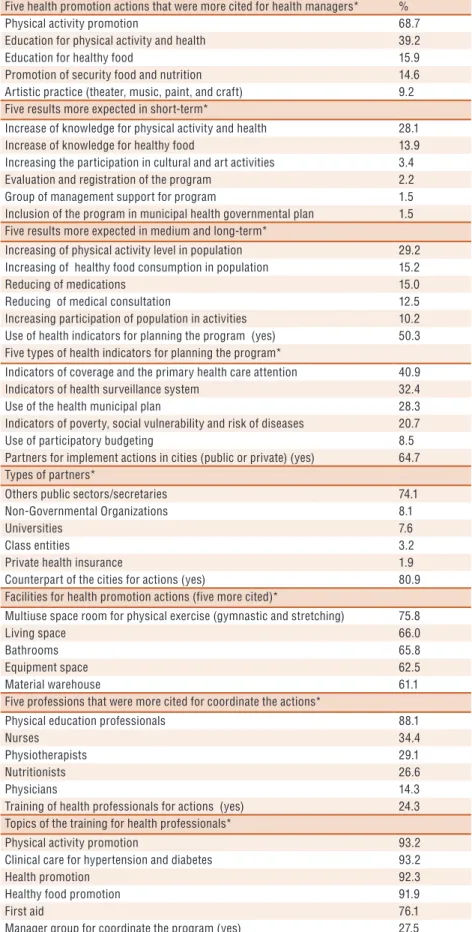
Most cities planned to develop actions on physical activity promotion. he expected short term results were increases in the knowledge about physical activity and healthy food, whereas the expected long-term results were increases on the population levels of physical activity practice and healthy food consumption, as well as a decrease in the use of medications and medical consultations (Table 1).
one-Actions in “Academia da Saúde” Florindo et al.
Table 1. Characteristics of plan for “Academia da Saúde” program in 914 Brazilian cities that
received funds until July of 2012.
Five health promotion actions that were more cited for health managers* %
Physical activity promotion 68.7
Education for physical activity and health 39.2
Education for healthy food 15.9
Promotion of security food and nutrition 14.6
Artistic practice (theater, music, paint, and craft) 9.2
Five results more expected in short-term*
Increase of knowledge for physical activity and health 28.1
Increase of knowledge for healthy food 13.9
Increasing the participation in cultural and art activities 3.4
Evaluation and registration of the program 2.2
Group of management support for program 1.5
Inclusion of the program in municipal health governmental plan 1.5 Five results more expected in medium and long-term*
Increasing of physical activity level in population 29.2
Increasing of healthy food consumption in population 15.2
Reducing of medications 15.0
Reducing of medical consultation 12.5
Increasing participation of population in activities 10.2
Use of health indicators for planning the program (yes) 50.3 Five types of health indicators for planning the program*
Indicators of coverage and the primary health care attention 40.9
Indicators of health surveillance system 32.4
Use of the health municipal plan 28.3
Indicators of poverty, social vulnerability and risk of diseases 20.7
Use of participatory budgeting 8.5
Partners for implement actions in cities (public or private) (yes) 64.7 Types of partners*
Others public sectors/secretaries 74.1
Non-Governmental Organizations 8.1
Universities 7.6
Class entities 3.2
Private health insurance 1.9
Counterpart of the cities for actions (yes) 80.9
Facilities for health promotion actions (five more cited)*
Multiuse space room for physical exercise (gymnastic and stretching) 75.8
Living space 66.0
Bathrooms 65.8
Equipment space 62.5
Material warehouse 61.1
Five professions that were more cited for coordinate the actions*
Physical education professionals 88.1
Nurses 34.4
Physiotherapists 29.1
Nutritionists 26.6
Physicians 14.3
Training of health professionals for actions (yes) 24.3
Topics of the training for health professionals*
Physical activity promotion 93.2
Clinical care for hypertension and diabetes 93.2
Health promotion 92.3
Healthy food promotion 91.9
First aid 76.1
Most cities had supplemented the federal funding using their own resources as demanded by the contract with the federal government; and also built facilities for physical activity practice. Nonetheless, only half of the cities used health indicators for guiding the actions and only one quarter had a management group for the program. Finally, the majority of the cities had partners for implementing the actions, which were mainly from the public sector (Table 1).
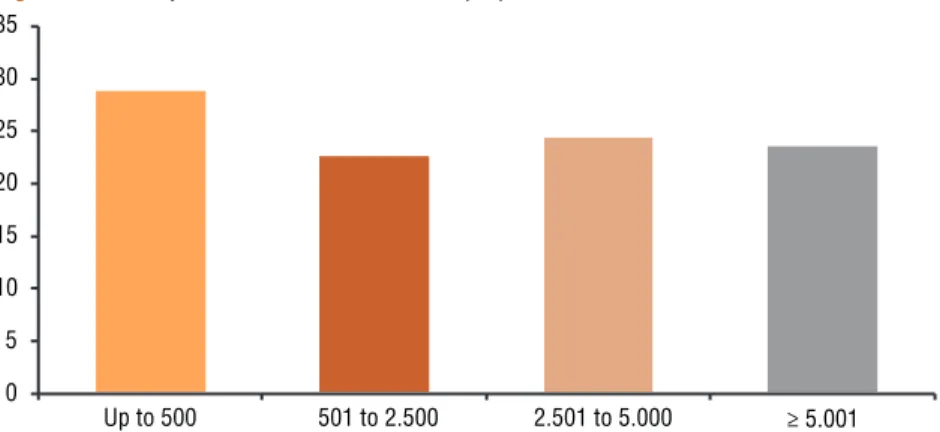
About one-quarter of the cities had as aim to reach at least one million of people with health promotion actions (Figure 3).
Figure 1. Prevalence (%) of cities that received funds for “Academia da Saúde” program until July of
2012 (n=2074 cities) and cities that were evaluated in this study (n=914 cities), according region in Brazil
Figure 2. Main objectives for submission of the proposals in the cities
Actions in “Academia da Saúde” Florindo et al.
DISCUSSION
his study showed that the priorities of proposals for “Academia da Saúde” program in Brazil were improve physical activity and healthy food. he main expected results are improve the knowledge (in short term) and increase of physical activity level and consumption of healthy food and decrease of medications and medical consultations (in long term). here are partners and counterparts for actions in the cities, but only half of the cities used health indicators or public management indicators for planning the programs, and only one quarter of the cities had planned training of health professionals and provided formation manager group for coordinate the actions.
he priorities established are important for public health, because physical inactivity and low consumption of fruits and vegetables are two important problems in world12and in the Brazilian population7, 8. Physical activity practice and healthy food consumption are two priority actions for control of chronic diseases3,13 and epidemiological surveys showed that these two positive behaviors are more prevalent in people of high socioeconomic level in Brazil7,8. Programs similar to “Academia da Saúde” can contribute for improve physical activity in leisure time14, and this behavior is associated with low consumption of medications15.
In addition, the education is a determinant factor of health in Bra-zil16 and the education is related with healthy food and physical activity practice7,8. herefore, actions for improve knowledge are important in health promotion.
Only half of the cities used health indicators or management tool for planning the actions. Although the goals were related with important public health variables for health promotion (physical activity and healthy food, for example), the use of health indicators for planning in the cities is very important for evaluate the program and can contribute for resolutions of municipal health problems17. hese evaluation indicators can be based in principles of health promotion according with objective of “healthy cities”18,19. For example, one suggestion is improve the use of indicators of municipal health plan. herefore, is recommended improve the evaluation this topic in next process of submissions the projects for obtain funds.
Most cities had partners for actions. he partnership are very impor-tant for health promotion actions, because for most of major public health problems is needed inter sectors actions3,20. For example, for interventions that aim to improve healthy life styles, partners of sectors as education, environment and sports are very important21,22. In case of the present study, the public sector was considered the more important partner. However, few cities had partners with Non-Governmental Organization, Universities and Class entities. We know that the Non- Governmental Organization23,24 and Class Entities25 can contribute with many actions in public health. In this case, we recommended that will be improved the partnership with other sectors outside of governmental context.
nutritionists and physical education professionals are very important for promotion healthy food and physical activity in these cities with “Aca-demia da Saúde”10. And survey conducted in primary health care settings in Brazil showed that physicians and nurses are important for physical activity promotion26. However, is necessary improve actions for training these professionals. Only 25% of the cities had plan for training health professionals for develop the actions in “Academia da Saúde”. Studies conducted with health professionals in Brazil showed that knowledge is important for physical activity and healthy food promotion in primary health care units26,27. he food guide for Brazilian population and book about physical activity promotion in primary health care settings can be good instruments for training these professionals28,29.
Only half of the cities had planned the actions with basis in health indicators or public management. his result is worrying, because is related with the justiication of the program in the cities and extensive evalua-tion of the acevalua-tions. he use of health indicators or public management for planning of actions could contribute for resolutions public health problems in the cities. In this case, the suggestion is that the actions can be planned with basis in epidemiological indicators or in primary health care indica-tors. For example, cities can use data of National Health Surveys or data of Ministry of Health.
It is important clarify that the actions studied in this paper were planned to be conducted in these cities, but we not know if actions are implemented in this moment. And is need to encourage the use of health indicators for plan of the actions in cities and improve the evaluation process of the programs. For example, systematic review showed that physical activity interventions with focus in behavior and social approach involving multicomponent strategies, social support in community, physical activity counseling in primary health care and community physical activity classes are important for increase of physical activity9. herefore, we recommend that the cities include others variables for evaluation program as number of people that participated of actions and received intervention (for example: number of people that participated of the groups, number of people that adhered and number of individual counseling). In addition, we suggest include others aspects of health promotion in evaluation as equity, social participation, inter sectors actions and use of quantitative and qualitative methods18.
Actions in “Academia da Saúde” Florindo et al.
interventions of health promotion also should contribute for modify the environment for facilitate the change behavior and for contribute with empowerment of people2,21,22.
Few cities had manager group for coordinate the program. his is worrying, because the manager group is important for the empowerment and social control of the health promotion actions and sustainability of the program2,20. Furthermore, the manager group is essential in health promotion process18,19. he formulation and proposal of manager groups needs to increase in cities with “Academia da Saúde”.
he “Academia da Saúde” program is very promising as intervention of health promotion, because the number estimate of people that will be served for actions is exceed one million of people in the at least 25% of the cities. Many people can be beneited with these actions in primary health care settings, because the Uniied Health Care System has a good coverage for Brazilian population30.
his study has some limitations. Firstly, is important mention that responses of health managers can have relected some opinions about what they really would like in terms of the actions, but, not the actions that re-ally are being carried in the cities. In this case, new evaluation process are necessary to verify if the actions are being conducted. Another limitation is the sample size of the cities and the distribution of these cities in Brazil, because we had a low response rate (44%), and half of the cities were the south and southeast and a few cities were of north and midwest (18.7%). However, excluding the northeast region, the diferences between the cities of regions that received funds and cities of regions that were evaluated in this study not were large.
We conclude that the actions proposed by cities that received funds for develop “Academia da Saúde” program are based in physical activity and healthy food promotion, the most of the cities have partners showing inter sectors actions, but is need improve the use of health indicators for evaluation process and planning health professionals training and induce the formation of manager group for coordinate the program in the cities. Furthermore, the continuum process of evaluation these actions to verify the implementation in the cities and mainly the evaluation of efectiveness in physical activity level and healthy food consumption of the population in the cities that received funds is a big challenge for the Ministry of Health.
Acknowledgments
We thank the National Council for Scientiic and Technological Develop-ment or “Conselho Nacional de DesenvolviDevelop-mento Cientíico e Tecnológico (CNPq)” by grant for this project.”
REFERENCES
1. Lalonde M. A new perspective on the health of Canadians: a working document. Ottawa: Minister of National Health and Welfare. Government of Canada; 1974.
4. Malta D, Castro AM, Cruz DK, Gosh CS. A promoção da saúde e da atividade física no Sistema Único de Saúde. Rev Bras Ativ Fis Saúde 2008;13(1):24-7.
5. Malta DC, Barbosa da Silva J. Policies to promote physical activity in Brazil. Lancet 2012 ;380(9838):195-6.
6. Ministério da Saúde (BR). Portaria nº 2.681, de 7 de Novembro de 2013. Redeine o Programa Academia da Saúde no âmbito do Sistema Único de Saúde (SUS). Diário Oicial da União, número 218, seção 1, 8 de Novembro de 2013, p. 37. <http://bvsms.saude.gov.br/bvs/saudelegis/gm/2013/prt2681_07_11_2013.html>.
7. Florindo AA, Hallal PC, Moura EC, Malta DC. Practice of physical activities and associated factors in adults, Brazil, 2006. Rev Saude Publica 2009;43 (Suppl 2):65-73.
8. Jaime PC, Figueiredo IC, Moura EC, Malta DC. Factors associated with fruit and vegetable consumption in Brazil, 2006. Rev Saude Publica 2009;43 (Suppl 2):57-64.
9. Heath GW, Parra DC, Sarmiento OL, Andersen LB, Owen N, Goenka S, et al. Evidence-based intervention in physical activity: lessons from around the world. Lancet 2012;380(9838):272-81.
10. Florindo AA, Nakamura P, Farias Junior JC, Siqueira FV, Reis RS, Cruz DK, et al. Promoção da atividade física e da alimentação saudável e a saúde da família em municípios com academia da saúde. Rev Bras Educ Fis Esporte. No prelo. 2016.
11. Ministério da Saúde (BR). Portaria 719 de 07 de abril de 2011. Cria o Pro-grama Academia da Saúde. Diário Oicial da União, número 68, seção 1, 8 de Abril de 2011, p.62. <http://bvsms.saude.gov.br/bvs/saudelegis/gm/2013/ prt2681_07_11_2013.html>.
12. Lim SS, Vos T, Flaxman AD, Danaei G, Shibuya K, Adair-Rohani H, et al. A comparative risk assessment of burden of disease and injury attributable to 67 risk factors and risk factor clusters in 21 regions, 1990-2010: a systematic analysis for the Global Burden of Disease Study 2010. Lancet 2012 ;380(9859):2224-60.
13. Ministério da Saúde (BR). Plano de Ações Estratégicas para o Enfrentamento das Doenças Crônicas Não Transmissíveis (DCNT) no Brasil 2011-2022. Brasília(DF); 2011. <http://bvsms.saude.gov.br/bvs/publicacoes/plano_acoes_en-frent_dcnt_2011.pdf>.
14. Simoes EJ, Hallal P, Pratt M, Ramos L, Munk M, Damascena W, et al. Efects of a community-based, professionally supervised intervention on physical activity levels among residents of Recife, Brazil. Am J Public Health 2009;99(1):68-75.
15. Garcia LMT, Salvador EP, Sá TH, Florindo AA. Association between leisure-time physical activity and long-term medication use in adults from a low socioeconomic region. Rev Bras Cineantropom Desempenho Hum 2014;16(4):371-80.
16. Ministério da Saúde (BR). Lei 12.864 de 24 de Setembro de 2013. Altera o caput do art. 3º da Lei nº 8.080, de 19 de setembro de 1990, incluindo a atividade física como fator determinante e condicionante da saúde, e dá outras providências. Diário Oicial da União, 25 de Setembro de 2013, p. 5. <http://www.planalto.gov.br/ ccivil_03/_ato2011-2014/2013/lei/l12864.htm>.
17. Capucci PF. Uso de indicadores em sistemas locais de saúde. São Paulo. [Dissertação de Mestrado]. São Paulo. Fundação Getúlio Vargas; 1999.
18. Akerman M, Mendes R, Bógus CM, Westphal MF, Bichir A, Pedroso ML. Avaliação em promoção da saúde: foco no “município saudável”. Rev Saude Publica 2002;36(5):638-46.
19. Westphal MF. Municípios saudáveis: aspectos conceituais. Saude e Sociedade. 1997;6(2):9-18.
Actions in “Academia da Saúde” Florindo et al.
CORRESPONDING AUTHOR
Alex Antonio Florindo Rua Arlindo Bettio, 1000, Ermelino Matarazzo,
CEP: 03828-000 – São Paulo, SP, Brasil.
Email: [email protected]
21. Sallis JF, Cervero RB, Ascher W, Henderson KA, Kraft MK, Kerr J. An eco-logical approach to creating active living communities. Ann Rev Public Health 2006;27:297-322.
22. Giles-Corti B. People or places: what should be the target? J Sci Med Sport. 2006;9(5):357-66.
23. Ramos S. O papel das ONGs na construção de políticas de saúde: a Aids, a saúde da mulher e a saúde mental. Ciênc saúde colet 2004;9(4):1067-78.
24. Junqueira LAP. A gestão intersetorial das políticas sociais e o terceiro setor. Saúde Soc 2004;13(1):25-36.
25. Pereira AC, Campinas LLSL. Ações de promoção e educação em saúde: satis-fação dos freqüentadores de uma instituição promotora de saúde. Mundo Saúde 2007;31(3):329-35.
26. Florindo AA, Mielke GI, Gomes GA, Ramos LR, Bracco MM, Parra DC, et al. Physical activity counseling in primary health care in Brazil: a national study on prevalence and associated factors. BMC Public Health 2013;13:794.
27. Florindo AA, Brownson RC, Mielke GI, Gomes GA, Parra DC, Siqueira FV, et al. Association of knowledge, preventive counseling and personal health behaviors on physical activity and consumption of fruits or vegetables in community health workers. BMC Public Health 20159;15(1):344.
28. Ministério da Saúde (BR). Guia Alimentar para a População Brasileira. Secretaria de Atenção à Saúde, Departamento de Atenção Básica. Brasília(DF); 2014. <http:// bvsms.saude.gov.br/bvs/publicacoes/guia_alimentar_populacao_brasileira_2ed.pdf>.
29. Florindo AA, Andrade DR. Experiências de promoção da atividade física na Es-tratégia de Saúde da Família. FAPESP. Sociedade Brasileira de Atividade Física e Saúde. Florianópolis; 2015.