Quality of life of primary caregivers of spinal cord injury survivors
Qualidade de vida de cuidadores familiares de pessoas com lesão da medula espinal
Calidad de vida de cuidadores familiares de personas con lesión de medula espinal
Ágatha Graça
I, Matheus Amarante do Nascimento
II, Edson Lopes Lavado
III, Márcia Regina Garanhani
IIII Universidade Estadual de Londrina, Curso de Fisioterapia. Londrina-PR, Brasil.
II Universidade Estadual de Londrina, Departamento de Educação Física. Londrina-PR, Brasil.
III Universidade Estadual de Londrina, Departamento de Fisioterapia. Londrina-PR, Brasil.
Submissão: 06-09-2011 Aprovação: 01-02-2013
ABSTRACT
The aim of this study was to analyze quality of life of caregivers who are relatives of patients with spine cord injury (SCI). Fourteen women (seven caregivers and seven controls) were evaluated by the Medical Outcomes Study 36 - Item Short-Form Health Survey (SF-36) and the Caregiver Burden Scale (CBS) Questionnaires. The data from both questionnaires were compared using the Mann-Whitney U testing procedure for differences between caregivers and controls (p<0.05). The results from SF-36 were not statistically signifi cant between groups, however, for the CBS data, there were signifi cant differences between groups (p>0.05), characterized by the percentage difference of 62%, 66.7%, 55%, 50%, 57% and 63% for tension, isolation, disappointment, emotional involvement, environment and overall score, respectively. The CBS questionnaire was more adequate for verifying quality of life of caregivers of SCI patients, and caregiving may have a negative impact on their quality of life.
Key words: Spinal Cord Injuries; Caregivers; Quality of Life.
RESUMO
Este estudo objetivou avaliar a qualidade de vida de cuidadores familiares de pacientes com Lesão da medula espinal (LM). Quatorze mulheres (sete cuidadoras familiares e sete controles) foram submetidas à avaliação pelo questionário Medical Outcomes Study 36 – Item Short-Form Health Survey (SF-36) e pelo questionário Caregiver Burden Scale (CBS). Utilizou-se o Teste de Mann-Whitney (p<0,05) para comparação entre os grupos acerca dos escores obtidos para os dois questionários. Para o primeiro questionário (SF-36) não houve diferença signifi cativa entre os grupos, porém para o segundo questionário (CBS) os resultados apresentaram diferença estatisticamente signifi cativa (p>0,05), caracterizada pela diferença percentual de 62%, 66,7%, 55%, 50%, 57% e 63%, para tensão geral, isolamento, decepção, envolvimento emocional, ambiente e escore global, respectivamente. O questionário CBS mostrou-se adequado para verifi car a qualidade de vida dos cuidadores de pessoas com LM e o ato de cuidar produz um impacto negativo sobre a qualidade de vida destes.
Descritores: Traumatismos da Medula Espinal; Cuidadores; Qualidade de Vida.
RESUMEN
Este estudio objetivó evaluar la calidad de vida de los cuidadores familiares de pacientes con Lesión de Médula Espinal (LM). Catorce mujeres (siete cuidadores familiares y 7 controles) se sometieron a la evaluación del cuestionario SF-36 y el cuestionario CBS. Para la comparación entre los grupos acerca de los cuestionarios se utilizó el test de Mann-whitney (p<0,05 ). Para el SF-36 no hubo diferencia signifi cativa entre los grupos, pero para el CBS los resultados fueron estadisticamente signifi cativos (p>0,05), por la diferencia de porcentaje del del 62 %, 66,7 %, 55 %, 50 %, 57 % y 63 %, para una tensión general, aislamiento, decepción, implicación emocional, el medio ambiente y puntuación global, respectivamente. El cuestionario CBS ha demostrado ser apropiado para comprobar la calidad de vida de los cuidadores de personas con LM y el ato de cuidar produce un impacto negativo sobre la calidad de vida de estos.
Palabras clave: Lesiones de la Médula Espinal; Cuidadores; Calidad de Vida.
Matheus Amarante do Nascimento E-mail: [email protected]
INTRODUCTION
According to the American Spinal Injury Association(1),
spi-nal cord injury (SCI) is a reduction or loss of motor and/or sensory and/or autonomic function below the level of injury due to trauma of neuronal elements of the spinal canal. It may be partial or total, which in turn can lead to complications and changes in respiratory, thermal, circulatory and neuromotor function, spasticity and pain(2).
In this sense, people with SCI need assistance from others to perform daily living, leisure and professional activities, usu-ally provided by relatives or caregivers, who become respon-sible for providing a broad and complex range of services and tasks, to assist recovery, promote independence and improve quality of life of these people(3).
The attention, support for activities of daily living, assis-tance with functional difficulties in self-care (personal hy-giene, eating, ambulation) and emotional support(3-4), may
reflect on the quality of life of caregivers, since the higher the difficulty and burden experienced by the caregiver, the greater the physical, emotional and social impact(2,4-7).
Qualitative studies have discussed the experiences of care-givers of persons with disabilities(2-3,7-9). There is a strong
cor-relation between depression in caregivers and the level of as-sistance and the amount of hours per day devoted to the care of these people(7); it has been also reported high levels of physical
and emotional stress, exhaustion, fatigue, anger, resentment and depression, interfering directly in their quality of life(10).
However, investigations to date have limitations on the methodological aspects, few had control groups, and applica-tion of general quesapplica-tionnaires on quality of life, such as the MedicalOutcomes Study 36 - Item Short-Form Health Survey (SF-36)(11), which often cannot measure with depth the effects
and consequences that caring can have on the life of family caregivers of people with SCI.
The Caregiver Burden Scale (CBS)(12) is an instrument used to
specifically measure the subjective impact of chronic diseases in the lives of caregivers. The questionnaire consists of 22 ques-tions, grouped into five areas: general strain, isolation, disap-pointment, emotional involvement and environment, therefore covering important areas for caregivers, including health, men-tal well-being, personal relationships, physical overload, so-cial support, finance and environment. Each question has four types of responses (in any way, rarely, sometimes or often), with scores ranging from one to four. The score of each dimension is calculated using the arithmetic mean of each item comprising the dimension, to then obtain the overall score, by calculat-ing the arithmetic mean of the scores assigned to the 22 items. The value of the overall score can range from one to four, and the higher the score, the greater impact of the disease on the caregiver’s life(10).In Brazil, the CBS has been translated and
validated for caregivers of rheumatic patients and showed ap-plicability and reliability and was also applied to a population of caregivers of SCI patients in São Paulo(12-13).
The aim of this study was to evaluate the quality of life of family caregivers of patients with SCI, through a general questionnaire (SF-36) and another questionnaire specific for caregivers (CBS).
MATERIALS AND METHODS
It was executed a cross-sectional series of cases and con-trols, where the sample consisted of family caregivers, hav-ing as initial inclusion criteria: age greater than or equal to 18 years and to be caregivers of people with SCI for at least a year, and control participants with similar age and gender to the caregivers, who did not perform any caring activity for people with disability. Participants who sought medical attention for any reason, in the last three months, who suf-fered of chronic or severe disorders such as chronic injuries, orthopedic and rheumatic disorders, severe or chronic car-diorespiratory disease since before or after the onset of the caregiving activity, or showing any cognitive deficit were excluded from the study. Participants were selected from the list of family caregivers of SCI patients treated at the Adult Neurofunctional Physical Therapy Clinic, University Hospi-tal of Londrina State University, and the controls living in the city of Londrina.
The study began after approval by the Ethics Committee of the University Hospital of Londrina State University, ac-cording to the norms of the Resolution 196/96 of the Na-tional Health Council on research involving humans, proto-col No. 049/10.
Thus, seven family caregivers met the criteria for inclusion, forming the case group, and the control group consisted of seven healthy subjects, non-caregivers, matched by sex and age. After receiving information about the study purpose and the procedures they would be submitted, all participants signed a consent form.
Data collection was conducted through interviews at the Adult Neurofunctional Physical Therapy Clinic, University Hospital of Londrina State University, between August and October of 2010, and the interviews were scheduled accord-ing to the possibilities of the participants.
The assessment of quality of life was made with an initial application of the SF-36 questionnaire(11), through personal
in-terview, followed by the CBS questionnaire(12).
The variables were summarized by the median and inter-quartile range, with the exception of the general characteris-tics of the groups, which were expressed as mean and stan-dard deviation.
To verify possible differences between the groups on scores produced by both questionnaires, the Mann-Whitneytest was applied. To compare information on the general
characteris-tics of the groups, the Student’s t test for independent samples was used. For data processing, we used SPSS version 13.0, adopting a significance level of P <0.05.
RESULTS
Table 1 - General characteristics of the caregivers (n = 7) and control (n = 7) groups.
Variables Caregivers Group(N = 7) Control Group(N = 7) p
Age (years) 51.29 ± 4.21 51.29 ± 4.21 1.0
Total time as a
caregiver (years) 7:43 ± 3:02 0 0.03
Time spent as a
caregiver daily (hours) 18:29 ± 3.71 0 0.003
* P <0.05.
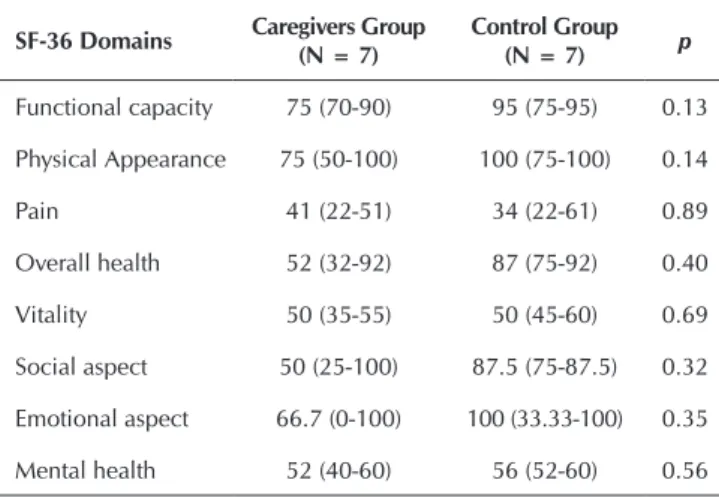
Table 2 shows the results of the comparison between the groups on the scores obtained by the SF-36 questionnai-re(11). There was no significant difference between the groups
(p>0.05).
Table 2 - Comparison between caregivers (n = 7) and control group (n = 7) for the scores of the SF-36 questionnaire.
SF-36 Domains Caregivers Group
(N = 7)
Control Group
(N = 7) p
Functional capacity 75 (70-90) 95 (75-95) 0.13
Physical Appearance 75 (50-100) 100 (75-100) 0.14
Pain 41 (22-51) 34 (22-61) 0.89
Overall health 52 (32-92) 87 (75-92) 0.40
Vitality 50 (35-55) 50 (45-60) 0.69
Social aspect 50 (25-100) 87.5 (75-87.5) 0.32
Emotional aspect 66.7 (0-100) 100 (33.33-100) 0.35
Mental health 52 (40-60) 56 (52-60) 0.56
* P <0.05.
Table 3, in turn, presents the results of both groups on the CBS questionnaire(12). There were statistically significant
diffe-rences for all domains (p<0.05).
Table 3 - Comparison between caregivers (n = 7) and control group (n = 7) for the scores of the CBS questionnaire.
CBS domains Caregivers Group(N = 7) Control Group(N = 7) p
General strain 2.62 (1.87-3.37) 1 (1.1) 0.001
Isolation 3 (2-3.33) 1 (1.1) 0.003
Disappointment 2.20 (2.20-3) 1 (1.1) 0.001
Emotional involvement 2 (1-2.33) 1 (1.1) 0.009
Environment 2.33 (2-2.66) 1 (1.1) 0.001
Overall score 2.72 (1.95-2.86) 1 (1.1) 0.001
* P <0.05.
DISCUSSION
According to the results on general characteristics, it was found that, although we did not stipulate the female gender as one of the initial inclusion criteria for participation in the study, all participants in the caregivers group were women, which corroborates the information in the literature that sug-gests women with the social role of caregiver(8,14-18). Another
important aspect concerns the degree of kinship, since that in the present study, of the seven caregivers, four were wives and three were mothers of patients with SCI. These data agrees with the information that the role of caregiver is usually assig-ned to women(8), what is seen as something natural, since,
so-cially, a woman, in her role as mother or wife, assumes these tasks as one more function relevant to the domestic sphere(19).
When analyzing the literature for information about the gender of people with SCI, it seems that most individuals are male(20-24), which is aligned with the characteristics of the
indi-viduals in this study.
With respect to the total time as a caregiver and time (in hours per day) spent in the care of patients, statistically signi-ficant differences between groups were found, which was ex-pected, since women without caring activity for people with disabilities were selected for the control group, so we could check the impact of this activity in family caregivers.
Regarding the SF-36 questionnaire(11), there was no
statis-tically significant difference between caregivers and control group for any of the areas included in the questionnaire. This suggests that this questionnaire might not be an adequate tool to identify possible differences between caregivers of patients with SCI and their respective controls.
It is noteworthy that the number of seven women may be a small representation of this population, and also the fact that they have been caregivers for years and are not at the early stage of SCI when the difficulties are greater(25-26), may have
influen-ced the results. Unlike the results of this study, Ünalan et al.(4)
when comparing the quality of life of 50 caregivers of people with SCI (with time of injury ranging from 0 to 49 months) to 40 healthy people (control group), by applying the SF-36 questio-nnaire(11), caregivers had lower scores in their domains, which
was statistically significant in all but the pain domain.
Another study(16) that analyzed the quality of life of nine
informal caregivers of patients with neurological sequelae (stroke and SCI), using the SF-36 questionnaire(11) and
com-paring the scores with the results of the control group (n = 11), found higher values for the scores of all domains of the SF-36(11) for the control group (p<0.05) except for the general
state of health domain.
Conversely, the CBS questionnaire(12) provided very
inte-resting information in this study, since, when scores on this questionnaire were compared, all domain values for the ca-regivers group were higher when compared to the control group (p<0.05), which in percentage terms would be 62%,
In a study of 60 female caregivers, authors(13) also used the
SF-36(11) and CBS(12) and found that, regarding the domains of
the SF-36(11), results showed a greater impact on the physical
component than on the mental component, pain and vitality were the most affected and for the CBS questionnaire(12), the
environment domain showed the highest score, followed by the disappointment domain. However, because this study did not use a control group, it was not possible to quantify diffe-rences in percentage terms, which makes infediffe-rences about the larger impact of the act of providing assistance in the lives of caregivers difficult.
In the present investigation we verified that the family care-givers provided assistance for a period ranging from two to 24 hours a day, for a total time of one to 19 years, which agrees with the information pointed out by authors(8) that reported
that the time (in hours per day) directed to the care of patients dependent on others usually ranges from 3 to 24 h.
The significant difference in the strain domain might be due to experiencing the new responsibility of caring for a per-son who is dependent not only on the physical aspect, but also on the emotional one, which corroborates the informa-tion of authors(9) that showed that the most common reports of
caregivers relate to the fear of not providing adequate care. In addition, these caregivers cope with feelings of powerlessness in the face of a distressing future and feelings of incompetence for the specific and stressful tasks of care(27).
In the same study(9) it was showed that the profile of the
pos-sible physical complications resulting from SCI outlines another profile of equivalent problems depicted by social isolation and alienation because of embarrassment, rejection and self-degra-dation. However, this isolation affects the person with SCI and their families, which is confirmed by data from this study, since the isolation domain also showed significant difference.
As a result, the family caregiver, when undertaking the ar-duous task of caring for a person with physical dependence, abdicates the activities which are generally performed in their daily life (leisure, professional), moving away from contact with other people.
Caring for someone with SCI at home is a complex task because, besides taking into account the characteristics of the inability of the person being cared for, the care often requi-res the use of requi-resources to support the work of the caregi-ver(25). Furthermore, studies show that SCI is a major public
health problem, and this is due to the difficulty and comple-xity of caring for these people at home thus requiring new hospitalizations(27-29).
In this sense, on the environment domain, it is important to discuss the matter of wheelchair accessibility in the bathroom, which is necessary for the person with SCI to be able to perform activities of personal hygiene and movement. For this, the trans-fers require physical effort, and that overloads the caregivers, which could lead to a deterioration in their quality of life.
Thus, the level of difficulty and complexity of home care for a physically disabled person will generally be related to their degree of incapacity for self-care and/or activities of daily living, coupled with the availability of material resources to perform such task(25,30).
CONCLUSION
The results of this study showed that the CBS questionnai-re was moquestionnai-re appropriate for evaluating the quality of life of family caregivers of people with SCI and suggest that caring for a person with neuromotor disabilities can have a negative impact on the quality of life of family caregivers.
Consideration should be given to the fact that due to the number of study participants, errors type I and II may be pre-sent, which suggests the continuation of the study or other con-trolled studies with a more appropriate number of participants and follow up to validate the results, since the greatest difficul-ties are encountered in the initial phase of spinal cord injury.
Through the results, we conclude that family caregivers of pe-ople with SCI have a significant reduction in the quality of life compared to the control group, justifying the need to monitor not only the person with SCI, but also of their caregivers, in order to meet their needs and minimize potential losses in their welfare.
REFERENCES
1. Ditunno Jr JF, Young W, Donovan WH, Creasey G. The in-ternational standards booklet for neurological and functio-nal classification of spifunctio-nal cord injury. American Spifunctio-nal In-jury Association. J Am Paraplegia Soc 1994;32(2):70–80. 2. Pereira MEMSM, Araujo TCCFA. Coping and rehabilita-tion of people with spinal cord injury and their caretakers. Psico (Porto Alegre) 2006;37(1):37-45.
3. Barbosa IV. Spinal Cord Injury and its meanings for the fa-mily. Fortaleza. Dissertation [Masters in Nursing] -Federal University of Ceará; 2008.
4. Ünalan H, Gençosmanoglu B, Akgün K, Karamehmetoglu S, Tuna H, Önes K, Rahimpenah A, et al. Quality of life of primary caregivers of spinal cord injury survivors living
in the community: controlled study with short form-36 questionnaire. Spinal Cord 2001;39(6):318-22.
5. Nogueira PC. Burden of care and quality of life related to health of caregivers of individuals with spinal cord injury. Thesis [ PhD in science] - Ribeirão Preto College of Nur-sing- São Paulo University; 2010
6. Amendola F, Oliveira MAC, Alvarenga MRM. Qua-lity of life of family caregivers of patients dependent on the family health program. Texto Contexto Enferm 2008;17(2):266-72.
dependent elderly people in the perspective of family ca-regivers. Cienc Cuid Saúde 2009;8(3):428-35.
9. Azevedo GR, Santos VLCG. (Handicapped) Caregiver: the social representations of family members about the caregiving process. Rev Latino-Am Enfermagem 2006;14(5):770-80.
10. Weitzenkamp DA, Gerhart KA, Charlifue SW, Whitene-ck GG, Savic G. Spouses of spinal cord injury survivors: the added impact of caregiving. Arch Phys Med Rehabil 1997;78(8):822-27.
11. Ciconelli RM, Ferraz MB, Santos W, Meinão I, Quaresma MR. Brazilian-Portuguese version of the SF-36. A reliable and valid quality of life outcome measure. Rev Bras Reu-matol 1999;39(3):143-50.
12. Medeiros MMC, Ferraz MB, Quaresma MR, Menezes AP. Adaptation and validation of the caregiver burden scale to Brazilian cultural milieu. Rev Bras Reumatol 1998;38(4):193-99.
13. Blanes L, Carmagnani MI, Ferreira LM. Health-related quality of life of primary caregivers of persons with para-plegia. Spinal Cord 2007;45(6):399-403.
14. Martins T, Ribeiro JP, Garret C. Validation study of the overolad evaluation questionnare for informal caregivers. Psicol Saúde Doenças 2003;4(1):131-48.
15. Lemos ND, Gazzola JM, Ramos LR. Caring for the Alzheimer’s patient: the impact of the illness on the care-giver. Saúde Soc 2006;15(3):170-79.
16. Sousa AG, Raphael CZ, Ferrari RAM, Frigero M. Evaluation of the health quality in caregivers of patients with neuro-logical sequels. Conscientiae Saúde 2008;7(4):497-502. 17. Pereira MEMSM, Araújo TCCF. Coping strategies in
rehabilitation of spinal cord injury. Arq Neuro-Psiquiatr 2005;63(2-B):502-7.
18. Faro ACM. Proposal of basis survey to the assistance fami-ly and to the spinal cord injuried patient’s caregiver. Rev Esc Enferm USP 1999;33(4):334-41.
19. Faro ACM. Care of spinal cord injuried patient at home.
Thesis [ PhD in science] - Ribeirão Preto College of Nur-sing- São Paulo University; 1999.
20. Veturini DA, Decesario MN, Marcon SS. Knowing the history and the life conditions of subjects with medullar lesion. Rev Gaúch Enferm 2006;27(2):219-29.
21. Noronha JP. Epidemiological investigation envolving ca-ses of traumatic spinal cord injuries from a rehabilitation unit in Goiânia – Goiás – Brazil. Dissertation [Masters in Nursing] - Goiás Catholic University; 2008.
22. Bruni DS, Strazzieri KC, Gumieiro MN, Giovanazzi R, Sá VG, Faro ACM. Physiopathological aspects and nursing care on rehabilitation of patient with spinal cord injury. Rev Esc Enferm USP 2004;38(1):71-9.
23. Faro ACM. Assistência de enfermagem ao paciente com traumatismo raquimedular. In: Ventura MF, Faro ACM, Onoe EKM, Utimura M. Enfermagem Ortopédica. São Paulo: Ícone; 1996. p.175-89.
24. Campos MF, Ribeiro AT, Listik S, Pereira CAB, Sobrinho JA, Rapoport A. Epidemiology of spine injuries. Rev Col Bras Cir 2008;35(2):88-93.
25. Machado WCA & Scramin AP. Functional (in)dependence in the dependent relationship of quadriplegic men with their (un)replaceable parents/caregivers. Rev Esc Enferm USP 2010;44(1):53-60.
26. Scramin AP & Machado WCA. Take care of people with quadriplegia at home environment: Long-term nursing in-terventions. Esc Anna Nery Rev Enferm 2006;10(3):501-8. 27. Carvalho ZMF, Freitas GL, Holanda KM, Silva GA. Pa-tients with spinal cord injury: Teaching experience about the care for their families. Esc Anna Nery Rev Enferm 2006;10(2):316-22.
28. Nasi AL. Routines in emergency rooms. 2nd ed. Porto Alegre: Artmed; 2005
29. Carvalho ZMF. Nursing people with spinal cord injury. Interações Estud Pesqui Psicol Interações 2004;6:175-83. 30. Murta SG, Guimarães SS. Coping with traumatic spinal