w w w. s b f g n o s i a . o r g . b r / r e v i s t a
Original
Article
Involvement
of
GABAergic
pathway
in
the
sedative
activity
of
apigenin,
the
main
flavonoid
from
Passiflora
quadrangularis
pericarp
Andressa
C.
Gazola
a,∗,
Geison
M.
Costa
a,b,
Leonardo
Castellanos
b,
Freddy
A.
Ramos
b,
Flávio
H.
Reginatto
a,
Thereza
C.M.
de
Lima
c,
Eloir
P.
Schenkel
aaProgramadePós-graduac¸ãoemFarmácia,UniversidadeFederaldeSantaCatarina,Florianópolis,SC,Brazil bDepartamentodeQuímica,UniversidadNacionaldeColombia,Bogotá,Colombia
cProgramadePós-graduac¸ãoemFarmacologia,UniversidadeFederaldeSantaCatarina,Florianópolis,SC,Brazil
a
r
t
i
c
l
e
i
n
f
o
Articlehistory:
Received6September2014 Accepted13March2015 Availableonline1April2015
Keywords:
Apigenin
Passifloraquadrangularis
Passionflower Passionfruit Sedative
a
b
s
t
r
a
c
t
InthecurrentstudyweshowedthatoraladministrationofanaqueousextractofPassifloraquadrangularis L.,Passifloraceae,pericarpresultsinasignificantprolongationofthesleepdurationinmiceevaluatedin theethylether-inducedhypnosistestwhichindicatessedativeeffects.Apigenin,themainflavonoidof theextract,inducedasimilarsedativeresponsewhenappliedalone,atadoseequivalenttothatfound intheextract,suggestingthatapigeninismediatingthesedativeeffectsofP.quadrangularisextract.In addition,thesedativeeffectofapigeninwasblockedbypretreatmentwiththebenzodiazepine antag-onistflumazenil(1mg/kg),suggestinganinteractionofapigeninwithgamma-aminobutyricacidtype A(GABAA)receptors.However,apigeninatconcentrations0.1–50MfailedtoenhanceGABA-induced
currentsthroughGABAAreceptors(␣12␥2S)expressedinXenopusoocytes.Nevertheless,basedonour
results,wesuggestthattheinvivosedativeeffectoftheP.quadrangularisextractanditsmainflavonoid apigeninmaybebeduetoanenhancementoftheGABAergicsystem.
©2015SociedadeBrasileiradeFarmacognosia.PublishedbyElsevierEditoraLtda.Allrightsreserved.
Introduction
The genus Passiflora has the most economical significance
amongallothergenerainthefamilyPassifloraceae.Itsspeciesare
mainlydistributedthroughoutLatinAmerica.Passiflora
quadrangu-larisL.isusuallycultivatedataltitudesbelow2500m(Killip,1938).
InBrazil,theoccurrenceofthisspeciesisdescribedinthestatesof
AmazonasandMaranhão(Cervi,1997)and alsoin Colombia,in
theregionsofChocó,Meta,HuilaandSantander.Popularlyknown
as“maracujá-ac¸u”inBrazil(Cervi,1997)and“badea”inColombia
(HernándezandBernal,2000),thisspeciesiswidelyconsumedin
Colombiaasjuice.Thefruitsaremuchbiggerthantheotherfruits
ofPassifloraspeciesshowingpaleyellowishgreencolorwhenripe
(Vanderplank,2000).
Todate,onlyfewpharmacologicalandchemicalstudieswith
pericarpsofPassifloraspeciesisavailable.Intraditionalmedicine,
preparationsusingleavesofsomespeciesareusedassedativesand
mildtranquilizers(LewisandElvin-Lewis,1977;Schindler,1884).
Inparticular,sedative, anxiolytic-likeandanticonvulsanteffects
∗ Correspondingauthor.
E-mail:[email protected](A.C.Gazola).
ofleavesextractsfromdifferentspecies ofPassiflora havebeen
reported(forareview,seeDhawanetal.,2004).
Regardingthechemicalcomposition,mostofthestudiesisalso
relatedtoleavesextractsandreportedthepresenceofflavonoids
(Petry etal.,1998;Ulubelenetal.,1982;Zucolottoetal.,2012)
andsaponins(Orsinietal.,1985;Reginattoetal.,2001).In this
respect,duethelackintheliteratureaboutneuropharmacological
andchemicaldataofpericarpfromPassifloraspeciesand
consid-eringthatthesedativeandanxiolytic-likeactivitiesofP.edulisvar.
flavicarpapericarpwerepreviouslydescribed(Senaetal.,2009),
theaimofthepresentstudywastoevaluatethesedativeactivity
ofP.quadrangularispericarpaqueousextracts,thecorrelationofthe
sedativeactivitytoitsflavonoidsconstituentsbesidestostudythe
involvementofthegamma-aminobutyricacidsystemintheaction
ofthesecompounds.
Materialsandmethods
Plantmaterialandextraction
Fruits of Passiflora quadrangularis L., Passifloraceae, were
collectedinColombia[Neiva,Huila(2◦59′55′′,−75◦18′16′′)],
iden-tifiedbyProf.LuisCarlosJimenez(InstitutoNacionaldeCiencias,
http://dx.doi.org/10.1016/j.bjp.2015.03.009
Universidad Nacional de Colombia) and a voucher specimen
wasdepositedintheHerbariumoftheUniversidadNacionalde
Colombia(COL572634).
Extractfortheethylether-inducedhypnosistestaswellasthe
HPLC-DADanalyseswasobtainedasfollows.Freshpericarpwas
directlyextractedbyinfusionwithhotwater(90◦C;plant:solvent,
1:3,w/v)for10min.Theaqueousextractsweresubsequently
fil-teredandfreeze-dried.
HPLC-DADanalyses
TheanalyseswereperformedonaPerkinElmerSeries200
high-performanceliquidchromatography(HPLC)systemequippedwith
diodearraydetection (DAD),quaternary pump,onlinedegasser
and auto-sampler (injectionvolume was20l). The separation
wasperformedwithaPerkinElmerBrownleeAnalyticalC18
col-umn(250mm×4.6mmi.d.;5m).Theflowwasmaintainedata
constantrateof1.2ml/min.Themobilephaseusedconsistedof
solventA(acetonitrile)andsolventB(0.5%formicacidinwater)
inalineargradientelution(0–20min–15%–35%ofA;20–25min
–isocratic35%A).Thechromatogramsweremonitoredat340nm
andUVspectrawererecordedinthe200–400nmrange.Thedata
were processed with Chromera software® (Version 3.2.0.4847)
(PerkinElmer®
,Waltham,MA,USA).
Qualitative and quantitative analyses were performed with
the extract in a concentration of 5000g/ml. For qualitative
analyses the reference standards co-eluted with the extract
wereapigenin(≥95%–Sigma–Aldrich®,USA),isoorientin(
≥98%
– Extrasynthèse®, France), vitexin-2′′-O-rhamnoside (
≥98% –
Sigma–Aldrich®,USA),vitexin-2′′-O-xyloside(Costaetal.,2013),
isovitexin(≥98%–Fluka®,USA)andswertisin(Santosetal.,1996).
Thequantitativeanalysesweredevelopedusingtheexternal
standardmethod,beingapigeninusedasareferencesubstanceto
createacalibrationcurvewithsixpointsina0.5–40g/ml
con-centrationrange.Allofthestandardsolutionswereanalyzedin
triplicate,andtheaveragepeak areasweremeasured.The
vali-dationoftheanalyticalprocedureswasperformedinaccordance
withICHguidelines(2005).Inparticular,thefollowing
parame-terswereevaluated:specificity,linearity,accuracy,precision(both
repeatabilityandintermediateprecision),thelimitof
quantifica-tion(LOQ)andthelimitofdetection(LOD).
Animals
MaleadultSwissmice(3–4months)weighing 35–50gwere
usedfor behavioral evaluations.Animalsweremaintainedona
12-hlight-darkcycle(lightsonat7a.m.)ataconstantroom
temper-ature(23±2◦C).Micewerehousedingroupsoftwentyperplastic
cage(30cm×37cm×16cm)withfoodandwaterprovidedad
libi-tumexceptduringtheexperiments.Allanimalswereallowedto
adapttothelaboratoryconditionsforatleastoneweekpriorto
thebehavioralassessmentsofthestudy.Onthedayofthe
exper-iment,animalswerehousedintheexperimentalroomforatleast
1hpriortothestartofthetestingprocedures.Eachanimalwas
usedonlyonce.Experimentswereconductedinaccordancewith
nationalandinternationalstandardsofanimalwelfare(Brazilian
Law#11,794,10/08/2008;NIHpublication#85-23,revisedin1996)
andapprovedbythelocalCommitteeforAnimalCareinResearch
(#23080.044085/2009-37/CEUA/UFSC).Allefforts weremadeto
minimizethenumberofanimalsusedandtheirsuffering.
Drugsandtreatments
Micewereorallytreated(p.o.)throughanintragastriccannula,
inaconstantvolumeof0.1ml/10gofanimalweight,withP.
quad-rangularisaqueousextractorapigenin,bothdissolvedindistilled
water.Intheethylether-inducedhypnosistest,theextractwas
testedatthedosesof100,300and600mg/kgandapigeninwas
testedatthedosesof0.1,0.3,0.6and1.0mg/kg.Anequalvolume
ofdistilledwater(vehicle,p.o.)treatedmiceofthecontrolgroups.
Diazepam(DZP–Hoffman-LaRoche®,Switzerland)wasusedas
positivedrugcontrol,dissolvedinwaterwith10%ofpropylene
glycol,andadministeredp.o.atadoseof1mg/kginthesedative
test(Senaetal.,2009).Animalswereindividuallytested1hafter
theirtreatmentswiththeextractorapigeninand30minaftertheir
treatmentwithDZP.
InordertoassesstheinvolvementoftheGABAergicsystem,a
groupofanimalswerepretreated(i.p.)withphysiologicalsaline
solution(QuimibrásIndústriasQuímicasS.A.,Brazil)or
flumaze-nil(Flumazen®
,UniãoQuímicaLab.,Brazil–1mg/kg–Carvalho
etal.,2011)15minpriortheoraltreatmentwiththetest
com-poundapigenin(0.6mg/kg),thereferencedrugDZP(1mg/kg)or
distilledwater(controlgroup).
Ethylether-inducedhypnosistest
Animalswereplacedinanethylether-saturatedglasscage(6ml,
13minofsaturation,30cm×20cmglasscage)aftertreatments.A
stopwatchwasusedtorecordthedurationofhypnosisinseconds
(s).Thehypnosistimewasmeasuredbythelossoftherighting
reflex,andtherecoveryofthisreflexwasconsideredasthe
end-pointofthehypnosis(Vieira,2001).
Voltageclampanalysis
Preparation of stages V–VIoocytes from Xenopus laevis and
synthesis of capped off run-offpoly(A+) cRNA transcripts from
linearizedcDNAtemplates(pCMVvector)wereperformedas
pre-viouslydescribed(Khometal.,2006).Briefly,femaleXenopusLaevis
frogs(Nasco,FortAtkinson,USA)wereanaesthetizedbyexposing
themfor15mintoa0.2%solutionofMS-222(methanesulfonate
salt of3-aminobenzoicacidethyl ester;Sigma,Vienna,Austria)
beforesurgicallyremovingpartsoftheovaries.Folliclemembranes
from isolated oocytes were digested with 2mg/ml collagenase
solution (Type 1A).Selected stages V–VIoocytes wereinjected
withabout10–50nlofDEPC-treatedwater(diethyl
pyrocarbon-ate) containing thecRNAs at a concentration of approximately
300–3000pg/nl.TheamountofcRNAwasdeterminedbymeans
ofaNanoDropND-1000(KiskerBiotech,Steinfurt,Germany).To
ensureexpressionofthegamma-subunit,cRNAsforexpressionof
˛1ˇ22sreceptorsweremixedinaratioof1:1:10,respectively.
Afterinjection,oocyteswerestoredat18±8◦Cfor24–48hinND96
solutioncontaining penicillinG (10,000IU/100ml)and
strepto-mycin(10mg/100ml).ElectrophysiologicalexperimentsonGABAA
receptorswereperformedusingthe
two-microelectrode-voltage-clampmethodataholdingpotentialof−70mV,makinguseofa
TURBOTEC01Camplifier(npielectronic,Tamm,Germany)andan
AxonDigidata1322Ainterface(MolecularDevices,Sunnyvale,CA).
DataacquisitionwasdoneusingpCLAMPv.9.2.Thebathsolution
contained90mMNaCl,1mMKCl,1mMMgCl2.6H2O,1mMCaCl2
and5mMHEPES(pH7.4).Microelectrodeswerefilledwith3MKCl.
GABAandapigeninwereappliedbymeansofafastperfusion
system(ScreeningTool,npielectronic,Tamm,Germany)(Baburin
etal.,2006)tostudytheGABA-inducedchloridecurrent(IGABA)
modulation.ToelicitIGABA,thechamberwasperfusedwith120l
ofGABAcontainingsolutionatavolumeratebetween300and
1000ml/s.TheIGABArisetimerangedfrom100to250ms(Khom
etal.,2006).Toexcludevoltage-clamperrors,oocyteswith
maxi-malcurrentamplitudes>3mAwerediscarded.
PotentiationoftheIGABA inpercentwasdefinedaccordingto
the formula:IGABA (%)=[I(GABA + apigenin)/IGABA−1]×100, where
Water 0 50 100 150 200
100
*
*
*
300
mg/Kg
Time (s)
600 DZP
Fig.1.EffectsoftheoraltreatmentwiththeaqueousextractfromthepericarpofP. quadrangularis(100,300and600mg/kg)onthedurationofthehypnosisinducedby ethyletherinmice.Diazepam(DZP)(1mg/kg,p.o.)wasusedascontroldrug.n=7–8 animals/group.Dataareexpressedasmean±S.E.M.*p≤0.05comparedwiththe controlgroup.Comparisonswereaccomplishedwithone-wayANOVAfollowedby Dunnett’stestorStudent’sttest(DZPgroup×controlgroup).
concentrationsofapigenin,andIGABAisthecontrolGABA-induced
chloridecurrent.
Statisticalanalysis
Results of the in vivo experiments are expressed as
means±S.E.M. Data of the experiments without flumazenil
pre-treatmentwere analyzed by Student’s t test (positive
con-trolgroups X control groups) or one-way analysis of variance
(ANOVA)followedbyDunnett’stest.Influmazenilpretreatment
protocol data were analyzed by two-way ANOVA followed by
Newman–Keuls’test.Allofthestatisticalanalyseswereperformed
usingGraphPad Prism®
5.0 (La Jolla,CA,USA) and/or Statistica
Statsoft® 7.0(Tulsa,OK,USA).Differenceswereconsideredtobe
statisticallysignificantwhenp≤0.05.
Forinvitroexperiments,OriginSoftware®
(OriginLab
Corpora-tion)wasused.Responsesweregraphedasmean±S.E.M.fromat
leastthreeoocytesoutof≥2differentbatches.Statistical
signifi-cancewascalculatedusingone-wayANOVAfollowedbyTukey’s
testwithaconfidenceintervalofp≤0.05.
Resultsanddiscussion
Inthecurrentstudy,weevaluatedthesedativeactivityofthe
aqueousextract obtainedfrompericarpsofP.quadrangularisby
meansofethylether-induced hypnosistest.Thistestallowsthe
assessmentofsedativeeffectwithoutintroducingpossible
phar-macokinetic biases caused by hepatic metabolism of the sleep
inductor,suchasinthecaseofpentobarbital-inducedhypnosistest
(Duarteetal.,2007;Carvalhoetal.,2011).
Theethylether-inducedhypnosistestofPassifloraextract
As depicted in Fig. 1, the pericarp extract of P.
quadran-gularis increased the hypnosis duration (100 and 300mg/kg –
[F3.27=3.859, p=0.0203]), an effect similar to DZP. The
seda-tive activity of P. quadrangularis pericarp extract was not
previously reported. In the literature was found just one
neuropharmacological study with this species describing the
anxiolytic-likeeffectofthehydroethanolicextractfromleavesin
ratsevaluatedintheelevatedplus-mazetest(Castroetal.,2007).
Athigherdoses(600mg/kg),however,theextractdidnotshowa
sedativeactivity.Thereasonforthisfindingshouldbeduetothe
factthatathigherdosesallchemicalcompoundspresentinthis
extractcouldbepresentathigheramountandthelackofresponse
Time (min)
Absorbance (mA
U
)
0 0 10 20 30 40 50 60 70 80 90
2 4 6 8 10 1
*
12 14 16 18 20 22 24
Fig.2. Chromatogramof theaqueous extractfrom P.quadrangularispericarp (5000g/ml)at340nm.Co-elutionwithstandardsshowedthepresenceof vitexin-2′′-O-xyloside(1)andapigenin(*).SeesubsectionHPLC-DADanalysisinMaterials
andMethodssectionforthedescriptionofthechromatographicconditions.
maybeattributedtothecompetitionbetweenseveralcompounds
oftheextractactingindifferentreceptors,evenexcitatoryones.
Thequalitativeanalysisoftheflavonoidconstituentsintheextract
Regardingthequalitativeanalysis,moststudiesareindicating
flavonoidsasthemainchemicalconstituentsresponsibleforthe
CNSactivitiesofPassifloraspecies(Petryetal.,2001;Lietal.,2011;
Senaetal.,2009).Therefore,thepresenceofflavonoidconstituents
wasinvestigatedinP.quadrangularispericarpextractbyco-elution
withapigenin,isoorientin,vitexin-2′′-O-rhamnoside,vitexin-2′′-O
-xyloside,isovitexinandswertisin standards.Previousstudiesof
ourresearchgroupidentifiedtheflavonoidvitexin-2′′-O-xyloside
asthemajorcompoundintheleavesextractofthisplantspecies
(Costaetal.,2013).Nevertheless,thequalitativeHPLC-DAD
anal-ysisofthepericarpextractinco-elutionwithreferencestandards
showedthatthemain flavonoidisnota glycoside,butan
agly-coneidentifiedasapigenin(Fig.2).Thepresenceofotherminor
flavonoids wasvisible in thechromatogram but their contents
wereverylowandcouldnotbeisolated.Theco-elutionprocedures
employedallowedtheidentificationofoneofthemasthesame
gly-cosidefoundintheleaves,i.e.vitexin-2′′-O-xyloside,andexcluded
thepresence ofisoorientin, vitexin-2′′-O-rahmnoside, isovitexin
andswertisin(Fig.2).Therefore,asapigeninispresentinamuch
higher amount, quantitative analysiswas focused in this main
flavonoid.
Thequantitativeanalysisofapigeninintheextract
Inordertoquantifythecontentofapigeninintheextract,a
methodologywasdevelopedandvalidated.Theparameters
speci-ficity,linearity,accuracy,precision,limitofquantification(LOQ)
andlimitofdetection(LOD)wereevaluated(Tables1and2).The
quantificationdemonstrated agoodlinearrelationship between
peakareaandconcentration(r2>0.999).LOQandLODweredefined
bytherelativestandarddeviation(RSD>5%)andbyasignal:noise
ratioof3:1,respectively.TheRSDvaluesforrepeatabilityand
inter-mediateprecisionrangedfrom0.5to1.9%. Therecoveryofthe
spikedsamplesrangedfrom99to103%,showingthattheanalytical
approachusedinthisstudyisrepeatableandaccurate.
Sincetheproceduresofthequantitativeanalysiswereaccurate
allowingthecorrectquantificationofapigeninintheextract,they
wereemployedandthisflavonoidwasfoundas2.449±0.004mg/g
Table1
ValidationdataforapigeninquantificationbyHPLC-DAD.
Flavonoid Linearityrange(g/ml) Calibrationequationa Correlationfactor(r2) LODb(g/ml) LOQb(g/ml)
Apigenin 0.5–40 y=112834x–23037 0.9996 0.0625 0.25
aSixdatapoints(n=3).
bLOQ,limitofquantification;LOD,limitofdetection.
Table2
ApigeninquantificationinPassifloraspeciesasevaluatedbyHPLC-DAD.
Flavonoid Repeatabilitya Intermediateprecisiona Recoverya,b
Concentration(g/ml) RSD(%) Concentration(g/ml) RSD(%) P.quadrangularis(5000g/ml) Mean(%) RSD(%)
Apigenin 1 1.9 10 0.5 103.7 0.1
10 0.7
40 1.1
RSD,relativestandarddeviation.
aLimits:RSD:<5%.
bSpikedsampleswithapigeninstandardsolutionat5g/ml.
Apigeninintheethylether-inducedhypnosistest
Apigeninwasevaluatedintheethylether-inducedhypnosistest
atdosesof0.1,0.3,0.6and1.0mg/kg.Thesedoseswereselected
consideringtheapproximatedquantityofapigeninpresentinthe
active dosesof theextract, in viewof thequantification result
forthiscompound. Thus,forthedoses100and 300mg/kgof P.
quadrangularis pericarpextract,the correspondingquantitiesof
apigeninare0.24and0.73mg/kg,respectively.
Among all the administered doses of apigenin, 0.6mg/kg
demonstratedasedativeeffect(F4.35=2.657,p=0.0490),resulting
inasignificantincreaseinthesleepingduration(Fig.3).
Theresultsobtainedsuggesta positiverelationship between
apigeninlevelsandthesedativeeffectoftheextract.This
assump-tionissupportedbyotherauthorswhodemonstratethatapigenin
atdifferentdosespossessessedativeeffect.Forexample,Avallone
etal.(2000)described thiseffectwhen apigenin(i.p.)was
eval-uatedbyspontaneouslocomotorbehavior inrats.Moreover,by
telemetrytests, Chowetal. (2011)demonstrated thatapigenin
(p.o.)promotedsedativeeffectinC57BL/6Jmice.
Ontheotherside,whenapigeninwasadministeredinthedoses
of0.1 and0.3mg/kg, i.e.,theapproximatedamountofapigenin
in100mg/kgofP.quadrangularispericarpextract,thisflavonoid
didnotshowanysedativeactivity(Fig.3),showingaUinverted
Water 0 50 100 150 200
0.1
*
*
0.3
mg/kg
Time (s)
0.6 1.0 DZP
Fig.3.Effectsoftheoraltreatmentwiththeflavonoidapigenin(0.1,0.3,0.6,and 1.0mg/kg)onthedurationofethylether-inducedhypnosisinmice.Diazepam(DZP) (1mg/kg,p.o.)wasusedasastandarddrug.n=8animals/group.Dataareexpressed intermsofmeans±S.E.M.*p≤0.05comparedwiththecontrolgroup.Comparisons wereaccomplishedwithone-wayANOVAfollowedbyDunnett’stestorStudent’st
test(DZPgroup×controlgroup).
dose-effectcurve.Somefindings indicatethat, as occursin our
results,thehormesismodelcouldpredictsresponsesinthelow
doses zone very wellin biological tests(Calabrese, 2009). This
factindicatesthattheeffectobservedforpericarpextractisnot
dueonlytothecontentofapigenin.Actually,thiscompoundcan
bethemainresponsible,butprobablythereisalsoasignificant
contributionofothercompounds.
StudyingapotentialinvolvementoftheGABAergicsysteminthe
sedativeactivityofapigenin
Losietal.(2004)reportedaninteractionofapigeninwiththe
GABAergicandglutamatergicneurotransmissionincultured
cor-ticalneurons.Theseneurotransmittersystemsplayakeyrolein
controllingtheexcitabilityofthebrainandarethustargetedby
many psychoactive substances as wellas clinically used drugs
(Mihicand Harris,2011).In addition,Lollietal. (2007)showed
thatmethanolandhydromethanolextractsfromP.actiniaexerts
anxiolytic-likeandsedativeeffectsinmiceafteroral
administra-tion.Authorsalsoshowthatpreviousadministrationofflumazenil
intheelevatedplusmazetestindicatethattheanxiolytic-like
activ-ityisrelatedtotheinfluenceoftheGABAergicactivation(Lollietal.,
2007)pointingthatthis pathwaycanbemodulatebyPassiflora
extracts.
Water 0 50
100 &
150
*
Time (s)
DZP DZP Water API FMZ Saline
Fig.4. Effectsoftheoraltreatmentofapigenin(API–0.6mg/kg),diazepam(DZP– 1.0mg/kg)andwaterinanimalspre-treated(i.p.)withflumazenil(FMZ–1.0mg/kg) orsalineonthedurationofhypnosisinducedbyethyletherinmice.DZPwasusedas controldrug.n=7–8animals/group.Dataareexpressedasmean±S.E.M.*,&p≤0.05
0
–10
–20
–30
–40
–50
–60
–70
–80
–90
–100
100
90
80
70
60
0.1 1 10 50
Concentration (μM)
Concentration (μM)
*
Inhibition of l
GABA
(%)
P
otention of l
GABA
(%)
A
B
50
40
30
20
10
0
0.1 1 10 50
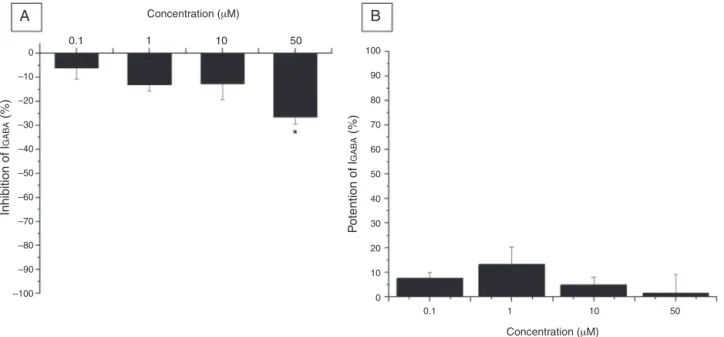
Fig.5. ModulationofIGABAthroughGABAAreceptors(˛1ˇ22s)atGABAconcentrationseliciting3–7%ofthemaximalGABAresponse(EC3–7)byapigenin(A)andluteolin
(B)attheindicatedconcentrations.Eachbarrepresentsthemean±S.E.M.fromatleast3differentoocytesoftwodifferentoocytebatches.Statisticalsignificance(p<0.05, one-wayANOVAfollowedbyTukey’stest)isindicatedby(*).
AsdepictedinFig.3,0.6mg/kgofapigeninincreasedsedationin
miceintheethylether-inducedhypnosistest.Thissedativeeffect
wasblockedbyapplicationofflumazenilatadoseof1.0mg/kg
(Fig.4).Sinceflumazenilisabenzodiazepineantagonist,thisresult
indicatesthatapigeninmightinteractwiththe
benzodiazepine-bindingsiteofGABAAreceptorstopromoteitssedativeeffect.
WehavethereforeexpressedGABAAreceptorscomposedof˛1,
ˇ2and2SsubunitsinXenopuslaevisoocytesandstudieda
poten-tialmodulationofGABA-inducedcurrents(IGABA)byapigeninand
luteolinmakinguseofthe2-microelectrodevoltage-clamp
tech-niqueandafastperfusionsystem.
However,asillustratedinFig.5A,apigeninfailedtoenhance
IGABA throughthis receptorsubtypeatalltested concentrations
(0.1–50M).Actually,as notexpected,it inhibitedIGABA atthe
higherconcentration,aresultthathasfurtherinvestigated.
Takingintoaccount thatthe sedativeeffect ofapigeninwas
observedafteroralapplicationitistemptingtospeculatethatnot
onlyapigenin,butanyofthemetabolitesformedafter
gastroin-testinaland/orhepaticmetabolismmightinvivomodulateGABAA
receptors.Gradolattoetal.(2004)reportedthatatleastseven
com-poundsareoriginatedfromhepaticmetabolismofapigeninwith
luteolinbeingidentifiedasthemainmetabolite.Therefore,wehave
alsoanalyzed themodulationof IGABA through ˛1ˇ22S GABAA
receptorsexpressedinXenopusoocytesbyluteolin.Asillustrated
inFig.5B,luteolinalsodidnotelicitedasignificantenhancement
ofIGABA.Thus,thisresultcouldnotexplainthesedativeeffectof
apigeninobservedafteroraltreatmentofmice,butitshowsthe
importanceofbetterunderstandthemetabolismofinvivo
admin-isteredcompounds.
Otherpossibleexplanationfor ourinvivofindings mightbe
thatapigenincanbeactingasa secondordermodulator.
Previ-ousstudiesshowedthat apigenindidnotmodulateIGABA when
appliedalonetothereceptor,butitshowedstrongeffectswhen
co-appliedwithanotherGABAAreceptormodulatorsuchasdiazepam
(Campbelletal.,2004).
Inaddition,theinfluenceofotherGABAAreceptorsubtypesin
thesedativeactivityofapigenincouldnotbediscarded. In this
sense,itwaspreviouslyshowedthat˛5subunitofGABAAreceptors
exertsinfluenceofthesedativeactivity(Savi ´cetal.,2008).
Inconclusion,thisstudyprovidesevidencesthattheaqueous
extractfromthepericarpofP.quadrangularisinducessedationin
mice.Inaddition,apigenin,themainflavonoidfoundintheextract,
alsoinducedsedativeeffect,suggestingthatthisflavonoidplaysan
importantroleinthesedativeeffectoftheextract.Furthermore,a
potentialinvolvementofGABAAreceptorsinmediatingthe
seda-tiveeffectofapigeninwasdemonstratedinvivobutnotinvitroand
themolecularmechanismremainstobeelucidated.
Conflictofinterest
Allauthorshavenonetodeclare.
Authors’contributions
ACG (PhDstudent) contributedin runningall thelaboratory
work,analysisofthedataanddraftedthepaper.GMCcontributedin
phytochemicalanalyses.LCandFARcontributedincollectionofthe
plant,confectionofvoucherspecimen,supervisionoflaboratory
workandcriticalreadingofthemanuscript.FHRsupervisedthe
lab-oratoryworkandcontributedtocriticalreadingofthemanuscript.
TCMLandEPSdesignedthestudy,supervisedthelaboratorywork
andcontributedtocriticalreadingofthemanuscript.Alltheauthors
havereadthefinalmanuscriptandapprovedthesubmission.
Acknowledgments
ThisresearchwasfundedbyCNPq,CAPES,FAPESC,COLCIENCIAS
andtheDIB-UniversidadNacionaldeColombia.ACGisrecipient
ofaPhDscholarshipfromFAPESCandreceivedaPDSE
scholar-shipfromCAPESinherforeignstageattheUniversityofVienna
underthesupervisionofDr.StephenHering.WealsothankCNPq,
whichprovidedresearchgrantstoEPS,FHRandTCML.Theauthors
aregratefultoProf.LuisCarlos Jimenezfor theidentificationof
plantmaterialandSophiaKhomandStephenHeringfortechnical
References
Avallone,R.,Zanoli,P.,Puia,G.,Kleinschnitz,M.,Schreier,P.,Baraldi,M.,2000. Phar-macologicalprofileofapigeninaflavonoidisolatedfromMatricariachamomilla. Biochem.Pharmacol.59,1387–1394.
Baburin,I.,Beyl,S.,Hering,S.,2006.AutomatedfastperfusionofXenopusoocytes fordrugscreening.Pflugers.Arch.453,117–123.
Calabrese,E.J.,2009.Gettingthedose–responsewrong:whyhormesisbecame marginalizedandthethresholdmodelaccepted.Arch.Toxicol.83,227–247.
Campbell,E.L.,Chebib,M.,Johnston,G.A.R.,2004.Thedietaryflavonoidsapigenin and(−)-epigallocatechingallateenhancethepositivemodulationbydiazepam oftheactivationbyGABAofrecombinantGABAAreceptors.Biochem.Pharmacol. 68,1631–1638.
Carvalho,R.S.M.,Duarte,F.S.,deLima,T.C.M.,2011.InvolvementofGABAergic non-benzodiazepinesitesintheanxiolytic-likeandsedativeeffectsoftheflavonoid baicaleininmice.Behav.BrainRes.221,75–82.
Castro,P.C.F.,Hoshino,A.,Silva,J.C.,Mendes,F.R.,2007.Possibleanxiolyticeffectof twoextractsofPassifloraquadrangularisLinexperimentalmodels.Phytother. Res.21,481–484.
Cervi,A.C.,1997.PassifloraceaedoBrasil:EstudodogêneroPassifloraL.subgênero Passiflora.Fontqueria45,1–92.
Chow,N.K.,Fretz,M.,Hamburger,M.,Butterweck,V.,2011.Telemetryasatoolto measuresedativeeffectsofvalerianrootextractanditssingleconstituentsin mice.PlantaMed.77,795–803.
Costa,G.M.,Gazola,A.C.,Madóglio,F.A.,Zucolotto,S.M.,Reginatto,F.H.,Castellanos, L.,Ramos,F.A.,Duque,C.,Schenkel,E.P.,2013.Vitexinderivativesas chemi-calmarkersinthedifferentiationofthecloselyrelatedspeciesPassifloraalata Curtis.andPassifloraquadrangularisLinn.J.Liq.Chromatogr.Relat.Technol.36, 1697–1907.
Dhawan,K.,Dhawan,S.,Sharma,A.,2004.Passiflora:areviewupdate.J. Ethnophar-macol.94,1–23.
Duarte,F.S.,Duzzioni,M.,Mendes,B.G.,Pizzolatti,M.G.,DeLima,T.C.M.,2007. Partic-ipationofdihydrostyryl-2-pyronesandstyryl-2-pyronesinthecentraleffectsof Polygalasabulosa(Polygalaceae)afolkmedicinetopicalanesthetic.Pharmacol. Biochem.Behav.86,150–161.
Gradolatto,A., Canivenc-Lavier,M.C., Basly,J.P.,Siess,M.H.,Teyssier,C.,2004.
MetabolismofapigeninbyratliverphaseIandphaseIIenzymesandbyisolated perfusedratliver.DrugMetab.Dispos.32,58–65.
Hernández,A.,Bernal,R.,2000.ListadeespeciesdePassifloraceaedeColombia.Biota Colombiana1,320–335.
ICH,2005.ValidationofAnalyticalProcedures:TextandMethodology–Q2(R1). InternationalConferenceonHarmonization,London.
Khom,S.,Baburin,I.,Timin,E.N.,Hohaus,A.,Sieghart,W.,Hering,S.,2006. Phar-macologicalpropertiesofGABAAreceptorscontaininggamma1subunits.Mol. Pharmacol.69,640–649.
Killip,E.P.,1938.TheAmericanSpeciesofPassifloraceae.v.XIX.PartII.Botanical Series,FieldMuseumofNaturalHistory,Chicago.
Lewis,W.H.,Elvin-Lewis,M.P.F.,1977. MedicalBotany: PlantsAffectingMan’s Health.JohnWiley&Sons,NewYork.
Li,H.,Zhou,P.,Yang,Q.,Shen,Y.,Deng,J.,Li,L.,Zhao,D.,2011.Comparativestudies onanxiolyticactivitiesandflavonoidcompositionsofPassifloraedulis‘edulis’ andPassifloraedulis‘flavicarpa’.J.Ethnopharmacol.133,1085–1090.
Lolli,L.F.,Sato,C.M.,Romanini,C.V.,Villas-Boas,L.D.B.,Santos,C.A.M.,Oliveira, R.M.W.,2007.PossibleinvolvementofGABAA-benzodiazepinereceptorinthe anxiolytic-likeeffectinducedbyPassifloraactiniaextractsinmice.J. Ethnophar-macol.111,308–314.
Losi,G.,Puia,G.,Garzon,G.,Vuono,M.C.,Baraldi,M.,2004.Apigeninmodulates GABAergicandglutamatergictransmissioninculturedcorticalneurons.Eur.J. Pharmacol.502,41–46.
Mihic,S.J.,Harris,R.A.,2011.Hypnoticsandsedatives.In:Brunton,L.L.,Chabner, B.A.,Knollmann,B.(Eds.),Goodman&Gilman’s:ThePharmacologicalBasisof Therapeutics.McGrawHillMedical,NewYork,pp.457–480.
Orsini,F.,Pelizzoni,F.,Verotta,L.,1985.Quadranguloside,acycloartanetriterpene glycosidefromPassifloraquadrangularis.Phytochemistry25,191–193.
Petry,R.D.,DeSouza,K.C.B.,Basani,V.L.,Petrovick,P.R.,González-Ortega,G.,1998.
Doseamentodoteordeflavonoidestotaisemextratoshidroalcoolicosde Passi-floraalataDryander(maracujá).Rev.Bras.Farm.79,7–10.
Petry,R.D., Reginatto,F.,De-Paris,F.,Gosmann,G.,Salgueiro,J.B.,Quevedo,J., Kapczinski,F.,Ortega,G.G.,Schenkel,E.P.,2001.Comparative pharmacologi-calstudyofhydroethanolextractsofPassifloraalataandPassifloraedulisleaves. Phytother.Res.15,162–164.
Reginatto,F.H.,Kauffmann,C.,Schripsema,J.,Guillaume,D.,Gosmann,G.,Schenkel, E.P.,2001.SteroidalandtriterpenoidalglycosidesfromPassifloraalata.J.Braz. Chem.Soc.12,32–36.
Santos,R.I.,Santos,M.A.,Schenkel,E.P.,1996.AnalysisoftheplantdrugWilbrandia ebracteata(Cogn)Cogn.Int.J.Pharmacogn.34,300–302.
Savi ´c,M.M.,Huang,S.,Furtmüller,R.,Clayton,T.,Huck,S.,Obradovi ´c,D.I.,Ugreˇsi ´c, N.D.,Sieghart,W.,Bokonji ´c,D.R.,Cook,J.M.,2008.AreGABAAreceptors contain-ing␣5subunitscontributingtothesedativepropertiesofbenzodiazepinesite agonists?Neuropsychopharmacology33,332–339.
Schindler,S.S.,1884.CatalogueofBrazilianMedicinalPlants:GivingADetailed AccountofTheirTherapeuticProperties,UsesandDoses.Typ.ELithdeMoreira, Maximino&Co,RiodeJaneiro.
Sena,L.M.,Zucolotto,S.M.,Reginatto,F.H.,Schenkel,E.P.,deLima,T.C.M.,2009.
NeuropharmacologicalactivityofthepericarpofPassifloraedulisflavicarpa Degener:putativeinvolvementofC-glycosylflavonoids.Exp.Biol.Med.234, 967–975.
Ulubelen, A., Topcu, G., Mabry, T.J., Dellamonica, G., Chopin, J., 1982. C-glycosylflavonoidsfromPassiflorafoetidavarhispidaandP.foetidavar.hibicifolia. J.Nat.Prod.45,103.
Vanderplank,J.,2000.Passionflowers.TheMITPress,Cambridge.
Vieira, R.A., (MSc thesis) 2001. Avaliac¸ão da possível atividade central da Stachytarphetacayenensis(gervão-roxo).ProgramadePós-graduac¸ãoem Far-macologia,UniversidadeFederaldeSantaCatarina,Florianópolis,121pp.