The value of fetal ultrasonography and magnetic resonance
imaging in the assessment of diaphragmatic hernias*
O valor da ultra-sonografia e da ressonância magnética fetal na avaliação das hérnias diafragmáticas
Bruno Amim1, Heron Werner Jr.2, Pedro Augusto Daltro3, Erika Antunes4, Tatiana Fazecas5, Leise Rodrigues5, Fernando Guerra6, Edson Marchiori7, Emerson Leandro Gasparetto8, Romeu Côrtes Domingues9
OBJECTIVE: To demonstrate the relevance of ultrasonography and magnetic resonance imaging findings in the prenatal characterization and prognostic evaluation in cases of congenital diaphragmatic hernia. MATE-RIALS AND METHODS: Fourteen pregnant women (mean gestational age = 28.7 weeks) who had under-gone ultrasonography for suspicion of fetuses with congenital diaphragmatic hernia were assessed by means of magnetic resonance imaging on a 1.5 tesla equipment, following the standard protocol. Two radiologists evaluated the images and the findings were defined by consensus. RESULTS: Twelve fetuses had left dia-phragmatic hernia and two, right diadia-phragmatic hernia. Ultrasonography showed the fetal liver inside the thorax of five fetuses (three with left diaphragmatic hernia, and two with right diaphragmatic hernia) and magnetic resonance imaging in eight fetuses (six with left diaphragmatic hernia, and two with right matic hernia). Stomach and small bowel loop herniation was observed in all of the fetuses with left diaphrag-matic hernia (n = 12) at both magnetic resonance imaging and ultrasonography. Eight fetuses (seven with left diaphragmatic hernia and one with right diaphragmatic hernia) survived after surgical treatment. CON-CLUSION: Ultrasonography and magnetic resonance imaging are complementary imaging methods in the evaluation of congenital diaphragmatic hernia. Magnetic resonance imaging is a helpful diagnostic method complementary to ultrasonography for evaluation of the fetal liver positioning, considering its relevance as a prognostic factor in cases of congenital diaphragmatic hernia.
Keywords: Fetus; Congenital diaphragmatic hernia; Ultrasonography; Magnetic resonance imaging.
OBJETIVO: Demonstrar a significância dos achados da ressonância magnética e da ultra-sonografia na ca-racterização pré-natal e avaliação do prognóstico de pacientes com hérnia diafragmática congênita. MATE-RIAIS E MÉTODOS: Catorze gestantes (idade gestacional média de 28,7 semanas) examinadas com ultra-sonografia e apresentando fetos com suspeita de hérnia diafragmática congênita foram avaliadas por meio da ressonância magnética. Os exames foram realizados em aparelho de 1,5 tesla usando seqüências-pa-drão. Dois radiologistas avaliaram as imagens e estabeleceram os achados por consenso. RESULTADOS: Doze fetos tinham hérnia diafragmática à esquerda e dois, à direita. O fígado fetal foi localizado no interior do tórax de cinco fetos pela ultra-sonografia (três com hérnia diafragmática esquerda e dois com hérnia diafragmática direita) e de oito pela ressonância magnética (seis com hérnia diafragmática esquerda e dois com hérnia diafragmática direita). Herniação do estômago e alças de intestino delgado foi observada em todos os fetos com hérnia diafragmática esquerda (n = 12), tanto pela ultra-sonografia quanto pela resso-nância magnética. Oito fetos sobreviveram após cirurgia (sete com hérnia diafragmática esquerda e um com hérnia diafragmática direita). CONCLUSÃO: A ultra-sonografia e a ressonância magnética são métodos de imagens complementares na avaliação das hérnias diafragmáticas congênitas. A ressonância magnética pode auxiliar a ultra-sonografia na avaliação da posição do fígado, o qual representa importante fator prognóstico.
Unitermos: Feto; Hérnia diafragmática congênita; Ultra-sonografia; Ressonância magnética. Abstract
Resumo
* Study developed at Clínica de Diagnóstico por Imagem (CDPI), Rio de Janeiro, RJ, Brazil.
1. Fellow Master degree, Course of Post-graduation in Radi-ology – Universidade Federal do Rio de Janeiro (UFRJ), MD, Trainee at Clínica de Diagnóstico por Imagem (CDPI), Rio de Janeiro, RJ, Brazil.
2. MD, Clínica de Diagnóstico por Imagem (CDPI), Rio de Ja-neiro, RJ, Brazil.
3. MD, Radiologist, Responsible for Pediatric Radiology Unit – Clínica de Diagnóstico por Imagem (CDPI), Rio de Janeiro, RJ, Brazil.
Amim B, Werner Jr H, Daltro PA, Antunes E, Fazecas T, Rodrigues L, Guerra F, Marchiori E, Gasparetto EL, Domingues RC. O valor da ultra-sonografia e da ressonância magnética fetal na avaliação das hérnias diafragmáticas. Radiol Bras. 2008;41(1):1–6.
4. MD, Trainee at Clínica de Diagnóstico por Imagem (CDPI), Rio de Janeiro, RJ, Brazil.
5. MDs, Radiologists at Clínica de Diagnóstico por Imagem (CDPI), Rio de Janeiro, RJ, Brazil.
6. MD, Surgeon at Instituto Fernandes Figueira, Rio de Ja-neiro, RJ, Brazil.
7. Titular Professor of Radiology, Universidade Federal Flumi-nense (UFF), Niterói, RJ, Adjunct Coordinator for the Course of Post-graduation in Radiology, Universidade Federal do Rio de Janeiro (UFRJ), Rio de Janeiro, RJ, Brazil.
8. Associate Professor of Radiology at Universidade Federal do Rio de Janeiro (UFRJ), MD, Radiologist, Clínica de Diagnós-tico por Imagem (CDPI), Rio de Janeiro, RJ, Brazil.
9. MD, Radiologist, Director, Clínica de Diagnóstico por Ima-gem (CDPI), Rio de Janeiro, RJ, Brazil.
Mailing address: Dr. Bruno Amim. Avenida das Américas, 4666, sala 325, Barra da Tijuca. Rio de Janeiro, RJ, Brazil, 22640-120. E-mail: [email protected]
INTRODUCTION
Congenital diaphragmatic hernia (CDH) is a developmental involving the posterolateral diaphragm that manifests at about the 9th gestational week, with hernia-tion of abdominal viscera into the chest cavity. The incidence is about one in 3000– 4000 live births, representing one of the most frequent causes of neonatal morbid-ity and mortalmorbid-ity(1–3).
CDH etiology is still to be known, but in 30% of cases it is associated with chro-mosomal anomalies or anatomical malfor-mations(3). Morbidity and mortality are
re-lated to pulmonary hypoplasia resulting from mechanical compression of the devel-oping lungs(4), and to the presence of
he-patic herniation. However, studies in the literature demonstrate that pulmonary hy-poplasia would be a primary defect asso-ciated with CDH (5).
The prenatal diagnosis of CDH is estab-lished by ultrasonography (US). However, in some cases this method is limited by the presence of artifacts resulting from poor fetal positioning or because of other limi-tations such as maternal obesity or an in-sufficiently trained operator(6,7). An
accu-rate diagnosis is critical, particularly in centers where intrauterine therapeutic tra-cheal occlusion is adopted to promote an increase in bronchoalveolar pressure and pulmonary volume(2). For this reason,
mag-netic resonance imaging (MRI) used as a supplement to US can be useful to confirm the diagnosis and as an aid in the evalua-tion of the fetal prognosis(8,9).
The arrival of new MRI techniques has allowed a more detailed study of fetuses considering that, with faster sequences, the images acquisition can be performed dur-ing a sdur-ingle respiratory pause of the mother, minimizing fetal motion artifacts, besides eliminating the necessity of sedation(10–12).
The higher image resolution and contrast of MRI as compared with US allows a more accurate evaluation of the diaphrag-matic lesion extent, herniated viscera and the fetal pulmonary maturity(11,12).
The present study was aimed at demon-strating the relevance of MRI and US find-ings for establishing the prenatal diagno-sis in 14 cases of CDH.
MATERIALS AND METHODS
The present study was developed in the Clínica de Diagnóstico por Imagem (CDPI), Rio de Janeiro, RJ, in the period between July/1999 and February/2007, with patients coming from Instituto Fernandes Figueira and private clinics. This study was ap-proved by the Committee for Ethics in Research of the Institution, and all of the patients signed a standard term of free and informed consent. The sample included fourteen pregnant women with ages rang-ing between 20 and 37 years (mean, 29.5 years) who had been assessed by obstetric sonography between the 13th and 26th gestational weeks (mean, 22.3 weeks), with a suggested diagnosis of CDH. MRI had been requested for diagnostic elucidation. Previously to the examination, each pa-tient answered a standard questionnaire about possible contraindications for the study and was given information on the procedure. MRI was performed and later supplemented by US. The studies were per-formed between the 26th and 36th gesta-tional weeks (mean, 28.7 weeks) in a Magnetom Avanto and a 1.5 tesla Magne-tom Vision equipment (Siemens; Ger-many). Images acquisition was performed with a surface coil positioned on the abdo-men of the pregnant woman, in T2-weighted sequences HASTE (repetition time [TR] = 1000 ms and echo time [TE] = 85–87 ms; field of view (FoV) = 250–380 mm; 256 ×
112–256 mm matrix] in the axial, coronal and sagittal planes of the fetus, and T1-weighted sequences (TR = 201 ms, TE = 4,72 ms; FoV = 250–400 mm; 256 × 90– 256 mm matrix) with 3.0 mm to 7.0 mm slices. Following, the patients were submit-ted to US scans in Logic 500 and Voluson 730 (General Electric; USA) equipment coupled with 3.5 MHz, 5.0 MHz and volu-metric 3D and 4D transducers.
Both MRI and US images were inde-pendently reviewed by two experienced ra-diologists, with the findings (herniated vis-cera and lesions extent) being defined by consensus. Ultrasonography evaluated the diaphragm integrity through the observa-tion of the fetal stomach inside the chest cavity, causing mediastinal deviation and decrease in pulmonary volume. Color-Doppler US was utilized to visualize the
blood flow in supra-hepatic and portal veins, aiming at identifying the presence, or not, of the liver inside the thorax. On MRI images the stomach was identified as a hyperintense structure on T2-weighted sequences, while the intestinal loops were visualized as tubular serpiginous structures with variable signal intensities presumably as a result of the presence or absence of meconium. The fetal liver position was assessed on T1-weighted sequences, defin-ing the presence or absence of herniation. Additionally, all of the patients under-went follow-up throughout the gestational and postnatal periods. Their gestations were interrupted between the 37th and 38th weeks (mean 37.6 weeks) by vaginal delivery (3 patients) and Cesarean section (11 patients). On average, the fetuses weighted 2933 g (1919 g to 3520 g).
RESULTS
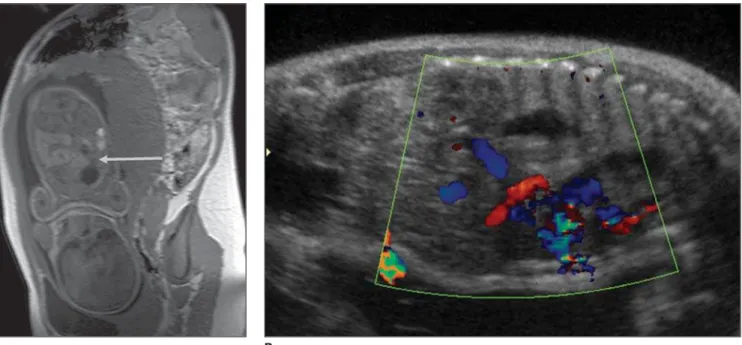
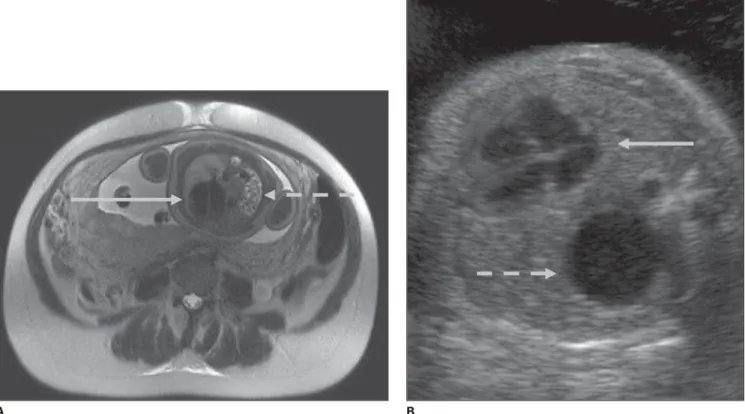
Among the 14 fetuses, 12 presented left-sided (LDH), and two right-sided con-genital diaphragmatic hernias (RDH). The fetal liver was found inside the thorax in eight fetuses by MRI (six with LDH and two with RDH), and in five fetuses by US (three with LDH and two with RDH) (Fig-ure 1). The presence of the stomach and bowel loops inside the chest cavity caus-ing right mediastinal shift was observed both on MRI and US in all of the 12 fetuses with LDH, (Figures 2, 3 and 4). A mild left mediastinal shift also was observed on both imaging methods in the two cases of RDH. Additionally, cranial shift of the left kidney was found in one fetus with LDH both on MRI and US images.
Figure 1.A: Coronal T1-weighted MR image demonstrating slightly hyperintense liver herniated into the left hemithorax (arrow). B: Sagittal color-Doppler US image demonstrating the liver in the chest cavity.
A B
Figure 2. T2-weighted MRI (A,B) and US (C) images of different patients. On A, axial view showing hyperintense stomach (dashed arrow) and intesti-nal loops causing heart shift (continuous arrow) and contralateral lung com-pression. On B, coronal view demonstrating left hemithorax filled by the stom-ach and small bowel loops (dashed arrow). The right lung presents a normal signal intensity (continuous arrow). On C, US sagittal image demonstrating the stomach in the thoracic cavity (arrow) compressing the lung anteriorly.
A B
Figure 3.A: Axial, T2-weighted MRI demonstrating herniation of small bowel loops (dashed arrow) and right mediastinal shift (continuous arrow).
A B
Amongst the 14 fetuses studied, six (42.8%) — five with LDH and one with RDH — progressed to post-natal death, two of them after being submitted to sur-gical hernia correction. Eight fetuses
(57.1%) survived after surgery (seven with LDH and one with RDH). Among these seven fetuses with LDH who survived, six presented with the liver in its usual topog-raphy, evidencing the relevant role of
he-patic herniation in the determination of the fetal prognosis. Six of the eight surviving children reached the age of seven months, with gastroesophageal reflux being identi-fied in four (three with LDH correction and
Figure 4. Coronal (A) and sagittal (B) T2-weighted MRI demonstrating her-niation of small bowel loops and stom-ach into the left hemithorax (continu-ous arrow), causing ipsilateral lung compression (dashed arrow). The right lung presents with normal signal inten-sity.
B
one with RDH correction), and pneumonia in three (two with LDH correction and one with RDH correction). One children pre-sented retardation of neurological develop-ment besides a significant visual deficit.
DISCUSSION
Congenital diaphragmatic hernias result from a developmental defect in the dia-phragm because of a failure in the closure of the pleuroperitoneal canal between the 9th and 10th gestational weeks(4). If the
pleuroperitoneal canal remains openwhen the intestines return to the abdomen from the umbilicalcord during the tenth week, the abdominal viscera move freelyinto the thoracic cavity. If the pleuroperitoneal ca-nal closes but fails to become muscular-ized, the viscera may move into the chest, as a result of the limited intra-abdominal space(4). So, in fetuses with CDH, bronchi
are present, but the bronchiolus branching is reduced. The number of alveoli/acinus is normal, but the absolute number of alveoli is reduced because of the lower number of bronchiolus division. The vascular bed also presents altered, with a significant decrease in the number of vessels and muscular hy-perplasia. The prognosis in cases involving a child with CDH will be directly related with the extent of pulmonary hyperplasia that is associated with the gestational pe-riod where the herniation process was com-pleted(4).
The prenatal diagnosis of CDH by means of US is suggested as the presence of the stomach in the fetal chest is demon-strated(3). Also, cardiomediastinal shift and
the presence of left portal vein branches at the level or above the diaphragm can be observed, indicating the liver herniation into the fetal chest(13).
MRI can clearly demonstrate the pres-ence of the stomach and bowel loops in the left hemithorax, particularly on T1-weighted sequences(7,8,14). The herniated
liver is best visualized on T1-weighted se-quences. The stomach is seen as a structure of low T1 and high T2 signal intensities. Bowel loops appear like serpiginous struc-tures of either high or low T1 and T2 sig-nal intensities. This variable sigsig-nal inten-sity is presumably caused by the presence or absence of meconium(7,8).
Cardiome-diastinal shift to the right and the resulting pulmonary compression are best visualized on axial images. The pulmonary paren-chyma can be best visualized on T2-weighted sequences, as a hyperintense structure because the lungs are filled with fluid. In 57% to 86% of cases of CDH, the hepatic parenchyma is partially herniated (liver-up)(3). On MRI, the liver is seen as a
structure of high T1 and low T2 signal in-tensities, so, this method plays a significant role in the evaluation of the fetal progno-sis, considering that the presence or ab-sence of part of a herniated liver in the chest cavity corresponds, respectively, to an ap-proximate 57% and 7% mortality rate(3). On
axial images, the herniated liver can be easily visualized anteriorly to the stomach. Also, it can be seen in the chest cavity on coronal images both on T1- and T2-weighted sequences. The gastric volvulus also can be identified in the fetal chest, in cases where the greater curvature is supe-rior to the lesser curvature of the stomach(3).
Right-sided congenital diaphragmatic hernias correspond to 12% of all cases of CDH(3,15). The liver is always in the chest
cavity, compressing cardiac structures in the left hemithorax. Bowel loops shift into the right hemithorax is less frequent. The mortality rate in cases of this type of her-nia is around 80%(3,15). Fetal ascites and
hydrothorax also may occur because of hepatic venous obstruction by a Budd-Chiari mechanism, although cervical and cephalic edemas may result from an ob-struction of the superior vena cava(3).
Two major indicators in the evaluation of fetal prognosis are the detection of he-patic herniation that is best visualized by MRI, and pulmonary maturity that can be evaluated by means of the lung/cephalic circumference ratio (LCR), or by the pul-monary parenchyma signal intensity. LCR is obtained by means of axial US scans at the level of the four cardiac chambers, in the period between the 24th and 26th ges-tational weeks. A LCR < 1.0 is associated to 100% mortality, while a LCR > 1.4 is as-sociated to a good prognosis. For a LPC between 1.0 and 1.4, the mortality rate is around 60%(9,16). On MRI, a homogeneous
high signal intensity of the fetal pulmonary parenchyma indicates the absence of pul-monary hypoplasia, while low signal
inten-sity suggests the presence of pulmonary hypoplasia(14).
In the present study, a partially herniated liver was found in the chest cavity of eight fetuses by MRI — six of them with LDH and two with RDH. Therefore, MRI com-plemented US that had identified hepatic herniation in five fetuses (three with LDH and two with RDH). Because of the diffi-culty in identifying the pulmonary paren-chyma, MRI demonstrated possible pulmo-nary hypoplasia in five fetuses (three with LDH and two with RDH). In the present study, marked polyhydramnios was found both by US and MRI in five cases, two of them with RDH and three with LDH (one fetus with 18-trisomy). In this group of fetuses with marked polyhydramnios, only two survived. The presence of microphthal-mos associated with RDH was best as-sessed by US. Besides LDH, the fetus with 18-trisomy presented cerebellar vermis hy-poplasia visualized both by US and MRI, and also interventricular communication identified by US.
Finally, US and MRI constitute comple-mentary methods in the evaluation of pa-tients with CDH. MRI plays a significant role as a supplement to US in the diagno-sis and prognostic evaluation of CDH, and can easily assess the liver position. Addi-tionally, MRI does not present the typical US limitations represented by the presence of artifacts resulting from poor fetal posi-tioning, beam attenuation in maternal adi-posity and operator dependence.
REFERENCES
1. Adzick NS, Harrison MR, Glick PL, et al. Dia-phragmatic hernia in the fetus: prenatal diagnosis and outcome in 94 cases. J Pediatr Surg. 1985;20: 357–61.
2. Harrison MR, Mychaliska GB, Albanese CT, et al. Correction of congenital diaphragmatic hernia in utero IX: fetuses with poor prognosis (liver herniation and low lung-to-head ratio) can be saved by fetoscopic temporary tracheal occlusion. J Pediatr Surg. 1998;33:1017–23.
3. Leung JW, Coakley FV, Hricak H, et al. Prenatal MR imaging of congenital diaphragmatic hernia. AJR Am J Roentgenol. 2000;174:1607–12.
4. Harrison MR, Adzick NS, Flake AW. Congenital diaphragmatic hernia: an unsolved problem. Semin Pediatr Surg. 1993;2:109–12. 5. Ijsselstijn H, Tibboel D. The lungs in congenital
diaphragmatic hernia: do we understand? Pediatr Pulmonol. 1998;26:204–18.
sono-graphy in the diagnosis and prediction of the outcome after birth. AJR Am J Roentgenol. 1996; 166:1195–202.
7. Hubbard AM, Adzick NS, Crombleholme TM, et al. Congenital chest lesions: diagnosis and char-acterization with prenatal MR imaging. Radiol-ogy. 1999;212:43–8.
8. Hubbard AM, Adzick NS, Crombleholme TM, et al. Left-sided congenital diaphragmatic hernia: value of prenatal MR imaging in preparation for fetal surgery. Radiology. 1997;203:636–40. 9. Sydorak RM, Harrison MR. Congenital
diaphrag-matic hernia: advances in prenatal therapy. Clin Perinatol. 2003;30:465–79.
10. Frates MC, Kumar AJ, Benson CB, et al. Fetal anomalies: comparison of MR imaging and US for diagnosis. Radiology. 2004;232:398–404.
11. Blasbalg R, Ogawa RE, Costa DN, et al. Como fazer exames com imagens ponderadas em T2 para o estudo do abdome superior? Radiol Bras. 2005;38(5):v–vi.
12. Francisco VV, D’Ippolito G, Silva GPA, et al. Pre-valência de artefatos em exames de ressonância magnética do abdome utilizando a seqüência GRASE: comparável com as melhores seqüências rápidas? Radiol Bras. 2005;38:323–8.
13. Goldstein RB. Avaliação ultra-sonográfica do tórax fetal. In: Callen PW, editor.
Ultra-sonogra-fia em obstetrícia e ginecologia. 4ª ed. Philadel-phia: Guanabara Koogan; 2002. p.401–29.
14. Kuwashima S, Nishimura G, Iimura F, et al. Low-intensity fetal lungs on MRI may suggest the di-agnosis of pulmonary hypoplasia. Pediatr Radiol. 2001;31:669–72.
15. Hedrick HL, Crombleholme TM, Flake AW, et al. Right congenital diaphragmatic hernia: prenatal assessment and outcome. J Pediatr Surg. 2004;39: 319–23.